
How Attio makes money from a free AI CRM
Monthly visits
1.7M
October 2026. Third-party estimate, not official MAU/DAU. Similarweb counted 1.7M for the month.
Attio draws an estimated 1.7M visits a month (October 2026, Similarweb). It is the 259th-largest site in our database of 922, tied at 1.7M with eight other sites, just behind Cozey.
| Site | Attio, attio.com |
|---|---|
| What it is | An AI-native CRM: custom objects, automatic enrichment, agents and workflows, built for go-to-market teams |
| Who it is for | Startup and growth-stage sales teams that want a CRM they can program and extend |
| Category | Sales · AI-native CRM |
| Monthly visits | 1.7M, October 2026. Third-party estimate, not official MAU/DAU; Similarweb |
| Founded | 2017, by Nicolas Sharp and Alexander Christie, in London (Attio Limited registered 11 April 2017; the team pivoted to a horizontal CRM in 2019 and launched publicly in March 2023) |
| Headquarters | London, United Kingdom |
| Operator | Attio Limited — privately held; $52M Series B in August 2025 led by GV, $116M raised in total |
| Survival engine | Distribution, with repeat buying second. A free CRM that builds itself from a team’s inbox, then charges by the workspace as the team adds users, objects and AI credits — the free tier is the funnel, expansion the engine |
| Pricing | Free $0 (up to 3 users); Plus $40/workspace/month annual ($50 monthly); Pro $100 ($125 monthly); Ultra $1,000/month annual. Source: attio.com/pricing, read 27 November 2026 |
| Pricing model | Subscription by workspace plus users; annual billing about 20% cheaper; 14-day Pro trial on every new workspace; AI credits and Governance add-ons |
| Typical basket (derived) | Derived from listed prices and bundle structure (November 2026): a typical five-user workspace runs about $180–$416 a month — Plus at $40 plus four extra users at $35 each, or Pro at $100 plus four at $79 each, on annual billing. Attio does not disclose real average order value, so this is a derivation, not a company figure |
| Free hook | Free tier (up to 3 users, 50,000 records, 3 objects); 14-day Pro trial; first year of Pro at 20% off for VC-backed startups |
| Meta ads | Running — about 62 active ads on Attio’s own Ad Library page on 27 November 2026, including creator-partner posts; a keyword search returns about 2,900 matches, mostly other advertisers |
| Country breakdown | Not publicly disclosed |
| Audience | Female 26.24% / Male 73.76% (Similarweb snapshot of April 2026, captured 20 May 2026; October 2026 audience data not verified); age split not verified |
TL;DR
- Attio gives small teams a CRM that builds itself. Connect an inbox and a calendar and the product fills in contacts, companies and deals on its own — free for up to three users, with 50,000 records and three objects. The money comes later, when the team grows: a five-user workspace pays $180 a month on Plus or $416 on Pro, and Ultra starts at $1,000.
- The public numbers are all third-party or company claims: 1.7M visits in October 2026, up 4.17% on the month; 5,000 paying customers claimed in August 2025; $52M raised in a Series B the same month, $116M in total. The company has never disclosed revenue, profit or its real average order value.
- The other side: the price list changed on 10 November 2026, from per-user pricing to a workspace fee plus a per-user rate, and the old prices still circulate in third-party reviews. The ratings are thin outside G2 — Capterra has eight reviews and Trustpilot six — and the 4x ARR target is a goal for 2025, not a result.
The CRM that builds itself
The homepage sells a night shift
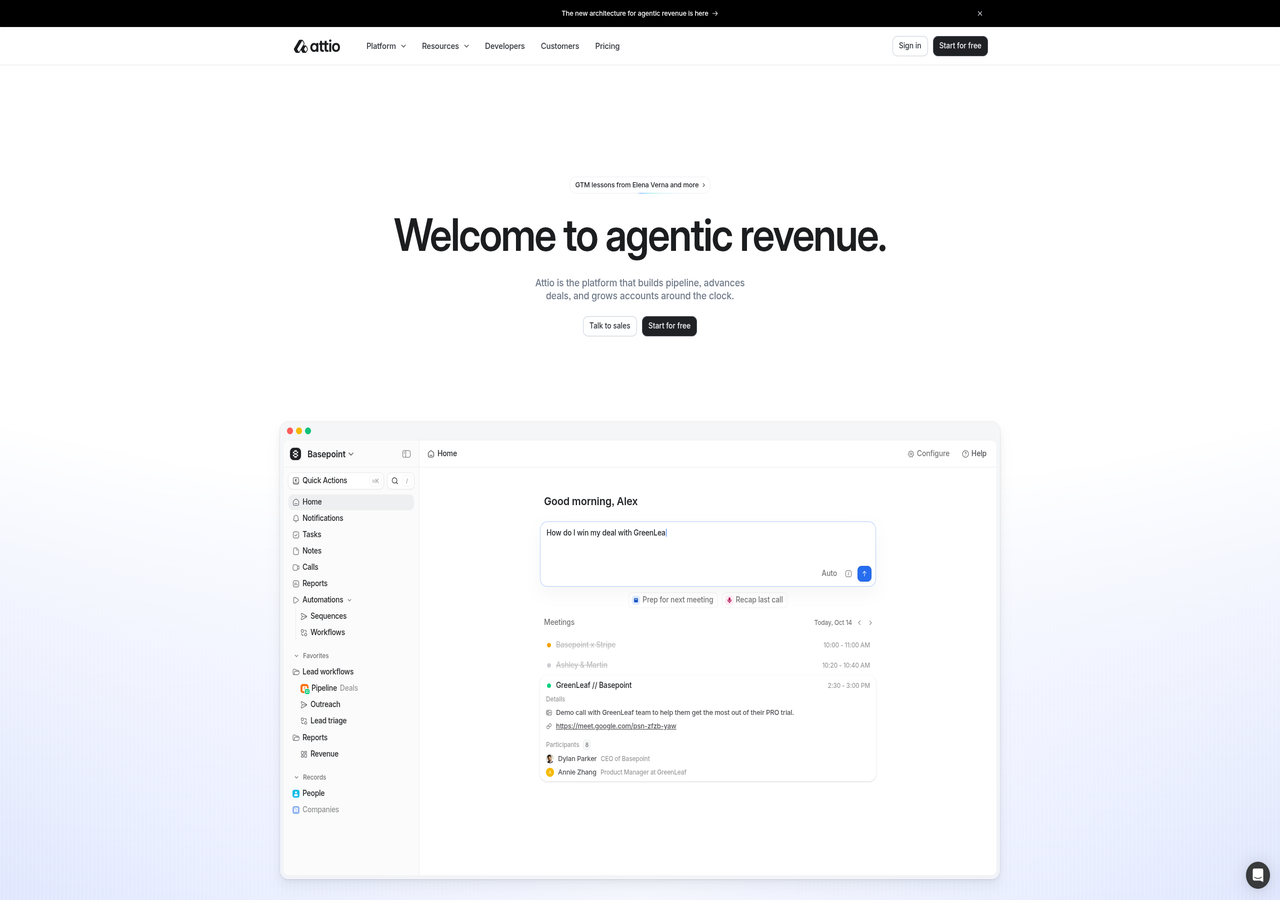
Screenshot of the attio.com homepage, read 27 November 2026. The hero is “Welcome to agentic revenue.” above “Talk to sales” and “Start for free” buttons, with a product screenshot showing an AI assistant answering “How do I win my deal with GreenLeaf”.
The homepage does not sell a database. It sells a night shift. On 27 November 2026 the hero is “Welcome to agentic revenue.” over the line “Attio is the platform that builds pipeline, advances deals, and grows accounts around the clock.” — and the product shot underneath shows an assistant answering a rep’s question about a live deal.
The banner above it names the bet: “The new architecture for agentic revenue is here.” The navigation is five words — Platform, Resources, Developers, Customers, Pricing — and the only two buttons are “Sign in” and “Start for free”. Nothing on the first screen mentions a price, a plan or a limit.
That order is the funnel in one screen. The visitor is asked to picture the product doing the work before learning what it costs, and the first thing the site offers for free is not a discount but the product itself — a workspace that fills itself in from an inbox and a calendar.
Search is the brand name
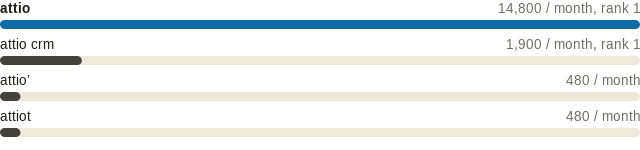
Semrush, October 2026, United States — estimated monthly search volume and ranking position.
Search is the brand talking about itself. The word “attio” draws about 14,800 searches a month in the US and ranks first for attio.com, taking about 60% of the site’s organic traffic; “attio crm” adds another 1,900, also at rank one.
The shape is the same as every distribution-led tool we track: the traffic arrives already sold on the name, and the signup page only has to close. The risk sits in the same numbers. If the name stops being the first thing a sales team types, there is no generic keyword underneath to catch the fall — the top keywords are all “attio” plus a product word, and no intent word like “attio pricing” shows a measurable volume.
Nine years, one rebuild
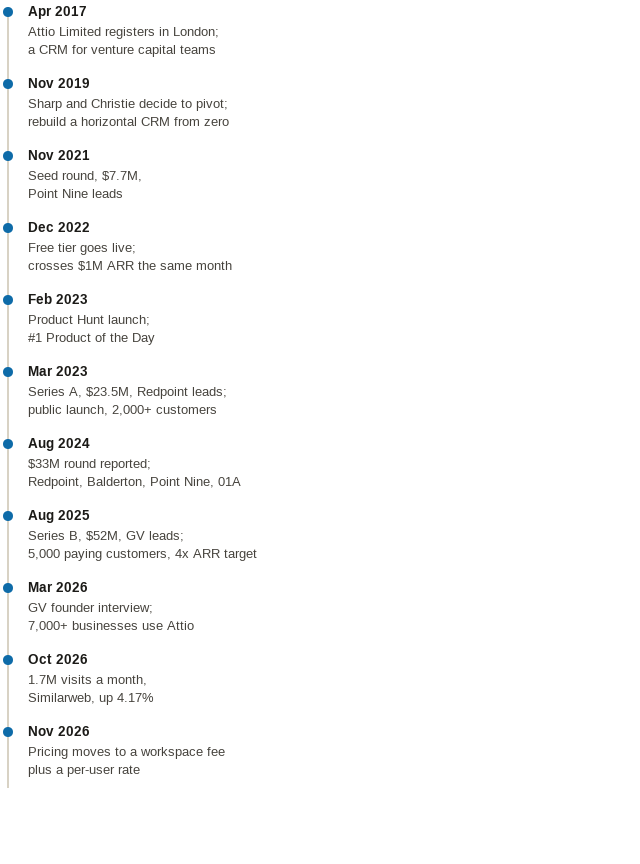
Company history; Attio, TechCrunch and PR Newswire (2017–2026), Similarweb (October 2026). The August 2024 round is reported, not announced.
The company was a staircase before it was a business. Nicolas Sharp ran business development at Passion Capital, where he and Alexander Christie built a CRM for venture capital teams — then decided the whole category was broken and rebuilt it from zero, in a café in central London, over three quiet years.
The money followed the same line. A $7.7M seed round in November 2021, then $23.5M from Redpoint in March 2023, the same week the product launched publicly with 2,000 customers — and on 26 August 2025, GV led a $52M Series B that took the total raised to $116M.
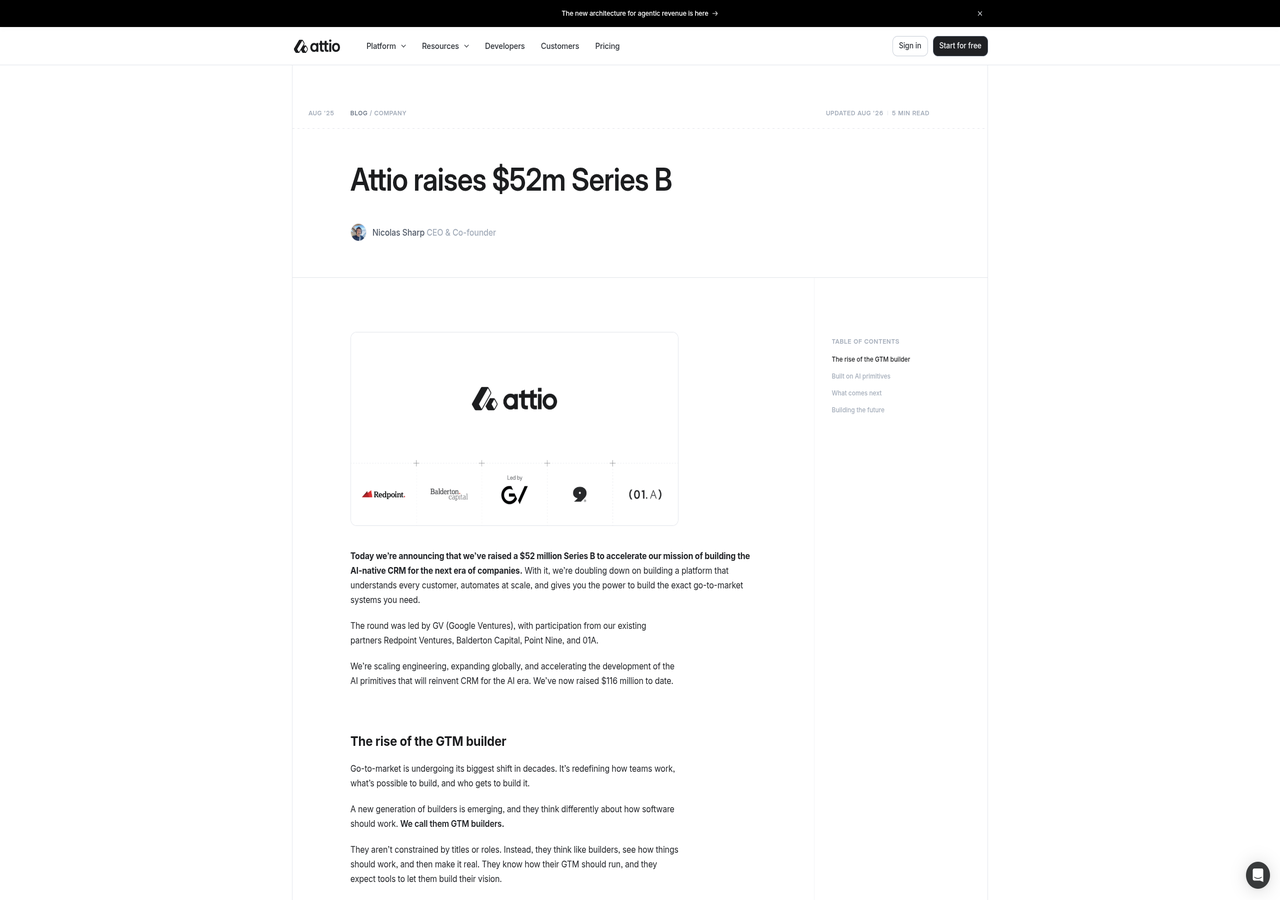
Attio’s Series B announcement, 26 August 2025. The post records a $52M round led by GV, with Redpoint, Balderton, Point Nine and 01A, and $116M raised to date.
The earliest homepage the Wayback Machine holds for the company is from 15 July 2019 — “Unlock Your Team’s True Potential” over an email box, with a dashboard full of venture firms. The domain itself is older: the first capture, from May 2001, is a domain-for-sale page, and the archive holds 799 captures in total.
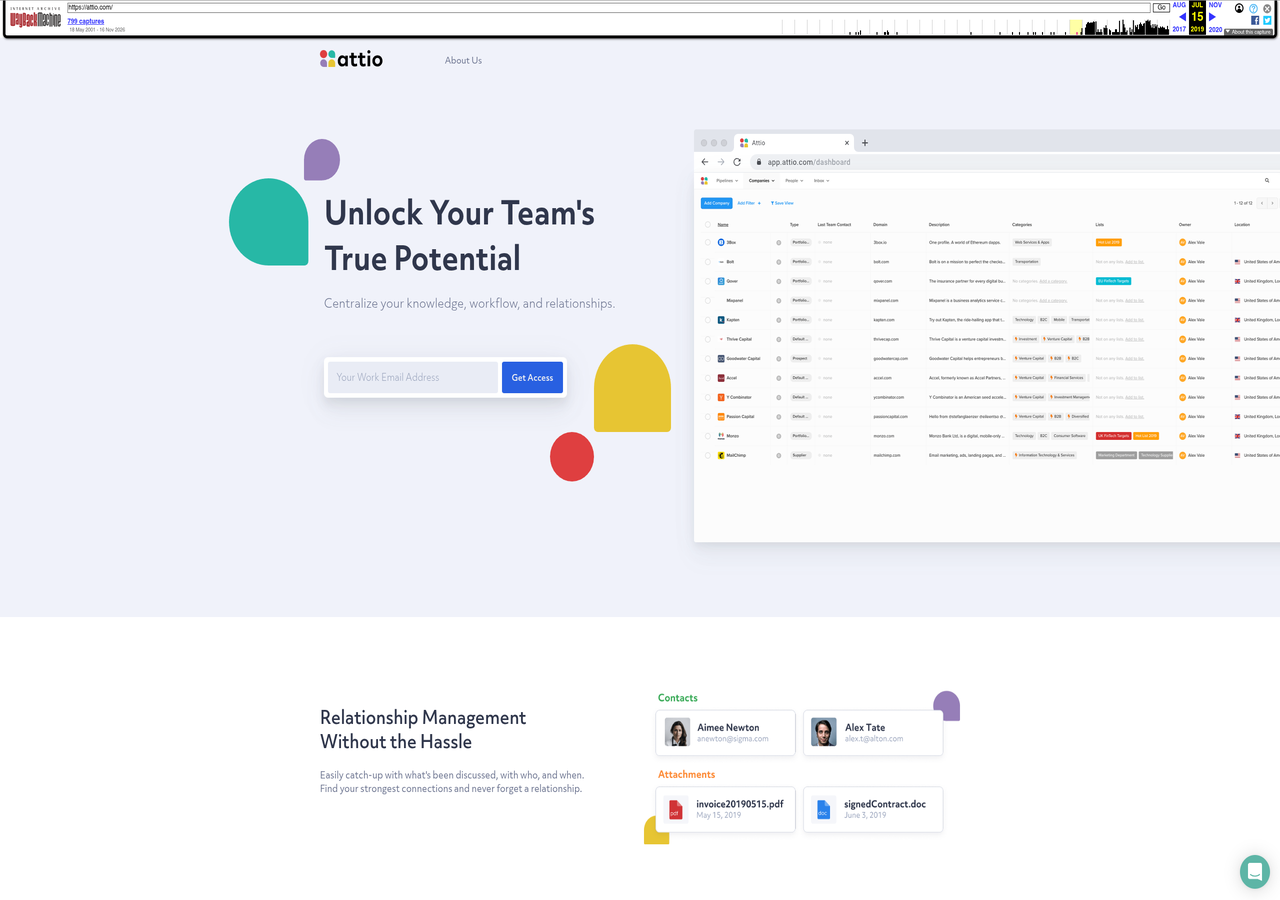
Wayback Machine, 15 July 2019. The first snapshot of Attio’s own homepage: “Unlock Your Team’s True Potential”, with a dashboard of venture-capital firms — the product was still a CRM for investors.
The press calls it the CRM for the Airtable generation, and the comparison is the point. Salesforce sells a system of record; Attio sells a system that writes its own records. The free tier is not a sample of the product — it is the product, and the bill only arrives when the team outgrows it.
The price list: free to start, steep to grow
Four plans, one workspace
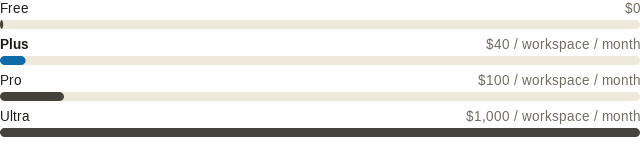
List prices, November 2026. Annual billing, per workspace a month; monthly billing is about 20% higher on Plus and Pro.
| Plan | $ / workspace / month | Monthly billing | What’s in it |
|---|---|---|---|
| Free | $0 | $0 | Up to 3 users; 50,000 records; 3 objects; Ask Attio, enrichment, agents and workflows |
| Plus | $40 | $50 | Includes 1 user; extra users $35/month each; up to 10 users; 250,000 records; 5 objects |
| Pro | $100 | $125 | Includes 1 user; extra users $79/month each; 1M records; 12 objects; call intelligence; sequences |
| Ultra | $1,000 | Annual only | Includes 5 users; extra users $189/month each; unlimited objects; SQL, API and MCP access; SSO and SCIM |
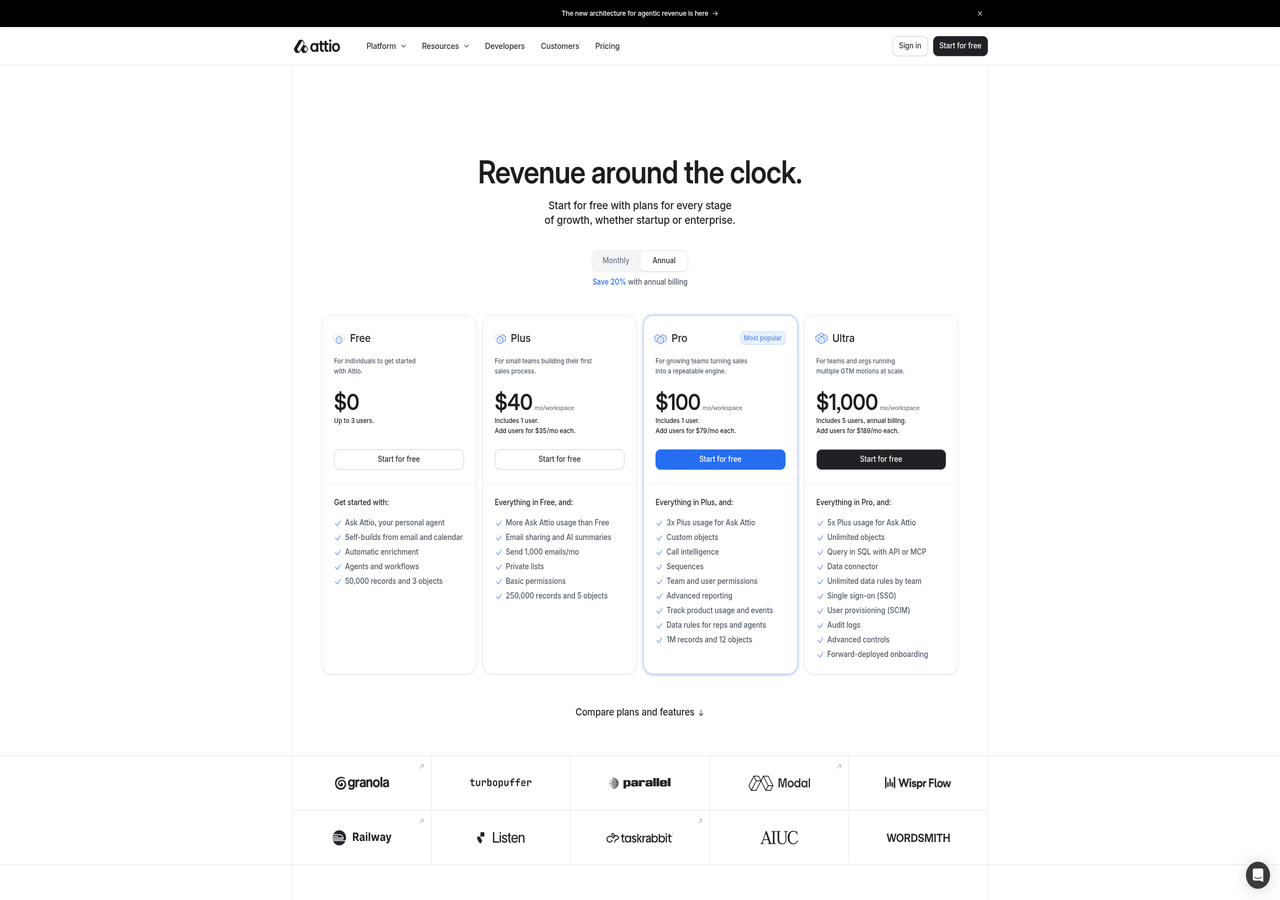
Screenshot of the attio.com/pricing page, read 27 November 2026. Annual billing is selected: Free $0, Plus $40, Pro $100 (Most popular), Ultra $1,000 per workspace a month; the page promises 20% off with annual billing.
There are four prices and one rule: the workspace pays, not the seat. Free costs nothing for up to three users; Plus is $40 a month per workspace on annual billing, Pro $100, Ultra $1,000 — and every plan after Free includes one user, with extra users at $35, $79 and $189 a month.
The structure changed on 10 November 2026, from charging per user to a workspace fee plus a per-user rate. The old prices still circulate — third-party reviews quote Plus at $29 a user a month — and they are out of date. Quote the pricing page, not the review.
The bill grows in three directions at once. A team pays more when it adds users, when it adds objects — Free allows three, Plus five, Pro twelve, Ultra unlimited — and when it burns through its Ask Attio credits, which can be topped up in packs from $70 to $475 a month. Governance, the SSO and audit-log bundle, is another $30 a user a month on Pro.
The trial is the fitting room
Fourteen days is the whole fitting room. Every new workspace gets two weeks of Pro, and when the trial ends the team picks a plan — including Free, which keeps the workspace alive at three users and 50,000 records. There is no card up front and no separate trial for Ultra.
The cancellation terms are written in the FAQ, not the marketing: admins can change plans at any time, upgrades apply at once and are prorated, downgrades wait for the next renewal, and a cancelled team keeps access until the end of the billing period. No refund terms were published.
The startup discount is the quietest hook on the page. A venture-backed startup with up to ten users gets Pro at 20% off for the first year and 30% off the second — if it applies within ninety days of creating the workspace. It is a discount on the future, not on the first bill.
What keeps teams paying
| Mechanism | Status | How it shows up |
|---|---|---|
| Free tier | ✓ | Free $0, up to 3 users, 50,000 records, 3 objects |
| 14-day Pro trial | ✓ | Every new workspace; downgrades to Free at the end |
| API and MCP | ✓ | API, SDK and an MCP server on every plan; Ultra adds SQL access |
| Annual discount | ✓ | Plus and Pro about 20% cheaper on annual billing |
| Pay as you grow | ✓ | Extra users $35–$189 a month; AI credit packs $70–$475 a month |
| Startup discount | ✓ | First year of Pro 20% off, second year 30% off, for VC-backed startups |
| Cancel keeps access | ✓ | Access runs to the end of the billing period |
| No sign-up needed | — | Not verified — a workspace requires registration |
| Built-in dialler | — | Not verified — reviewers say there is none |
| Marketing automation | — | Not verified — reviewers say the suite is missing |
| Skip / pause | — | Not verified — no pause option was published |
The funnel is the product doing its own onboarding. A team that has watched its inbox turn into a CRM arrives already convinced it works, and the trial only has to remove the reasons not to pay: no card up front, a free tier to fall back to, and a bill that starts at $40 a workspace, not $40 a seat.
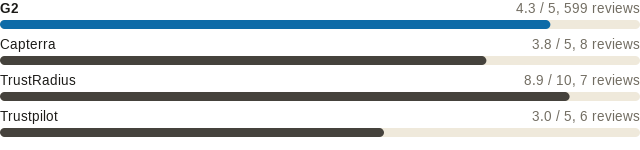
G2, read 27 November 2026 (4.3/5, 599 reviews; 57% five-star, 35% four-star, no one-star reviews). Capterra, TrustRadius and Trustpilot from secondary reads, November 2026; their samples are too small to read.
The rating is the trust element the homepage never shows. G2 gives Attio 4.3 out of 5 from 599 reviews, read on 27 November 2026 — 57% five-star, 35% four-star, and no one-star reviews at all. The other platforms are too thin to read: Capterra has eight reviews at 3.8, Trustpilot six at 3.0, half of them one star.
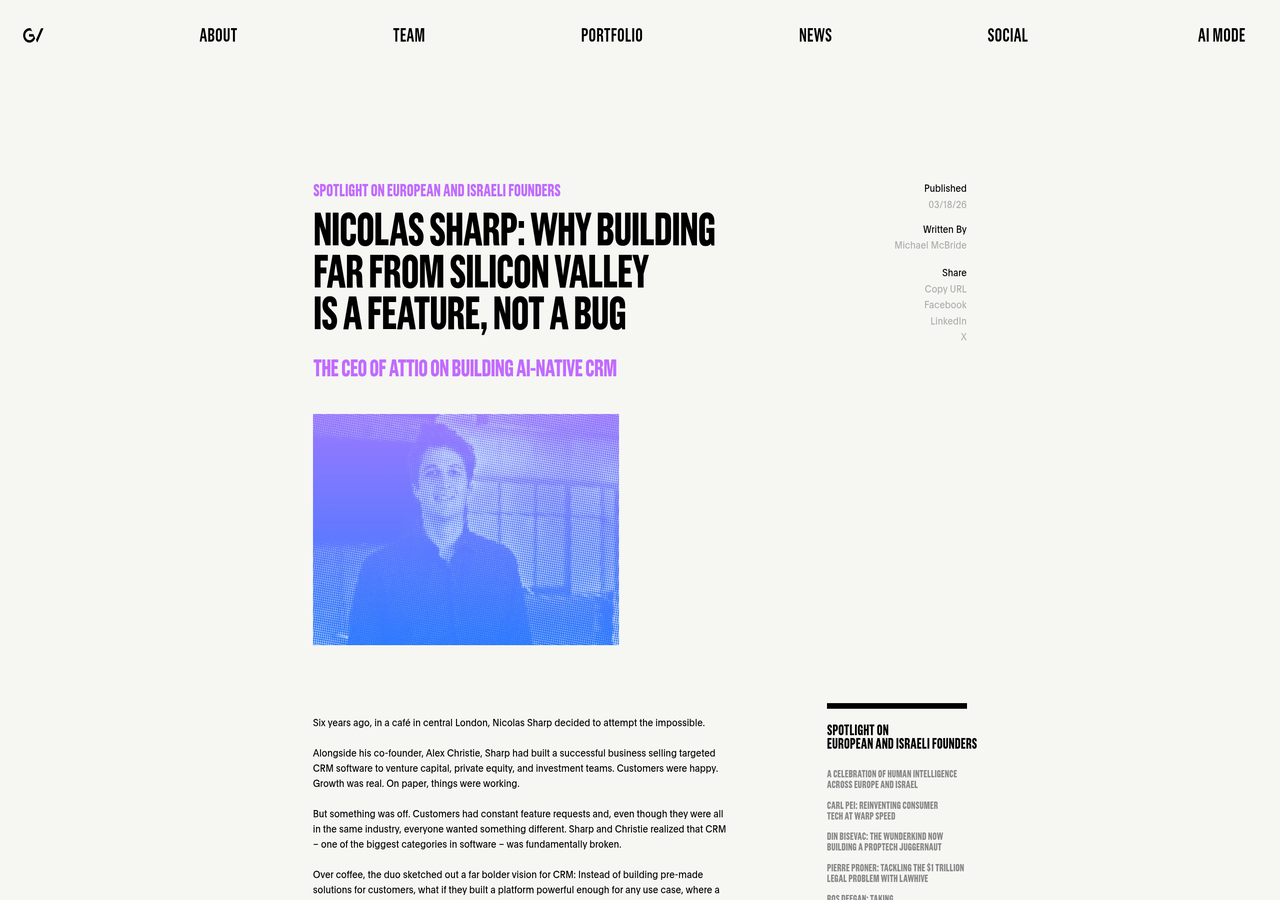
GV interview with Nicolas Sharp, 18 March 2026. “Why building far from Silicon Valley is a feature, not a bug” — the café pivot, told by the firm that led the $52M round.
The investor’s version of the story is the same story with the numbers removed. GV’s March 2026 interview with Sharp opens in a central London café, six years earlier, where the two founders sketched a platform “powerful enough for any use case” — and the firm that led the Series B is the one telling it.
Where the visits come from
| Channel | Share of visits | Platform & stack |
|---|---|---|
| Meta ads | Running, about 62 active ads | Ad Library page, 27 November 2026; “Ask more from your CRM”, running since 16 November 2026 |
| Brand search | “attio” 14,800 a month, rank 1 | Semrush, October 2026; about 60% of organic traffic |
| Product Hunt | Launch 26 February 2023 | #1 Product of the Day, per Systemaic |
| Direct, organic, social, email | Not verified | No October 2026 channel split was published |
Two sources of visits are visible, and the rest are not. Meta ads are running — about 62 on Attio’s own Ad Library page on 27 November 2026, including creator-partner posts, with “Ask more from your CRM” running since 16 November — and the brand word draws 14,800 searches a month.
One figure on the page is left out on purpose. A keyword search in the Ad Library returns about 2,900 matches, but most of them belong to other advertisers — Folk’s ads show up under the same keyword. The teardown counts Attio’s own page, not the keyword.
| Layer | What it runs on |
|---|---|
| Platform | Next.js (page source shows _next/image paths) |
| CMS | Storyblok (page source shows a.storyblok.com image paths) |
| Payments | Not verified — the FAQ says card payments, plus invoices and PO/ACH/wire on Pro and Ultra |
| Analytics | Google Analytics (Similarweb snapshot, April 2026) |
| Reviews | G2 4.3 from 599 reviews; Capterra 3.8 from 8; Trustpilot 3.0 from 6 |
| Not verified — no email provider was identified this round |
The stack is the product. Next.js and Storyblok run a site that is mostly a demo of the product itself, and the integrations the homepage names — Claude, Slack, Clay, Linear, Notion, Granola — are the pitch: a CRM that plugs into the tools a go-to-market team already uses.
The category is bigger than one CRM
Six CRMs, one five-user bill
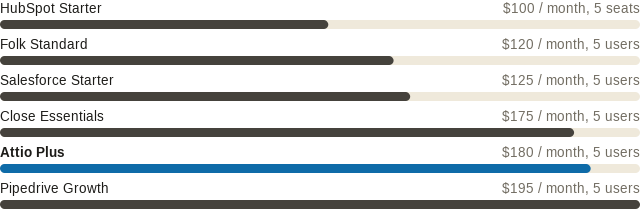
Annual-billed prices from each vendor’s own pricing page, November 2026. Attio’s Plus bill is $40 plus four extra users at $35 each.
| Site | 5-user bill | Free tier | Model |
|---|---|---|---|
| HubSpot | $100/month | Yes, 2 users | 1,800+ integrations; $1,500 onboarding on Professional |
| Folk | $120/month | No | Per-seat pricing; 14-day trial; founder-stated $1.8M a year |
| Salesforce | $125/month | Yes | Starter Suite; full AI needs Core at $195/user/month |
| Close | $175/month | No | Built-in dialler; the calling-first rival |
| Attio | $180/month | Yes, 3 users | Workspace pricing; MCP on every plan |
| Pipedrive | $195/month | No | Per-seat pricing; 14-day trial |
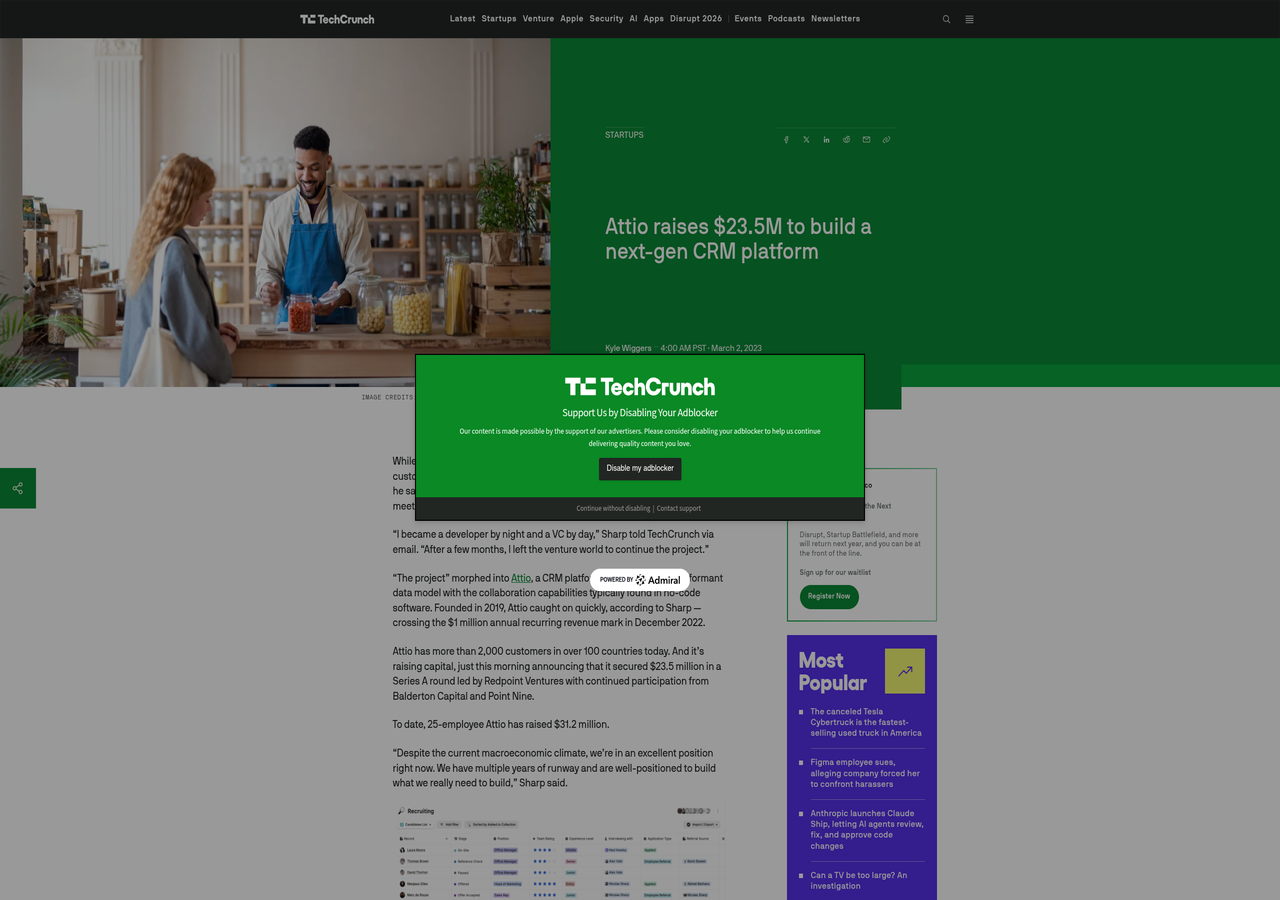
TechCrunch, 2 March 2023. “Attio raises $23.5M to build a next-gen CRM platform” — 2,000 customers in over 100 countries, $31.2M raised to date, and $1M in annual recurring revenue crossed in December 2022.
Attio is not the cheapest CRM for a five-user team — it is the fifth of six. HubSpot’s Starter is $100 a month, Folk’s Standard $120, Salesforce’s Starter $125, and only Pipedrive’s Growth, at $195, costs more than Attio’s Plus at $180. The free tier is the price advantage, not the paid plans.
The comparison that matters is the one the table hides. Attio’s Plus bill is fixed at $40 a workspace plus $35 per extra user, so a one-user team pays $40 while Salesforce charges $25 a seat — and a ten-user team pays $355 on Plus against $250 on Salesforce Starter. The workspace model wins small and loses as the team grows.
The early numbers are the ones that still check out. TechCrunch’s March 2023 story put Attio at 2,000 customers and $1M in annual recurring revenue, crossed in December 2022 — and two and a half years later the company claimed 5,000 paying customers and a target of four times the revenue. The target is not a result, and the company has never published the revenue itself.
The free alternative is real, and it sits inside this table. HubSpot and Salesforce both run free tiers, and Folk sells the same idea — a modern CRM for small teams — at $120 for five users. Attio’s $180 has to be worth it against both, and the answer it gives is the product that builds itself, not the price.
Three things not to quote as facts
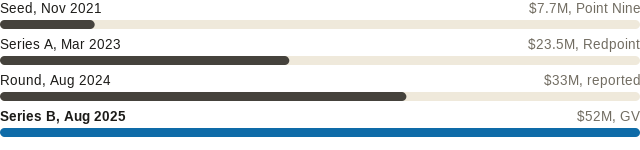
Attio announcements, 2021–2025. The four rounds add to $116.2M, against the company’s $116M; PitchBook counts $124M, a different tally.
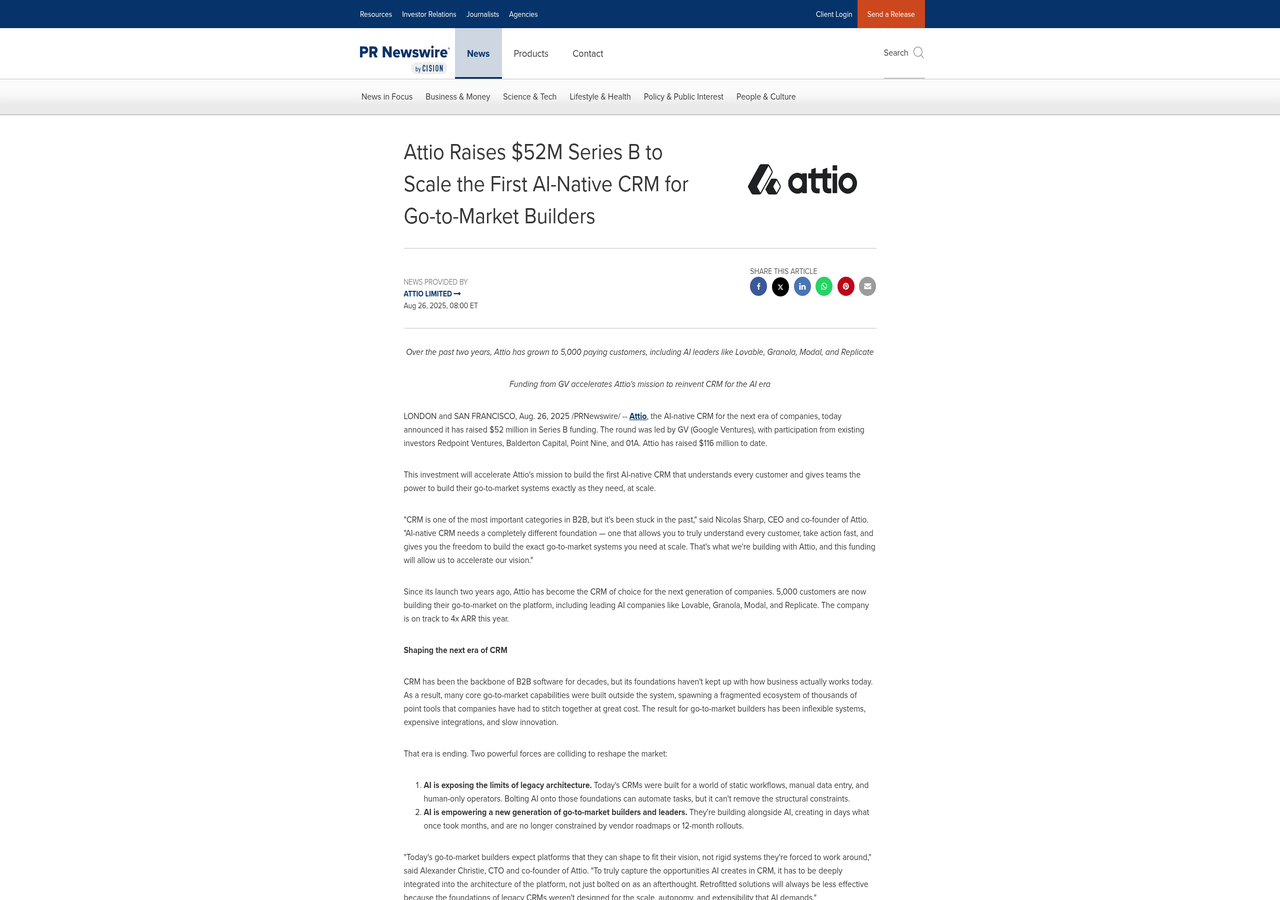
PR Newswire, 26 August 2025. “Attio Raises $52M Series B” — 5,000 paying customers, $116M raised to date, and the company “on track to 4x ARR this year”.
First, the revenue. The company said in August 2025 that it was “on track to 4x ARR this year” — a target for the year, carried by its own blog and its own press release, with no audited accounts behind it and no revenue figure of any kind. Quote the target as a target, not as growth.
Second, the customer count. Three numbers circulate — 5,000 paying customers in August 2025, more than 7,000 businesses in a March 2026 interview, and 30,000+ customers on the homepage today — and they count different things at different times. The paying-customer number is the only one with a date and a definition.
Third, the funding total. The rounds that are documented are $7.7M in 2021, $23.5M in 2023, a reported $33M in August 2024 and $52M in 2025 — $116.2M added up, against the company’s $116M. PitchBook counts $124M, which is a different tally, not a contradiction. Neither number is a valuation, and no valuation has ever been published.
The August 2024 round is the thinnest of the four. No standalone announcement was found this round; the $33M is reported by a secondary source that says the company confirmed it, without naming the round. It is in the timeline as reported, not as announced.
Attio is one of 2 in our Sales · AI-native CRM collection. The nearest rival is Folk at 226.2K visits a month, and the most useful side-by-side is Attio vs Folk. For the other AI-native CRM teardown, see Folk.
The full teardown is for members
The full breakdown is for members: the $180 decision and what a five-user team is really paying for, how the free tier pays for itself, the November repricing, the $116M question — and what a founder should copy, and what not to.
Similar sites in the database
Attio (1.7M) sits between Cozey (1.7M) and KÜHL (1.7M) in the database. The sites nearest to it on traffic are shown below.
| Site | Monthly visits | Category |
|---|---|---|
| Honeylove | 1.7M | Lingerie · Bras & shapewear |
| Hallow | 1.7M | Health · Prayer & meditation |
| Cozey | 1.7M | Home · Modular sofas |
| Attio | 1.7M | AI-native CRM |
| KÜHL | 1.7M | Technical outdoor apparel |
| Rhoback | 1.7M | Golf · Performance apparel |
| Xero Shoes | 1.69M | Footwear · Minimalist barefoot shoes |
Related teardowns
- Folk — 226.2K visits a month, the other AI-native CRM in the database, Standard $24/user/month.
Read the next one in your inbox
The new ones go out by email first, one a week, with the traffic source and month attached to every number. Leave your address and the next one comes to you.