
How BookBub makes money selling $122–$4,216 email slots
Monthly visits
3.94M
October 2026. Third-party estimate, not official MAU/DAU. Semrush is the headline figure — Similarweb counted 4.4M for the same month.
BookBub draws an estimated 3.94M visits a month (October 2026, Semrush) — and a second counter disagrees: Similarweb counted 4.4M for the same month, up 1.53% where Semrush says down 19.35%. It is the 144th-largest site in our database of 901. The average visit lasts 2 minutes 57 seconds over 3.45 pages.
The pitch fits in one line: readers get a free daily email of discounted ebooks, and authors pay to get into it. The inbox is the product. The $122–$4,216 fee to appear in it is the business — without the email, there is nothing to sell.
| Site | BookBub, bookbub.com |
|---|---|
| What it is | Ebook discovery and deals by daily email: free for readers, paid Featured Deal placement for authors and publishers; plus Chirp audiobooks and Author Websites |
| Who it is for | Readers hunting discounted ebooks, and authors and publishers promoting one |
| Category | Content · Ebook discovery and deals subscription |
| Monthly visits | 3.94M, October 2026. Third-party estimate, not official MAU/DAU; Semrush. Similarweb counted 4.4M for the same month, up 1.53% — the two counters disagree on the direction, and the gap is stated, not smoothed over |
| Founded | January 2012; founders Josh Schanker and Nicholas Ciarelli |
| Headquarters | Cambridge, Massachusetts |
| Operator | Private — unlisted, not acquired or controlled; parent company Pubmark Inc., which also owns Chirp |
| Survival engine | Email. Readers pay nothing; authors and publishers pay $122–$4,216 per Featured Deal to reach 15M+ subscribers (2019 figure) by email. Editorial trust — 80–90% of submissions turned away — is what lets the slot charge that much |
| Pricing | Readers free; Featured Deal $122–$4,216 per placement. Source: 2026 price list as quoted by third parties from the official rate card (see pricing section) |
| Pricing model | One-off fee per Featured Deal, by category and book price; BookBub Ads on CPM/CPC bidding from $1 a day; Chirp audiobooks sold per copy; Author Websites Pro $7.99 a month on annual billing |
| Free hook | Free daily deals email and free books; wishlist price alerts; authors submit for free and pay only if selected; Author Websites free tier |
| Meta ads | Not verified — whether BookBub runs Meta ads was not established this round |
| Country breakdown | United States 70.15% (2.77M), United Kingdom 9.18%, Canada 5.84% (Semrush, October 2026) |
TL;DR
- BookBub draws an estimated 3.94M visits a month (October 2026, Semrush; Similarweb says 4.4M for the same month). Readers pay nothing. Authors and publishers pay $122–$4,216 per Featured Deal to reach 15M+ subscribers (2019 figure) by email — 1,000+ deals a month (Publishers Weekly, 2019).
- The money is in the slot, not the book. BookBub sells no ebooks itself — the sale happens at Amazon or Apple Books. What it sells is placement in a daily email readers trust, because editors turn away 80–90% of submissions.
- It survives because the list is the moat: 14 years of daily emails, the Big Five publishers as customers, and two more lines (Chirp audiobooks, Author Websites) built on the same author relationships. The risks are the mirror image — Trustpilot at 3.0 from 2,402 reviews, with unsubscribe complaints, and traffic one counter says is falling 19.35%.
The first screen sells a free inbox, not a bookstore
The hero is a promise, not a price
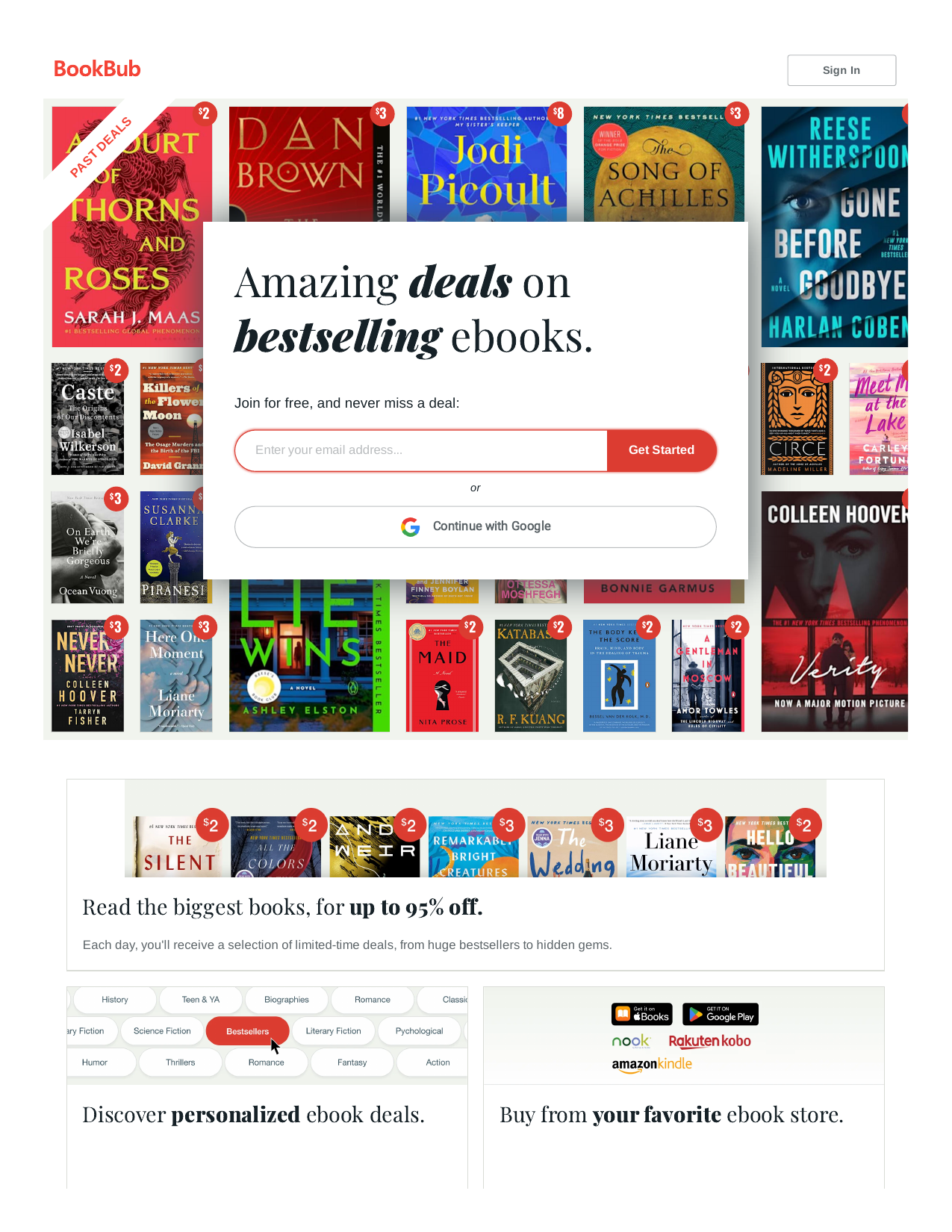
The BookBub homepage, read 23 November 2026. The first screen promises “Amazing deals on bestselling ebooks”, an email box with “Get Started” and “Continue with Google” — and “Read the biggest books, for up to 95% off” further down the page.
The homepage we read on 23 November 2026 opens on a discount, not a catalogue. “Amazing deals on bestselling ebooks” is the hero, with “Join for free, and never miss a deal:” underneath, and an email box with “Get Started” beside “Continue with Google”. No price appears on the first screen at all — the books are sold as savings first, reading second.
Below the hero, “Read the biggest books, for up to 95% off” leads a row of $2 and $3 deals, with “Each day, you’ll receive a selection of limited-time deals, from huge bestsellers to hidden gems” underneath. The middle of the page does the personalisation work: “Discover personalized ebook deals” asks readers to say what they like, then promises handpicked deals that match.
“Buy from your favorite ebook store” names the deal: read on any Kindle, tablet or phone, and the ebooks are yours to own forever. The retailer marks on the page are Apple Books, Google Play, nook by Barnes & Noble, Rakuten kobo and Amazon Kindle. “Get deal alerts for your wishlist” turns a saved book into a future email.
The conversion device is the signup, not a sale. “Join BookBub for Free” closes the page, above three reader quotes — Suzie M., Ellyn C., Mona E. — from the site’s own pool. The email address is the only thing asked for, and it is the only thing the business needs.
Three more ways to sell the same inbox
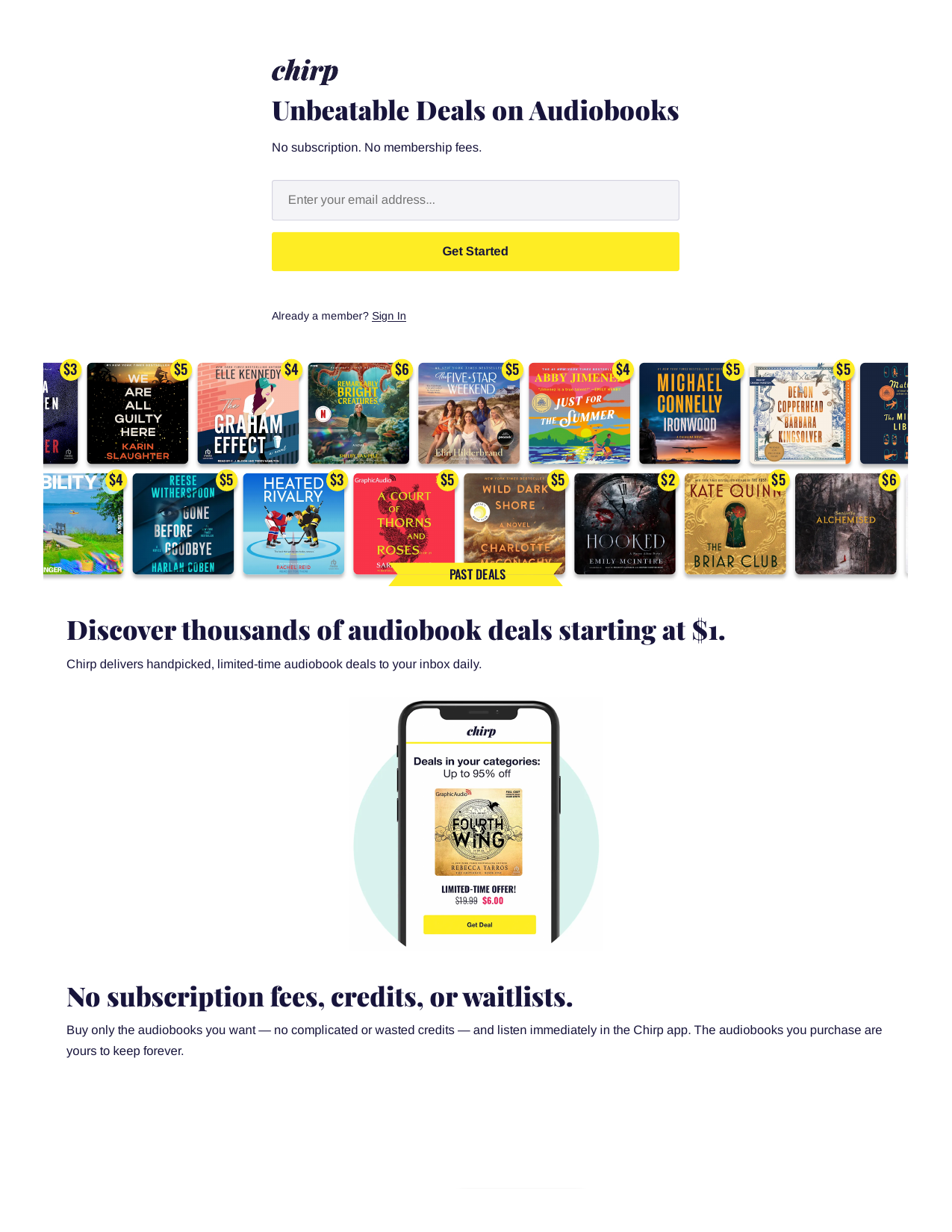
The Chirp homepage, read 23 November 2026. “Unbeatable Deals on Audiobooks” — deals starting at $1, no subscription fees, no credits and no waitlists — and 50,000+ five-star app reviews, as the page itself puts it.
Chirp is the same idea in audio. “Unbeatable Deals on Audiobooks” is the headline, over thousands of audiobook deals starting at $1, up to 95% off, with no subscription fees, no credits and no waitlists — the opposite of Audible’s credit model. Each audiobook is sold once, per copy, and the daily email does the selling.
BookBub Ads is the same inbox sold a second time. Any author can buy space at the bottom of the daily email or on the site, on CPM or CPC bidding, from $1 a day. The price list says clicks run $0.35–$0.60 and a thousand impressions about $10 — third-party readings, not the company’s own page.
Author Websites, launched in February 2025, sells the relationship a third time. A free tier builds the author a site; Pro costs $7.99 a month on annual billing, or $9.99 monthly, and adds an email tool — 1,000 sends a month free, 10,000 on Pro. The author who already pays for a slot is the obvious buyer.
Four prices for one email slot
| Plan | Price | What it is |
|---|---|---|
| Children’s, free book | $122 | The cheapest slot; about 510,000 subscribers (2023 reading) |
| Contemporary Romance, free book | $620 | About 1,250,000 subscribers in the category |
| Cozy Mysteries, free book | $671 | About 1,490,000 subscribers in the category |
| Contemporary Romance, $1–$2 book | $1,450 | Same category, higher book price |
| Contemporary Romance, $3+ book | $2,910 | Same category, full-price book |
| Historical Fiction, $3+ book | $4,216 | About 1,760,000 subscribers; the most expensive slot |
| Author Websites Pro, annual | $7.99 a month | Billed yearly; $9.99 a month billed monthly |
Featured Deal prices are the 2026 price list as quoted by third parties from the official rate card (Freyja Publishing, October 2026; Chapter, 2026); the partners pricing page was not directly readable this round. Subscriber counts are the category sizes published with the rate card.
One slot, $122 to $4,216
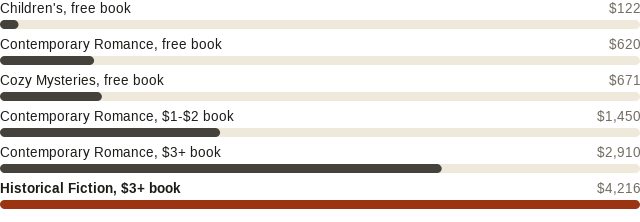
The cheapest slot costs $122. The most expensive costs $4,216 — about 34.6 times as much. The price follows two things: how many subscribers the category has, and how much the book costs.
Prices, 2026 price list as quoted by third parties from the official rate card. The partners pricing page was not directly readable this round.
The arithmetic tells the story. The cheapest slot costs $122 — a free children’s book. The most expensive costs $4,216 — a full-price historical fiction title. Between them sits a ladder priced on two things: how many subscribers the category has, and how much the book costs. A free book in Contemporary Romance costs $620; the same category at $3 or more costs $2,910.
The ladder has climbed a long way. In 2013 the range was $30–$1,250; by 2015 it was $30–$1,925; the 2026 list runs $122–$4,216. That is roughly a three- to ten-fold rise in twelve years — the list got bigger, and the editors got pickier, and the price followed both.
The price is only charged when the editors say yes. Submission is free; the fee is due only if the book is selected, and only 10–20% are. That is the whole bargain: authors pay for the filter as much as for the reach, because a slot that anyone can buy is worth nothing to a reader.
The most expensive slot in the category
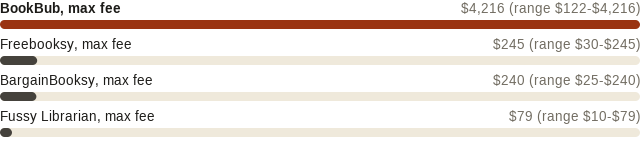
BookBub’s most expensive slot costs $4,216 — about 17 times Freebooksy’s $245 ceiling. The premium is the list: 15M subscribers (2019 figure) and an 80–90% rejection rate, against rivals that charge less and accept nearly everything.
Highest fee per site, 2026 third-party readings of each site’s pricing page; ranges in the chart labels.
The gap is the brand premium in one picture. Freebooksy tops out at $245, BargainBooksy at $240, the Fussy Librarian at $79 — all three charge less for their dearest slot than BookBub charges for its cheapest category in Contemporary Romance. What authors pay for is not the email, which anyone can send, but the list that opens it.
What the slot does, and what it does not
| Mechanism | Hit | Why, in one line |
|---|---|---|
| Free tier | ✓ | Readers register and read the daily email free; no paywall on the reader side |
| No account | — | An email address is required to receive the deals; browsing without one is possible |
| Free trial | ✓ | Author Websites free tier with no time limit, plus a 14-day Pro trial |
| Ads on the site | ✓ | BookBub Ads: self-serve ads in the daily email and on site, from $1 a day |
| API | 未核到 | No public API found on the pages read |
| Email capture | ✓ | The homepage signup is the product; the daily email is what authors pay to enter |
| SMS capture | 未核到 | No SMS wording found on the pages read |
| Auto-renew | ✓ | Author Websites Pro bills $7.99 a month on annual billing or $9.99 monthly; readers have no subscription |
| Cancel anytime | 未核到 | No cancellation wording in the official pages read; Trustpilot carries unsubscribe complaints |
| Pause subscription | 未核到 | No pause terms found on the pages read |
| Skip a delivery | — | Digital goods; there is no delivery to skip |
| Free shipping | — | Digital goods; no shipping |
| Gift subscription | 未核到 | No gift subscription found on the pages read |
| Gift card | 未核到 | No gift card found on the pages read |
| Loyalty plan | — | No points or loyalty programme found on the pages read |
| First-order hook | ✓ | Free books, up to 95% off, wishlist price alerts; authors submit for free |
| Bulk saving | — | One slot per deal; no volume discount published |
| Subscribe & save discount | ✓ | Author Websites Pro $7.99 a month on annual billing against $9.99 monthly, about 20% less |
| Refer a friend | 未核到 | No referral terms found on the pages read |
| Refund guarantee | ✓ | Featured Deal fully refundable with at least 7 days’ notice; unspent ad budget is not charged (third-party readings) |
| Community | ✓ | On-site reviews, author follows, new-release alerts |
| Multi-product repeat | ✓ | Featured Deal, BookBub Ads, Chirp and Author Websites sell to the same author four ways |
| AI content | 未核到 | No AI recommendation or AI content retention found on the pages read |
Read the table as a business that sells access to an inbox, not a product to a reader. The free tier, the trial and the refund terms all lower the first step for authors; the 80–90% rejection rate and the per-slot fee raise the cost of getting in. The retention is built into the daily habit, not bolted on as a programme.
The hooks that do exist are all first-order: free books, up to 95% off, wishlist alerts, free submission. There is no loyalty plan, no referral plan and no gift card on the pages read — the company spends its retention effort on the email itself: one deal a day, every day, for fourteen years.
Two counters, one month, and an inbox that pays
3.94M visits, and a second opinion that disagrees
| Channel | Share of visits | Platform & stack |
|---|---|---|
| Direct | 1st | Similarweb marketing channels, October 2026; Semrush puts Direct at 43.44% |
| Organic Search | 2nd | Similarweb marketing channels, October 2026; Semrush organic search traffic fell 2.72% in October 2026 |
| 3rd | Similarweb marketing channels, October 2026; the email is the product itself | |
| 7.52% | Semrush, October 2026, desktop; google.com is the top referrer after direct | |
| AI referral | 956 visits | Semrush, October 2026: ChatGPT 727, Gemini 177, simplebiz.ai 52 |
| Platform | — | Not confirmed; no ecommerce platform signal in the tech profile |
| — | Provider not confirmed; the channel exists and ranks third | |
| SMS | — | Not confirmed; no SMS wording found |
| Reviews | — | Trustpilot 3.0 from 2,402 reviews; BookBub App 4.74 stars from 962 ratings |
| Payments | — | PayPal detected in the tech profile; the checkout page was not read |
Marketing channels, Similarweb, October 2026. Search and backlink figures, Semrush, October 2026.
Three months, one counter

Semrush counted 3.94M visits in October, down from 4.89M in September. Similarweb counted 4.4M for the same month, up 1.53%.
Visits, Semrush, August to October 2026. The Similarweb figure for October is 4.4M; the two counters disagree.
Semrush has the site at 3.94M visits in October 2026, down 19.35% on the month. Similarweb has it at 4.4M, up 1.53%. The two counters disagree on the level and on the direction — the honest number for October is the headline 3.94M, with the 4.4M stated beside it.
What is not in dispute is the shape: a site people type in, not one they discover by search. Direct is the top channel at 43.44% (Semrush), with organic search second and mail third. The average visit lasts 2 minutes 57 seconds over 3.45 pages, with a 47.64% bounce rate (Similarweb, October 2026). The audience is 70.15% American (Semrush), and three fifths of it arrives on a phone.
Paid is light and pointed at authors, not readers. The one number with a public trace is the AI referral line: ChatGPT sent 727 visits in October, Gemini 177 — small, but the first sign that answer engines are sending readers to a deals inbox. Google Ads, Meta ads and the email provider were all unconfirmed this round.
Seven in ten visits are American
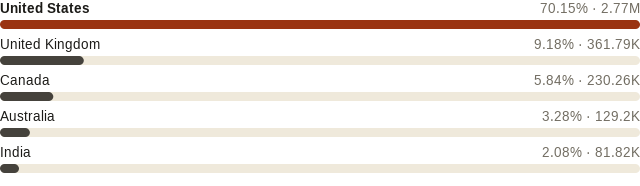
Seven in ten visits are American. The United Kingdom, Canada, Australia and India together add about 20% — twelve years after the UK launch, the list is still a US list.
Country shares, Semrush, October 2026. The Similarweb figure for October is 4.4M; the two counters disagree.
The geography is the growth ceiling in miniature. The UK launch came in September 2014, Canada followed, and twelve years later the United States still takes 70.15% of visits. Chirp is still sold only in the US and Canada. The list went international early and stayed American.
What people search for
| Keyword | Monthly searches | Note |
|---|---|---|
| bookbub | 33,100 | Brand term, rank 1, 15.09% of organic traffic |
| book bub | 8,100 | Brand term with a space, rank 1 |
| kindle unlimited | 368,000 | Borrowed term — BookBub ranks 8th for it, not a brand term |
| freida mcfadden | 90,500 | Author term, rank 2 |
| ereader books for free | 22,200 | Free-ebook intent, rank 1 |
Monthly searches are Semrush figures for bookbub.com, October 2026, read 23 November 2026. Intent terms (bookbub pricing and three others) returned no figures — the keyword overview page would not load.
Search here is brand-led, not shopper-led. The top term is the brand itself — “bookbub” at 33,100 searches a month, rank 1 — and the second brand spelling, “book bub”, adds 8,100. The money-intent phrases, “bookbub pricing” and the rest, returned no figures this round: the keyword page would not load.
The borrowed term is the warning. “Kindle unlimited” draws 368,000 searches a month, and BookBub ranks 8th for it — but that is Amazon’s demand, not BookBub’s. Counting it as brand demand would flatter the list by ten times. The real signal is narrower: people search for the name, then log in.
What outsiders say
Three pools, one split verdict

Trustpilot scores the brand 3.0 from 2,402 reviews. The App Store scores the BookBub app 4.74 stars from 962 ratings, and Chirp’s app 4.77 from 90,116.
Trustpilot, read 23 November 2026; BookBub App Store rating via AppBrain, updated 8 October 2026; Chirp App Store rating via DollarBreak, checked 18 November 2026.
The ratings split by pool, and the split is the story. Trustpilot scores the brand 3.0 from 2,402 reviews — a pool big enough to read as a pattern, not an anecdote. The App Store scores the BookBub app 4.74 stars, but from only 962 ratings; Chirp’s app scores 4.77 from 90,116. The apps are loved; the company is argued with.
The complaints repeat: emails that will not stop, unsubscribe buttons that do not seem to work, and one author who says a cancelled promotion kept taking £245 a month. The praise repeats too: authors call the Featured Deal the only channel that reliably pays for itself, and readers call the recommendations excellent. Both pools are real; the gap between them is the risk.
The money came once, then stopped
Two raises, then silence

BookBub’s funding, as reported: a $3.8M Series A in May 2014, $7M more in May 2015, and no public funding since — while the list grew to 15M subscribers and the business expanded into audiobooks and author websites.
Funding figures are Publishers Weekly (May 2014) and BookBub’s own blog (May 2015); the subscriber figure is Publishers Weekly (December 2019). The profit claim is the company’s own, from 2014.
BookBub’s funding record is short on purpose. A $3.8M Series A in May 2014 — the first outside money, from NextView Ventures and Founder Collective — then $7M more in May 2015, equity plus debt, from the same investors. Nothing public since.
The 2014 announcement carried the only profit claim the company has ever made. VentureBeat reported the company as profitable and bootstrapped since its 2012 launch; the investor’s own blog called it “running profitable”. That is a twelve-year-old self-description, not a current audited profit — and the page must say so.
The eleven-year silence is the point. A company that has not raised since 2015, and has still expanded into audiobooks and author websites, is paying its own way — or at least not paying with new shares. What it earns, and what it keeps, is unpublished. The survival is visible; the margin is not.
The press noticed early. The Guardian called BookBub the “Groupon of e-books” in January 2015, and Publishers Weekly’s 2019 profile put the list at 15 million subscribers and 1,000-plus deals a month. Both numbers are old — 2015 and 2019 — and both are still the newest public figures of their kind.
Fourteen years on the record
The archive starts with an ad page

Wayback Machine first captures of chirpbooks.com, 2019–2026, one per year, no gap. The record starts when the product does.
Wayback Machine CDX API, read 23 November 2026. The earliest bookbub.com capture is 7 April 2012.
The archive backs the survival story, with a caveat. The Wayback Machine’s earliest capture of bookbub.com dates to 7 April 2012 — and it is not the homepage, but the advertising page. The business of selling authors a slot was there from the first month the site was archived.
Chirp’s record has no gaps at all. The Wayback Machine has a first capture of chirpbooks.com in every year from 2019 to 2026 — 2019-04-10, 2020-01-13, 2021-01-24, 2022-01-04, 2023-01-01, 2024-01-01, 2025-01-11 and 2026-01-19. The record starts when the product does, and it has not missed a year since.
The earlier captures are the company itself: from April 2012 the domain shows the deals business, not a parking page. Fourteen years of daily email, archived from the start — a small site, but one that has kept its address and its model for the whole of it.
BookBub is one of six sites in the reading subscription collection. Compare BookBub with Scribd and RYZE side by side.
The full teardown is for members
The full analysis of pricing, acquisition, conversion and retention is member content. Membership is $29 a month or $249 a year.
Similar sites in the database
BookBub (3.94M) sits between PicWish (3.96M) and Yoto (3.9M) in the database.
| Site | Category | Monthly visits | Source |
|---|---|---|---|
| PicWish | Image tools · AI photo editing | 3.96M | Semrush, Oct 2026 |
| MasterClass | Education · Celebrity-led course subscription | 3.94M | Semrush, Oct 2026 |
| Yoto | Baby & kids · Screen-free audio player DTC brands | 3.9M | Similarweb, Oct 2026 |
Compare BookBub with Scribd and RYZE side by side. The full database, with working filters, is on the teardowns index.
Read the next one in your inbox
The new ones go out by email first, one a week, with the traffic source and month attached to every number. Leave your address and the next one comes to you.