
How Calm makes money on sleep, not meditation
Monthly visits
3.05M
October 2026. Third-party estimate, not official MAU/DAU. Semrush counted 3.05M for the month, down 8.7% on September.
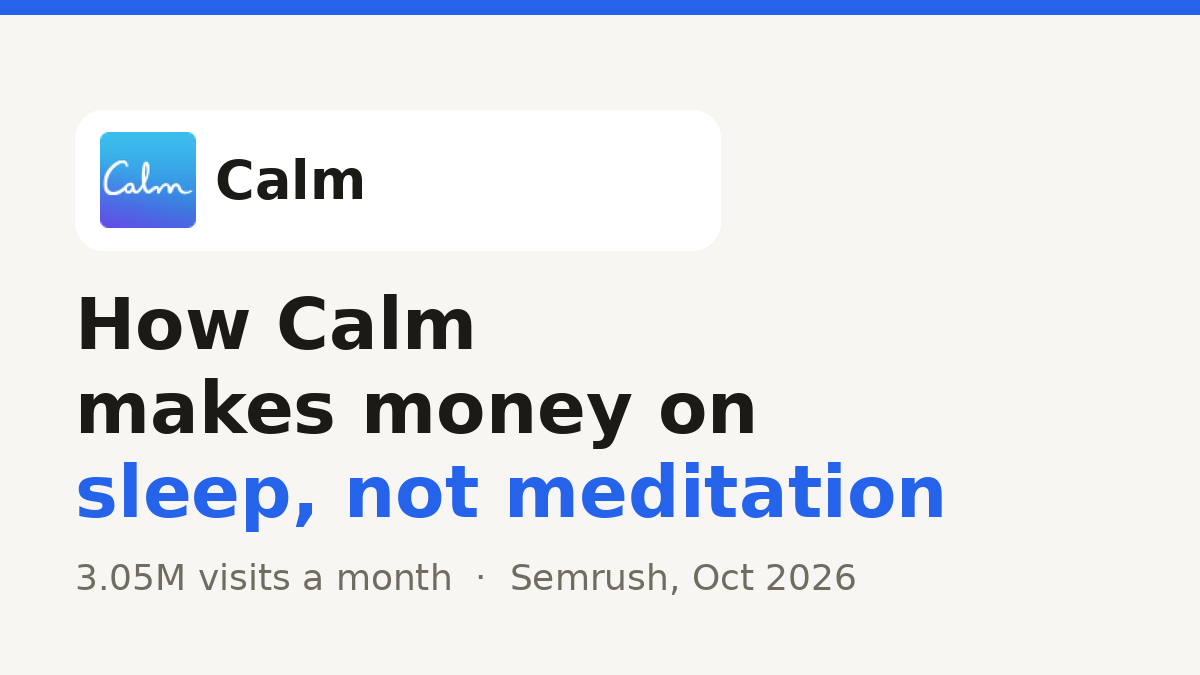
Calm draws an estimated 3.05M visits a month (October 2026, Semrush), down 8.7% on September. It is the 176th-largest site in our database of 901, one place behind Rothy’s at 3.09M.
The pitch fits in one line: 500+ Sleep Stories told by famous voices, and a $79.99-a-year subscription that renews itself unless you stop it.
| Site | Calm, calm.com |
|---|---|
| What it is | Meditation and sleep subscription app: guided meditation, 500+ Sleep Stories, sleep music and soundscapes, on iOS, Android, web, Apple TV and wearables |
| Who it is for | People who want help falling asleep, managing stress and building a meditation habit — and the employers and health plans that buy it for them |
| Category | Health · Meditation & sleep subscriptions |
| Monthly visits | 3.05M, October 2026. Third-party estimate, not official MAU/DAU; Semrush, down 8.7% on September (3.34M) and down from 3.88M in August |
| Founded | 2012 (4 May 2012; the first web capture predates it, 3 January 2012) |
| Headquarters | San Francisco, California |
| Operator | Calm.com, Inc.; privately held and venture-backed, never listed or acquired. Founders Michael Acton Smith and Alex Tew (co-executive chairmen); chief executive David Ko stepped down in April 2026 and the successor has not been named |
| Survival engine | Repeat-purchase-led. About 4.5 million people pay $69.99–$79.99 a year for sleep, and the annual plan renews itself unless cancelled at least 24 hours ahead. The second pull is distribution: 3,000+ employers and 26 million covered lives buy the same subscription, and Target, Hilton and Ozlo now sell the brand on shelves and in hotel rooms |
| Pricing | Premium annual $79.99/yr on the website ($69.99/yr in the App Store listing), monthly $16.99; Family $119.99/yr for six accounts; Lifetime $499.99 one-off (website only); Calm Sleep $69.99/yr as a separate subscription. Source: Calm’s own blog pricing table (October 2026) and third-party price checks (November 2026); Lifetime from the Calm Help Center |
| Pricing model | Annual or monthly subscription, auto-renewing; a free tier with some content free forever, and a 14-day free trial on the website |
| Free hook | A free tier with some content free forever, 7 Days of Calm starter course, and a 14-day free trial on the website (7 days in the app) |
| Meta ads | Not verified — the ad library returned 403 this round; a third-party snapshot dated 9 November 2026 counted 80 ads |
| Country breakdown | United States 64.08% (1.95M), United Kingdom 10.37%, Canada 3.8%, Australia 2.95%, India 2.63% (Semrush, October 2026) |
TL;DR
- Calm sells sleep for $79.99 a year: 3.05M monthly visits, about 4.5 million paying subscribers, and 180 million downloads since 2012.
- The money is made on renewals: an annual plan that auto-renews, a 24-hour cancellation deadline, and refunds that you have to ask for separately — while Trustpilot reviewers call the exit hard to find.
- The second business is someone else paying: 3,000+ employers and 26 million covered lives buy the same subscription, and Target, Hilton, and Ozlo now sell the brand on shelves and in hotel rooms.
Sleep is the product — the subscription is the business
The search footprint is generic words, not the brand
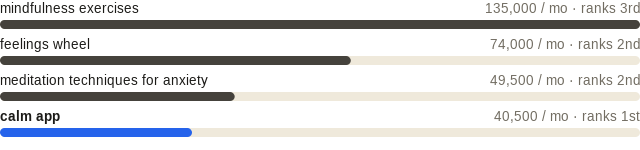
Generic words outrank the brand word; the odd one out is left off the chart.
Semrush, October 2026, read 25 November 2026.
The search footprint is generic, and the brand word is small. “Mindfulness exercises” draws 135,000 searches a month and ranks third, “feelings wheel” 74,000 and ranks second, and “calm app” — the brand word — only 40,500 a month, worth 6.8% of organic search traffic. Calm is found by people looking for a technique, not by people looking for Calm.
One keyword is left out of the chart on purpose. “Masochist” draws 135,000 searches a month and ranks sixth, but the overview gives it no landing page, so it reads as a stray ranking, not a content strategy. The shape that matters is the other four: the funnel starts with a problem — sleep, anxiety, feelings — and the brand is the answer, not the query.
Fourteen years from a landing page to 4.5 million subscribers
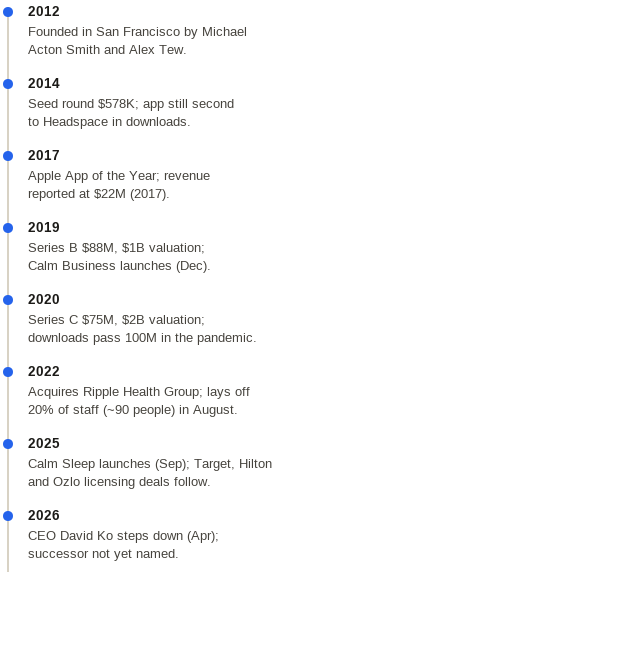
Fourteen years, one model: free content in, annual renewals out.
GlobeNewswire, 8 December 2020; Business Wire, 11 July 2023; Calm blog, 16 September 2025; MobiHealthNews, 15 August 2022.
Calm started as a landing page in 2012 — the Wayback Machine’s first capture is 3 January 2012, months before the company was founded on 4 May — and spent its first years behind Headspace in downloads. Apple named it App of the Year in 2017, and the money followed: an $88M Series B in February 2019 at a $1B valuation, then a $75M Series C in December 2020 at $2B, led by Lightspeed.
The 2020 valuation is history, not a current price — no new round has been priced since — but the subscriber count behind it is real enough: 1 million paying in 2019, over 4 million by the end of 2020, and about 4.5 million on Sacra’s 2025 count. Five years, half a million net adds. The growth moved elsewhere.
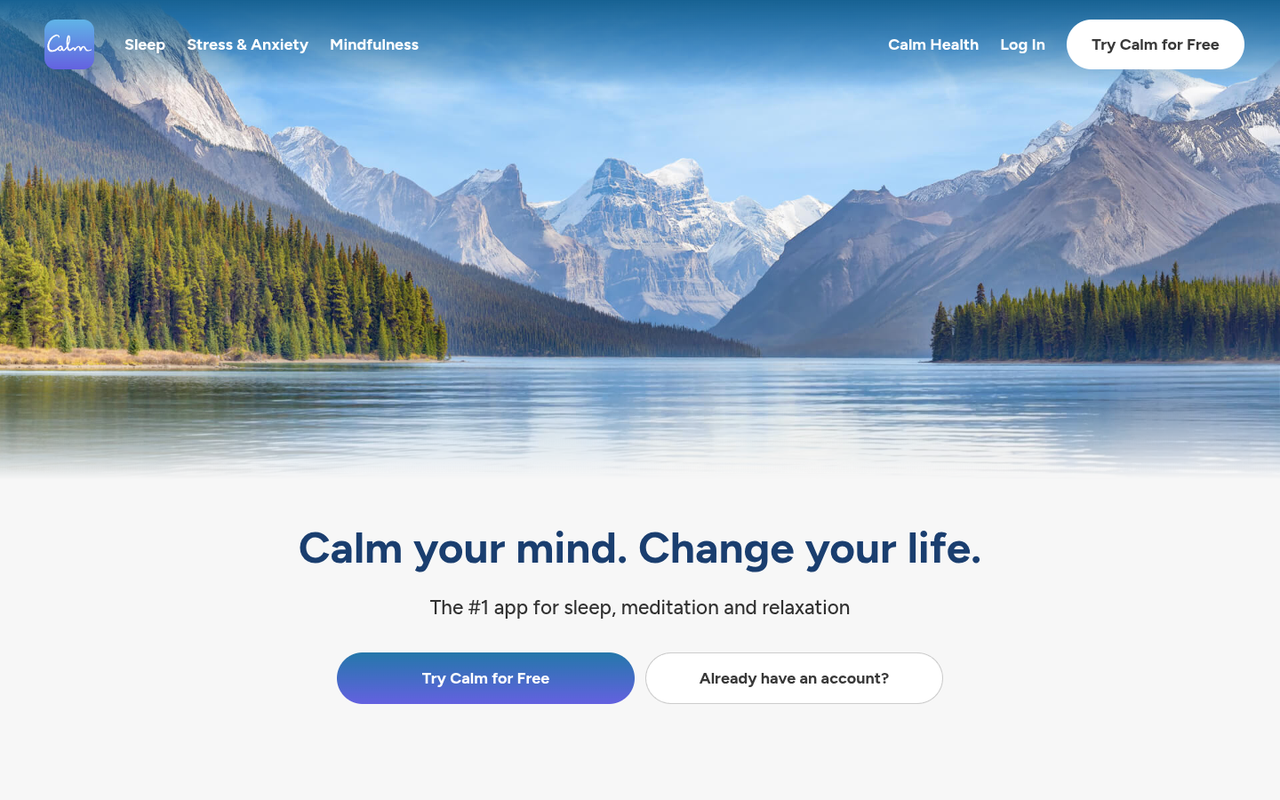
The Calm homepage, Wayback capture 17 October 2026; the live page seen 25 November 2026 shows the same hero. “Calm your mind. Change your life.” over “The #1 app for sleep, meditation and relaxation”.
The homepage sells sleep, not meditation. The hero is a mountain lake, the headline is about calming the mind, and the first thing the page promises is sleep — the 500+ Sleep Stories, told by Harry Styles, Matthew McConaughey and Jennifer Garner, are the reason to come back every night. Meditation is the library; sleep is the habit.
The price depends on where you buy it
| Plan | Price | What it is |
|---|---|---|
| Premium annual (website) | $79.99 / year ($6.67 / month) | The headline plan; 14-day free trial on the website; auto-renews until cancelled |
| Premium annual (App Store) | $69.99 / year | The same subscription, $10 less in the store listing — the site charges more than the store |
| Premium monthly | $16.99 / month ($14.99 on Calm’s own blog) | Monthly billing costs $203.88 over a year, against $79.99 for the annual plan on the website |
| Premium Family | $119.99 / year | Six Premium accounts; “Save 77% on Premium”; 7-day free trial; rose from $99.99 in October 2026 |
| Lifetime | $499.99 one-off | Website only, non-refundable; the old $399.99 still appears in App Store copy |
| Calm Sleep | $69.99 / year | A separate subscription launched September 2025; Premium does not include it; existing subscribers add it for $19.99 / year |
| Student | $9.99 / year | US .edu email; third-party-checked November 2026 |
| Headspace annual (rival) | $69.99 / year | The closest rival; monthly $12.99; no permanent free tier |
| Insight Timer MemberPlus (rival) | $59.99 / year | The low-price alternative; monthly about $9.99; no family plan |
The price is not one price. The website charges $79.99 a year, the App Store listing says $69.99, and Calm’s own blog lists $14.99 a month against the $16.99 in the store — three channels, three prices, all live in November 2026. The homepage makes the annual plan the default: $79.99 against a struck-through $203.88, the cost of twelve monthly payments.
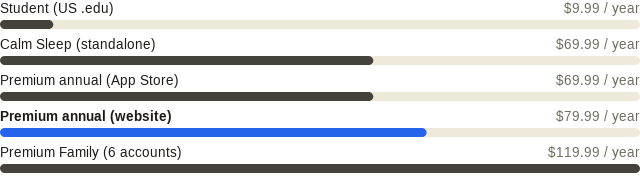
The annual plan is the product; everything else is a door into it.
Third-party-checked November 2026 and cross-checked against Calm’s blog table, October 2026.
The ladder has a second rung most subscribers never see. Family is $119.99 a year for six accounts — up from $99.99 in October 2026 — and Lifetime is a $499.99 one-off the website sells without a refund. Calm Sleep, launched in September 2025, is a second $69.99-a-year subscription on top of Premium, not inside it. The company is selling the same sleep twice.
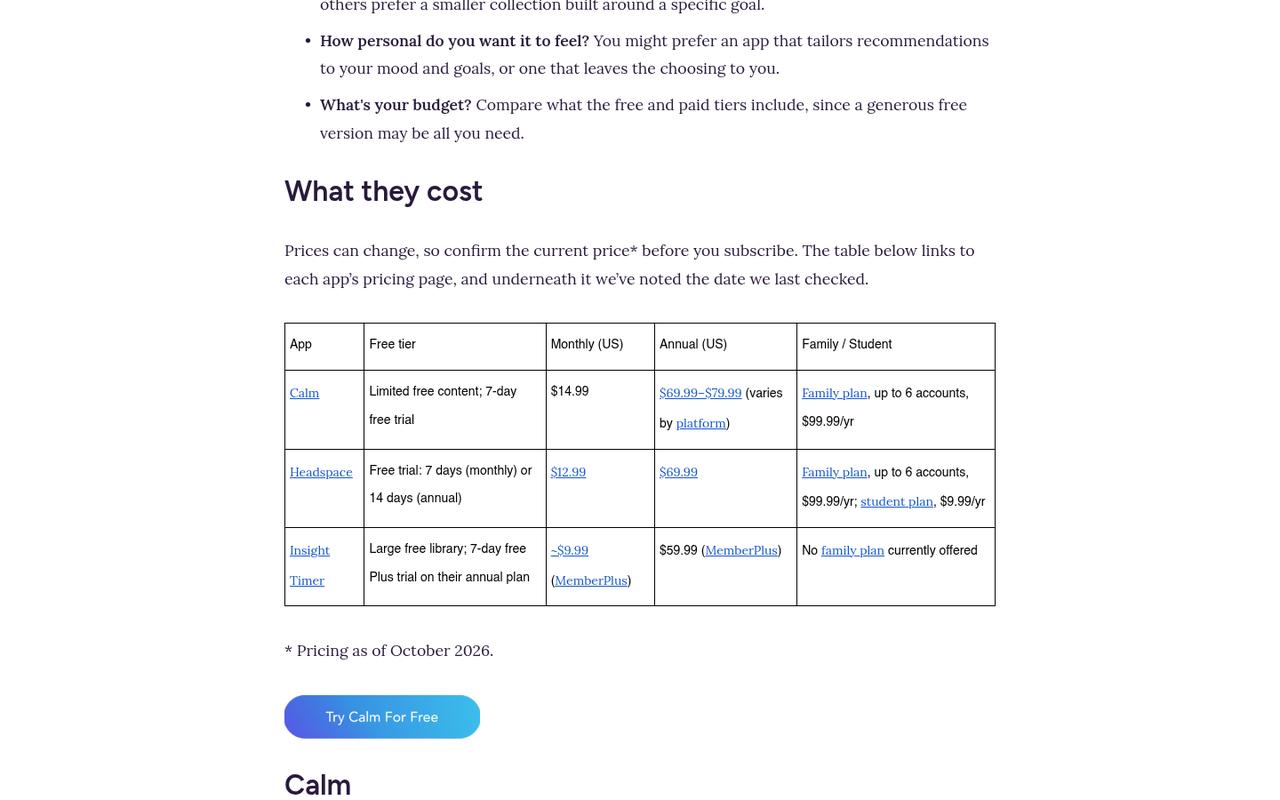
Calm’s own blog compares the prices, “Pricing as of October 2026”. Its table lists Calm at $14.99 a month and $69.99–$79.99 a year, “varies by platform” — and Family at $99.99, the price before the October 2026 rise to $119.99, third-party-checked November 2026.
Against the shelf, Calm is the most expensive subscription in the group. Insight Timer is $59.99 a year, Headspace $69.99, and Calm $79.99 on the website — yet Calm holds the highest App Store rating at 4.8 from about 2 million ratings, and 180 million downloads. The price is not the pitch. The pitch is that the stories are worth staying for.
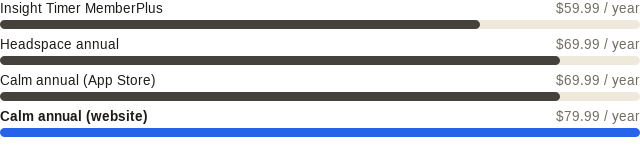
The dearest subscription in the group, and the best-reviewed.
Third-party-checked November 2026 values from the rivals’ own pricing pages.
Employers and health plans buy the same app — while the CEO’s chair sits empty
What keeps subscribers paying
| Mechanism | Hit | Why, in one line |
|---|---|---|
| Free tier | ✓ | Some content is free forever, with no ads — 7 Days of Calm, first days of courses, rotating picks, breathing exercises |
| No sign-up to try | — | A Calm account is needed to subscribe and sync; the free content needs the app download |
| Free trial | ✓ | 14 days on the website for new users, 7 days inside the app |
| Skip a month | — | No shipments to skip — the subscription is access to a content library |
| Pause | Not verified | No pause option appears in the terms or the Help Center |
| Cancel any time | ✓ | Cancel on the website at profile/manage-subscription, at least 24 hours before renewal; store purchases cancel in the store |
| Refund | ✓ | 30 days for website purchases, 14 days for monthly plans; Apple purchases go to Apple; Lifetime, Family, gift cards and business plans never refund |
| Free shipping | — | A digital subscription; nothing ships |
| Loyalty programme | — | No points or loyalty programme found |
| Gift card | ✓ | Gift cards exist — the terms mention them — but no face value or buy page was found |
| Gift subscription | ✓ | A Guest Pass gives a friend 30 days free; gift cards are the paid version |
| Referral reward | Not verified | The Guest Pass exists; whether it pays a reward was not found |
| First-order hook | ✓ | Free tier forever, 7 Days of Calm, a 14-day website trial, and a 30-day Guest Pass |
| Unused credits roll over | — | No usage concept — the subscription is library access |
| Multiple devices | ✓ | iOS, Android, web, Apple TV, Apple Watch, WearOS and Samsung Health |
| API | — | No public API found |
| Advertising | — | No ads in the product or on the site; the App Store listing says so |
The renewal is the retention mechanism. The annual plan renews at whatever the current price is, cancellation has to happen at least 24 hours before the renewal date, and cancelling does not refund anything on its own — a refund is a separate form, and only inside 30 days of a website purchase or 14 days of a monthly one.
The exit is where the complaints live. Trustpilot rates Calm 1.3 out of 5 from about 502 reviews, and the recent ones are almost all one or two stars about charges nobody expected and cancellations that would not go through. The terms disclose the 24-hour deadline and the refund form; the app leads with the stories, not the exit.
The reviews split by job, not by score

Three platforms, two different products being rated.
App Store, Google Play and Trustpilot, read 25 November 2026.
The two pools measure different things. The App Store’s 4.8 from about 2 million ratings is the content — the stories, the voices, the sleep — and Google Play’s 4.5 from about 596,000 reviews is close behind. Trustpilot’s 1.3 from about 502 reviews is the billing: the renewal, the cancellation, the refund. One company, two reputations, and the split is the point.
The gap is the widest on this site so far. Yoto’s Trustpilot sample is about 47,460 reviews at 4.4; Calm’s is about 502 at 1.3, while its App Store rating is the highest of any teardown here. The people who love the app do not review the company, and the people who review the company are the ones who could not leave it.
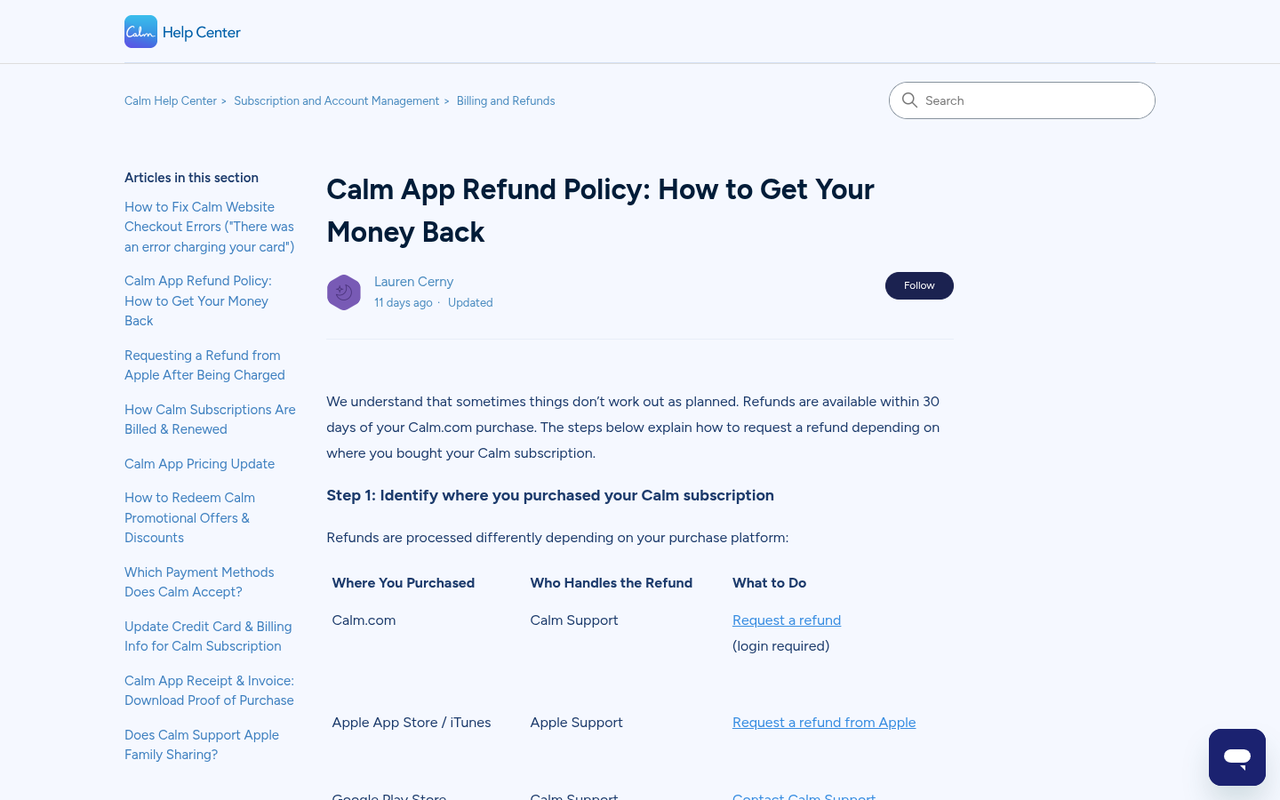
Calm’s Help Center refund policy, read 25 November 2026. Refunds are available within 30 days of a Calm.com purchase; Apple purchases are refunded by Apple, not Calm.
The refund page is the retention story in miniature. Website purchases get 30 days, monthly plans 14, and Google Play purchases go through Calm Support — but Apple purchases go to Apple, and Lifetime, Family, gift cards and business plans are never refundable. The money back exists, but it is a form to fill in, not a button to press.
Traffic is a brand return visit, and it is shrinking

Three months down, and the search traffic fell faster than the visits.
Semrush, October 2026, read 25 November 2026.
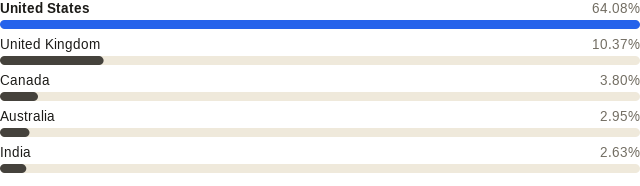
The United States is nearly two-thirds of it; the rest is spread thin.
Semrush, October 2026, read 25 November 2026.
| Channel | Share of visits | Platform & stack |
|---|---|---|
| Direct | 42.75% of desktop journeys | Semrush, October 2026; the largest channel — brand return visits and subscribers coming back |
| Google search | 11.38% of desktop journeys | Semrush, October 2026 |
| Organic search | Down 26.15% on the month | Semrush, October 2026; the brand word “calm app” draws 40,500 searches a month |
| Paid search | Down 37.0% on the month | Semrush, October 2026; absolute value not reported |
| Meta ads | Not verified | The ad library returned 403 this round; a third-party snapshot dated 9 November 2026 counted 80 ads |
| App Store | About 22,000 US iPhone downloads in 30 days; $3.1M App Store spend | AppTrendKit, October 2026 estimate; $143 per download |
| Enterprise | 3,000+ employers; 26M+ covered lives | Calm Business (2023) and Calm Health (company figures); price per employer not published |
| Retail and licensing | Target bedding, Hilton rooms, Ozlo Sleepbuds, TRIP drinks | Licensing deals from September 2025; revenue share not published |
| Backlinks | 498.55K links, 59.96K domains | Semrush, October 2026; links down 8.82%, domains up 4.22% on the month |
| — | No list size published; renewal notices are the only email touchpoint found | |
| Word of mouth | — | Celebrity-narrated Sleep Stories are the distribution: Harry Styles, Matthew McConaughey, Jennifer Garner |
The website is shrinking while the app keeps selling. Visits fell three months running — 3.88M in August, 3.34M in September, 3.05M in October — and organic search fell 26.15% in the month, paid search 37.0%. Direct visits are still 42.75% of desktop journeys, the shape of subscribers coming back to a subscription they already pay for.
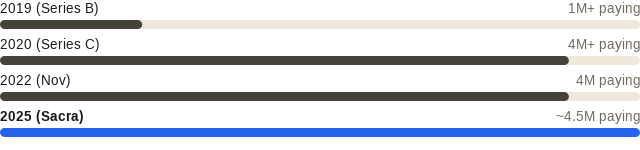
Five years, half a million net adds — the growth moved elsewhere.
Sacra, 2025; Wikipedia, 2022.
The revenue is six numbers, and they disagree. Sacra puts 2023 at $300M, Business of Apps puts 2022 at $355M, GetLatka estimates 2024 at $596.4M, and Business of Apps puts 2025 at about $210M, down 24%. This page does not pick one and call it the revenue; the direction of the business cannot be read off third-party estimates that point both ways.
What is not in dispute is the flat line underneath. Paying subscribers were 1 million in 2019, over 4 million by the end of 2020, 4 million in November 2022 and about 4.5 million on Sacra’s 2025 count. The consumer engine stopped growing, and the new growth is employers and health plans buying the same subscription for someone else.
| Area | What we found |
|---|---|
| Platform | JavaScript-rendered single-page app; automated reads are blocked by PerimeterX bot protection |
| App | iOS and Android “Calm — Sleep, Meditate, Relax” (App Store 4.8, Google Play 4.5); also Apple TV, Apple Watch, WearOS, Samsung Health |
| Content | 500+ Sleep Stories, new stories every week; soundscapes and music; an AI-cloned James Stewart Christmas story in 2023 |
| Calm Sleep | Separate app (September 2025): personal sleep plans, a sleep-readiness bar, Apple HealthKit sync |
| Payments | Card or Google Pay on the website; App Store and Google Play in-app purchase; auto-renewal at the current price |
| Email provider | Not verified |
| Compliance | 30-day refund window on website purchases, 14 days on monthly plans; Lifetime, Family, gift cards and business plans non-refundable |
Three things should not be quoted as facts. No audited profit figure is published — the company once said it had been profitable since 2016, then cut 20% of its staff in the same year. No renewal rate, churn, conversion rate or current subscriber count beyond Sacra’s 2025 estimate is published. And no revenue split between consumers, employers, health plans and licensing is published either.
The open question is who runs the second act. David Ko stepped down as chief executive in April 2026 and no successor has been named, just as the company is betting its growth on employers, health plans and a second subscription, Calm Sleep, that costs $69.99 a year on top of Premium. The consumer engine is flat; the new engines have no published numbers yet.
Calm is the first teardown in the Meditation & sleep subscriptions collection. Compare Calm with Function Health and MasterClass side by side.
The full teardown is for members
The full analysis of pricing, acquisition, conversion and retention is member content. Membership is $29 a month or $249 a year.
Similar sites in the database
Calm (3.05M) sits between Rothy’s (3.09M) and ResizePixel (3.04M) in the database.
| Site | Category | Monthly visits | Source |
|---|---|---|---|
| Function Health | Health · Preventive blood testing subscription DTC brands | 3.1M | Similarweb, Oct 2026 |
| Rothy’s | Apparel / DTC | 3.09M | Semrush, Oct 2026 |
| Calm | Health / Meditation & sleep subscriptions | 3.05M | Semrush, Oct 2026 |
| ResizePixel | Image tools | 3.04M | Semrush, Oct 2026 |
| ButcherBox | Food & drink / DTC | 3.04M | Semrush, Oct 2026 |
Compare Calm with Function Health and MasterClass side by side. The full database, with working filters, is on the teardowns index.
Read the next one in your inbox
The new ones go out by email first, one a week, with the traffic source and month attached to every number. Leave your address and the next one comes to you.