
How DataCamp makes money on $11 subscriptions
Monthly visits
6.2M
October 2026. Third-party estimate, not official MAU/DAU. Similarweb — up 0.42% on the month.
DataCamp draws an estimated 6.2M visits a month (October 2026, Similarweb), up 0.42% on the month. It is the 100th-largest site in our database of 901 — Clockify and MyFitnessPal tie at 6.39M just above it.
The pitch fits in one line: the first chapter of every course is free, the second chapter costs $11 a month billed annually — and a certificate that expires in two years keeps the subscription renewing.
| Site | DataCamp, datacamp.com |
|---|---|
| What it is | Browser-based interactive data science and AI learning platform (Python, R, SQL, Power BI, AI): short videos plus in-browser coding exercises |
| Who it is for | Working people and students learning data skills and earning certificates, plus enterprise teams |
| Category | Education · Data science & AI learning |
| Monthly visits | 6.2M, October 2026. Third-party estimate, not official MAU/DAU; Similarweb, up 0.42% on the month |
| Founded | 2013, by Martijn Theuwissen and Jonathan Cornelissen, two Leuven University graduates; the company started in Belgium and moved its centre to New York. Earliest Wayback Machine capture: 25 April 2013 |
| Headquarters | New York City |
| Operator | DataCamp, Inc., private and unlisted, not acquired. CEO Jonathan Cornelissen; COO Martijn Theuwissen |
| Survival engine | Renewal. Annual subscriptions auto-renew, Teams renews per seat, enterprise signs multi-year contracts, and the two-year certificate gives every learner a reason to come back |
| Pricing | Premium $11 a month billed annually (special; list $28 a month billed annually, $330 a year), or $35 a month monthly; Teams $11 per user a month billed annually (special); Basic free. Source: datacamp.com/pricing, read live 19 November 2026 |
| Pricing model | Subscription: free first chapter, then an annual plan; no per-course sales |
| Free hook | Basic is free — the first chapter of every course, no card required |
| Meta ads | About 230 active ads, Ad Library, 19 November 2026 (Page @datacampinc; mostly the Black Friday 60%-off sale; a keyword search returns ~3,000 results from all advertisers mentioning DataCamp, not this Page’s count) |
| Country breakdown | Not published — Similarweb showed no country split for October 2026 (an April 2024 Semrush snapshot had the United States at 24.4%, India 11.85%, the United Kingdom 5.55%; expired, history only) |
TL;DR
- DataCamp draws an estimated 6.2M visits a month (October 2026, Similarweb), up just 0.42% on the month — flat growth for two years, on a site that calls itself cash-flow positive.
- The money is the renewal: Premium at $11 a month billed annually on special, against a $28 list price and $35 monthly. The free first chapter is the funnel; the two-year certificate and the team seat are what bring the payment back.
- The company claims $50M+ in annual recurring revenue (2019), 20M+ learners and 6,000+ enterprise customers — all company figures, unaudited, and the paid-subscriber count has not been updated since 2019.
The homepage sells the first chapter, not the price
Learn data and AI skills
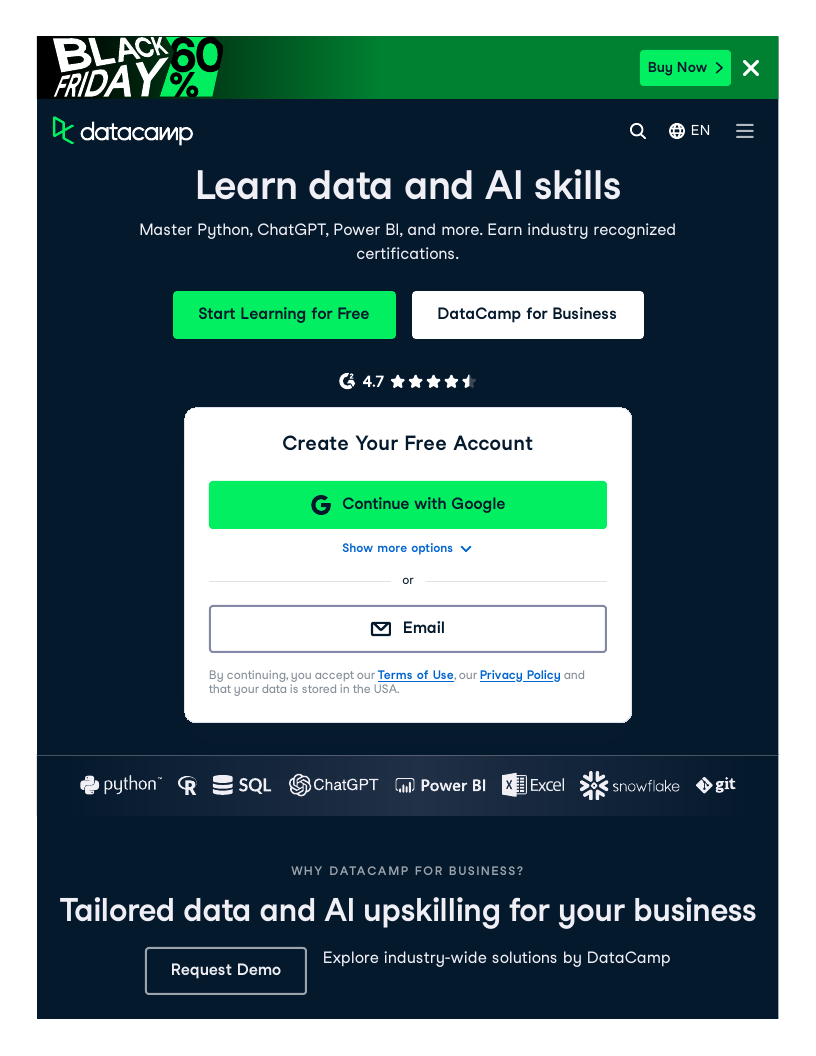
The DataCamp homepage, captured 19 November 2026. The hero reads “Learn data and AI skills” over “Master Python, ChatGPT, Power BI, and more. Earn industry recognized certifications.” The top banner is the Black Friday sale: 60% off.
The homepage we read on 19 November 2026 opens with learning, not pricing. The hero reads “Learn data and AI skills”, over “Master Python, ChatGPT, Power BI, and more. Earn industry recognized certifications.” The buttons are “Start Learning for Free” and “DataCamp for Business”.
The first thing the page asks for is an account, not a card. “Create Your Free Account” offers Google or email sign-in, under a 4.7-star G2 rating and a row of skill logos: Python, R, SQL, ChatGPT, Power BI, Excel, Snowflake, Git. Below it, the business pitch: “Tailored data and AI upskilling for your business”, with a “Request Demo” button.
Nothing on the homepage names a price. The number it leans on is scale: 20M+ learners, 810+ courses, and 80% of the Fortune 1000 using the platform. The price only appears one click away, on the pricing page — and the top banner gives the reason to click now: the biggest-ever sale, 60% off.
Three prices, one lever: the annual plan
$11 a month, if you pay for the year
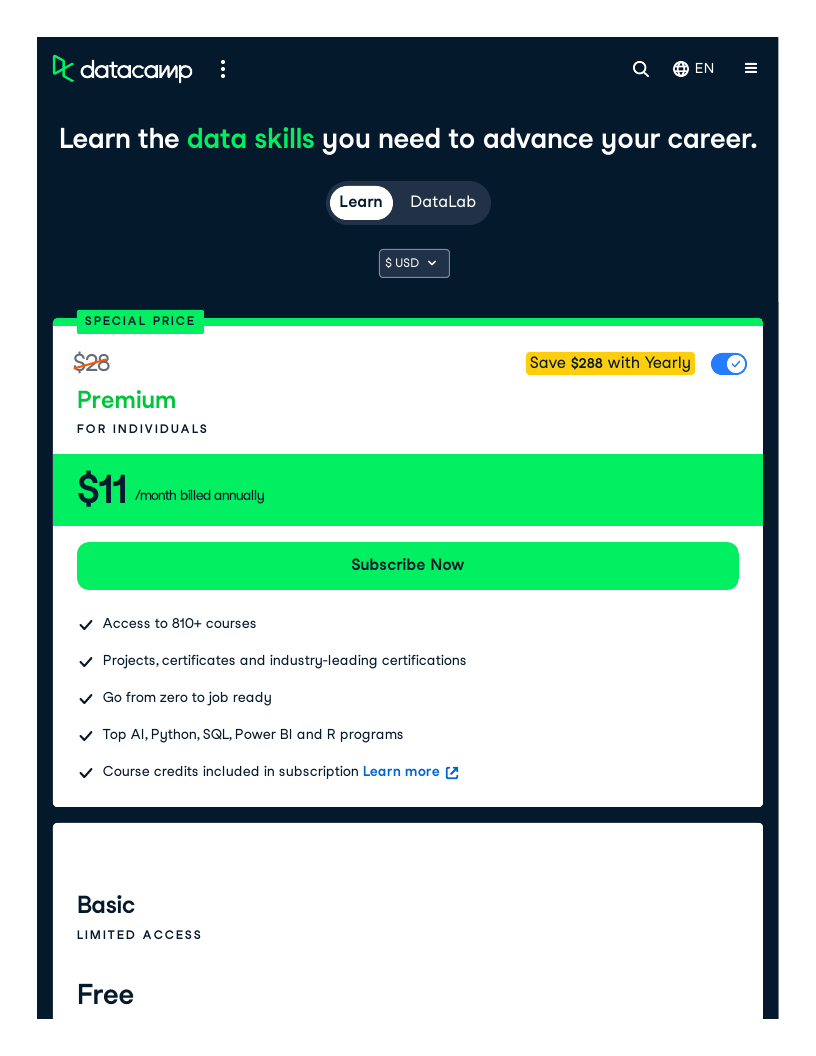
The DataCamp pricing page, captured 19 November 2026. Premium is $11 a month billed annually, struck through from $28, with the toggle reading “Save $288 with Yearly”. Basic is free below it.
The pricing page prints three numbers for the same plan. Premium is $11 a month when billed annually on special, $28 a month billed annually at list — $330 a year — and $35 a month when billed monthly. The page’s own line is “Save $288 with Yearly”: $35 times 12 is $420, minus the $132 special annual price.
Teams is priced at the same $11 per user a month billed annually on special, from two seats up — so a two-person team pays $264 a year on special, double the $132 a single learner pays, for the same courses plus admin controls, progress tracking and single sign-on. Enterprise has no published price; it is sold by demo.
| Plan | Price | What you get |
|---|---|---|
| Basic | $0 | First chapter of every course, free forever, no card; limited practice and projects |
| Premium, annual (special) | $11/mo ($132/yr) | All 810+ courses, projects, certificates and certifications, career and skill tracks, course credits |
| Premium, annual (list) | $28/mo ($330/yr) | Same as above at list price; the special is a promotion, not a tier |
| Premium, monthly | $35/mo | Same as above, billed monthly; can be paused, unlike the annual plan |
| Teams, annual (special) | $11/user/mo, 2 seats minimum | Everything in Premium plus admin dashboard, learning activity and progress tracking, licence management, Google/Microsoft SSO |
| Enterprise | Custom, by demo | Custom tracks, Skill Matrix, SAML 2.0 SSO, LMS/LXP integrations, custom reporting, co-branded landing pages |
| Student plan | 50%+ off the current price | Premium at a student discount; third-party readings put it at $164 a year |
Prices: datacamp.com/pricing, read live 19 November 2026. The $28 list price is the annual list price shown as a monthly average; the $35 monthly price is the month-to-month rate.
One plan, three prices
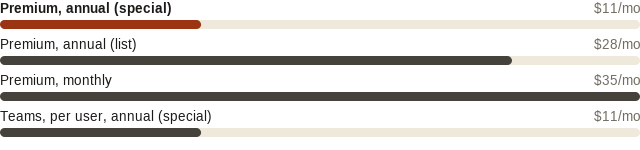
One plan, three prices: Premium is $11 a month billed annually on special, $28 at list, and $35 month to month. Teams matches the $11 special price per user.
Pricing page, read live 19 November 2026.
The arithmetic is the pitch. Annual on special costs $132 a year; monthly costs $420. That $288 gap is the page’s loudest number — and it is also the warning: the special is a promotion, and third-party readings from September and October put Teams at $28 a user a month. The price on the page today is not the price a year from now.
The second chapter is the paywall
What the meter allows, and what it stops
| Mechanism | Hit | Why, in one line |
|---|---|---|
| Free tier | ✓ | Basic is free: the first chapter of every course, no card |
| No account | — | Learning needs an account; whether guests can read the first chapter is not verified |
| Free trial | — | No trial for individuals; Basic is the trial. Teams has a 14-day trial in third-party readings, not seen on the pricing page |
| Ads on the site | — | No ads on the site; DataCamp itself runs about 230 active Meta ads |
| API | 未核到 | No public API documentation found in the pages read |
| Email capture | ✓ | Blog subscription and free-open-week signup; email is 4.04% of desktop visits |
| Auto-renew | ✓ | On by default, per the support site, 15 October 2026 |
| Cancel anytime | ✓ | Cancel in account settings; access runs to the end of the current period |
| Pause subscription | ✓ | Monthly plans can pause; annual plans cannot |
| Skip a delivery | — | No delivery to skip; this is digital learning, not a box |
| Free shipping | — | No goods to ship |
| Gift subscription | 未核到 | No gift purchase found in the pages read |
| Loyalty plan | — | No points scheme found |
| First-order hook | ✓ | First chapter free, plus a free open week (2–8 November 2026, whole library free) |
| Subscription discount | ✓ | Annual at $11 a month against $35 monthly; students get 50%+ off |
| Refer a friend | 未核到 | No referral reward found in the pages read |
| App incentive | ✓ | Mobile app with streaks and a daily five-minute challenge |
| Certification renewal | ✓ | Certificates last two years; renewal means re-testing |
| Course credits | ✓ | Premium includes course credits; the allowance is not published |
| Career profile | ✓ | Free, on the pricing page |
Read the table as a school with the first lesson free. The wall sits at the second chapter of every course: finish the free taste and the next click asks for $11 a month billed annually. There is no trial to burn through, because the free chapter is the trial.
What brings the payment back is not the course but the certificate. The Associate certificate is included in Premium, takes two two-hour timed exams plus a practical exam, must be finished within 30 days of registering, and expires after two years. A learner who finished a track has a reason to renew — and a learner who has not finished has a reason not to cancel.
The terms are blunt about refunds. Cancel any time, but the unused part of the period is not refunded (Terms §6.2, revised 4 May 2026); only billing errors are repaid. Monthly plans can pause; annual plans cannot. About 9% of Trustpilot reviews are one star — 93 of 994 — mostly about auto-renewal charges and no refunds.
Where the visits come from
Direct traffic is the brand
| Channel | Share of visits | Platform & stack |
|---|---|---|
| Direct | 39.62% of visits, October 2026 | Similarweb — the largest channel |
| Organic search | 31.19% of desktop visits | Toolify citing Similarweb, Sep 2023–Aug 2026 |
| Social, organic | 6.34% of desktop visits | Same three-year desktop window |
| Referral | 6.32% of desktop visits | Same window; 128 referring sites |
| Paid search | 5.75% of desktop visits | Same window |
| 4.04% of desktop visits | Same window | |
| Brand keyword | “datacamp”, about 33,100 searches a month | Semrush, April 2024 — volume only; the term itself was not shown |
| AI referrals | GenAI 2.02% of desktop visits | Same three-year window |
| Backlinks | 141.12M links from 35.69K domains | Semrush, April 2024 — expired, history only |
| Platform | — | Web, in-browser coding, zero install; iOS and Android apps; DataLab cloud notebooks |
| Reviews | — | Trustpilot 4.6/5 (994 reviews); G2 4.7/5 (738 reviews) — read 23 November 2026 |
| Payments | — | PayPal and cards at checkout (purchase.datacamp.com); invoice purchases excluded from Black Friday pricing |
| Stack | — | Next.js and React on Cloudflare; Zuora for subscription billing; ProfitWell and AppsFlyer for analytics (BuiltWith, 19 November 2026) |
Marketing channels: Similarweb, October 2026 for Direct; the rest is a three-year desktop window (September 2023–August 2026) cited by Toolify — not October 2026 monthly shares.
How visits arrive, desktop
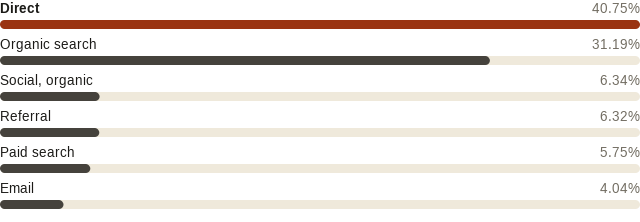
How visits arrive, desktop: Direct is 40.75% and organic search 31.19% over three years; the rest is single digits.
Toolify citing Similarweb, desktop, September 2023–August 2026. October 2026 Direct is 39.62%.
Direct visits are 39.62% of traffic in October 2026 — the largest channel — and organic search adds about a third of desktop visits over three years. Nearly four in ten visitors type the address in by hand. That is what a brand people remember looks like.
The honest limit is the calendar. Visits rose just 0.42% in October, and the last Semrush snapshot we could read — April 2024, at 7.41M — sits above today’s 6.2M from a different source. Two years, no visible growth in scale.
The distribution that matters is not search. It is 6,000+ enterprise customers sending employees in, 40,000+ schools using Classrooms free, and a YouTube channel with 220K subscribers. A classroom that learns free today is a team seat tomorrow — and the ads agree: about 230 active Meta ads, most of them selling the Black Friday 60% off.
What the renewal is worth
| Counter | Figure | What it is |
|---|---|---|
| Monthly visits | 6.2M | Similarweb, October 2026 |
| Rank in the database | 101st of 890 | Clockify and MyFitnessPal tie at 6.39M just above it |
| Learners | 20M+ | Company figure, November 2026; 10M+ in 2019 |
| Courses | 810+ | Pricing page, 19 November 2026 |
| Enterprise customers | 6,000+ | Company figure, December 2025 release |
| Annual recurring revenue | $50M+ | Co-founder interview, 2019; the company says it expects to pass $100M by the end of 2026 |
| Paid subscribers | 200,000 | 2019 figure; no update published since |
| Funding raised | ~$32.6M | Last round Series B, $25M, December 2018 |
| Acquisitions | Optima, $15M | November 2025; price from fwdstart, not the official release |
| Trustpilot | 4.6/5 (994 reviews) | 9% one star (93 of 994), mostly auto-renewal and refund complaints |
| G2 | 4.7/5 (738 reviews) | 88% five stars; one one-star review in 738; G2 badges for best results and usability, spring 2026 |
| Monthly price, annual | $11 | Special price; $28 list, $35 monthly |
Revenue and subscriber figures are company claims, unaudited; the 2019 subscriber count cannot be reconciled with the $50M+ revenue figure.
Learners, 2019 to 2026

Learners: 10M+ in 2019, 18M+ in December 2025, 20M+ in November 2026. The count doubled while traffic stayed flat.
Company figures: 2019 co-founder interview; December 2025 G2 release; November 2026 homepage and pricing page.
What the rivals charge

What the rivals charge: DataCamp Premium is $11 a month billed annually on special; Udemy’s personal plan is about $20 a month; Coursera Plus is $59 a month.
DataCamp pricing page, 19 November 2026; Udemy, rankingright, September 2026; Coursera Plus, onlinecourseing, 24 October 2026.
The headline is the arithmetic that does not add up. Two hundred thousand paying subscribers at the $132 annual special price is about $26.4M — well under the $50M+ revenue the founders claimed in 2019. Either the subscriber count is out of date, or the enterprise line carries most of the money. The company publishes no split, so this teardown does not guess one.
What is verifiable is the shape. A site that raised only $32.6M, never took a majority investor, and bought another company in November 2025 is a site that believes its own cash flow. The risk sits next to it: two years of flat traffic, a certificate whose standing is weaker than Google’s or Microsoft’s, and a free AI that teaches the same Python for nothing.
The moat is the syllabus, not the lesson. Once a learner has started a track, passed a certificate and joined a team seat, leaving means starting over and letting the certificate lapse. That is the whole business: not selling courses, but selling the right to keep learning.
What outsiders say
Third-party ratings, read 23 November 2026

Third-party ratings, read 23 November 2026: Trustpilot 4.6/5 from 994 reviews; G2 4.7/5 from 738 reviews. The two platforms agree on the average and disagree on the one-star share — see the text.
Sources: trustpilot.com/review/www.datacamp.com and g2.com/products/datacamp/reviews, read live 23 November 2026.
Two review platforms score DataCamp almost identically — and read very differently underneath. Trustpilot gives 4.6 out of 5 across 994 reviews, G2 gives 4.7 out of 5 across 738. The averages agree; the audiences do not.
The split is the story. On Trustpilot, 83% of reviews are five stars and 9% are one star — 93 of 994 — most of them about auto-renewal charges and no refunds. On G2, 88% are five stars and only one review in 738 is one star. The same product looks loved by professionals and resented by individual subscribers.
The recent flow is still moving. Trustpilot logged 210 reviews in the last twelve months, and the newest — 22 November 2026 — is five stars. A September third-party reading put one-star reviews at about 13%; today the page itself shows 9%.
Fourteen years on the record
First capture of each year, 2013–2026
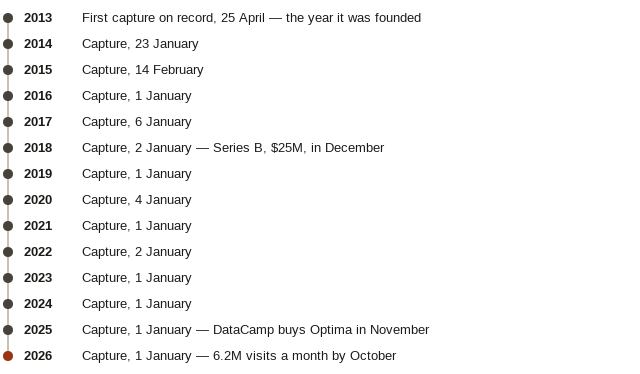
The Wayback Machine’s first capture of datacamp.com, 25 April 2013 — yearly first captures run from that date to 1 January 2026, with the Series B in December 2018 and the Optima acquisition in November 2025 marked.
Source: web.archive.org CDX API, read 23 November 2026; 1,988 captures to 17 November 2026.
The archive backs the founding story. The Wayback Machine first captured datacamp.com on 25 April 2013 — the year the founders say they started — and has caught it every year since, fourteen years without a gap.
Two dates on the line mark the money. The Series B — $25M — closed in December 2018, five years after the first capture. In November 2025 the company turned buyer, acquiring Optima; the price, $15M, comes from a third-party report, not the official release.
Fourteen years of captures against flat traffic is the honest read. The site survived — same domain, same name, no acquisition, no shutdown — while the monthly visits sat near 6.2M. Longevity is proven; growth is not.
DataCamp is the first data science and AI learning site in the data science & AI learning collection, at 6.2M visits a month — the 100th-largest site in the database. Compare DataCamp with Scrimba and Memrise side by side.
The full teardown is for members
The full analysis of pricing, acquisition, conversion and retention is member content. Membership is $29 a month or $249 a year.
Similar sites in the database
DataCamp (6.2M) sits between MyFitnessPal (6.39M) and n8n (6.01M) in the database — the 100th-largest site of 896, with Clockify tied at 6.39M just above it.
| Site | Category | Monthly visits | Source |
|---|---|---|---|
| Dropout | Streaming / Comedy streaming subscription | 6.57M | Semrush, Oct 2026 |
| Clockify | Time tracking tools | 6.39M | Semrush, Oct 2026 |
| MyFitnessPal | Health / Calorie & nutrition tracking subscriptions | 6.39M | Semrush, Oct 2026 |
| n8n | Automation tools | 6.01M | Semrush, Oct 2026 |
Compare DataCamp with Scrimba and Memrise side by side. The full database, with working filters, is on the teardowns index.
Read the next one in your inbox
The new ones go out by email first, one a week, with the traffic source and month attached to every number. Leave your address and the next one comes to you.