
How Dreamstime Makes Money From Repeat Downloads
Monthly visits
27.96M
Semrush, October 2026. Third-party estimates, not official MAU/DAU.
Dreamstime draws an estimated 27.96 million visits a month (October 2026, Semrush) — the 28th-largest site in our database of 901 — and sells other people's photographs back to the people who need fresh ones every month. Its library holds 379 million files, its community counts 61 million registered users and 1.4 million contributors, and buyers pay in one of two ways: a subscription that renews, or a pack of credits that runs out.
The site is a marketplace with a cut. Contributors keep 25–60% of each sale, so Dreamstime keeps 40–75%. It has run since 2000 without ever raising outside money, and no public source says whether it is profitable.
| Site | Dreamstime, dreamstime.com |
|---|---|
| What it is | Royalty-free stock photo, video, vector and audio marketplace: 379 million files, subscription or credit packs |
| Who it is for | Designers, marketers and content creators who need licensed images, video and vectors every month |
| Category | Design tools |
| Monthly visits | 27.96M, October 2026. Third-party estimates, not official MAU/DAU; Semrush 27.96M (September 27.95M, August 25.39M — October flat, +0.03%) |
| Founded | 2000 (domain registered 2000; restructured as a community microstock marketplace in 2004 and moved to the United States) |
| Headquarters | Brentwood, Tennessee, USA (1616 Westgate Circle); research and operations centred in Bucharest, Romania |
| Operator | Dreamstime.com LLC, private and unlisted; co-founder and CEO Serban Enache, co-founder and CTO Dragos Jianu; never raised outside funding |
| Survival engine | Repeat-purchase-led. Subscriptions and credit packs bring the same buyers back every month, and the marketplace keeps 40–75% of each sale. The library is the draw; the renewal is the business. |
| Pricing | Subscriptions from $23 a month (5 images, promotional price; list price $25) to $39.99 a month unlimited; credit packs from $14.99 for 3 credits to $1,750 for 550 credits. Source: dreamstime.com/credits, read 20 November 2026 |
| Pricing model | Subscription + pay-as-you-go credit packs; extended licences and enterprise accounts on top |
| Free hook | Your first 15 images free, no credit card required (homepage); 5 free credits a day; 1 million+ free photos |
| Meta ads | 0 active ads on 20 November 2026 (Meta Ad Library, Page ID 348762408887) |
| Country breakdown | United States 26.65% (7.45M); India 8.94% (2.5M); Brazil 5.78% (1.62M) — Semrush, October 2026 |
TL;DR
- Dreamstime draws an estimated 27.96 million visits a month (October 2026), and the traffic is almost all brand-led: "dreamstime" gets 301,000 searches a month, and the next four keywords are all its own name too.
- The money is a repeat-purchase machine with two tracks: monthly subscriptions from $23 (5 images) to $39.99 unlimited, and credit packs from $14.99. Contributors keep 25–60% of each sale; the marketplace keeps the rest.
- The risk is that the free trial is the complaint: Trustpilot gives 3.5 from 2,424 reviews, with 30% one-star, mostly about trial charges and cancellations that would not cancel — and above it, Shutterstock and Getty are merging while AI images flood the libraries.
The first screen sells the library, not a price
The homepage is a search box with 379 million answers
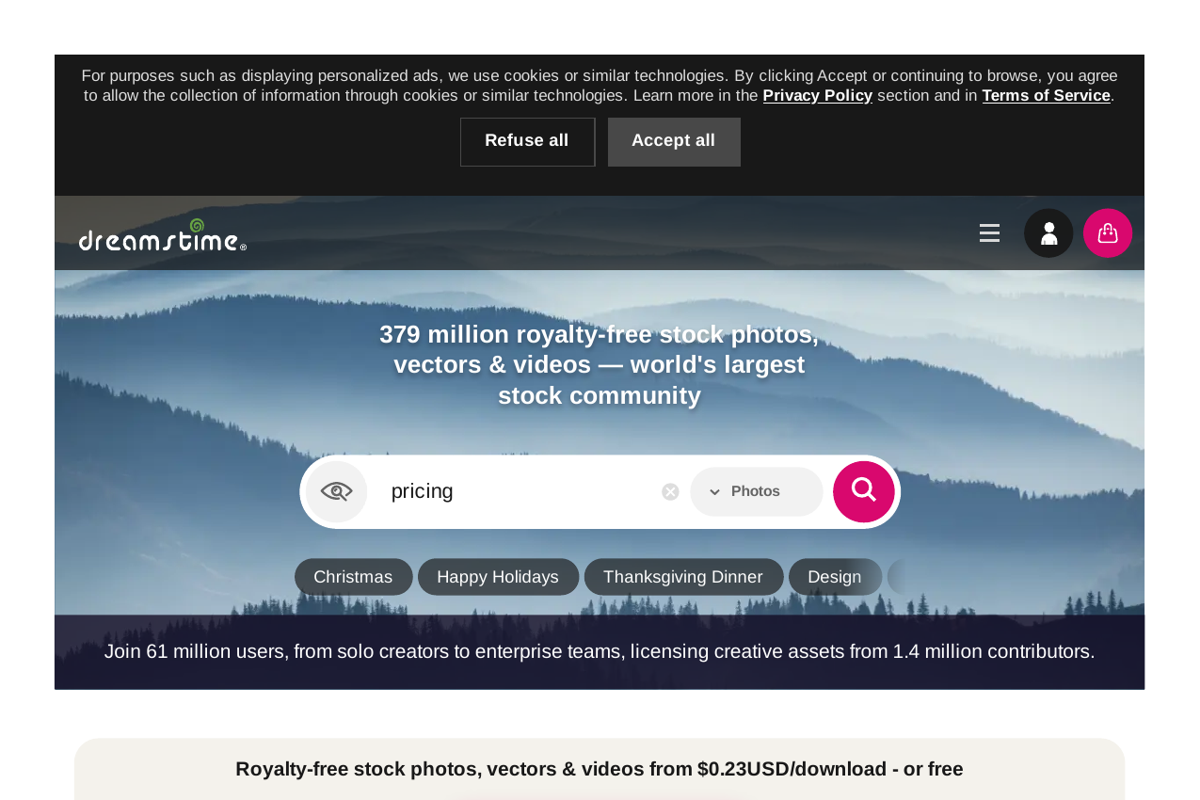
The Dreamstime homepage, read 20 November 2026. "379 million royalty-free stock photos, vectors & videos — world's largest stock community", a search box, and "Join 61 million users… 1.4 million contributors". A cookie banner sits on top; the page underneath is the pitch.
The homepage we read on 20 November 2026 opens with a number, not a price. "379 million royalty-free stock photos, vectors & videos — world's largest stock community" sits above a search box, and below it a line that does the positioning: 61 million users licensing from 1.4 million contributors.
The price appears one scroll down, and it is small on purpose: "from $0.23USD/download — or free". That $0.23 is the annual 750-image plan at list price ($2,028 a year for 9,000 images), and "or free" points at the free photos and the daily free credits. The first screen's job is to get a visitor searching, not buying.
The price list has a hole in the middle
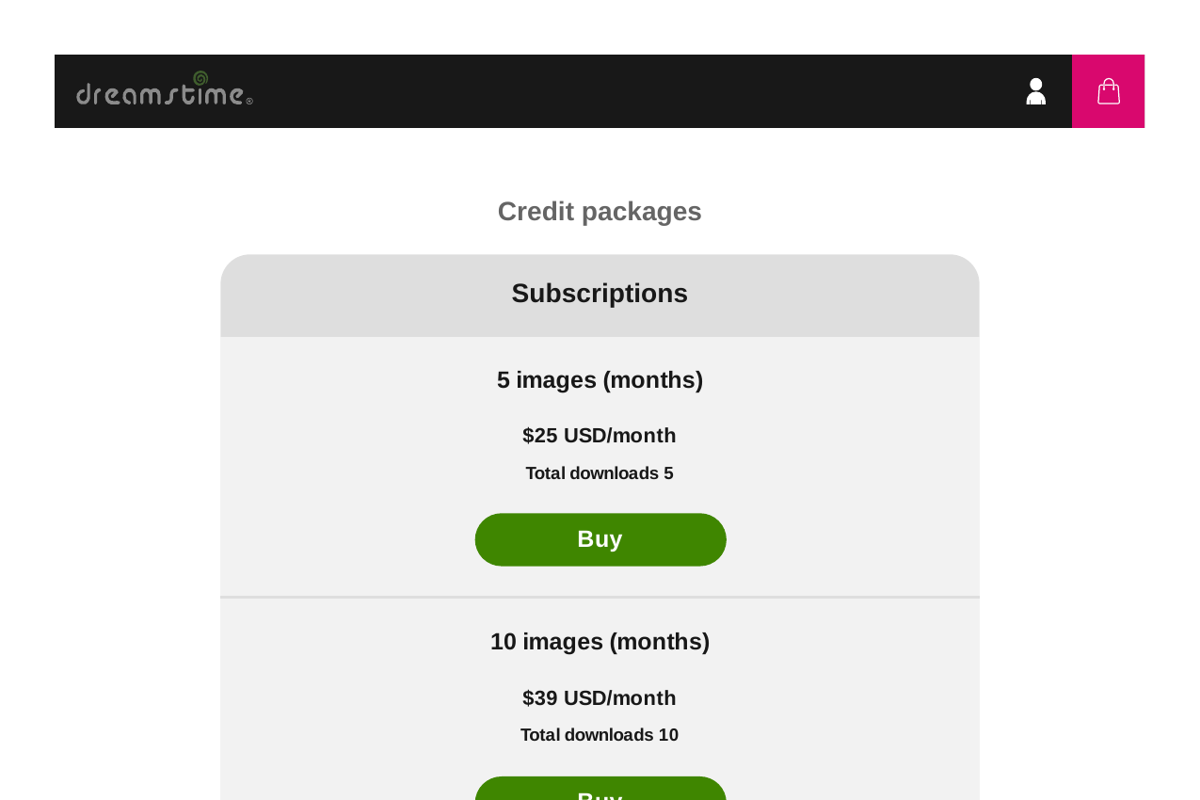
The Subscriptions tab of dreamstime.com/credits, read 20 November 2026. List prices: 5 images $25 a month, 10 images $39, 15 images $25 with the first week $0, 25 images $39. The promotional prices in the table below are lower.
Five images cost $25 a month at list price, and fifteen images cost $25 too. Ten and twenty-five both cost $39. The ladder is broken in the middle: buying three times as many images costs nothing extra at two steps, and the 15-image plan — the trial plan, marked Best value — is the cheapest way to buy fifteen images by a wide margin.
| Plan | Images a month | List price | Promotional price | Cost per image |
|---|---|---|---|---|
| 5 images | 5 | $25/month | $23/month | $4.60 |
| 10 images | 10 | $39/month | $35/month | $3.50 |
| 15 images (trial) | 15 | $25/month, first week $0 | $25/month, first week $0 | $1.67 |
| 25 images | 25 | $39/month | $35/month | $1.40 |
| 200 images | 200 | $94.99/month | $94.99/month | $0.47 |
| 750 images | 750 | $219/month | $197/month | $0.26 |
| 750 images, annual | 750/month, 9,000/year | $2,028/year | $1,724/year | $0.19 |
| Unlimited (Zero Gravity) | Unlimited, level 0 images and audio only | $39.99/month | $39.99/month | — |
List prices read from dreamstime.com/credits on 20 November 2026; promotional prices from the master table, verified against the same page. The 30-day trial on Unlimited renews at $39.99 a month. Credit packs run separately, from $14.99 for 3 credits to $1,750 for 550 credits.
The shape is the point. A buyer who needs a few images a month pays $4.60 each; a buyer who needs 750 pays $0.26. The steep drop is what turns a casual downloader into a subscriber: once the volume is there, the subscription is the only price that makes sense, and it renews every month.
Every mechanism that touches money
| Mechanism | Hit | Why, in one line |
|---|---|---|
| Free photos (1M+ free images) | ✓ | Free photos section; 5 free credits a day, no card required (pricing page, 20 November 2026) |
| Browse without signing up | ✓ | Homepage FAQ: free photos can be browsed without registering |
| Free trial, first 15 images | ✓ | 15-image plan, first week $0, marked Best value (credits page, 20 November 2026) |
| Trial downloads watermarked | ✓ | Trustpilot replies from the company: trial downloads carry watermarks |
| Monthly subscription | ✓ | Eight tiers, $23–$219 a month at promotional prices; unused downloads roll over |
| Credit packs, pay as you go | ✓ | 3 credits $14.99 to 550 credits $1,750; credits expire after 12 months |
| Extended licences | ✓ | 2 for $59 to 500 for $11,500 a month |
| Enterprise accounts | ✓ | Multi-seat, volume pricing, API integration (homepage) |
| API access | ✓ | Enterprise accounts include API integration |
| Display advertising | — | No advertising was found on the site; no ad revenue line exists |
| Refund policy | 未核到 | No refund terms were found in the Terms or FAQ this round |
The table has two tracks that make money and one line that costs trust. Subscriptions and credit packs both renew the relationship; the watermarked trial is the friction buyers complain about, and the refund policy is the blank space.
The cost per image falls off a cliff
Cost per image by monthly plan
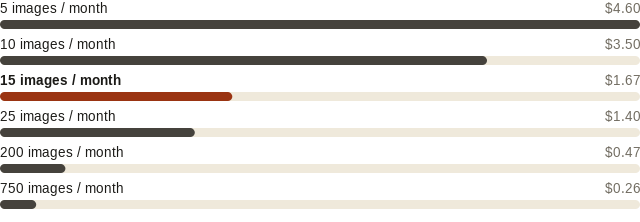
Cost per image by monthly plan, at promotional prices (master table). The 15-image trial plan is the cliff edge: $1.67 an image against $4.60 on the 5-image plan.
Promotional prices, master table; list prices are higher on the 5, 10 and 750-image plans.
The chart is the sales pitch in one picture. At five images a month, each image costs $4.60; at fifteen, $1.67; at 750, $0.26. A buyer who crosses from occasional to regular saves two-thirds on every image, and the saving only exists inside a subscription.
Credit packs sit outside this curve on purpose. A buyer who needs three images once pays $14.99 for 3 credits and never subscribes — the pack catches the demand the subscription cannot, and the credits expire after twelve months, so the money is kept either way.
27.96 million visits, and almost no advertising
Flat October, after a quiet climb
Monthly visits, August to October 2026

October was 27.96M, flat on September's 27.95M and up from August's 25.39M.
Monthly visits, Semrush, August to October 2026. Third-party estimates, not official MAU/DAU.
October was 27.96 million, up 0.03% on September's 27.95 million — flat. The climb happened before: August was 25.39 million, so September added 2.56 million and October added almost nothing. The site is not growing fast; it is holding a very large audience.
The split underneath is stranger. Organic search traffic fell 3.75% in October and paid search fell 68.53%, yet total visits stayed flat. Something else made up the difference, and no public source says what. This teardown records the gap and does not invent a cause.
Where the visits come from
| Channel | Share of visits | Platform & stack |
|---|---|---|
| Google organic search | 34.8% | Semrush's top channel, October 2026 (desktop) |
| Direct | 24.56% | Second channel, Semrush, October 2026 (desktop) |
| Paid search | — | No share published; paid search traffic fell 68.53% in October |
| Average session | 06:00 | Semrush, October 2026; global rank 1,711 |
| Referring domains | 360.79K | Semrush, October 2026; backlinks 32.15M |
| AI referrals | Gemini ~16K, ChatGPT ~4K | Semrush AI Traffic module; Perplexity 937; no month given |
| Platform | — | Self-built site; no content system was found |
| CDN | — | Fastly, migrated 2025; mobile LCP fell from about 4 seconds to 2 seconds |
| AI engine | — | PhotoEye™, in-house since 2019: auto-tagging, object detection, smart crop |
| Payment processor | — | Not verified (credits page: "We accept all major credit cards") |
| Analytics | — | Not verified |
| Advertising (Meta) | — | 0 active ads, Meta Ad Library, 20 November 2026 (Page ID 348762408887) |
Marketing channels, Semrush, October 2026; technologies, Fastly customer case (November 2025) and the company homepage. BuiltWith's full list was not read this round.
The mix is search plus habit: a third of desktop visits arrive through Google, a quarter arrive direct, and nothing is bought — the site runs no Meta ads at all. The stack matches the story: one self-built platform, an edge network that resizes images on the fly, and an in-house AI that tags them.
The brand word does the work
Top organic keywords, October 2026
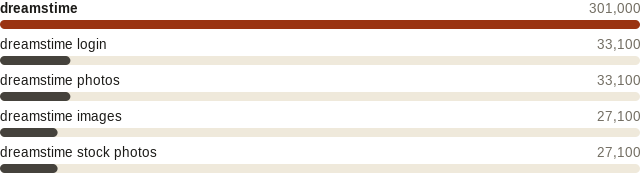
The brand word brings 301,000 searches a month and is 2.68% of organic traffic. The next four keywords are all its own name too.
Monthly search volumes, Semrush, October 2026. The six target phrases checked this round ("dreamstime pricing", "dreamstime free images", "how does dreamstime make money", "dreamstime subscription", "dreamstime alternatives", "dreamstime vs shutterstock") returned no Semrush volume, so no volume is given for them.
Search here has one head, and it is the brand. "dreamstime" at 301,000 searches a month is nine times "dreamstime login" at 33,100, and the top five keywords are all the company's own name. The generic phrase that built DaFont — "free fonts" at 30% of its organic traffic — has no equivalent here.
The five brand words together are only about 3.7% of organic traffic. The rest is a long tail of image searches — "christmas", "thanksgiving dinner", "design" — each too small to chart. No single keyword can break this site, and no single keyword built it either.
Fourth among the paid libraries
| Site | Monthly visits, Oct 2026 | Note |
|---|---|---|
| Shutterstock | 98.04M | Listed (NYSE: SSTK); 2025 revenue $989.9M |
| Adobe Stock | 48.49M | Adobe-owned; August 72.78M fell to 46.44M in September, unexplained |
| iStock | 45.22M | Getty Images-owned |
| Dreamstime | 27.96M | This teardown; global rank 1,711 (Semrush) |
| 123RF | 10.76M | — |
| Depositphotos | 8.36M | — |
| Pixabay | 75.05M | Free library, for contrast only |
| Pexels | 51.42M | Free library, for contrast only |
Rival visits, October 2026 third-party estimates (Semrush). Pixabay and Pexels give their libraries away free, so they are not compared on revenue.
Rival visits, October 2026
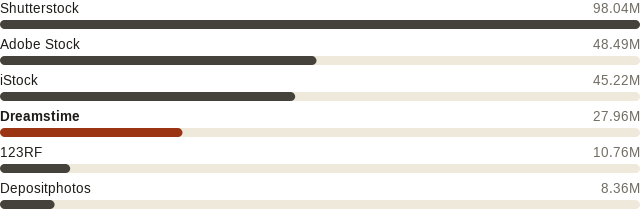
Dreamstime at 27.96 million is 29% of Shutterstock and 58% of Adobe Stock — and 2.6 times 123RF.
Visits, October 2026 third-party estimates (Semrush).
The gap is the story in the other direction. Dreamstime is less than a third of Shutterstock and barely half of Adobe Stock, but it is 2.6 times the next paid rival, 123RF. It is the largest of the independents — and the smallest of the four that matter.
The free libraries sit above it on traffic and below it on revenue: Pixabay at 75.05 million and Pexels at 51.42 million give the product away. Dreamstime's bet is that enough buyers will pay for a licence instead — and 27.96 million visits a month say the bet still holds.
Two listed giants, one merger, no published revenue
2025 revenue: the listed giants against Dreamstime

2025 revenue, as reported in SEC filings: Shutterstock $989.9 million (10-K, 17 February 2026); Getty Images $981.3 million (annual report). Dreamstime has no published revenue figure.
Revenue figures from the Shutterstock 2025 10-K (17 February 2026) and the Getty 2025 annual report, via Mark Studios research. Market context: UK Competition and Markets Authority, May 2026 — the two giants together supply 60–70% of paid stock content.
The traffic gap is a money gap. Shutterstock reported $989.9 million of 2025 revenue in its 10-K, filed 17 February 2026; Getty reported $981.3 million. Dreamstime publishes no revenue figure at all — no filing, no press release, no interview number.
That silence is the other half of the risk. The two listed giants above it are merging — Shutterstock and Getty signed a merger-of-equals, pending regulatory approval — and together they already supply 60–70% of paid stock content by the UK CMA's count. Dreamstime's answer has to be the repeat buyer, not scale.
What the outside world says
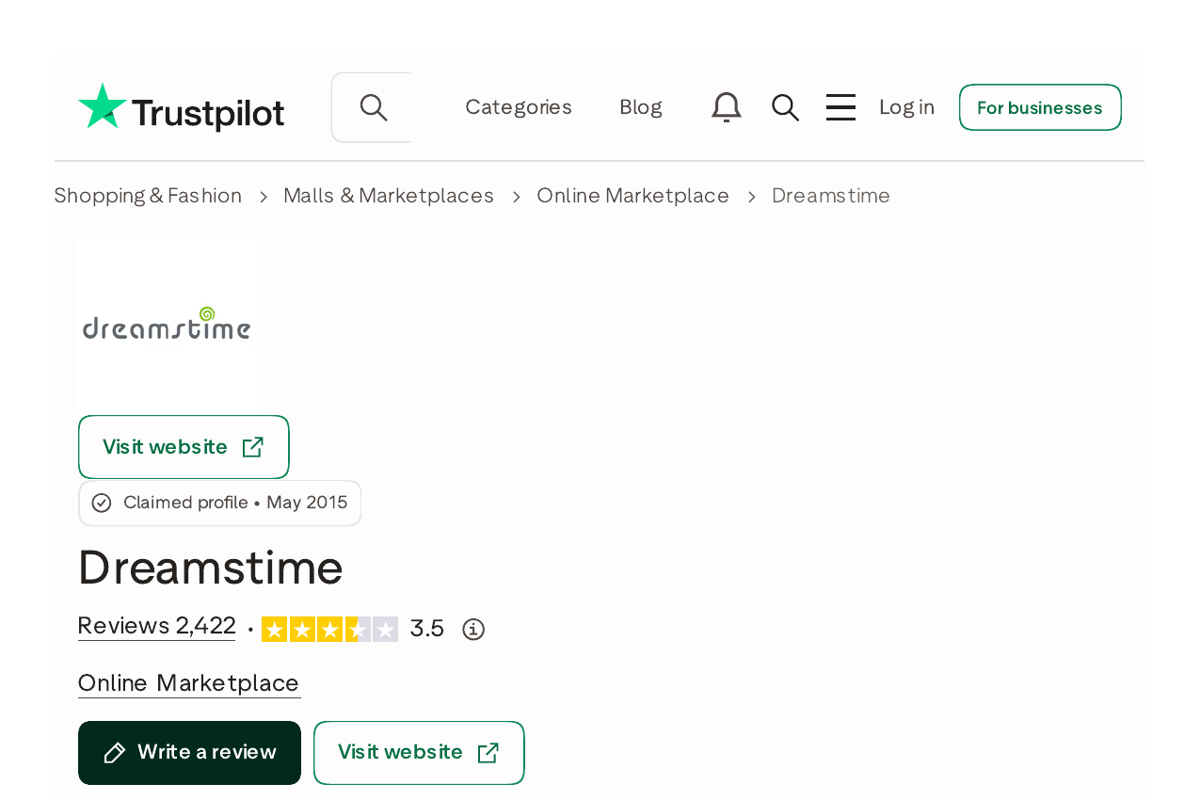
Trustpilot, read 22 November 2026: 3.5 out of 5 from 2,424 reviews. Five-star reviews are 51%; one-star reviews are 30% (star distribution read 20 November 2026). The company replies to 87% of negative reviews, usually within two weeks.
The reviewers are split in a way the numbers make plain. Half give five stars, mostly for the range of images and a search that works; nearly a third give one star, mostly about trial charges and cancellations that would not cancel. G2, where the buyers are businesses, is kinder: 4.3 from 645 reviews.
Business buyers rate it higher than the public does
Third-party ratings: Dreamstime against its rivals
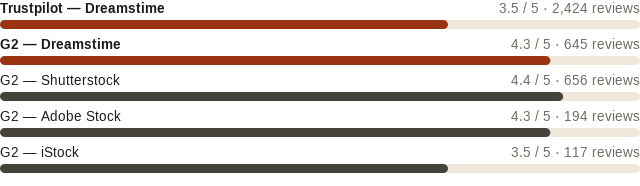
Trustpilot and G2, read 22 November 2026. Rival G2 scores from G2's comparison page (August 2026 update): Shutterstock 4.4 out of 5 (656 reviews), Adobe Stock 4.3 (194), iStock 3.5 (117).
Trustpilot 3.5 out of 5 (2,424 reviews) and G2 4.3 out of 5 (645 reviews), both read 22 November 2026. The latest Trustpilot review is dated 20 November 2026; complaints in October and November 2026 repeat the same two charges — trial billing and cancellations that would not cancel.
The split runs by audience. Trustpilot's 2,424 reviewers are mostly end users, and 30% of them give one star, almost all about the trial and the billing around it. G2's 645 reviewers are business buyers, and they score it 4.3 — the same as Adobe Stock, a tenth below Shutterstock.
The gap is the retention warning in numbers. A business buyer who finds the library useful renews; a consumer who felt charged for a free trial does not come back, and writes about it where the next buyer looks first.
Fastly customer case study, November 2025: "Dreamstime delivers 320 million images instantly with Fastly". As of November 2025 the company managed about 320 million files, with over 10 million new files a month, serving 57 million registered designers.
The case is the hardest outside fact the site has. Fastly, a company with no reason to flatter a customer in print, says Dreamstime serves 320 million files to 57 million registered designers, adds over 10 million files a month, and halved its mobile load time by moving to Fastly's edge. The library is still growing, a quarter of a century in.
Dreamstime is one of 16 sites in the Design tools collection. Compare Dreamstime with Photopea side by side.
The full teardown is for members
The full analysis of pricing, acquisition, conversion and retention is member content. Membership is $29 a month or $249 a year.
Similar sites in the database
Dreamstime (27.96M) sits between Strava (29.14M) and Typeform (26.3M) in the database.
| Site | Category | Monthly visits | Source |
|---|---|---|---|
| Strava | Sports / Fitness social & activity tracking subscription | 29.14M | Semrush, Oct 2026 |
| Dreamstime | Design tools | 27.96M | Semrush, Oct 2026 |
| Typeform | Form tools | 26.3M | Semrush, Oct 2026 |
Compare Dreamstime with Photopea side by side. The full database, with working filters, is on the teardowns index. The Design tools collection has the 16 design tools in one place.
Read the next one in your inbox
The new ones go out by email first, one a week, with the traffic source and month attached to every number. Leave your address and the next one comes to you.