 Everstood
Grammarly teardown: 77.45M visits a month for the writing assistant now part of Superhuman
Monthly visits
77.45M
Semrush, October 2026. Third-party estimate, not official MAU/DAU.
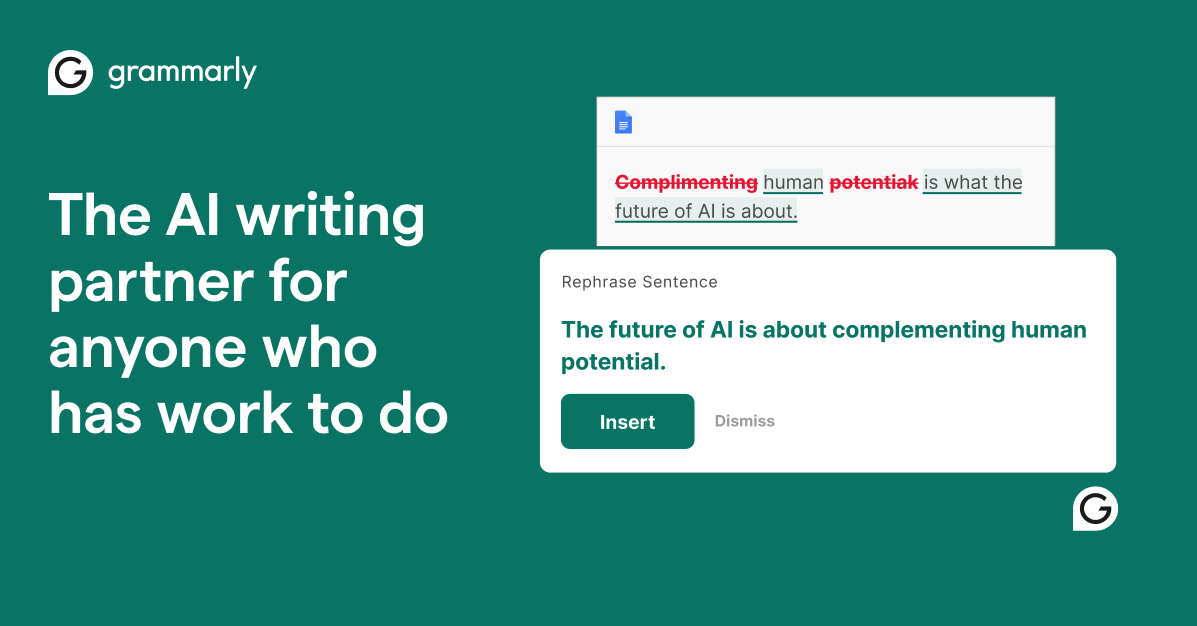
Grammarly is an AI writing assistant that Semrush credits with 77.45M visits in October 2026. That makes it the seventh largest site in our database of 195, just below Trello at 78.23M and just above TinyURL at 68.61M, and the largest writing tool we track: Quillbot is second at 53.2M, Wordcounter.net third at 13.24M and LanguageTool fifth at 8.23M. The pricing is a textbook freemium split. The free tier corrects grammar and gives 100 AI prompts a month. Pro costs $12 a member a month when billed annually, or $30 when billed monthly, which is a 60% gap between two ways of paying for the same product. The company behind it no longer calls itself Grammarly. The homepage says Grammarly is now a part of Superhuman, and the parent company rebranded to Superhuman in October 2025.
| Site | Grammarly, grammarly.com |
|---|---|
| What it is | AI English writing assistant: grammar and spelling correction, tone adjustment, full-text rewriting, plagiarism and AI-generated text detection, plus AI text generation with prompts |
| Who it is for | Individuals, students and teams who write in English at work, at school or for publication and want corrections, rewrites and AI help without leaving the app they write in |
| Category | Writing tools |
| Monthly visits | 77.45M, Semrush, October 2026. Third-party estimate, not official MAU/DAU |
| Pricing | Free $0 a month: write without mistakes, see your writing tone, generate text with 100 AI prompts. Pro $12 a member a month billed annually ($144 a year) or $30 a member a month billed monthly ($360 a year), with a free trial. Enterprise: custom pricing, delivered through Superhuman Go. Source: Grammarly plans page, read 16 November 2026 |
| Pricing model | Freemium subscription with a per-member price. The free tier is the product most people use. Pro unlocks full-sentence rewrites, tone control, brand voice, plagiarism and AI detection, and 2,000 AI prompts a month. Enterprise is sold to larger organisations through Superhuman Go |
| Country breakdown | United States 56.99% (44.14M); India 6.61% (5.12M); Canada 3.71% (2.87M). Semrush, October 2026 |
| Operator | Superhuman Platform Inc., headquartered in San Francisco, with offices in Kyiv, New York and Vancouver. Grammarly was founded in 2009 by Alex Shevchenko, Max Lytvyn and Dmytro Lider, and the parent company rebranded from Grammarly Inc. to Superhuman in October 2025. Source: Wikipedia, checked November 2026. The homepage says "Grammarly is now a part of Superhuman" |
| Acquisition channels | Not publicly disclosed (see the acquisition section) |
TL;DR
- Grammarly draws an estimated 77.45M visits a month (Semrush, October 2026), the seventh largest site in our database and the largest writing tool we track, about 1.5 times Quillbot at 53.2M and 9.4 times LanguageTool at 8.23M. The United States is 56.99% of that traffic, the second highest United States share in our database behind Calendly at 59.51%. The top three countries together are 67.31%. United States visits alone, 44.14M, are larger than SurveyMonkey's entire monthly traffic of 43.17M.
- Free costs $0 and includes 100 AI prompts a month. Pro costs $12 a member a month billed annually, $144 a year, or $30 a member a month billed monthly, $360 a year. Paying annually saves $216 a year, which is 60% less than paying monthly, and Pro raises the prompt allowance to 2,000 a month, 20 times the free tier. A free trial is offered with $0 payment today and an email reminder two days before the trial ends; the trial length is not stated on the pricing page. Enterprise is custom priced and delivered through Superhuman Go. The plans page says the product is trusted by over 40 million people and 50,000 organisations, and the homepage claims a 17x return and $5,000 saved per employee per year. Both are the site's own claims, quoted with that label attached.
- It survived by being present where people already write. Founded in Ukraine in 2009, it reached one million daily active users by 2015, raised $200 million at a $13 billion valuation in November 2021, took $1 billion in nondilutive funding in May 2025, bought Coda in December 2024 and Superhuman in July 2025, and rebranded its parent company to Superhuman in October 2025. The risk in the story is the rebrand itself, and a March 2026 feature that ended in a discontinued product and a class-action lawsuit.
What problem does Grammarly solve, and for whom?
The homepage states the problem in one line: "Think big. We'll take care of the details." The longer version sits underneath it: "Work with an AI partner that helps turn your thoughts into writing that's clear, credible, and impossible to ignore." The problem is that mistakes in written English cost credibility, and the audience is anyone whose work is judged by what they write: students, job applicants, professionals writing email, and teams writing to customers. The product started as a checker for students and became a writing layer for work, and the traffic data fits that width. The United States is 56.99% of visits, India second at 6.61% and Canada third at 3.71%. India as the second country is the tell. English is the working language of a large Indian professional class, and a writing assistant sells to people writing in a language they did not grow up speaking as much as to native speakers who want to write faster.
The second audience is the team that writes to customers. The homepage sells the same product to that buyer with a different promise: "Keep your voice, make it clear", with suggestions that follow a brand style guide and strike a confident tone. The product page for teams adds style guides, brand tones, snippets and analytics, which are features an individual never needs. The country mix supports the team story too. A United States share near 57% is rare in our database: Figma is 19.9% United States, Notion 17.72%, Trello 20.94%. Only Calendly, at 59.51%, is more concentrated in the United States. Grammarly is a United States product with an international tail, and the gap between first and second place, 56.99% against 6.61%, is the widest in the top five.
The third audience is the organisation that already pays for software and wants one writing standard. Enterprise is sold through Superhuman Go with proactive AI that works in every app and tab, unlimited members, dedicated support, confidential mode, data loss prevention and bring-your-own-key encryption. That is a security and compliance sale, not a writing sale, and it is the newest of the three audiences. The homepage puts the return on investment next to it: "17x. Organizations that deploy Grammarly save an average of $5,000 per employee per year." The figure is the site's own claim, quoted with that label attached.
The product and its first screen
The homepage we read on 16 November 2026 opens with "Think big. We'll take care of the details." and the AI partner line quoted above. The page then walks through four promises in order. "Better writing, better results" is the speed claim: professional, clear and convincing writing in a few clicks, not a few hours, illustrated with an animation of a sentence being rephrased and shortened. "Keep your voice, make it clear" is the tone claim: suggestions that strike the right tone without losing an authentic voice, illustrated inside a Zendesk text box following a brand style guide. "Get a read on your writing" is the audience claim: see work through the audience's eyes and make sure the message is understood the first time. "This is responsible AI" is the trust claim: Grammarly does not sell or monetise user content, does not provide it for advertising, and does not allow third-party service providers to train their models on user content.
The pricing cards sit on the homepage itself, before any click to a pricing page. Free is $0 a month with mistake-free writing, tone and 100 AI prompts. Pro is $12 a member a month billed annually, $30 when billed monthly, with full-sentence rewrites, tone adjustment, on-brand writing and 2,000 AI prompts. Enterprise is custom priced through Superhuman Go. Putting the price on the homepage is a choice most sites in our database do not make, and it fits the product: the free tier is the trial, and the price is low enough to print without scaring anyone away.
The product underneath is a layer that sits inside other apps rather than a destination of its own. It is available as a standalone application, as a browser extension for Chrome, Safari and Firefox, and as an add-on for Google Docs, on Windows, macOS, Linux, Android and iOS, according to Wikipedia. It supports five English variants: American, British, Canadian, Australian and Indian. The generative AI layer arrived in April 2023, built on GPT-3, and now includes generating essays from scratch, suggesting and inserting citations, a feature to "humanize" text so it is less likely to be flagged as AI-generated, and grade prediction based on instructor, course and university, according to Wikipedia. The Authorship tool, released in September 2024, tries to identify whether a passage was written by the author, lifted from another source, or generated by AI. The plans page carries the trust signals: "Trusted by over 40 million people and 50,000 organizations", with Atlassian, Zoom and Databricks logos. The 40 million figure and the 50,000 organisations are the site's own claims, quoted with that label attached.
Pricing: $12 a member, or $30 if you pay monthly
Grammarly has three plans, and the middle one carries the whole business. Free costs $0 and corrects spelling and grammar, shows tone, and generates text with 100 AI prompts a month. Pro costs $12 a member a month when billed annually, which is $144 a year, or $30 a member a month when billed monthly, which is $360 a year. Enterprise is custom priced and delivered through Superhuman Go, with proactive AI in every app and tab, unlimited members, dedicated support, confidential mode, granular roles and permissions, data loss prevention, unlimited generative AI prompts and bring-your-own-key encryption.
The gap between the two ways of paying for Pro is the most important number on the page. Annual billing costs $144 a year and monthly billing costs $360 a year, so the annual plan saves $216 a year, which is 60% less. The homepage toggle says the same thing in its own words: "Save up to 60%". The prompt allowance is the second gap. Free gives 100 AI prompts a month and Pro gives 2,000, which is 20 times as many. Pro also adds full-sentence rewrites with one click, tone adjustment, writing fluently in English, unlimited personalised suggestions, plagiarism detection and AI-generated text detection, one style guide and one brand tone. Enterprise removes the caps: unlimited prompts, unlimited style guides and brand tones, unlimited user groups, team and individual analytics, audit logs API and cost centre visibility.
Three details deserve attention. First, Pro is sold with a free trial. The plans page shows "Try for free" with "$0 payment today" and an email reminder two days before the trial ends. The page does not state the trial length in the text we read, so this teardown does not print one. Second, Pro used to be called Premium, and the FAQ says switching from Premium to Pro cancels the Premium subscription with a refund prorated to the remainder, and that Pro includes all the advanced writing features Premium had, plus team features that were previously only in the Business plan. Third, payment is by major credit card or PayPal, and teams buying for ten or more members on an annual plan can request an invoice payable by bank transfer, card, Apple Pay or Google Pay. Educational institutions get discounts, with a link to learn more.
The monthly versus annual gap is worth comparing with the other writing tool we have torn down. LanguageTool charges $24.90 a month for Premium billed monthly and $69.90 a year billed annually, which is $5.83 a month. Its monthly price is 4.27 times its annual rate. Grammarly's monthly price is 2.5 times its annual rate. Both sites punish monthly payers, and LanguageTool punishes them harder. The difference is the absolute price. Grammarly's annual Pro at $12 a month is roughly double LanguageTool's annual Premium at $5.83 a month, and Grammarly's monthly Pro at $30 is the price of a deliberate choice: it is high enough to push buyers toward the annual plan, and low enough that a single month of Pro is a plausible impulse buy.
How does Grammarly get its users?
Not publicly disclosed. Grammarly publishes no acquisition mix, and our database holds no verified channel data for it, so this section is short on purpose. Anyone who tells you Grammarly's traffic is exactly X percent organic search is guessing, however plausible the guess sounds.
Four things are observable without inventing numbers. First, the browser extension is distribution. A checker that lives in every text box a person types in does not need the person to remember to open it, and every corrected sentence is a reminder the product exists. Second, the free tier is the funnel. A free product that corrects grammar in the flow of writing acquires users at the moment they make a mistake, which is the moment they most want the product. Third, the education channel is real in kind, even if its size is not published. The plans page offers discounts for educational institutions, and the product started as a subscription for students. Fourth, the brand is the default word for the category in the United States. A United States share of 56.99% and a homepage that can sell with the single line "Think big. We'll take care of the details." both point to a product that no longer needs to explain what it is to its largest market.
From visit to payment: what the pricing page proves
The conversion story we can defend from public evidence is about where the paywall sits. The free tier corrects mistakes, shows tone and gives 100 AI prompts a month. The wall sits at the features that change what the writing says rather than whether it is correct: full-sentence rewrites, tone adjustment, staying on-brand, plagiarism and AI detection, and 2,000 prompts instead of 100. A user who only needs corrections never pays. A user who needs the product to rewrite a sentence, match a brand voice or check a document for plagiarism has to pay, and the price of that decision is $12 a member a month on the annual plan.
What the pricing page proves is where the friction sits, and the friction is deliberately low. Pro is offered with a free trial, $0 payment today, and a reminder email two days before the trial ends. The monthly price of $30 is the fallback for a buyer who will not commit, and the annual price of $12 is the reward for one who will. The gap between them, $216 a year, is the conversion lever: a buyer who tries Pro for a month and likes it is shown a price that is 60% lower if they commit for a year. The team features are the second lever. Pro is sold to "individuals or teams" at the same per-member price, with one style guide and one brand tone included. A team that adopts Pro for its writing standard has a reason to keep paying that an individual does not: the style guide and the brand tone live in the product, and leaving means rebuilding them somewhere else. What we cannot see from outside is the conversion rate from free to Pro, or the share of revenue that comes from individuals versus teams.
Retention: what keeps people coming back?
Not publicly disclosed. Grammarly publishes no churn, renewal or cohort figures in the sources we checked. The structural point is still worth making, because it is the bet the whole product rests on: a writing assistant that lives in every text box is used every time a person writes, and writing is a daily habit.
Three features of the product support return visits more directly than the daily habit does. The first is the extension itself. A checker that is present in Gmail, Google Docs, Zendesk and every other text box does not need to be remembered, and a product that does not need to be remembered does not need to be re-acquired. The second is the team layer. Style guides, brand tones, snippets and analytics are configuration a team builds once and would lose by leaving, which is a switching cost the free tier never creates. The third is the detection layer. Plagiarism detection, AI-generated text detection and the Authorship tool tie the product into academic and workplace integrity workflows, where the checker is part of a process rather than a preference. The counterweight is that the free tier is genuinely useful and the paid tier is easy to leave. A user who only needs corrections can use the free product forever, and a team that stops paying keeps the free tier. Retention depends on the paid features staying ahead of what the free tier and the browser's own spell checker already do.
Why Grammarly is still standing
Our read, stated as a position you can argue with: Grammarly survives because it sits inside the work instead of beside it, and because it expanded along the same workflow instead of away from it. The company was founded in 2009 by Max Lytvyn, Alex Shevchenko and Dmytro Lider, developed in Ukraine, and launched on 1 July 2009 as a subscription product to help students improve grammar and spelling. By 2015 it had a million daily active users, a freemium model, a browser extension for Chrome, Safari and Firefox, and an add-on for Google Docs. The history dates in this section come from Wikipedia, checked November 2026.
The second half of the argument is the money, with its label attached. In 2019 Grammarly added a tone detector, raised $90 million in a second funding round, and raised $200 million in total that year at a valuation over $1 billion. In November 2021 it raised another $200 million at a $13 billion valuation. After the 2022 Russian invasion of Ukraine, it ceased all business in Russia and Belarus and kept paying the salaries of Ukrainian staff who left to join the army. In April 2023 it launched generative AI built on GPT-3, and in September 2024 it released the Authorship tool. In December 2024 it announced the acquisition of the productivity startup Coda, and Coda chief executive Shishir Mehrotra replaced Rahul Roy-Chowdhury as Grammarly chief executive. In May 2025 it raised $1 billion in nondilutive funding from General Catalyst, in July 2025 it announced the acquisition of the email client Superhuman, and in October 2025 the parent company rebranded to Superhuman. Grammarly is not bootstrapped and not independent, and the teardown does not pretend otherwise. It survived because the extension put it in the writing flow, the freemium model put it on millions of machines, and the funding bought the two products that turned a checker into a productivity platform.
The last part of the argument is the rebrand, and the honest caveat that sits next to it. The homepage now says "Grammarly is now a part of Superhuman" and sells Enterprise through Superhuman Go, which is a bet that writing assistance becomes one feature of an AI productivity suite rather than a standalone product. The caveat is that the Grammarly name, which is the default word for grammar checking in its largest market, is being folded into a brand most people have never heard of. The March 2026 Expert Review episode is the warning label on that bet: a feature that simulated writing advice from living and deceased authors, including Stephen King, Neil deGrasse Tyson, Carl Sagan and bell hooks, without their permission, drew complaints and a federal class-action lawsuit filed on 11 March 2026, and was discontinued the same day. The feature had launched in August 2025. Seven months from launch to discontinuation is a short life for a flagship AI feature, and it is the number this teardown keeps coming back to.
What you can copy, and what you cannot
Copyable this week
- Put the product inside the work, not beside it. An extension that corrects text where people already write beats a destination app they must remember to open.
- Price the gap, not just the plan. A 60% difference between monthly and annual billing turns the pricing page into a commitment device, and $216 a year is a concrete reason to commit.
- Let the free tier be the demo. 100 AI prompts a month is enough to feel the product and small enough to hit the ceiling, and the ceiling is where the sale happens.
- Sell the team version of the same plan. One per-member price for individuals and teams, with a style guide and a brand tone as the team lock-in, is simpler than a separate team tier and harder to leave.
- Expand along the same workflow. Correction to generation to detection to a productivity suite sells more of the same relationship to the same writer, instead of selling a second product to a second buyer.
Not copyable
- Seventeen years of being the default word for grammar checking, and tens of millions of people who already have the extension installed. A new tool cannot buy the installed base that makes the free tier a funnel.
- A $13 billion valuation in 2021 and $1 billion of nondilutive funding in 2025. The war chest bought Coda and Superhuman, and a bootstrapped competitor cannot match that expansion by saving.
- The United States concentration. A United States share of 56.99%, the second highest in our database, is years of compounding in one market, helped by a brand that is the default word there.
Risks and gaps in this teardown
- The traffic figure comes from a single source for the month quoted, Semrush, and is a third-party estimate. Grammarly publishes no official MAU or DAU. No September 2026 figure for Grammarly is in our records, so this teardown states no month-on-month change.
- "Think big. We'll take care of the details.", "Work with an AI partner that helps turn your thoughts into writing that's clear, credible, and impossible to ignore.", "Better writing, better results", "Keep your voice, make it clear", "Get a read on your writing" and "This is responsible AI" are Grammarly's own words, printed by Grammarly on its homepage. They are quoted as the site's own wording, not as independently verified data. The plans page figures, trusted by over 40 million people and 50,000 organisations, and the homepage claim of 17x return and $5,000 saved per employee per year, are Grammarly's own claims, quoted with that label attached.
- The history dates (founded 2009 by Max Lytvyn, Alex Shevchenko and Dmytro Lider, developed in Ukraine, launched 1 July 2009, one million daily active users by 2015, freemium model and browser extension in 2015, tone detector in 2019, $90 million round and $200 million total raised in 2019 at a valuation over $1 billion, $200 million raised in November 2021 at a $13 billion valuation, generative AI in April 2023, Authorship tool in September 2024, Coda acquisition in December 2024 with Shishir Mehrotra becoming chief executive, $1 billion nondilutive funding in May 2025, Superhuman acquisition in July 2025, parent rebrand to Superhuman in October 2025) come from Wikipedia, checked November 2026.
- Prices were read from the Grammarly plans page on 16 November 2026. Free is $0, Pro is $12 a member a month billed annually ($144 a year) or $30 a member a month billed monthly ($360 a year), and Enterprise is custom priced. The $216 a year saving and the 60% gap are arithmetic from the printed figures, and are labelled as such. The free trial is offered with $0 payment today and an email reminder two days before the trial ends; the trial length is not stated on the page we read, so it is not printed here.
- Grammarly is now part of Superhuman, by its own homepage and by Wikipedia: the developer is Superhuman Platform Inc., headquartered in San Francisco, and the parent company rebranded from Grammarly Inc. to Superhuman in October 2025. Our master table flags Grammarly as pending review on whether it still counts as an independent site. This teardown reports the affiliation and leaves that call to the person who owns the table.
- In March 2026 Grammarly discontinued an AI feature called Expert Review, which offered writing advice simulated from living and deceased authors without their permission. The feature had launched in August 2025 and included Stephen King, Neil deGrasse Tyson, Carl Sagan and bell hooks. Journalist Julia Angwin filed a federal class-action lawsuit against the company on 11 March 2026, the same day Superhuman announced the feature was discontinued, according to Wikipedia. This teardown reports the episode and the response without taking a position on either.
- In early 2018 a Google security researcher found a severe vulnerability in the Grammarly browser extension that exposed authentication tokens to websites. The company released a hotfix within hours and reported no evidence of compromised user data. The vulnerability was registered as CVE-2018-6654, according to Wikipedia.
- Acquisition mix, conversion rates and retention are not publicly disclosed. Sections above say so rather than estimating them.
- Country breakdown comes from Semrush for October 2026 and covers the top three countries only. The remaining share is not broken out in the sources we checked.
- Grammarly is the second writing tool we have torn down. LanguageTool was the first. Quillbot (53.2M) is the third writing tool in the database, torn down in the same series, and it is listed in the similar-sites table.
Similar sites in the database
Grammarly is the second writing tool we have torn down. Quillbot and LanguageTool are the other writing tools we have torn down, and they are the same-category peers in the table below. Grammarly is about 1.5 times the size of Quillbot by monthly visits, and Quillbot is about 6.5 times the size of LanguageTool.
| Site | Category | Monthly visits | Source |
|---|---|---|---|
| Quillbot | Writing tools | 53.2M | Semrush, Oct 2026 |
| LanguageTool | Writing tools | 8.23M | Semrush, Oct 2026 |
Compare Grammarly with Quillbot and LanguageTool side by side. The full database, with working filters, is on the teardowns index.
Read the next one in your inbox
This teardown is free to read. The new ones go out by email first, one a week, with the traffic source and month attached to every number. Leave your address and the next one comes to you.