
How Hungryroot makes money from AI grocery carts
Monthly visits
3.2M
October 2026. Third-party estimate, not official MAU/DAU. Semrush counted 3.2M for the month, up 1.69%.
Hungryroot draws an estimated 3.2M visits a month (October 2026, Semrush), up 1.69% on the month. It is the 168th-largest site in our database of 901. The average visit lasts 7 minutes — people come back to check a cart that is already filled for them.
The pitch fits in one line: a five-minute quiz, and the week’s groceries pick themselves. The money is in the repeat — households who let the cart fill itself order about twice as often and stay about twice as long.
| Site | Hungryroot, hungryroot.com |
|---|---|
| What it is | AI-personalized grocery and recipe subscription: SmartCart fills a weekly cart and recipes to match diet, shipped from five US fulfilment centres |
| Who it is for | US households that want healthy eating without the weekly shop — families cooking to a health preference, short on time |
| Category | Food & grocery · AI-personalized subscription ecommerce |
| Monthly visits | 3.2M, October 2026. Third-party estimate, not official MAU/DAU; Semrush, up 1.69% on the month (September 3.15M). Global rank #17,451, US #4,733 |
| Founded | April 2015; founder Ben McKean (ex-Groupon), with chef Franklin Becker as co-founding chef |
| Headquarters | New York City, New York |
| Operator | Private — unlisted, not acquired or controlled; Hungryroot, Inc. Series C $40M (June 2021) led by L Catterton; no new equity round announced since |
| Survival engine | Repeat orders. 700,000+ households pay every week for a cart SmartCart fills for them — average order $125, first-year spend over $1,000 a household. Distribution is the lever: hundreds of Meta ads running plus creator video buy the next household |
| Pricing | Per serving from $0.49 (supplements) to $8.99 (dinner); breakfast $3.99, lunch $5.99, snack and dessert $1.99, drinks $3.99. Source: hungryroot.com, read 24 November 2026; the weekly total is set by budget band and shown only after sign-up |
| Pricing model | Weekly subscription, no membership fee — the plan is the week’s food bill; the cart renews weekly and charges when the shopping window closes |
| Free hook | 30% off the first delivery, a free gift with every delivery, free shipping over $70. No free trial — payment details are required before the menu is shown |
| Meta ads | Running — three third-party readers count 767 (Sprites), 85 distinct creatives (adlibrary.io) and 1,084 (AdMakeAI) active ads; the counts use different methods |
| Country breakdown | United States 99.06% (3.17M); Germany 0.17% (5.54K); India 0.1% (3.11K). Semrush, October 2026 |
TL;DR
- Hungryroot draws an estimated 3.2M visits a month (October 2026, Semrush), up 1.69% on the month. It sells AI-picked weekly groceries to 700,000+ households and reported $700M net revenue for 2025, up 55% — a company figure, unaudited.
- The cart fills itself: SmartCart picks the week’s groceries from a five-minute quiz and past behaviour, and households who use it order about twice as often and stay about twice as long. The average order is $125; a household spends over $1,000 in its first year.
- The catch is the price of convenience: the same basket costs about 18% more than buying it yourself (CNET, 2026), and a 2023 class action says cancelling is too hard. Own-brand goods, close to half of revenue, carry the margin that pays for five cold-chain fulfilment centres.
The cart fills itself
Dinner is $8.99 a serving; the week is the price
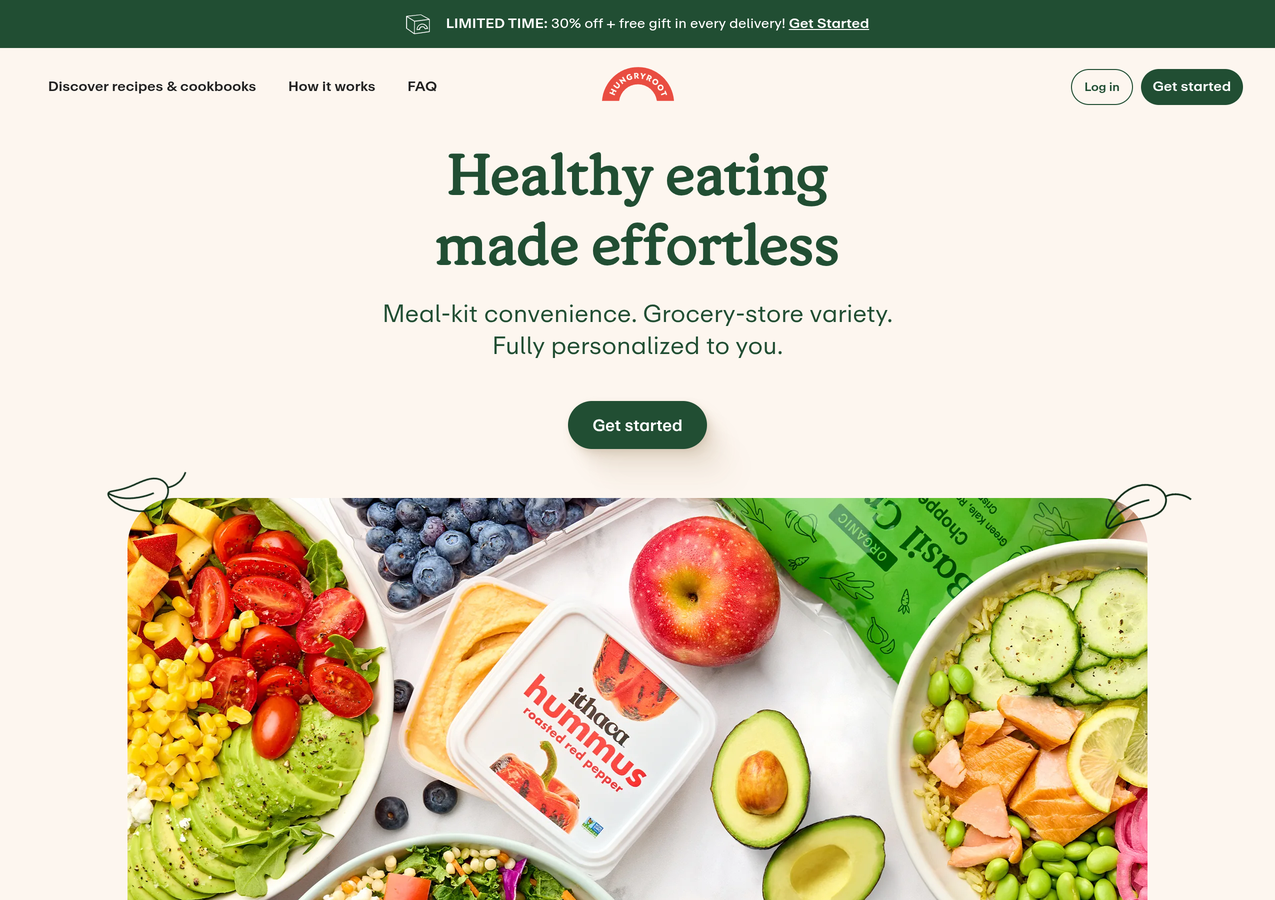
The Hungryroot homepage, read 24 November 2026. “Healthy eating made effortless” — “Meal-kit convenience. Grocery-store variety. Fully personalized to you.” The banner offers 30% off the first delivery and a free gift with every delivery.
The homepage we read on 24 November 2026 opens with a promise, not a price. “Healthy eating made effortless” is the headline, and the copy underneath sells the gap between two familiar products: easier than a meal kit, wider than a grocery store.
The price is deliberately small. Dinner is $8.99 a serving, lunch $5.99, breakfast $3.99 — numbers that read as cheap next to takeout. The week’s total, the number that matters, is never printed: it depends on the budget band the shopper picks, and it appears only after sign-up.
That is the whole pricing idea. The per-serving prices are the hook; the weekly budget is the product. A household that sets a $125 week and lets SmartCart fill it never sees a single price again — it sees a cart, a delivery day, and a charge.
| Serving | Price from | What it is |
|---|---|---|
| Breakfast | $3.99 | Overnight oats, egg bites, smoothie packs |
| Lunch | $5.99 | Salads, grain bowls, wraps |
| Dinner | $8.99 | Chef-crafted recipes, 50,000+ in the library |
| Snack | $1.99 | Bars, dips, fruit |
| Dessert | $1.99 | Small sweet finishes to the week |
| Drink | $3.99 | Juices, smoothies, kombucha-style drinks |
| Supplement | $0.49 | Add-on powders and shots |
Seven prices, one weekly bill
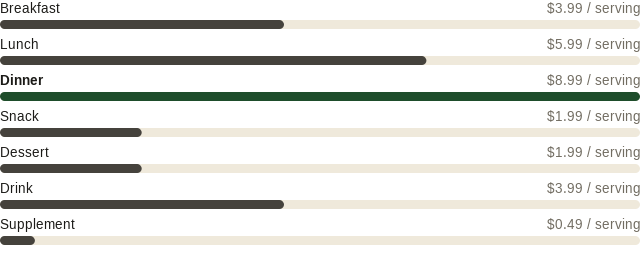
Dinner is the dearest serving at $8.99; supplements are the cheapest at $0.49. The spread is the point — a week of groceries is a mix, and the mix is priced by the serving, not the box.
Per-serving prices from hungryroot.com, read 24 November 2026.
The budget bands are the quiet part of the price. Shoppers pick a weekly band — under $125, $125–$175, $175–$250, or $250 and up — and SmartCart fills to it. The bands are the company’s own framing; the exact first-party figures sit behind registration and were not read this round.
Shipping is free over $70, and $6.99 below it — a threshold low enough that a $125 average order almost always clears it. The old “$59 a week” figure that still circulates in third-party write-ups is from 2022 and is not used here.
The repeat order is the business
From $25M to $700M, one cart at a time
A seven-year climb, with one year missing
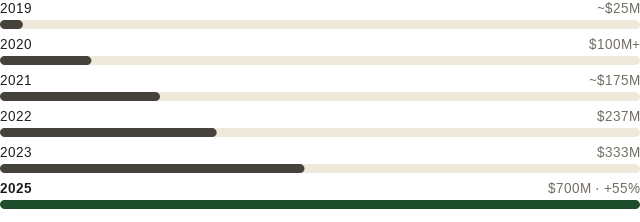
The climb is steep and almost unbroken: about $25M in 2019, over $100M in 2020, $237M in 2022, $333M in 2023, $700M in 2025. The gap is 2024 — the company never disclosed it, and this page does not fill it in.
Revenue reported by the company, PR Newswire, 19 February 2026; earlier years from company releases and Retail Brew, 9 February 2024. All figures company-reported, unaudited.
The revenue line is the company telling its own story, and it tells it in percentages. 2025 net revenue was $700M, up 55% on the year — the headline of a company release dated 19 February 2026, which also claims another year of growth and profitability.
Read the earlier years the same way. 2023 revenue was $333M with profit over $9M, per the chief executive speaking to Retail Brew in February 2024. The 2021 funding release says the company has been profitable since the start of 2020 — a claim that sits awkwardly next to the 2025 release’s “second year” language.
The honest reading is that the profit story has two versions and 2024 is the missing year. The company disclosed neither 2024 revenue nor 2024 profit, so no continuous audited line can be drawn — and none is drawn here. The $700M and the profit are company figures, unaudited.
September dipped, October steadied

August was the peak at 3.95M visits. September fell to 3.15M, and October steadied at 3.2M — up 1.69% on the month, but still a fifth below August.
Visits, Semrush, August to October 2026.
Traffic is almost entirely American and almost entirely direct. The United States is 99.06% of visits, and direct traffic is 49.48% of desktop visits — people type the address or tap the app, they do not arrive by accident. The average visit runs 7 minutes, and 76.48% of US visits arrive on a phone.
That shape fits the product. A weekly cart is checked on a phone, edited, approved, and forgotten until next week. Search is the small half of the story — and what search there is, is the brand itself.
Almost entirely American
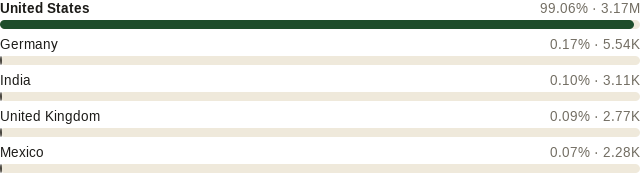
Ninety-nine in a hundred visits come from the United States. The next four countries together are less than half a percent — the delivery map is 48 states, and the traffic map matches it.
Visits by country, Semrush, October 2026.
Search is the brand, not the problem
| Keyword | Monthly searches | Note |
|---|---|---|
| hungry root | 135,000 | Brand term with a space, rank 1, 44.66% of organic traffic |
| hungryroot | 110,000 | Brand term, rank 1, 36.39% of organic traffic |
| hungryroot login | 1,300 | Rank 1, 0.43% of organic traffic |
| hungryroot meals | 1,300 | Rank 1, 0.43% of organic traffic |
| hungry roots | 1,300 | Brand term, rank 1, 0.43% of organic traffic |
Monthly searches are Semrush figures for hungryroot.com, October 2026, read 24 November 2026. Intent phrases (hungryroot pricing and four others) returned no figures — the keyword page would not load.
Two spellings, eight-tenths of the search
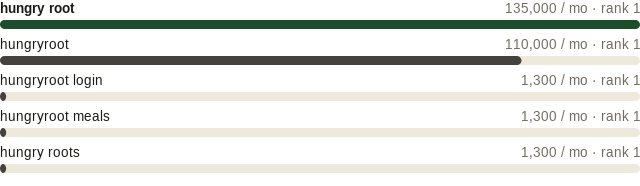
Two spellings of the brand take over 80% of organic traffic. The top generic term never appears — people search for Hungryroot by name, then log in.
Monthly searches, Semrush, October 2026. Intent phrases such as “hungryroot pricing” returned no figures this round.
Search here is brand harvest, not discovery. “Hungry root” draws 135,000 searches a month and “hungryroot” 110,000 — together, more than eight-tenths of organic traffic. The next terms are “hungryroot login” and “hungryroot meals”: existing customers, not new ones.
The money-intent phrases were not measurable this round. “Hungryroot pricing”, “how hungryroot makes money” and three more returned no figures — the keyword page would not load — so no search volume is printed for them. The brand terms carry the page instead.
The ads buy the next household
Three steps, no decisions
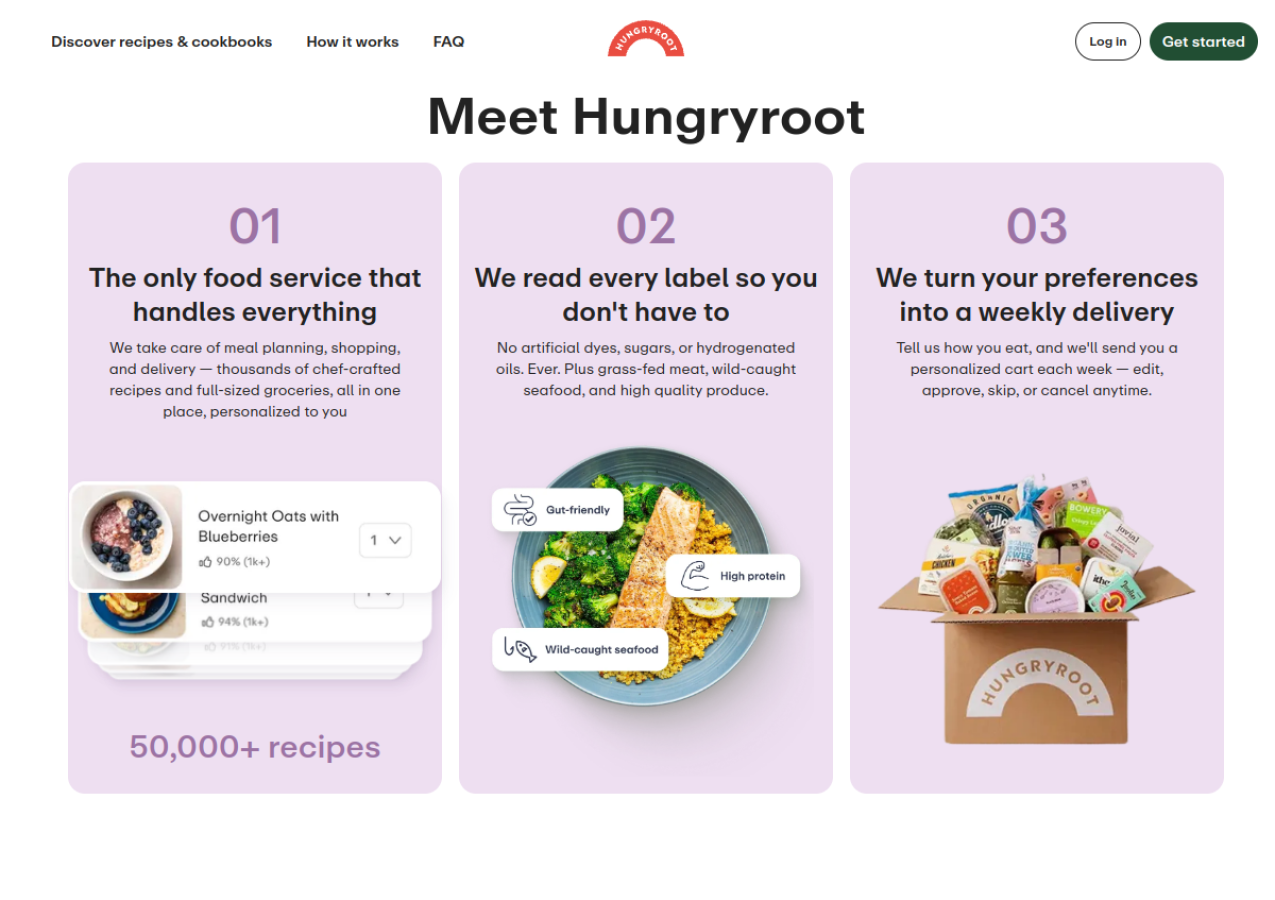
The Hungryroot How It Works page, read 24 November 2026. “Meet Hungryroot” — three steps: the only food service that handles everything, labels read so you don’t have to, and preferences turned into a weekly delivery. 50,000+ recipes; edit, approve, skip, or cancel anytime.
The How It Works page we read on 24 November 2026 is three panels and no fine print. Step one: the service handles meal planning, shopping and delivery. Step two: every label is read for you — no artificial dyes, sugars or hydrogenated oils. Step three: tell it how you eat, and a personal cart arrives each week.
The claim underneath is the retention pitch in miniature: “edit, approve, skip, or cancel anytime.” The cart is a default, not a commitment — and a default that can be edited is one a household keeps.
| Mechanism | Hit | Why, in one line |
|---|---|---|
| Skip a delivery | ✓ | Skip any week from the account page; the FAQ says skip, reschedule or cancel anytime |
| Pause deliveries | ✓ | Pause for up to 8 weeks, per the help centre |
| Cancel anytime | ✓ | Cancel anytime before the shopping window closes — though Trustpilot complaints and a 2023 class action say the flow is hard to find |
| Free shipping over $70 | ✓ | Free over $70 on the homepage; $6.99 below that (third-party check, 20 October 2026) |
| Free gift every delivery | ✓ | A free gift rides with every delivery, per the homepage |
| First-order hook | ✓ | 30% off the first delivery on the site; ad channels offer 40% off |
| Referral | ✓ | A referred friend gets $50 off a first order over $100; the referrer gets $50 credit (third-party checks, Sep–Nov 2026; the company’s own referral page was not read) |
| Email capture | ✓ | Sign-up starts with a diet quiz; Braze runs email, SMS and push (hiring page) |
| Swap items in the cart | ✓ | Every item in the weekly cart can be edited; the cart learns as tastes drift |
| Unused credits roll over | ✓ | Unused plan credits move to a wallet for the next order (third-party check, 20 September 2026) |
| Best Price Program | ✓ | If the same item is cheaper elsewhere, up to $10 an order comes back as credit |
| Gift subscription | Not verified | No option to gift a subscription was found on the pages read |
| Gift card | Not verified | Coupon sites list $5–$500 digital gift cards; the company’s own gift-card page was not read this round |
| Loyalty plan | Not verified | No points or loyalty programme was found on the pages read |
| Refund guarantee | Not verified | The FAQ offers a self-serve form for problem orders; no refund window or rate was published |
| Free trial | — | No free trial; payment details are required before the menu is shown |
| No account | — | Registration and payment details come before the cart or the menu |
Read the table as a subscription built to be kept, not joined. Eleven mechanisms hold a household in — skip, pause, swap, rollover credits, a gift in every box — and the two that would let someone in for free are both missing: no trial, no account-free browsing.
The soft spot is the exit. Cancelling is allowed anytime on paper, but the one-star reviews cluster on exactly that step — unexpected charges, a cancel flow that is hard to complete — and a class action filed in January 2023 says the same thing in legal language. The retention table and the complaint table are the same table, read twice.
Hundreds of ads, three different counts

Three readers, three numbers — because they count differently. Sprites counts every active ad (767); adlibrary.io counts distinct creatives after de-duplication (85); AdMakeAI counts active ads on its own crawl (1,084). No single number is the truth.
Meta Ad Library via Sprites (read 19 November 2026), adlibrary.io (November 2026) and AdMakeAI (November 2026). The library itself was not read directly this round.
| Channel | Share of visits | Platform & stack |
|---|---|---|
| Direct | 49.48% | Semrush, October 2026; the largest source, desktop |
| Google search | 2.6% (google.com) | Semrush, October 2026 |
| Organic search | Down 1.92% on the month | Semrush, October 2026; brand terms are over 80% of it |
| Paid search | Down 53.91% on the month | Semrush, October 2026; absolute spend was not published |
| AI referral | ChatGPT 668 visits | Semrush, October 2026; small next to search |
| Meta ads | 767 / 85 / 1,084 active | Three third-party readers, different methods — see chart |
| Email & SMS | — | Braze runs email, SMS/RCS and push (hiring page); list size was not published |
| Payments | — | Stripe (third-party tech check, 13 November 2026); not confirmed by the company |
| Platform | — | Self-built site; React, Cloudflare, AWS (third-party tech check) |
| Fulfilment | — | Own stock, five US fulfilment centres (company release, 19 February 2026) |
Marketing channels, Semrush, October 2026. Meta Ad Library counts are third-party reads, November 2026; the library itself was not read directly this round.
The ads are mostly creator video. Testimonials lead — a customer whose cholesterol fell by a third, another down 20 pounds — and the offer in the ad is better than the offer on the site: 40% off the first order against 30% on the homepage. The longest-running static ad, a fridge full of food with a three-line story, has run 524 days.
Mail is the quiet half of the machine. A hiring page for a Braze specialist confirms email, SMS and push are run as one lifecycle channel — the weekly cart, the skipped week, the win-back. List size and open rates were not published.
What outsiders say
Two strong scores, one unhappy corner
Loved in the app, argued with on Trustpilot

Two verdicts, one company. The App Store scores it 4.9 from 29K ratings; Trustpilot scores it 4.1 from 7,457 reviews. The site’s own 4.8 is a self-reported number and is not averaged with either pool.
Trustpilot read 24 November 2026; App Store (US storefront) read 24 November 2026; site figure from hungryroot.com, read 24 November 2026.
The ratings point the same way, and the pools are different people. App Store reviewers score the app 4.9 from 29K ratings; Trustpilot scores the company 4.1 from 7,457 reviews. The site itself claims 4.8 — and quietly claims 6.4K Trustpilot reviews on its homepage, against the 7,457 the Trustpilot page shows today.
The complaints repeat: food arriving warm or spoiled, packaging broken, ice packs melted, deliveries late. The praise repeats too: fresh produce, simple recipes, food that fits a diet without thinking. WIRED scored it 7 out of 10 in March 2025 — easy recipes and real customisation, flavours sometimes too mild, and payment details demanded before the menu.
The price check is the sharper test. CNET priced the same basket twice in 2026: $176.76 from Hungryroot against $150.24 bought item by item — about 18% more for the convenience. The company’s answer is a Best Price Program that refunds at most $10 an order. The gap is the whole positioning: cheaper than takeout, dearer than the supermarket.
Eleven years from six items to a $700M grocer
From a six-item shop to an IPO candidate
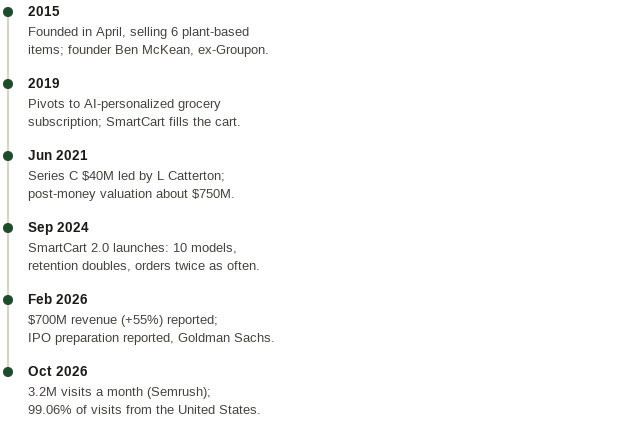
Eleven years, six markers: six items in 2015, a pivot in 2019, a $40M round in 2021, SmartCart in 2024 — and in February 2026, $700M of revenue and IPO preparation reported in the same week.
Founding and pivot from Supermarket News, 8 February 2023; funding from The Spoon and Bloomberg, June 2021; SmartCart from PR Newswire, 10 September 2024; revenue and IPO preparation from PR Newswire and The Information, 19 February 2026.
The company started in April 2015 selling six plant-based items, grew to sixty, and in 2019 stopped being a food brand and became a grocery service. The pivot is the whole story: the same food, sold as a filled cart instead of a chosen product.
The funding stopped in June 2021 — a $40M Series C led by L Catterton, taking the total raised to $75.4M at a post-money valuation of about $750M. No equity round has been announced since. The money since then has come from customers: $333M of revenue in 2023, $700M in 2025.
The IPO is reported, not filed. The Information wrote in February 2026 that the company was preparing a listing that could come as soon as that year, working with Goldman Sachs — and the chief executive said the timetable was not set. As of 24 November 2026 no S-1 has been filed, so this page does not call it imminent.
What survives is a default. A household that lets SmartCart fill the cart stops deciding what to buy, and a household that stops deciding keeps paying. The risk is the mirror image: a basket that costs 18% more than the supermarket, a cold chain that has to stay cold across five warehouses, and an auto-renewal flow that a court filing says is too hard to leave.
Hungryroot is the only site in the food and grocery AI-personalized collection. Compare Hungryroot with Dandelion Chocolate and ButcherBox side by side.
The full teardown is for members
The full analysis of pricing, acquisition, conversion and retention is member content. Membership is $29 a month or $249 a year.
Similar sites in the database
Hungryroot (3.2M) sits between Descript (3.24M) and Castlery (3.19M) in the database.
| Site | Category | Monthly visits | Source |
|---|---|---|---|
| Descript | Video tools · AI audio and video editing | 3.24M | Semrush, Oct 2026 |
| Tecovas | Footwear · Western boots DTC brand | 3.2M | Similarweb, Oct 2026 |
| Castlery | Home · Furniture DTC brand | 3.19M | Semrush, Oct 2026 |
Compare Hungryroot with Dandelion Chocolate and ButcherBox side by side. The full database, with working filters, is on the teardowns index.
Read the next one in your inbox
The new ones go out by email first, one a week, with the traffic source and month attached to every number. Leave your address and the next one comes to you.