
How Ideogram makes money on $15 AI images
Monthly visits
3.1M
October 2026. Third-party estimate, not official MAU/DAU. Semrush counted 3.1M for the month, down 7.35% on September.
Ideogram draws an estimated 3.1M visits a month (October 2026, Semrush), down 7.35% on September and 44% on August’s 5.54M. It is the 172nd-largest site in our database of 901. One word does the searching: “ideogram” draws 33,100 searches a month and ranks first — over two-fifths of all organic search traffic.
The pitch fits in one line: a few free credits a week, and a $15 plan for everyone who outgrows them. Ideogram generates images with readable text inside them — posters, logos, packaging — and charges by the credit for every image, edit and upscale after the free pool runs dry.
| Site | Ideogram, ideogram.ai |
|---|---|
| What it is | AI image and video generation tool: text-to-image, AI editing and character consistency, strong at images with readable text; an API and MCP agent workflows for developers |
| Who it is for | Designers, marketers, content creators and developers who need visuals with text that holds up |
| Category | Image tools · AI image generation |
| Monthly visits | 3.1M, October 2026. Third-party estimate, not official MAU/DAU; Semrush, down 7.35% on the month (September 3.35M, August 5.54M) |
| Founded | 2022 (federal corporation registered 5 December 2022; announced August 2023); the domain was first captured by the Wayback Machine on 23 August 2023 |
| Headquarters | Toronto, Ontario, Canada (TechTO, VentureBeat and others); a San Francisco office and a small New York team |
| Operator | Ideogram, Inc.; founded by Mohammad Norouzi (chief executive), Jonathan Ho, William Chan and Chitwan Saharia — former Google Brain researchers behind Imagen |
| Survival engine | Repeat-purchase-led. A few free credits a week bring creators in; paid plans from $15 a month sell the priority credits that weekly publishing burns, and the brand word “ideogram” draws 33,100 searches a month while direct traffic is 52.46% of desktop journeys |
| Pricing | Free $0 (weekly credits, amount varies; Google, Apple or Microsoft sign-in only — email sign-up gets none; free generations are public); Plus $20 a month or $15 a month billed annually ($180 a year); Pro $60 or $42 annual ($504 a year); Team $30 a user or $20 annual ($240 a user a year); pay as you go 1¢ a credit; Enterprise custom. Source: ideogram.ai/pricing, read live 25 November 2026; the page says annual billing saves up to 33%, the arithmetic is 25% on Plus, 30% on Pro and 33.3% on Team |
| Pricing model | Freemium subscription; each plan buys a monthly pool of priority credits (2,400 to 7,500 per user); unused subscription credits expire at month end; top-up credits roll over; the API bills per image, edit or second of video |
| Free hook | Weekly credits, amount varies, for accounts signed in with Google, Apple or Microsoft; email sign-up gets none; no free trial for paid plans |
| Meta ads | Not verified — the ad library returned 403 this round |
| Country breakdown | United States 32.21%, India 9.43%, Bangladesh 6.02%, Brazil 3.93%, Pakistan 3.58% (Semrush, October 2026) |
TL;DR
- Ideogram turns prompts into posters for 3.1M monthly visits: free weekly credits, Plus from $15 a month, and the only AI image tool that spells reliably inside the picture.
- The money is made on the meter: every poster, logo and edit draws down priority credits, so creators who publish weekly climb from $15 to $42 — and buy top-ups when the pool runs dry.
- The weak spot is trust: the founder himself said in July 2024 the business was not yet profitable, users rate it 3.7 out of 5 on Trustpilot over billing and vanishing free credits, and traffic has fallen 44% since August — while Midjourney and Leonardo answer with cheaper entry prices and steadier free tiers.
A few free credits a week, $15 when the meter runs dry: how Ideogram sells images by the credit
The search footprint is the brand itself
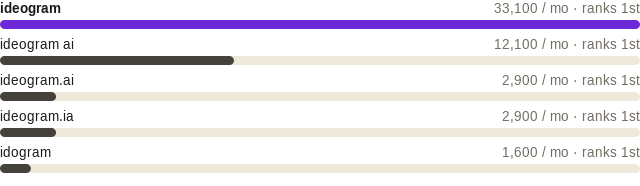
Brand words only: all five keywords are spellings of the name, and all five rank first.
Semrush, October 2026, read 24 November 2026.
The search footprint is the brand itself. “ideogram” draws 33,100 searches a month and ranks first, taking 41.85% of all organic search traffic; the next four are the same word with “ai”, “.ai” or a misspelling attached — even “idogram” draws 1,600. No category word makes the list. People arrive already knowing the name; nobody finds Ideogram by searching for an image generator.

The Ideogram homepage, read 25 November 2026. “The open models for visual intelligence.” over a flower-spelled “Ideogram 4.6”, with a “Get started” button and a logo wall — Netflix, Skechers, Gamma, Wix, Printify and Canva — at the foot.
The homepage sells the model, not the subscription. The hero is a single image with the words spelled out in flowers, and the first screen carries no price at all — only “Get started” and a video card. The meter starts after the first free credits, and the page’s real pitch is that the text inside the picture will actually read correctly.
A slow start, then a steady build
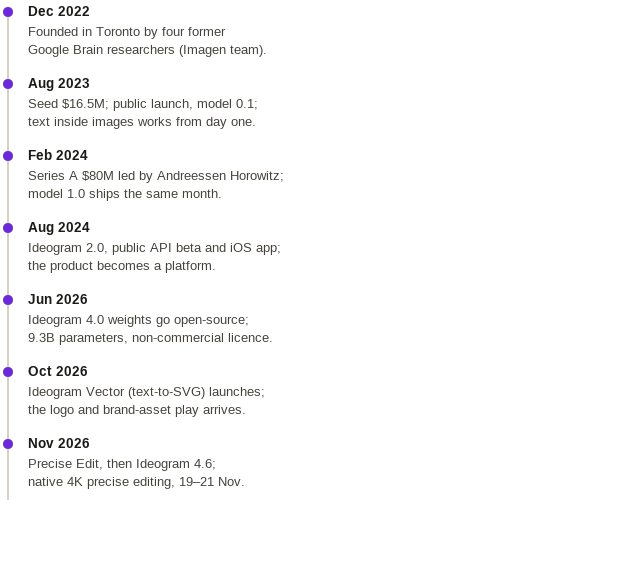
Four founders, two funding rounds, then a new model every few months.
Wayback Machine; VentureBeat, 28 February 2024.
The dates tell a founder-led story, and the page does not dress it up. Four former Google Brain researchers — Mohammad Norouzi, Jonathan Ho, William Chan and Chitwan Saharia, the team behind Imagen — left Google in December 2022 and founded Ideogram in Toronto. The company announced itself in August 2023 with a $16.5M seed round, and the first public model, 0.1, shipped the same month.
The money followed the model. A Series A of $80M, led by Andreessen Horowitz, closed in February 2024, taking total disclosed funding to $96.5M; no valuation was ever disclosed, and no new round has followed since. The product kept shipping instead: 2.0 and a public API beta in August 2024, open 4.0 weights in June 2026, Vector in October, then Precise Edit and 4.6 in November.
Everyone knows the name, nobody trusts the bill: 33,100 brand searches a month, 3.7 stars on Trustpilot
The ladder runs $0 to $60 a month
| Plan | Price | Monthly pool | What it is |
|---|---|---|---|
| Free | $0 | Weekly credits, amount varies | No price card on the page; the FAQ confirms weekly credits for Google, Apple or Microsoft sign-in only, email sign-up gets none; generations are public |
| Plus | $20 / mo · $15 annual | 2,400 priority credits | Recommended; all image and video models; private generation; unlimited slow credits; unlimited character consistency; quality export; top-ups |
| Pro | $60 / mo · $42 annual | 7,500 priority credits | Best cost per credit; batch generation; largest generation queue; everything in Plus |
| Team | $30 / user / mo · $20 annual | 3,600 priority credits per user | Central billing and administration; early access to collaboration features; everything in Plus |
| Enterprise | Custom | Custom credit amount | Postpaid or prepaid; private custom models trained on your visual data; volume discounts on the API; priority support; SOC 2 |
| Pay as you go | 1¢ / credit | No monthly allowance | Credits bought as needed, usable across all apps and models, including API access |
| Midjourney Basic (rival) | $10 / mo · $8 annual | — | No free tier; Standard $30 a month adds unlimited Relax images; private mode from Pro $60 |
| Leonardo Essential (rival) | $12 / mo · $10 annual | 8,500 tokens / mo | Free tier gives 150 fast tokens a day, the most generous free tier of the five |
| Recraft Basic (rival) | $12 / mo · $10 annual | 1,000 credits / mo | True editable SVG output; free images belong to Recraft and carry no commercial licence |
| NightCafe Beginner (rival) | $7.49 / mo annual · $12.49 monthly | — | Five credits a day for logging in, plus daily challenges; a community, not a production tool |
| Adobe Firefly Standard (rival) | $9.99 / mo | 2,000 credits | Adobe’s own models, sold as commercially safe; video, audio and translation all draw the same credit pool |
The ladder is short and the meter is the product. Free is weekly credits of an unpublished amount, and only for accounts that sign in with Google, Apple or Microsoft; Plus adds 2,400 priority credits a month for $20, and the pool climbs in steps to 7,500 at $60. Midjourney’s Basic is $10 a month and Leonardo’s Essential $12 — Ideogram’s monthly entry price is the highest of the five, and its annual $15 is the dearest way into this collection.
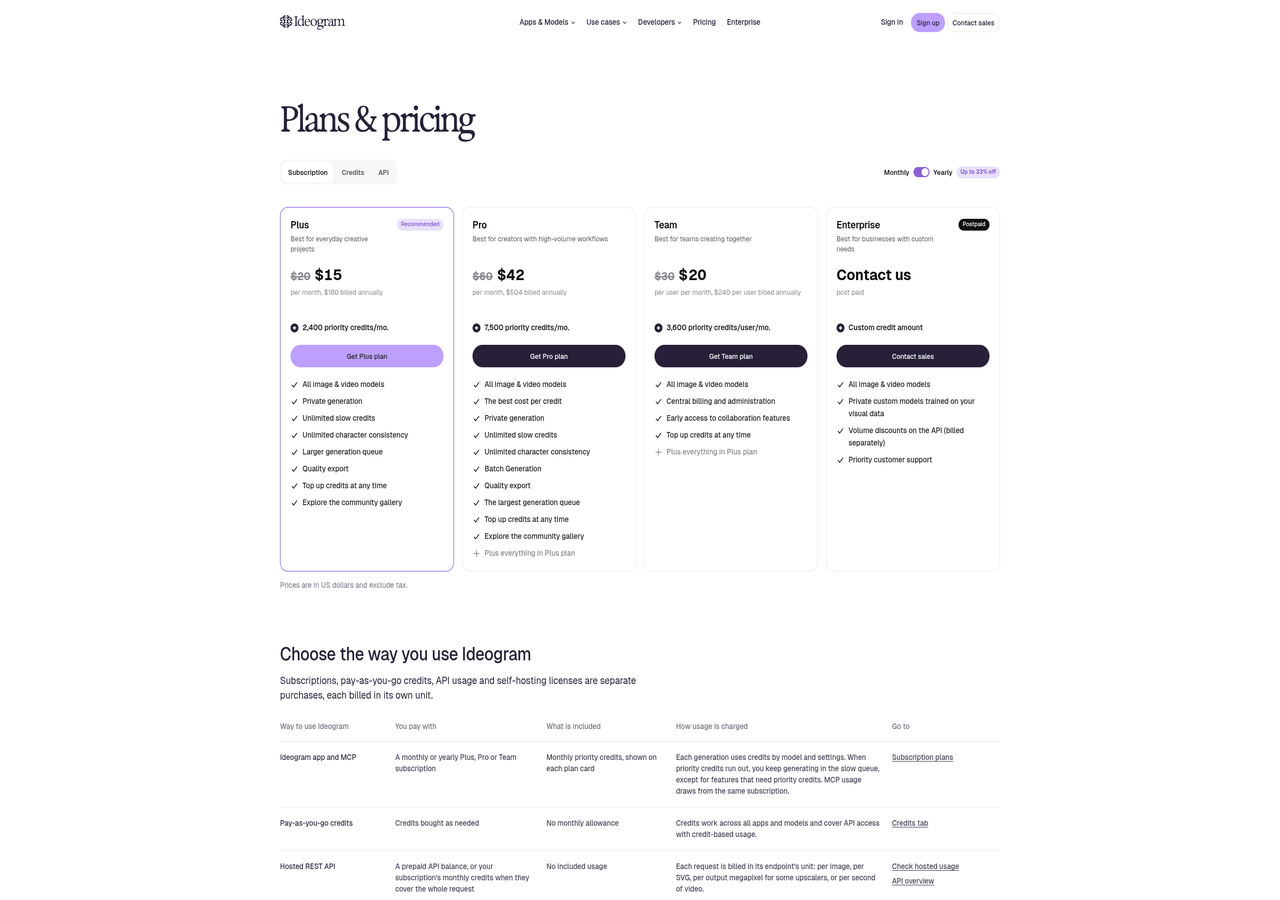
The Ideogram pricing page, read 25 November 2026. Four paid cards on annual billing — Plus $15, Pro $42 and Team $20 a user visible, with “$20”, “$60” and “$30” struck through — and “Up to 33% off” above the monthly/yearly switch. No Free $0 card appears; the free tier is described only in the FAQ below.
The annual prices are the honest part of the page. Monthly billing on Plus costs $240 a year; annual billing costs $180, a 25% saving. The same arithmetic puts Pro at $504 a year against $720 monthly, and Team at $240 a user against $360. The page’s own words claim “up to 33%”; the arithmetic tops out at 33.3% on Team, and matches the claim exactly.
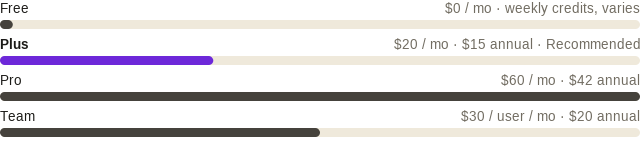
The ladder, in dollars. Annual billing saves 25% on Plus, 30% on Pro and 33.3% on Team.
ideogram.ai/pricing, read live 25 November 2026.
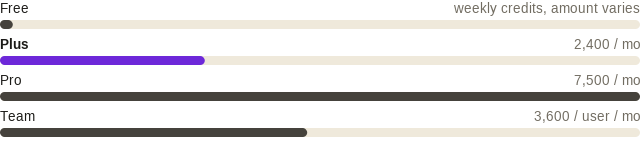
The meter, in credits. Plus buys 2,400 a month; Pro buys 7,500.
ideogram.ai/pricing, read live 25 November 2026.
The credits are the meter, and the one users complain about. Plus gets 2,400 priority credits a month, Pro 7,500, Team 3,600 per user — and when the pool runs dry, the only refill is an upgrade, a top-up or pay-as-you-go credits at 1¢ each. Subscription credits expire at the end of the month; top-up credits roll over, and separately bought credits last 365 days.
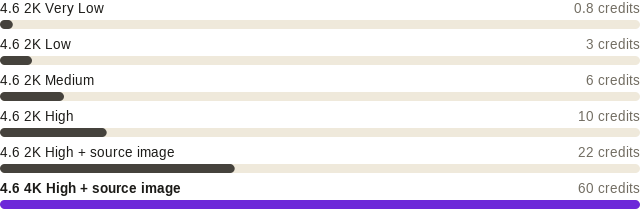
One image, six prices. The dearest 4K edit costs 75 times the cheapest 2K draft.
ideogram.ai/pricing, read live 25 November 2026.
One image costs almost nothing, and a finished one costs real money. A 2K image at Very Low quality costs 0.8 credits; the same image at High costs 10, and at 4K with a source image it costs 60. A Pro plan’s 7,500 credits buy 125 of those top-end images a month — or 7,500 of the cheapest ones. The spread is the business model: the meter is cheap until the work is good.
What keeps subscribers paying
| Mechanism | Hit | Why, in one line |
|---|---|---|
| Free tier | ✓ | Free $0, weekly credits of an unpublished amount; Google, Apple or Microsoft sign-in only, email sign-up gets none |
| No sign-up to try | — | Free credits need an account; anonymous creation not confirmed |
| Free trial | — | No trial for paid plans; the FAQ says so outright |
| Ads | — | No ad revenue; no “No ads” tier found |
| API | ✓ | Hosted REST API plus MCP into Claude and Cursor; usage draws the same credit pool |
| Cancel any time | ✓ | Cancel in account settings; paid plan kept until the billing period ends, but cancel at least 5 days before renewal |
| Pause | Not verified | No pause terms found on the pricing page or help centre |
| Delay payment | Not verified | No delayed-payment terms found |
| Refund | — | Subscriptions, renewals and credits are never refunded (docs, first-party) |
| Credits roll over | Partial | Subscription credits expire at month end; top-up credits roll over; bought credits last 365 days |
| Loyalty programme | — | No loyalty programme or long-subscription reward found |
| Team seats | ✓ | Billed per user; Team adds central billing, management and collaboration features |
| Character consistency | ✓ | Unlimited character consistency from Plus up |
| Custom models | ✓ | Train a custom model for $40 a time; Enterprise gets private custom models |
| Batch generation | ✓ | Batch generation from Pro up |
| Vector SVG | ✓ | Ideogram Vector turns text or images into SVG, October 2026 |
| Video generation | ✓ | Video from third-party models (Seedance, MiniMax, Kling), billed per second |
| Self-hosting licence | ✓ | Ideogram 4.0 weights are open for local use; commercial use needs a paid licence |
| Commercial use | ✓ | All tiers including Free may use generated images commercially |
| Private generation | Partial | Paid tiers generate privately; free generations are public |
| Delete images | ✓ | Plus and Pro can delete images |
| Email list | — | No email list or email hook found |
| Gift subscriptions | — | No gift card or gift subscription found |
| First-order hook | ✓ | Free weekly credits; upgrade only when they run out |
Retention runs on the weekly publishing habit, not on a programme. There is no loyalty scheme and no pause button in the terms; the lock-in is the workflow itself — a marketer who needs a poster with readable text every week is not relearning another generator to save $5 a month. The second lock is the team: seats are billed per user, so every hire adds to the bill.
The refund terms are where the meter bites. Subscriptions, renewals and credits are never refunded, and cancellation must land at least five days before renewal or the next month is charged anyway. Trustpilot reviewers from 2026 describe seven months of automatic charges with only $20 returned, and a $10 top-up that billed $30.
The reviews are the bill, in public

The split: Trustpilot users rate it 3.7, G2’s 5.0 rests on two reviews, and Capterra has none.
Trustpilot, G2 and Capterra, read 24 November 2026.
Three review platforms agree on the shape and disagree on nothing that matters. Trustpilot rates Ideogram 3.7 out of 5 from 170 reviews, G2 5.0 from only two, and Capterra has no reviews at all. The praise is the same everywhere: the image quality, and a support team that answers fast. The complaints are the same too, and they are about the bill, not the idea.
The one-star reviews are harsher, and they belong on the page. An October 2026 Trustpilot review says an update left about 95% of images with errors, and the reviewer cancelled for ChatGPT. Others describe a Pro annual plan at $604.80 plus hundreds of dollars in credits, thirty generations to get one usable image, and high-definition downloads charged at three times the expected price.
Traffic fell 44% since August

October fell 7.35% — the third monthly fall in a row, from 5.54M in August.
Semrush, August to October 2026, read 24 November 2026.
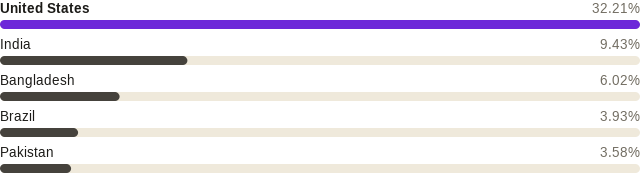
The United States is a third of the traffic. Desktop is over 71% of visits in all five top countries.
Semrush, October 2026, read 24 November 2026.
| Channel | Share of visits | Platform & stack |
|---|---|---|
| Direct | 52.46% | Semrush, October 2026; the largest channel — brand return visits and word of mouth |
| Google search | 14.13% of desktop journeys | Semrush, October 2026 |
| Organic search | Down 0.28% on the month | Semrush, October 2026; the brand word “ideogram” draws 33,100 searches a month |
| Paid search | Not verified | Semrush, October 2026; absolute value not reported |
| Meta ads | Not verified | The ad library returned 403 this round |
| AI referrals | ChatGPT 16K, Gemini 4K | Semrush, October 2026; ChatGPT is the largest AI referrer by far |
| Product Hunt | #5 on launch day | Precise Edit, 1 November 2026: 143 votes, 5 comments; Vector launched 26 October, 4.6 on 21 November |
| Social | 75,500 followers | X account @ideogram_ai (third-party, November 2026); the 4.6 launch post drew 71,800 views |
| — | No list size published; no email hook found | |
| Backlinks | 268.54K links, 20.69K domains | Semrush, October 2026; links up 14.08%, domains up 28.39% on the month |
The traffic fell and the search stayed flat. Visits dropped from 5.54M in August to 3.35M in September and 3.1M in October, down 7.35% on the month and 44% in three months — a slide, not a steady climb. Organic search slipped 0.28% in the same month, and no source explains the fall. The brand word still draws 33,100 searches a month, but fewer people are arriving.
The audience is American first in a way the price is not. The United States is 32.21% of visits, India 9.43% and Bangladesh 6.02% — and desktop is over 71% of visits in all five top countries, a professional tool’s footprint. The $20 plan costs the same everywhere. What each country’s visitors actually pay is not published, so the page does not guess.
| Area | What we found |
|---|---|
| Platform | Astro static site (image URLs carry /_astro/, inferred, not officially disclosed); images via storage.googleapis.com |
| Payments | Stripe handles subscriptions (pricing FAQ, first-party); PayPal and other wallets not supported; iOS subscriptions via the App Store |
| AI models | Image models 1.0–4.6 are self-trained (founders from Google’s Imagen team); video models are third-party resales (Seedance, MiniMax, Kling) |
| API / MCP | Hosted REST API (v2 current); MCP reaches Claude, Cursor and other agent clients; API usage draws the prepaid credit balance |
| Open weights | Ideogram 4.0 weights and inference code are public (Hugging Face, GitHub, June 2026); non-commercial licence, commercial use needs a paid licence |
| App | Web app plus an iOS app; no native Android app verified |
| Email provider | Not verified — no email-service signal found this round |
| Reviews | No rating widget on the homepage; one Skechers customer quote |
| Social | X account @ideogram_ai, 75,500 followers (third-party, November 2026); post-visit destinations include stripe.com — a checkout signal |
Three things should not be quoted as facts. The founder said in July 2024 that the company had not yet built a successful business and was not profitable — no profit figure has been published since, and the single third-party revenue figure in circulation is uncorroborated. The valuation was never disclosed, and the funding is almost three years old: the last round was the Series A in February 2024.
The open question is whether the meter survives the trust complaints. The free credits are real, the $15 annual plan costs more than Leonardo’s $10 and Midjourney’s $8, and no rival spells text inside images as reliably — but every complaint is about credits burned on a bad generation, a refund that never comes, or a free tier that quietly runs out. If creators trust the meter, the habit keeps renewing; if they fear it, the free credits stop being a hook and start being a warning.
Ideogram is the fifth teardown in the AI image tools under $15 a month collection. Compare Ideogram with Midjourney and NightCafe side by side.
The full teardown is for members
The full analysis of pricing, acquisition, conversion and retention is member content. Membership is $29 a month or $249 a year.
Similar sites in the database
Ideogram (3.1M) sits between Goldbelly (3.12M) and Flipsnack (3.1M) in the database.
| Site | Category | Monthly visits | Source |
|---|---|---|---|
| Castlery | Home / Furniture DTC brand | 3.19M | Semrush, Oct 2026 |
| Goldbelly | Food & drink · Famous restaurant food delivery subscription | 3.12M | Semrush, Oct 2026 |
| Ideogram | Image tools · AI image generation | 3.1M | Semrush, Oct 2026 |
| Flipsnack | Presentation tools | 3.1M | Semrush, Oct 2026 |
| Function Health | Health · Preventive blood testing subscription DTC brands | 3.1M | Similarweb, Oct 2026 |
Compare Ideogram with Midjourney and NightCafe side by side. The full database, with working filters, is on the teardowns index.
Read the next one in your inbox
The new ones go out by email first, one a week, with the traffic source and month attached to every number. Leave your address and the next one comes to you.