
How LingQ makes money: the 20-word paywall
Monthly visits
988.9K
October 2026. Third-party estimate, not official MAU/DAU. Similarweb counted 988.9K for the month, up 2.76% on September 2026 (about 962K).
LingQ draws an estimated 988.9K visits a month (October 2026, Similarweb). It is the 353rd-largest site in our database of 927 — and the third-largest of the four sites in the Online language learning subscription collection.
| Site | LingQ, lingq.com |
|---|---|
| What it is | Subscription language-learning platform: learn 50+ languages by reading and listening to real content, looking up words, saving them as LingQs and reviewing them on a schedule |
| Who it is for | Adult learners who study by reading and listening, especially intermediate and advanced learners who want to progress through large amounts of input |
| Category | Education / Online language learning subscriptions |
| Monthly visits | 988.9K, October 2026. Third-party estimate, not official MAU/DAU; Similarweb; up 2.76% on September 2026 (about 962K, derived) |
| Founded | Late 2007, by Steve Kaufmann and his son Mark; predecessor The Linguist launched in 2002 (company About page; Wikipedia, “Steve Kaufmann”) |
| Headquarters | West Vancouver, British Columbia, Canada (company About page: #200-2232 Marine Drive, West Vancouver, BC, Canada V7V 1K4) |
| Operator | LingQ Languages Ltd. — family-owned, private, not listed, not group-controlled; historically $0 raised in outside funding (Owler); Mark Kaufmann is CEO, Steve Kaufmann is the founder |
| Survival engine | Renewals: a prepaid subscription that auto-renews, with a free plan capped at 20 saved words — plus the founder’s 1.47M-subscriber YouTube channel as the distribution |
| Pricing | Premium $14.99 a month, $119.99 a year ($10.00 a month), $215.76 for 24 months ($8.99 a month); Premium Plus $29.99 a month, $269.99 a year ($22.50 a month). Prices read from lingq.com and the official blog, 29 November 2026 |
| Pricing model | Subscription, prepaid for the selected term and auto-renewing until cancelled; cancel in Settings; first Premium sign-up refunded in full within 30 days |
| Typical basket (derived) | $119.99 — one year of Premium (the 12-month plan, $10.00 a month effective); derived from listed prices and bundle structure; the company has not disclosed its actual average order value |
| Free hook | Free plan, never expires: 20 saved words (LingQs), 5 imported lessons, 1 playlist, the full course library readable; no trial on the web; a 7-day trial is reported in-app (not tested this round) |
| Meta ads | Active — at least 6 ads verified in the Meta Ad Library on 29 November 2026, all started 16 November 2026 (Black Friday creative, one per language: French, Spanish, German, Italian, Russian) |
| Country breakdown | Not publicly disclosed (Similarweb, October 2026); Semrush’s February 2025 snapshot put the United States at 26.3%, the United Kingdom at 5.71% and Russia at 5.09% — an expired mirror, noted here, not used as current |
| Audience | Not verified — Similarweb audience data was not readable for this domain; no age or gender split published in the free data |
TL;DR
- LingQ charges for the words you save: 20 free LingQs, then Premium at $14.99 a month or $119.99 a year, and the site drew 988.9K visits in October 2026 (Similarweb), up 2.76% on September.
- The money is the renewal. Founded in late 2007 by Steve Kaufmann and his son Mark, the family company has raised $0 in outside funding (Owler), runs on a 27-person named team, and lets its founder’s 1.47M-subscriber YouTube channel do the selling.
- The other side: Trustpilot gives 2.6 out of 5 from 24 reviews, with complaints about auto-renewal charges; the site draws about two-fifths of Babbel’s traffic; and every revenue figure is a third-party estimate — about $4M a year (builtbyfoundry, 2026) against $20,187,000 (Pubrio) — the company has published none of its own.
Members also unlock: Category benchmarks in full · The annual bill, billed three ways · The channel is the engine · What a founder should copy — and what not to See the full teardown →
Twenty free words, then the paywall
The visits are the teacher’s audience
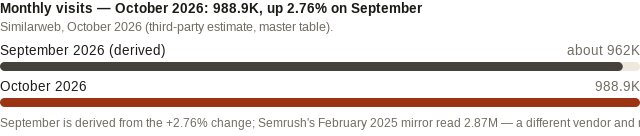
Monthly visits, Similarweb, October 2026 (third-party estimate). September is derived from the +2.76% change.
October 2026 drew an estimated 988.9K visits, up 2.76% on September’s roughly 962K. The brand term does the finding: “lingq” draws 6,600 searches a month and “lingq.com” another 1,300, both ranking first (Semrush, February 2025 snapshot). The rest of the top keywords are stranger — “imouto” and “chingones”, words from inside the lessons themselves, searched 5,400 and 3,600 times a month.
That split is the shape of the business. A subscription that renews itself does not need to be found every month — it needs to be found once, then kept. The course library is the search surface: learners look up a word from a lesson, land on LingQ, and meet the free plan before they meet the price.
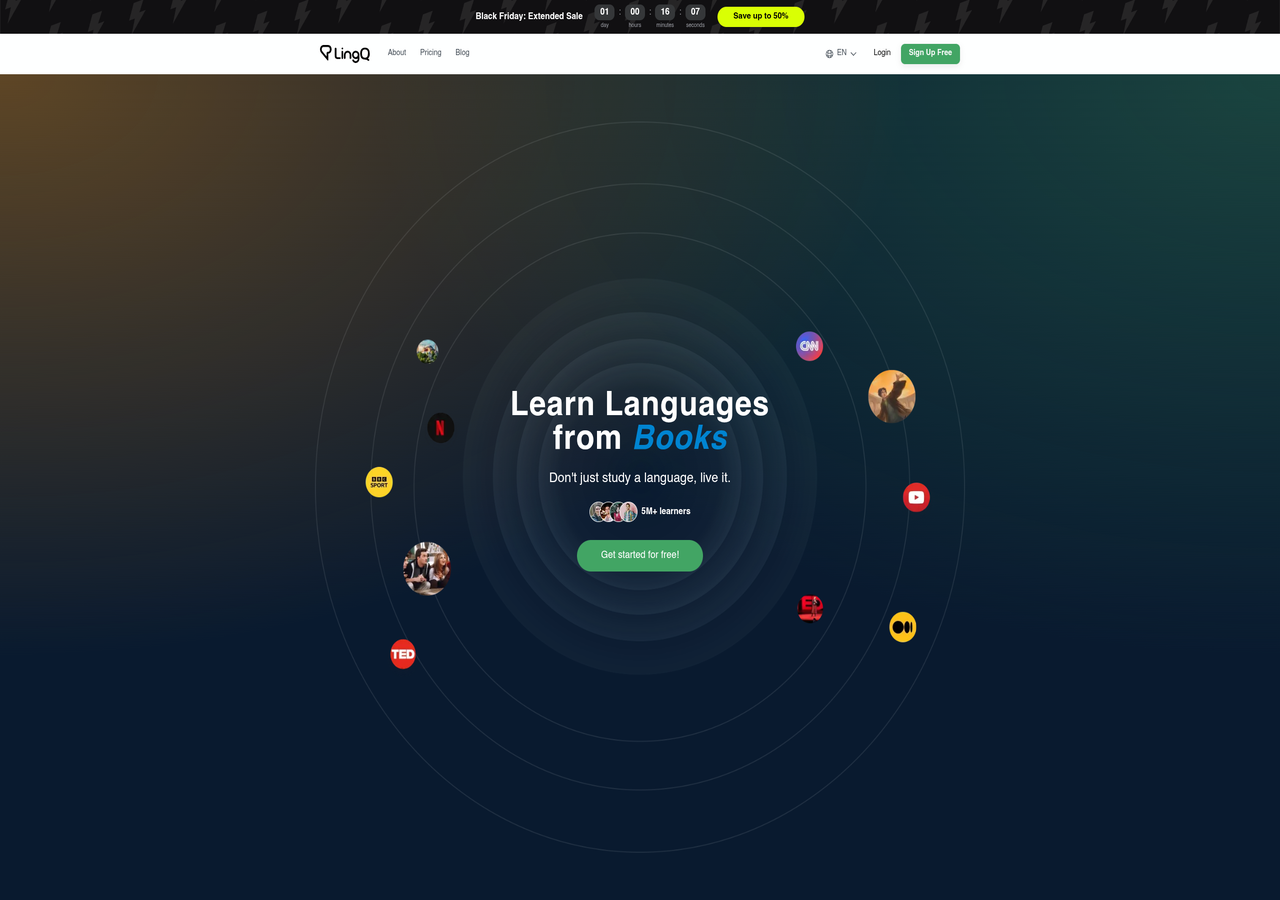
Screenshot of the LingQ homepage, read 29 November 2026. The Black Friday banner promises up to 50% off; the hero sells reading real books, not studying drills.
The homepage opens on the sale, not the method: a Black Friday banner, “Extended Sale”, “Save up to 50%”, with about a day left on the countdown. Below it, the hero is “Learn Languages from Books”, the subline “Don’t just study a language, live it”, and the two numbers that do the selling — “5M+ learners” and “Get started for free!”
The free plan is a real product with a hard edge. The whole course library is readable, with audio and transcripts, and the free account never expires. What runs out is the saving: 20 LingQs, 5 imported lessons, 1 playlist. One independent test found the 20-word cap gone “within the first lesson or two” (productivity-apps, 25 October 2026) — the upgrade prompt is the paywall, and it arrives fast.
Eighteen years, zero outside money
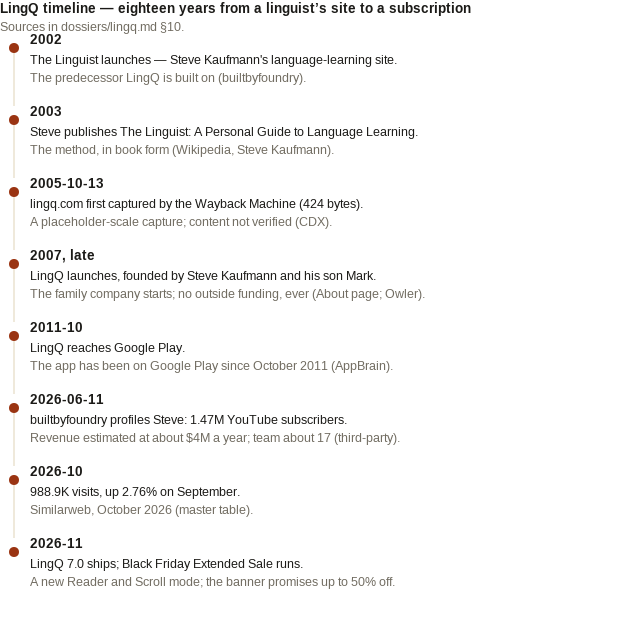
Timeline, 2002 to 2026. One rename, no funding round, one product line that kept growing.
LingQ started in late 2007, when Steve Kaufmann — a former Canadian trade diplomat who speaks 20 languages — and his son Mark turned a language-learning site called The Linguist, live since 2002, into a subscription platform. The company About page says so in one line, and Wikipedia’s “Steve Kaufmann” entry agrees. The earliest Wayback capture of lingq.com is 13 October 2005, a 424-byte placeholder, so the domain predates the product by two years.
The funding record is the shortest in this collection: nothing. Owler’s company page says LingQ “has historically raised $0 in funding”, with no acquisitions found, and the founders are still in charge — Mark as CEO, Steve as the public teacher. Eighteen years in, the company has never taken outside money, never been bought, and never listed.
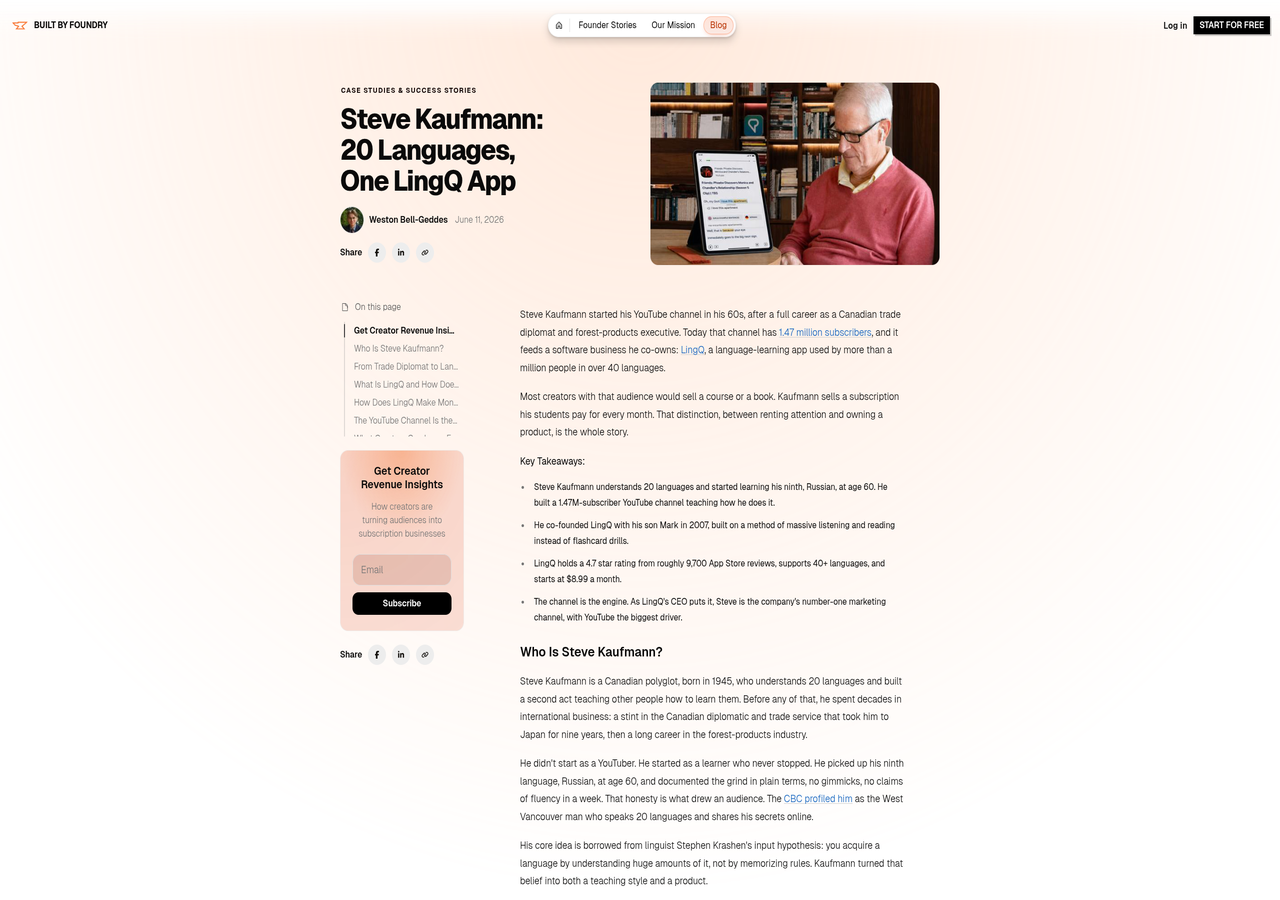
Screenshot of the builtbyfoundry profile of Steve Kaufmann, 11 June 2026. The channel is the distribution: 1.47 million subscribers, and the CEO calls Steve the company’s number-one marketing channel.
The distribution is a person. Steve Kaufmann started his YouTube channel in his sixties; it now has 1.47 million subscribers (builtbyfoundry, 11 June 2026). The profile quotes the CEO directly: “The channel is the engine. As LingQ’s CEO puts it, Steve is the company’s number-one marketing channel, with YouTube the biggest driver.” No ad spend is on record; the teacher is the ad.
The revenue record is the opposite of the funding record: two third-party estimates that disagree by five times. Builtbyfoundry puts annual revenue at about $4M; Pubrio puts it at $20,187,000. Neither gives a method or a year, so this page lists both and takes neither as the current figure — and it does not divide either one by an unknown subscriber count to invent revenue per user.
LingQ against its category
Benchmarked against 3 peers in Education · Online language learning subscriptions — computed from the Everstood database. Visits are third-party estimates (October 2026).
| Monthly visits — category median | 1.34M |
| Median starting paid price | |
| Sites with a free tier | |
| This site's rank in the group |
Member benchmark · Unlock the full benchmarks & the member sections →
The price list: $14.99 a month, $10 on the year
Three terms, one ladder
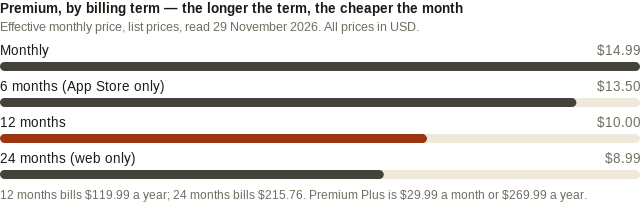
Premium by billing term, list prices, read 29 November 2026. Twelve months bills $119.99 a year; 24 months bills $215.76.
| Plan | Billed | Effective monthly price | What it unlocks |
|---|---|---|---|
| Free | $0 | $0 | 20 saved words (LingQs), 5 imported lessons, 1 playlist; full course library readable; never expires |
| Premium, monthly | $14.99 | $14.99 | Unlimited saved words and imported lessons, full sentence translation, offline lessons, learning stats, Lynx AI chat, 600 transcription minutes a month |
| Premium, 6 months (App Store only) | $80.99 | $13.50 | Same Premium features, billed through the App Store |
| Premium, 12 months | $119.99 | $10.00 | Same Premium features; $59.89 less than twelve monthly payments, a 33.3% saving |
| Premium, 24 months (web only) | $215.76 | $8.99 | Same Premium features; $72.00 less per year than monthly billing, a 40.0% saving |
| Premium Plus, monthly | $29.99 | $29.99 | Everything in Premium, plus advanced Lynx AI chat with 5x points, ElevenLabs top-quality voices, AI lesson simplification, 3,600 transcription minutes a month |
| Premium Plus, 12 months | $269.99 | $22.50 | Same Plus features; $89.89 less than twelve monthly payments, a 25.0% saving |
| Premium Plus, 24 months (web only) | $719.76 | $29.99 | Same Plus features; $29.99 × 24, no discount at all on the two-year term |
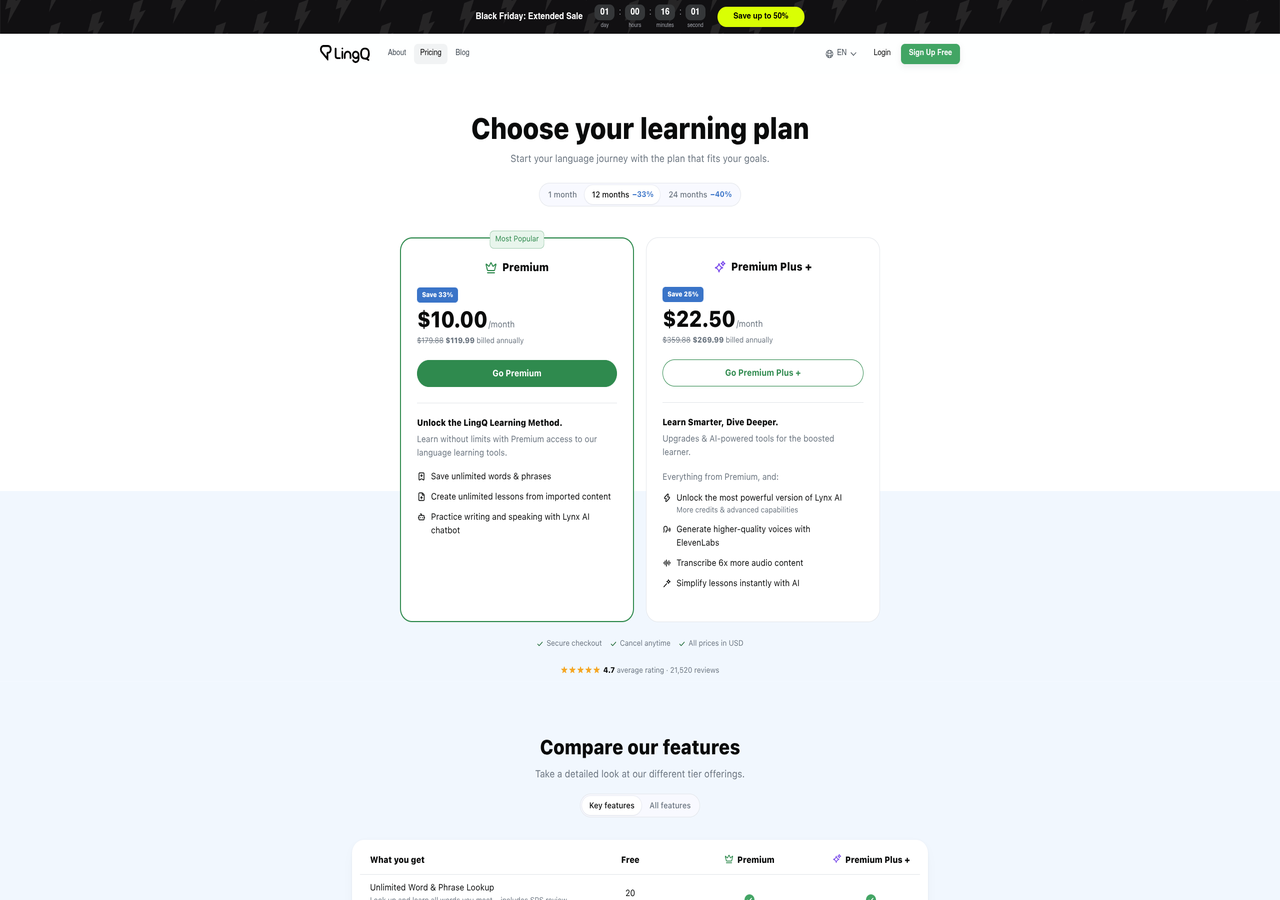
Screenshot of the LingQ pricing page, read 29 November 2026. The 12-month term is the default pitch: Premium at $10.00 a month, Plus at $22.50.
The ladder is the pitch. Monthly billing is $14.99; the 12-month term cuts the effective month to $10.00; the 24-month term cuts it to $8.99 — but only on the web, and only for Premium. Plus has no two-year discount at all: $719.76 is $29.99 times 24, the same as paying monthly for two years. The page shows the 12-month term first, and marks Premium “Most Popular”.
There is no lifetime plan, and no trial on the web. The checkout charges the full term up front, and the only trial line on record is in the app, where users report a 7-day trial that was not tested this round. The first Premium sign-up is refunded in full within 30 days; after that, the Terms say no refunds, and App Store purchases follow Apple’s rules instead.
The $119.99 typical basket
The typical order is one year of Premium. The 12-month plan at $119.99 sits between the $179.88 a year of monthly billing and the $107.88 annualised cost of the 24-month plan, and it is the term the pricing page pushes hardest. Plus at $269.99 a year is the higher tier for heavy users, not the typical buy. The company has not disclosed what its customers actually pay on average, so this page does not multiply $119.99 by 988,900 visits and call it revenue.
The banner and the price card disagree. The homepage banner promises “Save up to 50%”, but the plan cards on the same day show 33% off the 12-month plan, 40% off the 24-month plan and 25% off Plus annual — no tier reaches 50%. A Trustpilot review from June 2024 made the same complaint about the discount arithmetic. The banner is a claim; the cards are the price.
What keeps subscribers paying
| Mechanism | Status | How it shows up |
|---|---|---|
| Free tier | ✓ | Free $0, never expires: 20 saved words, 5 imported lessons, 1 playlist; full course library readable (pricing page) |
| No sign-up needed | — | An account is required; a free account does not need a payment method (Terms) |
| Free trial | — | No trial on the web; a 7-day trial is reported in-app, not tested this round |
| Meta ads | ✓ | At least 6 ads verified in the Meta Ad Library on 29 November 2026, all started 16 November 2026 (Black Friday creative, one per language) |
| Public API | Not verified | An “API Secret Agent” is named on the About page, but no public API documentation was read this round |
| Cancel anytime | ✓ | “Cancel anytime” on the pricing page; cancel in Settings, then Change plan, then Free |
| 30-day first-sign-up refund | ✓ | Full refund within 30 days of the first Premium sign-up (Terms, February 2024 version); no refunds after that |
| Auto-renewal | ✓ | Fees are charged up front for the selected term and “on a recurring basis until canceled” (official FAQ) |
| Content deleted on cancel | ✓ | “All of your Content will be deleted at the end of your billing period upon cancellation of your Premium membership” (Terms) |
| Offline lessons | ✓ | Offline lesson access is a Premium feature (pricing page feature table) |
| Learning stats and challenges | ✓ | Learning progress stats and language challenges are Premium features; the stats page shows known words and milestones |
| Import your own content | ✓ | Unlimited imports on Premium (YouTube, Netflix, podcasts, articles); Free is capped at 5 lessons |
| Tutors and live conversation | — | The About page lists native-speaker tutors and live conversations, but whether tutor sessions are charged, and how, was not verified |
| Referral programme | Not verified | No referral or invite-reward programme was read this round |
| Gift subscription | Not verified | No gift subscription product was read this round |
| Loyalty programme | — | No points or loyalty programme was found on the official site |
The table has no loyalty scheme and no referral programme to hide behind — the retention work is done by the subscription itself. A year is prepaid, it renews on its own, and cancelling deletes the content at the end of the billing period. The cost of leaving is losing the words you saved, which is the whole point of the product.
The friction is not in leaving; it is in noticing. The checkout’s only renewal line, recorded by an independent review, reads: “This subscription will automatically renew. You can cancel all subscriptions any time before your next payment date.” The Terms and the FAQ then disagree about what cancelling does — the Terms say the account ends at the close of the billing period, the FAQ says “immediately” — and this page lists both rather than picking one.
Half the visits arrive direct
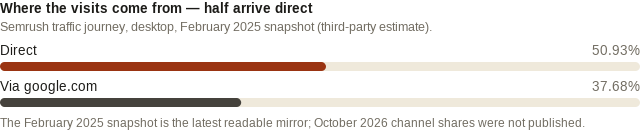
Traffic channels, Semrush, February 2025 snapshot. October 2026 channel shares were not published.
| Channel | Share of visits | Source |
|---|---|---|
| Direct | 50.93% | Semrush traffic journey, desktop, February 2025 snapshot |
| Via google.com | 37.68% | Semrush traffic journey, desktop, February 2025 snapshot |
| Organic search | Share not published | Semrush: organic search traffic rose 13.77% in February 2025; top keyword “lingq”, 6,600 searches a month |
| Paid search | Not verified | The February 2025 snapshot gave no paid-search share; no October 2026 figure was read |
| Meta paid ads | Active — at least 6 ads | Meta Ad Library, 29 November 2026; all six started 16 November 2026, Black Friday creative, one per language (French, Spanish, German, Italian, Russian) |
| AI search | Not verified | The February 2025 snapshot predates Semrush’s AI-traffic reporting; no October 2026 figure was read |
Half the visits arrive direct. Direct traffic is 50.93% of desktop visits, with google.com next at 37.68% — the shape of a product people arrive at by name. The channel shares come from the February 2025 snapshot, the latest readable mirror; October 2026 shares were not published, so this page does not present February shares as October facts.
| Layer | What it runs on |
|---|---|
| Platform | Web app plus iOS and Android apps; Google Play listing since October 2011; Chrome extension imports any web page in one click |
| Stack | Self-built web app (the pricing page renders in JavaScript, so prices are not in the page text); native mobile apps; LingQ 7.0 shipped in November 2026 |
| Channels | Web and app subscriptions on lingq.com; the founder’s YouTube channel is the largest channel by reach at 1.47M subscribers (builtbyfoundry, 2026). Direct is the largest channel by share of visits at 50.93% (Semrush, February 2025) |
| AI | Lynx AI chat (basic on Premium, advanced on Plus with 5x points); ElevenLabs top-quality voices on Plus; InWorld AI voices on Premium; Whisper transcription, 600 minutes a month on Premium, 3,600 on Plus |
| Email / SMS | Not verified — email reminders exist (a Trustpilot review mentions them), but the provider was not verified |
| Payments | Not verified — the checkout page was not read this round |
| Infrastructure | Not verified — the host is not public; the About page names one Dev-Ops and one Back-End employee, which is not infrastructure proof |
| Support | Email support@lingq.com and phone +1-604-925-9544 (About page); a two-person “Learner Success” team; Trustpilot reviews call the replies slow |
The stack is a self-built web app with native mobile apps and a third-party AI layer behind it: Lynx for chat, ElevenLabs and InWorld for voices, Whisper for transcription, all billed by usage. The AI is the cost side of the Plus tier — 3,600 transcription minutes a month is six times Premium’s 600 — and the reason Plus costs twice as much.
Third of four, and the cheapest year is not the biggest
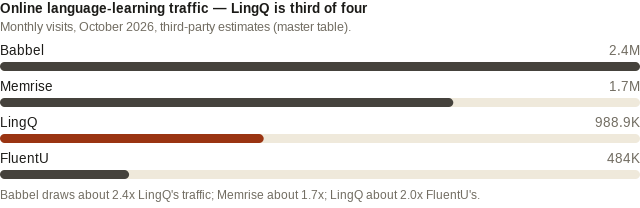
Online language-learning traffic, October 2026. Babbel draws about 2.4x LingQ’s traffic; Memrise about 1.7x; LingQ about 2.0x FluentU’s.
| Site | Monthly visits | 12-month price | Languages | Free tier |
|---|---|---|---|---|
| Babbel | 2.4M | $107.40/yr | 14 | No free tier (first lessons free) |
| Memrise | 1.7M | £61.99/yr | 149 | Free tier |
| LingQ | 988.9K | $119.99/yr | 50+ | Free tier |
| FluentU | 484K | $143.99/yr | 9–10 | No free tier (14-day trial) |
LingQ is third of four on traffic — 41% of Babbel’s 2.4M, 58% of Memrise’s 1.7M, about twice FluentU’s 484K. On price it sits in the middle: Babbel’s year is $107.40, $12.59 cheaper, and FluentU’s is $143.99, $24.00 dearer. Memrise prices in pounds, so it stays out of the dollar comparison. The four together draw about 5.57M visits a month.
LingQ does not compete on price, and it does not compete on language count either — Memrise lists 149 languages against LingQ’s 50+. What it sells that the others do not is the freedom to import anything: any article, video or podcast becomes a lesson. Babbel sells structured courses, Memrise sells video accent lessons, FluentU sells captioned video; LingQ sells the content itself.
A 4.7 on the site, a 2.6 on Trustpilot
The public review record is split, and the split is the story. The site shows 4.7 out of 5 from 21,520 reviews on the pricing page, and 4.67 out of 5 from 57,370 ratings on the homepage, both first-party and from unnamed stores. Trustpilot shows 2.6 out of 5 from 24 reviews, read as text on 29 November 2026 — the page itself could not be captured, its server blocked the screenshot.
The Trustpilot complaints repeat the same story: an auto-renewal charge the buyer did not expect, and a refund refused. The newest, from 23 November 2026, says the first email mentioned only extending the trial, not endless renewal, and the charge was only recovered through the card issuer. A June 2024 review makes the same discount complaint as the banner above. Twenty-four reviews is a tiny, self-selected sample, and it sits next to 10,539 App Store ratings at 4.7 and 48,125 Google Play ratings at 4.44.
The app-store trend is the quieter warning. One independent review of recent App Store ratings found the lifetime average at 4.50 but the last 100 ratings at 3.65, with the paywall’s position the most common complaint — 56 negative mentions out of 80. The product works; the billing is what people argue about — which is the cost of a model that charges first and explains later.
LingQ is the third teardown in our Online language learning subscription collection. The nearest teardown on traffic is Babbel at 2.4M visits a month, and the most useful side-by-side is LingQ vs Babbel vs Memrise. For the video-accent rival by traffic, see the Memrise teardown.
Unlock the full LingQ teardown
Inside the full teardown:
- Category benchmarks in full
- The annual bill, billed three ways
- The cheapest year is not the biggest
- The channel is the engine
- What a founder should copy — and what not to
Prefer to inspect a full teardown first? Read the iLovePDF teardown — fully unlocked.
Similar sites in the database
LingQ (988.9K) sits just below Mindvalley and just above Aconvert in the database. The sites nearest to it on traffic are shown below.
| Site | Monthly visits | Category |
|---|---|---|
| SpeechGen | 994.41K | AI voice tools |
| Mindvalley | 991.6K | Education · Personal growth subscriptions |
| LingQ (lingq.com) | 988.9K | Education / Online language learning subscriptions |
| Aconvert | 984.75K | File conversion |
| Momentous | 984.29K | Health & wellness · Sports nutrition supplements DTC brand |
Related teardowns
- Babbel — 2.4M visits a month, the structured-course leader in the same collection, with the cheapest year at $107.40.
- Memrise — 1.7M visits a month, the video-accent rival with 149 languages and a free tier.
Read the next one in your inbox
The new ones go out by email first, one a week, with the traffic source and month attached to every number. Leave your address and the next one comes to you.
Free email brings one full teardown a week. Membership opens the whole archive, all of it, right now.