
How Lulu and Georgia makes money without investors, one room at a time
Monthly visits
3.6M
October 2026. Third-party estimate, not official MAU/DAU. Similarweb counted 3.6M for the month, up 8.26%.

Lulu and Georgia draws an estimated 3.6M visits a month (October 2026, Similarweb), up 8.26% on the month. It is the 160th-largest site in our database of 901. The average visit lasts 1 minute 36 seconds — people browse rugs, compare sizes, and check whether the room will hold together.
The pitch fits in one line: designer rugs and furniture, sold direct, with a free designer on the other end of the order. The money is in the second room — 52% of customers buy again, and the brand has never taken outside money.
| Site | Lulu and Georgia, luluandgeorgia.com |
|---|---|
| What it is | Designer home décor DTC brand: self-designed rugs, furniture, lighting, wallpaper and more, sold direct online, with a free interior design service and a printed catalogue |
| Who it is for | Home buyers who want designer rugs and whole-room furnishing and will pay a premium for original design |
| Category | Home · Designer rugs & home décor DTC brand |
| Monthly visits | 3.6M, October 2026. Third-party estimate, not official MAU/DAU; Similarweb, up 8.26% on the month. Global rank #14,494, US #2,982 |
| Founded | 2012; founder Sara Sugarman, still president. The family carpet business dates to 1955 |
| Headquarters | Los Angeles (5410 Wilshire Blvd, per Trustpilot) |
| Operator | Private — unlisted, not acquired; Lulu and Georgia, Inc. No outside funding, no debt, founder-owned |
| Survival engine | Repeat. 52% of customers buy again — about twice the industry average, on the founder's own account — and the free design service is what turns one rug into a whole room. Brand does the other half: designer collaborations and curated picks hold the price |
| Pricing | Yana Hand-Knotted Wool Rug 8'x10' $1,608 (was $2,298, Black Friday −30%); full range $348–$3,008 at sale prices. Source: luluandgeorgia.com, read 24 November 2026 |
| Pricing model | One-off purchase, no subscription; the nearest thing to a refill is the next room |
| Free hook | Free interior design service (virtual, in-person or by email) and 10% off the first order for an email signup |
| Meta ads | About 61 live ads in the US (Meta Ad Library, read 24 November 2026; Meta reports an approximate count) |
| Country breakdown | Not published for October 2026; an older Semrush read (March 2025) put the US at 82.21%, the UK at 5.67% and Sweden at 4.62% |
TL;DR
- Lulu and Georgia draws an estimated 3.6M visits a month (October 2026, Similarweb), up 8.26%. It sells a hand-knotted wool rug for $1,608 at 8'x10' — and says it has grown to nine figures with no debt and no investors.
- The repeat rate is the story: 52% of customers buy again, about twice the industry average, and the free design service is the mechanism — a designer builds a draft order for the whole room, then follows up to close it.
- The risk is the service behind the sale. Trustpilot scores it 3.5 from 7,084 reviews, with 27% at one star, and the complaints cluster on delivery delays, hard-to-reach support and returns that cost the buyer.
The first screen sells a sale, not a room
The hero is a discount, not a rug
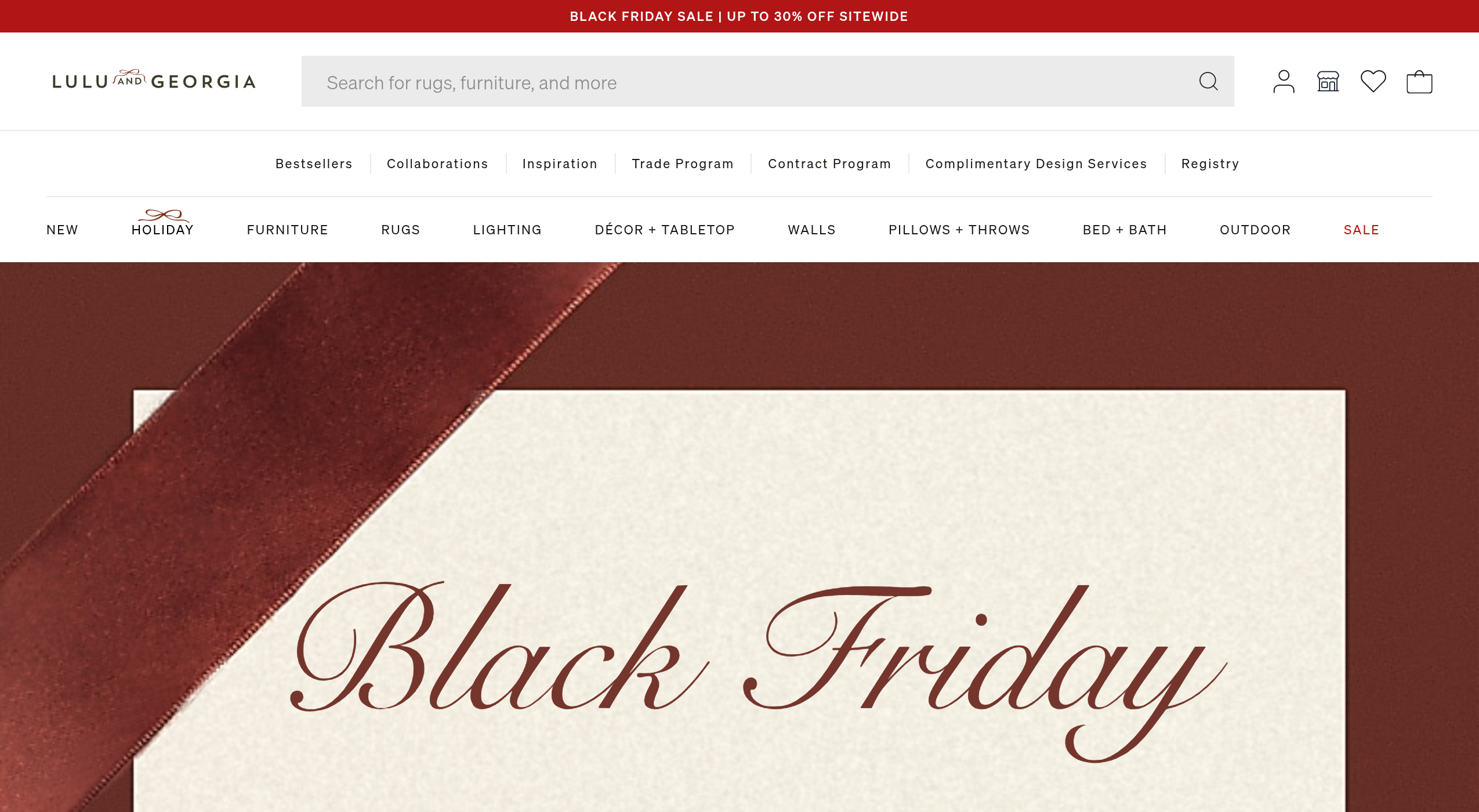
The Lulu and Georgia homepage, read 24 November 2026. The banner is a Black Friday sale — “BLACK FRIDAY SALE | UP TO 30% OFF SITEWIDE” — and the hero is the same sale in script, with a “SHOP THE SALE” button below it.
The homepage we read on 24 November 2026 opens with a sale, not a room. The banner promises up to 30% off sitewide, the hero repeats it in script, and the first content below is “100+ new markdowns added”.
The navigation shows the real business underneath the sale. Bestsellers and Collaborations sit next to Trade Program and Complimentary Design Services — the shop sells designer names and free advice, not just rugs.
That is the whole pitch in one screen: the brand does not ask you to admire the weave first. It asks you to buy during the sale, at 30% off, before the price goes back up.
What $348 buys, and what $3,008 buys
| Size | Sale price | List price | What it is |
|---|---|---|---|
| 2'6" x 8' Runner | $348 | $498 | Entry point; the smallest size, backordered until February |
| 4' x 6' | $418 | $598 | Small room or bedside |
| 6' x 9' | $1,258 | $1,798 | Living-room size for a smaller room |
| 8' x 10' | $1,608 | $2,298 | The master-table price; in stock, ships in 5–7 business days |
| 9' x 12' | $2,098 | $2,998 | Large living room |
| 10' x 14' | $2,448 | $3,498 | Open-plan size |
| 12' x 15' | $3,008 | $4,298 | Largest rug; a whole room in one piece |
Sale prices from luluandgeorgia.com, read 24 November 2026; every size about 30% off its list price. The 8'x10' is the master-table price.
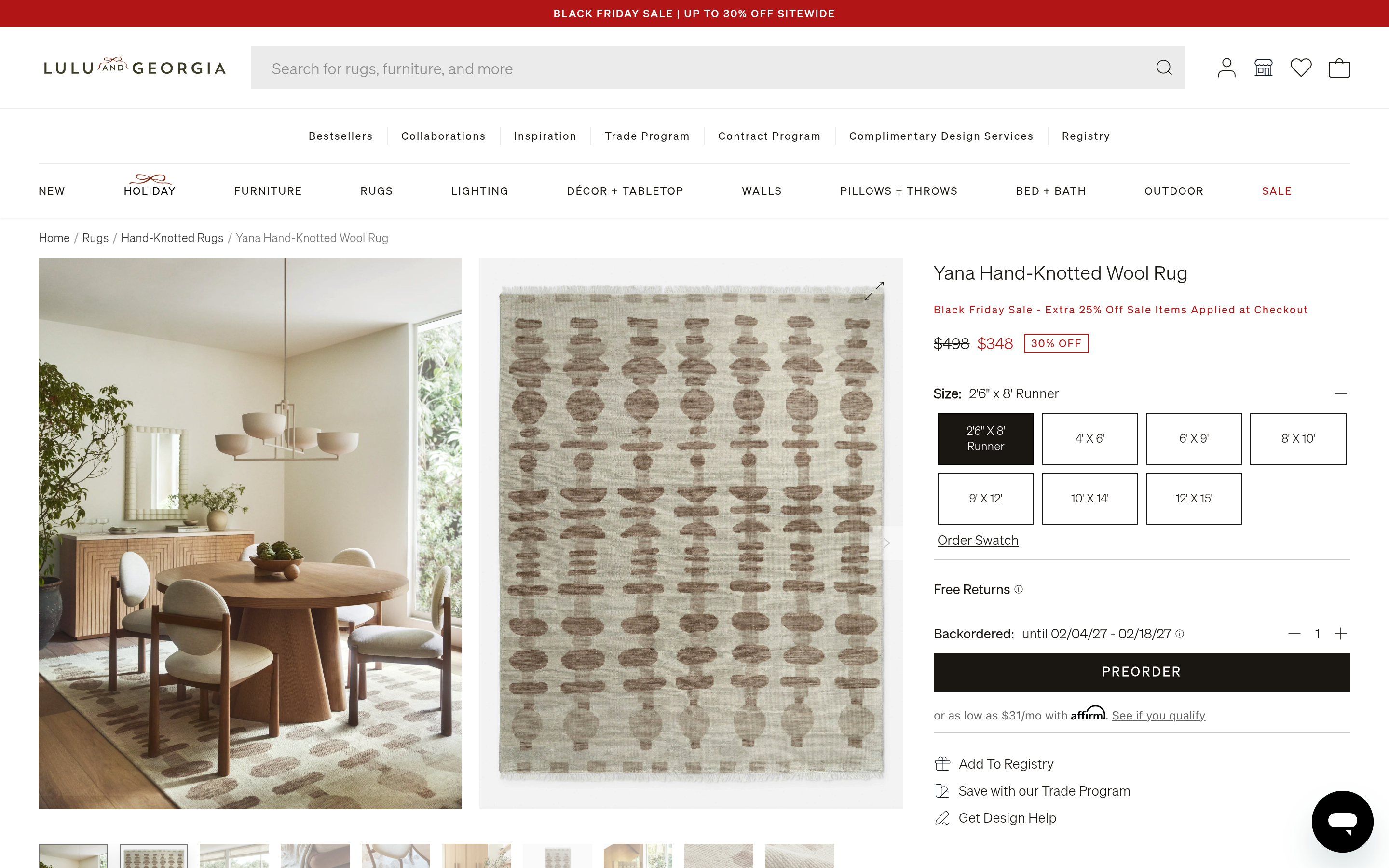
The Yana product page, read 24 November 2026. The runner is $498 struck through and $348, marked 30% OFF, with Free Returns and a pre-order note — backordered until 02/04/27–02/18/27 — and Affirm from $31 a month.
A $2,660 ladder, and the middle is the shop
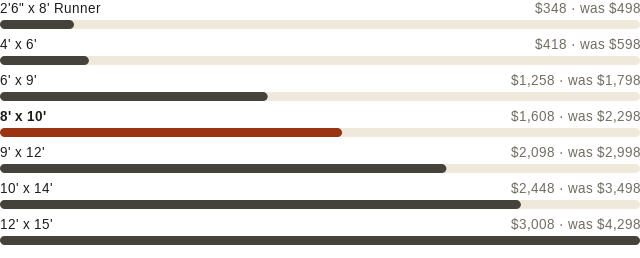
The ladder runs $348 to $3,008 at sale prices. The 8'x10' at $1,608 is the middle of the shop — a hand-knotted wool rug at a sale price — and everything above it is a bigger room, not a better rug.
Sale prices from luluandgeorgia.com, read 24 November 2026; list prices $498–$4,298.
The price is the position. At $1,608 for an 8'x10', Yana costs nearly three times the washable-rug shelf — and the gap is the point. The rug is hand-knotted wool, not machine-washable fabric, and it is sold as design, not as a utility.
The sale is the strategy, not the exception. Every size carries a −30% Black Friday tag in November, and sale items take a further 25% off at checkout. The list price anchors the value; the sale price closes the order.
The same 8'x10' rug, four prices apart
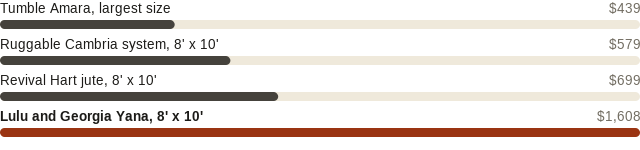
Yana is the dearest of the four by a wide margin. Tumble's largest size tops out at $439, Ruggable's Cambria system is $579 and Revival's Hart jute is $699 — Yana at $1,608 is more than twice the next one up.
Entry prices from the brands' own sites and the database, 2026; Ruggable and Revival are 8'x10', Tumble is its largest listed size.
The middle is where the other brands live. Lulu and Georgia does not compete there — it sells above them, on designer names and a free design service, and the premium is the brand, not the cloth.
The room, priced by the piece
| Piece | From | What it is |
|---|---|---|
| Mirror | $448 | Entry point; the cheapest way into the catalogue |
| Floor lamp | $765 | Lighting, the second piece of a room |
| Side table | $979 | Furniture at the low end of the range |
| Yana rug, 8' x 10' | $1,608 | The rug that anchors the room, at sale price |
| Armchair | $1,749 | Seating, where the order starts to grow |
| Sofa | $1,898 | The big piece; sofas run to $6,299 |
Entry prices from luluandgeorgia.com, read November 2026; the rug price is the Black Friday sale price.
One room, six price tags
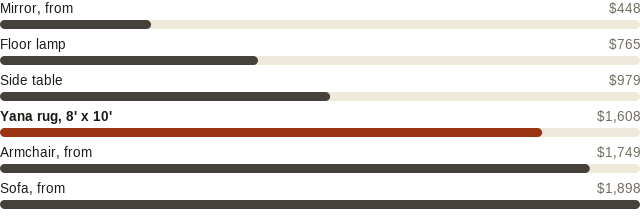
The room is the unit, not the rug. A mirror starts at $448 and a sofa at $1,898 — and the rug at $1,608 sits between them, which is why the design service sells the room, not the rug.
Entry prices from luluandgeorgia.com, read November 2026.
The room is the unit of sale. A buyer who comes for a $1,608 rug is one design appointment away from a $1,898 sofa and a $979 side table — and the free design service is the bridge between the two.
What the shop does, and what it does not
| Mechanism | Hit | Why, in one line |
|---|---|---|
| Skip a delivery | — | No subscription product, so there is nothing to skip |
| Pause | — | No subscription product |
| Cancel | △ | Orders can be cancelled, but custom pieces cannot, and in-transit cancellations pay a 15% restocking fee |
| Free shipping | — | No free-shipping threshold; delivery runs $8.95 and up, or 10% of the order over $220 |
| Gift subscription | △ | Gift cards run $50–$2,000 in 10 tiers, but they are one-off, not a recurring gift |
| Gift card | ✓ | $50–$2,000 in 10 tiers on the gift-card page; final sale, excluded from promotions |
| Loyalty plan | — | The rewards programme has been discontinued, per a third-party report |
| First-order hook | ✓ | 10% off the first order for an email signup, in the footer; an SMS popup offers up to 30% off |
| Email capture | ✓ | The 10% off trades for an email address; the mail platform is not published |
| Refer a friend | △ | Referrer and friend each get $25, per third-party coupon sites; the site page was not read |
| Refund guarantee | △ | 30-day free returns on marked items, but custom pieces never return and white-glove returns pay 15% |
| Free exchanges | — | No free-exchange policy was found; returns go back as a refund or store credit |
| Free design service | ✓ | Virtual, in-person or by email, free; the designer sends a draft order and follows up to close it |
| Printed catalogue | ✓ | The founder says the paper catalogue is coming back, after 14 years mostly online |
| Instalments | ✓ | Affirm from $31 a month on the Yana page; Afterpay reported by a third-party review |
| Trade discount | ✓ | Trade Program members get 20% off, no codes, on the trade page |
| Showroom | ✓ | First showroom opened 14 October 2026 on Melrose Ave, West Hollywood |
| Subscription discount | — | No subscription product |
| Free trial | — | No trial; the 30-day return window does that job instead |
| Ads on the site | ✓ | The brand buys Meta ads at scale and runs no ad inventory of its own |
Read the table as a design-led machine, not a loyalty programme. The hooks that matter are the ones that lower the cost of the first room: free design help, 10% off the first order, and free returns on eligible items.
The loyalty plan is the gap in the table. The rewards programme is gone, and the referral offer — $25 each way — is reported by coupon sites, not by the brand itself. A repeat rate of 52% with no loyalty programme is a claim about the product, not about the points.
52% come back for the second room

52% of customers buy again, about twice the industry average — on the founder's own account, in a Shopify interview in June 2026. The number is self-reported and unaudited; it is also the whole business.
Repeat rate from the Shopify founder interview, 23 June 2026; the industry average is the founder's own comparison.
The repeat rate is the number this teardown stands on. If 52% is right, the brand does not need cheap traffic — every first order carries a second one inside it. If it is wrong, the whole model is a sale with no sequel.
Search brings the brand, and the brand brings the room
The brand term does the work
| Keyword | Monthly searches | Note |
|---|---|---|
| lulu and georgia | 60,500 | Brand term, rank 1, 14.0% of organic traffic |
| wallpaper | 673,000 | Generic term, rank 7, 5.84% of organic traffic |
| mirror | 165,000 | Generic term, rank 2, 3.91% of organic traffic |
| side table | 49,500 | Generic term, rank 1, 1.89% of organic traffic |
| luluandgeorgia | 8,100 | Brand term, rank 1, 1.87% of organic traffic |
Monthly searches are Semrush figures for luluandgeorgia.com, March 2025 — an older snapshot. Money-intent phrases (lulu and georgia pricing and three others) returned no figures — the keyword page would not load.
Search is the brand and the problem at once
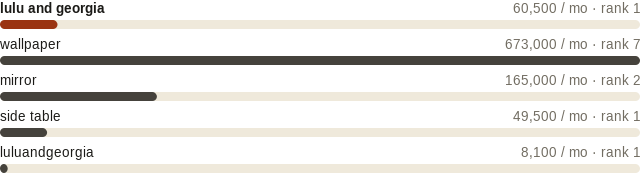
Search is the brand and the problem at once. “Lulu and georgia” draws 60,500 searches a month — but “wallpaper” draws 673,000, eleven times more, and the brand only ranks seventh for it.
Monthly searches, Semrush, March 2025. Money-intent phrases such as “lulu and georgia pricing” returned no figures this round.
Search here is brand-led and problem-led at once. The brand term is 14% of organic traffic, and the generic terms — wallpaper, mirror, side table — bring shoppers who have not chosen a brand yet. The brand ranks first for its own name and seventh for the biggest generic word.
The risk sits in that split. “Wallpaper” at 673,000 searches a month is eleven times the brand term, and seventh place is not first. A funnel that harvests its own name still pays to be found by strangers.
| Channel | Share of visits | Platform & stack |
|---|---|---|
| Direct | 29.38% | Similarweb, October 2026; the largest channel |
| Paid search | 2nd channel | Similarweb, October 2026; share not published |
| Organic search | 3rd channel | Similarweb, October 2026; brand terms are 14% of it |
| Meta ads | About 61 live ads (US) | Meta Ad Library, read 24 November 2026; Meta reports an approximate count |
| Platform | — | Shopify; 40,000+ SKUs migrated from Adobe Commerce |
| — | 10% off the first order for a signup; the mail platform is not published | |
| SMS | — | A popup offers up to 30% off for an SMS signup |
| Showroom | — | First store, 8735 Melrose Ave, West Hollywood, opened October 2026 |
Marketing channels, Similarweb, October 2026, unless noted. Semrush figures are March 2025 and older.
The shape is a brand people come back to directly. Direct is the largest channel at 29.38%, and paid search sits second — the brand pays to be found, then keeps the buyer on its own terms.
What is not in dispute is the shape: a brand people search for by name, in a funnel that still pays for most of its introductions. The Meta machine is small — about 61 ads — next to the rug brands that run hundreds.
What outsiders say
Two verdicts in one score
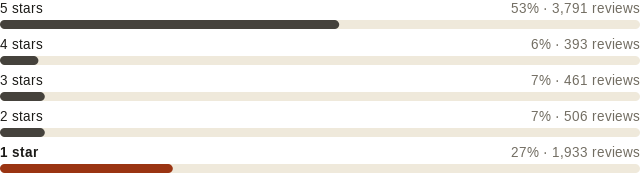
Two verdicts in one score. 53% of reviewers give five stars and 27% give one — the middle is nearly empty. The 3.5 average is a split, not a consensus.
Trustpilot read 24 November 2026; 7,084 reviews, 1,629 in the last 12 months.
The ratings point two ways, and the split is the story. Trustpilot scores it 3.5 from 7,084 reviews: 53% at five stars, 27% at one star, and almost nothing in between. The five-star reviewers praise the design and the packaging; the one-star reviewers could not reach support, waited months for delivery, or paid to send a rug back.
The brand does answer. The profile has been claimed since April 2019, it replies to 99% of negative reviews, typically within 24 hours, and it runs a paid Trustpilot subscription. The replies are part of the retention work — a complaint answered in a day is a second order kept.
The other verdict is quieter. The founder's numbers — nine figures, 20–30% growth, 52% repeat — are self-reported, with no audit and no third-party check. The review aggregators that try to estimate the revenue disagree by a factor of 37, so none of their figures is printed here as fact.
Fourteen years from a family carpet shop to nine figures
From a carpet shop to a brand, in five markers
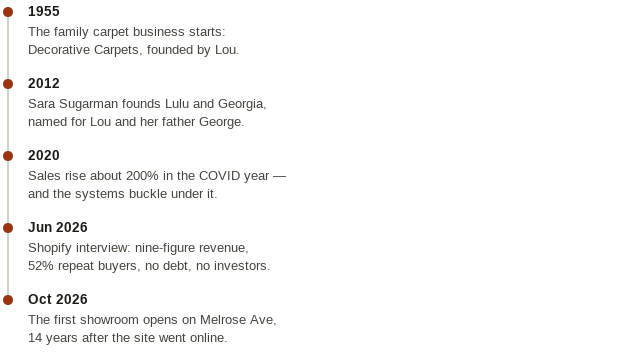
Fourteen years, five markers: a family business in 1955, a brand in 2012, a COVID surge in 2020 — and in 2026 the first shop opens on Melrose Avenue.
Founding from Shopify and Career Contessa; growth from the Shopify founder interview, June 2026; showroom from PRNewswire, October 2026.
The company started with a carpet shop, not a website. Lou founded Decorative Carpets in 1955; his son George ran it next; and Sara Sugarman, the third generation, put the family trade online in 2012 — named for Lou and George, Lulu and Georgia.
The growth numbers since are the company's own, unaudited. Sales rose about 200% in the COVID year, and the systems buckled — customer service, warehousing and returns all at once, with no ERP behind them. The brand says it has grown to nine figures since, at 20–30% a year.
The institutional proof is thinner than the percentages. A first showroom in October 2026 puts the brand on a real street for the first time, and the founder talks about hospitality work and a children's line next. The stores are not the proof yet — there is one — and the expansion is the bet, not the result.
The story is the risk
The claim that sells the room is also the claim that can break it. “52% buy again” is the whole model, and it is self-reported — while the public scoreboard says 3.5 out of 5, with more than a quarter of reviewers at one star. A repeat machine cannot run on unanswered support tickets.
The returns policy is the second exposure. Custom pieces never return, white-glove returns pay 15% plus the original delivery, and there is no free shipping at any threshold. A $1,608 rug that comes back costs the buyer hundreds — and the buyer who pays that does not come back for the sofa.
The founder is the third. The brand, the buying eye and the supplier relationships sit with Sara Sugarman, and no succession or team size is published. A curated shop is a person with a catalogue; the catalogue does not curate itself.
What survives is a designer brand, a free design service, and a repeat rate that — if it is real — pays for everything else. The risk is the mirror image: a reputation that splits by review, a returns policy that taxes the second order, and a growth line that stops the month the repeat rate does.
Lulu and Georgia is one of 4 sites in the rugs DTC collection. Compare Lulu and Georgia with Ruggable and Revival Rugs side by side.
The full teardown is for members
The full analysis of pricing, acquisition, conversion and retention is member content. Membership is $29 a month or $249 a year.
Similar sites in the database
Lulu and Georgia (3.6M) sits between RYZE (3.6M) and Vivino (3.6M) in the database.
| Site | Category | Monthly visits | Source |
|---|---|---|---|
| Cal.com | Scheduling tools · Online scheduling | 3.6M | Semrush, Oct 2026 |
| RYZE | Food & drink · Mushroom coffee DTC | 3.6M | Similarweb, Oct 2026 |
| Vivino | Food & drink · Wine marketplace & ratings | 3.6M | Similarweb, Oct 2026 |
Compare Lulu and Georgia with Ruggable and Revival Rugs side by side. The full database, with working filters, is on the teardowns index.
Read the next one in your inbox
The new ones go out by email first, one a week, with the traffic source and month attached to every number. Leave your address and the next one comes to you.