
How Marine Layer makes money: $54 tees
Monthly visits
1.4M
October 2026. Third-party estimate, not official MAU/DAU. Similarweb counted 1.4M for the month, up 11.75% on September 2026.
Marine Layer draws an estimated 1.4M visits a month (October 2026, Similarweb). It is the 290th-largest site in our database of 922, and the biggest of the three sites in the Apparel / Casual DTC brands category.
| Site | Marine Layer, marinelayer.com |
|---|---|
| What it is | A men’s and women’s casual apparel DTC brand built on absurdly soft self-developed fabrics — $54 Signature Crew Tees, sweaters and outerwear — sold online and in about 55 stores; a Certified B Corp |
| Who it is for | Shoppers who want everyday clothes that feel soft enough to live in |
| Category | Apparel |
| Monthly visits | 1.4M, October 2026. Third-party estimate, not official MAU/DAU; Similarweb; up 11.75% on September 2026 |
| Founded | 2009 (master table); the first pop-up shop opened in 2010 in San Francisco’s Marina district and sold $20,000 in two weeks (Business of Fashion, 16 January 2023); one trade source dates the founding to 2010 |
| Headquarters | San Francisco, California; 1572 California Street, San Francisco, CA 94109 |
| Operator | Marine Layer, Inc. — private; founded by Mike Natenshon (chief executive) and Adam Lynch (chief operating officer); minority investors Provenance and Innovation Global Capital; not listed, not group-controlled |
| Survival engine | Brand-led: a $54 hero tee built on self-developed fabric, sold through about 55 stores and its own site — the stores do the marketing, and the softness does the repeat buying |
| Pricing | Signature Crew Tee $54 list ($41 on sale, 25% off, 28 November 2026); Coastal Merino Crewneck Sweater $158; Noah Rollneck Sweater $110 (was $138). Prices read from marinelayer.com, 28 November 2026; the 25% off is a Black Friday promotion |
| Pricing model | One-time retail; no subscription, no membership fee; Re-Spun trade-in credit, email and SMS flows and 365-day free returns do the retention work |
| Typical basket (derived) | $108–$162, derived from listed prices and bundle structure; the company has not disclosed actual AOV. Two Signature Crew Tees come to $108; three tees at 20% off come to $129.60; a tee plus a Noah Rollneck comes to $164 |
| Free hook | Email or SMS signup for 15% off the first order (third-party, 2026); Any 3 Tees for 20% Off; free shipping on orders $75+; free returns for 365 days |
| Meta ads | Active — about 440 active ads in the US (~590 all countries), official page Marine Layer @marinelayer, page ID 66222681822 (Meta Ad Library, 28 November 2026) |
| Country breakdown | Not publicly disclosed (Similarweb, October 2026) |
| Audience | Not verified — Similarweb audience data is a paid feature |
TL;DR
- Marine Layer turns absurdly soft tees into profit: a $54 hero tee, about 55 stores, and repeat buyers returning for the same softness. The site draws 1.4M visits a month (October 2026, Similarweb), up 11.75% on September — and it has been profitable since 2011, years before most DTC brands its size.
- The money is one-time retail, not subscription: a $54 Signature Crew Tee as the entry point, sweaters at $110–$158 and coats up to $288 to lift the order, and about 55 stores that drove about 35% of sales in the last published split. Sales passed $150M in 2023, up 30%, with EBITDA over $10M; a company spokesperson put the past year at about $200M in December 2025.
- The other side: the revenue figures do not agree with each other — third-party estimates range from $35.3M to about $200M — and the public review record is thin and sour, 2.6 out of 5 on Trustpilot from 22 reviews. The $54 list price is routinely cut by 25% off sales, and 58.27% of organic traffic comes from the brand name itself.
The tee that started the company
A $54 tee, and a pop-up that sold $20,000 in two weeks

Screenshot of the Marine Layer homepage, read 28 November 2026. A 25% off everything Black Friday hero over folded knitwear, with Shop His and Shop Hers buttons.
The homepage opens on a sale, not a story: “25% OFF EVERYTHING”, with “Everything you want, now a bit more tempting” underneath and two doors, Shop His and Shop Hers. The story is one scroll down — “The best of the season”, with the same knitwear the hero stacks on a cake stand.
The story is the product. Founder Mike Natenshon started the company in 2009 after his girlfriend threw out his softest vintage tee, and set out to recreate its softness. The About page tells it plainly — a freezing dorm room in Maine, the film Endless Summer, a move to San Francisco — and the product page finishes it: “This tee is the reason Marine Layer came into existence.”
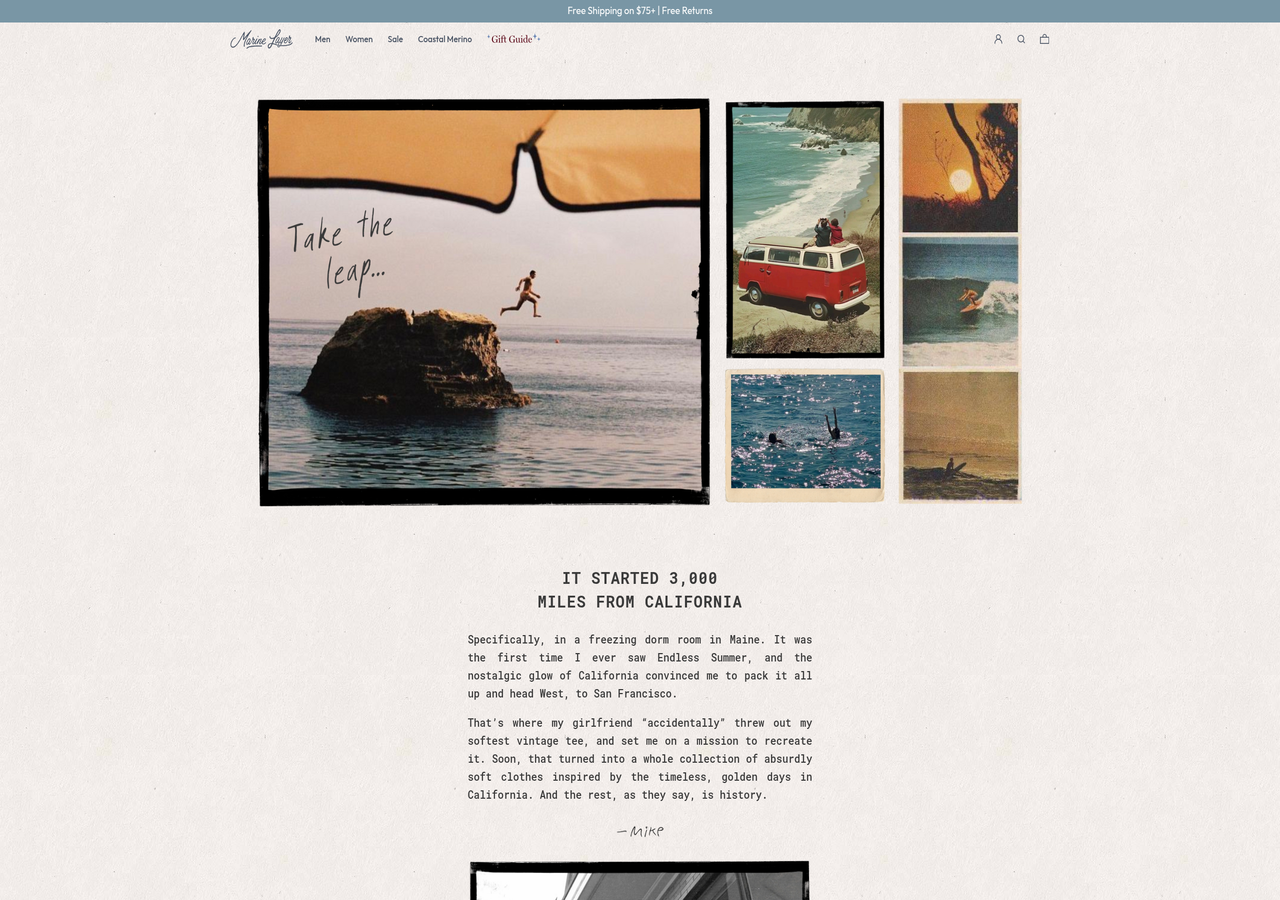
Screenshot of the Marine Layer About page, read 28 November 2026. “Take the leap…” over a cliff-jump photograph, and “It started 3,000 miles from California.”
The pop-up is the proof the story works. In 2010 Natenshon opened a two-week pop-up in San Francisco’s Marina district, meaning to collect email addresses and send people to the website. It sold $20,000 of clothes instead, and he signed a five-year lease on the same space. That shop is still the model: a store that sells, and advertises itself by existing.
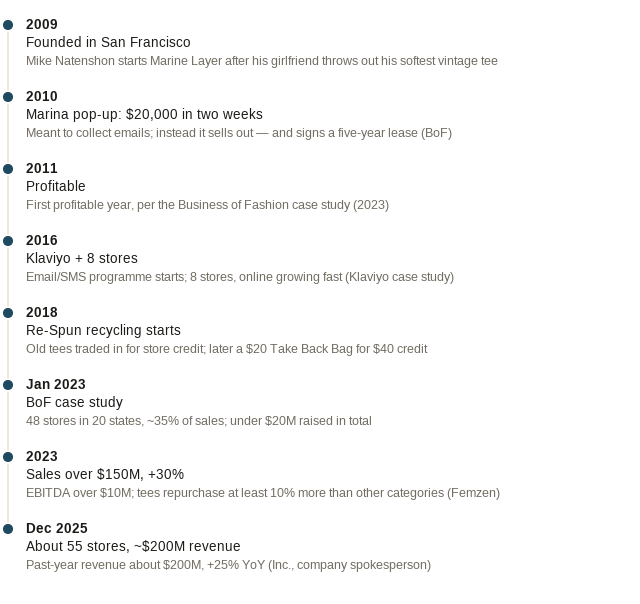
Timeline, 2009 to 2025. The pop-up came first; the profit came a year later; the stores came after that.
Profit came early and stayed. The Business of Fashion case study of January 2023 records the company as profitable since 2011 — two years after founding, and a decade before the current DTC shakeout. The same case study puts the store count at 48 in 20 states, about 35% of annual sales, with total funding under $20M through the end of 2022.
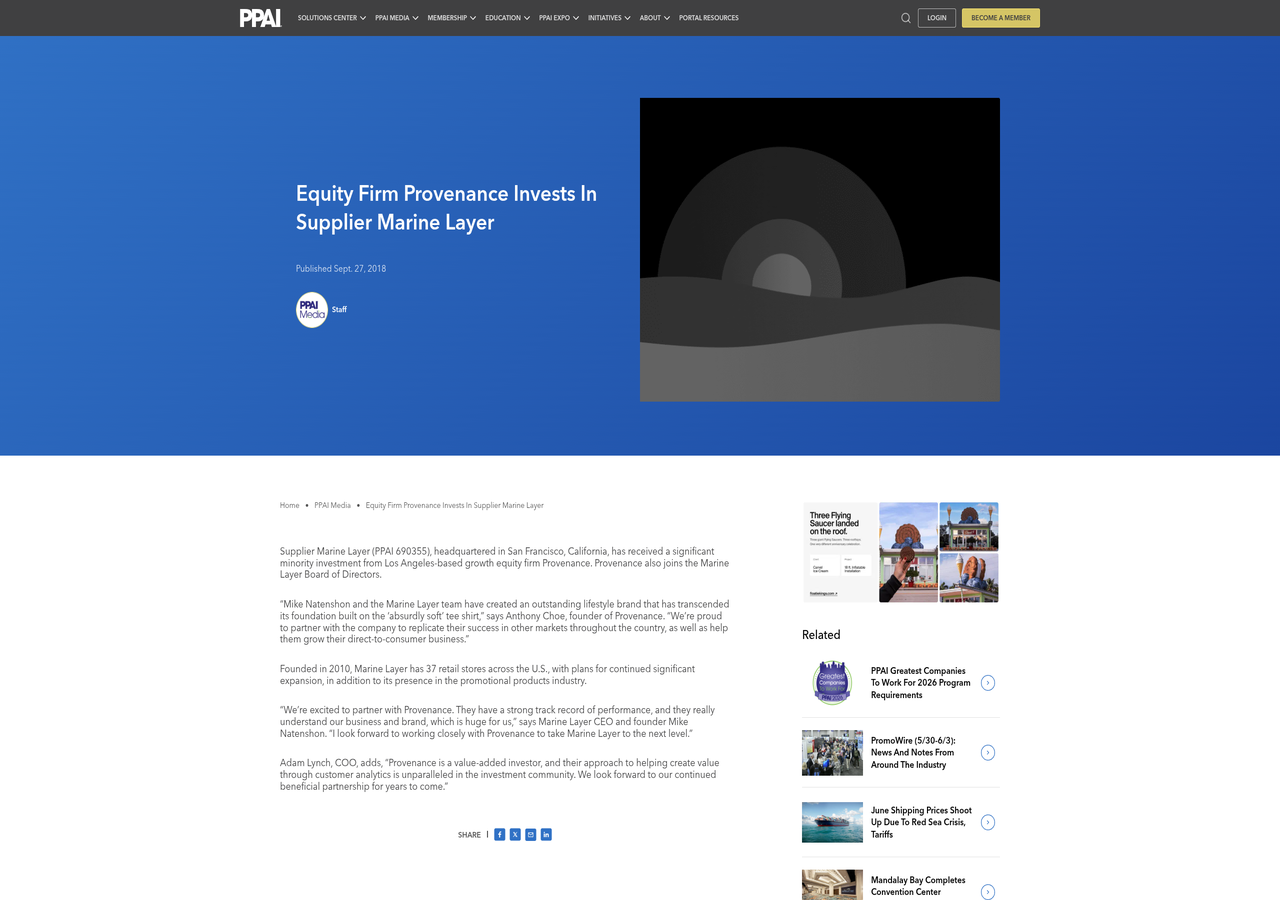
Screenshot of the PPAI article, 27 September 2018. Provenance took a significant minority investment and joined the board; the founders stayed in charge.
The funding matches the restraint. Provenance took a minority stake in 2018 and joined the board; Innovation Global Capital invested in April 2015. No investor holds a majority, and the founders still run the company — Natenshon as chief executive, Adam Lynch as chief operating officer. One third-party database puts total funding at $40.2M, but that figure counts a $2.47M pandemic-era loan; the case-study figure, under $20M raised, is the one this page uses.
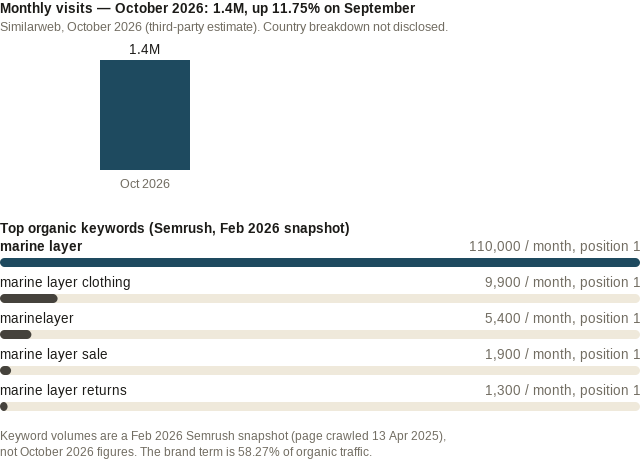
Monthly visits, Similarweb, October 2026 (third-party estimate). Keyword volumes are a February 2026 Semrush snapshot, not October figures; the brand term is 58.27% of organic traffic.
The visits follow the brand, not a generic term. October 2026 drew an estimated 1.4M visits, up 11.75% on September. The largest keyword is the brand itself — “marine layer” at 110,000 searches a month, position 1, and 58.27% of organic traffic in the February 2026 Semrush snapshot. That is the opposite of a site living on generic search: if the brand slips, the traffic slips with it.
The rest of the top five is the same story in smaller type: “marine layer clothing” at 9,900 searches a month, “marinelayer” at 5,400, then “marine layer sale” and “marine layer returns”. People arrive already knowing the name, and the sale and returns terms in the top five say the visit is often a purchase or a problem, not a browse.
The price list: $54, and the basket does the rest
Three tees, 20% off
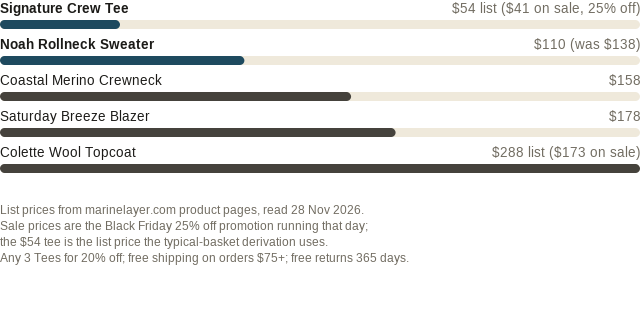
List prices from marinelayer.com product pages, read 28 November 2026. Sale prices are the Black Friday 25% off promotion running that day.
| Product | List price | Sale price | Role |
|---|---|---|---|
| Signature Crew Tee | $54 | $41 | Entry point; the tee the company started on |
| Signature Sea Change Crew Tee | $47 | — | Lower-priced tee variant (third-party) |
| Noah Rollneck Sweater | $110 | — | Mid-price knit; was $138 |
| Coastal Merino Crewneck Sweater | $158 | — | Premium knit; Coastal Merino range $158–$188 |
| Saturday Breeze Blazer | $178 | — | Often bought with the $128 chinos as a set |
| Colette Wool Topcoat | $288 | $173 | Top of the ladder; 40% off on Black Friday |
| Custom Club patch | $15 | — | Add-on; 70 designs, sewn on tees, fleece and cashmere |
The ladder runs $54 to $288, and the tee is the bottom rung on purpose. A $54 tee is expensive for a tee and cheap for the brand — cheap enough to try, dear enough to mean something. The knitwear at $110–$158 and the outerwear at $168–$288 are where the order grows, and the Black Friday cut — $288 down to $173 on the topcoat — is how the top of the ladder moves.
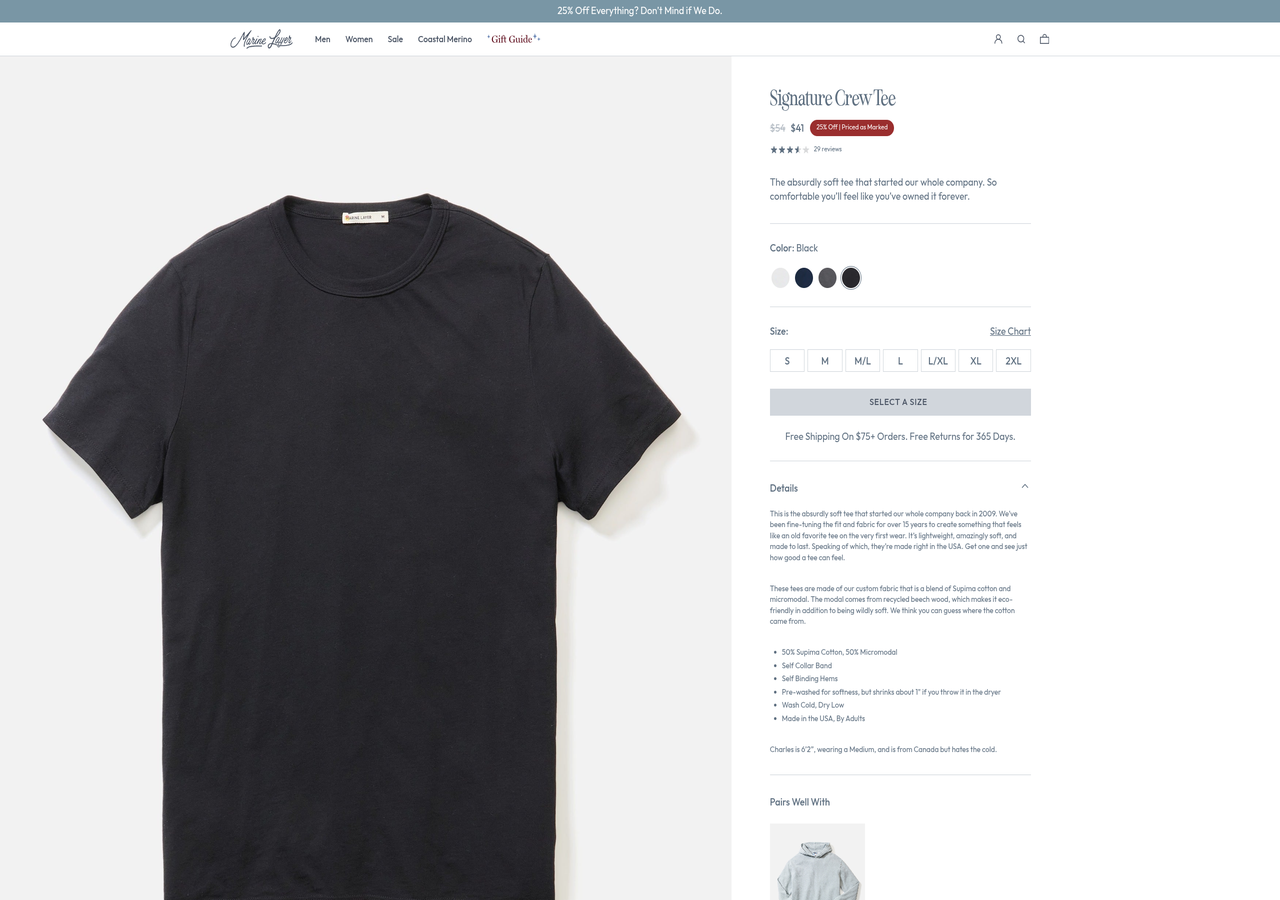
Screenshot of the Signature Crew Tee product page, read 28 November 2026. $54 list, $41 on sale; 29 reviews; free shipping on orders $75+ and free returns for 365 days.
The product page does the selling in one screen. The price sits next to the discount badge — $54 struck through, $41 in red — and the copy underneath does the rest: “The absurdly soft tee that started our whole company. So comfortable you’ll feel like you’ve owned it forever.” The fabric is named, 50% Supima cotton and 50% Micromodal, and the guarantee is printed under the buy button: free shipping on orders $75+, free returns for 365 days.
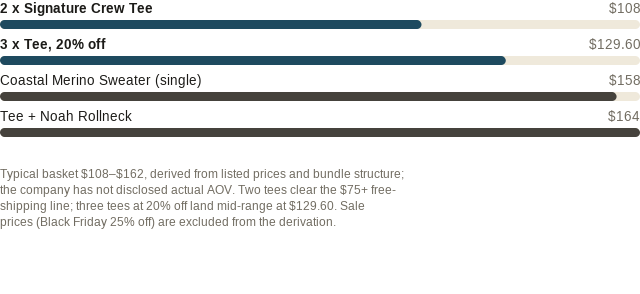
Typical basket $108–$162, derived from listed prices and bundle structure; the company has not disclosed actual AOV. Sale prices are excluded from the derivation.
The typical order is two or three tees, or a tee with something warmer. Two Signature Crew Tees come to $108 — just over the $75 free-shipping line — and three tees at 20% off come to $129.60. A tee plus a Noah Rollneck comes to $164. The range this page uses, $108–$162, is derived from those listed prices and the bundle on the product page; the company has not disclosed an actual average order value.
The bundle is the mechanism, not the discount. “Any 3 Tees for 20% Off” sits on the product page next to the price, and it turns a single-tee buyer into a three-tee buyer before the cart opens. The $75 free-shipping line does the same work from the other side: one tee at $54 does not clear it, two do.
What brings shoppers back
| Mechanism | Status | How it shows up |
|---|---|---|
| Skip / pause / cancel | — | No subscription; one-time retail, so nothing to skip or cancel |
| Free shipping | ✓ | Free standard shipping on orders $75+ (site banner, 28 November 2026); free return shipping in the US |
| Gift subscription | — | No gift subscription; gift cards $25–$500 (third-party) |
| Loyalty programme | — | Good Vibes Rewards is described in third-party sources, but the live site search returned no results on 28 November 2026 and /pages/rewards is a 404; the programme may be account-only or retired |
| First-order hook | ✓ | 15% off the first order for email or SMS signup (third-party, 2026; current rate not confirmed on the site) |
| 365-day free returns | ✓ | Almost everything returnable within 365 days, no reason needed; final sale, customised and outlet items excepted (returns policy page) |
| Re-Spun trade-in credit | ✓ | Old tees $5 each in credit, up to $25 a quarter; Take Back Bag $20 buys $40 of credit (PR Newswire, 15 February 2024) |
| Email / SMS retention | ✓ | Klaviyo-attributed revenue up 40.4% year over year; dual welcome flows for online and in-store buyers (Klaviyo case study, 2023) |
| Catalogue mail | ✓ | Print catalogues are a marketing channel (podcast summary); one buyer complained the mail kept coming after unsubscribing (Trustpilot, June 2025) |
| Store repeat visits | ✓ | Stores are a sales channel and a repeat-visit touchpoint; shoppers who buy online and in store are the most valuable (Klaviyo case study) |
| Customisation repeat | ✓ | Custom Club patches $15 each; the San Francisco custom shop became the second-highest store by sales (Inc., 29 December 2025) |
| Subscription | — | No subscription product of any kind |
There is no subscription to retain anyone, so the retention is a set of small hooks instead. The 365-day return window removes the risk of the first order. The $5 trade-in credit on an old tee removes the guilt of the second. The email flows keep the name in front of the buyer until the softness itself does the rest — tees repurchase at least 10% more than other categories, according to the 2024 Femzen analysis.
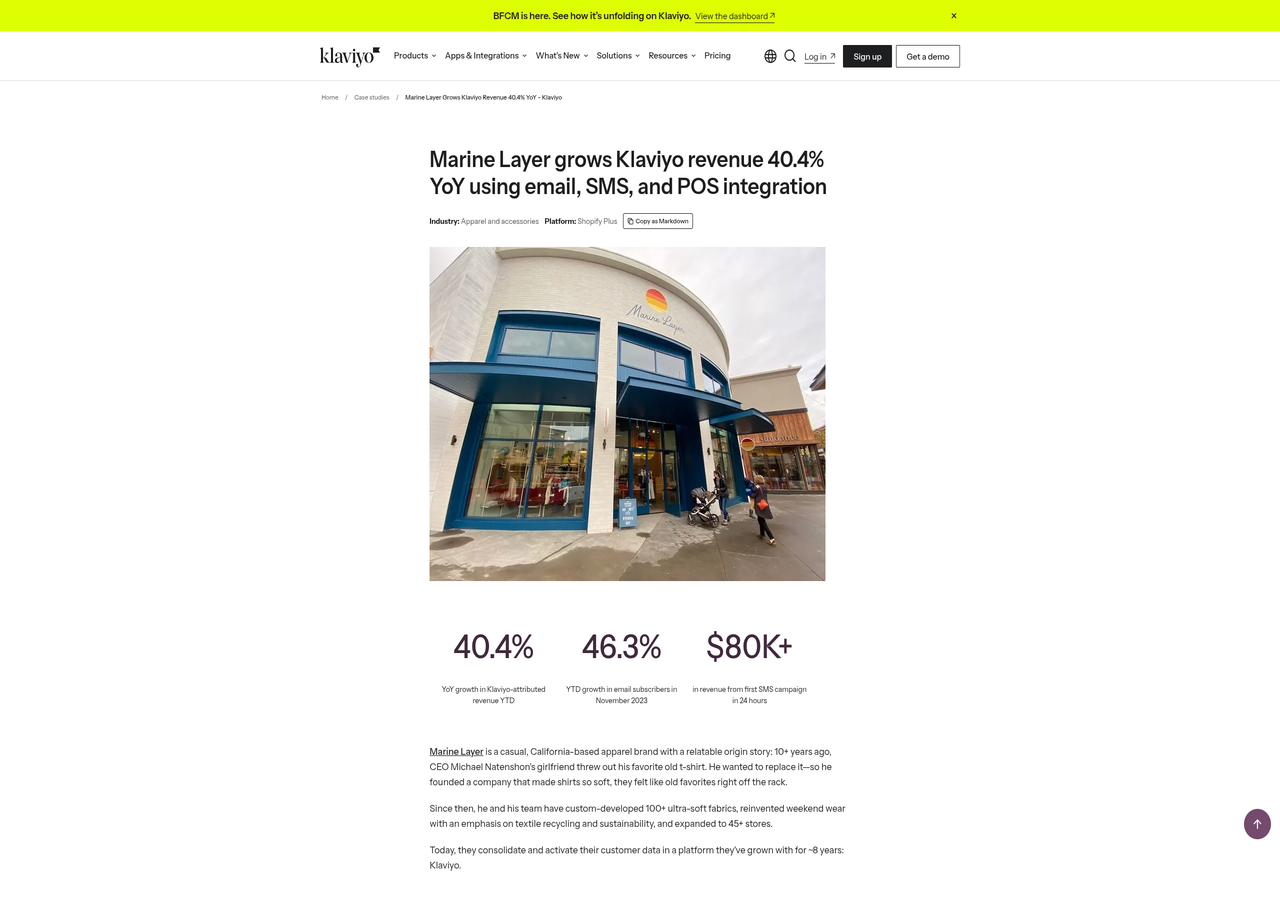
Screenshot of the Klaviyo case study. Klaviyo-attributed revenue grew 40.4% year over year; email subscribers grew 46.3%; the first SMS campaign made $80K+ in 24 hours.
The email numbers are the clearest retention signal the company has published. Klaviyo-attributed revenue grew 40.4% year over year, email subscribers grew 46.3% to November 2023, and the first SMS campaign made more than $80,000 in 24 hours. The store till feeds the same system: NewStore point-of-sale data flows into Klaviyo, so a shopper who buys in a store and online is tracked as one customer, not two.
Re-Spun is the hook with the best story. Since 2018 the company has taken back old tees for $5 of credit each, and since February 2024 a $20 Take Back Bag has bought $40 of credit. By then more than 500,000 tees had been diverted from landfill and $2M of credit issued; by July 2026 the count was 735,000 pounds, about 1.8 million tees. It is a cost, not a revenue line — but it is also a reason to come back with a bag full of old shirts.
The reviews are too thin, and too sour, to ignore
The public review record cuts against the brand story. Trustpilot shows 2.6 out of 5 from 22 reviews, unclaimed, with the past year’s reviews mostly about customer service, shipping and returns — and one buyer complaining that catalogue mail kept arriving after unsubscribing. A coupon site shows 2.3 out of 5 from 19 reviews, split between five stars and one star.
Neither sample is big enough to call a verdict, and both are skewed toward people with a complaint. The product itself scores better where it is reviewed: the Signature Crew Tee carries 4.7 stars in third-party write-ups, and one review roundup of 200-plus verified buyers found the mood positive, driven by the fabric. The gap between the product score and the service score is the risk: the tee is loved, the experience around it is not always.
The shelf is bigger than one brand
Marine Layer owns the first seat
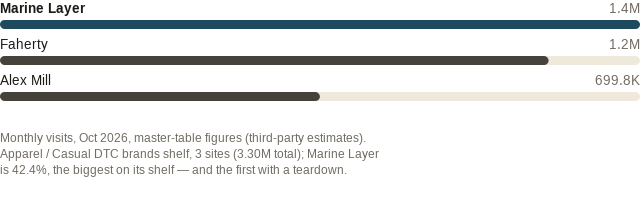
Monthly visits, October 2026, master-table figures (third-party estimates). Apparel / Casual DTC brands shelf, 3 sites (3.30M total); Marine Layer is 42.4%.
| Site | Monthly visits | Category | What it sells |
|---|---|---|---|
| Marine Layer | 1.4M | Apparel | Absurdly soft tees, sweaters and outerwear; online plus about 55 stores |
| Faherty | 1.2M | Apparel | Beach-inspired casual apparel; online plus 80+ stores and 700 wholesale points |
| Alex Mill | 699.8K | Apparel | New York basics; DTC-led plus 3 New York stores and department-store wholesale |
Three sites share the casual-apparel shelf in the database, and Marine Layer is the biggest of them at 42.4% of the shelf’s 3.30M visits. The gap is not the catalogue — Faherty has more stores and a bigger wholesale book — it is the model. Marine Layer sells one fabric story through its own stores; Faherty sells a beach lifestyle through 700 wholesale doors; Alex Mill sells New York basics through three shops and two department stores.
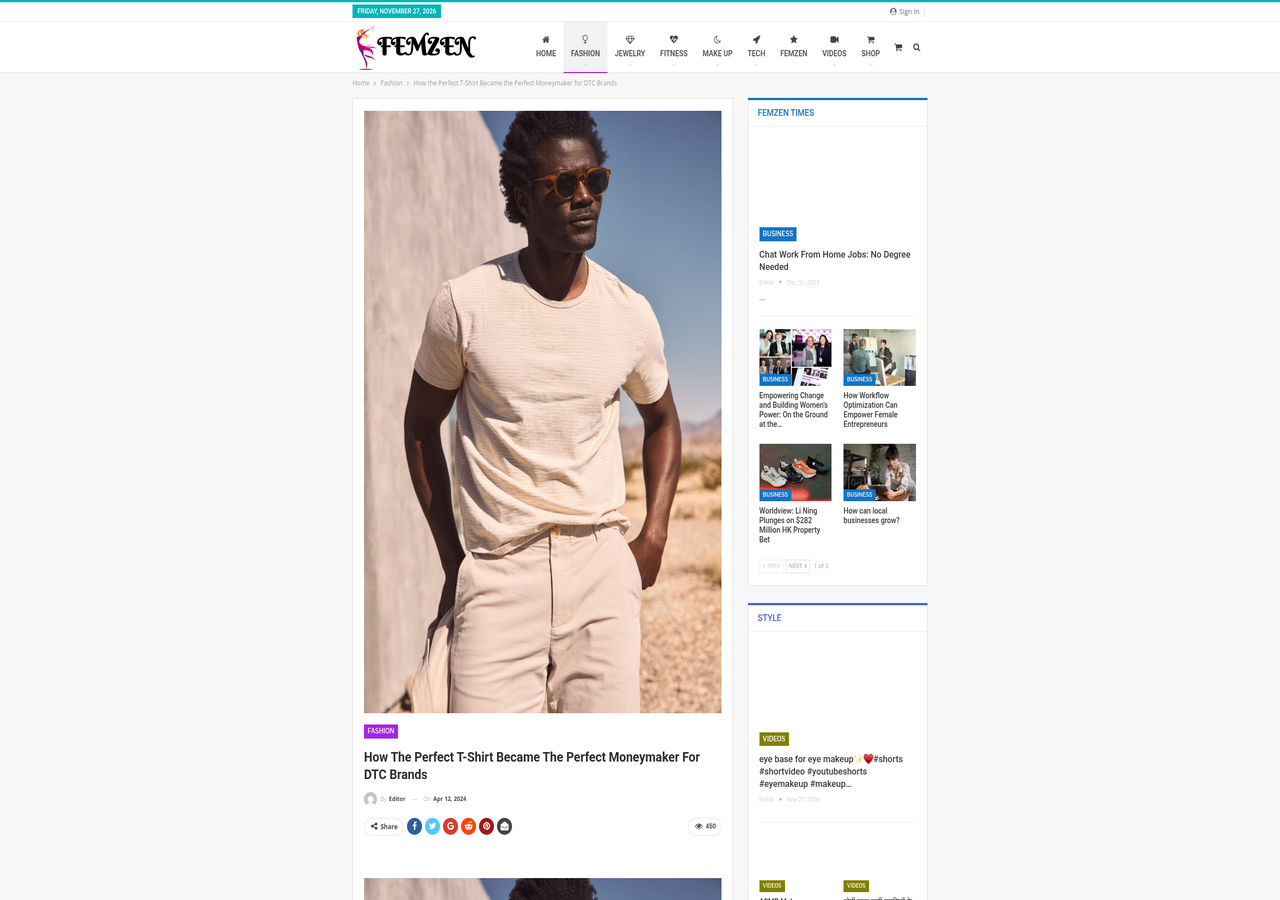
Screenshot of the Femzen article, 12 April 2024. The perfect tee became the perfect moneymaker: Marine Layer passed $150M in 2023 sales, up 30%, with EBITDA over $10M.
The Femzen comparison puts the scale in context. In 2023 True Classic did $207M in sales, up 40%, and was seeking a $1B valuation; Buck Mason grew its tee business more than 40% a year and used the profit to buy a Pennsylvania knitting mill in December 2022. Marine Layer did over $150M, up 30%, with EBITDA over $10M — the smallest of the three, and the only one profitable since 2011.
The positioning splits three ways. True Classic sells multi-packs — three, six or nine tees for $60 to $130 — and uses high-priced categories as gifts to lift the order. Buck Mason sells fabric iteration and its own factory. Marine Layer sells the softness, the store and the trade-in credit — and it is the only one of the three that treats the physical store as the acquisition channel.
Where the visits come from
Direct, Google, and the store down the street
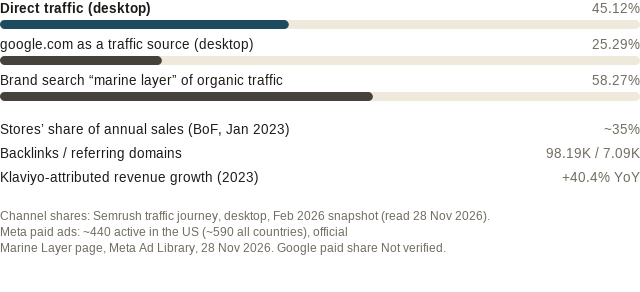
Channels and ad counts. Shares are Semrush, February 2026 snapshot, desktop traffic journey; the Meta count is a live-browser Ad Library check, 28 November 2026.
| Channel | Share of visits | Platform & stack |
|---|---|---|
| Direct traffic | 45.12% | Semrush, February 2026 snapshot (desktop) |
| google.com | 25.29% | Semrush traffic journey, February 2026 snapshot (desktop) |
| Brand search “marine layer” | 58.27% of organic traffic | 110,000 searches a month, position 1 (Semrush, February 2026 snapshot) |
| Stores | ~35% of annual sales | 48 stores in 20 states (Business of Fashion, January 2023); about 55 by December 2025 |
| Meta paid ads | Active — ~440 in the US (~590 all countries) | Meta Ad Library, 28 November 2026; official page Marine Layer @marinelayer, page ID 66222681822 |
| Google paid ads | Not verified | Semrush snapshot shows paid search up 85.48% but gives no share or count |
| Email / SMS | Not verified as a share | Klaviyo-attributed revenue up 40.4% year over year (Klaviyo case study, 2023) |
| Referring domains | 7.09K | Backlinks 98.19K (Semrush, February 2026 snapshot) |
Direct traffic is the largest share at 45.12%, with google.com at 25.29% — both desktop figures from the February 2026 Semrush snapshot, not the October month of the 1.4M total. The brand term is more than half of organic traffic, so the site lives or dies on people typing its name — and on the stores that put the name in front of them.
Paid is not the blank it looked like. The Ad Library text fetch returned 403, but the live-browser check found about 440 active ads in the US on the official Marine Layer page, about 590 across all countries, most started in November 2026 and landing on marinelayer.com.
The Semrush snapshot adds that paid search rose 85.48% without giving a share or a count. The store is still the paid channel the company talks about: the chief marketing officer joked that the only marketing spend was rent, and the 2010 pop-up proved the point by selling $20,000 in two weeks.
| Layer | What it runs on |
|---|---|
| Platform | Shopify Plus (Klaviyo case study; homepage images carry cdn/shop/files) |
| Store POS | NewStore (Klaviyo case study; store purchases feed Klaviyo) |
| Email / SMS | Klaviyo, in use since 2016 (Klaviyo case study) |
| Payments | PayPal and Shop Pay (third-party, 2026); checkout page not read this round |
| Inventory | Shared cross-channel stock (podcast summary); ship-from-store (trade press, July 2026) |
| Support | Phone and ohhey@marinelayer.com; returns portal at returns.marinelayer.com |
| Reviews | On-site product reviews (Signature Crew Tee 4.7 stars, third-party); Trustpilot unclaimed, 2.6/5 from 22 reviews |
| Advertising pixels | Not verified — no pixel found in the stack this round |
The stack is a bought-in Shopify Plus storefront with Klaviyo doing the customer work and NewStore tying the tills to the website. The interesting part is what is not in the stack: no subscription billing, no custom platform, no loyalty software named on the site. The retention runs on the point-of-sale data and the email flows, not on new technology.
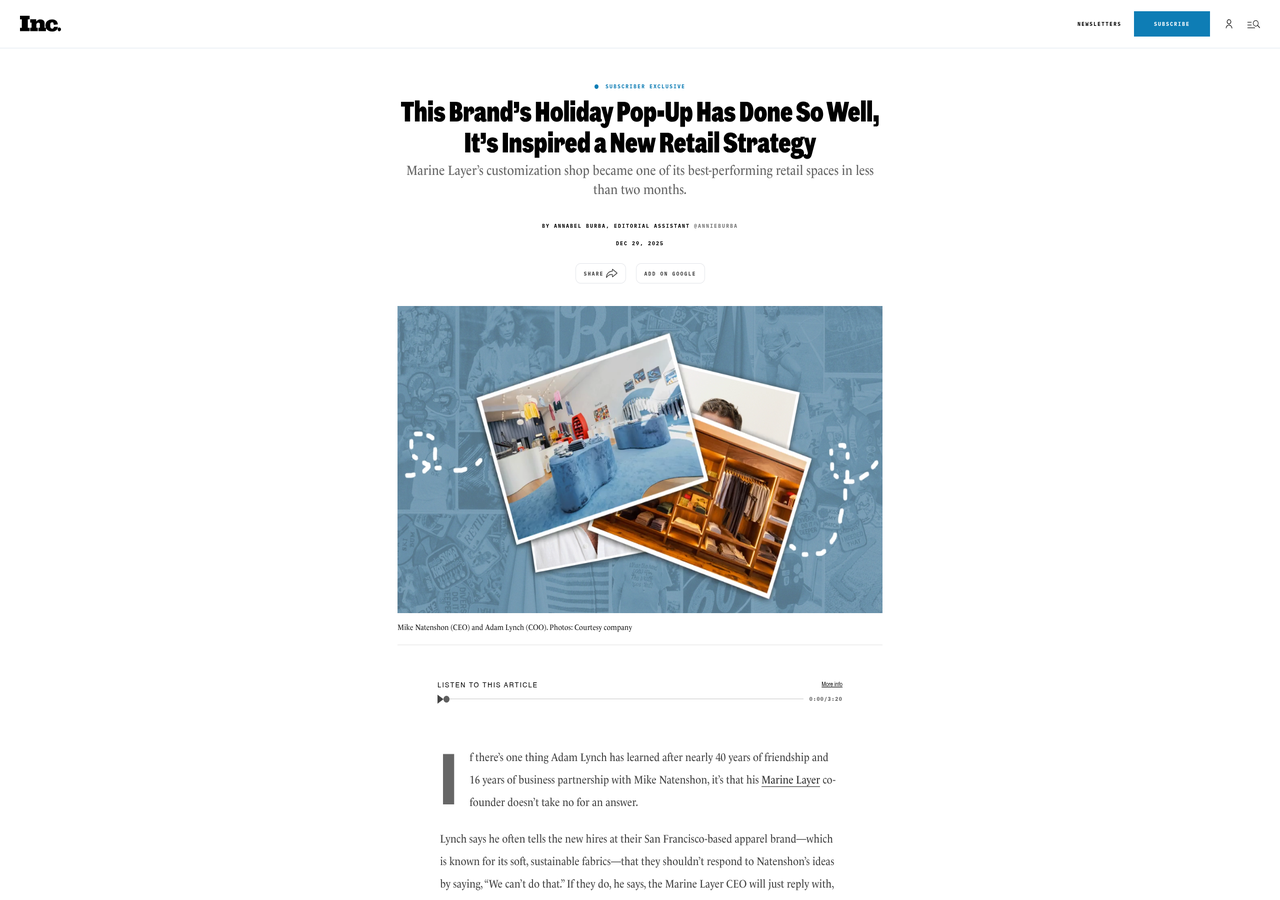
Screenshot of the Inc. article, 29 December 2025. The holiday customisation pop-up became one of the best-performing retail spaces in under two months; about 55 stores, about $200M revenue in the past year.
The newest store idea is the custom shop. In October 2025 the company opened two Custom Club pop-ups, in New York and San Francisco, selling 70 patches at $15 each to sew onto tees, fleece and cashmere.
The San Francisco shop became the second-highest store in the company by sales, and the first per square foot, in under two months. The plan is to roll the custom bar out to 10 to 15 permanent stores in 2026 — the same pop-up logic as 2010, with a patch instead of a tee.
The store count keeps moving. The Business of Fashion case study counted 48 stores in January 2023; a December 2025 Inc. article counted about 55, with comparable store sales up 15% over six months; a 2026 trade video counts 57. The stated goal, from March 2023, is to double from about 50 to 100 stores within a few years — which makes rent the biggest bet the company is making.
Marine Layer is the first teardown in our Apparel · Casual DTC brands collection. The nearest rival on the shelf is Faherty at 1.2M visits a month, and the most useful side-by-side is Marine Layer vs Faherty vs Alex Mill. For the closest rival by traffic, see the True Classic teardown.
The full teardown is for members
The full breakdown is for members: the $54 math, the stores in detail, the founders and the funding — and what a founder should copy, and what not to.
Similar sites in the database
Marine Layer (1.4M) sits just below Thuma and just above BaubleBar in the database. The sites nearest to it on traffic are shown below.
| Site | Monthly visits | Category |
|---|---|---|
| Boll & Branch | 1.43M | Home / Bedding DTC |
| Thuma | 1.4M | Home · Bedroom furniture DTC brands |
| Marine Layer (marinelayer.com) | 1.4M | Apparel |
| BaubleBar | 1.4M | Jewelry · Affordable luxury fashion jewelry DTC brands |
| Papier | 1.4M | Stationery · Personalised paper DTC brands |
| Crisp | 1.4M | Customer support · Omnichannel messaging |
| MagicEraser | 1.37M | Image tools |
Related teardowns
- True Classic — 1.6M visits a month, the tee-led DTC brand that did $207M in 2023 sales.
- Bombas — 4.67M visits a month, the biggest apparel DTC brand in the database.
- Rhoback — 1.7M visits a month, high-performance golf apparel sold direct.
Read the next one in your inbox
The new ones go out by email first, one a week, with the traffic source and month attached to every number. Leave your address and the next one comes to you.