
How MindMeister makes money from free maps
Monthly visits
1.98M
October 2026. Third-party estimate, not official MAU/DAU. Semrush counted 1.98M for the month, up 8.62% on September.
MindMeister draws an estimated 1.98M visits a month (October 2026, Semrush), up 8.62% on September. It is the 229th-largest site in our database of 901, just behind FabFitFun at 2M and ahead of TTSMaker at 1.97M.
MindMeister gives away three free maps, then charges $6.50 a month per seat — and the fourth map is where the money starts.
| Site | MindMeister, mindmeister.com |
|---|---|
| What it is | A browser-based mind mapping tool: AI-generated maps, real-time collaboration and presentation mode, plus MeisterTask integration |
| Who it is for | People who draw mind maps for brainstorming, project planning and study notes, as individuals and in teams |
| Category | Mind mapping · Mind mapping / collaboration tools |
| Monthly visits | 1.98M, October 2026. Third-party estimate, not official MAU/DAU; Semrush, up 8.62% on September |
| Founded | 2007, launched 7 February 2007 as a private beta; the Meister company was founded in 2006 (TechCrunch, 27 September 2015; Starter Story, 4 November 2019) |
| Headquarters | Vienna, Austria, as the company describes it; the legal entity, MeisterLabs GmbH, is registered in Vaterstetten, Germany (Kinescope, checked 15 October 2026) |
| Operator | MeisterLabs GmbH (Meister), private; founded by Till Vollmer (CEO) and Michael Hollauf (CPO), still in charge; Verdane led a $52M growth financing round in July 2021, with no majority stake evidenced |
| Survival engine | Repeat buying, with the free funnel behind it. Three free maps and 500 AI credits a month pull in 1.98M visits; the fourth map, exports and more AI credits sit behind a $6.50-a-month seat |
| Pricing | Free $0 (3 mind maps); Personal $6.50/user/month, Pro $10.50, Business $15.50, all per user per month on annual billing; 6-month billing $7.50/$12.50/$19. Source: the site’s own pricing page, read 26 November 2026 |
| Pricing model | Freemium subscription, per user per month; annual or 6-month billing, no monthly-only option |
| Typical basket (derived) | Derived from listed prices and bundle structure (November 2026): a typical paying user costs $6.50–$10.50 per user per month on annual billing, so a single-seat annual order is $78 (Personal) to $126 (Pro) a year, $186 on Business; a five-seat Pro team pays $630 a year. MindMeister does not disclose real average order value, so this is a derivation, not a company figure |
| Free hook | Three free mind maps, 500 AI credits a month, no credit card; students and educators pay half price |
| Meta ads | Not verified — the Ad Library returned access denied on 26 November 2026, which does not mean no ads are running |
| Country breakdown | Brazil 30.61% (606.87K); United States 18.22% (361.29K); Japan 9.1% (180.51K). Semrush, October 2026 |
| Audience | Not verified — neither Similarweb nor Semrush publishes age or gender breakdowns for mindmeister.com on its public overview page (checked 26 November 2026) |
TL;DR
- MindMeister lets anyone draw three mind maps free, with 500 AI credits a month and no credit card. The fourth map, file exports and more AI credits cost $6.50 a user a month on the Personal plan.
- The founder says the business was close to $10 million in annual recurring revenue in 2019, and that 80% of revenue came through the website and the app stores. No revenue figure has been published since.
- Trustpilot scores the site 4.0 out of 5 from 162 reviews, but 48% of those reviews give one star, mostly about renewals that arrived with no reminder and refunds that were refused.
Three free maps, then the wall
Nineteen years of the same funnel
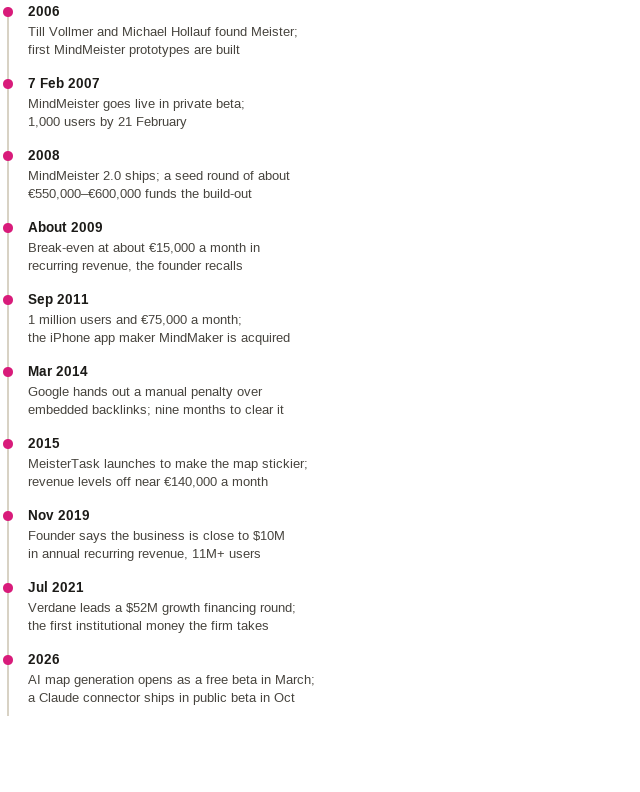
Company history; TechCrunch, 27 September 2015; Starter Story, 4 November 2019; Tech.eu, 14 July 2021; Kinescope, checked 15 October 2026.
MindMeister went live as a private beta at 7 p.m. on 7 February 2007, with 200 invites sent to friends and business contacts. By 21 February it had 1,000 users, and by May it had 10,000 — on monthly recurring revenue of just €180.
The founders, Till Vollmer and Michael Hollauf, had built the tool because they were collaborating in Google Docs and brainstorming in MindManager, a $300 desktop program that could not collaborate at all. The idea was to combine the two: a mind map that lived in the browser and let everyone edit it together.
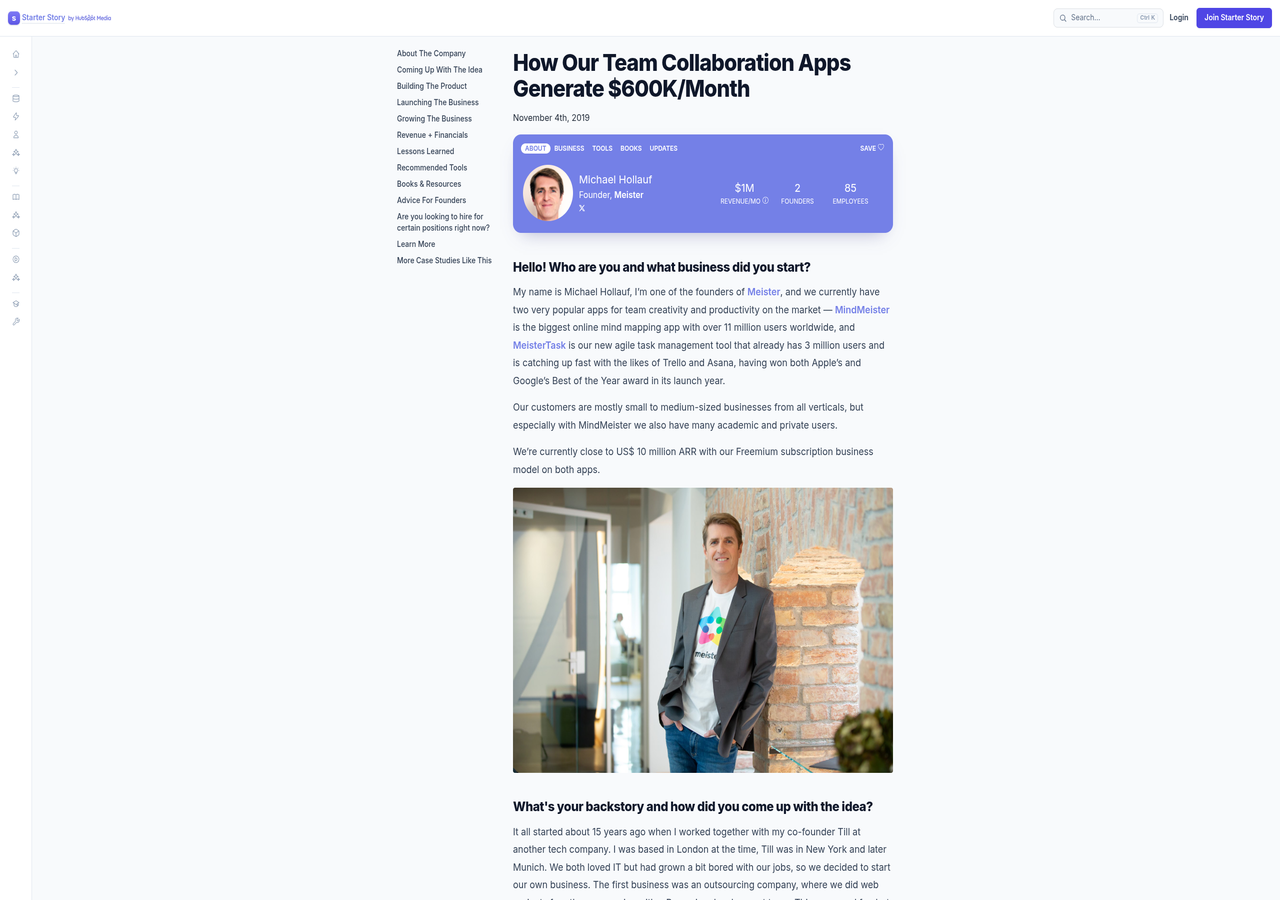
Starter Story, 4 November 2019. The founder puts the business close to $10 million in annual recurring revenue, with over 11 million users.
The numbers the founder tells are the only revenue numbers that exist. Monthly recurring revenue passed €6,000 in June 2008, broke even near €15,000 around 2009, reached €75,000 by September 2011 with a million users, and levelled off near €140,000 a month after 2013. In November 2019 he put the business close to $10 million in annual recurring revenue.
Nothing has been published since. The 2019 interview is also the newest headcount: just over 50 people across offices in Munich, Vienna and Seattle, with a three-person sales team for enterprise customers and 80% of revenue arriving through the website and the app stores.
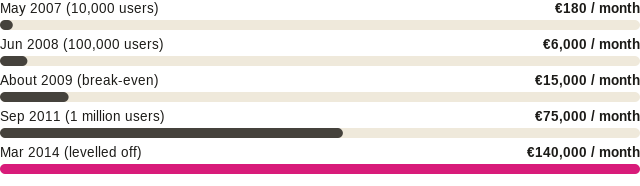
Monthly recurring revenue milestones, as the founder told them to TechCrunch, 27 September 2015. No figure has been published since 2019.
The funding story is short. A seed round of about €550,000 to €600,000 in 2008 — the two sources disagree on the number — was the only outside money for thirteen years. Then, in July 2021, Verdane led a $52 million growth financing round, the first institutional money the firm had taken.
Verdane is a private equity firm, which is why the stake matters. No public source says Verdane took a majority stake, and both founders still run the company — Vollmer as chief executive, Hollauf as chief product officer. On the published record, the round was growth financing, not a takeover.
The penalty that nearly killed it
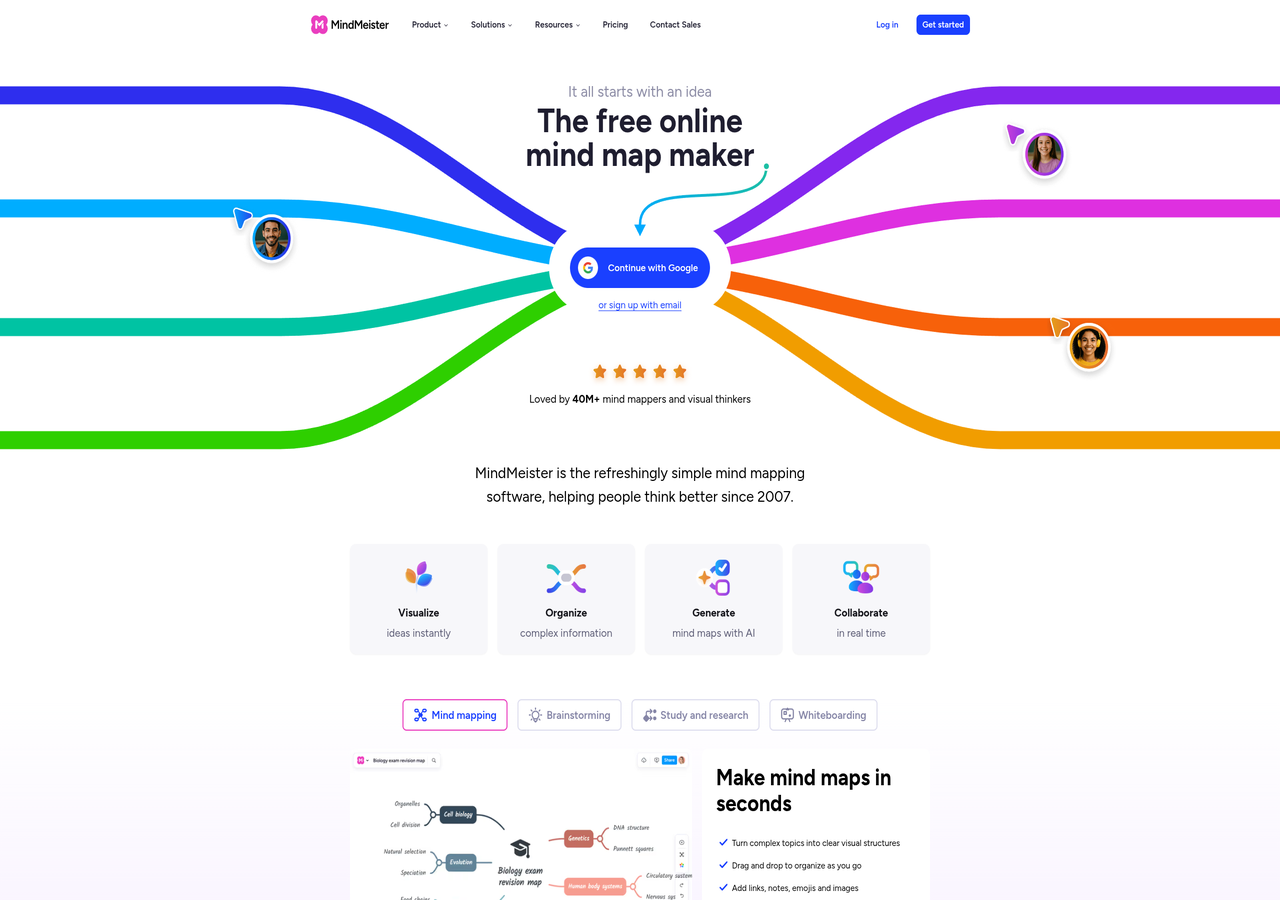
Screenshot of the mindmeister.com homepage, read 26 November 2026. The free map maker is the offer; 40M+ users is the site’s own claim, not a verified count.
The homepage sells the free tier first: “It all starts with an idea”, “The free online mind map maker”, “No download. No credit card. Just open your browser and go.” Under the five-star mark it says the tool is loved by 40M+ mind mappers — a company claim, not a verified count.
The claim has moved over the years: nearly 4 million users in 2015, over 11 million in 2019, over 25 million on the Capterra listing, 40M+ on the homepage today. The numbers rise, but none of them has ever been audited, so this page treats the 40M+ as a slogan, not a fact.
The business has survived one near-death already. In March 2014 Google handed out a manual penalty because MindMeister had encouraged websites embedding its maps to link back to the homepage. Search rankings fell from first place to the second or third page, and it took nine months of emailing site owners, begging them to remove the links, before Google lifted the penalty on 23 December 2014.
Growth fell from 30–40% a year to 15% that year. The founder still counts the penalty as a €400,000 loss. A business that lives on brand search cannot afford to lose Google, and MindMeister learned that the expensive way.
The price list: $6.50 a seat, $78 a year
What three free maps buy you
| Plan | Price | What it is |
|---|---|---|
| Free | $0 forever | 3 mind maps, 500 AI credits a month, unlimited collaborators, templates, presentation mode |
| Personal | $6.50 / user / month | Annual billing ($78 a year); unlimited maps, 2,000 AI credits, file exports, 2 attachments per map |
| Pro | $10.50 / user / month | Annual billing ($126 a year); 5,000 AI credits, unlimited attachments and version history |
| Business | $15.50 / user / month | Annual billing ($186 a year); unlimited AI credits, group sharing, SAML SSO, dedicated success manager |
| 6-month billing | $7.50 / $12.50 / $19 | Personal / Pro / Business per user per month on a 6-month term; annual billing saves up to 18% |
| Academic discount | 50% off | Students, educators, educational institutions and non-profits pay half price on paid plans |
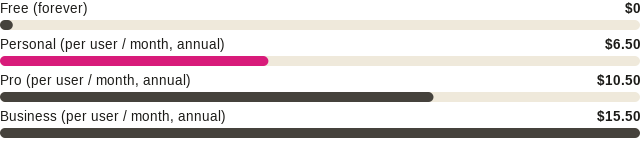
Plan prices, own site, November 2026. Annual billing is the default; there is no monthly-only option on the web.
The wall is a count, not a timer. Three maps are free, with 500 Meister AI credits a month — enough for five map creations or edits, at 100 credits each — and unlimited collaborators on those three maps. The fourth map, file exports and more AI credits need a paid seat.
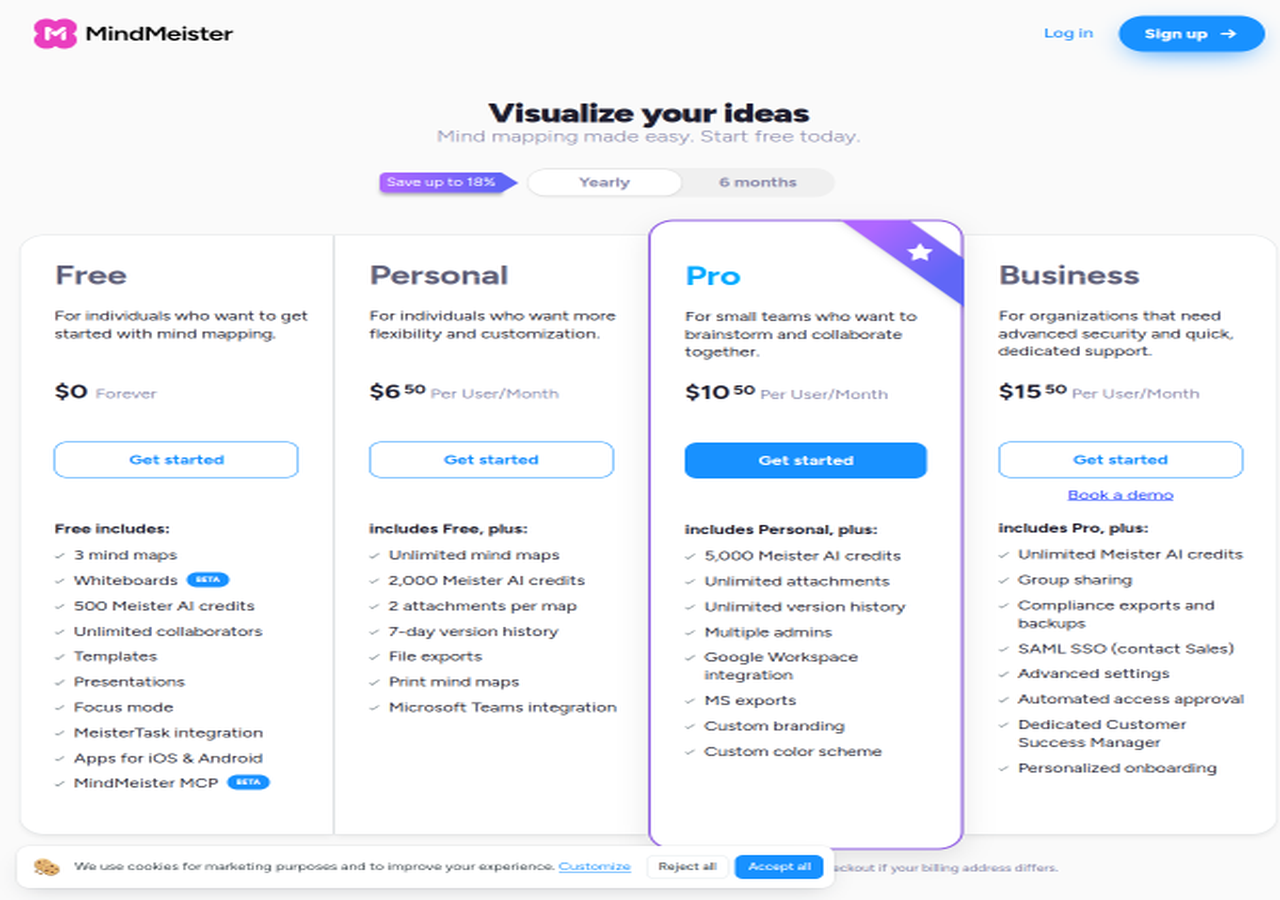
Screenshot of the mindmeister.com pricing page, read 26 November 2026. Annual billing is the default; the 6-month option costs more per month.
The pricing page confirms the numbers the database already held: Personal $6.50, Pro $10.50 and Business $15.50 per user a month on annual billing, with a Yearly and a 6 months toggle and up to 18% saved on the annual term. There is no monthly-only option on the web, which is the single most complained-about feature in the reviews.
AI credits are the second wall. The free plan gets 500 a month, Personal gets 2,000, Pro gets 5,000 and Business gets unlimited, resetting on the first day of each month. In March 2026 AI map generation opened as a free beta on all plans; by October 2026 there was a Claude connector and a public beta of a server for Claude.
No monthly billing, no pause button
| Mechanism | Status | What we found |
|---|---|---|
| Free tier | ✓ | Free $0: 3 mind maps, 500 AI credits a month, unlimited collaborators (pricing page) |
| No registration | — | An account is required; sign up free, no credit card needed |
| Free trial | ✓ | One-week Personal trial on the App Store channel; on the web the free tier is the trial |
| Ads | — | No on-site ads found; Meta ad spend Not verified |
| API | ✓ | Claude connector and MCP server in public beta (October 2026); MeisterTask integration |
| Skip a payment | — | No skip mechanism found; the subscription renews until cancelled |
| Pause subscription | — | No pause mechanism found |
| Cancel anytime | ✓ | Cancel in Account > Plans; one month’s notice after the first term, paid features run to term end |
| Auto-renewal terms | ✓ | Renews automatically by default; a yearly plan cancelled right after renewal refunds 11 of 12 months |
| Free shipping | — | Not applicable; a software subscription with no physical goods |
| Gift subscription | — | No gift subscription found |
| Loyalty programme | — | No loyalty programme found |
| First-order hook | ✓ | Three free maps with no credit card; 50% off for students and educators |
Cancelling is documented and exacting. A consumer who cancels within 14 days of the first purchase gets a full refund. After the first term, cancellation takes one month’s notice — so a yearly plan cancelled right after renewal refunds 11 of the 12 months. Business customers get no revocation right and no refund on renewals, and must give 30 days’ notice.
That notice period is where the complaints live. Reviewers write that annual renewals arrived with no reminder, and that refunds were refused after the charge had already landed. One reviewer quoted a $419 renewal for four users on a six-month term, refused in full. The policy is published; the reminder is what people say is missing.
The retention design that is not in the table is the second product. MeisterTask launched in 2015 precisely because the founder saw churn catching up with acquisition: a task manager is more business-critical than a mind map, he reasoned, so turning maps into tasks would make the whole suite stickier. Eleven years later, the integration is still on the pricing page.
The $4.92 neighbour
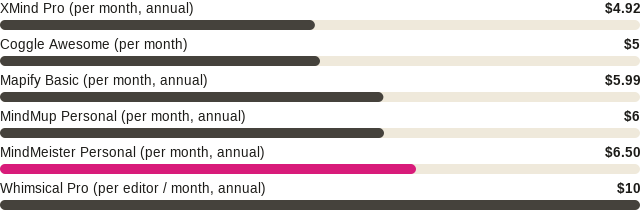
Rival entry prices, third-party price checks, October 2026. MindMeister sits in the middle of the band.
By price, MindMeister sits in the middle of its own category. XMind Pro costs $4.92 a month on annual billing, Coggle Awesome $5, Mapify Basic $5.99 and MindMup Personal $6 — all below MindMeister’s $6.50. Whimsical Pro, at $10 an editor a month, is the only one above it.
The free tiers tell the same story from the other side. Three free maps is the common ceiling: MindMeister, Coggle and MindMup all stop at three, while XMind gives ten online maps free. Coggle’s extra is unlimited public diagrams; XMind’s is a desktop app that works offline.
What MindMeister charges for is the team layer: real-time collaboration, comments and @mentions, presentation mode, and the MeisterTask bridge that turns a branch into a task. The map itself is free; the meeting around it is the product.
A 1.98M month, mostly desktop
Half the visits arrive direct

Traffic journey, Semrush October 2026, desktop. Direct is first at 50.14%; the full-device split is not published.
October’s 1.98M is a Semrush figure, up 8.62% on September — but September itself fell hard, from 3.04M in August to 1.83M. October is a recovery, not a record, and the swing is the first thing to say about the number.
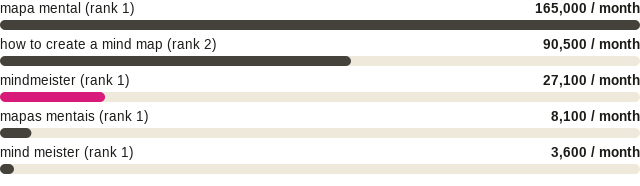
Top keywords, Semrush October 2026. The biggest keyword is Portuguese, matching Brazil’s 30.61% share of visits.
The keyword list explains the map. The biggest search term is not the brand but the Portuguese “mapa mental”, at 165,000 searches a month — and Brazil is 30.61% of all visits, the largest country by far. The brand word “mindmeister” is worth 27,100 searches a month, a quarter of all organic traffic.
| Channel | Share of visits | Platform & stack |
|---|---|---|
| Direct | 50.14% of traffic journey, first place | Semrush, Oct 2026, desktop |
| google.com | 9.89% of traffic journey, second place | Semrush, Oct 2026, desktop |
| Organic search | Brand word 25.26% of organic traffic | Semrush, Oct 2026 |
| Paid search | Down 86.83% month on month; absolute value not shown | Semrush, Oct 2026 |
| AI referrals | ChatGPT 2K, Gemini 2K, Perplexity 436 visits | Semrush, Oct 2026 |
| Backlinks | 10.71M backlinks; 61.05K referring domains | Semrush, Oct 2026 |
| Drip emails exist (2019 founder interview); list size Not verified | Starter Story, Nov 2019 | |
| Meta ads | Not verified — the Ad Library returned access denied on 26 November 2026 | Meta Ad Library, 26 Nov 2026 |
Desktop does the work. In Brazil 95.27% of visits are desktop, in the United States 94.72% and in Japan 93.09%. A mind map is a wide canvas, and this one is drawn at a desk, not on a phone.
Direct traffic at 50.14% is the number that matters most. Half the visits arrive without a search or a link, which is what nineteen years of the same name buys. The founder said in 2019 that the biggest slice of the marketing budget went to Google Ads; Semrush now shows paid search traffic down 86.83% in a month, with no absolute value published.
The stack is bought, not built
| Area | What we found |
|---|---|
| Platform | Next.js, with Storyblok as the content layer (homepage image paths); WordPress for the blog (2019) |
| Hosting | Google Cloud; servers in an ISO 27001-certified data centre in Frankfurt, Germany |
| Payments | Card or PayPal (pricing page FAQ) |
| Analytics | Google Analytics, Amplitude, Sistrix (2019 founder interview) |
| Content | Storyblok (current, homepage CDN); WordPress (2019) |
| Email marketing | Not verified — drip emails exist, the provider is not named |
| Subscription tech | Not verified — no Recharge evidence; self-built SaaS billing plus App Store and Google Play billing |
| AI layer | Meister AI, metered by credits (100 credits per map generation); Claude connector and MCP server in public beta |
The stack is bought, not built, and the paperwork proving it is seven years old. A 2019 interview lists Google Cloud hosting, Google Analytics, Amplitude and Sistrix, and a WordPress blog; the only current fingerprint is the Next.js site and the Storyblok content network serving the homepage images.
Two details in the fingerprint are the product. Hosting in Germany, ISO 27001 certification and GDPR compliance sit on the homepage itself, and the founder said in 2019 that German-region users choose the tool partly for the server location. Security is a feature here, not a footnote.
What the company does not say
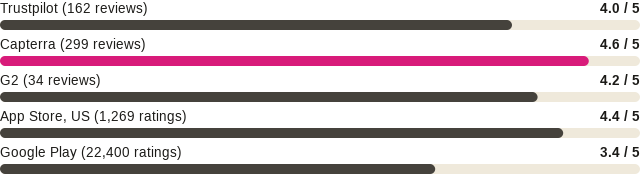
Third-party ratings, read 26 November 2026. Capterra also shows a second reading of 4.7 from 565 reviews; this page uses the 4.6 reading.
Trustpilot tells the other side of the story in numbers. The site scores 4.0 out of 5 from 162 reviews, read 26 November 2026, up from 3.9 in a check six weeks earlier. Under the headline, 48% of the reviews give one star, and the complaints repeat: renewals with no reminder, refunds refused, a cancel button that some users say does not work.
The app stores split the same way. The iOS app scores 4.4 out of 5 from 1,269 ratings in the United States; Google Play sits at 3.4 from 22,400 ratings. Capterra gives 4.6 from 299 reviews, though a second reading puts it at 4.7 from 565. G2, with only 34 reviews, gives 4.2 and names the three-map free limit as the most common complaint.
Three things should not be quoted as facts. No revenue figure has been published since 2019, so the $10 million ARR is a founder interview line, not a current result. The 40M+ users is the site’s own slogan. And the seed round is either €550,000 or €600,000, depending on which founder interview is read.
The open question is whether the AI layer changes the funnel. Meister AI now builds a map from a prompt or a file, and the credits for it are metered by plan — which gives the free tier a new reason to exist and the paid tiers a new reason to upgrade. The defence is the part that cannot be copied cheaply: nineteen years of the same name, half the traffic arriving direct, and a map that turns into a task list.
MindMeister is the first site in the mind mapping tools collection. Its closest pattern match among published teardowns is Excalidraw — a free diagramming canvas at 4.13M–4.57M visits a month, against MindMeister’s 1.98M.
MindMeister against its closest matches: compare MindMeister with Coggle and Whimsical side by side. The closest pattern matches among published teardowns are Excalidraw and diagrams.net — one sells nothing and lives on its ecosystem, the other is free with paid apps in the Atlassian store.
The full teardown is for members
The full analysis of pricing, acquisition, conversion and retention is member content. Membership is $29 a month or $249 a year.
Similar sites in the database
MindMeister (1.98M) sits between FabFitFun (2M) and TTSMaker (1.97M) in the database.
| Site | Category | Monthly visits | Source |
|---|---|---|---|
| Made In | Kitchen · Cookware DTC brands | 2.19M | Semrush, Oct 2026 |
| KEEN | Footwear · Outdoor shoes DTC brands | 2.1M | Similarweb, Oct 2026 |
| PDFCandy | PDF tools | 2.09M | Semrush, Oct 2026 |
| Withings | Health tech · Smart health devices DTC brands | 2.01M | Semrush, Oct 2026 |
| FabFitFun | Subscription · Quarterly beauty & lifestyle box DTC brands | 2M | Similarweb, Oct 2026 |
| MindMeister | Mind mapping · Mind mapping / collaboration tools | 1.98M | Semrush, Oct 2026 |
| TTSMaker | AI voice tools | 1.97M | Semrush, Oct 2026 |
Compare MindMeister with Coggle and Whimsical side by side. The full database, with working filters, is on the teardowns index.
Read the next one in your inbox
The new ones go out by email first, one a week, with the traffic source and month attached to every number. Leave your address and the next one comes to you.