
How Noom makes money on a $70 subscription
Monthly visits
1.69M
October 2026. Third-party estimate, not official MAU/DAU. Semrush counted 1.69M for the month.
Noom draws an estimated 1.69M visits a month (October 2026, Semrush). It is the 263rd-largest site in our database of 922, tied at 1.69M with Xero Shoes, just behind Rhoback and KÜHL at 1.7M.
| Site | Noom, noom.com |
|---|---|
| What it is | A subscription weight-management app: psychology-based behaviour courses, coaching, food logging and GLP-1 medication programmes |
| Who it is for | Adults who want to lose weight or manage it through behaviour change, including the 40–60 age group Noom courts for its drug programmes |
| Category | Health & wellness · Weight management subscription |
| Monthly visits | 1.69M, October 2026. Third-party estimate, not official MAU/DAU; Semrush |
| Founded | 2008, in New York City (Saeju Jeong and Artem Petakov; started as WorkSmart Labs in 2007, first app CardioTrainer launched 2008) |
| Headquarters | Princeton, New Jersey (moved from New York City in 2024) |
| Operator | Noom, Inc. — privately owned and independent; Silver Lake led a $540M Series F in May 2021, a minority investment |
| Survival engine | Repeat buying, with brand second. A prepaid subscription ladder that locks users into 4–12 months, then sells them $179–$299-a-month GLP-1 plans |
| Pricing | Noom Weight $70/month; $169 for 4 months ($42.25/month); $209/year ($17.42/month). Noom Med GLP-1Rx $129 to start, then $249/month. Source: noom.com, read 27 November 2026 |
| Pricing model | Subscription, prepaid and auto-renewing; 7- or 14-day trial; free microhabits layer since September 2025; prescriptions non-refundable once issued |
| Typical basket (derived) | $169–$209 upfront per new Noom Weight subscription (derived from listed prices and bundle structure; the company has not disclosed actual AOV). Most users start with the 4-month $169 plan; the annual plan is $209. GLP-1Rx costs $627 for the first three months |
| Free hook | 7- or 14-day trial (from $0.50); free microhabits layer with AI face scan; guest pass gives a friend 2 weeks plus 20% off |
| Meta ads | Not verified — Meta Ad Library returned access denied on 27 November 2026; no tracker count was verified this round |
| Country breakdown | United States 86.38% (1.46M); Canada 5.53% (93.69K); United Kingdom 2.53% (42.9K) |
| Audience | Not verified (Similarweb audience data not verified this round) |
TL;DR
- Noom sells psychology as a subscription: $70 a month for daily lessons, coaching and food logging, with a term ladder that drops the monthly price to $17.42 on the annual plan — paid upfront and auto-renewing. Most users start at $169 for four months.
- The public numbers are layered: $237M revenue in 2019 and $400M in 2020 are reported; the $1B ARR for 2023 is a Sacra estimate, not a company disclosure; the $100M GLP-1 figure from February 2025 is a revenue run-rate, not realised income. No profit figure has ever been disclosed.
- The other side: Noom paid $62M in 2022 to settle an auto-renewal lawsuit, cut about 995 staff the same year — mostly the coaches who were the product — and now sells the drugs its behaviour programme was meant to replace, at $249 a month.
The $70 subscription that sells psychology
The homepage sells the drugs first
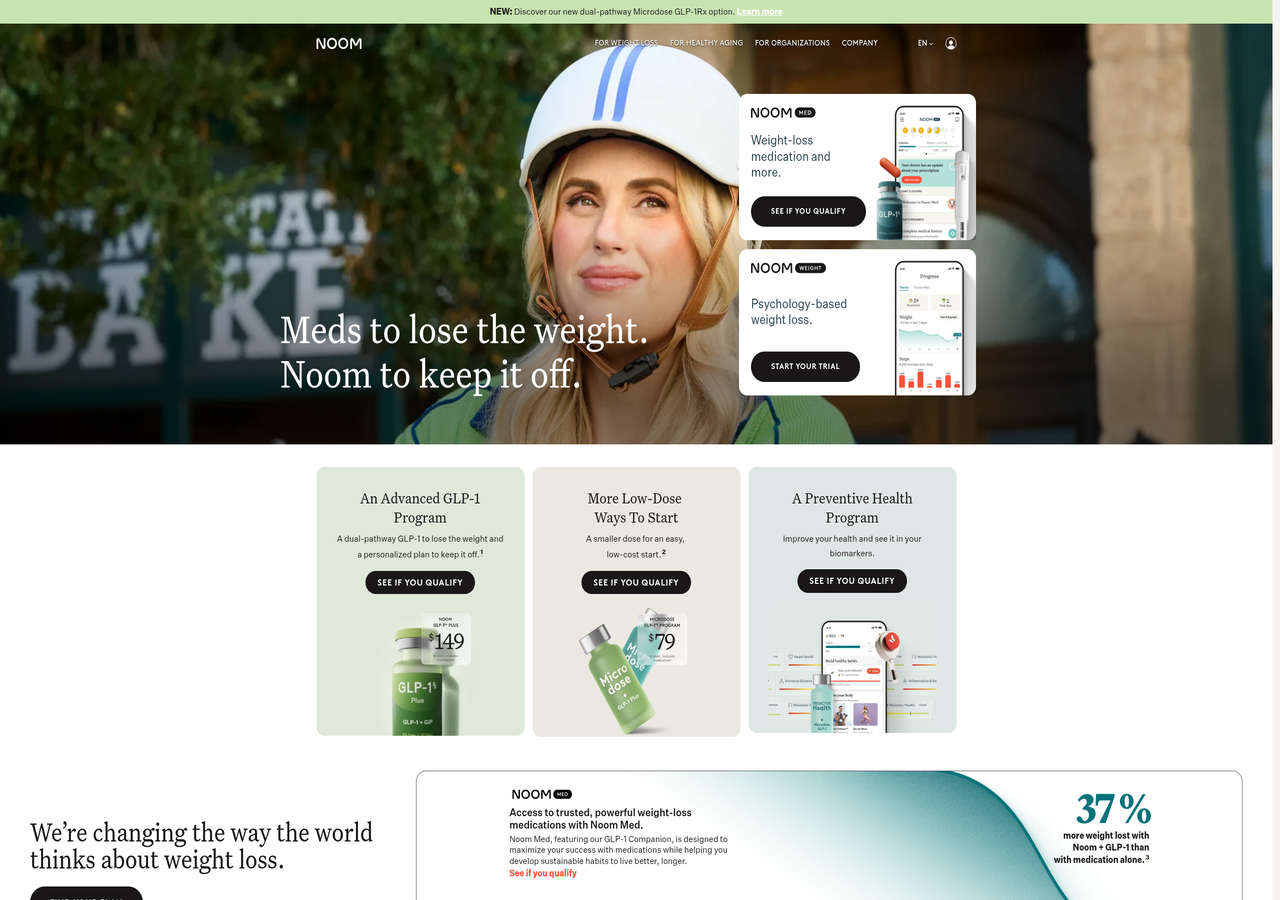
Screenshot of the noom.com homepage, read 27 November 2026. The hero is “Meds to lose the weight. Noom to keep it off.” — the drugs first, the psychology second — with three programmes below at $149, $79 and a preventive-health card.
The homepage does not sell weight loss. It sells medicine first and psychology second. On 27 November 2026 the hero reads “Meds to lose the weight. Noom to keep it off.” over a photo of Rebel Wilson, with two cards beside it: Noom Med, “weight-loss medication and more”, and Noom Weight, “psychology-based weight loss”.
Below them sit three drug programmes — an advanced GLP-1 at $149, a low-dose start at $79, a preventive-health programme — and a teal panel claiming 37% more weight lost with Noom plus a GLP-1 than with medication alone. The claim rests on a January 2026 analysis of 14,203 members over 40 weeks, and the site’s own footnote says the association does not imply causation.
That is the pivot in one screen. Noom spent a decade as the behaviour company — daily lessons, colour-coded food, a human coach — and the homepage now leads with the drugs. The psychology is still there, but it has moved from the product to the retention layer: the thing that keeps a drug customer paying after the prescription.
Eighteen years, one pivot
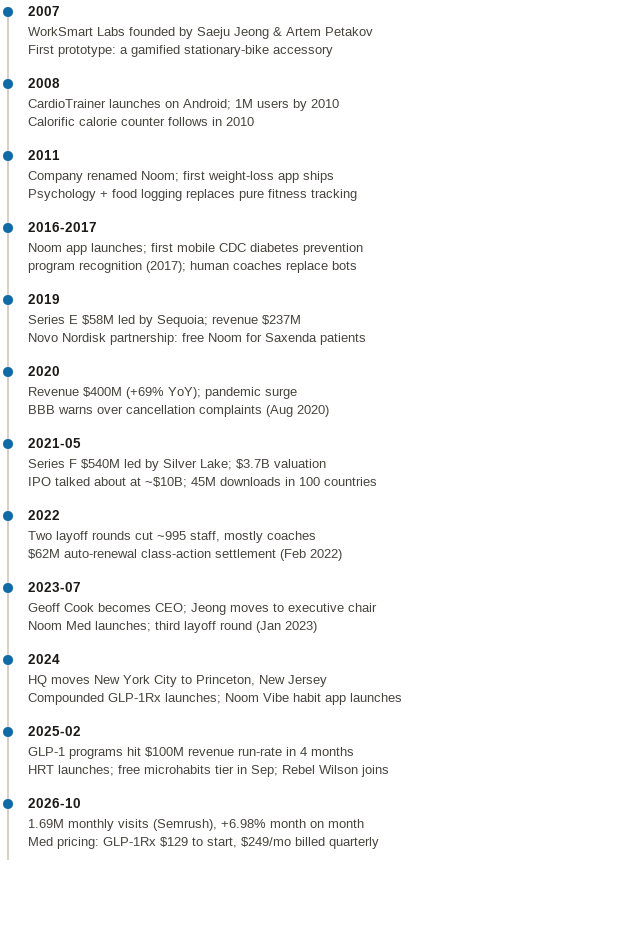
Company history; Inc. Magazine, TechCrunch (May 2021), Wikipedia, MobiHealthNews (2022–2023), Gizmodo (April 2022), Sacra and Semrush (October 2026).
The company started as WorkSmart Labs in 2007, building a gamified stationary-bike accessory. Its first app, CardioTrainer, launched on Android in 2008 and reached a million users by 2010; a calorie counter, Calorific, followed the same year. In 2011 the company renamed itself Noom and shipped its first weight-loss app.
The behaviour product arrived in 2016 and 2017: the Noom app launched, the CDC recognised it as the first mobile diabetes prevention programme, and human coaches replaced bot replies. Then came the money — $58M in 2019, $540M from Silver Lake in May 2021 at a $3.7B valuation — and the ad spend behind it, from $5M in 2017 to $330M in 2021.
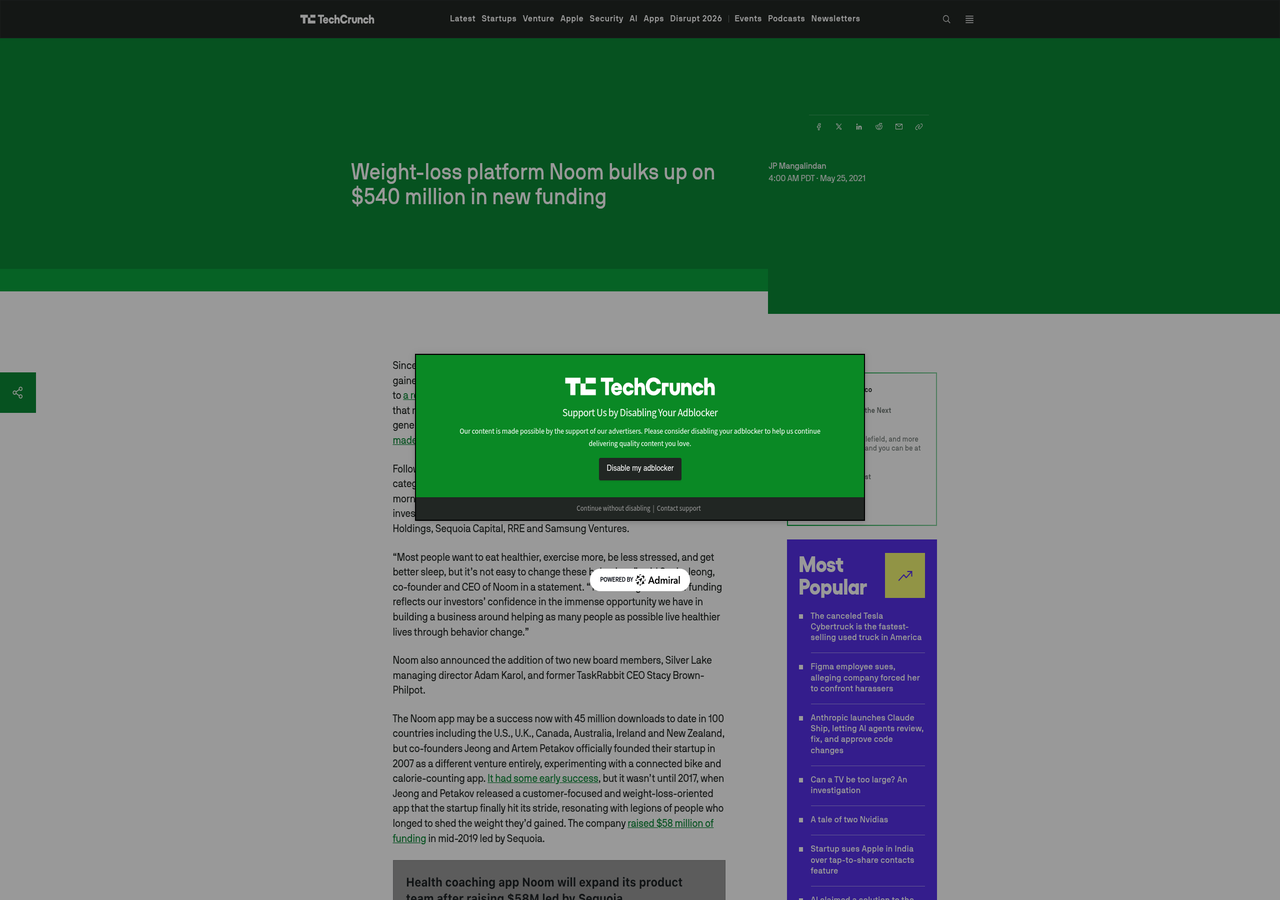
TechCrunch, 25 May 2021. “Weight-loss platform Noom bulks up on $540 million in new funding” — the Series F led by Silver Lake, a $3.7B valuation, 45 million downloads, and $400M revenue in 2020. A green ad-block notice covers part of the article body; the headline, date and key figures are visible outside it.
What the funding bought was growth, and what it cost was the coaches. In 2022 Noom cut about 995 staff in two rounds — 495 coaches in April, about 500 more in October — and paid $62M in February to settle a class action over auto-renewal. The coaching headcount fell from about 2,700 to about 1,000 in eighteen months.
The rebuild started in July 2023, when Geoff Cook took over as CEO and Noom Med launched. Compounded GLP-1s followed in September 2024, the drug programmes hit a $100M run-rate in February 2025, and a free microhabits layer arrived in September 2025 to widen the funnel again. The company that cut its coaches now sells the drugs and keeps the lessons as the glue.
The price list: $70 a month, $209 a year, $249 for the drugs
The term ladder is the product
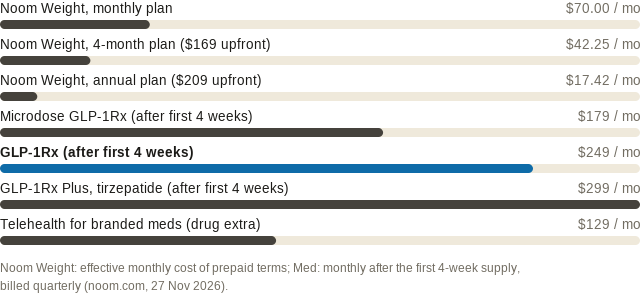
Noom Weight and Noom Med prices, noom.com, read 27 November 2026. Weight prices are prepaid and auto-renewing; Med prices are per month after the first 4-week supply.
| Plan | Upfront | Per month | Notes |
|---|---|---|---|
| Monthly | $70 | $70.00 | The walk-up price; auto-renews monthly |
| 2 months | $129 | $64.50 | Prepaid, auto-renews |
| 3 months | $159 | $53.00 | Prepaid, auto-renews |
| 4 months | $169 | $42.25 | Where most users start, per Noom’s blog |
| 6 months | $179 | $29.83 | Prepaid, auto-renews |
| 12 months | $209 | $17.42 | The cheapest month; Noom’s blog writes $17.50 |
The ladder is the mechanism. A month costs $70; a year costs $209 upfront, or $17.42 a month. The four-fold gap is not a discount, it is a commitment device: the longer the term, the more money Noom holds before the user has had time to quit. Most users start at $169 for four months, which is $42.25 a month.
Everything is prepaid and auto-renewing, and the trial is the on-ramp: 7 or 14 days from $0.50, with almost the full paid product inside. The refund window is 14 days from the first charge, and renewals do not refund at all. That combination — cheap trial, upfront terms, auto-renewal — was the subject of the $62M settlement in 2022.
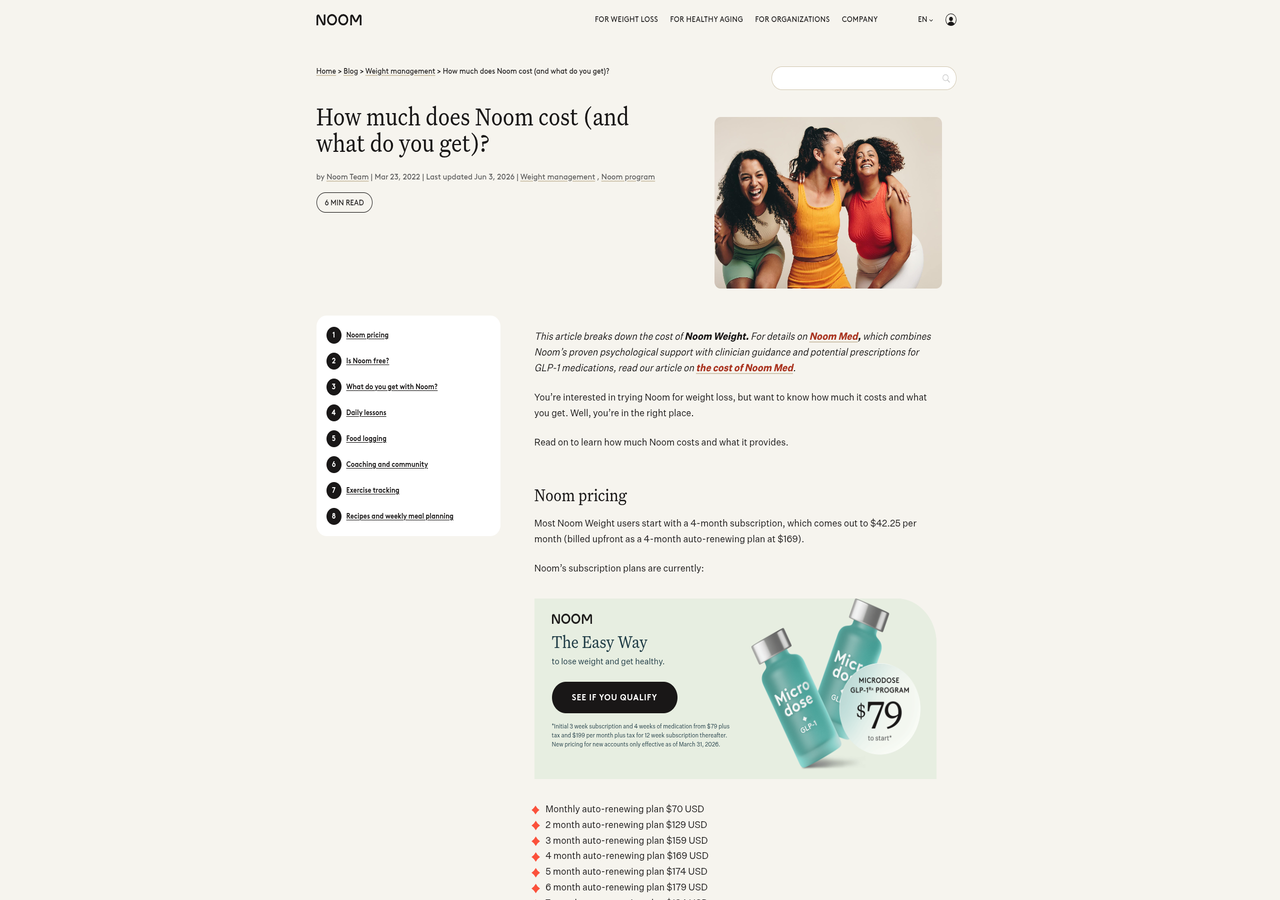
Noom’s cost blog, “How much does Noom cost (and what do you get)?”, updated 3 June 2026. “Most Noom Weight users start with a 4-month subscription, which comes out to $42.25 per month (billed upfront as a 4-month auto-renewing plan at $169).”
The blog is also where the arithmetic slips. Noom writes the annual plan as $17.50 a month; $209 divided by 12 is $17.42. The same rounding runs through the ladder — the 6-month plan is $29.83 a month, not the $30.00 the blog prints. The teardown uses the arithmetic values throughout.
Then the drugs, at $129 to start
| Plan | To start | Then per month | Notes |
|---|---|---|---|
| Microdose GLP-1Rx | $79 | $179 | Low dose; up to 11 lbs in 60 days, self-reported |
| GLP-1Rx | $129 | $249 | Up to 21 lbs in 90 days, self-reported |
| GLP-1Rx Plus | $149 | $299 | GLP-1 and GIP; up to 25 lbs in 90 days, self-reported |
| Proactive Health GLP-1Rx | $149 | $149 / 4 weeks | Microdose plus 17 biomarker tests |
| Metformin pill | $69 | $99 | Oral pill; not FDA-approved for weight loss |
| Branded telehealth | $39 | $129 | Clinical care only; drug cost not included |
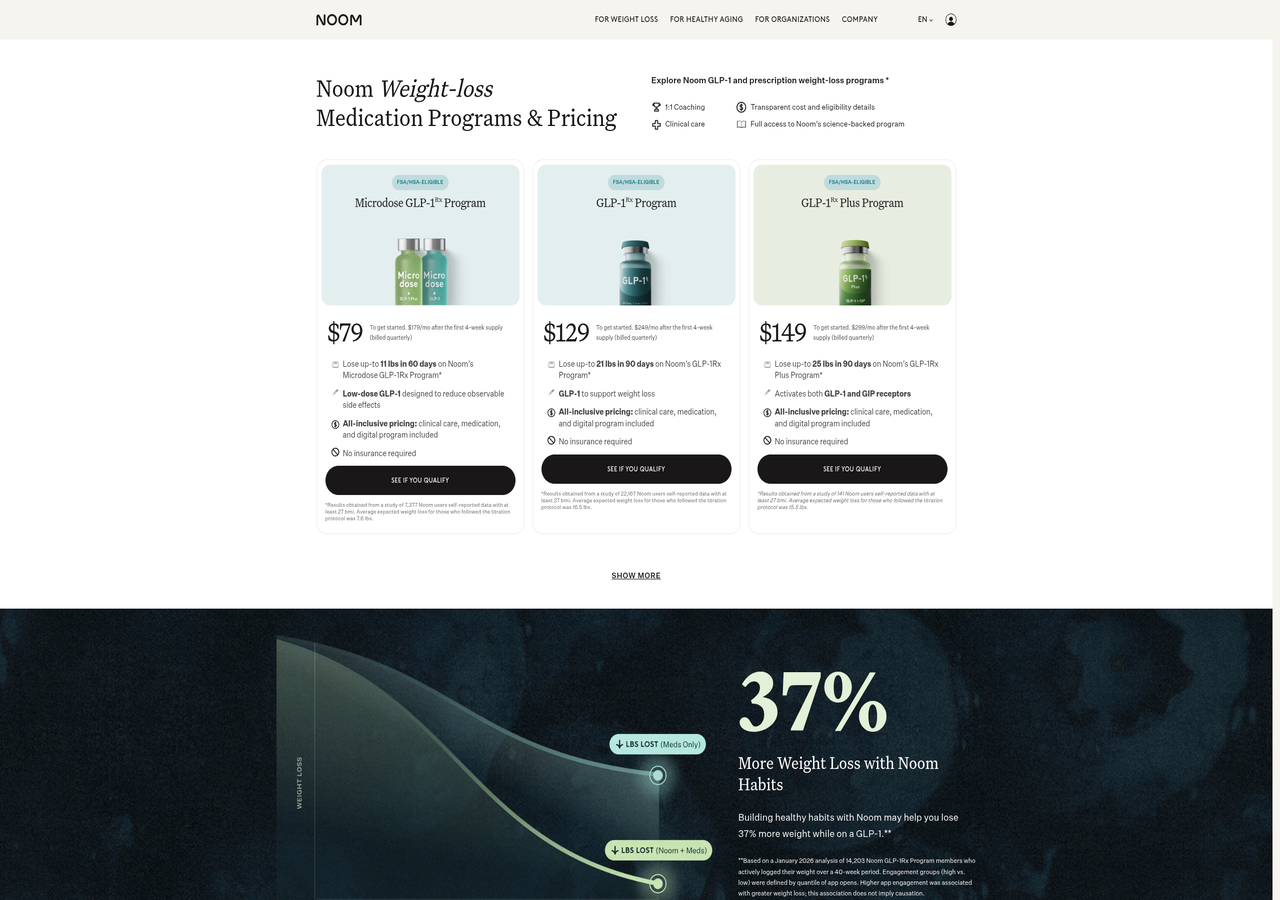
Screenshot of the Noom Med pricing page, read 27 November 2026. Microdose $79 to start, then $179 a month; GLP-1Rx $129, then $249 a month; Plus $149, then $299 a month — all billed quarterly, all including the full Noom programme.
Every Med plan includes the full Noom Weight programme, and the drug cannot be bought without it. That is the bundle: the medication is the acquisition, the lessons and coaching are the retention, and the quarterly billing is the lock-in. A GLP-1Rx customer pays $627 for the first three months, then $249 a month.
The price list itself is unstable. The same day, the homepage footnote shows GLP-1Rx at $149 to start and $349 a month, and the cost blog repeats those numbers — while the Med pricing page shows $129 and $249. Prices fell between October and November 2026, or they vary by signup path. The teardown quotes the pricing page and records the footnote as the older price.
What keeps customers paying
| Mechanism | Status | How it shows up |
|---|---|---|
| Free tier | ✓ | Free microhabits layer since September 2025: AI face scan, Future Me, body scan, food photo logging |
| Trial | ✓ | 7 or 14 days from $0.50, with nearly the full paid product inside; converts to a full prepaid term |
| Skip / pause | Not verified | No skip or pause mechanism was found on the site this round; cancelling keeps access to the end of the term |
| Cancel | ✓ | Self-serve in the app, on the web, or in the app store; access runs to the end of the current term |
| First-order hook | ✓ | Trial plus the free layer; the guest pass gives a friend 2 weeks and 20% off |
| Referral programme | ✓ | Guest pass: new user gets 2 weeks plus 20% off; the US referrer gets no reward |
| Loyalty programme | ✓ | NoomCoin and Vibes: habit points redeemable for a free 12 months or gift cards (secondary sources) |
| Gift subscription | — | No gift subscription product was found; Vibes can be redeemed for digital gift cards |
| Free shipping | — | Digital subscription; Med drug delivery is included in the plan price, with no separate shipping line |
The retention is in the term, not in a programme. A user who pays $169 upfront for four months has already decided to stay for four months, and the daily lessons and the coach are what fill the time until the renewal. The trial does the same work at the front: it ends in a full prepaid term, not in a monthly plan.
The refund rules complete the picture. Fourteen days from the first charge, and nothing back on a renewal. Med prescriptions do not refund once issued. Deleting the app does not cancel the subscription — a fact Noom’s own refund page states plainly, and one the 2022 settlement turned into a $62M lesson.
The category is bigger than one brand
Seven trackers, one premium price
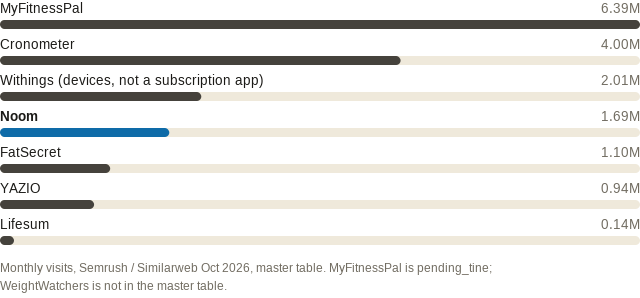
Monthly visits, Semrush and Similarweb, October 2026. Third-party estimates, not official MAU/DAU figures.
| Site | Monthly visits | Category | What it sells |
|---|---|---|---|
| MyFitnessPal | 6.39M | Calorie & nutrition tracking | Free food diary; Premium $79.99 a year |
| Cronometer | 4.00M | Calorie & nutrition tracking | Free tracking; Gold $59.99 a year |
| Withings | 2.01M | Health wearables & subscription | ScanWatch 2 $369.95 plus Withings+ subscription |
| Noom | 1.69M | Weight management subscription | Noom Weight $70 a month; Noom Med from $179 a month |
| FatSecret | 1.10M | Calorie & nutrition tracking | Free diary; Premium price not published |
| YAZIO | 939.2K | Calorie & nutrition tracking | Free diary; PRO price not published |
| Lifesum | 142.7K | Calorie & nutrition tracking | Free diary; Premium in the app store |
Noom is fourth of the seven by traffic and the most expensive by a wide margin. MyFitnessPal, at 6.39M visits, charges $79.99 a year for Premium; Cronometer, at 4M, charges $59.99 a year for Gold. Noom charges $209 a year for Weight — about two and a half to three and a half times as much — and $70 a month to anyone who will not commit.
The premium is the psychology. A free food diary logs calories; Noom sells daily lessons, a coach and a colour-coded food system, and now a prescription. The price only makes sense if the buyer believes the behaviour course is the product and the drug is the accelerator. The seven sites together draw about 16.27M visits a month, and Noom holds about a tenth of them.
Where the visits come from
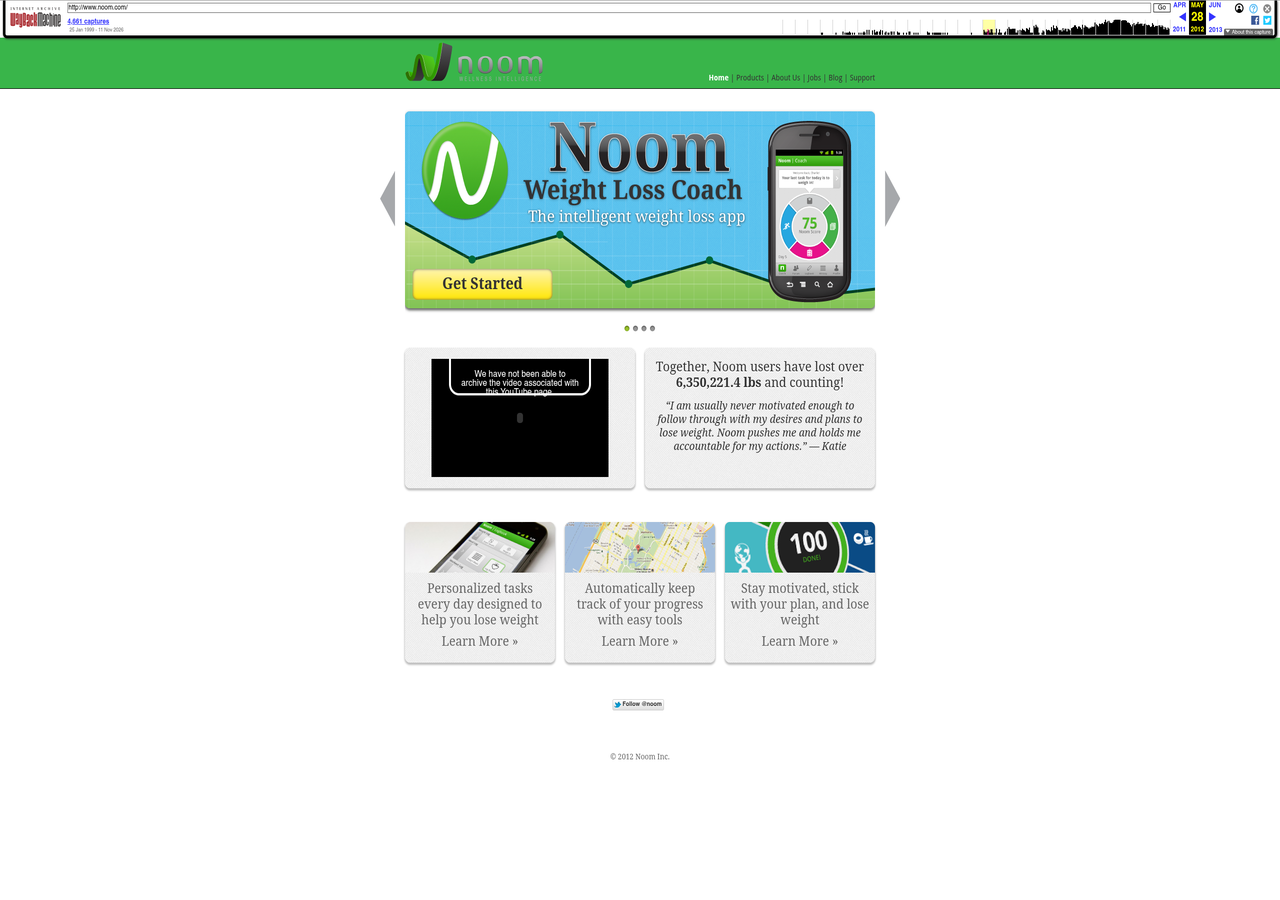
Wayback Machine, 28 May 2012. “Noom Weight Loss Coach — The intelligent weight loss app” — “Together, Noom users have lost over 6,350,221.4 lbs and counting!” The earliest capture, from February 2009, shows only a parked domain page.
The site has been selling the same promise since 2012, when the homepage already counted pounds lost in the millions. What changed is the funnel around it: the 2012 page sold an app, the 2026 page sells a prescription first and the app second. Fourteen years of brand is what lets the $70 price stand against free diaries.
| Channel | Share of visits | Platform & stack |
|---|---|---|
| Brand search | Not verified | “noom” 110,000 searches a month, rank 1, 30.07% of organic traffic; Semrush, October 2026 |
| Direct traffic | 32.14% | Semrush, October 2026; brand awareness is the first traffic source |
| Paid search & social | Not verified | Ad spend $5M in 2017 to $330M in 2021; paid search traffic up 63.63% in October 2026 while organic fell 6.57% |
| App stores | Not verified | App Store 4.7 out of 5, about 874,000 ratings; Google Play 4.1 out of 5, about 314,000 reviews, 10M+ downloads |
| Enterprise & pharma | Not verified | Employers and health plans; Novo Nordisk, Highmark, Castlight; about 250 B2B partners per Sacra |
| Meta paid ads | Not verified | Meta Ad Library returned access denied on 27 November 2026 |
The channels are the story, and only one of them is a share. Direct traffic is 32.14%, and the brand word “noom” draws 110,000 searches a month at a $6.56 cost per click — people arrive already knowing the name. The blog is the second pillar: recipe and walking content ranks for terms like “jello weight loss recipe” at 18,100 searches a month.
October 2026 is the warning in the table. Organic search traffic fell 6.57% while paid search traffic rose 63.63% — the visit growth came from bought clicks, not from more people finding Noom on their own. A brand that pays $6.56 a click for its own name is renting the demand it built.
| Layer | What it runs on |
|---|---|
| Platform | WordPress (site theme and image service visible in the homepage source, November 2026) |
| CDN | Cloudflare (stack snapshot, 24 November 2026) |
| Product analytics | Mixpanel (stack snapshot, 24 November 2026) |
| Error tracking | Sentry (stack snapshot, 24 November 2026) |
| Cookie consent | OneTrust (stack snapshot, 24 November 2026) |
| Payments | Apple and Google in-app purchases ($44.99–$199.99); web subscriptions through account.noom.com |
| Health tech | NuraLogix face scan and Haut.AI skin model (via Sacra, reporting company claims) |
| Not verified (an older stack listing names SendGrid; no mail tool was found in the site source this round) |
The stack is a WordPress marketing site in front of a subscription product, with the usual analytics and error tracking behind it. The technology is not the story. The story is the funnel: a free face scan and a quiz, then a prepaid term, then a prescription.
Three things not to quote as facts
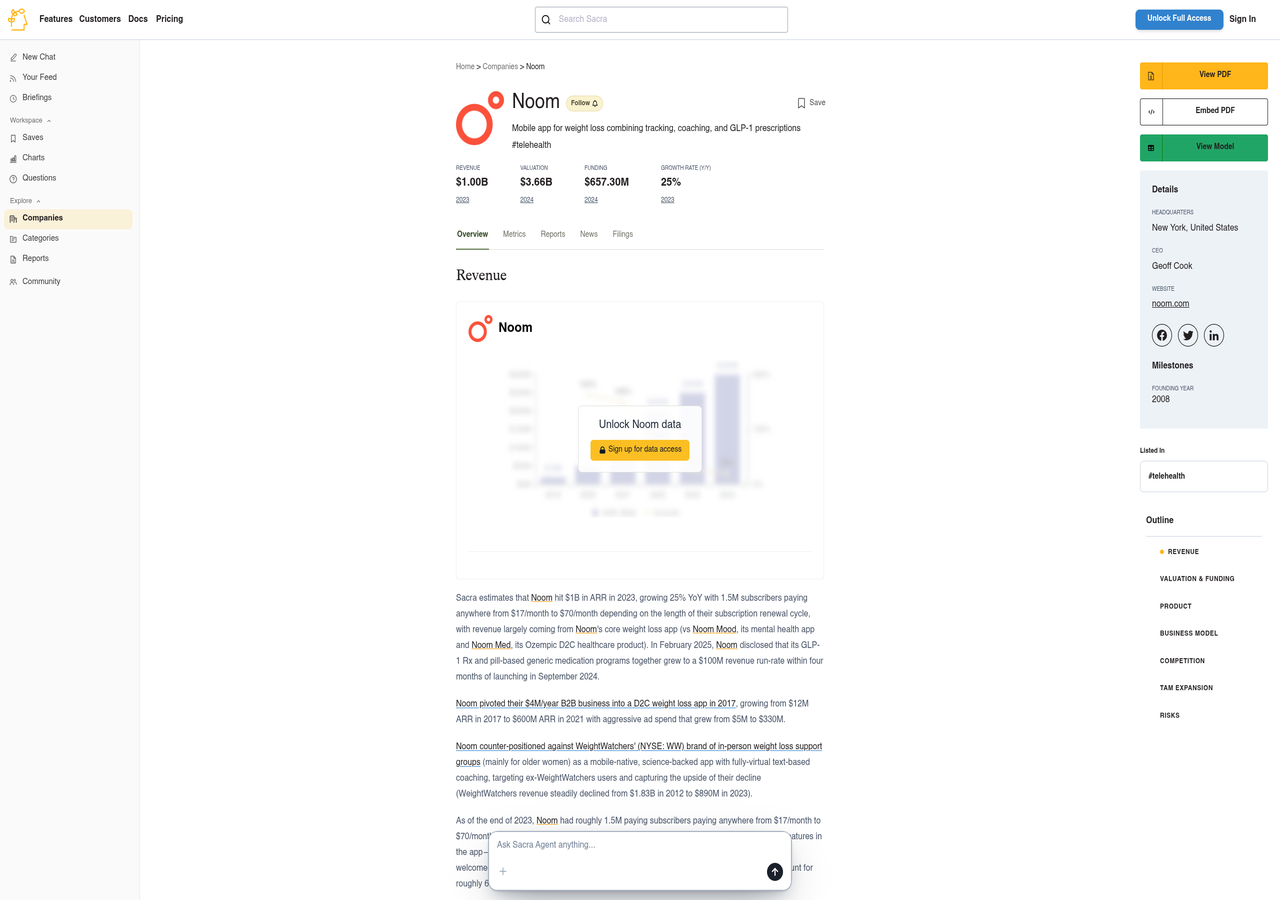
Sacra, company page for Noom, read 27 November 2026. Revenue $1.00B (2023), valuation $3.66B (2024), funding $657.30M (2024), growth 25% (2023) — all Sacra estimates, with the revenue chart behind a paywall. The text below the chart states the $1B ARR and the $100M run-rate.
First, the $1B. Sacra estimates Noom hit $1B in ARR in 2023, with about 1.5 million paying subscribers. That is an estimate, not a disclosure: the company itself last reported revenue in 2021, when it said 2020 came in at $400M. The arithmetic checks — $1B over 1.5 million subscribers is about $56 a month each, inside the $17–$70 Weight range with Med users pulling the average up — but an estimate that checks is still an estimate.
Second, the $100M. The February 2025 release says the GLP-1 and oral generic programmes reached a $100M revenue run-rate within four months of launching. A run-rate is an annualised pace, not a year of income, and it dates from February 2025 while the ARR estimate dates from 2023. The two numbers are not from the same year and must never be divided into a share.
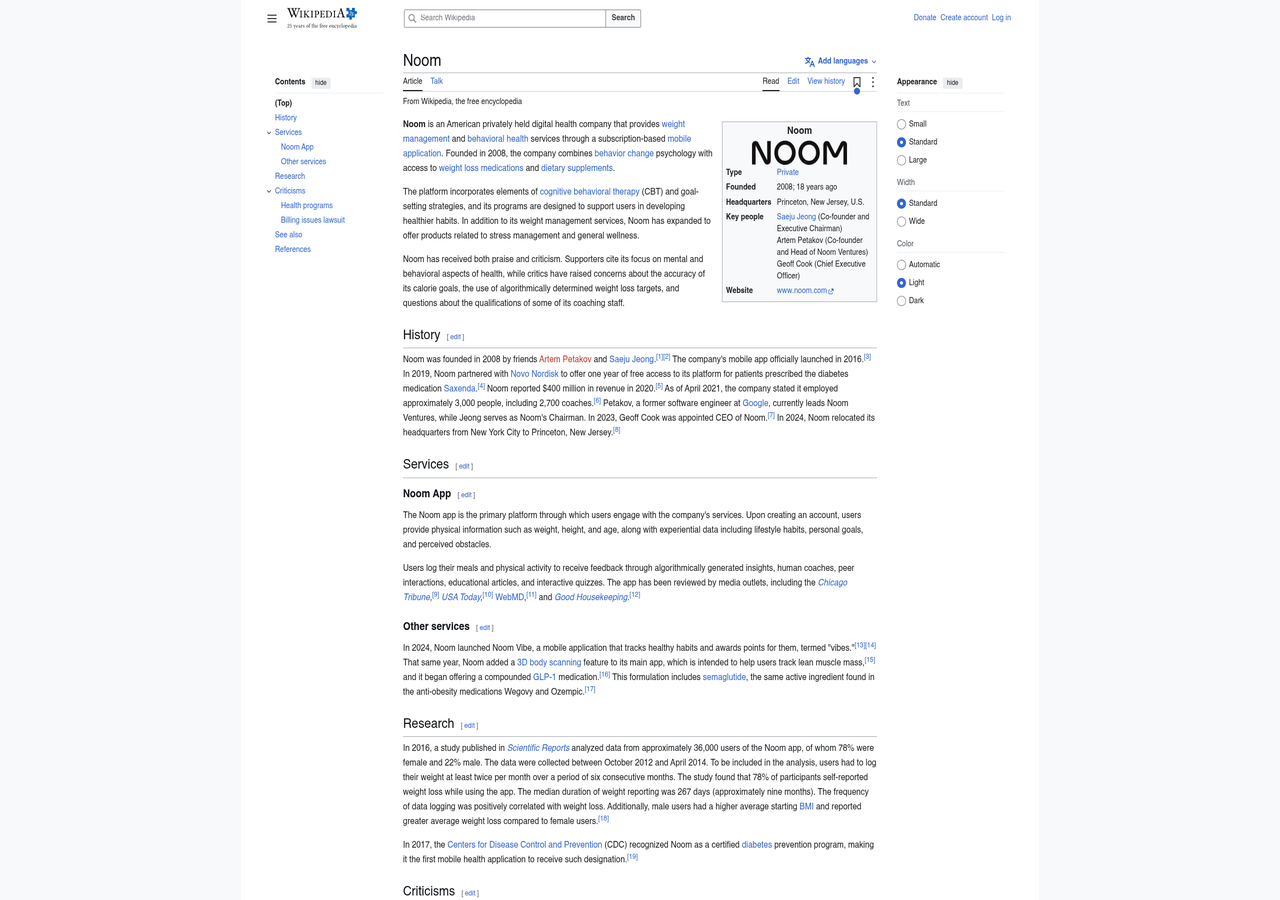
Wikipedia, “Noom”. Founded 2008, headquarters Princeton, New Jersey, key people Saeju Jeong, Artem Petakov and Geoff Cook. The history covers the $400M revenue in 2020, the 2023 CEO appointment and the 2024 move to Princeton.
Third, the founding year. Most sources list 2008, when CardioTrainer launched; Inc. and TechCrunch date the startup to 2007, when Jeong and Petakov founded WorkSmart Labs. The teardown dates the founding to 2008 and notes the 2007 start separately. The same care applies to the headcount: about 3,000 people in April 2021, including 2,700 coaches, is a dated figure, not a current one.
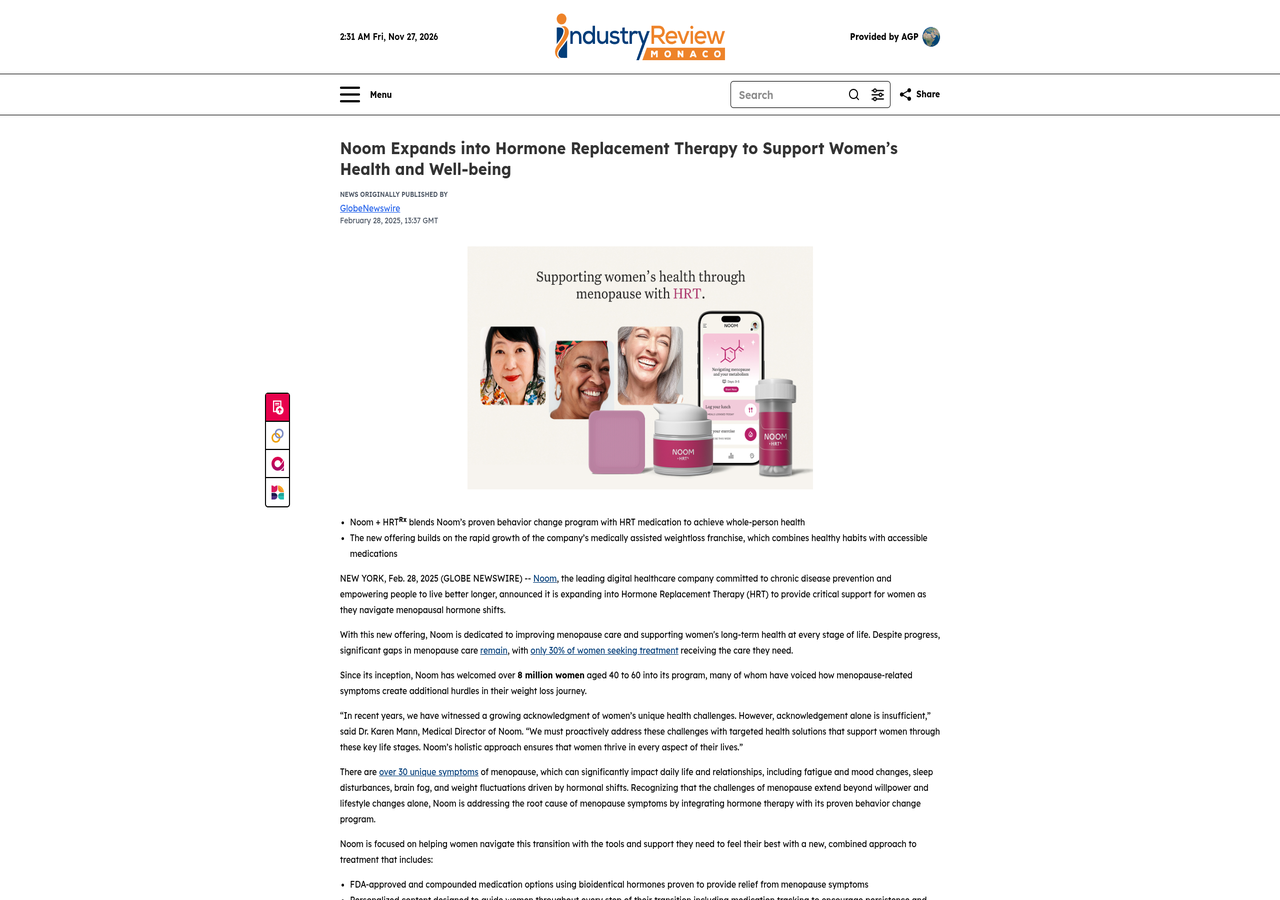
GlobeNewswire, 28 February 2025 (as carried by Industry Review Monaco). “Noom Expands into Hormone Replacement Therapy” — the release that records the $100M revenue run-rate for the GLP-1 programmes, the 8 million women aged 40 to 60 welcomed into the programme, and HRT from $69 to start.
The HRT release is also the source for the run-rate, and it shows how Noom now frames itself: a women’s health company for the 40–60 age group, with hormone therapy beside the weight-loss drugs. The 8 million women figure is the company’s own count, not a third-party verification.
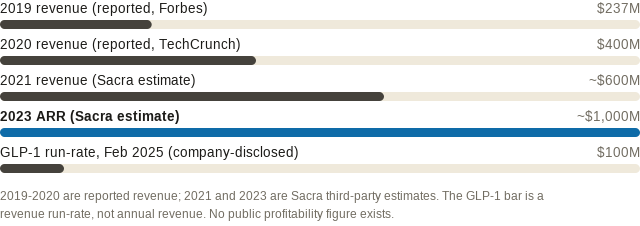
Revenue, reported and estimated. 2019 and 2020 are company-reported via Forbes and TechCrunch; 2021 and 2023 are Sacra estimates; the $100M GLP-1 figure is a company-disclosed run-rate from February 2025, not realised revenue.
The revenue line stops in 2021 because the company stopped reporting. Two years of reported growth, then five years of estimates and a run-rate: that is the whole public record of a company that has raised $624M to $657M and never disclosed a profit. The teardown does not fill the gap.
Noom is the first teardown in our Weight management subscription collection. The nearest rival is Cronometer at 4M visits a month, and the most useful side-by-side is Noom vs Cronometer. For the calorie trackers it competes with, see the Calorie and nutrition tracking subscriptions collection.
The full teardown is for members
The full breakdown is for members: the $70 decision and what a subscription is really paying for, the GLP-1 pivot, the $62M settlement, the enterprise channel — and what a founder should copy, and what not to.
Similar sites in the database
Noom (1.69M) sits between Xero Shoes (1.69M) and Our Place (1.67M) in the database. The sites nearest to it on traffic are shown below.
| Site | Monthly visits | Category |
|---|---|---|
| KÜHL | 1.7M | Technical outdoor apparel |
| Rhoback | 1.7M | Golf · Performance apparel |
| Xero Shoes | 1.69M | Footwear · Minimalist barefoot shoes |
| Noom | 1.69M | Health · Weight management subscription |
| Our Place | 1.67M | Home · Cookware |
| Merit Beauty | 1.66M | Beauty · Minimalist makeup |
| jpg2pdf.com | 1.63M | PDF tools |
Related teardowns
- Cronometer — 4M visits a month, calorie and micronutrient tracking, Gold $59.99 a year.
- Withings — 2.01M visits a month, health wearables plus a subscription, ScanWatch 2 $369.95.
Read the next one in your inbox
The new ones go out by email first, one a week, with the traffic source and month attached to every number. Leave your address and the next one comes to you.