 Everstood
Notion teardown: 110.22M visits a month selling the all-in-one workspace
Monthly visits
110.22M
Semrush, October 2026. Third-party estimate, not official MAU/DAU.
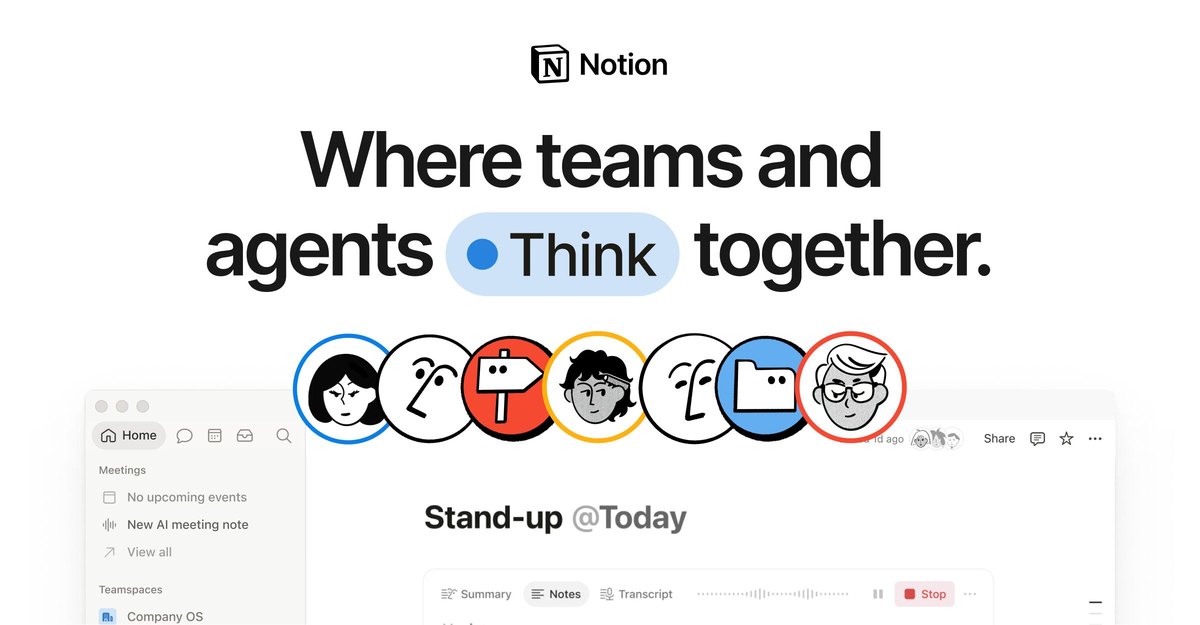
Notion is an AI notes and workspace tool that Semrush credits with 110.22M visits in October 2026. That makes it the fourth largest site in our database, behind iLovePDF at 303.35M, DeepL at 157.75M and Figma at 112.98M, and the second largest of the five sites added in our twenty-third batch. It is the first notes tool we have torn down. Evernote (6.58M) and Coda (748.28K) are the other notes tools in the database, neither torn down yet. The country mix is unusual for a site this large. The United States is 17.72% of traffic, South Korea is second at 8.32% and Japan third at 7.39%, so Korea and Japan together are 15.71%, nearly as much as the United States. Notion is also the clearest near-death story we have torn down. Notion Labs was founded in 2013, ran into financial trouble during early development, and released Notion 1.0 in August 2016 with a team of fewer than ten people by the time 2.0 shipped in March 2018. Ten years later it sells the same workspace, now with AI agents, and the homepage leads with them.
| Site | Notion, notion.com |
|---|---|
| What it is | AI notes and workspace tool: docs, wikis, databases, tasks, calendar, sites, forms, charts, AI Agent, AI meeting notes and custom agents, built from blocks |
| Who it is for | Individuals and teams that want notes, docs, databases and project tracking in one workspace, from personal use to enterprise |
| Category | Notes tools |
| Monthly visits | 110.22M, Semrush, October 2026. Third-party estimate, not official MAU/DAU |
| Pricing | Free $0/member/month; Plus $12/member/month or $10/member/month billed annually ($120/year); Business $24/member/month or $20/member/month billed annually ($240/year); Enterprise custom. Custom Agents $10 per 1,000 monthly Notion credits, free to try. Annual totals are arithmetic from the monthly figures the pricing page prints. Source: notion.com/pricing, prices verified by live browser on 2026-11-16; the page is JavaScript rendered and a plain text fetch shows no price numbers |
| Pricing model | Freemium subscription, priced per member. Guests are free; paid seats are counted per member and prorated when members are added |
| Country breakdown | United States 17.72% (19.53M); South Korea 8.32% (9.17M); Japan 7.39% (8.15M). Semrush, October 2026 |
| Operator | Notion Labs, Inc., San Francisco. Founded in 2013 by Ivan Zhao, Akshay Kothari, Chris Prucha, Jessica Lam, Simon Last and Toby Schachman. Source: Wikipedia, checked November 2026; the operator is not named on the Notion homepage or pricing page |
| Acquisition channels | Not publicly disclosed (see the acquisition section) |
TL;DR
- Notion draws an estimated 110.22M visits a month (Semrush, October 2026), the fourth largest site in our database and the first notes tool we have torn down. The United States is 17.72% of that traffic, with South Korea second at 8.32% and Japan third at 7.39%. Korea and Japan together are 15.71%, an unusually large Asian share for a US software site.
- The pricing ladder is a per-member ladder with a genuinely free solo tier. Free is $0 with unlimited pages and blocks for a single user, 5 MB file uploads, 7-day page history and 10 external guests. Plus is $12 a member a month, or $10 billed annually, and Business is $24 or $20, adding Notion Agent, AI meeting notes, enterprise search and SAML single sign-on. The paywall is seats, AI and admin controls, not storage.
- It survived a near-death rebuild and then compounded. Founded in 2013, in financial trouble early, 1.0 released in August 2016, 1 million users in September 2019, a $2 billion valuation in January 2020 and a $10 billion valuation in October 2021 with 20 million users. Since then it has grown sideways: Notion AI in 2023, Notion Calendar in 2024, Notion Mail in 2025, shut down in September 2026, and a developer platform with AI agents in 2026.
What problem does Notion solve, and for whom?
The About page states the problem in plain language: most people work with fifteen tabs open, one for email, one for Slack, one for Google Docs, and on, and on. Its answer is to blend much of a workflow into one all-in-one workspace, built from blocks that can be a task list, a product roadmap, a design repository or a wiki. The current homepage says the same thing in its 2026 form: "The AI workspace that works for you", above "The most ambitious companies run on Notion". The audience is deliberately wide, from a single person keeping notes to an enterprise running its system of record, and the pricing is built to let the same product serve both ends.
The trust claims on the homepage are the site's own display, not checked counts, and they are quoted here with that label attached: 100 million users in over 50 countries, over 50% of YC companies, 1.4 million plus community members, 62% of the Fortune 100, and G2's number one knowledge base for three consecutive years. The country mix in our traffic data fits the claim that the audience is genuinely global. A US share of 17.72% is low next to peers in our database: Grammarly is 56.99% United States, Quillbot 28.82%, Figma 19.9%. South Korea at 8.32% and Japan at 7.39% are the second and third countries, a shape no other large site in our database has.
The second audience is the team that already lives in Notion and wants the workspace to do more. The homepage sells three AI jobs in that order: capture knowledge, find answers with citations, and automate busywork with agents that triage product feedback, resolve support tickets in Slack, respond to security alerts and automate weekly reporting. That is a pitch to a team whose notes already live in Notion, and it is also the pricing story: the AI work is what the paid plans increasingly charge for.
The product and its first screen
The homepage we read on 16 November 2026 opens as "The AI workspace that works for you" and puts AI first, not docs. The page then walks through the three AI jobs: capture knowledge, find answers instantly with citations, and keep work moving around the clock with agents. Below that are five example agent jobs, triage product feedback, resolve support tickets in Slack, respond to security alerts faster, automate weekly reporting, and create custom developer tools, each with a small image. The trust section follows: G2's number one knowledge base for three consecutive years, 100 million users in over 50 countries, over 50% of YC companies, 1.4 million plus community members, and 62% of the Fortune 100. Those figures are Notion's own display.
The product underneath is one primitive repeated everywhere. Notes are made of blocks, and every line or paragraph is a block that can hold text, an image, a subpage or a database. Databases can be shown as tables, lists, calendars and timelines, which is how the same tool becomes a wiki, a task tracker and a project board. Around that core sit the surfaces added year by year: Notion AI in February 2023, Notion Calendar in January 2024 as the first standalone app, built from Cron, acquired in June 2022, Notion Mail in April 2025 as a Gmail-based email client with Notion AI, and Notion 3.0 in September 2025 with an AI agent feature. The developer platform followed in May 2026, with Workers for custom code, database sync from Salesforce and Zendesk, and external agent integration with Claude Code, Cursor, Codex and Decagon. The company reported that users had built over one million custom agents since the feature launched in February 2026. The history dates in this section come from Wikipedia, checked November 2026.
One of those surfaces has already been shut down, and the shutdown is part of the story. In June 2026 Notion announced it would shut down Notion Mail across web, desktop and iOS on September 22, 2026, and focus instead on agent-based email workflows. Users were told to export drafts, scheduled emails, snippets and auto-label instructions before the shutdown. A product that adds a surface a year and retires one that does not work is a different kind of company from one that only ever adds.
Pricing: four plans, and the member is the unit
The pricing page (notion.com/pricing, checked November 2026) lists four plans. Free is $0 a member a month: a trial of Notion AI, basic forms and sites, Notion Calendar, databases with subtasks, dependencies and custom properties, pages and blocks unlimited for a single user and limited for two or more members, file uploads up to 5 MB, 7-day page history and 10 external guests. Plus is $12 a member a month, or $10 a member a month billed annually: everything in Free, plus a trial of Notion AI, custom forms and sites, charts, collaborative blocks, larger file uploads up to 5 GB and 30-day page history. Business is $24 a member a month, or $20 billed annually: everything in Plus, plus Notion Agent, AI meeting notes, enterprise search beta, SAML single sign-on, granular database permissions, private teamspaces and domain verification. Enterprise is custom priced: everything in Business, plus zero data retention with language model providers, user provisioning, advanced security and controls, an audit log, a customer success manager and security connections for data loss prevention and SIEM. The price numbers in this teardown were verified by live browser on 2026-11-16, because the pricing page is JavaScript rendered and a plain text fetch shows no price numbers. The annual totals, $120 a year for Plus and $240 for Business, are arithmetic from the monthly figures the page prints.
Three details deserve attention. First, every paid plan is priced per member, and guests are free. The pricing page explains that a paid seat is a licence for one member, that adding a member uses an available paid seat or adds one with a prorated charge, and that removing a member frees the seat for a different user for the rest of the billing period. Revenue grows with headcount, which is the opposite of Jotform, where every paid plan is a one-user plan and the ladder is volume. Second, the free tier is genuinely usable for one person and deliberately tight for a team. A solo user gets unlimited pages and blocks. A workspace with two or more members gets a limited number of blocks before it has to upgrade, which is the wall that turns a personal tool into a team sale. Third, AI is now the paywall. Free and Plus get a trial of Notion AI. The full agent, AI meeting notes and enterprise search sit on Business, and custom agents cost $10 per 1,000 monthly Notion credits on top, free to try. Students and educators get Plus free with a one-member limit, which is distribution into the next generation of teams. There is no free trial of a paid plan on the pricing page. The refund terms are a full refund if you downgrade within three days of signing up for monthly billing, or within 30 days for annual billing.
What the money buys, beyond the caps, is the removal of limits that bite in the middle of real work. A free user hits the wall at 5 MB uploads and 7 days of history, and a team hits the wall at the block limit. A Plus buyer gets 5 GB uploads and 30 days of history. A Business buyer gets the agent that answers questions from the workspace and the meeting notes that write themselves, plus the single sign-on and permissions an IT department asks for before it lets a tool spread. What we cannot see from outside is how much revenue comes from Plus versus Business versus Enterprise, or how many free workspaces convert. A teardown that invented those numbers would read better and be worth less.
How does Notion get its users?
Not publicly disclosed. Notion publishes no acquisition mix, and our database holds no verified channel data for it, so this section is short on purpose. Anyone who tells you Notion's traffic is exactly X percent organic search is guessing, however plausible the guess sounds.
Four things are observable without inventing numbers. First, the template library is itself a distribution channel. Notion sells templates, free and paid, and every template is a page that can rank for the exact workspace somebody is looking for, from a student dashboard to a product roadmap. Second, the community is distribution. The homepage prints 1.4 million plus community members, and a community that publishes templates, tutorials and workspaces does the teaching a sales team would otherwise have to do. Third, the free tier is the distribution. A workspace that works without paying, and that holds a person's notes, demonstrates itself in the user's own data, and the workspace itself carries the product to everyone invited into it. Fourth, the bottom-up route is visible in the homepage's own claims: over 50% of YC companies and 62% of the Fortune 100. A tool that starts with one person in a startup and spreads to the team is the same motion, whether or not the percentages are exact.
From visit to payment: what the pricing page proves
The conversion story we can defend from public evidence is about three visible walls. The first is the team block limit. Free is unlimited for one person and limited for two or more members, so the moment a second person joins, the free plan starts running out. The second wall is file uploads and history: 5 MB and 7 days on Free, 5 GB and 30 days on Plus, 90 days on Business. The third wall is AI. A trial of Notion AI is on Free and Plus, but the agent, the meeting notes and enterprise search are Business features, and custom agents are metered on top at $10 per 1,000 credits. Each wall is hit in the middle of real work, which is when a buyer is most likely to pay.
The per-member model does different work from the walls. Every new member is a new seat, so a team that grows from five people to fifty multiplies what it pays without any change in the plan. That is why the Business plan, at $20 a member a month billed annually, is the plan the homepage pushes toward: it is where the AI features and the admin controls live, and it is where a growing team lands. The student discount does the opposite job. Plus free for students and educators, with a one-member limit, puts the product in people who will carry it into their first job. What we cannot see from outside is the free-to-paid conversion rate, the share of revenue that comes from Enterprise, or how many signups come from templates versus the community versus the homepage.
Retention: what keeps people coming back?
Not publicly disclosed. Notion publishes no churn, renewal or cohort figures in the sources we checked. The structural point is still worth making, because it is the bet the whole category rests on: a workspace is not a document, it is a system of record, and a system of record that already holds the team's knowledge is hard to move.
Three features of the product support return visits more directly than the daily habit does. The first is the database. A wiki, a task tracker and a project board built from the same blocks are one system, and leaving means rebuilding all three, not just the notes. The second is the template library. A workspace customised from templates, with the team's own structure, only exists inside Notion, and switching means rebuilding it. The third is the surrounding surface: Calendar, agents, meeting notes and the developer platform each add a reason to stay, because each one wires Notion deeper into the rest of the organisation. The counterweight is the Mail shutdown. A user who built on Notion Mail had to export their work before September 22, 2026, which is a reminder that a surface can be taken away as well as added. Whether that plays out as Plus renewals, Business expansion, or Enterprise consolidation, we cannot tell from public data.
Why Notion is still standing
Our read, stated as a position you can argue with: Notion survives because it rebuilt itself once, with almost nothing, and never split the product afterwards. The company was founded in 2013, ran into financial trouble during early development, and shipped 1.0 in August 2016 with a team that still numbered fewer than ten people when 2.0 shipped in March 2018. The product that came out of that rebuild was one primitive, the block, repeated everywhere, and every surface since, Calendar, AI, agents, the developer platform, is the same primitive with a new job. The price is the proof of the positioning. Four plans, one ladder, and a free tier that is unlimited for one person and limited for two: the product does not need a ladder of features because the member is the ladder.
The second half of the argument is the traffic figure, with its label attached. An estimated 110.22M visits in a single month (Semrush, October 2026) is the fourth largest figure we track, about a third of iLovePDF at 303.35M and just behind Figma at 112.98M. The country mix is the honest measure of how far the product has spread: the United States is only 17.72%, and South Korea and Japan together are 15.71%. A press-reported revenue figure, $500 million in annual revenue reported by CNBC in September 2025, is quoted here with that label attached, not as an official disclosure. The first half of the argument is the funding: $50 million at a $2 billion valuation in January 2020, then $275 million at a $10 billion valuation in October 2021 with 20 million users. Notion is not bootstrapped, and the teardown does not pretend otherwise. It survived because the rebuild produced a product that could carry ten years of additions without breaking, not because it never took money.
What you can copy, and what you cannot
Copyable this week
- Price by the member, not by the feature. Notion charges per person, and guests are free, so the bill grows with the team that uses the product. When the scarce resource is seats, the ladder should be seats.
- Make the free tier unlimited for one person and limited for two. A solo user who can build a real workspace for free will bring the team, and the team is where the free plan runs out.
- Grow sideways from the same primitive. Calendar, AI, agents and the developer platform are all the same blocks with a new job, so every new surface makes the old one harder to leave.
- Put the new capability at the top of the ladder, not in the middle. The agent, the meeting notes and enterprise search sit on Business, which is where a growing team lands anyway.
- Give students the paid plan free and let them carry it into work. Plus free for students and educators is distribution into the next generation of teams.
Not copyable
- Ten years of templates and community. A library of workspaces built by 1.4 million plus community members is a decade of somebody else's use cases, and every template is a search result a new tool does not have.
- The rebuild. A company that ran out of money, rebuilt the product with fewer than ten people and shipped 1.0 in 2016 has a story a new tool cannot claim on day one, and a product shaped by that constraint.
- The global spread. A United States share of 17.72% with South Korea and Japan together at 15.71% is years of compounding in markets a new tool has not entered.
Risks and gaps in this teardown
- The traffic figure comes from a single source for the month quoted, Semrush, and is a third-party estimate. Notion publishes no official MAU or DAU.
- "100M users", "over 50% of YC companies", "1.4M+ community members", "62% of Fortune 100" and "G2's #1 knowledge base for 3 consecutive years" are Notion's own claims, printed by Notion on its homepage. They are quoted as the site's own figures, not as independently verified data.
- The $500 million annual revenue figure was reported by CNBC in September 2025. It is press-reported, not an official disclosure by Notion, and it is quoted here with that label attached.
- The history dates (founded 2013, financial trouble during early development, Notion 1.0 in August 2016, Notion 2.0 in March 2018 with fewer than 10 employees, 1 million users in September 2019, $50 million at a $2 billion valuation in January 2020, $275 million at a $10 billion valuation in October 2021 with 20 million users, Cron acquired June 2022, Notion AI in February 2023, Notion Calendar in January 2024, Notion Mail in April 2025, Notion 3.0 in September 2025, developer platform in May 2026, Notion Mail shutting down September 22, 2026) come from Wikipedia, checked November 2026. The operator is not named on the Notion homepage or pricing page.
- Prices were verified by live browser on 2026-11-16 because the pricing page is JavaScript rendered and a plain text fetch shows no price numbers. Annual totals ($120 a year for Plus, $240 for Business) are arithmetic from the monthly figures the page prints, and are labelled as such.
- Notion Mail was shut down on September 22, 2026. Users were told to export drafts, scheduled emails, snippets and auto-label instructions before the shutdown. This teardown records the shutdown as a fact, not as a judgement on the rest of the product.
- Acquisition mix, conversion rates and retention are not publicly disclosed. Sections above say so rather than estimating them.
- Country breakdown comes from Semrush for October 2026 and covers the top three countries only. The remaining share is not broken out in the sources we checked.
Similar sites in the database
Notion is the first notes tool we have torn down. Evernote (6.58M) and Coda (748.28K) are the other notes tools in the database, neither torn down yet.
| Site | Category | Monthly visits | Source |
|---|---|---|---|
| Evernote | Notes tools | 6.58M | Semrush, Oct 2026 |
| Coda | Notes tools | 748.28K | Semrush, Oct 2026 |
Compare Notion with Evernote and Coda side by side. The full database, with working filters, is on the teardowns index.
Read the next one in your inbox
This teardown is free to read. The new ones go out by email first, one a week, with the traffic source and month attached to every number. Leave your address and the next one comes to you.