
How Podia makes money: $42 a month, plus 5%
Monthly visits
1.25M
October 2026. Third-party estimate, not official MAU/DAU. Semrush counted 1.25M for the month.
Podia draws an estimated 1.25M visits a month (October 2026, Semrush). It is the 303rd-largest site in our database of 927 — and the smaller of the two sites in the Education · Creator courses & membership platform collection.
| Site | Podia, podia.com |
|---|---|
| What it is | All-in-one platform for creators to sell courses, community, coaching, events, email and a website, with creators paid direct through their own Stripe or PayPal |
| Who it is for | Independent creators selling courses, memberships and digital products to their own audience |
| Category | Education |
| Monthly visits | 1.25M, October 2026. Third-party estimate, not official MAU/DAU; Semrush |
| Founded | September 2014, as Coach, by Spencer Fry; renamed Podia in December 2017 |
| Headquarters | New York, New York, United States (remote-first; Delaware-registered) |
| Operator | Podia Labs, Inc. — private, not listed, not group-controlled; founder Spencer Fry still chief executive; three small seed rounds 2015–2019, none since |
| Survival engine | Renewals: creators pay $42–$150 a month to keep their whole business in one place, and the 5% fee on the cheapest plan pushes them up a tier once they start selling |
| Pricing | Mover $42/mo billed annually ($49/mo billed monthly), 5% transaction fee; Shaker $84/mo ($99/mo), no fees; Earthquaker $150/mo ($179/mo), no fees; 14-day free trial. Prices read from podia.com, 29 November 2026 |
| Pricing model | Monthly or annual creator subscription; 14-day free trial, no credit card required; 72-hour refund window, no pro-rated refunds; cancelling unpublishes the site |
| Typical basket (derived) | $42–$84/month — the Mover annual plan to the Shaker annual plan ($504–$1,008 a year); derived from listed prices and bundle structure; the company has not disclosed its real average revenue per creator |
| Free hook | 14-day free trial, no credit card required; no permanent free tier |
| Meta ads | Active ads — the official Podia page in the Meta Ad Library shows about 20 active ads in the US (about 22 worldwide) on 29 November 2026, none inactive; the newest visible ad started running on 28 November 2026 |
| Country breakdown | United States 52.44%, France 12.68%, India 9.42%, United Kingdom 4.05%, Canada 2.19% (Semrush, October 2026) |
| Audience | Female 54.36% / Male 45.64% (Similarweb, March 2026); age split not published in the free data |
TL;DR
- Podia sells creators one storefront for everything: courses, community, coaching, events, email and a website from $42 a month billed annually, with a 5% fee on the cheapest plan and no fees above it. The site draws 1.25M visits a month (October 2026, Semrush).
- The money is renewals. The founder says Podia turned profitable in 2019–2020, the site calls itself independent and profitable, and it has taken no new funding since March 2019 while 15,000+ creators have earned $935M through it.
- The other side: only 18.8% of active creators earn over $1,000 a month, the 5% fee makes the cheapest plan the most expensive one past $840 in monthly sales, and Trustpilot splits 63% five-star against 26% one-star.
Members also unlock: The $840 line · The creator ledger · The funding file · What a founder should copy — and what not to See the full teardown →
One storefront, four bills in one
The visits are the brand
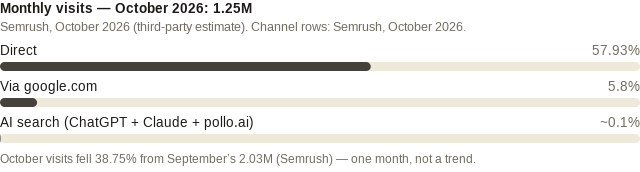
Monthly visits, Semrush, October 2026 (third-party estimate). Channel rows are the Semrush October 2026 desktop journey.
October 2026 drew an estimated 1.25M visits, down 38.75% from September’s 2.03M — one month, not a trend, and September itself was the high-water mark. The shape underneath is steadier: 57.93% of desktop visits arrive direct, and the brand term does the work, with “podia” alone drawing 18,100 searches a month and half of the site’s organic search traffic.
That split is the shape of the business. Creators arrive by name, or from a comparison page that already ranked Podia against Kajabi, and they stay because everything they sell lives in one place. The homepage sells the consolidation, not a single feature: four tools, four bills, four logins, replaced by one.

Screenshot of the Podia homepage, read 29 November 2026. The hero promises one place for courses, community, coaching and email, over a claim of 15,000+ creators and $900M+ earned.
The hero is a consolidation pitch, and the number under it does the persuading: 15,000+ creators, more than $900M earned between them. The site’s own 2026 report puts the same total at $935M, with $426M of it from online courses. Those are creator takings, not Podia revenue — the platform’s own cut is the subscription, and the report is the company’s own data.
Twelve years, two names
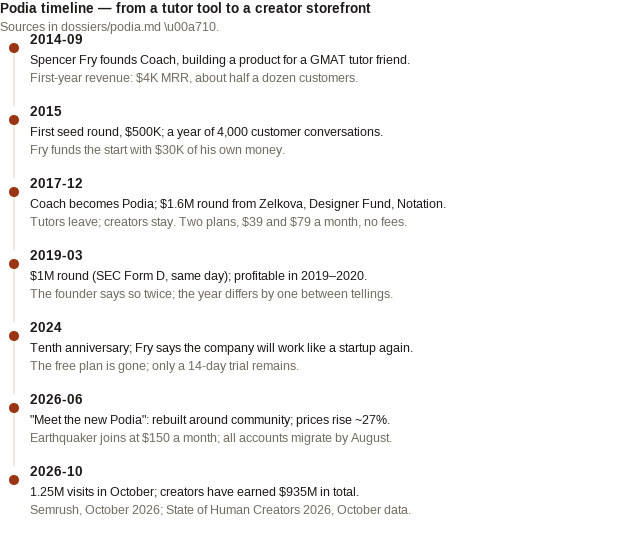
Timeline, 2014 to 2026. A tutor tool becomes a creator storefront, then stops raising money.
Podia started as Coach in September 2014, built for a GMAT tutor who needed to sell lessons online. The first year reached $4K in monthly recurring revenue and about half a dozen customers, while the founder spent a year talking to 4,000 people. Tutors left; creators stayed, so in December 2017 the company dropped tutoring and renamed itself Podia.
The money followed the same patience. Three small seed rounds — $500K in late 2015, $1.6M in 2017, $1M in March 2019 — add to $3.1M, and nothing has followed since. The founder says the company turned profitable in 2019–2020, and the site now calls itself independent and profitable. Databases that track funding put the total higher, at $4.5M to $5.23M, without itemising the difference.
The rename is recorded in TechCrunch, 21 December 2017: Coach becomes Podia because its users turned out to be content creators, not tutors, and the story records 7,500+ creators at the time. The TechCrunch page blocks automated captures, so the story is cited as text rather than shown as a screenshot.
The founder is still the story. Spencer Fry built Podia alone after two earlier exits, and he is still chief executive twelve years in. He will not disclose revenue — in a 2018 interview he called Podia a venture-backed business that does not talk about revenue — and the company has never published its own sales figures. The profit claim rests on his word, twice told, a year apart.
The price list: $42 buys the Mover plan
Three plans, one lever

Prices from podia.com, read 29 November 2026. The monthly rate shown is the annual-billing rate; month-to-month costs $49, $99 and $179.
| Plan | Price | What it is |
|---|---|---|
| Mover | $42/mo | 50 products, 500 videos, 25 spaces; email for 100 subscribers; 5% transaction fee |
| Shaker | $84/mo | 150 products, 1,000 videos, 100 spaces; email for 500 subscribers; no fees; affiliates, upsells, PayPal, Zapier |
| Earthquaker | $150/mo | Unlimited products, videos and spaces; email for 1,000 subscribers; no fees; unlimited assistants |
The ladder is short and the lever is the fee. Every plan includes unlimited customers and students, the website, the community and email; the step up buys room — more products, more email subscribers — and the removal of the 5% fee. Month-to-month billing costs $49, $99 and $179, so the annual rate saves about 14–16%.
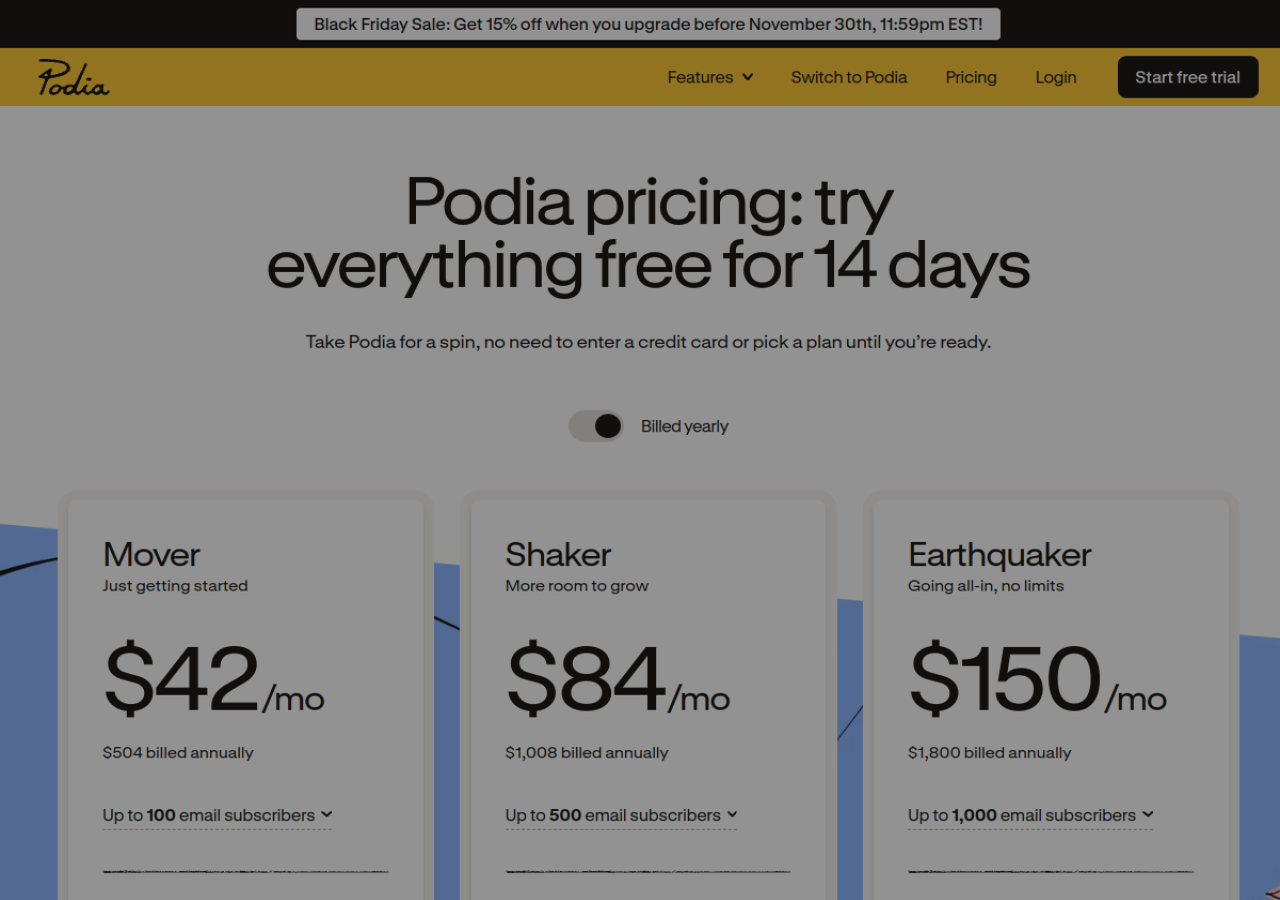
Screenshot of the Podia pricing page, read 29 November 2026. Mover is $42 a month billed annually with a 5% fee; Shaker and Earthquaker charge no fees.
The prices on the page are the annual-billing prices, and the fee is the point. A creator on Mover pays $42 a month plus 5% of every sale, while Shaker costs $84 flat. At $840 in monthly sales the fee equals the $42 gap between the plans, and past that line Mover is the expensive choice. The cheapest plan is a hook, not a home.
The $42–$84 typical basket
The typical order is a subscription, not a single purchase. A creator starting out pays $42 a month on the annual plan; a creator selling steadily pays $84, because the fee stops making sense first. The range runs $42 to $150 at entry, and the company has not disclosed what its creators actually pay on average, so this page does not multiply either number by a customer count and call it revenue.
One older number cross-checks the shape. In 2017 the ladder was two plans, $39 and $79 a month, with no transaction fees at all. The fee arrived later, and the 2026 rebuild raised the annual rates by about 27% — Mover from $33 to $42, Shaker from $75 to $84 — while adding the $150 Earthquaker tier and dropping the free plan. The direction is unmistakable: more money from the creators already inside.
What keeps creators paying
| Mechanism | Status | How it shows up |
|---|---|---|
| Free tier | — | No permanent free tier; only a 14-day trial |
| No signup | — | A site must be created to try it; the trial itself needs no credit card |
| Free trial | ✓ | 14 days, no credit card required; email limited to 100 subscribers during the trial |
| Cancel | ✓ | Home feed → site name → Admin → Billing → Cancel Plan; the site is unpublished and the dashboard closes |
| Refund window | ✓ | 72 hours after the most recent payment; no pro-rated refunds; annual plans get no partial refund |
| Migration help | ✓ | Free assisted migration: up to 50 products on Mover, 150 on Shaker and Earthquaker; quizzes, funnels and site pages do not move |
| No auto-upgrade | ✓ | “We never auto-upgrade you” when the email subscriber limit is hit; the creator chooses to upgrade |
| Affiliate programme | ✓ | 20% recurring commission for up to 12 months, 31-day cookie (Rewardful terms, 15 October 2026) |
| Creator-run affiliates | ✓ | From Shaker, creators can run their own affiliate programme inside their store |
| Upgrade lever (5% fee) | ✓ | Mover takes 5% of sales; at $840 a month the fee equals the Shaker price gap |
| Advertising | — | About 20 Meta ads running in the US; acquisition is not bought in bulk |
| API | ✓ | Zapier from Shaker; 1,900+ embeds; Podia MCP for AI tools |
The table has no free tier to lean on — the retention work is done by the move itself. A creator who cancels loses the site, the dashboard and every recurring membership at once, and the data is deleted after 180 days. The 72-hour refund window is short, and there is no partial refund on an annual plan, so leaving costs more than staying.
The referral programme is the funnel’s second floor. Podia pays affiliates 20% of a referred creator’s bill for up to a year, and its own help pages promise up to 30% — the terms page says 20%, and this page follows the terms. Creators on Shaker can run the same trick inside their own stores, which turns the best sellers into recruiters.
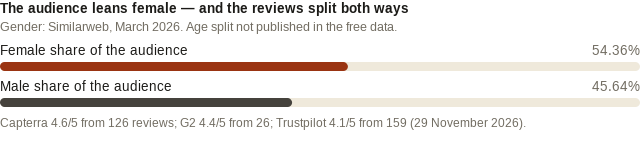
Who pays, and who does not. The gender split leans female; the age split was not published in the free data (Similarweb, March 2026).
A 4.6 on Capterra, a 4.1 on Trustpilot
The public review record is good and unusually split. Capterra shows 4.6 out of 5 from 126 reviews, G2 shows 4.4 out of 5 from 26, and Trustpilot shows 4.1 out of 5 from 159. The praise repeats: fast setup, a storefront that works in a week, and support that answers within minutes. The complaints repeat too, and they are specific.
Trustpilot’s own split is the sharpest: about 63% five-star against about 26% one-star, with almost nothing in between. The low scores cluster on four faults — missing features, slow or AI-first support, price rises and rule changes, and locked accounts. One 2026 review said the rebuild had made it “no longer the platform I signed up for”.
The shelf: a third of Kajabi’s price
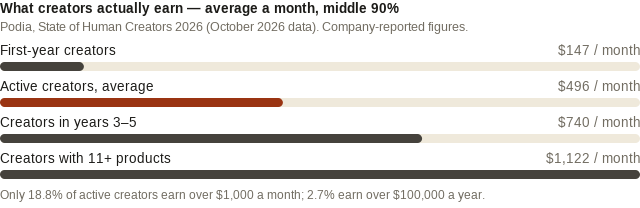
Creator earnings, Podia’s own 2026 report (October 2026 data, middle 90% averages). Company-reported figures, not independent data.
| Site | Entry price | Fee | What it sells |
|---|---|---|---|
| Podia Mover | $42/mo | 5% | Courses, community, email and website in one; 100 email subscribers |
| Podia Shaker | $84/mo | 0% | 150 products; 500 email subscribers; affiliates, upsells, Zapier |
| Podia Earthquaker | $150/mo | 0% | Unlimited everything; 1,000 email subscribers; unlimited assistants |
| Kajabi Basic | $143/mo | 0% | 5 products; 2,500 contacts; funnels, automation, branded mobile app |
| Kajabi Growth | $199/mo | 0% | 50 products; 10,000 contacts; advanced automation |
| Kajabi Pro | $399/mo | 0% | Unlimited products; 100,000 contacts; code editor, white labelling |
The gap is the whole pitch, and it is the whole risk. Podia starts at $42 a month against Kajabi’s $143, and its own comparison page says so in plain numbers. What the gap buys at Kajabi is the ceiling Podia does not have: sales funnels, deep automation, a branded mobile app, and email lists measured in tens of thousands instead of hundreds.
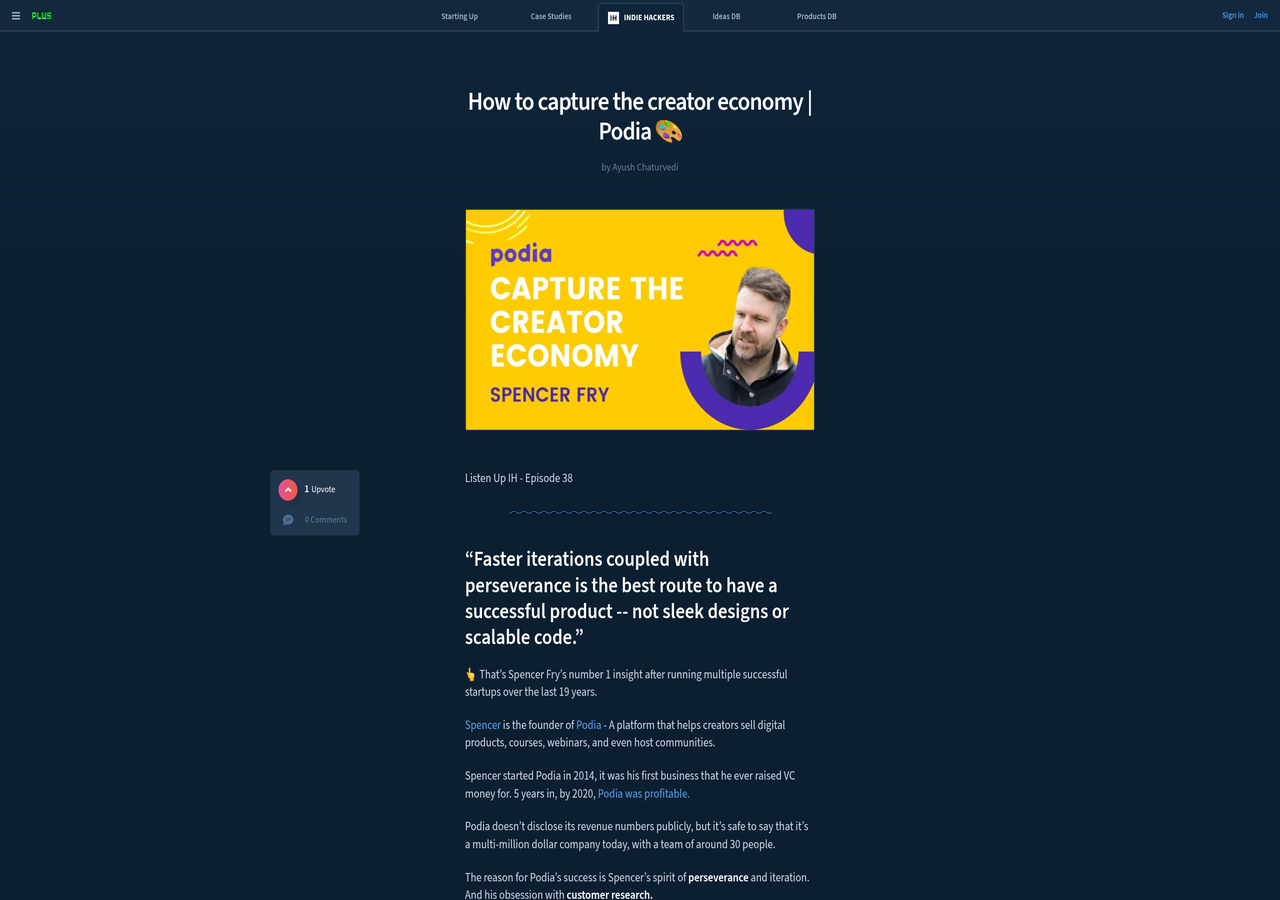
Screenshot of the Indie Hackers story on Podia. The founder’s account: $30K of his own money, $4K in monthly recurring revenue in the first year, profitable by 2020.
The earnings chart is the honest counterweight to the hero number. Active creators average $496 a month, but first-year creators average $147, and only 18.8% of active creators clear $1,000 a month. The $935M total belongs to 15,000 creators unevenly, and the typical creator on the platform earns less in a month than the platform charges its top tier.
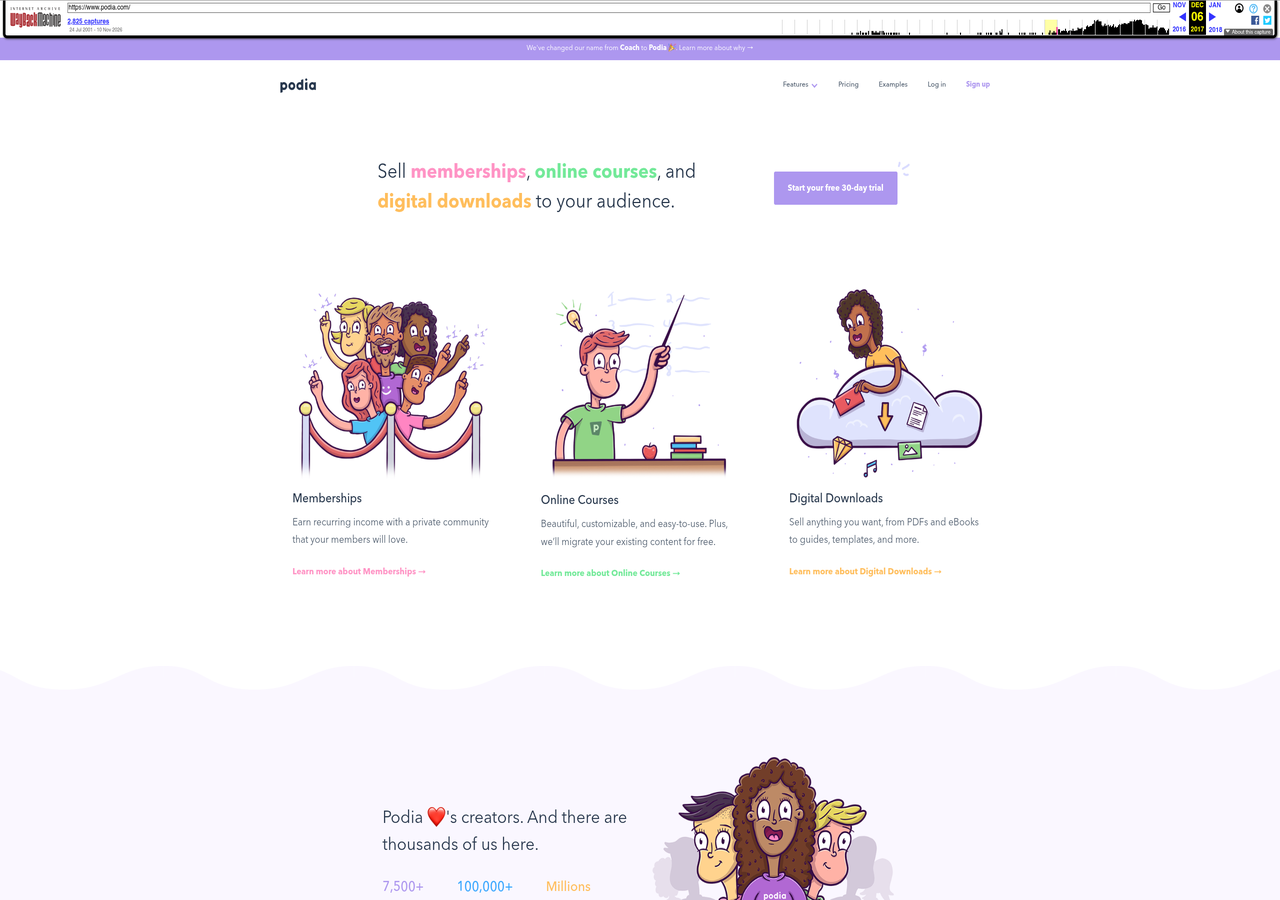
Screenshot of the Wayback Machine’s first capture of the renamed Podia site, 6 December 2017. The domain was registered in 1998, but the May 2017 capture is a domain-parking page, not the company’s site.
The renamed site first appears in the Wayback Machine on 6 December 2017, days after the December 2017 rename. The domain itself was registered in 1998, but the May 2017 capture is a domain-parking page offering the name for sale. The company was founded in 2014 as Coach, and its predecessor site withcoach.com dates to 2011. Nine years on, the domain, the model and the ownership are all unchanged.
Where the visits come from
| Channel | Share of visits | Platform & stack |
|---|---|---|
| Direct | 57.93% | Semrush traffic journey, desktop, October 2026 |
| Via google.com | 5.8% | Semrush traffic journey, desktop, October 2026 |
| Organic search | Share not published | Semrush: organic search traffic fell 2.73% month-on-month in October 2026; top keyword “podia”, 18,100 searches a month |
| Paid search | Share not published | Semrush: paid search traffic fell 91.68% month-on-month in October 2026 |
| Meta paid ads | About 20 active ads (US) | Ad Library live-browser check, 29 November 2026: official page Podia, about 22 active ads worldwide, none inactive |
| AI search | About 0.1% | Semrush, October 2026: about 1,000 visits from ChatGPT, 160 from Claude, 154 from pollo.ai |
Direct traffic leads at 57.93% of desktop visits, with google.com next at 5.8% — the shape of a product people arrive at by name or from a comparison page they already read. AI search is about 0.1% of visits: some 1,000 from ChatGPT, 160 from Claude and 154 from pollo.ai in October 2026. Paid search fell 91.68% in the same month, which is the number to watch next month.
| Layer | What it runs on |
|---|---|
| Platform | Creator storefront SaaS: Next.js + Sanity CMS; creators sell through their own subdomains |
| Channels | Direct sales on podia.com and creator subdomains; comparison pages for search; affiliate programme |
| AI | Podia Agent on all plans; Podia MCP for AI tools; llms.txt published 28 November 2026 |
| Payments | Stripe and PayPal, connected to the creator's own account; 2.9% + 30¢ per transaction, charged by the processor |
| Infrastructure | Not verified — AWS and Heroku signals both appear, mixed with creator-subdomain stacks |
| Integrations | Zapier from Shaker; Zoom, YouTube Live, Google Meet; ConvertKit, Mailchimp, AWeber, Drip |
| Support | Email hello@podia.com; chat support; AI resolves about 70% of conversations (company statement) |
The stack is a hosted creator storefront with a Sanity content back end on Next.js: no download, no self-hosting, the whole business behind a login. The hosting provider was not identified this round — the signals mix the main site with creator subdomains — and the payment methods are the creators’ own Stripe and PayPal accounts, not Podia’s.
Podia is the second teardown in our Education · Creator courses & membership platform collection. The nearest teardown on traffic is Cymbiotika at 1.26M visits a month, and the most useful side-by-side is Podia vs Kajabi vs Gumroad. For the closest rival by traffic, see the Kajabi teardown.
Unlock the full Podia teardown
Inside the full teardown:
- The $840 line
- The creator ledger
- The funding file
- What a founder should copy — and what not to
Prefer to inspect a full teardown first? Read the iLovePDF teardown — fully unlocked.
Similar sites in the database
Podia (1.25M) sits just below Cymbiotika and just above Rifle Paper Co. in the database. The sites nearest to it on traffic are shown below.
| Site | Monthly visits | Category |
|---|---|---|
| Whimsical | 1.27M | Collaboration whiteboard · Online whiteboard |
| Cymbiotika | 1.26M | Health & wellness · Liposomal supplements DTC brand |
| MeUndies | 1.25M | Clothing · DTC brand |
| Podia (podia.com) | 1.25M | Education · Creator courses & membership platform |
| Rifle Paper Co. | 1.25M | Stationery · Design stationery DTC brand |
| Book of the Month | 1.24M | Content products · Book subscription box |
| AISongMaker | 1.23M | AI music · AI composition |
Related teardowns
- Kajabi — 4.04M visits a month, the high-end creator platform Podia undercuts.
- Gumroad — the download store Podia compares itself against, fee for fee.
- Fourthwall — the creator storefront that sells merch, not courses.
Read the next one in your inbox
The new ones go out by email first, one a week, with the traffic source and month attached to every number. Leave your address and the next one comes to you.
Free email brings one full teardown a week. Membership opens the whole archive, all of it, right now.