
How PostHog Makes Money: 97% Pay $0
PostHog does not sell analytics. It sells the install: an open-source repository any engineer can clone, a pricing page that starts at $0, and a handbook that publishes the company's own finances. The first million events a month are free, no card required, and 97% of users pay nothing at all. The money arrives later, one event at a time, as usage grows and a second product joins the bill.
The company says it was cash-flow positive by the end of 2024 and puts annual recurring revenue at about $50 million in October 2025 — both its own words, neither audited. What follows is what can be checked: the pricing pages and handbook read on 21 November 2026, the 4.5 million visits in the traffic record, funding announcements and review scores — including what cuts against the story: 97% free means the bill rests on very few payers, and the biggest customers pay the lowest rates.
| Site | PostHog — posthog.com |
|---|---|
| What it is | Open-source product analytics, session replay, feature flags, experiments, surveys and error tracking, on one usage-based bill. |
| Who it is for | Product engineers and product teams that want to own their data and pay per event, not per seat. |
| Category | Tools · Product analytics & session replay |
| Monthly visits | 4.5M (Similarweb, Oct 2026) |
| Founded | 23 January 2020, by James Hawkins and Tim Glaser |
| Headquarters | San Francisco in company databases; the company describes itself as fully remote with no central office |
| Operator | PostHog, Inc.; private and unlisted; founder-controlled |
| Survival engine | Distribution-led (open-source self-hosting and a public handbook bring developers in) with a repeat-purchase leg (usage-based billing grows with volume) |
| Revenue | About $50M ARR, October 2025 (company handbook); cash-flow positive since end of 2024, the company says; no audited accounts published |
| Pricing | $0 base, pay as you go; first 1M events a month free; Boost $250, Scale $750, Enterprise $2,000 a month (list price) |
| Pricing model | Usage-based per product, no per-seat charges, no annual commitment |
| Free hook | 1M events, 5,000 recordings, 1M flag requests and 100,000 exceptions free every month; no card required |
| Meta ads | Live: 11 Meta creatives in the Understory snapshot (Oct/Nov 2026), longest live 59 days; the handbook says Meta/Instagram is a brand channel |
| Country breakdown | Not published (the Similarweb page shows no country split) |
Third-party estimates, not official MAU/DAU. Prices were read on posthog.com/pricing.md on 21 November 2026. Revenue figures are company claims or third-party estimates, not audited accounts.
TL;DR
- The first million events a month are free, with no card and no trial — the free tier is the funnel, and 97% of users never pay.
- There is no subscription to buy: every product meters separately, from $0.00005 an event, and the rate falls to $0.000009 at 250 million events.
- The company says it was cash-flow positive by the end of 2024, at about $50 million in annual recurring revenue — and raised $75 million in September 2025 at a $1.4 billion valuation.
- The cracks are visible: the biggest customers pay the least per event, self-hosting lets anyone skip the cloud bill, and no retention or conversion rate is published.
The first screen sells a free install, not a price
A hero, a wizard and 97% paying nothing
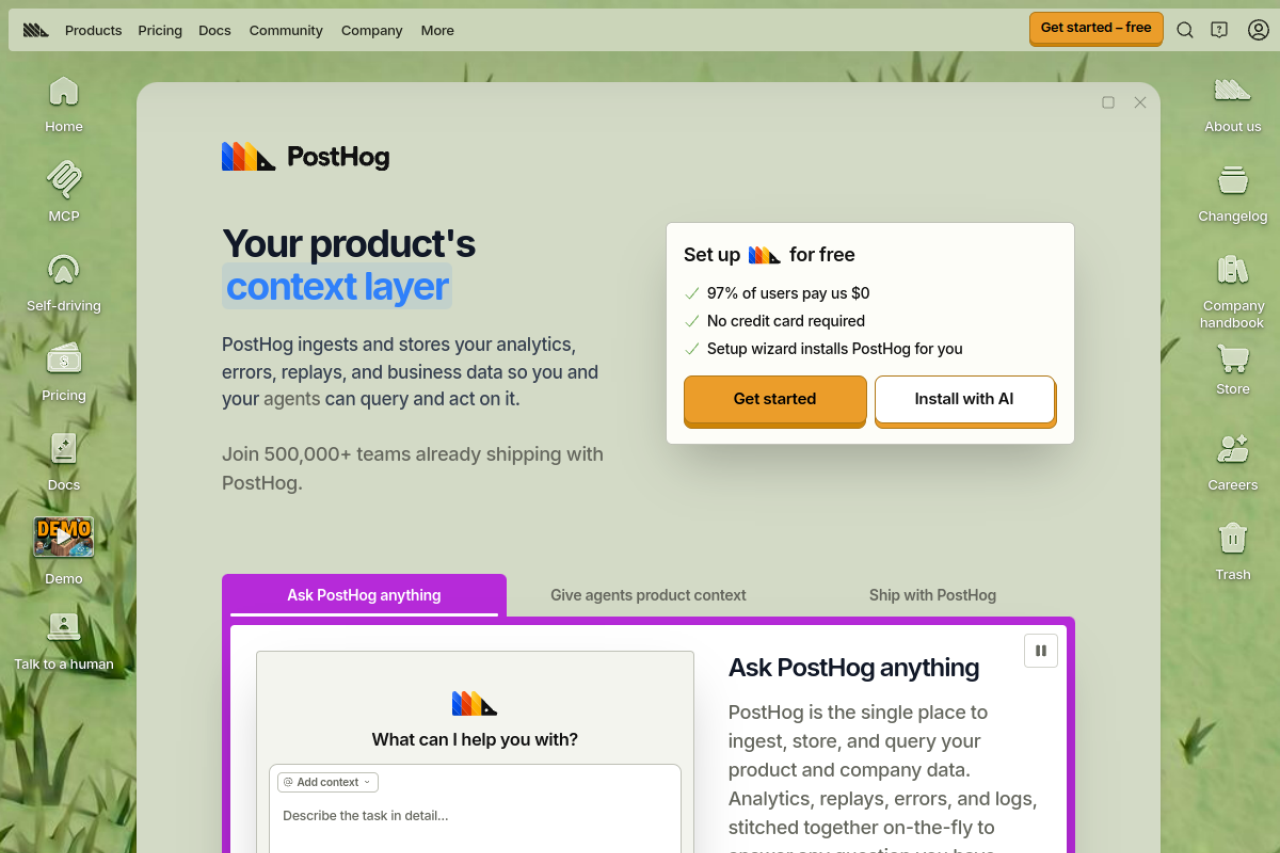
The homepage on 21 November 2026 is a terminal command, not a price list. The headline calls PostHog "your product's context layer", and the only action in view is a free setup: a wizard installs it, or one line of npx does it from the terminal. The selling is done by the absence of friction — no card, no trial clock, no sales call.
The trust line sits under the headline: more than 500,000 teams already shipping with PostHog. That number is the company's own and cannot be checked against the record — the traffic file counts visits, not teams — so this page reports it as a claim. What can be checked is the funnel itself: the product is one install away, and the bill starts at zero.
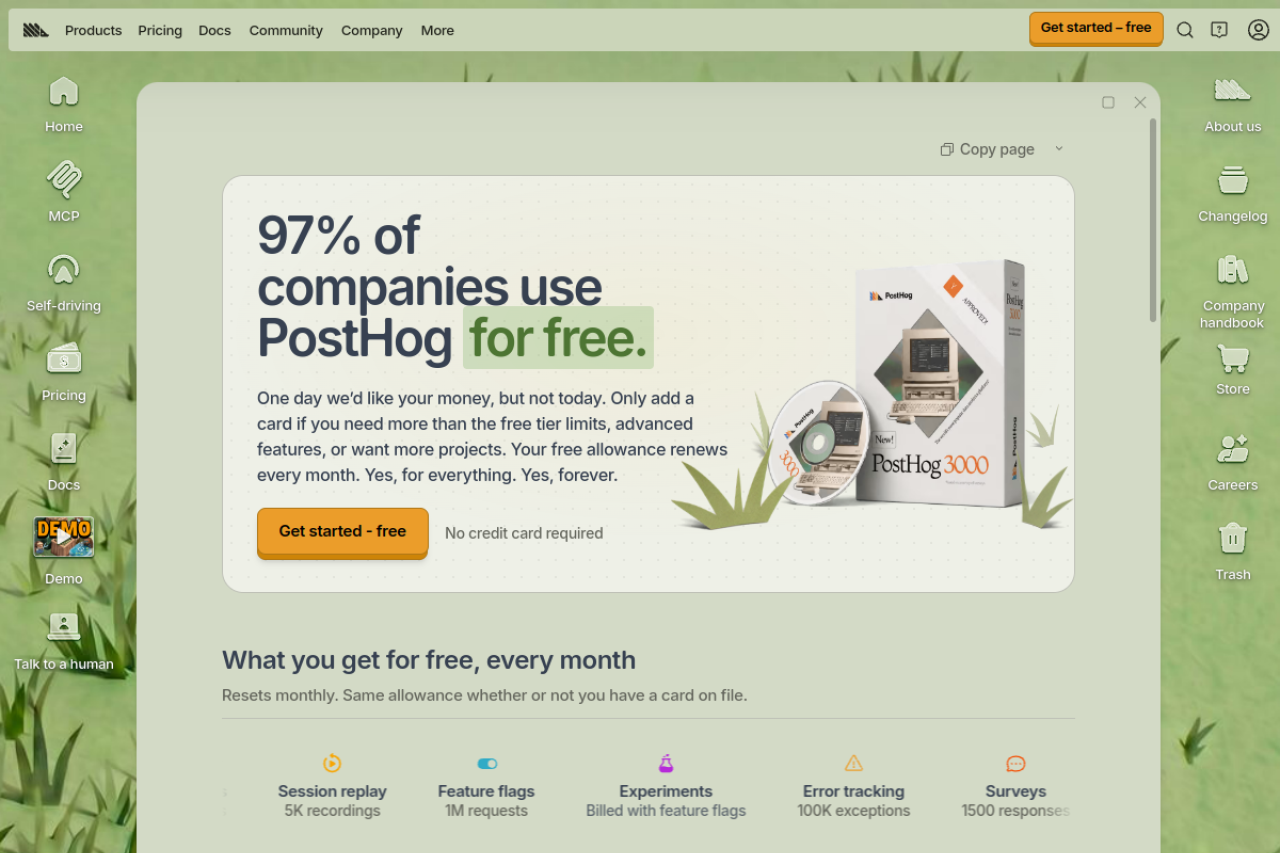
The pricing page says the quiet part out loud. "One day we'd like your money, but not today" — and the free allowance renews every month, for every product, forever. The page's own line is that 97% of companies use PostHog for free, which is also the risk: the whole business rests on the 3% that outgrow the free tier.
Fourteen products, one meter
| Product | Plan | Free every month | First paid rate |
|---|---|---|---|
| Product analytics | Free, then pay as you go | 1M events | $0.00005/event (1M–2M) |
| Session replay | Free, then pay as you go | 5,000 recordings | $0.005/recording (5K–15K) |
| Feature flags & Experiments | Free, then pay as you go | 1M requests | $0.0001/request (1M–2M) |
| Surveys | Free, then pay as you go | 1,500 responses | $0.10/response (1,501–2,000) |
| Error tracking | Free, then pay as you go | 100,000 exceptions | $0.00037/exception (100K–325K) |
| Sources | Free, then pay as you go | 1M rows | $0.000015/row (1M–10M) |
| AI Observability | Free, then pay as you go | 100,000 events | $0.00035/event (100K–150K) |
| Logs | Free, then pay as you go | 10 GB | $0.25/GB (11–300 GB) |
| PostHog AI | Free, then pay as you go | 500 credits | $0.01/credit |
| Emails | Free, then pay as you go | 10,000 emails | $0.003/email (10K–50K) |
| Context: identified events — the add-on that tracks people across visits — cost $0.000198 an event in the first paid band, about four times the anonymous rate. Platform packages sit on top of usage: Boost $250, Scale $750 and Enterprise $2,000 a month on the list price, though the enterprise page says custom pricing. Prices read 21 November 2026, posthog.com/pricing.md. | |||
Source: posthog.com/pricing.md, read 21 November 2026. All prices in USD, excluding taxes. No per-seat charges on any plan.
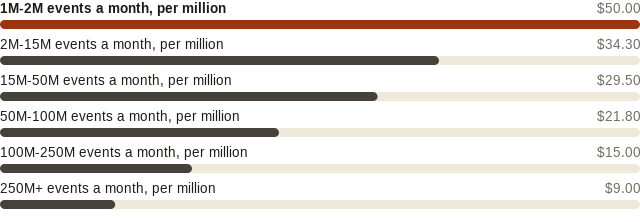
The meter is the whole pricing model. There is no monthly fee to buy and no seat to count — each product has its own free allowance, its own unit, and its own rate card, and the rate falls as volume rises. The second million events costs $50; the million after 250 million costs $9. Volume is the discount, and the discount is the retention plan: the more a customer grows, the cheaper each event gets, and the harder it is to justify leaving.
The trap is in the fine print of the meter. Anonymous events are cheap; identified events — the ones that follow a person across visits and devices — cost about four times as much in the first paid band. A team that wires up person profiles without noticing pays $248 for its second million events instead of $50. The pricing page publishes both rates, but the default is what a careless setup buys.

The only flat fees on the page are the platform packages, and they buy control, not usage. Boost at $250 a month adds unlimited projects, white labelling, a HIPAA agreement and enforced single sign-on; Scale at $750 adds priority support and SAML; Enterprise at $2,000 lists role-based access and dedicated support. The packages are where the enterprise sale lives — everything else is a meter reading.
The small print is the product
| Mechanism | Present | What the site shows |
|---|---|---|
| Free tier (per product, monthly) | ✓ | 1M events, 5,000 recordings, 1M flag requests, 100,000 exceptions free every month, resetting monthly |
| No card required | ✓ | Free plan needs no card; pricing page says "not a trial" |
| Free trial | — | No trial period — the free tier is the entry, and the page says so |
| Usage-based billing, no per-seat | ✓ | "There are no per-seat charges. Your whole team can use PostHog." |
| Billing limit per product | ✓ | Each product can cap its own spend; "going viral won't require another funding round" |
| Free tier stops at the limit | ✓ | "Usage stops at the free tier limits, so you can't be charged by surprise" |
| Surprise-bill refund promise | ✓ | Pricing page: "we'll pretty much always refund it!" — the formal terms were not read this round |
| Annual commitment discount | ✓ | 20% at $25K–$60K of credits a year, up to 40% at $500K–$1M |
| Startup credits ($50K, 12 months) | ✓ | Under 2 years old and under $5M raised; YC companies get $50K a year, renewable |
| Self-hosting (MIT core) | ✓ | Main repository is MIT licensed; enterprise directory is separate and proprietary |
| Cancel anytime | 未核到 | Cancellation terms were not read this round |
| Pause subscription | 未核到 | No pause clause found in the pages read |
| Gift subscription | — | B2B developer tool; no gift subscription exists |
| Loyalty programme | 未核到 | No loyalty programme found on the official site |
| Referral programme | 未核到 | No referral reward found on the official site |
| Skip a month | — | No monthly fee to skip — billing is per event, and the free tier resets monthly |
| Open-source API | ✓ | posthog-js on npm, 15.2M weekly downloads (third-party read, Oct 2026) |
The retention design is a pipeline, not a contract. There is nothing to cancel on a free tier, nothing to pause, and no loyalty programme to leave — the hold is the data itself. Once a team's events, replays and flags live in one place, moving them means re-instrumenting the product. The billing limit is the only generosity that matters: it makes the free tier safe to trust, and trust is what turns an install into a bill.
What is missing is as telling as what is there. No trial, no gift, no referral, no pause — the company spends nothing on the usual subscription mechanics, because it does not sell a subscription. The one promise that sounds like a refund policy is a sentence on the pricing page, not a clause in the terms, and this page says so plainly.
4.5 million visits, and a handbook instead of a sales team
| Traffic fact | Figure | Source |
|---|---|---|
| Monthly visits | 4.5M | Similarweb, Oct 2026 |
| Month change | +25.08% | September about 3.6M, calculated from the October figure and the change |
| Rank in our database | 128th of 901 | Recomputed from the master table, 25 November 2026 |
| Country split | Not published | Similarweb page shows no country split |
| Direct traffic | Not in the record | Channel split not in the master-table record |
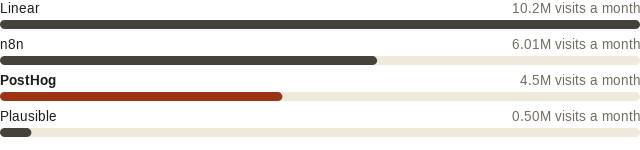
October's number is 4.5 million visits, the 128th largest site in our database of 901 — between Splice at 4.5 million and online2pdf at 4.49 million — and the fastest riser in its intake round, up 25.08% on September. The record carries no country split and no channel split, so this page claims no geography and no funnel. What the number does show is momentum: a developer tool growing by a quarter in a month, without a consumer brand behind it.
The gap to the leader is the point. Linear draws 10.2 million visits a month, more than twice PostHog, and sells project management to the same engineering teams. PostHog sells those teams the instrument panel for their own product. The two companies share an audience and almost nothing else — which is why PostHog's growth has to come from developers choosing the tool themselves, not from a sales team choosing it for them.
The repository is the funnel
| Channel | Share of visits | Platform & stack |
|---|---|---|
| Open-source repository | Main channel (company account) | PostHog/posthog on GitHub, about 41K stars, MIT core; 77,879 commits |
| Public handbook | Core distribution (company account) | Salaries, OKRs and finance targets all public; anyone can propose a change |
| Content & comparison pages | Supporting | Blog and changelog since 2020; posthog.com/compare against rivals |
| Paid ads (Google, Reddit, Meta) | Supporting (company account) | Google Search for conversion, Reddit and Meta for awareness; 123 distinct creatives in the Understory snapshot |
| App stores | Not applicable | B2B developer tool; no store distribution |
| Captured at signup | Newsletter on Substack; scale not verified | |
| Platform | Website stack not published | ClickHouse core since October 2020; self-hosted option; SOC 2 Type 2 (third-party read) |
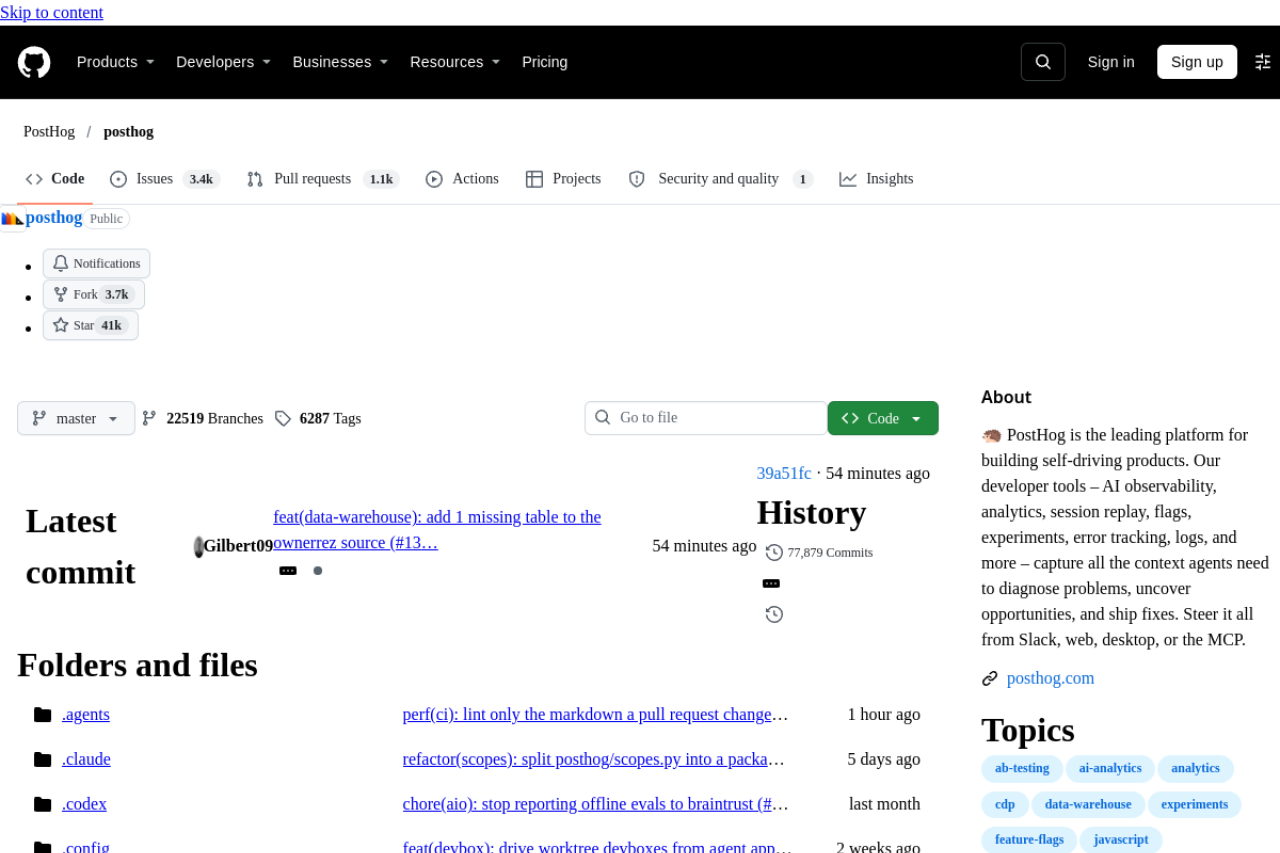
The funnel starts on GitHub, not on the homepage. The repository carries about 41,000 stars and nearly 78,000 commits, and the company's own history says the first version won 300 deployments within days of a Hacker News post in February 2020. An engineer who clones the code has already adopted the product; the cloud bill is a convenience upgrade, not a first purchase.
The handbook is the second half of the same machine. It publishes salaries, objectives, finance targets and the sales contract rules — the kind of document most companies keep behind a login. For a buyer choosing where to send product data, that openness is the pitch: a company that shows its own numbers is a company you can trust with yours. The hiring page says the company grows 97% by word of mouth, which is a claim, not a measurement — but the repository count is one.
The reviewers like it. The sample sizes vary.
| Source | Score | Reviews | Read |
|---|---|---|---|
| G2 | 4.5 / 5 | 1,057 reviews | Nov 2026 |
| Capterra | 4.5 / 5 | Review count not verified | Third-party report |
| TrustRadius | 8.4 / 10 | 19 reviews | Nov 2026 |
| Product Hunt | 4.99 / 5 | About 305 reviews | Nov 2026 |
The scores agree, and the samples do not. G2 gives 4.5 out of 5 from 1,057 reviews — the only rating here with a four-figure sample — and Capterra matches the 4.5, though its review count could not be verified this round. TrustRadius gives 8.4 out of 10 from nineteen reviews, and Product Hunt gives 4.99 from about 305. The big number measures the product; the small ones measure the enthusiasm of its fans.
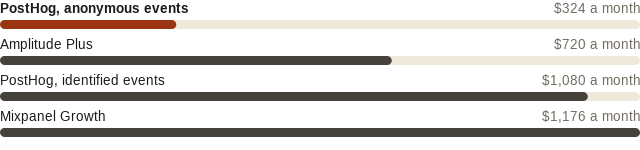
The price comparison is where the meter cuts both ways. At ten million events a month, PostHog's anonymous rate is $324 — the cheapest of the three vendors a third party priced on 4 November 2026, against $720 at Amplitude and $1,176 at Mixpanel. Switch the meter to identified events, the ones that follow people, and PostHog jumps to $1,080 — second most expensive, ahead of Amplitude. The same product is the cheapest and the dearest, depending on one toggle.
Outsiders priced the company at $1.4 billion
| Round | Amount | Date | Lead / note |
|---|---|---|---|
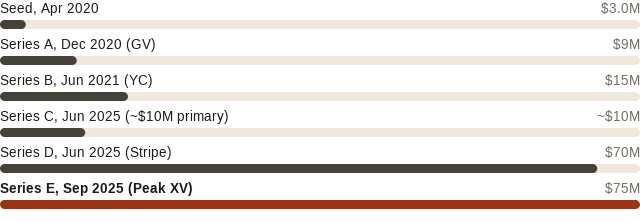
| Seed | $3.025M | Apr 2020 | Company handbook record |
| Series A | $9M | Dec 2020 | GV led; total raised $12M |
| Series B | $15M | Jun 2021 | Y Combinator led |
| Series C | ~$10M primary | Jun 2025 | Employee share sales; tightened founder control |
| Series D | $70M | 9 Jun 2025 | Stripe led; $920M valuation |
| Series E | $75M | 29 Sep 2025 | Peak XV led; $1.4B valuation |
| Total raised | $182M | — | Sum of announced rounds; some third parties say $194M — the $12M gap is unexplained |
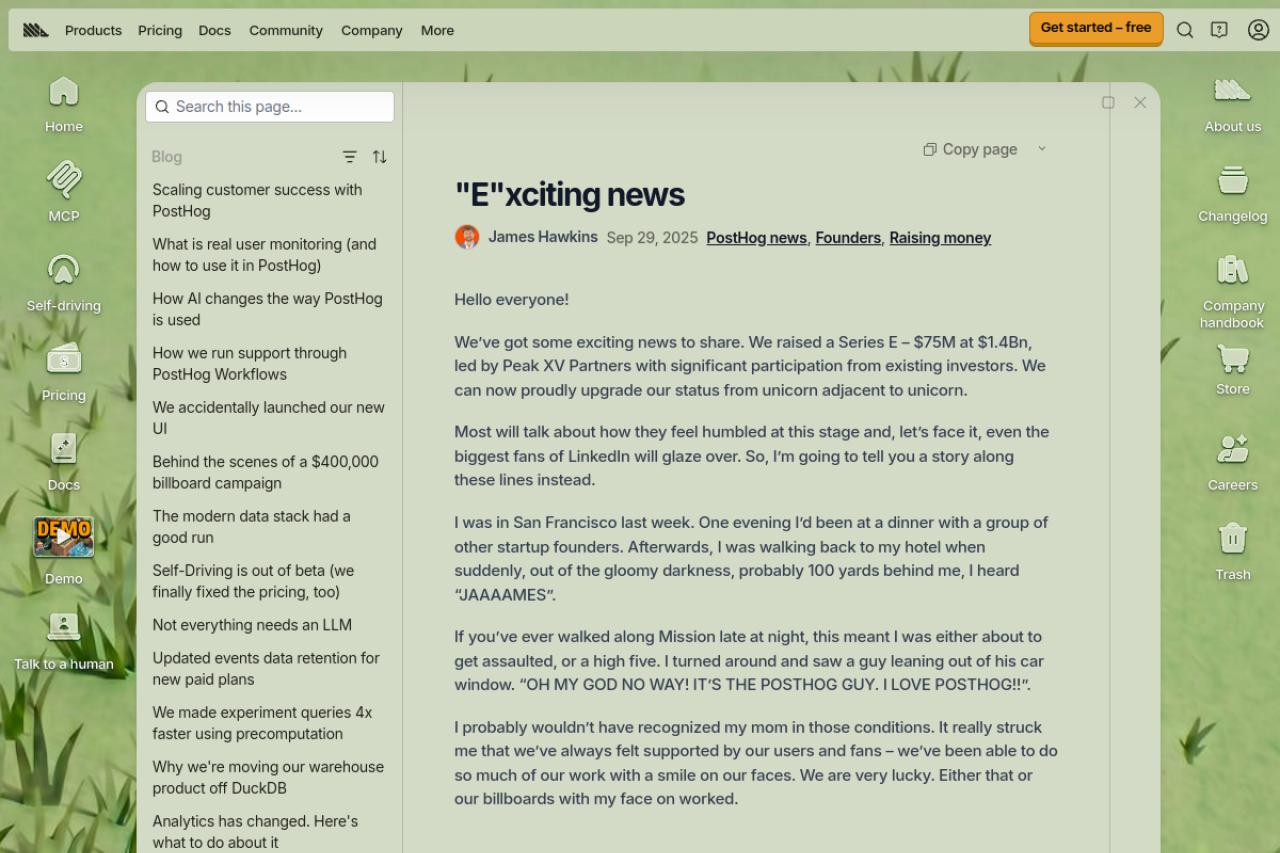
The funding record is short, recent and steep. Five years passed between the seed round and the Series D, then $145 million arrived in four months: $70 million from Stripe in June 2025 at a $920 million valuation, and $75 million from Peak XV in September at $1.4 billion. The company's own blog calls the second round an upgrade "from unicorn adjacent to unicorn" — a joke that is also a valuation claim, and this page reports it as the company's words.
The valuation is where the story gets uncomfortable. At $1.4 billion against about $50 million of annual recurring revenue, the company is priced at roughly 28 times revenue — and at the Series D, $920 million against $9.5 million of revenue was roughly 97 times. The multiple only makes sense if the growth holds: the handbook's own arithmetic says 5% monthly growth makes the company default alive, and 7.5% gets it to $100 million by the end of 2026. The target is a target, not a result.

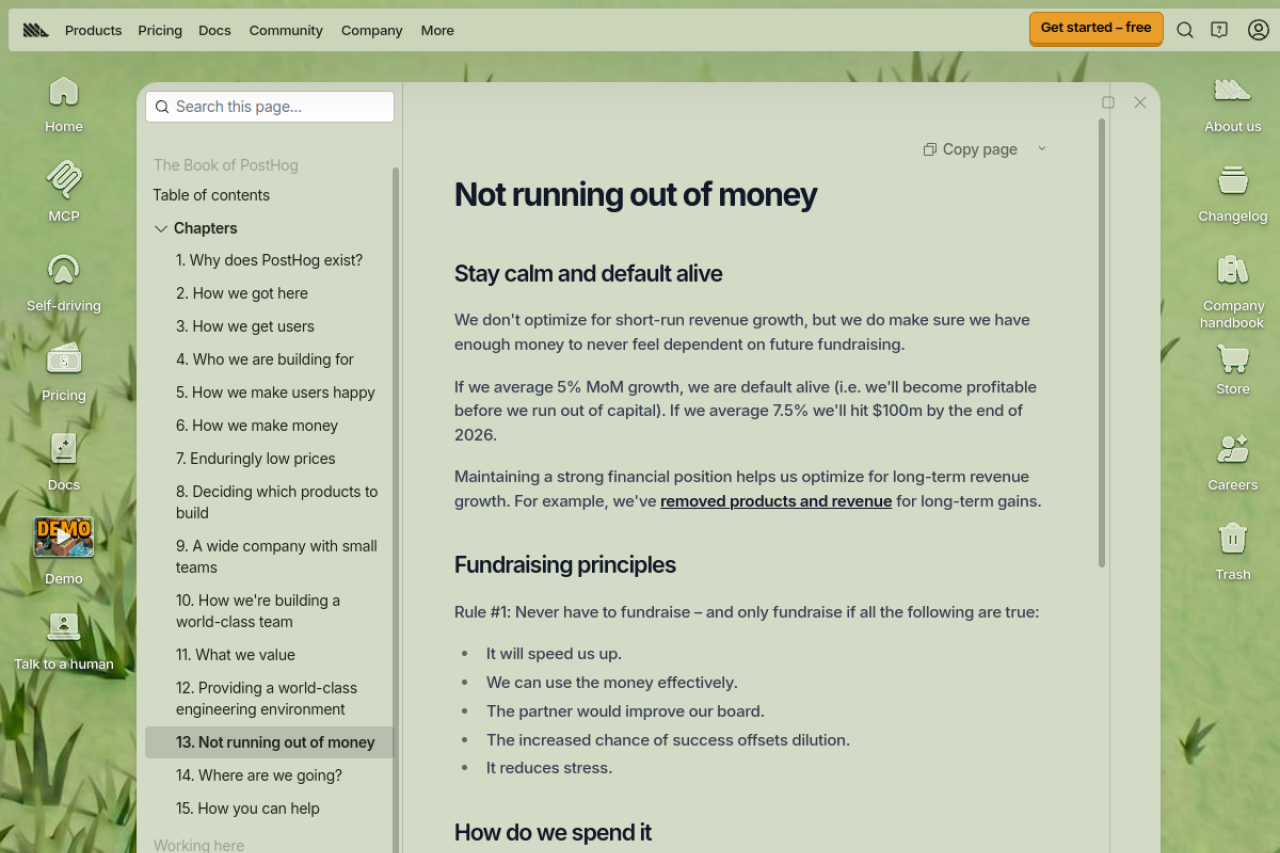
The handbook page is the most unusual piece of financial disclosure on the public internet for a company of this size. It defines "default alive", publishes the growth rates that would keep the company alive, and lists the fundraising rules — never raise unless it speeds the company up, improves the board, and is worth the dilution. A buyer reading it learns more about the company's finances than most public companies disclose. That is the point: the handbook is the sales deck, and it is free.
Compare PostHog with Plausible side by side — usage-based pricing against a flat privacy-first plan — or browse the full product analytics & session replay collection. The closest published teardown is n8n.
The full teardown is for members
The full analysis of pricing, acquisition, conversion and retention is member content. Membership is $29 a month or $249 a year.
Similar sites in the database
PostHog (4.5M) is the 128th-largest site of 901 — between Splice and online2pdf, both also near 4.5M.
| Site | Category | Monthly visits | Source |
|---|---|---|---|
| Splice | Music · Sample sound library subscription | 4.5M | Similarweb, Oct 2026 |
| online2pdf | Images/PDF tools · PDF conversion | 4.49M | Semrush, Oct 2026 |
| Moises | AI music · AI stem separation | 4.44M | Semrush, Oct 2026 |
Related teardowns
The closest teardown published so far is n8n, the open-source automation tool at 6.01M visits a month — another developer tool that gives the code away and charges for the hosted version. Compare PostHog with Plausible side by side, or browse the full product analytics & session replay collection. Also published: Linear, the developer tool at 10.2M visits a month.
Read the next one in your inbox
One teardown a week, every number sourced. Leave an email and the next one lands on Friday.
Sources: Traffic: Similarweb public page for posthog.com, October 2026 figure (4.5M visits, +25.08% on September; no country split published); rank 131st of 883 recomputed from the master table, 21 November 2026. Pricing: posthog.com/pricing.md, read 21 November 2026 (Free $0 with monthly free allowances; pay-as-you-go $0 base; per-unit tier rates for 14 products; identified events $0.000198 in the first paid band; Boost $250, Scale $750, Enterprise $2,000 a month on the list price; annual credit discounts 20–40%); posthog.com/pricing, read 21 November 2026 ("97% of companies use PostHog for free", "One day we'd like your money, but not today"). Company and growth: posthog.com, read 21 November 2026 ("Your product's context layer", "Join 500,000+ teams", "97% of users pay us $0"); posthog.com/handbook/story, read 21 November 2026 (founded 23 January 2020; Hacker News launch, 300+ deployments; cash-flow positive by end of 2024; $100M ARR target); posthog.com/handbook/finance, read 21 November 2026 ("Not running out of money", default alive at 5% monthly growth, $100m by end of 2026 at 7.5%); posthog.com/blog/series-e, 29 September 2025 ($75M Series E, $1.4Bn valuation, Peak XV led); posthog.com/blog/series-d, 9 June 2025 ($70M Series D, $920M valuation, Stripe led; Series C about $10M primary); Crunchbase News, 16 June 2025 (Series D, ARR $9.5M at that point); YourStory, 30 September 2025 (Series E); Sacra, read 21 November 2026 (ARR estimate $57.5M, February 2026, +99% year on year; $53.1M end of 2025). Open source: github.com/PostHog/posthog, read 21 November 2026 (41K stars, 3.7K forks, 77,879 commits); npm weekly downloads 15.2M (third-party read, October 2026). Advertising: Understory B2B ad library snapshot, October/November 2026 (123 distinct creatives; LinkedIn 74, Google 38, Meta 11; Meta longest live 59 days). Ratings: G2, November 2026 (4.5/5, 1,057 reviews); Capterra 4.5/5 (review count not verified, third-party report); TrustRadius 8.4/10, 19 reviews; Product Hunt 4.99/5, about 305 reviews. Competition: About Martech, 4 November 2026 (cost at 10M events a month: PostHog anonymous $324, identified $1,080; Mixpanel Growth $1,176 monthly; Amplitude Plus $720 monthly); master table, October 2026 (Linear 10.2M, n8n 6.01M, Plausible 0.50M). Target search terms: Semrush monthly volumes not available from the free sources read this round — no keyword volume is published on this page. Wayback Machine: earliest snapshot not verified this round. No official net profit, churn, renewal rate, conversion rate, free-to-paid rate or paid customer count is published for this site.