
How Rothy's makes money on $125 washable flats
Monthly visits
3.09M
October 2026. Third-party estimate, not official MAU/DAU. Semrush counted 3.09M for the month, up 127.65% on September’s 1.36M.
Rothy’s draws an estimated 3.09M visits a month (October 2026, Semrush), up 127.65% on September’s 1.36M. It is the 175th-largest site in our database of 901. The reason for the October jump was not verified this round, and this page does not guess one.
The pitch fits in one line: a flat made from recycled bottles, that you can wash in a machine. The brand did the selling first — a million pairs by 2018 — and the stores and the wholesale shelf did the scaling after: $211M of revenue in 2024, $227.7M in 2025, and a profit margin that is now thinning under tariffs.
| Site | Rothy’s, rothys.com |
|---|---|
| What it is | San Francisco shoe DTC brand — washable flats, loafers, sneakers and bags knit from recycled plastic bottles, sold online, in 40 stores and wholesale |
| Who it is for | City professional women who want a work shoe that is comfortable, washable and easy to explain — plus men’s sneakers and kids’ shoes |
| Category | Apparel · DTC brand |
| Monthly visits | 3.09M, October 2026. Third-party estimate, not official MAU/DAU; Semrush, up 127.65% on the month. The cause of the jump was not verified |
| Founded | 2012; launched September 2016. Founders Roth Martin and Stephen Hawthornthwaite, after about four years of development on their own money |
| Headquarters | San Francisco, California |
| Operator | Private — unlisted, not acquired or controlled. Alpargatas, the Brazilian owner of Havaianas, holds a 48.8% minority stake (November 2026) after declining its buyout option in December 2025; the founders keep a significant stake and run the company. Raised $42M early, then $473.35M from Alpargatas in December 2021 (PitchBook) |
| Survival engine | The brand. A $100 flat made from recycled bottles, machine-washable, with a story anyone can repeat in one sentence — that sold the first million pairs. Distribution is the second engine: 40 stores and wholesale at Nordstrom, Amazon and Anthropologie turned the remembered brand into $227.7M |
| Pricing | The Daily Flat $100; The Point III $165 list ($119 on sale in November 2026); The Almond Ballet $129; men’s RS02 Sneaker $149, RS01 $175; handbags $225–$285. Source: rothys.com, read 24 November 2026; the handbag band is the master-table value |
| Pricing model | One-off purchase, no subscription — shoes and bags bought once, with a 30-day return window that carries a $7.99 fee for mail-in refunds |
| Free hook | $20 off the first order over $100 for email sign-up; free shipping on all US orders; 30-day returns; $20 credit for sending back an old pair |
| Meta ads | Running in pulses — 148 ads in the library, 0 active on 19 November 2026, median run 3 days (Sprites); the library itself was not read directly |
| Country breakdown | United States 97.93% (3.02M); Canada 0.58% (18.03K); United Kingdom 0.38% (11.77K) — Semrush, October 2026 |
TL;DR
- Rothy’s draws an estimated 3.09M visits a month (October 2026, Semrush), up 127.65%. It sells washable knit flats from $100, and revenue reached $227.7M in 2025, up 8.1% — a figure disclosed by its minority shareholder Alpargatas, not an audited annual result.
- The brand is the business: a flat made from recycled bottles, launched at $125 in 2016, sold a million pairs by 2018 and $140M of shoes that year. The story is the acquisition channel — word of mouth and celebrities wearing the shoe, not a subscription or a discount.
- Distribution is the second engine: 40 stores and wholesale at Nordstrom, Amazon and Anthropologie, with wholesale near a third of revenue. The risk is cost — EBITDA margin fell from over 10% in 2024 to 7.9% in 2025 and 5% over the twelve months to March 2026, as tariffs on Chinese imports bit.
The $100 flat
Priced between $99 and $165
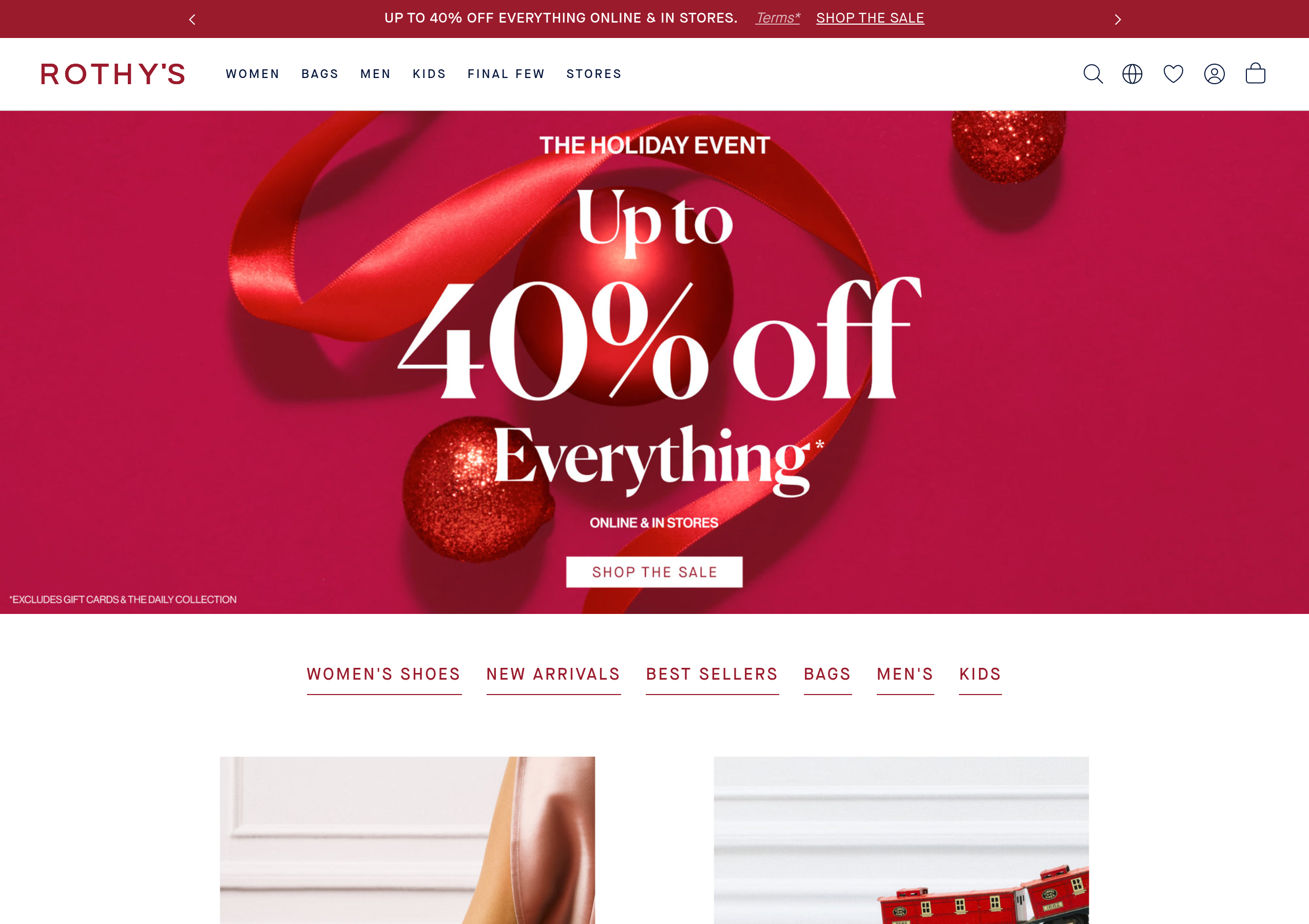
The Rothy’s homepage, read 24 November 2026. “The Holiday Event” — “Up to 40% off Everything”, online and in stores, 17 to 30 November 2026. The navigation tells the range: women, bags, men, kids, final few, stores.
The homepage we read on 24 November 2026 opens with a sale, not a shoe. “Up to 40% off Everything” is the headline, with the Daily Collection, gift cards and one sock brand excluded. The sale runs to 30 November — and the exclusion matters: the $100 Daily Flat, the entry product, is not discounted.
The price is the positioning. The Daily Flat is $100 — the cheapest way into the brand — and The Point III lists at $165, on sale at $119 while the promotion runs. That number only means something against its neighbours: Vivaia sells the same idea from $99, Allbirds’ Tree Breezer is $105, and Birdies starts at $130. Rothy’s sits a dollar above the cheapest copy.
| Product | Price | What it is |
|---|---|---|
| The Daily Flat | $100 | The entry flat; 14 colours, sizes 5–13, excluded from the November sale |
| The Point III | $165 list, $119 on sale | The pointed-toe flagship; the $119 price is the November 2026 promotion |
| The Almond Ballet | $129 | The almond-toe ballet flat |
| The Square Mary Jane | $89 | The cheapest flat on the page this round |
| The RS02 Sneaker (men’s) | $149 | The men’s everyday sneaker |
| The RS01 Sneaker (men’s) | $175 | The men’s first sneaker, launched 2021 |
| Handbags | $225–$285 | Totes and carry bags in recycled ocean plastic; master-table band |
The $100 flat sits a dollar above the cheapest copy
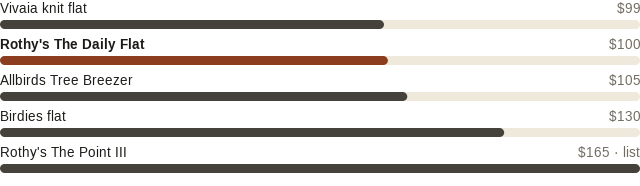
Five flats, one ladder. Vivaia is the floor at $99; the Daily Flat is a dollar above it at $100. The Point III at $165 is the top of the brand’s own range — and on sale at $119 it falls back into the middle, next to Birdies.
Prices: Rothy’s product pages, read 24 November 2026; Vivaia, Allbirds and Birdies via ecothes, 2026.
The range is wide on purpose. The $89 Square Mary Jane and the $100 Daily Flat let a first-time buyer in; the $165 Point is the proof of craft, and the $225–$285 bags are the second purchase. The men’s line runs $149 to $185. Nothing here is a subscription — every price is a one-off, and the repeat sale has to be earned by the shoe itself.
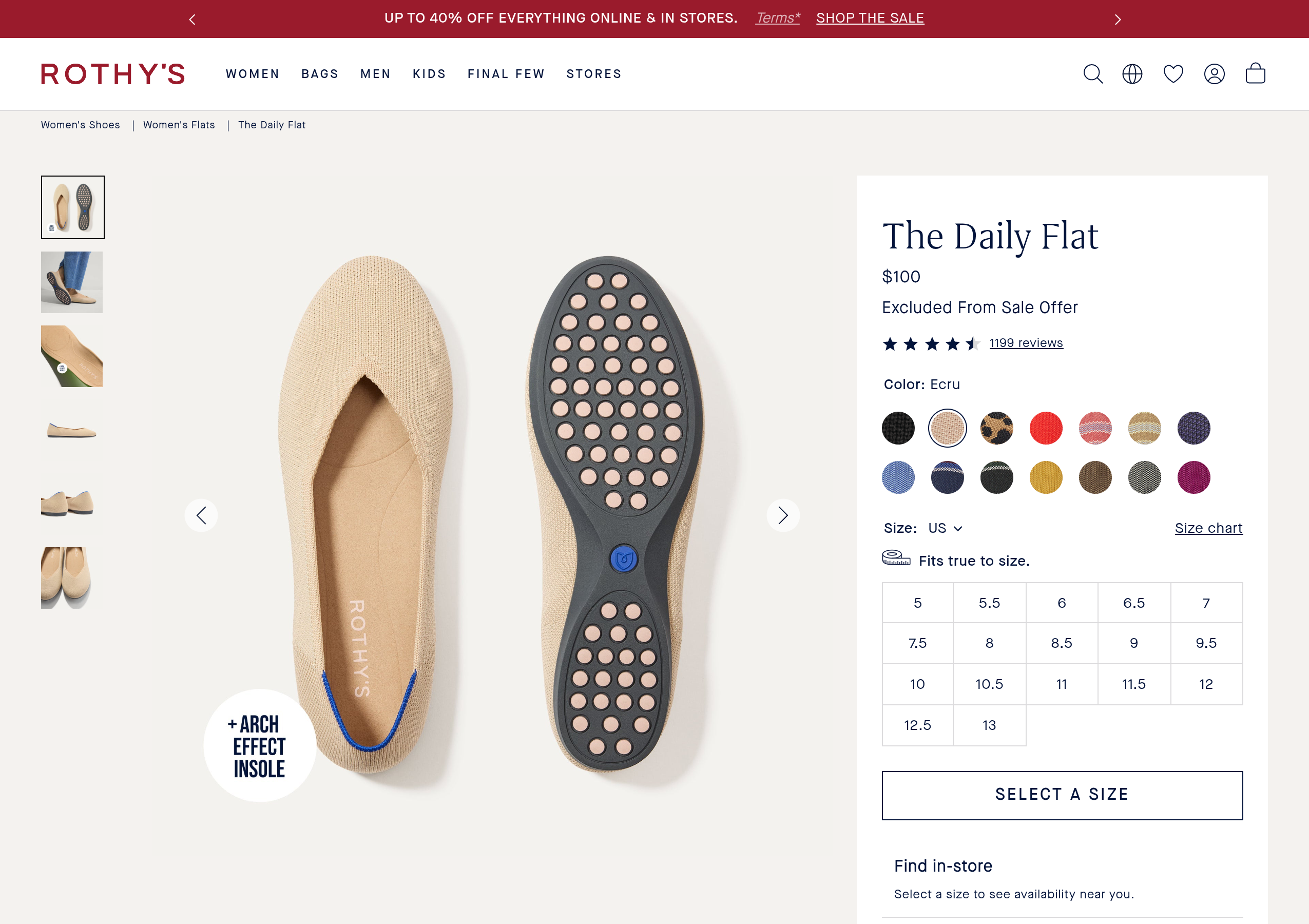
The Daily Flat in Ecru, read 24 November 2026. $100, 1,199 reviews, sizes 5 to 13, “Fits true to size”. “Free shipping on all orders. 30 days to return or exchange.” The generic product URL renders the photo area blank; this capture is the Ecru colour variant of the same product, where the photo renders.
The product page sells the practical facts, not the story. Fourteen colours, sizes 5 to 13, free shipping on all orders with no minimum, and 30 days to return or exchange. The story — recycled bottles, machine-washable — is the reason the visitor arrived; the page itself only has to remove the reasons to leave.
The brand sold the first million pairs
A story you can tell in one sentence
From $140M to $227.7M, with six quiet years in between

Three points, no line between them. Revenue was $140M in 2018, $211M in 2024 and $227.7M in 2025. The years 2019 to 2023 were never disclosed, and this page does not draw a smooth line through the gap.
2018 from the company, via TechCrunch, December 2018; 2024 from CNBC, 25 February 2025; 2025 from FashionUnited UK, 6 March 2026, reporting Alpargatas’ fiscal disclosure.
The idea took four years before it took a dollar. Martin and Hawthornthwaite sketched it over dinner in 2012 — yoga pants had become everyday wear, and no women’s shoe matched them for comfort — then spent about $1M of their own money and four years building a 3D-knit shoe from recycled bottles, in their own factory in Dongguan, China.
When it launched in September 2016 there were two styles: The Flat at $125 and The Point at $145. Two years later the company had sold a million pairs and $140M of shoes, and Goldman Sachs had put in $35M. The shoe did the talking: seamless knit, no break-in, and you could put it in the washing machine.
The brand was the acquisition channel. Celebrities wore the flat without being paid to — Meghan Markle among them — and the story told itself in a sentence: a shoe made from water bottles. There was no subscription to lock anyone in and no discount ladder to climb. The first purchase was the whole pitch.
The margin is thinning while the revenue grows

The margin tells the newer story. EBITDA was over 10% in 2024, then 7.9% in 2025 on $17.9M, then 5% over the twelve months to March 2026 on $15M. The stated cause is tariffs on products imported from China — the factory is in Dongguan, and the gross margin fell five points in the first quarter of 2026.
2024 from CNBC, 25 February 2025; 2025 from FashionUnited UK, 6 March 2026; twelve months to Q1 2026 from SGB, reporting Alpargatas’ first-quarter results.
The counterweight is in the reviews. Trustpilot scores the company 2.1 out of 5 from 199 reviews, and the complaints repeat: customer service, returns, sizing, soles wearing out, shoes shrinking or smelling after washing. The washable shoe is the whole promise — if washing damages it, the promise breaks.
The copycats are the other counterweight. Vivaia sells the same knit flat from $99, Allbirds’ Tree Breezer is $105, and both are washable and made from recycled bottles. Rothy’s sued its way to a federal consent judgment against MIA Shoes and three retailers in September 2026, barring four copycat styles — proof the company knows the story can be copied.
Fourteen years, from a dinner to 40 stores
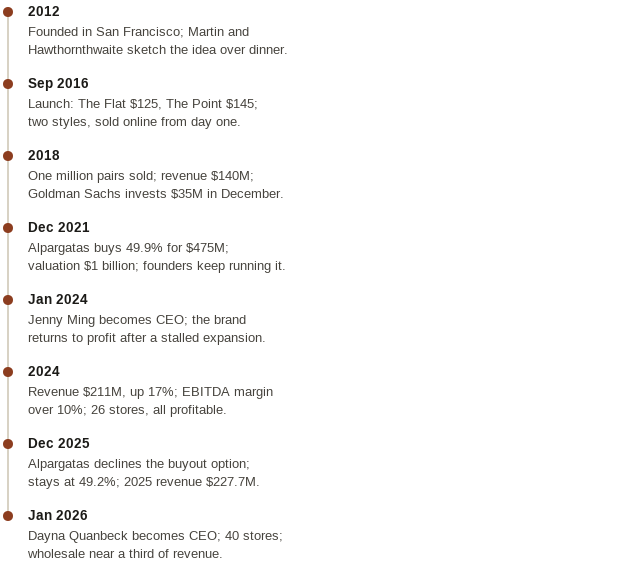
Fourteen years, eight markers: a dinner in 2012, a launch in 2016, a million pairs in 2018, a $1B valuation in 2021, a return to profit in 2024 — and in December 2025, the majority shareholder walking away from the buyout it had paid to keep open.
Founding from Wikipedia; launch prices from New Atlas, July 2016; 2018 from TechCrunch; 2021 from FashionUnited; 2024 from CNBC; December 2025 from FashionUnited UK; January 2026 from ainvest and Retail Brew.
The December 2025 decision is the strongest outside verdict on the page. Alpargatas paid for a four-year option to buy the remaining 51% — then let it lapse, keeping 49.2%. A buyer that knows the company better than anyone chose not to own it outright. The brand stayed independent, and the founders kept running it.
Stores and wholesale turned it into $227.7M
The second sale is offline
October was the best month in the run

October was the best month in the run — 3.09M visits, up 127.65% on September’s 1.36M. The cause was not verified this round: no October promotion or event was found in the sources read, and the page does not attribute the spike to the November sale.
Semrush, October 2026, total-table value.
The turn came in 2024, under Jenny Ming. She took over as CEO in January that year, cut marketing line by line, and pushed the brand out of the website: nine new stores, to 26 in total, all of them profitable, with same-store sales up 20%. Wholesale started the same year — Anthropologie, Bloomingdale’s, Nordstrom — and by 2025 it had tripled to near a third of revenue.
The logic was stated plainly by the new chief executive: online is all variable cost, and the fixed costs of a brand — the factory, the team, the stores — are spread by the channels that carry volume. In 2025 the brand did $227.7M, up 8.1%, with 40 stores. The online share is about 70%; the rest is stores and wholesale.
One store, then 40
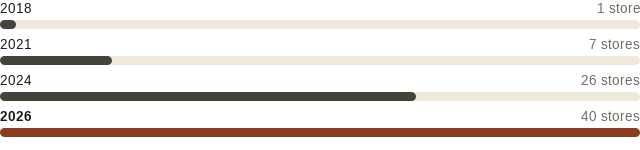
The first store opened in San Francisco in May 2018 — 600 square feet on Fillmore Street. By 2021 there were seven, by 2024 twenty-six, and by 2026 forty, with 30 to 40 more planned in the United States. The first store was profitable within four months, per a second-hand account.
2018 from Haute Living; 2021 from Retail Brew; 2024 from Modern Retail, February 2025; 2026 from Retail Brew, 27 August 2026.
The ads are short-lived by design. Sprites counted 148 ads in the library and none active on 19 November 2026, with a median run of three days — a pulse, not a campaign. The October creatives were product-led: the new Point, the almond trend, fall drivers. The brand does not buy its way to attention for long; it buys a week at a time.
| Mechanism | Hit | Why, in one line |
|---|---|---|
| Skip a purchase | — | No subscription, so nothing to skip |
| Pause purchases | — | No subscription, so nothing to pause |
| Cancel anytime | — | Orders cannot be cancelled or changed after placing; the fix is a return |
| Free shipping | ✓ | Free standard shipping on all US orders, no minimum; express $8–$35 |
| Gift card | ✓ | Sold on the site; excluded from the November sale; not refundable |
| First-order hook | ✓ | $20 off the first order over $100 for email or text sign-up |
| Referral | ✓ | Give $20, get $20 — both sides get $20 |
| Email capture | ✓ | Footer sign-up carries the $20 first-order offer |
| Refund guarantee | ✓ | 30 days to return or exchange; mail-in exchange free, mail-in refund $7.99 |
| Free returns in store | ✓ | Returns free at Happy Returns locations and Rothy’s own stores |
| Recycling credit | ✓ | Send back an old pair, get a $20 code; up to five a day |
| Resale hand-off | ✓ | The returns portal offers a one-click Poshmark listing for the returned shoe |
| Loyalty programme | — | No traditional points programme, per coupon-site sources |
| Special-group discount | ✓ | 20% off for teachers, students, medical staff, military and first responders |
| Gift subscription | Not verified | No gift subscription product was found on the pages read |
| Free trial | — | No trial; shoes are bought once, not tried on subscription |
Read the table as a one-off purchase with a long memory. Nothing here holds a customer by contract — no subscription, no skip, no pause, no loyalty points — so the retention has to live in the product: a shoe that survives the washing machine, a $20 credit for the old pair, and a store to try the next pair in. The second shoe is the retention metric, and it is not published.
| Channel | Share of visits | Platform & stack |
|---|---|---|
| Direct | 37.23% of visits | rothys.com, US store is 97.93% of traffic |
| Online sales | About 70% of revenue | Shopify storefront, SAP Business ByDesign ERP |
| Stores | 40 stores | First store May 2018; 30–40 more planned in the US |
| Wholesale | Near a third of revenue | Nordstrom nationwide, Amazon, Anthropologie, Bloomingdale’s |
| Meta ads | 148 in library, 0 active | Sprites read, November 2026; median run 3 days |
| Email & SMS | List size not disclosed | Attentive for SMS; email carries the $20 first-order hook |
| Returns & resale | 30-day window | Narvar Track; Happy Returns network; Poshmark hand-off |
| Payments | — | Afterpay instalments |
Marketing channels, October 2026. Traffic shares are Semrush figures from the master table; the revenue split is the company’s, via CNBC, February 2025, and the wholesale share is Glossy’s. The search split was not verified this round.
The stack is Shopify end to end for the storefront, with SAP running the back office and Narvar running post-purchase. The platform was verified three ways: a Shopify trade listing, Narvar’s own case study, and the SAP implementation case from 2019.
What outsiders say
Loved in stores, argued with online
One pool, and it is not kind

One pool, and it is not kind. Trustpilot scores the company 2.1 from 199 reviews — a small sample, and a low one. The on-site rating for the site as a whole was not verified this round — the Daily Flat alone carries 1,199 reviews on the product page — so this page does not claim the Trustpilot pool speaks for all buyers.
Trustpilot US profile read 24 November 2026; UK, IE and CA mirrors read 2.1–2.2 from 198–199 reviews.
The reviews split in a way the brand story does not explain. Some buyers call the customer care the best they have seen; others call it the worst. The recurring complaints are sizing, returns that turn final sale, soles peeling, and shoes that shrink or smell after washing. One buyer’s clog unravelled after eighteen months of light use and was offered a $20 recycling credit — the same credit any old shoe gets.
The gap between the two pools is the open question. The website’s own reviews are described by buyers as uniformly positive, and at least one buyer says the link to leave a review did not work for them. The on-site rating was not verified this round, so the page prints the outside number with its sample size and leaves the gap open.
The outside verdict that matters most is the one from the shareholder. Alpargatas, which owns 48.8% and knows the factory, the costs and the customers, decided in December 2025 not to buy the rest — and in the most recent quarter reported, net sales were $50.9M, up 12.3% year on year. The brand is growing, the margin is thinning, and the buyer with the best view chose to stay a minority.
Rothy’s is the fourth teardown in the footwear DTC collection. Compare Rothy’s with VIVAIA and Tecovas side by side.
The full teardown is for members
The full analysis of pricing, acquisition, conversion and retention is member content. Membership is $29 a month or $249 a year.
Similar sites in the database
Rothy’s (3.09M) sits between Goldbelly (3.12M) and Calm (3.05M) in the database.
| Site | Category | Monthly visits | Source |
|---|---|---|---|
| Goldbelly | Food & drink · Famous-restaurant food delivery subscription | 3.12M | Semrush, Oct 2026 |
| Rothy’s | Apparel · DTC brand | 3.09M | Semrush, Oct 2026 |
| Calm | Health · Meditation & sleep subscription | 3.05M | Semrush, Oct 2026 |
Compare Rothy’s with VIVAIA and Tecovas side by side. The full database, with working filters, is on the teardowns index.
Read the next one in your inbox
The new ones go out by email first, one a week, with the traffic source and month attached to every number. Leave your address and the next one comes to you.