
How SciSpace Makes Money: $12 Plans, 100 Free Credits
SciSpace charges $12 a month for its Premium plan on annual billing, and that one subscription buys the whole research workflow at once: paper search, Chat with PDF, literature reviews and writing. The subscription gets you in; the credit meter decides how much of the AI you can actually use. The site drew 4.01 million visits in October 2026 (Semrush), the 139th-largest site in our database.
The company started in 2015 as Typeset, a formatting tool for manuscripts, and spent its first eight years charging nothing at all. It renamed itself SciSpace in 2022, built an AI copilot on top of other companies' models, and turned the free tool into a subscription with a very thin free tier — 100 credits a month, against a single referenced draft that costs about 217.
| Site | SciSpace — scispace.com |
|---|---|
| What it is | AI research platform: paper search, Chat with PDF, literature reviews, writing and citations, in the browser. |
| Who it is for | Graduate students, researchers and R&D teams who read, review and write academic papers. |
| Category | AI research · Academic research |
| Monthly visits | 4.01M (Semrush, Oct 2026) |
| Founded | 2015, as Typeset; renamed SciSpace in 2022 (some sources say 2016) |
| Headquarters | Milpitas, California (some sources list Bengaluru, India) |
| Operator | PubGenius Inc.; CEO Saikiran Chandha; about 49 employees (PitchBook, 2025) |
| Survival engine | Repeat (subscription plus a credit meter) with a traffic leg (search-led free funnel) |
| Revenue | Not disclosed; one third-party estimate puts it at $10M–$50M a year (weak source) |
| Pricing | Free plan; Premium $12/month billed annually ($20 monthly); Advanced $70 ($90); Max $160 ($200) |
| Pricing model | Monthly or annual subscription, plus Agent credits per month |
| Free hook | Free plan; 100 Agent credits a month, no credit card |
| Meta ads | Active: about 18 ads running (Meta Ad Library, read 21 Nov 2026) |
| Country breakdown | United States 29.74%, India 8.75%, Indonesia 7.86% (Semrush, Oct 2026) |
Third-party estimates, not official MAU/DAU. Pricing was read live on scispace.com/pricing on 21 November 2026; revenue is not disclosed by the company.
TL;DR
- One subscription buys the whole research workflow: the $12 Premium plan covers paper search, Chat with PDF, literature reviews and writing — the bundle is the product, and the credit meter is the upsell.
- The free tier is deliberately thin: 100 credits a month, and one referenced draft costs about 217 credits — most serious users hit the wall on their first real task.
- Search feeds the funnel for free: "plagiarism checker" draws 2.24 million searches a month and SciSpace ranks 12th for it — the free plan catches that traffic, and the credit cap converts it.
- The friction is the meter: Trustpilot scores SciSpace 4.3 out of 5 from 412 reviews while G2 has only 2 reviews, and the recurring complaint is credits burning fast with a 24-hour refund window.
The first screen is a search box, not a sales pitch
The AI Platform for Scientific Research
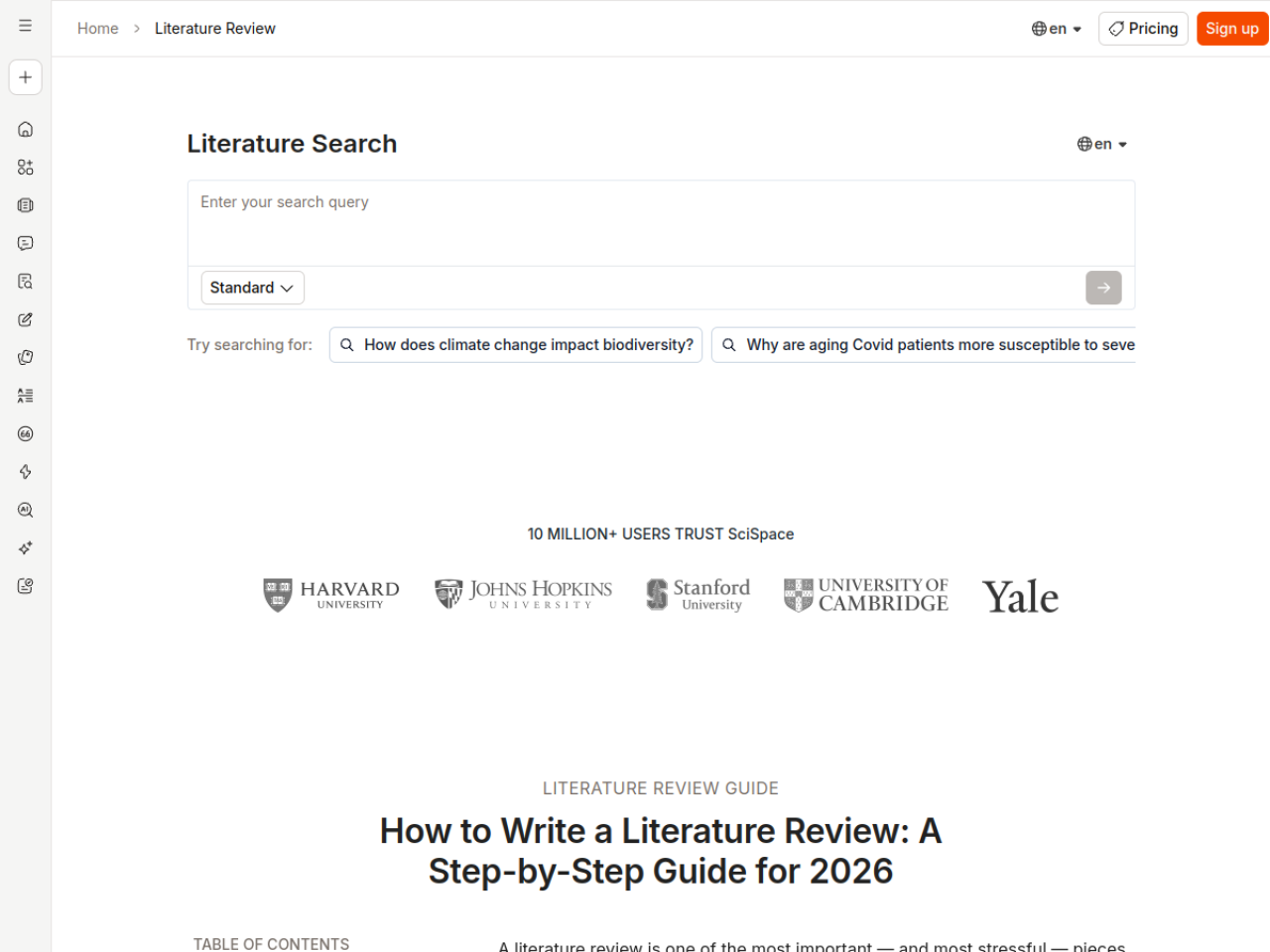
The homepage opens with a job, not a tool. One line — "The AI Platform for Scientific Research" — and a subline claiming 11 million researchers worldwide, over the marks of Harvard, Yale, Stanford, Cambridge and Johns Hopkins. The product being sold is not a search box; it is not having to read the papers yourself.
Below the headline, the workbench is five doors at once: an agent that searches papers and drafts reviews, Chat with PDF, a literature review builder, an AI writer and a citation generator. The company says its index holds more than 280 million papers, and a Chrome extension with 300,000 users puts the same tools inside the browser where researchers already read.
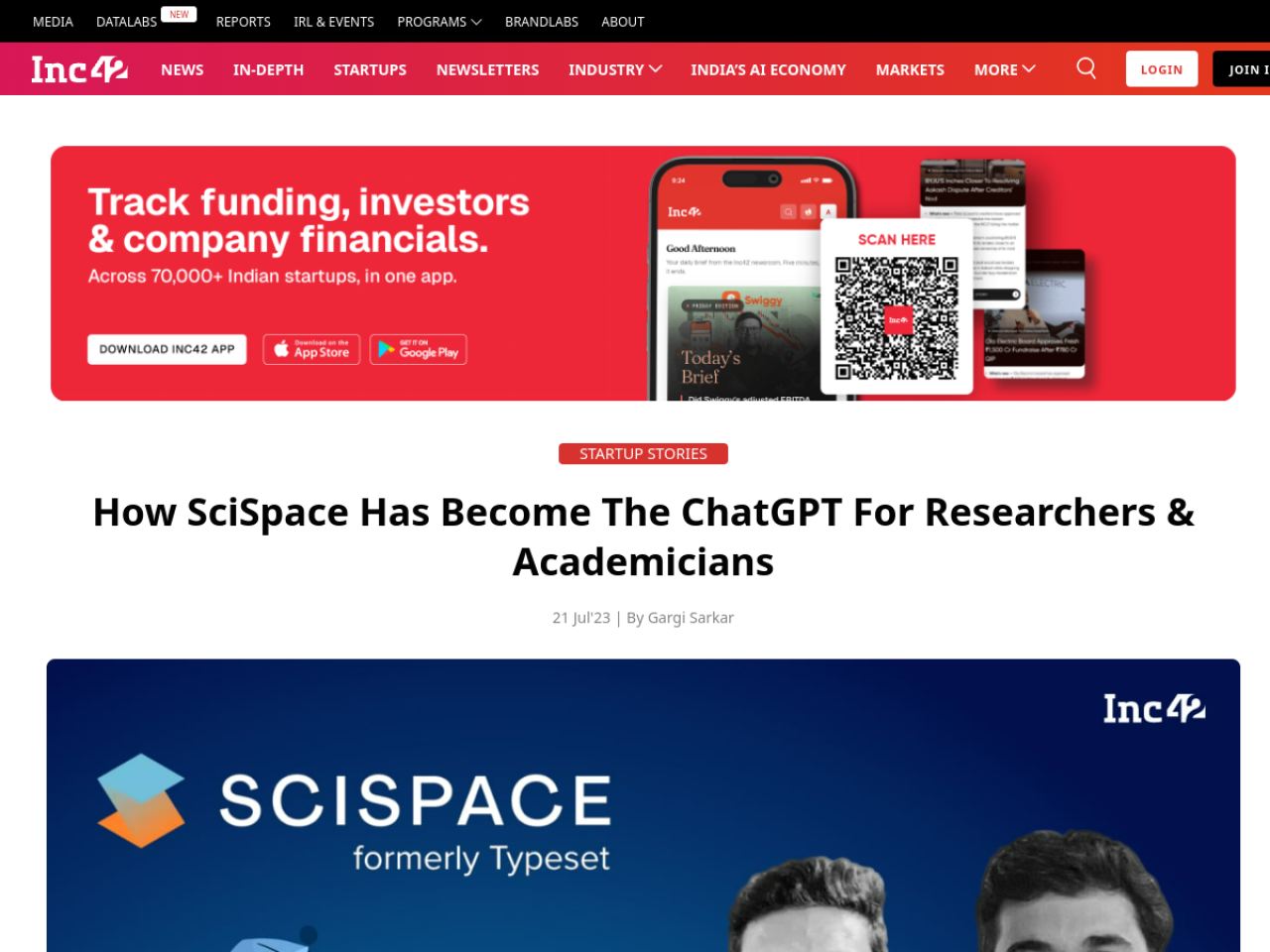
The company was free on purpose, and then it was not. In July 2023 the founders told Inc42 the platform had 400,000 active researchers and charged nobody a cent, while it built the paper warehouse first. Three years later the same product runs four paid tiers and a meter. The turn from free to paid is the whole story of this teardown.
The price is a ladder with a steep middle step
100 credits free, then $12, $70 or $160 a month
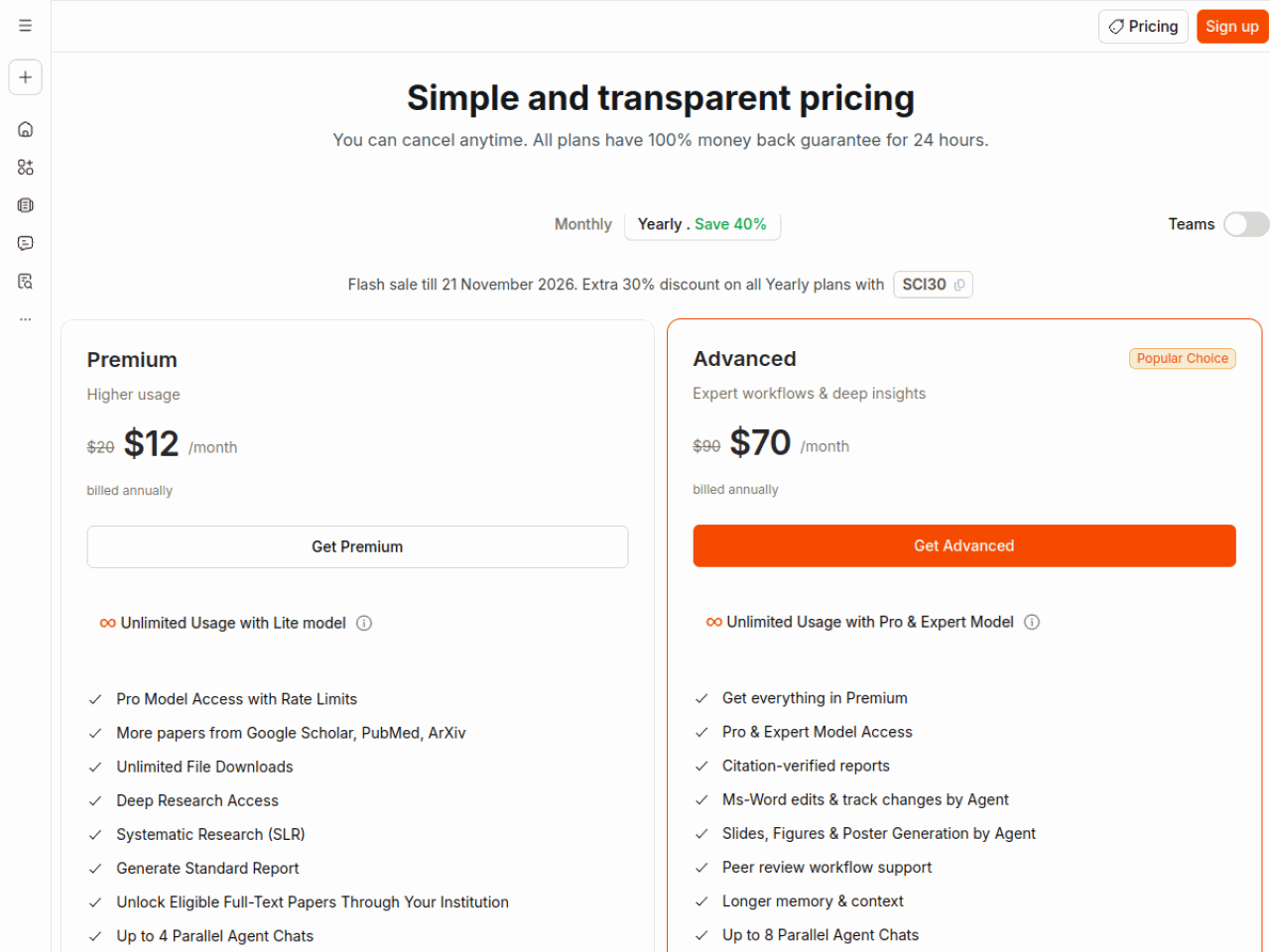
There are four paid plans and two numbers that matter on each: the price and the meter. Premium costs $12 a month on annual billing, Advanced $70 and Max $160 — and the jump from Premium to Advanced is nearly sixfold, the steepest step on any pricing page in this category. Annual billing cuts every price, most of all Premium, which drops 40% from $20 to $12.
| Plan | Price per month | Credits per month | What it is |
|---|---|---|---|
| Basic | $0 | 100 | The way in; Lite model, 4 parallel agent chats, limited reviews and PDF chats |
| Premium | $20 monthly · $12 billed annually | Unlimited Lite model, fair-use cap unpublished | Researchers; Pro model with rate limits, Deep Research, systematic reviews, standard reports |
| Advanced | $90 monthly · $70 billed annually | Unlimited Pro & Expert models, fair-use cap unpublished | Heavy users; Expert model, Verified Report, 8 parallel agent chats |
| Max | $200 monthly · $160 billed annually | Unlimited Max Thinking model, fair-use cap unpublished | Power users; biggest memory and context, publication-ready figures, posters, priority support |
| Enterprise | Custom | Shared credit pool | Institutions; SSO/SCIM, consolidated billing, dedicated support |
Source: scispace.com/pricing, read 21 November 2026 in a live browser (annual view). The flash-sale banner's deadline moves daily — older captures read 30 October, live reads on 21 November read 20–21 November — and it keeps showing past its own date. Teams pricing, read live on the same page: Premium $25, Advanced $100, Max $220 per user a month on monthly billing ($15/$75/$175 on annual billing).

The meter changed in October, and the page is still catching up with itself. Until then the paid plans were metered — Premium 1,200 credits a month, Advanced 10,000, Max 40,000 — and the credits guide now calls all three unlimited, with a fair-use cap it does not publish. Third-party tables still show the old 1,200 figure. The guide's examples show why the meter bites: three cited papers cost about 186 credits, and one referenced draft costs about 217 — more than double the free plan's whole month.
| Period | Revenue | Source |
|---|---|---|
| Not dated | $10M–$50M a year (estimate) | SignalHire estimate, method not disclosed, weak source |
| Not dated | Not disclosed | PitchBook revenue field is blank; the company has not published revenue |
| 2015–2022 | $3.85M raised (PitchBook) vs $890K (CB Insights) | Two databases disagree by more than fourfold; neither figure is confirmed by the company |
Source: SignalHire company page; PitchBook and CB Insights company pages, read 21 November 2026. The $10M–$50M revenue range is an aggregator estimate, not a company figure; SciSpace has not published revenue, and whether it is profitable is not disclosed.
| Mechanism | Present | What the site shows |
|---|---|---|
| Free plan | ✓ | $0 forever, 100 Agent credits a month, no credit card needed |
| Annual discount | ✓ | 40% off Premium on annual billing ($20 to $12); 22% off Advanced, 20% off Max |
| Credit meter | ✓ | 100 credits a month free; paid plans read unlimited with an unpublished fair-use cap; credits expire each cycle and do not roll over |
| Model ladder | ✓ | Lite, then Pro, then Expert, then Max Thinking — each tier unlocks a stronger model |
| Team seats | ✓ | Teams billed per user ($25/$100/$220 monthly); one shared credit wallet, all seats on the same plan |
| API, pay as you go | ✓ | Search and Task APIs billed separately, about $0.015 a search; new accounts get $5 of free API credits |
| 24-hour refund | ✓ | "All plans have 100% money back guarantee for 24 hours"; third-party readings add the fine print — first order only, and only if fewer than 300 credits were used |
| Auto-renewal | ✓ | Annual plans are charged up front and renew automatically; cancel any time, service runs to the end of the period |
| Top-up credits | — | No way to buy extra credits — one reviewer says the option was removed, so heavy months force a plan upgrade |
| One-off purchase | — | No single-purchase option; only subscriptions and pay-as-you-go API |
| Time-limited trial | 未核到 | No trial length is published on the pricing page; the free plan is the trial |
| No-registration use | — | Registration is required; the homepage offers sign-up only |
| Advertising on site | — | No ads on the site; the site sells subscriptions, not attention |
The lock-in is the work, not a contract. Literature reviews, PDF chats and citation libraries all live in one account, and cancelling drops the account to 100 credits a month — where a single referenced draft costs more than the whole allowance. Credits reset every month and do not roll over, so every month re-opens the same question — pay again, or stop researching — and the answer is usually to pay.
4.01 million visits, and the brand does the selling
| Traffic fact | Figure | Source |
|---|---|---|
| Monthly visits | 4.01M | Semrush, Oct 2026 |
| Month change | +5.04% | Semrush, Oct 2026 (Sep 3.82M) |
| August 2026 | 4.72M | Semrush |
| Rank in our database | 139th of 901 | Recomputed from the master table, 25 November 2026 |
| Average session | 8 minutes 54 seconds | Semrush, Oct 2026 |
| Global rank | 14,006 | Semrush, Oct 2026 |
| Direct traffic (desktop) | 40.3% | Semrush, Oct 2026 |

The traffic is growing, and the growth is not being bought. The site drew 4.01 million visits in October 2026, up from 3.82 million in September, while organic search fell 7.23% and paid search fell 9.14% in the same month. The growth is being carried by direct visits — people typing the address or opening a bookmark — which is 40.3% of desktop traffic.
| Channel | Share of visits | Platform & stack |
|---|---|---|
| Direct | 40.3% of desktop visits | Site and app; brand memory is the channel |
| Organic search | 29.82% of desktop visits | Google; tool terms: "plagiarism checker" 2,240,000 searches a month |
| Paid search | -9.14% month over month | Volume not published this round; paid search is shrinking |
| Paid social (own ads) | About 18 ads running | Meta Ad Library, read 21 Nov 2026; earliest started 12 Nov 2026, mostly webinar ads |
| AI traffic | ChatGPT 19K, Gemini 12K, Perplexity 8K visits | Semrush, Oct 2026 |
| Referral / backlinks | 1.25M backlinks, 24.07K referring domains | Semrush, Oct 2026 |
| Not verified | No named email provider was found this round |

The map is the company in miniature. The United States takes 29.74% of visits, India 8.75% and Indonesia 7.86% — and the company was founded in India, registered in California, and sells in English to the world. That split explains the pricing too: a $12 subscription is cheap for an American lab and dear for an Indian student, and the free plan is what keeps the second market inside the funnel.
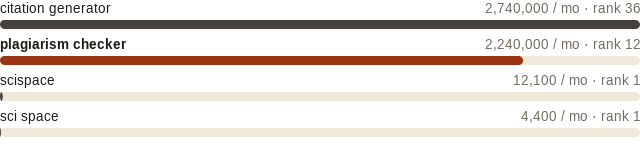
Search tells the same story as the pricing page. "plagiarism checker" draws 2.24 million searches a month and SciSpace ranks 12th for it; "citation generator" draws 2.74 million and SciSpace ranks 36th. The brand word "scispace" draws only 12,100 searches — the funnel runs on generic tool searches, not on people looking for SciSpace by name. Even so, the brand word ranks first, and direct traffic is the largest channel.
What outsiders say
| Source | Score | Reviews | Read |
|---|---|---|---|
| Trustpilot | 4.3 / 5 | 412 | 21 Nov 2026 |
| Capterra | 4.4 / 5 | 80 | 21 Nov 2026 |
| G2 | 3.8 / 5 | 2 | 21 Nov 2026 |
| Chrome Web Store | 4.3 / 5 | 143 | 20 Nov 2026 |
Source: Trustpilot, Capterra and G2 review pages, read 21 November 2026; Chrome Web Store rating via third-party snapshot, 20 November 2026. Trustpilot counted 411 reviews on 18 November and 412 on 21 November. G2 says there are not enough reviews to provide buying insight.

The outside verdict is warm, with one sharp edge. Trustpilot scores SciSpace 4.3 out of 5 from 412 reviews and Capterra 4.4 from 80, with support quality the most praised theme. The recurring complaint is the meter itself: credits burning fast, the 24-hour refund window closing before the bill is understood, and subscriptions that keep renewing. One reviewer says the option to buy extra credits was removed, so heavy months force a plan upgrade instead.
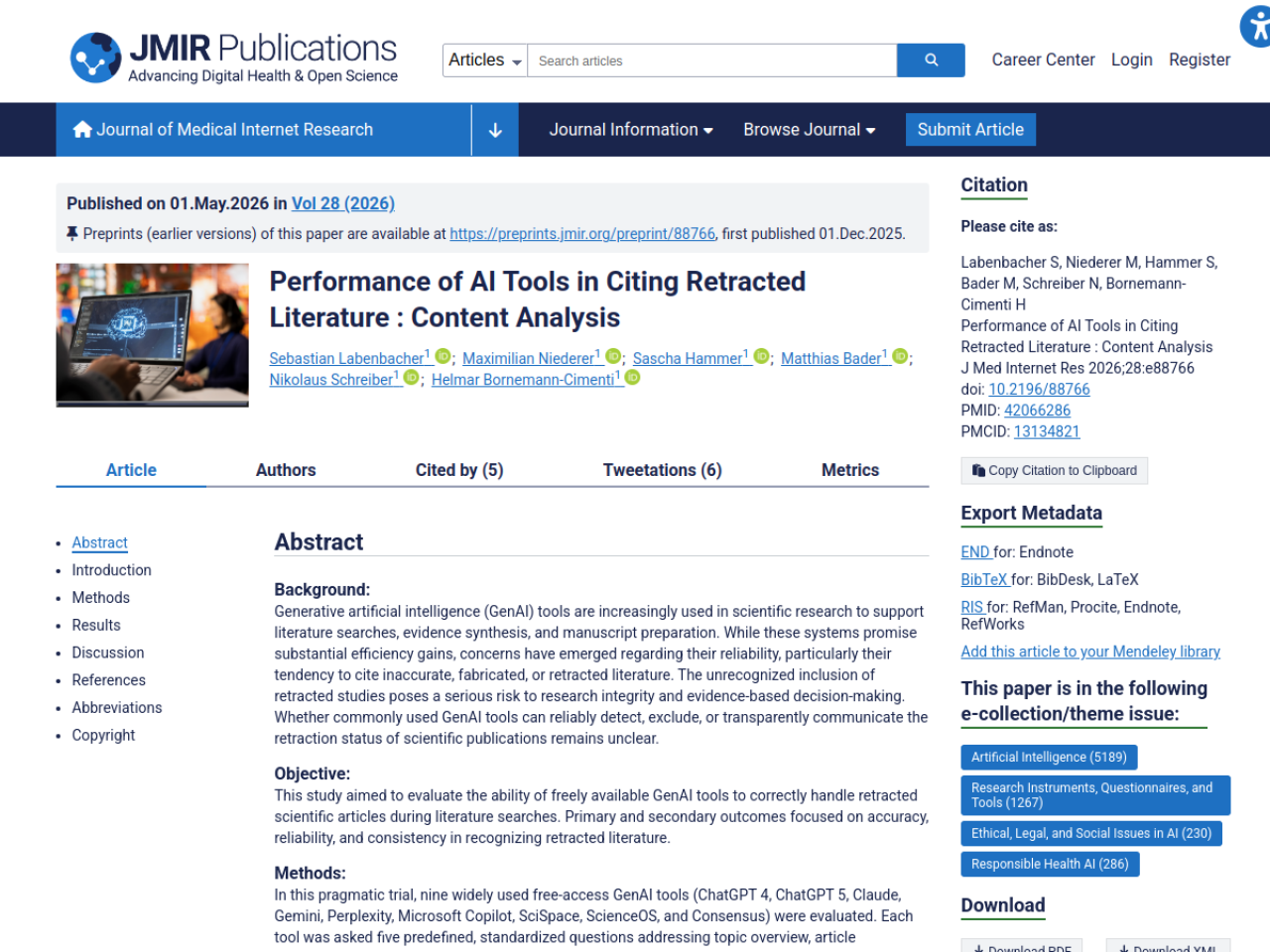
A peer-reviewed study is the hardest check this product has faced. In May 2026 the Journal of Medical Internet Research tested nine free AI tools on 15 known retracted papers: SciSpace version 1.5.1 produced no fully correct set of answers, and in 8 of 15 topic searches it returned retracted papers as legitimate evidence. The study used the free version and 15 papers, so it is narrow — but for a tool that sells verified answers, a 53% miss rate is the counterweight to every five-star review.
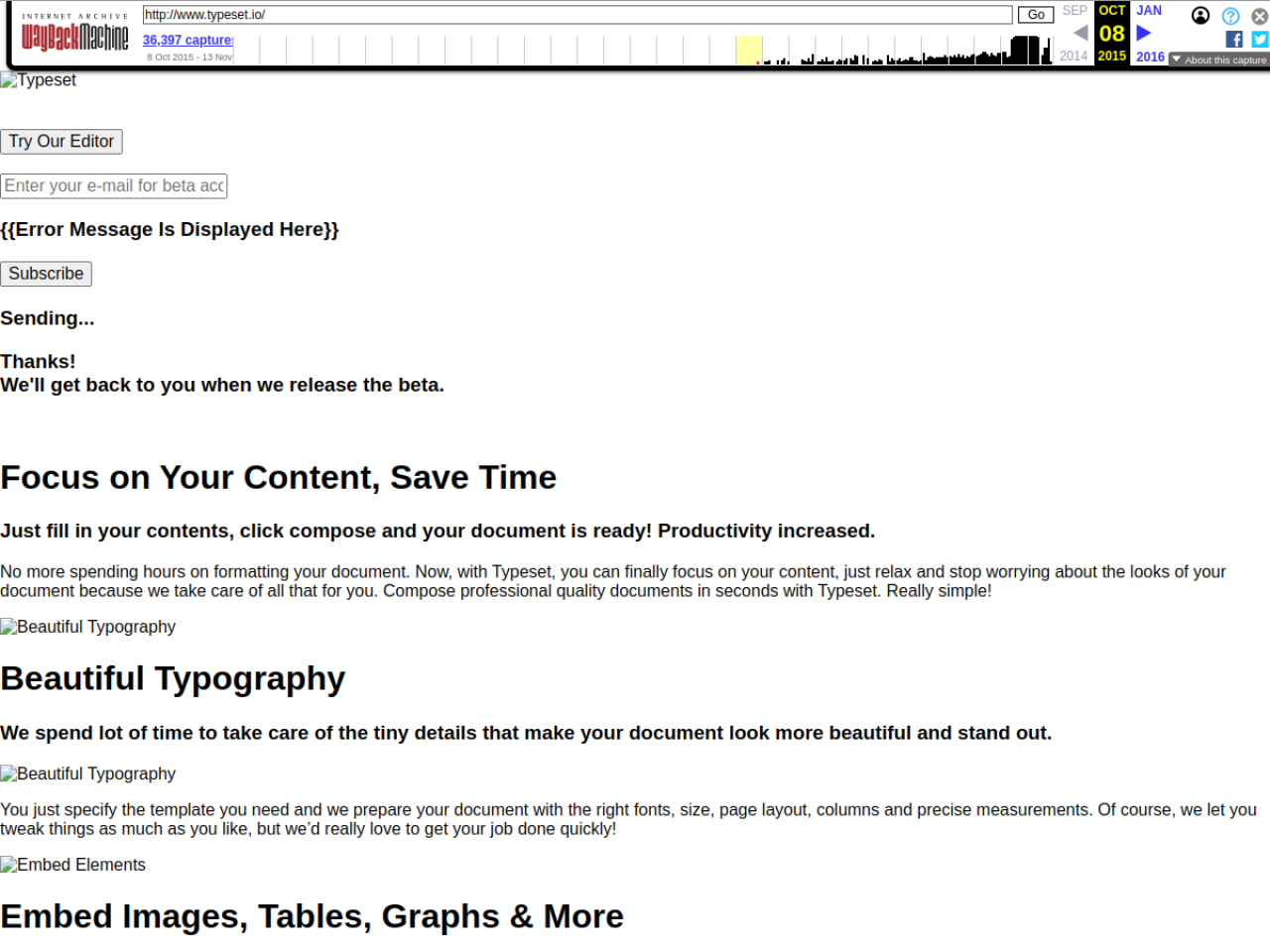
The site has been alive a long time. The Wayback Machine's first capture of typeset.io is 8 October 2015, and it already promises the same thing the homepage promises today: stop worrying about formatting, focus on the content. The founders told Inc42 in 2023 that the company then had 400,000 active researchers; the homepage today claims 11 million. One caution: the scispace.com domain itself was first captured in 2002 as an unrelated science-news portal — the name was reused later, so 2002 is not this company's history.
The week the models got cheap
On 20 November 2026, the week this teardown was written, Thinking Machines Lab released Inkling 2 Mini — an open-weights model, Apache 2.0, about 20GB, small enough to run offline on a MacBook Pro. It is a text and image model, not a research model.
That distinction matters for SciSpace. The expensive layer here is the reasoning over papers — the copilot and agent runs that burn credits — and an open model could one day run that layer locally, for free. What it does not touch is the wall around the product: the 280-million-paper index, the citation checks and the workflow that lives in the account. The risk is real but indirect and far off, not a hit to this quarter's revenue.
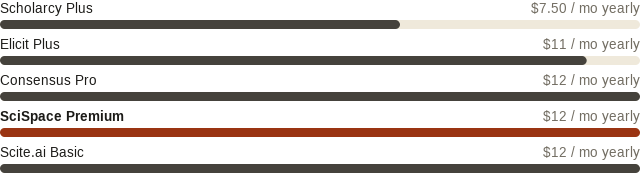
Compare SciSpace with Consensus side by side, or browse the full AI research tools collection.
The full teardown is for members
The full analysis of pricing, acquisition, conversion and retention is member content. Membership is $29 a month or $249 a year.
Similar sites in the database
SciSpace (4.01M) sits between Kajabi (4.04M) and CookUnity (4M) in the database — the 139th-largest site of 896, with 138 sites above it.
| Site | Category | Monthly visits | Source |
|---|---|---|---|
| WHOOP | Health wearables / Smart band | 4.12M | Semrush, Oct 2026 |
| Kajabi | Education / Creator courses and membership platform | 4.04M | Semrush, Oct 2026 |
| CookUnity | Food & drink / Chef-crafted meal delivery subscription | 4M | Semrush, Oct 2026 |
Related teardowns
The closest teardown published so far is Consensus, another AI research tool at 5.02M visits a month that sells a free plan plus Pro and Teams subscriptions. Compare SciSpace with Consensus side by side, or browse the full AI research tools collection.
Read the next one in your inbox
One teardown a week, every number sourced. Leave an email and the next one lands on Friday.
Sources: Traffic: Semrush public page for scispace.com, October 2026 figure (4.01M visits, +5.04% month over month; Aug 4.72M, Sep 3.82M; United States 29.74%, India 8.75%, Indonesia 7.86%; direct 40.3% of desktop visits; organic search -7.23% month over month; paid search -9.14%; "plagiarism checker" 2,240,000 searches a month, "citation generator" 2,740,000, "scispace" 12,100, "sci space" 4,400; 1.25M backlinks, 24.07K referring domains; page updated 11 Nov 2026). Pricing: scispace.com/pricing, read 21 November 2026 in a live browser (annual view; flash-sale banner deadline rolls daily, 20–21 November in live reads on 21 November; Teams prices $25/$100/$220 monthly, $15/$75/$175 annually, per user). Credits: SciSpace credits guide, updated 2 November 2026 (100 credits a month free, no rollover, task cost examples 186/217 credits). Company: PitchBook and CB Insights company pages, read 21 November 2026 (founded 2015, private, PubGenius Inc., Milpitas; funding $3.85M vs $890K, conflicting); Inc42 founder interview, 21 July 2023 (400,000 active researchers, free at the time). Ratings: Trustpilot (4.3/5, 412 reviews), Capterra (4.4/5, 80 reviews) and G2 (3.8/5, 2 reviews), read 21 November 2026; Chrome Web Store (4.3/5, 143 reviews, 300,000 users), 20 November 2026. Ads: Meta Ad Library, read 21 November 2026 (SciSpace page, about 18 active ads, earliest 12 Nov 2026). History: Wayback Machine, first capture of typeset.io 8 October 2015; scispace.com first captured 16 October 2002 as an unrelated science-news portal. Research: Journal of Medical Internet Research 2026;28:e88766, published 1 May 2026 (SciSpace 1.5.1, free version, 15 retracted papers, 8 of 15 returned as valid evidence). Open models: Thinking Machines Lab, 20 November 2026; Hugging Face model card, 20 November 2026; The Decoder, 20 November 2026. No official MAU, DAU, churn or profitability figure is published for this site.