
How Strava makes money on $79.99 subscriptions
Monthly visits
29.14M
Semrush, October 2026. Third-party estimate, not official MAU/DAU.
Strava draws an estimated 29.14M visits a month (Semrush, October 2026) — the 27th-largest site in our database of 901, down from 44.5M in September. The drop is the story of this page: visits fell 34.52% in a month while search traffic barely moved.
The pitch fits in one line on the homepage: "Community-Powered Motivation." Under it: "Track your progress and cheer each other on. Join over 100 million active people on Strava for free." The free tier is the product. The subscription, $11.99 a month or $79.99 a year, is the toll on the parts people care about most: the leaderboard, the route and the training plan. The chief executive says the company has been profitable for four years or more, on about $490M in annual recurring revenue, by Sacra's estimate.
| Site | Strava, strava.com |
|---|---|
| What it is | Fitness tracking and social platform: run and ride recording, leaderboards and training analysis |
| Who it is for | Runners, cyclists and other endurance athletes who track training and compare with friends |
| Category | Sports · Fitness social & activity tracking subscriptions |
| Monthly visits | 29.14M, Semrush, October 2026. Third-party estimate, not official MAU/DAU; August 42.11M, September 44.5M, October 29.14M |
| Founded | 2009, per Wikipedia and the company's own 2023 release |
| Headquarters | San Francisco, California |
| Operator | Strava, Inc. CEO Michael Martin, in the job since 2 January 2024, per the company's 11 December 2023 release |
| Survival engine | Repeat subscriptions. Free recording and the social feed pull people in, the leaderboard and the route planner sit behind the paywall, and the annual plan turns the decision into one a year |
| Pricing | $11.99 a month or $79.99 a year ($6.67 a month); Family $139.99 a year for up to 4 accounts; Student $39.99 a year; Strava + Runna $149.99 a year. Source: strava.com/subscribe, read in a live browser 19 November 2026 |
| Pricing model | Monthly or annual subscription; family, student and Runna bundle are annual only; no one-off purchase |
| Free hook | Record activities, join the community and share by Beacon free; 30-day trial of the full subscription |
| Meta ads | About 29 active ads in the Meta Ad Library on 19 November 2026, most running since 28–29 October 2026 |
| Country breakdown | United States 17.29% (5.04M); France 10.15% (2.96M); United Kingdom 8.92% (2.6M); Germany 5.41% (1.58M); Spain 5.06% (1.48M). Semrush, October 2026 |
TL;DR
- Strava draws an estimated 29.14M visits a month (Semrush, October 2026), down 34.52% from 44.5M in September, while organic search fell only 0.27% and paid search 14.82% — the fall is not a search story. The United States is first at 17.29% (5.04M), and the average visit lasts 08:40.
- One subscription, five ways to pay: $11.99 a month or $79.99 a year for an individual, $139.99 a year for a family of up to four, $39.99 a year for students, $149.99 a year bundled with Runna. Every plan buys the same features; the tiers differ by who pays and for how many people. A 30-day trial opens the full subscription, then charges automatically unless cancelled at least 24 hours before it ends.
- It survives on renewals: about 90% of revenue comes from subscriptions, by Sacra's estimate, on $490M of annual recurring revenue in 2025. The chief executive says the company has been profitable for four years or more. The risk is the free tier itself — only about 2% of registered users pay, by Sacra's estimate — and a rival, Garmin Connect, gives away the same recording and analysis free.
The first screen sells the community, and the trial is the price list
The first screen is a video, not a price
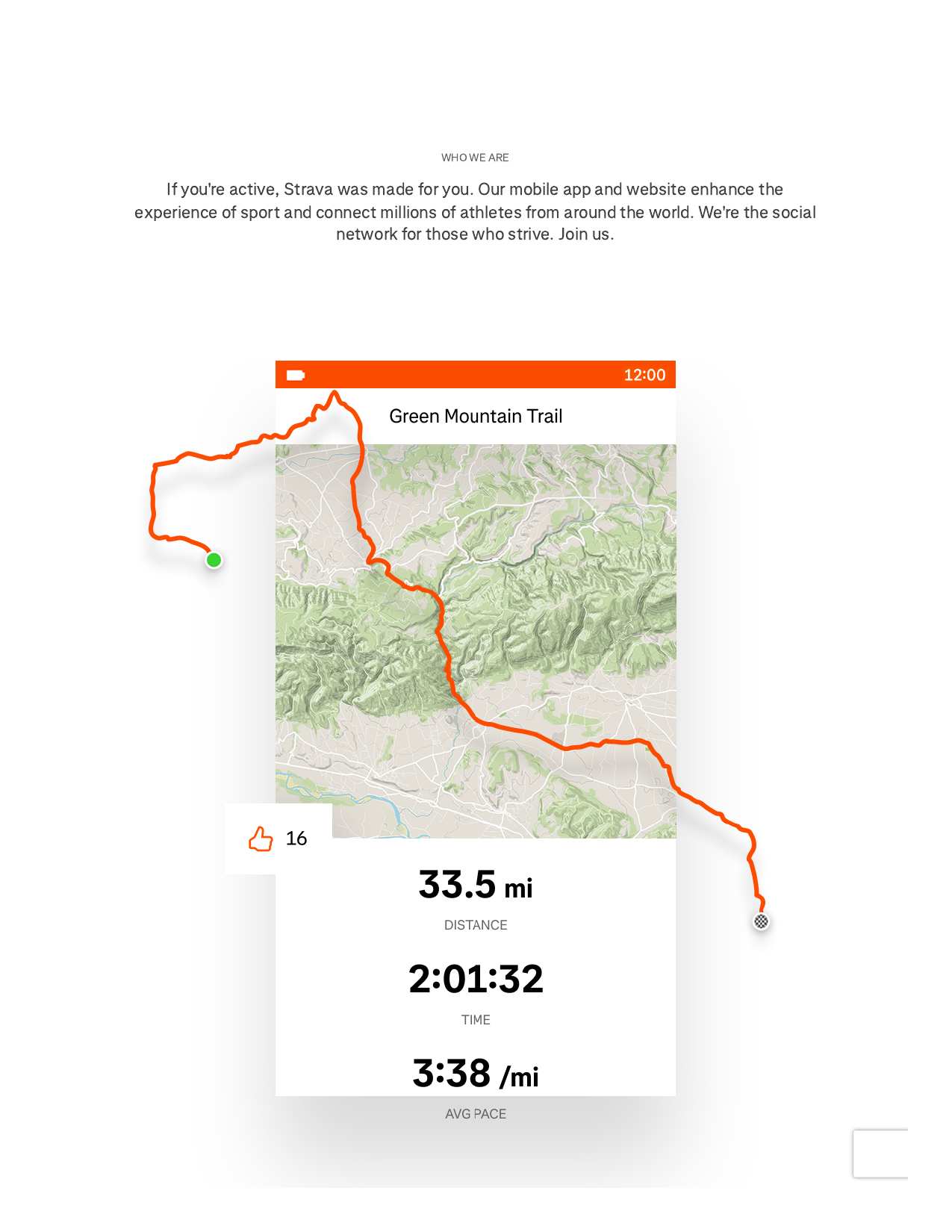
The Strava homepage, read 19 November 2026. Below the video hero, the "Who we are" section reads "If you're active, Strava was made for you. Our mobile app and website enhance the experience of sport and connect millions of athletes from around the world. We're the social network for those who strive." The activity card shows the Green Mountain Trail: 33.5 miles in 2:01:32, with 16 kudos.
The homepage we read on 19 November 2026 opens with a full-screen video under the headline "Community-Powered Motivation." The subheadline reads "Track your progress and cheer each other on. Join over 100 million active people on Strava for free." Three sign-up buttons sit on the first screen — Google, Apple and email — and no price appears anywhere on it.
The page sells belonging before it sells anything. Scroll down and the "Who we are" section calls the site "the social network for those who strive," above an activity card: a 33.5-mile trail run in 2:01:32, with 16 kudos from other athletes. The activity is the post. Recording is free, and the feed is the product.
That order matters for the money. A visitor arrives to log a run, finds friends already there, and only meets the paywall when the leaderboard, the route or the training plan matters. The free tier is not a demo. It is the network, and the network is what the subscription charges to rank inside.
The trial is the whole price list
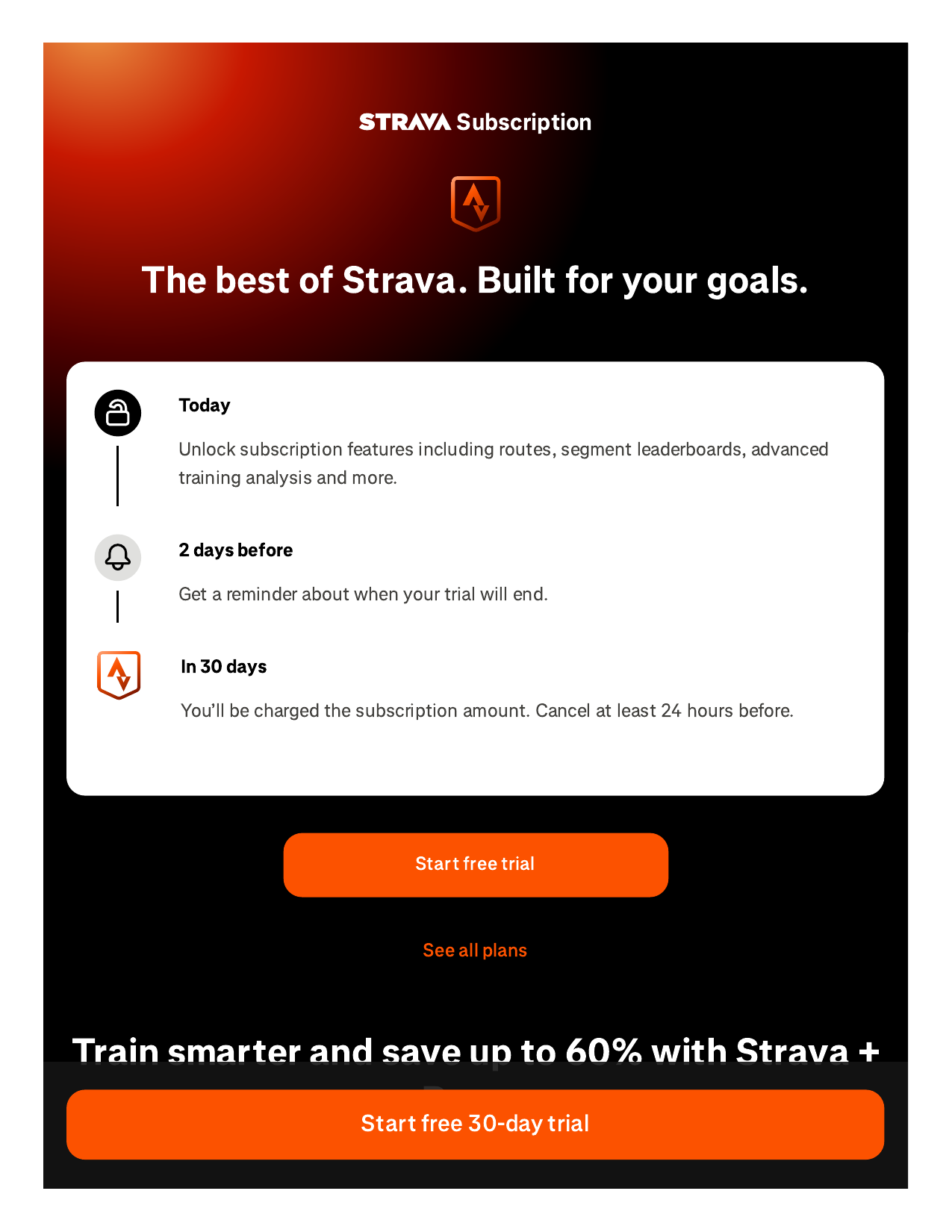
The Strava subscription page, read 19 November 2026. "The best of Strava. Built for your goals." The trial timeline reads "Today: unlock subscription features including routes, segment leaderboards, advanced training analysis and more"; "In 30 days: you'll be charged the subscription amount. Cancel at least 24 hours before."
There is a subscription page, and it is the price list. /subscribe opens with "The best of Strava. Built for your goals." and one offer: "Free for 30 days, then $6.67 a month. Billed $79.99 a year. Cancel anytime." The monthly price, $11.99, appears only after switching the toggle from Annual to Monthly.
The trial timeline is printed as three steps. Today, the trial unlocks routes, segment leaderboards and advanced training analysis. Two days before it ends, a reminder arrives. In 30 days, the subscription amount is charged, unless cancelled at least 24 hours before. The FAQ on the same page says the reminder comes 7 days before the trial ends — the two numbers disagree, and both are printed here as read.
The page also settles which address is real. /pricing is not a plan page; it is a blog post, "Updating Subscription Prices," dated 1 July 2025, which confirms the same US prices: $11.99 a month or $79.99 a year, $139.99 a year for a family plan, $149.99 a year with Runna.
Five plans, one feature set
| Plan | Price | What it buys |
|---|---|---|
| Individual, monthly | $11.99/mo | Full subscription, billed monthly |
| Individual, annual | $79.99/yr ($6.67/mo) | Full subscription, billed yearly; the default on the page |
| Family | $139.99/yr | Full subscription for up to 4 accounts (the subscriber plus 3) |
| Student | $39.99/yr | Full subscription at 50% off, verified through SheerID |
| Strava + Runna | $149.99/yr ($12.50/mo) | Strava subscription plus Runna training plans and coaching |
Prices from strava.com/subscribe, read 19 November 2026. Family, student and bundle plans are annual only; the family plan has no trial, per a third-party read of the same page on 25 September 2026.
Every plan buys the same features. The tiers differ by who pays, for how many people, and for how long — not by what is unlocked. That is the opposite of the usual software ladder, where the top tier buys more tools. Here the top tier buys more people.
The annual plan is the default, and the arithmetic is the pitch. Twelve months at $11.99 costs $143.88; the annual plan costs $79.99, a saving of $63.89, about 44%. A family of four pays $35 a person a year, about $2.92 a person a month — two people sharing already beat two annual plans at $159.98.
The bundle is the one price that does not add up cleanly. Strava + Runna costs $149.99 a year, and the page promises savings of up to 60%. Against the two annual prices — $79.99 for Strava and $119.99 for a standalone Runna year — the bundle saves $49.99, or 25.0%. The 60% figure must use a different baseline; the page does not say which. Sacra, read 22 November 2026, says the 60% is measured against paying monthly for both apps separately.
What the site keeps, and what it charges for
| Mechanism | Hit | Why, in one line |
|---|---|---|
| Free tier | ✓ | Record activities, join the community, share by Beacon, all free |
| No account | — | Recording and subscribing both need an account |
| Free trial | ✓ | 30 days of the full subscription, individual and student plans |
| Ads on the site | — | No display ads on the site; about 29 active Meta ads run off-site |
| API | ✓ | Public API syncs Garmin, Wahoo, COROS, Apple Watch, Zwift and Peloton |
| Email capture | 未核到 | No newsletter box found on the pages read; trial reminders arrive by email |
| Auto-renew | ✓ | Trial turns into a paid subscription unless cancelled 24 hours before |
| Cancel anytime | ✓ | In account settings; benefits run to the end of the billing period |
| Pause subscription | — | No pause option on /subscribe as read 19 November 2026 |
| Refund | 未核到 | No refund terms on /subscribe as read 19 November 2026 |
| Family plan | ✓ | $139.99 a year for up to 4 accounts |
| Student plan | ✓ | $39.99 a year, 50% off, verified through SheerID |
| Teacher / military / medical discount | ✓ | 25% off, linked in the homepage footer (US only) |
| Loyalty plan | — | No loyalty plan found on the pages read |
| Annual prepay lock-in | ✓ | Annual plan saves $63.89 against monthly billing |
| Bundle upsell | ✓ | Strava + Runna at $149.99 a year, live since July 2025 |
| Returning subscribers | 未核到 | No returning-subscriber share is published |
Read the table as a subscription with the free tier doing the selling. Recording is free, the feed is free, and the map is free. What costs money is knowing where you stand: the leaderboard, the route and the training load.
The hold on the customer is the annual renewal, not a contract. A subscriber who wants to leave can cancel in settings and keeps the benefits until the period ends, then falls back to the free tier — and the free tier keeps their history, their friends and their segments waiting for them.
What outsiders say
Third-party ratings for Strava

The app stores love the app, and Trustpilot hates the company. Strava scores 4.81 on the App Store from 378,635 ratings and 4.6 on Google Play from about 1.22 million reviews, but 1.3 on Trustpilot from 511 reviews.
The split is the useful number. Trustpilot's recent reviews are mostly about money and access: billing disputes, refunds refused, and the October 2026 Android login fault, which drew 193 negative reviews and 157 one-star ratings in two weeks, per unstar.app. A renewal business lives or dies on support answering when billing goes wrong.
29 million visits, down a third in a month
Three months, up once and down hard
Monthly visits, August to October 2026

August was 42.11M, September 44.5M and October 29.14M — up 5.67%, then down 34.52% on the rounded figures.
Monthly visits, Semrush, October 2026. Third-party estimates, not official MAU/DAU. Page last updated 11 November 2026.
The traffic fell off a cliff in October. August was 42.11M, September 44.5M and October 29.14M — up 5.67%, then down 34.52% on the page's rounded figures, 30.80% across the three months. The average visit lasts 08:40. The site ranks 1,622nd globally and 2,903rd in the United States.
The fall is not a search story. Organic search traffic fell 0.27% in October, and paid search fell 14.82% — neither explains a 15.36M-visit drop. What changed is not published. Direct visits are 51.45% of desktop traffic, so the site lives on people coming back, not on Google sending new ones.
Bigger than the rest of the sports shelf
Monthly visits vs other sports and fitness sites
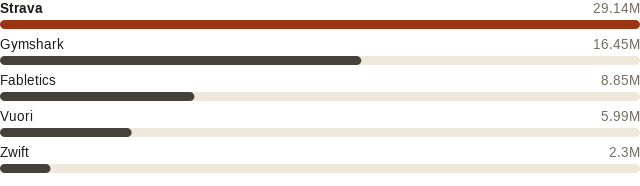
Strava leads at 29.14M — about 1.77 times Gymshark, 3.29 times Fabletics and 12.67 times Zwift.
Monthly visits, 2026-10. Third-party estimates, not official MAU/DAU. Gymshark, Fabletics and Vuori are Semrush figures from the database; Zwift is a Similarweb figure from the database.
Strava is the largest sports and fitness site in the database, and the gap is wide. Gymshark draws 16.45M visits a month — about 0.56 times as much — and Fabletics draws 8.85M, about 0.30 times as much. Vuori is at 5.99M and Zwift at 2.3M.
The gap is a network gap, not a marketing gap. Gymshark sells clothes; Strava sells the record of the run and the people who saw it. A store can be outspent. A leaderboard with 200M+ registered users behind it, by a third-party count from August 2026, cannot be bought in a quarter.
Five countries carry 47.83% of the traffic
Where the visits come from
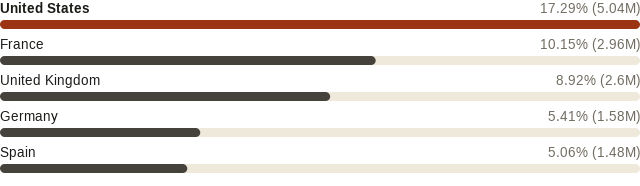
The United States leads at 17.29%, France follows at 10.15%, and the top three together are 36.36%.
Traffic share by country, Semrush, October 2026, read 19 November 2026. Third-party estimates.
No single market dominates. The United States sends 17.29% (5.04M) — ahead of France at 10.15% (2.96M) by 7.14 percentage points — and the United Kingdom is third at 8.92% (2.6M). The top three together are 36.36%, and the top five add Germany at 5.41% (1.58M) and Spain at 5.06% (1.48M) to reach 47.83%.
The traffic is desktop-first in most of these markets. The United States is 71.06% desktop; Germany is 62.37% desktop and the United Kingdom 61.18%. Spain is the exception at 53.1% mobile. France alone sends 2.96M visits, more than the whole traffic of Zwift at 2.3M.
Where the visits come from
| Channel | Share of desktop visits | Platform & stack |
|---|---|---|
| Direct | 51.45% | Visitors type the address or return on their own |
| google.com (organic) | 4.5% | The largest search source in the desktop traffic journey |
| AI referrals | ChatGPT 68K, Claude 48K, Gemini 6K | At least 122K together, about 0.42% of monthly visits — not a channel yet |
| Organic search (trend) | −0.27% in October | Search flat while total visits fall |
| Paid search (trend) | −14.82% in October | Absolute volume not published |
| Backlinks | 56.55M (−2.17%) | From 121.54K referring domains (+7.0%) |
| Platform | — | Not disclosed on the pages read |
| Hosting & CDN | — | Not disclosed; one third-party page names AWS, not read first-hand |
| Analytics | — | Not disclosed |
| — | Trial reminders arrive by email, per the subscription page | |
| Payments | — | Cards, PayPal, Apple Pay, Google Pay, per third-party summaries; processor not named |
Traffic journey, desktop, Semrush, October 2026. A full channel split (Direct / Organic / Social / Referral / Paid / Email) is not published for this domain, so none is shown here.
Direct visits are half of desktop traffic: 51.45%, against 4.5% from google.com organic search. After visiting, users go first back to google.com, then to apple.com — the shape of an app with a website attached, not a website with an app attached.
Meta is the one paid channel with a visible record, and it is running. About 29 ads were active in the Meta Ad Library on 19 November 2026, most running since 28–29 October 2026, one from 17 November 2026 announcing a Google Play Best of 2026 award. A keyword search for "Strava" returns about 530 results, but most of those are other advertisers — Suunto, Canyon, Garmin — merely mentioning the name.
What people search for
| Keyword | Monthly searches | Share of organic | Rank |
|---|---|---|---|
| strava login | 18,100 | 6.41% | 1 |
| strava sign | 14,800 | 5.24% | 1 |
| strava | 201,000 | 2.31% | 1 |
| stra | 60,500 | 2.19% | 1 |
| pace calculator | 60,500 | 1.74% | 4 |
Monthly searches are Semrush figures for strava.com, October 2026, read 19 November 2026. The top five terms together are worth 17.89% of organic traffic.
Search here is navigation, not discovery. The top three terms are all people trying to get to the site — "strava login" at 18,100 searches a month, "strava sign" at 14,800, and "strava" itself at 201,000 — together worth 13.96% of organic traffic. The brand word alone is worth 2.31%.
The one non-brand term in the top five is "pace calculator" at 60,500 searches a month, rank 4. A pace calculator is a free tool on the site, and it is the only search door that is not the front door. The five biggest terms together are worth 17.89% of organic traffic — the traffic comes from people who already know the name.
What the annual plan is worth
Cost per month, by plan
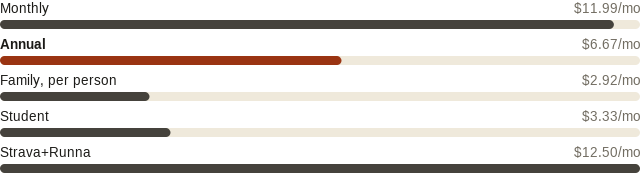
Annual costs about $6.67 a month — about 56% of the $11.99 monthly price — and a family member costs about $2.92.
Effective monthly cost by plan, from strava.com/subscribe, read 19 November 2026. Family is $139.99 a year split four ways; student is $39.99 a year; Strava + Runna is $149.99 a year.
Per month, the annual plan is the cheapest way in at about $6.67, against $11.99 for monthly billing — about 56%. The student plan costs about $3.33 a month, and a family member about $2.92. The bundle is the dearest line on the chart at $12.50 a month, because it buys two subscriptions at once.
The arithmetic is the same story as the ladder. The annual plan at $79.99 a year buys twelve months for the price of about six and a half monthly payments. The family plan at $139.99 buys four annual subscriptions for less than two. The ladder rewards commitment, and the top pays for coaching.
From a 2009 startup to a $2.2 billion valuation
Strava funding timeline
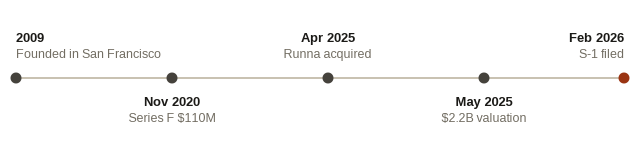
The funding story runs alongside the subscription. Strava was founded in 2009 by Michael Horvath and Mark Gainey, raised a $110 million Series F in November 2020 at a $1.5 billion valuation, and bought Runna in April 2025 and The Breakaway a month later. In May 2025 it raised again at a $2.2 billion valuation, led by Sequoia.
Sacra estimates 2025 revenue at $490 million, up 32% on 2024, with about 90% from subscriptions, and Strava filed a confidential S-1 in February 2026. Two limits sit on that story: the $490 million is an estimate, not audited revenue, and other estimates run from $180 million to $415 million. A valuation is a funding price, not cash in the bank.
Strava is one of the sports fitness subscription sites in the Sports fitness subscription collection. Compare Strava with Zwift and Gymshark side by side.
The full teardown is for members
The full analysis of pricing, acquisition, conversion and retention is member content. Membership is $29 a month or $249 a year.
Similar sites in the database
Strava (29.14M) sits just below Preply (29.42M) and Miro (29.66M).
| Site | Category | Monthly visits | Source |
|---|---|---|---|
| Preply | Education · Online language tutoring marketplace | 29.42M | Semrush, Oct 2026 |
| Miro | Collaboration whiteboard | 29.66M | Semrush, Oct 2026 |
| Dreamstime | Design tools · Stock photos | 27.96M | Semrush, Oct 2026 |
Compare Strava with Zwift and Gymshark side by side. The full database, with working filters, is on the teardowns index.
Read the next one in your inbox
The new ones go out by email first, one a week, with the traffic source and month attached to every number. Leave your address and the next one comes to you.