
How Cal.com makes money from free booking links — after closing the code
Monthly visits
3.6M
October 2026. Third-party estimate, not official MAU/DAU. Semrush counted 3.6M for the month, up 9.42%.
Cal.com draws an estimated 3.6M visits a month (October 2026, Semrush), up 9.42% on the month. It is the 157th-largest site in our database of 901. The average visit lasts 7 minutes 26 seconds — people come to book a meeting, not to browse.
The pitch fits in one line: scheduling for absolutely everyone, free for one person, $12 a seat for a team. The money is in the second seat — and in the API that lets other products sell bookings by the thousand.
| Site | Cal.com, cal.com |
|---|---|
| What it is | Scheduling tool: booking links, calendar sync, team round-robin, routing forms and an API, plus an AI phone assistant |
| Who it is for | People, teams and developers who book meetings with outsiders — sales, recruiting and support |
| Category | Scheduling tools · Online scheduling |
| Monthly visits | 3.6M, October 2026. Third-party estimate, not official MAU/DAU; Semrush, up 9.42% on the month. Global rank #15,643, US #9,103 |
| Founded | 2021; Peer Richelsen and Bailey Pumfleet, as Calendso; renamed Cal.com in September 2021 |
| Headquarters | Remote-first; Cal.com, Inc., a US (Delaware) company |
| Operator | Private — unlisted, not acquired; Cal.com, Inc. Venture-backed: $32.4M raised (seed $7.4M, Series A $25M) |
| Survival engine | Distribution. 50,337 GitHub stars put the product in developers’ toolboxes, and every free booking link advertises the brand; per-seat subscriptions and the pay-per-booking API do the charging |
| Pricing | Teams $12/user/month billed annually ($16 monthly); Organizations $28 ($37 monthly); Free $0; Enterprise custom. Source: cal.com/pricing, read 24 November 2026 |
| Pricing model | Per-seat subscription, plus a pay-per-booking platform API and per-minute AI |
| Free hook | Free plan (1 user, unlimited booking links and calendars, no credit card) and a 14-day paid trial |
| Meta ads | About 26 live ads in the US (Meta Ad Library, read 24 November 2026; Meta reports an approximate count) |
| Country breakdown | United States 48.05% (1.73M), India 6.98%, France 5.25%, United Kingdom 3.93%, Germany 3.54% (Semrush, October 2026) |
TL;DR
- Cal.com draws an estimated 3.6M visits a month (October 2026, Semrush), up 9.42%. It sells team scheduling at $12 a seat a month billed annually — and its annualised revenue is about $11M, on Sacra’s estimate.
- The distribution was the code: 50,337 GitHub stars and a free plan with no usage limits put a Cal.com link on every booking. In April 2026 the company closed the commercial source code, keeping only a community edition.
- The risk is the trade itself. No public profit figure exists, and the open-source goodwill that built the brand is now the thing being spent.
The first screen sells a link, not a calendar
The hero is a promise, not a product
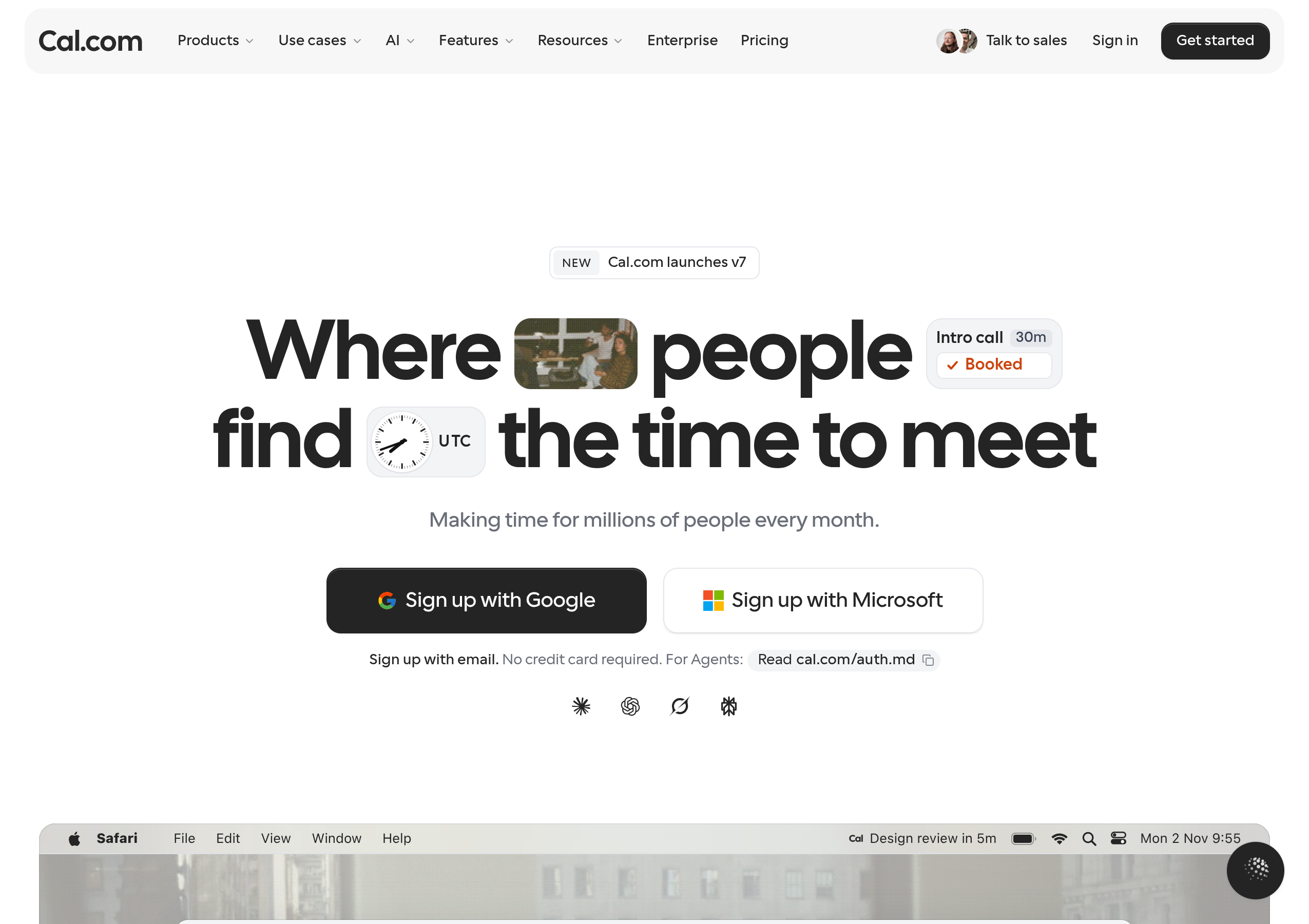
The Cal.com homepage, read 24 November 2026. The headline is “Where people find the time to meet”, under a “NEW Cal.com launches v7” banner, with sign-up by Google or Microsoft and “No credit card required” below it.
The homepage we read on 24 November 2026 opens with a sentence, not a screenshot. “Where people find the time to meet” sits over the subhead “Making time for millions of people every month”, and the first thing it asks for is a Google or Microsoft sign-up.
That is the whole pitch in one screen: the product is a link you send, not a calendar you manage. The page never shows the calendar first — it shows the meeting the link makes possible.
The navigation shows the business underneath the promise. Products, Use cases, AI, Features, Enterprise and Pricing sit in one row — and the free plan is the door, not the product.
Four plans, and the second seat is the sale
| Plan | Price | What it is |
|---|---|---|
| Individuals (Free) | $0 | 1 user, unlimited booking links and calendars, no credit card, forever |
| Teams | $12 / user / month billed annually ($16 monthly) | 1 team, shared availability, round-robin, collective links, 14-day trial |
| Organizations | $28 / user / month billed annually ($37 monthly) | Unlimited sub-teams, SAML SSO and SCIM, compliance pack, 14-day trial |
| Enterprise | Custom | Custom contract, SLA, dedicated database, HRIS integrations |
| Platform API | $299 / month to $2,499 / month | Pay per booking volume, up to 500 or 5,000 bookings (Sacra) |
| Cal.ai | $0.29 / minute | AI phone assistant for confirmations, reminders and rescheduling |
Annual prices from cal.com/pricing, read 24 November 2026; the page shows annual prices only, with a YEARLY switch on by default. Monthly $16 and $37 verified by switching the toggle the same day; the platform API prices are Sacra’s, not the site’s own price list.

The Cal.com pricing page, read 24 November 2026. Individuals is Free, “Free forever”; Teams is $12 per user a month with a “Save 25%” tag and the YEARLY switch on; Organizations is $28, Enterprise is Custom; both paid plans carry a “14 day free trial” note.
Annual billing is a 25% discount, not a detail
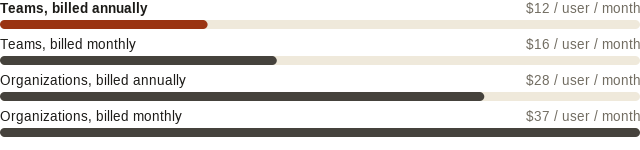
The yearly switch is worth a quarter of the price. Teams drops from $16 to $12 a seat a month on annual billing, Organizations from $37 to $28 — and the page loads with the switch on.
Annual prices from cal.com/pricing, read 24 November 2026; monthly prices verified by switching the toggle the same day.
The price is the position. At $12 a seat on annual billing, Teams undercuts Calendly’s Teams plan by $4 a seat a month — and the free plan is more generous than Calendly’s, which allows only one event type and one calendar connection.
The free plan is generous on purpose, and it ends at the second person. One user gets unlimited links and calendars; the moment a second person joins, the team pays. That cliff is the conversion plan.
The middle of the market

Cal.com sits in the middle of the team-plan shelf. SavvyCal’s Basic is $12 a user a month, Cal.com’s Teams is $16, Calendly’s Teams is $20 — all on monthly billing.
Monthly-billing prices, November 2026: SavvyCal comparison page, Cal.com pricing page (toggle), third-party comparisons.
The middle is where the fight is. SavvyCal has no free scheduling tier at all, Calendly’s free tier is the narrowest of the three, and Cal.com’s free tier is the widest — the price gap is small, so the free tier does the selling.
What the plan does, and what it does not
| Mechanism | Hit | Why, in one line |
|---|---|---|
| Free tier | ✓ | 1 user, unlimited booking links and calendars, no credit card, forever |
| No sign-up | — | Sign-up needs an email or a Google login |
| Trial | ✓ | Teams and Organizations both carry a 14-day free trial |
| Ads on the site | 未核到 | Whether the free tier shows ads was not found |
| API | ✓ | API v2, React Atoms, embeds and an MCP server; platform API bills per booking |
| Browser extension | ✓ | Listed as a free-tier feature on the pricing page |
| Mobile app | ✓ | Listed as a free-tier feature on the pricing page |
| Team seats | ✓ | Teams gets 1 team, Organizations gets unlimited sub-teams |
| SSO / SCIM | ✓ | Organizations tier: SAML SSO and SCIM provisioning |
| Compliance pack | ✓ | SOC 2 Type II, ISO 27001 and HIPAA, in the Organizations tier |
| Cancel | ✓ | Cancel in account settings or via support, effective at the end of the billing period |
| Refund | — | Fees are generally non-refundable, per Terms v2.0 |
| Refer a friend | △ | One year at 20% off, per a third-party listing; not confirmed on the site |
| Self-hosting | △ | Cal.diy is free for personal, non-production use; full self-hosting is an Enterprise arrangement |
| White label | ✓ | Teams can remove Cal.com branding from booking pages |
| Workflows | ✓ | Automated email, SMS, WhatsApp, webhooks and AI calls around bookings |
| Payments | ✓ | Stripe and PayPal payments on the free tier; the Cal Pay fee is not published |
Read the table as a team plan, not a solo tool. The hooks that matter are the ones that lower the cost of the second seat: a free tier with no usage limits, a 14-day trial, and a price that undercuts the incumbent.
The gap in the table is the referral. A 20% discount for a year is reported by a third-party listing, not by the company itself — and a distribution-led product with no referral programme on its own site is leaving its best channel unused.
The code was the distribution
50,337 stars is a sales channel
The repo is the funnel

The public repo, calcom/cal.diy, carries 50,337 stars and 15,740 forks. Developers find it on GitHub, self-host it, and some of them become paying customers.
GitHub first-party page, read 23 November 2026.
Cal.com started as Calendso, an open Calendly rival, and launched on Product Hunt in April 2021. The code was the marketing: developers discovered the repo, ran it themselves, and told other developers.
That is why the free plan looks the way it does. Unlimited links and calendars for one user, no credit card, Stripe and PayPal payments included — every booking link a free user sends carries the brand to the next person.
The site says it plainly in its own numbers: 1,515,776 verified sign-ups by November 2026, on its public dashboard at cal.com/open, and a team of 29 people running the whole thing.
Search is a short word, not a brand
| Keyword | Monthly searches | Note |
|---|---|---|
| cal | 368,000 | Rank 5, 9.42% of organic traffic |
| gcal | 201,000 | Rank 10, 2.43% of organic traffic |
| when 2 meet | 40,500 | Rank 2, 1.63% of organic traffic |
| google kalendereintrag | 18,100 | Rank 1, 1.99% of organic traffic |
Monthly searches are Semrush figures for cal.com, October 2026. Money-intent phrases (cal.com pricing and three others) returned no figures — the keyword page would not load.
Three letters do the searching
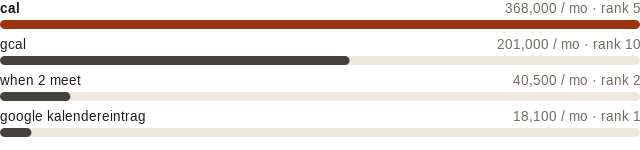
Search here is a short word, not a brand. “Cal” draws 368,000 searches a month — but it is a three-letter word, not a customer looking for Cal.com by name.
Monthly searches, Semrush, October 2026. Money-intent phrases such as “cal.com pricing” returned no figures this round.
Search here is generic and borrowed. The top terms are “cal” and “gcal” — words people type for any calendar — and no money-intent phrase appears in the top list at all.
The risk sits in that split. A funnel that lives on a three-letter word and a GitHub repo does not own its introductions — and both of those channels are getting thinner, with organic search down 14.94% on the month.
| Channel | Share of visits | Platform & stack |
|---|---|---|
| Direct | 56.87% (desktop) | Semrush, October 2026; the largest channel |
| Search (google.com) | 5.76% (desktop) | Semrush, October 2026 |
| Organic search | Down 14.94% on the month | Semrush, October 2026; share not published |
| Paid search | Down 86.2% on the month | Semrush, October 2026; share not published |
| Meta ads | About 26 live ads (US) | Meta Ad Library, read 24 November 2026; Meta reports an approximate count |
| GitHub | 50,337 stars, 15,740 forks | github.com/calcom/cal.diy, read 23 November 2026 |
| Platform | — | Next.js, tRPC, React, Tailwind, Prisma, PostgreSQL, TypeScript |
| — | List size not published; mail platform not published |
Marketing channels, Semrush, October 2026, unless noted.
The shape is a brand people come back to directly. Direct is the largest channel at 56.87% of desktop visits, and paid search has fallen 86.2% on the month — the company is not buying its introductions.
The Meta machine is small — about 26 ads — and it sells new products, not the core plan: Cal.com Discover for local pros, Cal.com Events for free event pages, Cal.ai on the Mac. The ads point at what comes next, not at what pays now.
The open-source question is live beyond Cal.com. The independent browser Ladybird entered alpha on 23 November 2026, funded entirely by donations through a non-profit — the opposite bet on how open code pays (ladybird.org).
What outsiders say
Two scores, both high

Two scores, both high. Trustpilot gives 4.7 from 476 reviews and G2 gives 4.6 from about 155 — the site’s own footer still shows the older 4.5 and 4.5.
Trustpilot and G2 first-party pages, read 23 November 2026.
The ratings point one way, and the complaints point at the seams. Trustpilot scores it 4.7 from 476 reviews: support answers fast — reviewers name staff and cite refunds in 15 minutes — and the free plan is enough for a one-person business.
The complaints cluster where the product meets strangers. Public booking links invite fake bookings, the Organizations plan has bugs, and one reviewer asked for weekly and monthly coaching packages the product does not offer.
The other verdict is quieter. G2 reviewers still call the product open source — one from October 2026 — seven months after the commercial code went closed. The brand the market remembers is not the product the company now sells.
Five years from a repo to $11M — then the door closed
From a repo to a company, in six markers
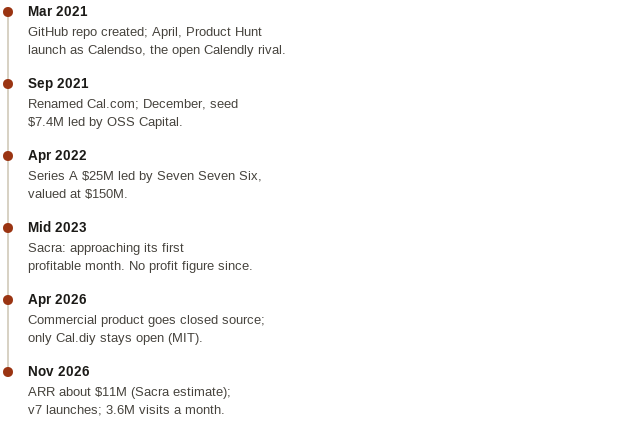
Five years, six markers: a repo in March 2021, a $25M Series A a year later, and in April 2026 the commercial code goes closed.
Founding and funding from the company blog and VentureBeat, April 2022; closed source from GitHub and developer reports, April 2026; ARR from Sacra, November 2026.
The company started with a repo, not a sales team. Peer Richelsen and Bailey Pumfleet built Calendso in March 2021, launched it on Product Hunt a month later, and renamed it Cal.com that September.
The money followed the developers. A $7.4M seed round closed in December 2021, then a $25M Series A in April 2022, led by Seven Seven Six at a $150M valuation — with angels including the CEOs of Shopify, Vercel and Supabase.
Revenue nearly doubles every year — on one estimate
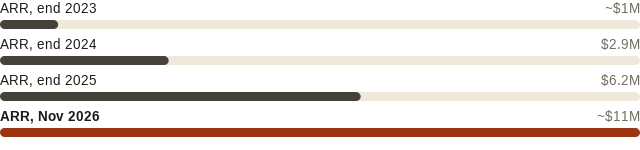
Annualised revenue nearly doubles every year on Sacra’s numbers: about $1M at the end of 2023, $2.9M a year later, $6.2M at the end of 2025, about $11M in November 2026.
Sacra estimate, November 2026, not an audited figure; a founder-shared $11.11M figure points the same way.
The growth line is the one number everyone quotes, and it is an estimate. Sacra puts annualised revenue at about $11M, up 111.4% in 2025 — but the company publishes no profit, no net income and no cash-flow figure.
The closest thing to a profit claim is three years old. Sacra says the company was approaching its first profitable month as early as mid-2023 — which is another way of saying it had not had one yet, and nothing since has updated the claim.
The institutional proof is thinner than the percentages. Enterprise customers are about 60% of recurring revenue and the platform API about 25%, both on Sacra’s estimate — and the API’s $299 and $2,499 price points do not appear on the company’s own price list.
The bet is the risk
The claim that built the brand is also the claim that can break it. In April 2026 the commercial code moved to a private repo, the public repo became Cal.diy — a community edition the company says is for personal, non-production use only — and the enterprise features left with it.
The reason given was security: AI can scan public code for vulnerabilities at machine speed. The cost is the distribution itself — community contributions no longer flow back into the production platform, and a Hacker News thread on the move drew 263 points and 190 comments, per a developer report.
The second exposure is the customer mix. About 60% of recurring revenue comes from enterprise customers, on Sacra’s estimate — and the European hosting zone, Cal.eu, closed on 1 November 2026, with users moved to the US platform. The compliance story for European buyers has a crack in it.
What survives is a free plan with no usage limits, a per-seat price below Calendly’s, and an API that charges by the booking instead of by the head. The risk is the mirror image: a distribution machine that ran on open code, now closed, with no public profit figure to show for the trade.
Cal.com is one of 2 sites in the scheduling tools collection. Compare Cal.com with Calendly and Jotform side by side.
The full teardown is for members
The full analysis of pricing, acquisition, conversion and retention is member content. Membership is $29 a month or $249 a year.
Similar sites in the database
Cal.com (3.6M) sits between FreePDFConvert (3.61M) and Ruggable (3.6M) in the database.
| Site | Category | Monthly visits | Source |
|---|---|---|---|
| FreePDFConvert | PDF tools · File conversion | 3.61M | Semrush, Oct 2026 |
| Ruggable | Home · Washable rugs DTC | 3.6M | Similarweb, Oct 2026 |
| RYZE | Food & drink · Mushroom coffee DTC | 3.6M | Similarweb, Oct 2026 |
Compare Cal.com with Calendly and Jotform side by side. The full database, with working filters, is on the teardowns index.
Read the next one in your inbox
The new ones go out by email first, one a week, with the traffic source and month attached to every number. Leave your address and the next one comes to you.