
How Castlery makes money from $1,998 sofas
Monthly visits
3.19M
October 2026. Third-party estimate, not official MAU/DAU. Semrush counted 3.19M for the month, up 27.67%.
Castlery draws an estimated 3.19M visits a month (October 2026, Semrush), up 27.67% on the month. It is the 170th-largest site in our database of 901. The average visit lasts 8 minutes 41 seconds — long enough to compare three sofas, not long enough to buy one.
The pitch fits in one line: a $1,998 sofa, sold by the inbox. The money is in the email — Klaviyo drove 51% of ecommerce revenue in the first half of 2026 — and the brand behind it is a Singapore furniture maker that has been profitable since 2020.
| Site | Castlery, castlery.com |
|---|---|
| What it is | Singapore furniture DTC brand — sofas, beds and dining tables sold direct online, in five showrooms across Singapore, Australia and the US |
| Who it is for | City households buying mid-range designer furniture — sofa buyers aged 25–45, household income $75K–$150K, per The Peak in 2024 |
| Category | Home · Furniture DTC brand |
| Monthly visits | 3.19M, October 2026. Third-party estimate, not official MAU/DAU; Semrush, up 27.67% on the month. Global rank #17,514, US #7,286 (Semrush) |
| Founded | 2013; founders Declan Ee, Fred Ji, Zhou Zhiwei and Travers Tan, starting from a basement office in Singapore |
| Headquarters | Singapore (global office, MacPherson); US arm Castlery Inc., Anaheim, California |
| Operator | Private — unlisted, not acquired or controlled; Castlery Private Limited. Four minority investors; $35.8M raised in total, latest a $30M Series A in October 2021 (PitchBook) |
| Survival engine | The inbox. Klaviyo drove 51% of ecommerce revenue in H1 2026 through automated flows — a $1,998 sofa is sold over weeks of email, not one click. The brand is the second engine: direct-from-factory design at $1,998, between Article and Joybird |
| Pricing | Jonathan Sofa $1,998; Owen II Sofa $1,799; Mori Chaise Sectional $3,798; Jaron Recliner Sofa $3,098; Jonathan Leather U-Shape Sectional $8,894. Source: castlery.com, read 24 November 2026 |
| Pricing model | One-off purchase, no subscription — sofas, beds and tables bought once, with a 30-day return window that carries a 20% restocking fee |
| Free hook | Email sign-up for a 4-piece gift and $50 off the first order, free shipping over $1,399, free interior styling service |
| Meta ads | Running — 307 active ads counted by Sprites (read 19 November 2026), median run 10 days; the library itself was not read directly |
| Country breakdown | United States 65.86% (2.1M); Australia 14.3% (456.36K); Singapore 11.91% (380.17K) — Semrush, October 2026 |
TL;DR
- Castlery draws an estimated 3.19M visits a month (October 2026, Semrush), up 27.67%. It sells $1,998 sofas, and ECDB puts its 2025 ecommerce revenue at $654M, up 19% — a third-party estimate, not a company figure.
- The inbox is the business: Klaviyo drove 51% of ecommerce revenue in the first half of 2026, with automated flows doing 74% of that. A $2,000 sofa needs weeks of email before it sells, and 60–70% of customers are new at any point.
- The brand is the second engine: direct-from-factory design priced between Article’s $1,299 and Joybird’s $2,484, backed by five showrooms. The risk is cost — tariffs have already cut profit by 1–3 points on a 4–8% margin.
The $1,998 sofa
Priced between $1,299 and $2,484
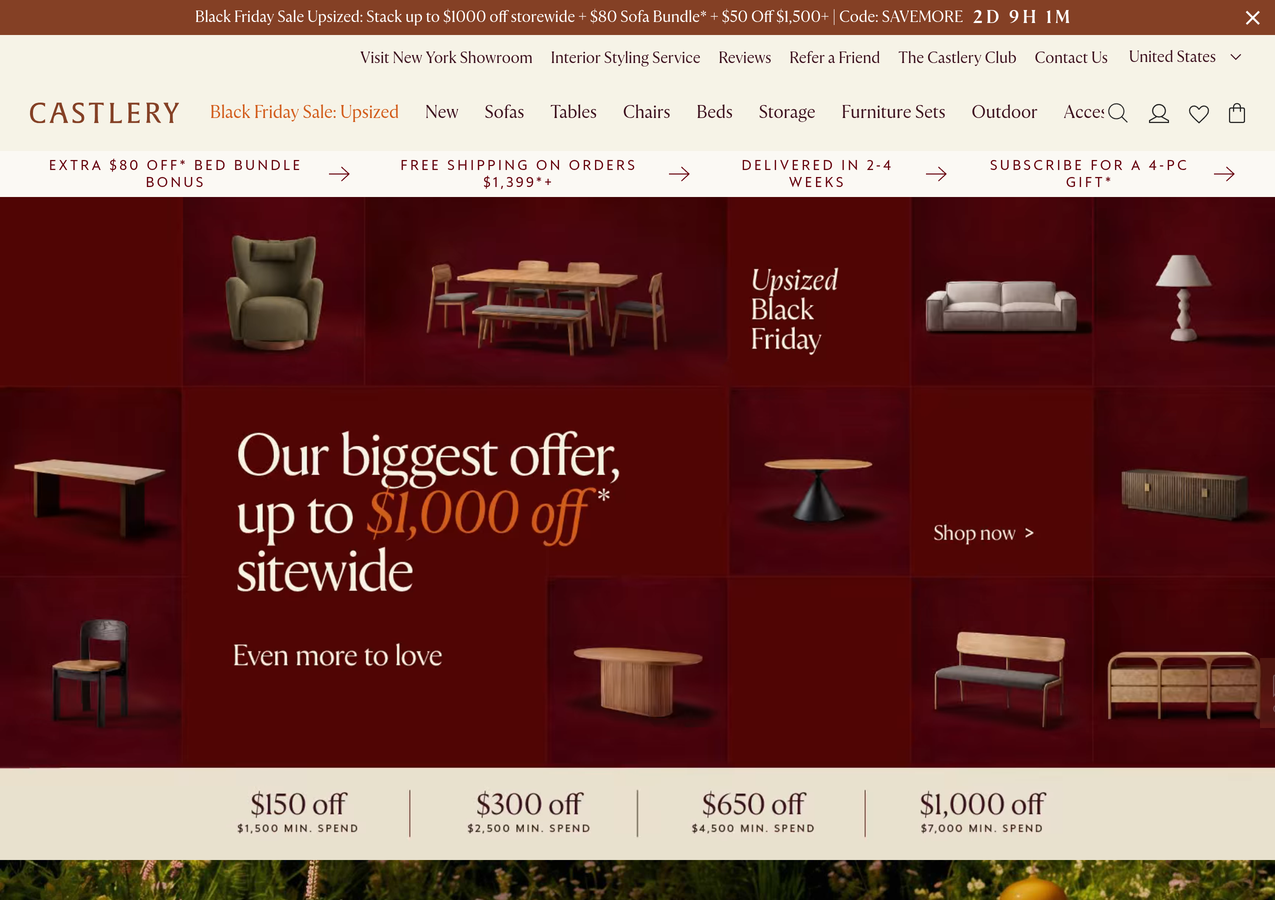
The Castlery US homepage, read 24 November 2026. “Upsized Black Friday” — “Our biggest offer, up to $1,000 off* sitewide.” The perks bar reads free shipping over $1,399, delivery in 2–4 weeks, and a 4-piece gift for subscribing.
The homepage we read on 24 November 2026 opens with a sale, not a sofa. “Our biggest offer, up to $1,000 off* sitewide” is the headline, with tiered discounts below it — $150 off $1,500, $300 off $2,500, $650 off $4,500, $1,000 off $7,000. The navigation tells the rest: sofas, tables, chairs, beds, storage, furniture sets, outdoor — a whole room, not a single product.
The price is the positioning. The Jonathan, the everyday three-seater, is $1,998 — $1,799 for the Owen II on Black Friday, $3,798 for the Mori chaise sectional, $3,098 for the Jaron recliner. That number only means something against its neighbours: Article sells its Timber for $1,299, West Elm’s Haven starts at $1,749, and Joybird’s Briar is $2,484. Castlery sits in the gap, claiming designer furniture at a reasonable price.
| Sofa | Price | What it is |
|---|---|---|
| Jonathan Sofa | $1,998 | The everyday three-seater; 4.8/5 from 1,053 reviews |
| Owen II Sofa | $1,799 | Black Friday price; removable covers, solid wood legs |
| Mori Performance Fabric Chaise Sectional | $3,798 | The performance-fabric sectional, spill-resistant |
| Jaron Performance Fabric Recliner Sofa | $3,098 | The recliner in performance fabric |
| Jonathan Leather U-Shape Sectional | $8,894 | Top-grain leather, low-profile, the dear end |
| Jonathan Leather Extended Sofa with Ottoman | $4,409 (was $4,646) | Leather three-seater with ottoman, on promotion |
The $1,998 sofa sits between $1,299 and $2,484
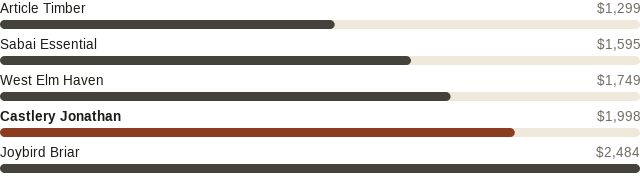
Five sofas, one ladder. Article is the honest-price floor at $1,299; Joybird is the custom ceiling at $2,484. The Jonathan at $1,998 is the middle of the ladder — dearer than the honest sofa, cheaper than the custom one.
Prices: Castlery product pages, read 24 November 2026; Article, Sabai and Joybird via warmcazza, 2 November 2026; West Elm via its own product page.
The range is wide on purpose. The $1,799 Owen II and the $8,894 leather U-shape are the ends of the same ladder: the cheap end lets a first-time buyer in, the dear end proves the craft, and the $1,998 middle is where most sofas actually sell. The leather range runs to $8,894, but the working band is $1,799 to $3,798.
The $699 gap against Article is the whole argument. Article’s Timber is $1,299; the Jonathan is $1,998. The difference buys design detail, layered fabrics and a showroom to sit in before buying — and a free styling service to furnish the room around it. Whether $699 of design is worth it is the question every visitor answers in the inbox, over weeks.
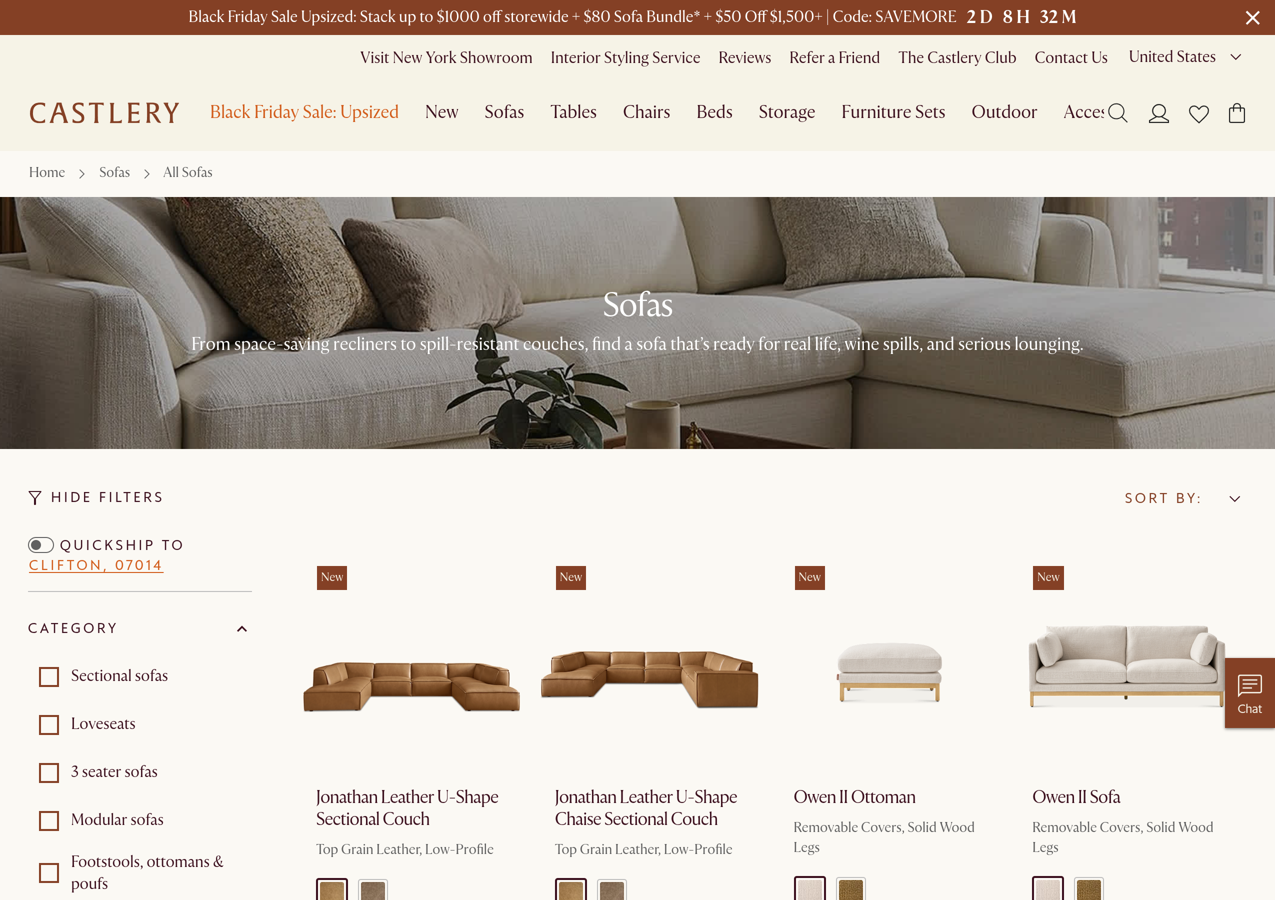
The sofas listing, read 24 November 2026. “From space-saving recliners to spill-resistant couches, find a sofa that’s ready for real life, wine spills, and serious lounging.” The Owen II Sofa and the Jonathan Leather U-Shape sit in the first row.
The listing page does the selling the homepage does not. The hero line is about real life — wine spills and serious lounging — and the grid below it is the range: sectionals, recliners, ottomans, each with removable covers and solid wood legs. The prices sit below the fold in this capture; the three checked this round — Owen II $1,799, Mori $3,798, Jaron $3,098 — were read in the live browser.
The inbox closes the sale
51% of revenue, one automated flow at a time
Klaviyo does half the selling

Klaviyo’s own case study puts the number at 51%: in the first half of 2026, just over half of Castlery’s ecommerce revenue was attributed to Klaviyo. Automations did 74% of that, and the return on Klaviyo spend was over 100 times. The number is a supplier’s case study, counted on multi-touch attribution — it is the size of the channel, not proof every one of those sales needed the email.
Klaviyo case study, 2026; figures are supplier-published and multi-touch attributed, not incremental revenue.
The logic fits the product. A $2,000 sofa is not bought on a first click, and 60–70% of customers are new to the brand at any point. So the first purchase is small — a cushion, a side table — and the follow-up is sorted by what was bought: a bed buyer gets bedside tables and rugs, not a generic newsletter. The store stylist can push a customer’s online cart straight to their account.
The money follows the same shape. The company says it has been profitable since 2020 and passed $100M in the financial year to March 2022, after growing six times through the pandemic. ECDB puts 2024 ecommerce revenue at $549M and 2025 at $654M, up 19%. Another data provider says 2024 was $397M — the two do not reconcile, and this page prints both rather than picking one.
From $100M to $654M, with a gap in the middle

The line rises fast and then stops being the company’s own words. The $100M is company-reported; the $549M and $654M are ECDB estimates, and a rival estimate for 2024 is $152M lower. The 2023 figure — $180M from one source — is not used here: its original source was never named.
FY2022 from the company, via Global Business Magazine, 2022; 2024 and 2025 from ECDB, e-commerce revenue estimates.
The growth is slowing where it matters. The company expects the financial year to March 2027 to be flat or single-digit, against 10–15% the year before. Tariffs are the reason: more than half of production was once in China, and moving it to Vietnam, Thailand and India has already cut profit by 1–3 points on a margin the company puts at 4–8%.
Five showrooms and 307 ads
The store backs the email
October was the best month in the run

October was the best month in the run — 3.19M visits, up 27.67% on September’s 2.5M, after a soft August at 2.73M. The jump is the Black Friday build-up: the sale started on 2 November and the ads followed on 14 November. Search, though, is slipping: organic search fell 11.4% in October while paid search rose 19.85%.
Semrush, October 2026, read 24 November 2026.
The ads are short-lived by design. Sprites counted 307 active ads in November 2026, with a median run of 10 days — a tenth of Tecovas’s 65 — and 642 published in total. The angles are the product and the prize: “The nap sofa you need”, a Good Design Award winner, a Black Friday early-access push from 14 November. The store is the slower channel: five showrooms, the newest a 3,000-square-foot New York flagship that cost seven figures on a ten-year lease.
The showroom is where the inbox gets its proof. A stylist in the store can send the customer’s online cart to their account, and the New York store is expected to break even in 18 months to two years. The plan is 8–12 stores by 2029, with Washington, Los Angeles, San Francisco and Seattle named, and London in site selection after a 2025 pop-up.
| Mechanism | Hit | Why, in one line |
|---|---|---|
| Skip a purchase | — | No subscription, so nothing to skip |
| Pause purchases | — | No subscription, so nothing to pause |
| Cancel anytime | ✓ | Free before dispatch; 20% restocking fee once the order is processed |
| Free shipping over $1,399 | ✓ | Free over $1,399 to selected cities, on the homepage; one coupon site says $999 |
| Gift card | Not verified | No gift card product was found on the pages read |
| First-order hook | ✓ | Email sign-up for a 4-piece gift, plus $50 off the first order |
| Referral | ✓ | A referred friend gets $100 off over $1,000; the referrer gets 100 points |
| Email capture | ✓ | Subscribe-for-a-gift banner on the homepage, via Klaviyo |
| Refund guarantee | ✓ | 30-day returns, but a 20% restocking fee and $50 without the original box |
| Extended warranty | ✓ | Mulberry extended warranty; full refund within 30 days |
| Birthday reward | ✓ | Club members get a birthday-month reward; the amount was not published |
| Trade discount | ✓ | Designers and architects get 10% off orders over $1,000 |
| Bundle reward | ✓ | Spend $2,000 and get 150 Club points; points convert to vouchers |
| Review reward | ✓ | 30 points for a written review, 75 with a photo |
| Free design service | ✓ | Free interior styling, by phone, online or in store |
| Room Designer tool | ✓ | Plan the room on the site before buying the sofa |
| Gift subscription | Not verified | A holiday gift shop sells one-off gifts; no gift subscription was found |
| Free trial | — | No trial; sofas are bought once, not tried on subscription |
Read the table as a one-off purchase with a long memory. Nothing here holds a customer by contract — no subscription, no skip, no pause — so the retention has to live in the club: points for spending, points for reviews, a birthday reward, a trade discount for designers. The second sofa is the retention metric, and it is not published.
| Channel | Share of visits | Platform & stack |
|---|---|---|
| Direct | 42.43% of visits | castlery.com, three regional stores (US, AU, UK) |
| Organic search | Down 11.4% in Oct | Category words: “table”, “throw cushion pillows” |
| Paid search | Up 19.85% in Oct | Spend and keywords not disclosed |
| Meta ads | 307 active | Sprites read, November 2026; median run 10 days |
| Email, SMS & WhatsApp | 51% of ecommerce revenue | Klaviyo, a customer for 5+ years |
| Showrooms | 5 stores | New York flagship, Sydney, Brisbane, Melbourne, Singapore |
| Logistics | 6 US warehouses | Maersk since 2021; Manhattan SCALE fulfilment |
| Payments | — | Affirm instalments |
Marketing channels, October 2026. Traffic shares are Semrush figures read 24 November 2026; the Klaviyo share is the supplier’s case study, H1 2026. The ecommerce platform was not verified this round.
The stack is Klaviyo end to end for the customer — email, text and WhatsApp in one system — with Manhattan SCALE running fulfilment and Maersk moving the boxes. The platform itself was not verified this round: the technology lists disagree, and the site’s own pages do not name it.
What outsiders say
Loved on Trustpilot, argued with on returns
Three pools, one verdict this time

Three pools, three verdicts — and this time they agree. Trustpilot scores the company 4.6 from about 6,071 reviews, RealReviews scores it 4.6 from 5,613, and the Jonathan Sofa scores 4.8 from 1,053 buyers on the company’s own pages. The older snapshots — 4.4 from 745 reviews in 2024 — are history, not the current verdict.
Trustpilot and RealReviews read 24 November 2026; the Jonathan rating from interiorinsider.
The argument is in the returns. Thirty days to return, but every piece carries a 20% restocking fee, $50 more without the original packaging, and clearance is final sale. The review sites’ lowest sub-score is returns and refunds — the same friction the terms page spells out. The homepage says “hassle-free returns”; the terms page charges for them.
From a basement to $654M
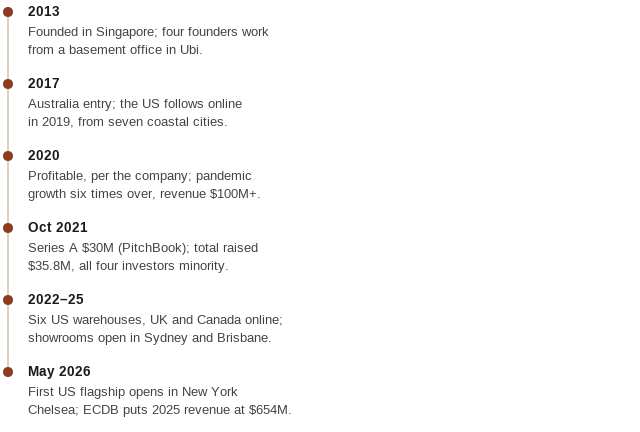
Thirteen years, six markers: a basement in Singapore in 2013, Australia in 2017, the US online in 2019, profit in 2020, a $30M Series A in 2021 — and in May 2026, a New York flagship with ECDB putting the year’s revenue at $654M.
Founding from Marketing-Interactive; profit and FY2022 revenue from Global Business Magazine, 2022; Series A from PitchBook; flagship from Vulcan Post, March 2026; 2025 revenue from ECDB.
The tariff bill is the open question. Profit is already down 1–3 points, growth is expected to be flat, and the email machine cannot fix the cost side. What it can do is keep the customer who already bought a bed coming back for the table — and that, not the ad, is the business now.
Castlery is the first teardown in the furniture DTC collection. Compare Castlery with Article and Room & Board side by side.
The full teardown is for members
The full analysis of pricing, acquisition, conversion and retention is member content. Membership is $29 a month or $249 a year.
Similar sites in the database
Castlery (3.19M) sits between Tecovas (3.2M) and Goldbelly (3.12M) in the database.
| Site | Category | Monthly visits | Source |
|---|---|---|---|
| Tecovas | Footwear · Western boots DTC brand | 3.2M | Similarweb, Oct 2026 |
| Castlery | Home · Furniture DTC brand | 3.19M | Semrush, Oct 2026 |
| Goldbelly | Food & drink · Famous-restaurant food delivery subscription | 3.12M | Semrush, Oct 2026 |
Compare Castlery with Article and Room & Board side by side. The full database, with working filters, is on the teardowns index.
Read the next one in your inbox
The new ones go out by email first, one a week, with the traffic source and month attached to every number. Leave your address and the next one comes to you.