
How Class Central makes money from free courses
Monthly visits
2.37M
October 2026. Third-party estimate, not official MAU/DAU. Semrush counted 2.37M for the month, up 0.29% on September.
Class Central draws an estimated 2.37M visits a month (October 2026, Semrush), up 0.29% on September. It is the 211th-largest site in our database of 901, just behind Outschool at 2.38M and ahead of Brilliant at 2.34M.
Class Central turns 2.37M monthly visits into affiliate commissions: a free catalog of 250K courses that earns only when learners pay a provider — small, bootstrapped and profitable, with no subscription to fall back on.
| Site | Class Central, classcentral.com |
|---|---|
| What it is | Online course aggregator and discovery platform — the founder calls it the “Tripadvisor for online education”: course search, reviews and rankings across 1,300+ universities and 100 providers |
| Who it is for | Self-learners looking for online courses and certificates |
| Category | Education · Online course aggregators |
| Monthly visits | 2.37M, October 2026. Third-party estimate, not official MAU/DAU; Semrush, up 0.29% on September (2.36M); August was 2.84M |
| Founded | 2011, by Dhawal Shah (company account; the first Wayback Machine capture of this product is 18 March 2019 — the February 2011 capture is a different product of the same name) |
| Headquarters | Remote team, no physical offices (company account) |
| Operator | Not publicly disclosed (private, unlisted; founder Dhawal Shah still chief executive; early Imagine K12 incubator funding around 2013, bootstrapped since 2016) |
| Survival engine | Distribution-led. The catalogue turns course-seeking visits into paid upgrades on Coursera and Udemy, and Class Central takes a referral commission when that happens. Direct visits are 50.46% of the desktop journey, so half the audience arrives already looking for the site itself |
| Pricing | $0 — free; no paid tier, no subscription. Source: the site’s own course page, read 25 November 2026 (its Product Offer lists $0) |
| Pricing model | Free to learners; referral commissions plus advertising |
| Free hook | The whole catalogue is free — 250K courses to search, a free account, and free certificate guides such as “470+ Coursera Courses Still Completely Free” |
| Meta ads | Not verified — the Meta Ad Library returned 403 on 25 November 2026, so whether the site buys Meta ads could not be checked |
| Country breakdown | United States 34.0% (805.92K); India 16.69% (395.66K); Brazil 4.64% (109.98K) — Semrush, October 2026 |
TL;DR
- Class Central charges learners nothing: 250K courses are free to search, the account is free, and the money arrives only when a learner upgrades to a paid offering on Coursera or Udemy — a referral commission, plus on-site advertising. Founder Dhawal Shah calls the company small, bootstrapped and profitable (Leading Learning, June 2025); no revenue figure is published.
- Traffic is 2.37M visits a month (Semrush, October 2026, up 0.29%), with direct visits at 50.46% and organic search down 8.59% in the same month. Five million people have signed up, and the catalogue carries 250,000 learner reviews.
- Founded in 2011 by Dhawal Shah as a one-page site tracking Stanford’s free courses, funded around 2013 by the Imagine K12 incubator, and bootstrapped since 2016. Trustpilot rates it 3.8 out of 5 — from just two reviews.
Free to use. The money is made elsewhere
What the homepage promises
The homepage opens with a single line: “Find your next course.” Under it sits a search box over 250,000 courses, and under that the line the site has used for years: “Find the best courses, wherever they exist.” Three counts carry the pitch — 1,300+ universities, 100 providers, 1,700+ institutions — with Harvard, Yale, MIT, Coursera, Udemy and Google named underneath.
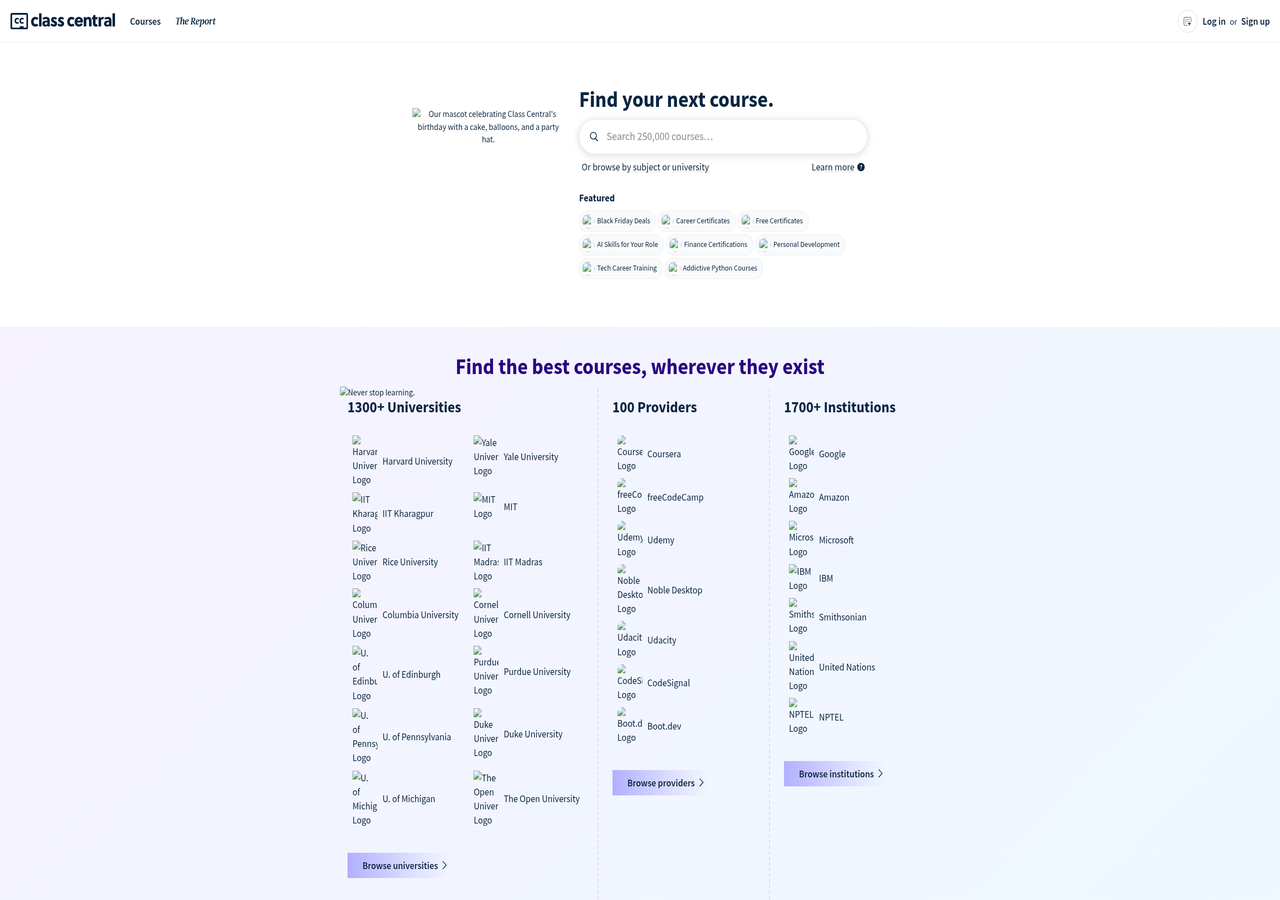
The Class Central homepage: “Find your next course” over a search box covering 250,000 courses, and the counts underneath — 1,300+ universities, 100 providers, 1,700+ institutions. Screenshot of the classcentral.com homepage, read 25 November 2026 (Wayback Machine capture of 19 November 2026; the live site blocks automated screenshots with a bot check).
The free account is the second promise, and it is counted in public: 100M visitors, 5M sign-ups, 7,331 sign-ups in the past seven days, 35M follows, 20M bookmarks, 2M lists created. The account saves courses, builds lists, follows subjects and sends personalised updates — the machinery that turns a one-off searcher into a returning learner.
The About page says how the free tier pays for itself, in one paragraph: “We’re bootstrapped and profitable. Class Central makes money through advertising and affiliate links. We stand to earn a commission when someone clicks through to a course provider and upgrades to a paid offering.” The same paragraph carries the limit: “For a substantial portion of our catalog, we do not have any affiliate partnerships.”
The outside scores split three ways

Three ratings, three different subjects, never averaged: Trustpilot 3.8 out of 5 from 2 reviews; Learning How to Learn 4.9 out of 5 from 27,816 course reviews on Class Central; TryItRandomly 4.5 out of 5 as an editorial score. November 2026.
Trustpilot, read 25 November 2026; the two reviews are from November 2019 and October 2020. Course rating read 25 November 2026; TryItRandomly, 25 March 2026.
Trustpilot rates Class Central 3.8 out of 5 — from two reviews, both five to six years old. That is not a reputation; it is a sample too small to read. The 250,000 reviews on the site are a different thing altogether: they rate the courses, not the platform, and the most-reviewed course on the site, Learning How to Learn, carries 4.9 out of 5 from 27,816 of them.
The third score comes from an independent review site, TryItRandomly, which gave Class Central 4.5 out of 5 in March 2026 and called it “the most practical starting point for anyone navigating the online course ecosystem”. Read the three side by side and the story is the catalogue, not the company: buyers trust the course list, and almost nobody has reviewed the business behind it.
The course page is where the money changes hands
One click out, and the commission clock starts
| Item | Price | What to know |
|---|---|---|
| Class Central search & account | $0 | Free; no paid tier, no subscription, no trial to sell |
| Learning How to Learn, on Class Central | $0 | Course page Product Offer lists $0; the course itself is a Coursera listing |
| Coursera Plus | $50–60 a month | Paid on Coursera; Class Central earns a commission if the learner upgrades through its link |
| Udemy subscription | About $20 a month | Paid on Udemy; same commission arrangement |
| Coursera certificate | Not verified | Paid on Coursera; the certificate price varies by course and was not verified this round |
The price is zero on Class Central’s side of the click and whatever the provider charges on the other side. The course page for Learning How to Learn lists a $0 Product Offer, a blue “Go to class” button, and a line at the top of the page that states the deal plainly: “Class Central is learner-supported. When you buy through links on our site, we may earn an affiliate commission.”
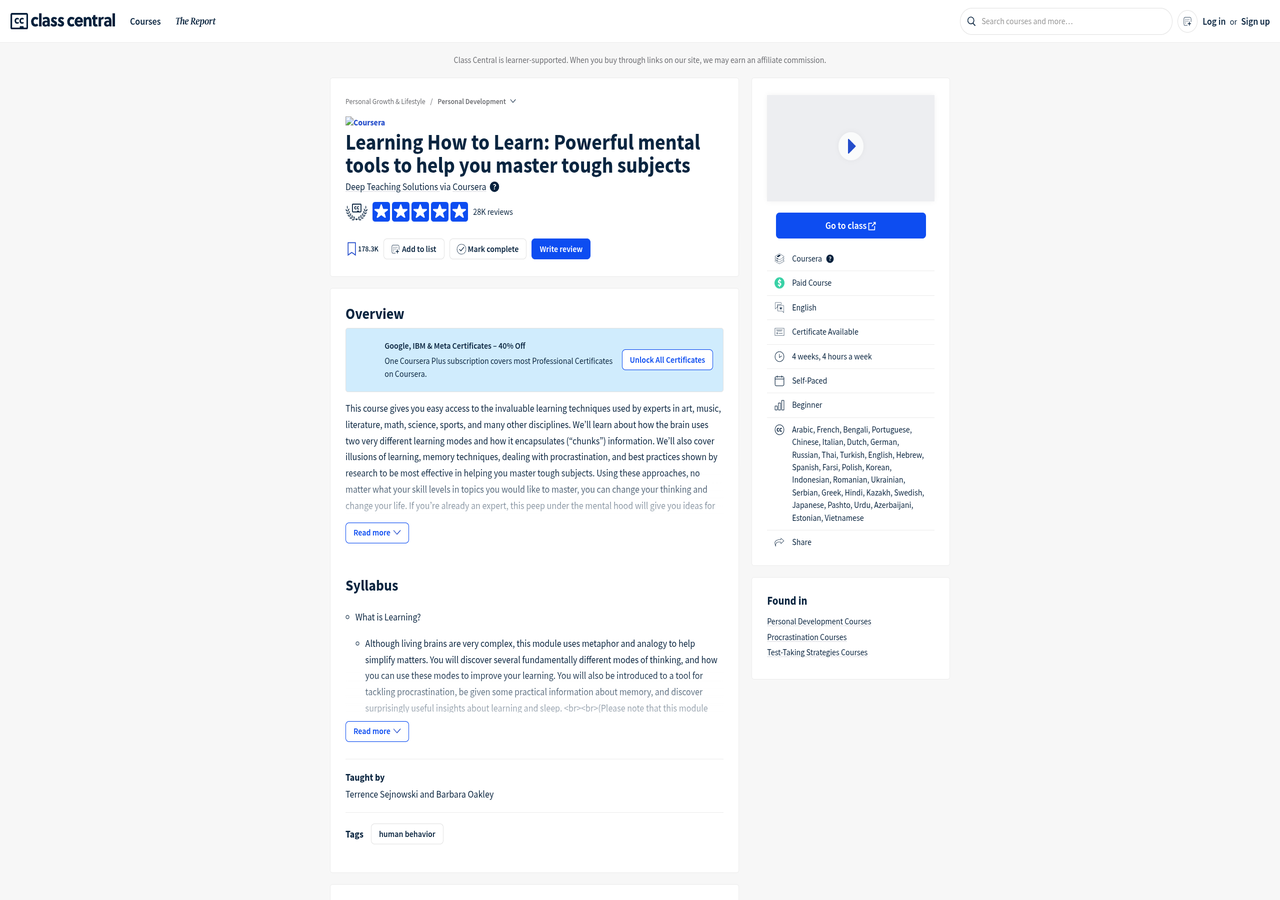
The Learning How to Learn course page: the affiliate disclosure at the top, a “Go to class” button, 28K reviews, a Coursera Plus 40% off banner, and the syllabus below. Screenshot of the classcentral.com course page, read 25 November 2026 (Wayback Machine capture of 9 October 2026; the live site blocks automated screenshots with a bot check).
The page sells the course the way a shop sells a product it does not stock. It shows the syllabus, the teachers — Terrence Sejnowski and Barbara Oakley — and 28,000 reviews, then hands the buyer to Coursera with a “Go to class” button. A Coursera Plus banner sits in the middle of the page offering 40% off a year of certificates, so the upsell is visible before the click.
That is the whole transaction, and it is the only one on the site. There is no checkout on Class Central, no subscription to cancel, no refund policy to write — the trial and the refund belong to Coursera or Udemy, and the commission is the only money Class Central ever sees.
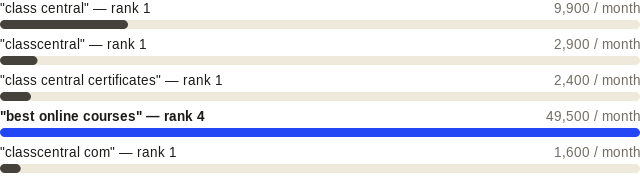
Search is two words wide, and the brand word is the narrower one. “Class central” draws 9,900 searches a month and ranks first; the category phrase “best online courses” draws 49,500 a month and the site only ranks fourth for it.
Semrush, last updated 11 November 2026. Monthly search volumes, October 2026.
Search is two words wide, and the brand word is the narrower one. “Class central” draws 9,900 searches a month and ranks first, bringing 9.37% of visits; “classcentral” adds 2.74%. Together the two spellings bring about a tenth of search traffic, while the category phrase “best online courses” is searched 49,500 times a month and the site only ranks fourth for it.

October is a flat line, not a recovery. Visits fell from 2.84M in August to 2.36M in September, then rose 0.29% to 2.37M in October, while organic search fell 8.59% in the same month.
Semrush, last updated 11 November 2026. Third-party estimates, not official MAU/DAU.
October is a flat line, not a recovery. Visits fell from 2.84M in August to 2.36M in September, then rose 0.29% to 2.37M in October — while organic search fell 8.59% in the same month. The total held because direct visits, at 50.46% of the desktop journey, did the holding: half the audience arrives by typing the address, not by searching.
Fifteen years, one catalogue
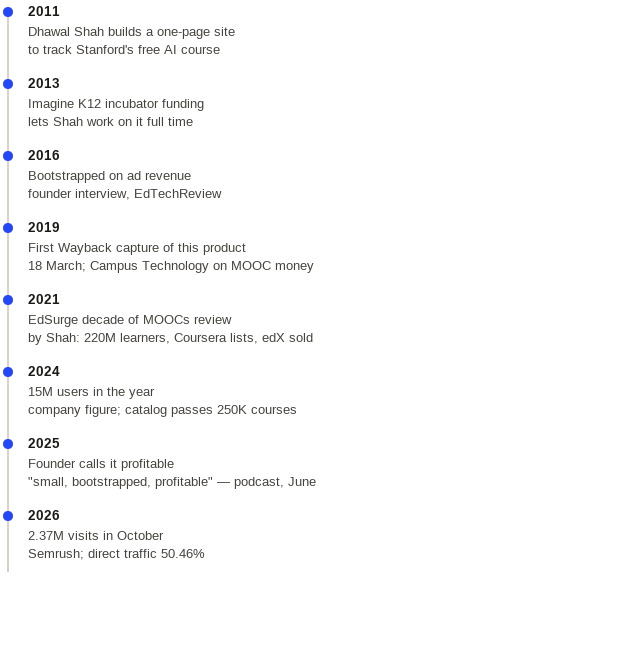
Fifteen years from a one-page weekend project to a 250,000-course catalogue. Dates from the company, the Wayback Machine, EdSurge, Campus Technology and Semrush.
Wayback Machine, first capture of this product 18 March 2019; the February 2011 capture is a different product of the same name. Semrush, October 2026.
Class Central began in November 2011 as a one-page site tracking Stanford’s free courses. Around 2013 the Imagine K12 incubator funded it so Shah could work on it full time, and since 2016 it has run bootstrapped on advertising and commissions. The Wayback Machine’s first capture of this product is March 2019, and the catalogue has grown from about 15 courses to 250,000 since.
One date needs care. The Wayback Machine’s earliest capture of the domain, February 2011, is a different product of the same name — a free course management system — not the aggregator Shah built that November. The company’s founding date is its own account; the archive backs the product only from March 2019.
| Mechanism | Status | What we found |
|---|---|---|
| Free account | ✓ | “Get the most out of Class Central with a free account”; 5M sign-ups, 7,331 in the past seven days |
| Saved courses / bookmarks | ✓ | 20M bookmarks; 27,512 courses bookmarked in the past seven days |
| Learning lists | ✓ | 2M lists created; 7,951 lists in the past seven days |
| Learning reminders | ✓ | Following a subject, university or provider brings personalised updates; reviewers cite timely notifications about tracked courses |
| Email newsletter | Not verified | The Report has a newsletter entry point in third-party write-ups, but no subscription form was confirmed on the site this round |
| Course reviews | ✓ | 250K learner reviews on the site; Learning How to Learn carries 27,816 of them |
| Rankings / best-of lists | ✓ | 250 Most Popular Online Courses of All Time; 100 Most Popular Online Courses, 2025 edition |
| Certificate tracking | Not verified | Free certificate guides exist, but no feature for tracking certificates already earned was found |
| Progress tracking | ✓ | Help page: the account lets learners “plan and track your learning” |
| Referral | — | No referral or rewards programme found |
| Community | — | No forum or community feature; the founder says the early MOOC community “slowly diluted” |
| Mobile app | — | None; the Help page says “the site is mobile friendly” |
| First-order hook | ✓ | Free is the hook: 250K courses to search, a free account, and free certificate guides |
| Skip / pause / cancel | — | Not applicable: no subscription to skip, pause or cancel |
Retention is a list, not a subscription. Nothing on the site charges a fee, so nothing locks a learner in — what brings them back is the account that remembers which courses they saved, which subjects they follow and which lists they built. What is missing is the machinery other education sites lean on: no newsletter confirmed, no community, no app, and no referral programme to pay a learner for bringing the next one.
| Channel | Share of visits | Platform & stack |
|---|---|---|
| Search (Google) | “class central” 9,900 searches a month, rank 1, 9.37% of traffic; “classcentral” 2,900 a month, rank 1 | Semrush, Oct 2026 |
| Direct | 50.46% of visits (desktop journey) | Semrush, Oct 2026 |
| Referral (google.com) | 21.82% of visits (desktop journey) | Semrush, Oct 2026 |
| Organic search | Down 8.59% in October 2026 (absolute visits not published) | Semrush, Oct 2026 |
| AI referrals | About 34K a month: ChatGPT 24K, Gemini 6K, Claude 4K | Semrush, Oct 2026 |
| Content / The Report | 1,700+ articles; annual most-popular lists and monthly round-ups | Site, read 25 Nov 2026 |
| Follow a subject or provider and receive personalised updates; newsletter entry not confirmed | Site, read 25 Nov 2026 | |
| Outbound (where visits go) | Visitors most often go next to coursera.org and udemy.com | Semrush, Oct 2026 |
| Meta ads | Not verified — the Ad Library returned 403 | Meta Ad Library, 25 Nov 2026 |
| Backlinks | 1.65M backlinks (+0.79%), 21.78K referring domains (+13.87%) | Semrush, Oct 2026 |
| Area | What we found |
|---|---|
| Platform | Not verified — the site sits behind Cloudflare and returns 403 to automated reads, so no platform markers could be checked |
| Payments | Not applicable — no checkout, no paid tier; the site itself charges $0 |
| Analytics | Not verified — no analytics markers could be read behind the Cloudflare block |
| Follow-based updates confirmed; newsletter provider not verified | |
| Customer service | Help Center self-serve; no support email, chat or phone found this round |
| Subscription billing | Not applicable — no subscription product |
| Reviews | On-site course reviews 250K; Trustpilot 3.8/5 (2 reviews) off-site |
| Distribution | Outbound to Coursera and Udemy; The Report’s 1,700+ articles and annual lists |
| Advertising | Advertising income confirmed by the About page; ad slots were not visually confirmed this round |
| Mobile app | None; the site is mobile friendly |
| Site | Monthly visits | Price point | What the comparison shows |
|---|---|---|---|
| Alison | 9.03M | Premium €7.99 a month | Free courses too, but Alison sells its own certificates — Class Central only earns the referral |
| DataCamp | 6.2M | Premium $11 a month | Self-run subscription courses against a free aggregator that earns on the click-out |
| MasterClass | 3.94M | Standard $10 a month | Celebrity content behind a paywall against free discovery of other people’s courses |
| Skillshare | 2.59M | Premium $13.99 a month | Nearly the same traffic, the opposite model: a subscription library, not a free directory |
| Brilliant | 2.34M | Premium $20 a month | Traffic just behind Class Central, at $20 a month on an annual plan — a paid interactive library against a free directory |
Three things should not be quoted as facts. No revenue figure, no commission rate and no profit figure has ever been published, so 2.37M visits cannot be turned into a dollar value. The $5M annual revenue figure from one data vendor is excluded: its method is unclear and no other source backs it. And the February 2011 Wayback capture is a different product of the same name — a free course management system, not the aggregator Shah built that November.
The open question is whether the free catalogue keeps its value as the providers tighten their own paywalls. Shah put it plainly on the podcast: as certificates and assignments moved behind payment, “the MOOC experience has largely been reduced to basically a YouTube playlist.” A directory of free courses is worth less when the courses stop being free — and Class Central does not set the price on either side of the click.
Class Central is the first online course aggregator in the database, in the Online course aggregation & discovery collection. Class Central against its closest matches: compare Class Central with Alison and DataCamp side by side. The closest pattern matches among published teardowns are Alison and DataCamp — one sells its own certificates, the other its own subscription.
The full teardown is for members
The full analysis of pricing, acquisition, conversion and retention is member content. Membership is $29 a month or $249 a year.
Similar sites in the database
Class Central (2.37M) sits between Outschool (2.38M) and Brilliant (2.34M) in the database.
| Site | Category | Monthly visits | Source |
|---|---|---|---|
| Buck Mason | Apparel · Modern American basics DTC brands | 2.4M | Similarweb, Oct 2026 |
| Room & Board | Home · Modern furniture & home decor DTC brands | 2.4M | Similarweb, Oct 2026 |
| Wistia | Video marketing · Video hosting & marketing | 2.4M | Similarweb, Oct 2026 |
| Outschool | Education · Kids live online classes marketplace | 2.38M | Semrush, Oct 2026 |
| Class Central | Education · Online course aggregators | 2.37M | Semrush, Oct 2026 |
| Brilliant | Education · STEM interactive learning | 2.34M | Semrush, Oct 2026 |
Compare Class Central with Alison and DataCamp side by side. The full database, with working filters, is on the teardowns index.
Read the next one in your inbox
The new ones go out by email first, one a week, with the traffic source and month attached to every number. Leave your address and the next one comes to you.