
How Copyleaks makes money from AI detection
Monthly visits
3.82M
October 2026. Third-party estimate, not official MAU/DAU. Semrush counted 3.82M for the month, down 19.83%.
Copyleaks draws an estimated 3.82M visits a month (October 2026, Semrush), down 19.83% on the month. It is the 150th-largest site in our database of 901. The average visit lasts 8 minutes 37 seconds — people paste in long documents and wait for a verdict.
The pitch fits in one line: a free scan tells you whether the text was written by a machine, and the subscription that follows charges by the word. The money is in the renewal — teachers and teams who cannot afford to stop checking.
| Site | Copyleaks, copyleaks.com |
|---|---|
| What it is | AI-generated content and plagiarism detection platform: AI detection in 30+ languages, plagiarism detection in 100+ languages, plus AI image and video detection |
| Who it is for | Teachers, publishers and content teams who need to check whether text is original or machine-written |
| Category | Writing tools · AI detection and plagiarism |
| Monthly visits | 3.82M, October 2026. Third-party estimate, not official MAU/DAU; Semrush, down 19.83% on the month (September 4.77M). Global rank #14,680, US #7,000 |
| Founded | 2015; founders Alon Yamin and Yehonatan Bitton |
| Headquarters | New York, with operations centred in Stamford, Connecticut — sources differ on which city is home |
| Operator | Private — unlisted, not acquired or controlled; Copyleaks Inc. Seed $1.1M (2019) and Series A $6M (May 2022) from venture firms; no new round announced since |
| Survival engine | Renewal. Subscriptions renew by the month or year — Personal from $13.99 a month, Pro from $74.99 — and schools buy per-student licences through Canvas and Moodle integrations that are hard to swap out. Distribution is the lever: a free 25,000-character scan catches search traffic |
| Pricing | Personal $16.99/month or $13.99/month billed yearly ($167.88/year); Pro $99.99/month or $74.99/month billed yearly ($899.88/year). Source: copyleaks.com/pricing, read 23 November 2026; Enterprise and Education custom |
| Pricing model | Subscription only, charged in credits — 1 credit covers up to 250 words or 1 image. No one-off purchase; credits reset each billing cycle |
| Free hook | A free AI-detector scan of up to 25,000 characters, no login; a free account adds a limited number of credits (count not published). No free plan, no free trial |
| Meta ads | Not running — 0 active ads in the Meta Ad Library (US and all countries checked, 23 November 2026). Rival detectors run ads that name Copyleaks; Copyleaks itself runs none |
| Country breakdown | United States 57.05% (2.18M); India 9.33% (356.71K); Canada 2.76% (105.41K). Semrush, October 2026 |
TL;DR
- Copyleaks draws an estimated 3.82M visits a month (October 2026, Semrush), down 19.83% on the month. It sells AI and plagiarism detection from $13.99 a month — and the company says revenue grew 1,310% in three years to 2024, with 30M+ scans a month. The absolute revenue figure is not published.
- The funnel is a free scan: up to 25,000 characters, no login, on a page that ranks for “ai detector” — a term searched 4,090,000 times a month. The lock-in is institutional: Instructure named it the AI and text-matching partner for Canvas in June 2026, and schools pay per student through the LMS.
- The claim that carries the sale is “over 99% accuracy” — an internal test on English data. Independent tests put it at 66% (Scribbr, 2024) to 79% (aidetector.ac, 2026), and Trustpilot scores it 2.7 from 397 reviews, 48% of them one star.
The first screen sells a verdict, not a product
The hero is a promise, not a price
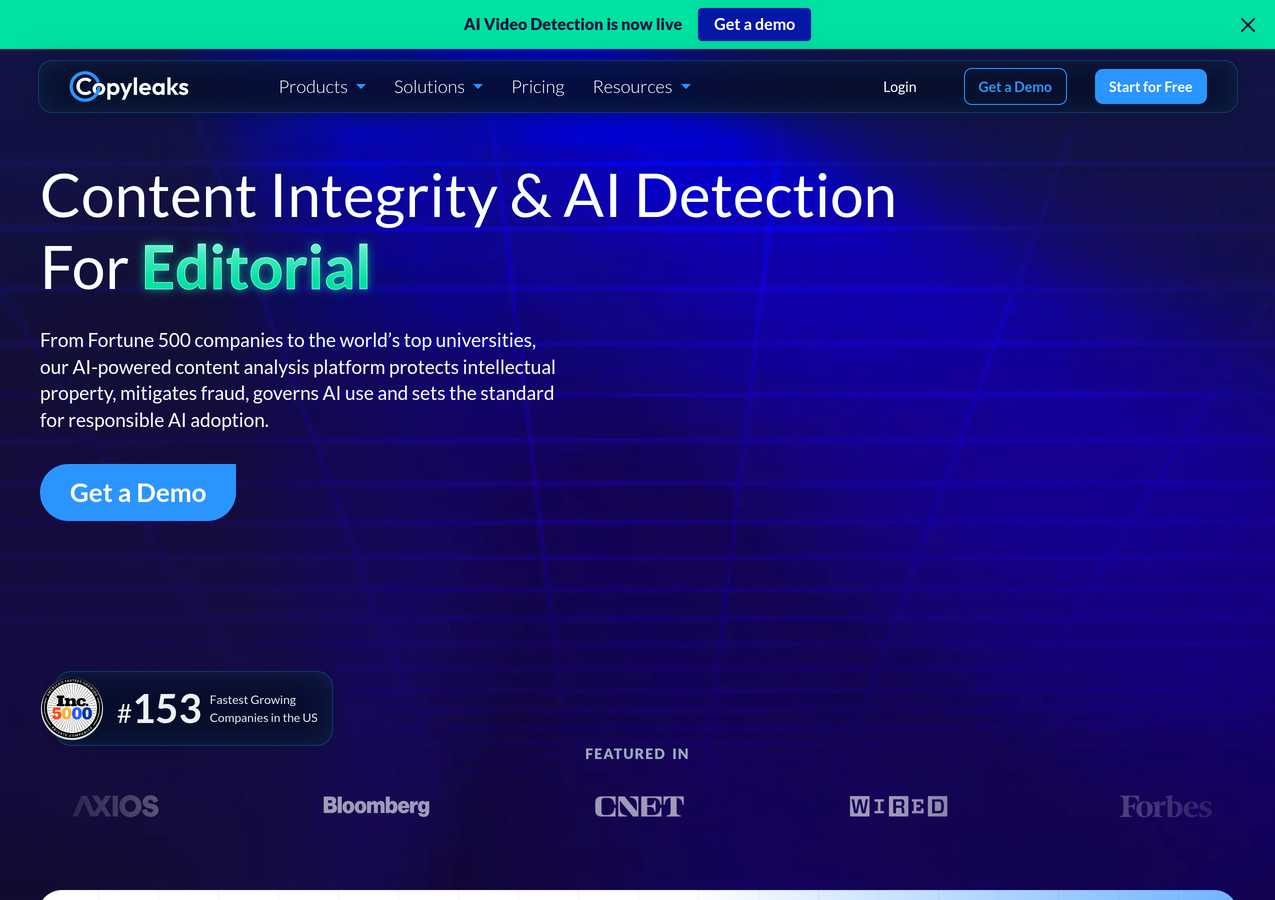
The Copyleaks homepage, read 23 November 2026. “Content Integrity & AI Detection For Editorial” — under an “AI Video Detection is now live” banner, with an Inc. 5000 #153 badge and a “Featured in” row (Axios, Bloomberg, CNET, WIRED, Forbes).
The homepage we read on 23 November 2026 opens with a verdict, not a price. “Content Integrity & AI Detection For Editorial” is the headline, and the copy underneath speaks to Fortune 500 companies and top universities in the same breath: protect intellectual property, mitigate fraud, govern AI use.
The number on the page is “Over 99% accuracy” — with a footnote that matters more than the number: the rating comes from internal testing of English-language datasets. It is the company testing itself, on its own data, in one language.
The trust wall does the rest of the selling. Inc. 5000 #153, TIME’s EdTech Rising Stars #2, and a row of media logos — Axios, Bloomberg, CNET, WIRED, Forbes — sit under the hero. The logos are a wall, not a bibliography: the page does not say what each outlet reported.
What $13.99 buys, and what $74.99 buys
| Plan | Price | Credits and what it is |
|---|---|---|
| Personal | $16.99/month, or $13.99 billed yearly ($167.88/year) | 100 credits a month (25,000 words or 100 images); 1,200 credits a year on the yearly plan |
| Pro | $99.99/month, or $74.99 billed yearly ($899.88/year) | 1,000 credits a month (250,000 words); 12,000 a year; 25 user seats, whole-site scans, cross-language detection, analytics dashboard |
| Enterprise | Custom | API integration, organisation-wide detection policies, on-premises or private-cloud hosting, dedicated customer success |
| Education | Custom, per full-time student | LMS integration (Canvas, Moodle, D2L Brightspace, Schoology, Sakai, Edsby, Blackboard), grade sync, institution-level analytics |
Prices from copyleaks.com/pricing, read 23 November 2026; the pricing page FAQ confirms the same figures in its own words. Yearly prices are the default view (“Save up to 25%”).
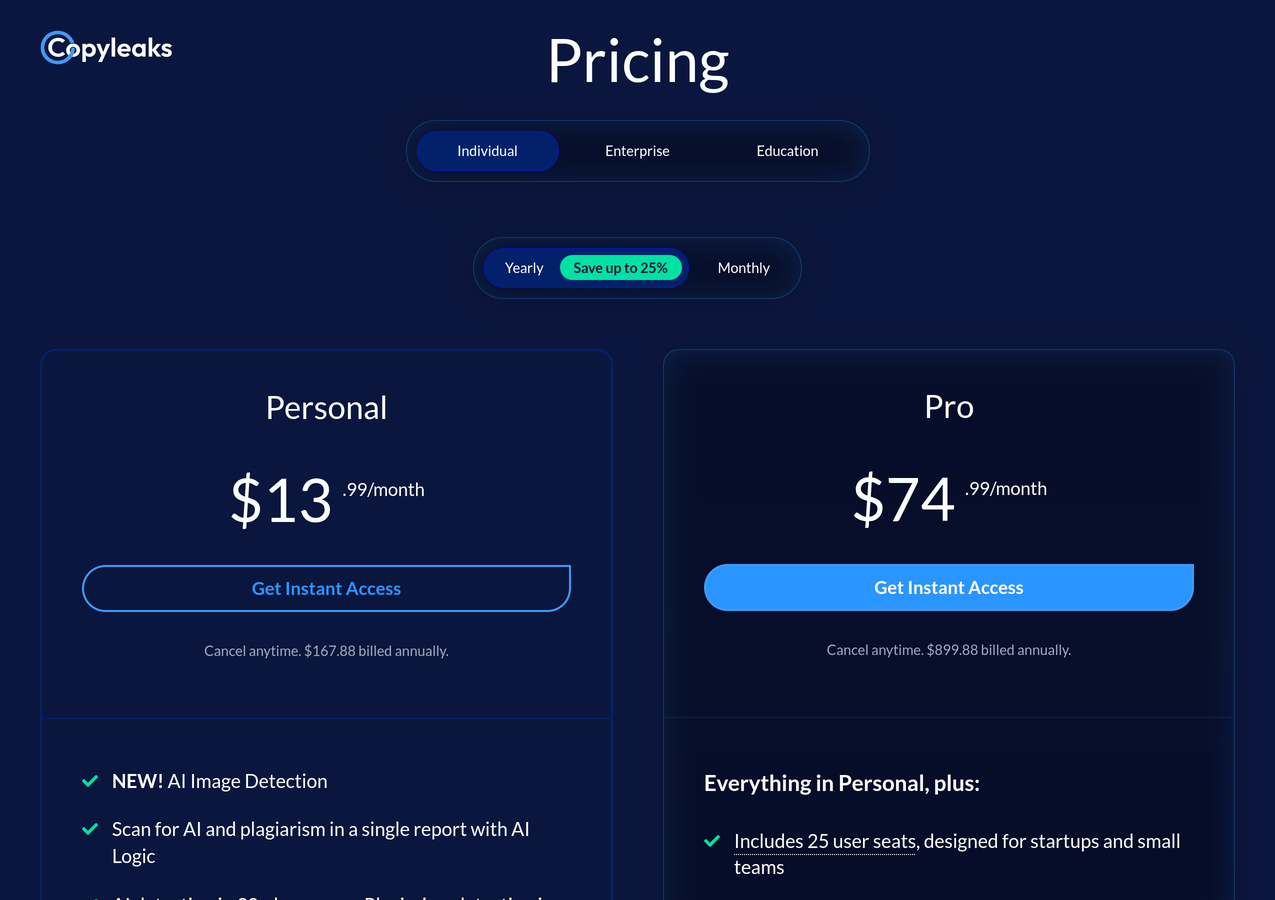
The Copyleaks pricing page, read 23 November 2026. Personal $13.99/month and Pro $74.99/month on the yearly view (“Save up to 25%”); Enterprise and Education sit behind “Talk to Sales”.
Two self-serve prices, everything else custom

The ladder has two rungs and then a wall. Personal costs $13.99 a month on the yearly plan; Pro costs $74.99 — more than five times as much — and everything above that is a sales conversation.
Prices from copyleaks.com/pricing, read 23 November 2026.
The dearest of four, by a dollar
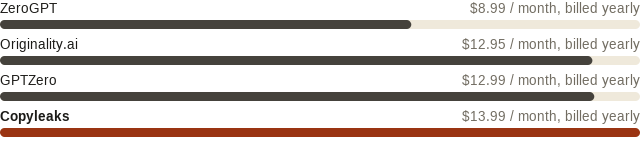
Copyleaks charges the most of the four — $13.99 a month on the yearly plan, a dollar above GPTZero and Originality.ai, five above ZeroGPT. The premium buys what the others do not: plagiarism detection in 100+ languages and the LMS integrations.
Rival prices from third-party re-checks of each vendor’s pricing page, November 2026.
The arithmetic is the business model. One credit covers 250 words or one image, so Personal’s 100 monthly credits buy 25,000 words — about a hundred pages — and Pro’s 1,000 buy 250,000. A teacher marking a class set of essays burns through Personal in a week; that is the point.
The yearly discount is the retention hook in plain sight: Personal drops about 18% on the yearly plan, Pro 25%. There is no free trial and no free plan — the free thing is a single scan, not a subscription — so the first paid step is also the first commitment.
The small print is strict. Plans renew automatically and can be cancelled any time, but cancelling keeps access only to the end of the billing period. Switching plans forfeits unused credits. A refund needs a request within the first 10 days of the billing cycle, with no pages scanned and no credits used — and even then it is not guaranteed.
What the shop does, and what it does not
| Mechanism | Hit | Why, in one line |
|---|---|---|
| Free tier | △ | Free single scan of 25,000 characters, no login — but no free plan card and no free trial on the pricing page |
| No account | ✓ | The free AI-detector scan needs no login |
| Free trial | — | No free trial; multiple third-party checks of the pricing page agree |
| Ads on the site | — | Copyleaks buys no Meta ads and sells no ad inventory of its own |
| API | ✓ | Scalable API integration sold with Enterprise; sandbox is free, real scans burn plan credits |
| Browser extension | ✓ | Chrome, Edge and Firefox, listed on the pricing page |
| Google Docs add-on | ✓ | Scan directly from inside any Google Doc |
| MCP access | ✓ | Run scans from Claude and other AI tools that support MCP |
| Team seats | ✓ | Pro includes 25 user seats; more can be bought |
| LMS integration | ✓ | Canvas, Moodle, D2L Brightspace, Schoology, Sakai, Edsby, Blackboard |
| Per-student pricing | ✓ | Education plans are priced on the number of full-time students |
| Auto-renew | ✓ | All plans renew automatically unless cancelled before the next cycle |
| Cancel anytime | ✓ | Cancel or change plan at any time; access runs to the end of the billing period |
| Refund guarantee | △ | Refunds are not guaranteed: 10 days, zero usage, and a support request |
| Extra credits | ✓ | One-time credit top-ups when the monthly allowance runs out |
| Email capture | △ | A free account trades an email address for more monthly credits; list size was not published |
| Loyalty plan | — | No points or loyalty programme found on the pages read |
| Refer a friend | 未核到 | No referral reward found on the pages read; the affiliate page was not read this round |
| Community | — | No user community on the pages read |
| AI image detection | ✓ | New on the pricing page: visual report on where AI is present in an image |
| AI video detection | ✓ | Announced as live on the homepage banner, read 23 November 2026 |
| Code detection | ✓ | Codeleaks covers code, with 20+ code repositories in the comparison database |
Read the table as a funnel with one free step and no free plan. The scan is free, the account is free, and everything after that is credits — which is why the mechanism that matters most is the one that never appears on the pricing page: the LMS integration that puts the detector inside the teacher’s workflow.
The hooks that do exist are all first-order: a free scan that needs no login, an annual discount of up to 25%, and extra credits on demand. The retention is structural, not programmatic — a school that routes marking through Canvas does not churn the way a single subscriber does.
A free scan is the funnel
Search brings the panic, the scan catches it
The funnel starts in a search box. The term “ai detector” is searched 4,090,000 times a month, and Copyleaks ranks sixth for it — the single largest source of its organic traffic, 39.75% of it. The brand term, “copyleaks ai detector”, draws only 33,100 searches. People arrive looking for a detector, not for Copyleaks.
The landing page is the product itself: paste text, get a verdict, no account. That is the whole acquisition strategy in one interaction — and the numbers show how it behaves. Direct traffic is 42.85% of visits and google.com another 29.49%, while organic search fell 45.13% in October and paid search fell 99.86%. The free-scan funnel works, but it is not stable.
The audience reads like a workday tool. In the US, 93.65% of visits arrive on desktop, not a phone — people check long documents at a desk, not on the move. The average visit runs 8 minutes 37 seconds, the time it takes to paste, scan and read a report. After visiting, people often leave for google.com or zerogpt.com: they compare detectors before they pay.
| Channel | Share of visits | Platform & stack |
|---|---|---|
| Direct | 42.85% | Semrush, October 2026 |
| Google search | 29.49% | Semrush, October 2026; google.com is the top referrer after direct |
| Organic search | Down 45.13% on the month | Semrush, October 2026; generic terms lead — “ai detector” is 39.75% of organic traffic |
| Paid search | Down 99.86% on the month | Semrush, October 2026; absolute spend was not published |
| AI referral | ChatGPT 13K visits, Gemini 4K | Semrush, October 2026; small next to search |
| Meta ads | 0 active ads | Meta Ad Library, read 23 November 2026 — the company buys no Meta advertising |
| LMS distribution | — | Canvas, Moodle, D2L Brightspace, Schoology, Sakai, Edsby, Blackboard; Instructure’s sales team sells it directly |
| Platform | — | WordPress plus Next.js, from the site’s own page sources |
| — | Not verified; no email platform was named on the pages read | |
| Payments | — | Visa, Mastercard, American Express, Discover, Google Pay, Apple Pay; the payment processor was not named |
Marketing channels, Semrush, October 2026. The Meta Ad Library count was read directly on 23 November 2026. LMS distribution is a sales channel, not a traffic share — it does not appear in the traffic split.
September was the peak, October fell back

September was the peak. Semrush counted 4.77M visits in September 2026 and 3.82M in October — a 19.83% fall in one month, with organic search down 45.13% in the same period.
Visits, Semrush, August to October 2026.
The shape is a spike and a slide. August counted 3.43M visits, September 4.77M, October 3.82M — the September peak was the back-to-school term, and October gave back a fifth of it. A funnel built on generic search terms inherits their seasonality.
What is not in dispute is the shape: a site people find by typing a problem, not a brand. Direct is the largest channel at 42.85%, and the brand term is a tenth of the generic term’s search volume. The free scan is the brand’s front door — and the front door is rented from Google.
What people search for
| Keyword | Monthly searches | Note |
|---|---|---|
| ai detector | 4,090,000 | Generic term, rank 6, 39.75% of organic traffic |
| ai checker | 2,740,000 | Generic term, rank 11, 5.54% of organic traffic |
| plagiarism checker | 2,240,000 | Generic term, rank 17, 2.72% of organic traffic |
| copyleaks ai detector | 33,100 | Brand term, rank 1, 10.72% of organic traffic |
| copy leaks | 14,800 | Brand term with a space, rank 1 |
Monthly searches are Semrush figures for copyleaks.com, October 2026, read 23 November 2026. Intent phrases (copyleaks pricing and three others) returned no figures — the keyword page would not load.
Search is the problem, not the brand
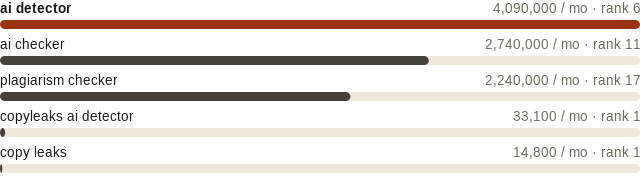
Search is the problem, not the brand. “Ai detector” draws 4,090,000 searches a month — more than a hundred times the brand term. People search for a detector, then meet Copyleaks.
Monthly searches, Semrush, October 2026. Intent phrases such as “copyleaks pricing” returned no figures this round.
Search here is problem-led, not brand-led. The top three terms are generic — “ai detector”, “ai checker”, “plagiarism checker” — and together they dwarf the brand term by two orders of magnitude. The money-intent phrases, “copyleaks pricing” and the rest, returned no figures this round: the keyword page would not load.
The risk sits in that ranking. Copyleaks is sixth for “ai detector”, not first — and October’s organic traffic fell 45.13% in a month. The funnel’s front door is a search position it does not own, for a term it does not control.
What outsiders say
Two verdicts, one company
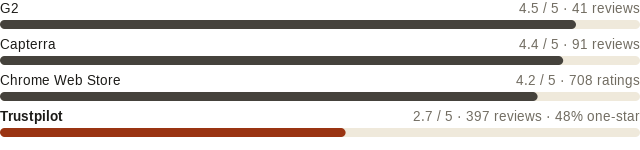
Two verdicts, one company. G2 scores it 4.5 from 41 reviews and Capterra 4.4 from 91 — small pools of software buyers. Trustpilot scores it 2.7 from 397 reviews, 48% of them one star.
G2 and Capterra via ToolsGavel, checked 21 November 2026; Trustpilot read 23 November 2026; Chrome Web Store via ess.ai, October 2026.
The ratings point two ways, and the pools are different people. G2 and Capterra score the company 4.5 and 4.4 — but from 41 and 91 reviews, the small pools of software buyers who chose it deliberately. Trustpilot scores it 2.7 from 397 reviews, 48% of them one star, and its own summary says most recent reviewers were unhappy.
The complaints repeat: credits burn fast, the same document scores differently on two scans, human names and human writing get flagged as machine-made, and refunds are hard to get. One pattern matters more than the rest — a detector that calls a student’s work AI-generated is not a bad review, it is a classroom incident.
The accuracy tests tell the same split story. Scribbr’s twelve-tool test (February 2024, revised October 2024, 30 short texts) gave Copyleaks 66% — against its own premium tool’s 84%, a result to read with the conflict in mind, since Scribbr sells a competing detector. A 2,400-sample benchmark put it at 79% accuracy with a 12% false-positive rate. A peer-reviewed study, meanwhile, found it the most sensitive of five tools on GPT-4 text, at 93%.
None of those numbers is the 99% on the homepage. The homepage figure is an internal test on English data; the independent tests land between 66% and 93%, depending on the sample and the measure. This page prints all of them and picks none.
Eleven years from plagiarism to AI panic
From a classroom tool to a Canvas partner
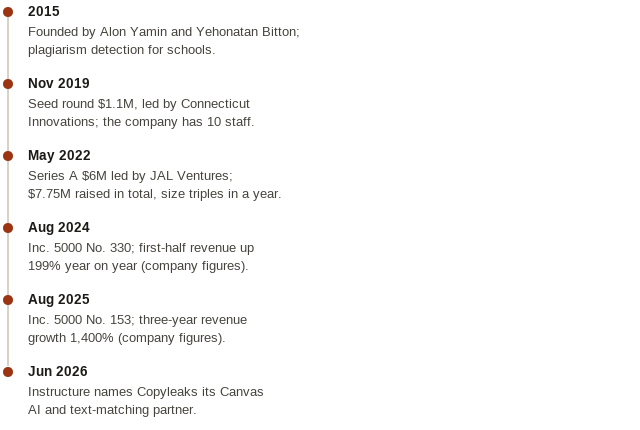
Eleven years, six markers: founded in 2015 to catch plagiarism, funded twice, twice on the Inc. 5000 — and in June 2026 the company that owns Canvas started selling it to schools directly.
Funding from BusinessWire, 24 May 2022, and Calcalist; Inc. 5000 from the company’s own announcements, August 2024 and August 2025; Canvas partnership from GlobeNewswire, 25 June 2026.
The company started in 2015, when the problem was plagiarism, not AI. Two founders with Unit 8200 backgrounds built a checker for schools, raised a $1.1M seed round in November 2019, and a $6M Series A in May 2022 led by JAL Ventures — $7.75M raised in total. Then ChatGPT arrived, and the same detector had a second product to sell.
The growth numbers since are the company’s own, unaudited: revenue up 1,310% in three years to 2024, first-half 2024 revenue up 199% year on year, three-year growth of 1,400% to the Inc. 5000 #153 spot in August 2025. The absolute revenue figure was never disclosed — third-party estimates of $5M, $7.0M and $14.3M disagree by nearly three times, so none of them is printed here as fact.
The institutional proof is harder than the percentages. The State University of New York at Albany holds a public procurement contract with Copyleaks Inc. for $65,176 — a state record, not a company claim, that a public university pays for the product. In June 2026, Instructure named Copyleaks its AI and text-matching partner for Canvas, with its global sales team offering the product directly to K-12 and higher-education institutions.
The company says it runs 30M+ scans a month for 500+ enterprises and institutions, from a team of 60 people in 2024 — up from 10 four years earlier. Those are company figures, and the revenue behind them is still unpublished. The last funding round was May 2022; no new round has been announced in more than four years.
The 99% claim is the risk
The claim that sells the product is also the claim that can break it. “Over 99% accuracy” is an internal test on English data; independent tests put the figure between 66% and 93%, and the gap is not a rounding error. A detector that is wrong in a classroom does not lose a customer — it creates an accusation.
The company has already softened the language. Its blog now says the tool does not replace educator judgement — an admission, in plain terms, that the score is not a verdict. The detection itself is a race: models get stronger, paraphrasing tools get better, and one 2026 study found Copyleaks failed to call any of 40 purely AI-written papers fully AI-generated.
The competition is a wall on every side. Turnitin is the default detector inside schools, with 16,000+ institutions; GPTZero gives away 10,000 words a month free, a monthly allowance that suits daily use better than Copyleaks’ single-scan limit; Originality.ai charges about the same yearly price and adds readability and fact-checking. Copyleaks’ answer is breadth — more languages, more LMS integrations — not a better score.
The traffic adds a second warning. October 2026 fell 19.83% on the month, organic search fell 45.13%, and paid search all but stopped. A funnel that rents its front door from Google, and spends nothing on Meta ads, has no paid lever to pull when the ranking slips.
What survives is a free scan, an LMS lock-in, and billing by the word. The risk is the mirror image: an accuracy claim that independent tests will not confirm, a reputation split between happy software buyers and angry individual users, and a category where the next model makes every detector a little less certain.
Copyleaks is one of 23 sites in the writing tools collection. Compare Copyleaks with DupliChecker and Quillbot side by side.
The full teardown is for members
The full analysis of pricing, acquisition, conversion and retention is member content. Membership is $29 a month or $249 a year.
Similar sites in the database
Copyleaks (3.82M) sits between Yoto (3.9M) and VIVAIA (3.8M) in the database.
| Site | Category | Monthly visits | Source |
|---|---|---|---|
| Yoto | Mother & baby · Screen-free children’s audio player DTC brand | 3.9M | Similarweb, Oct 2026 |
| VIVAIA | Footwear · Eco-friendly women’s shoes DTC brand | 3.8M | Semrush, Oct 2026 |
| Vidnoz | Video tools · AI video generation | 3.78M | Semrush, Oct 2026 |
Compare Copyleaks with DupliChecker and Quillbot side by side. The full database, with working filters, is on the teardowns index.
Read the next one in your inbox
The new ones go out by email first, one a week, with the traffic source and month attached to every number. Leave your address and the next one comes to you.