
How Elicit makes money: $39 Pro, $31M raised
Monthly visits
1.58M
October 2026. Third-party estimate, not official MAU/DAU. Semrush counted 1.58M for the month, up 2.32% on September 2026.
Elicit draws an estimated 1.58M visits a month (October 2026, Semrush). It is the 274th-largest site in our database of 922, and third of five in AI research.
| Site | Elicit, elicit.com |
|---|---|
| What it is | An AI research assistant: search across 138M+ papers, summarise them and run systematic-review workflows; the company sells subscriptions to researchers and research teams |
| Who it is for | Researchers and academic teams who need literature reviews and systematic reviews with citations behind every claim |
| Category | AI research · Academic research |
| Monthly visits | 1.58M, October 2026. Third-party estimate, not official MAU/DAU; Semrush; up 2.32% on September 2026 |
| Founded | The product began in 2018 inside Ought, a non-profit research lab; Elicit became an independent public benefit corporation in September 2023 |
| Headquarters | Oakland, California (some databases list Covina, California, which appears to be a registered-agent address) |
| Operator | Elicit Research, PBC — privately held and independent; $31M raised across two rounds ($9M seed in September 2023, $22M Series A in February 2025 at a $100M valuation); PitchBook lists both lead investors as minority holders; the founders still run the company |
| Survival engine | Subscriptions that renew, spread by word of mouth. A free search pulls researchers in; the systematic-review workflow pushes heavy users onto a $39–$49 Pro plan, and team Scale seats and Enterprise contracts renew |
| Pricing | Academic Pro $39/user/month billed yearly ($468/year); Industry Pro $49 ($588/year). Basic is free; Academic Plus $11 ($132/year); Scale $89 Academic / $229 Industry; Enterprise by quote. Prices read from the official pricing page, 27 November 2026 |
| Pricing model | Subscription, monthly or yearly billing; yearly billing saves 35–43% against monthly rates (third-party read of monthly rates, November 2026). Cancel anytime; the paid period is not refunded; no free trial of the paid tiers — the free Basic tier is the entry point |
| Typical basket (derived) | $39–$49 per user per month on yearly billing ($468–$588 a year), derived from listed prices and bundle structure; the company has not disclosed actual ARPU/AOV. Pro is the mainstream paid tier — the systematic-review workflow that screens 5,000 papers sits in Pro and above; Plus at $11 is the light tier. Monthly billing runs $69–$75 (third-party read, November 2026); team Scale seats at $89–$229 push single orders higher, but seat counts are not disclosed |
| Free hook | Basic free tier: unlimited search across 138M+ papers, unlimited summaries and full-text chat, Zotero import. No first-order discount was found; the free tier is the hook |
| Meta ads | Not verified — the Ad Library returned access denied on 27 November 2026 |
| Country breakdown | United States 28.35% (449.2K); Indonesia 6.86% (108.67K); India 5.75% (91.09K); Vietnam 4.28% (67.81K); Brazil 4.02% (63.69K) (Semrush, October 2026) |
| Audience | Female 60.05% / Male 39.95% (Similarweb, October 2026 page); the age split was not published |
TL;DR
- Elicit survives on renewals, not ads: free search across 138M+ papers pulls researchers in, the systematic-review workflow pushes them onto a $39–$49 Pro plan, and team Scale seats at $89–$229 plus Enterprise contracts renew. Direct traffic is 51.38% and the brand term “elicit” draws 49,500 searches a month.
- The money is real but unaudited: investor Footwork said in February 2025 that Elicit had 400,000+ monthly active users, tens of thousands of paying subscribers and “millions in annual revenue”; the company reached $1M ARR four months after launching paid tiers. No profit figure has ever been disclosed.
- The other side: G2 scores 4.5 out of 5 and Capterra 5.0 out of 5, each from a single review; the homepage’s “5 million+ researchers” is a cumulative count, not monthly users; and the $100M valuation (February 2025) sits next to an investor’s “millions” of revenue — two numbers from different dates, not a ratio to quote.
The systematic review is the product
A free search that ends at a usage wall
On 27 November 2026 the homepage opens with “AI for Scientific Research” and the line “Elicit helps researchers be 10x more evidence-based”, over a single button, “Try now”. Under it, a trust wall reads “TRUSTED BY OVER 5 MILLION RESEARCHERS, INCLUDING AT”, with B. Braun, NASA, Stanford, Takeda and Unilever.
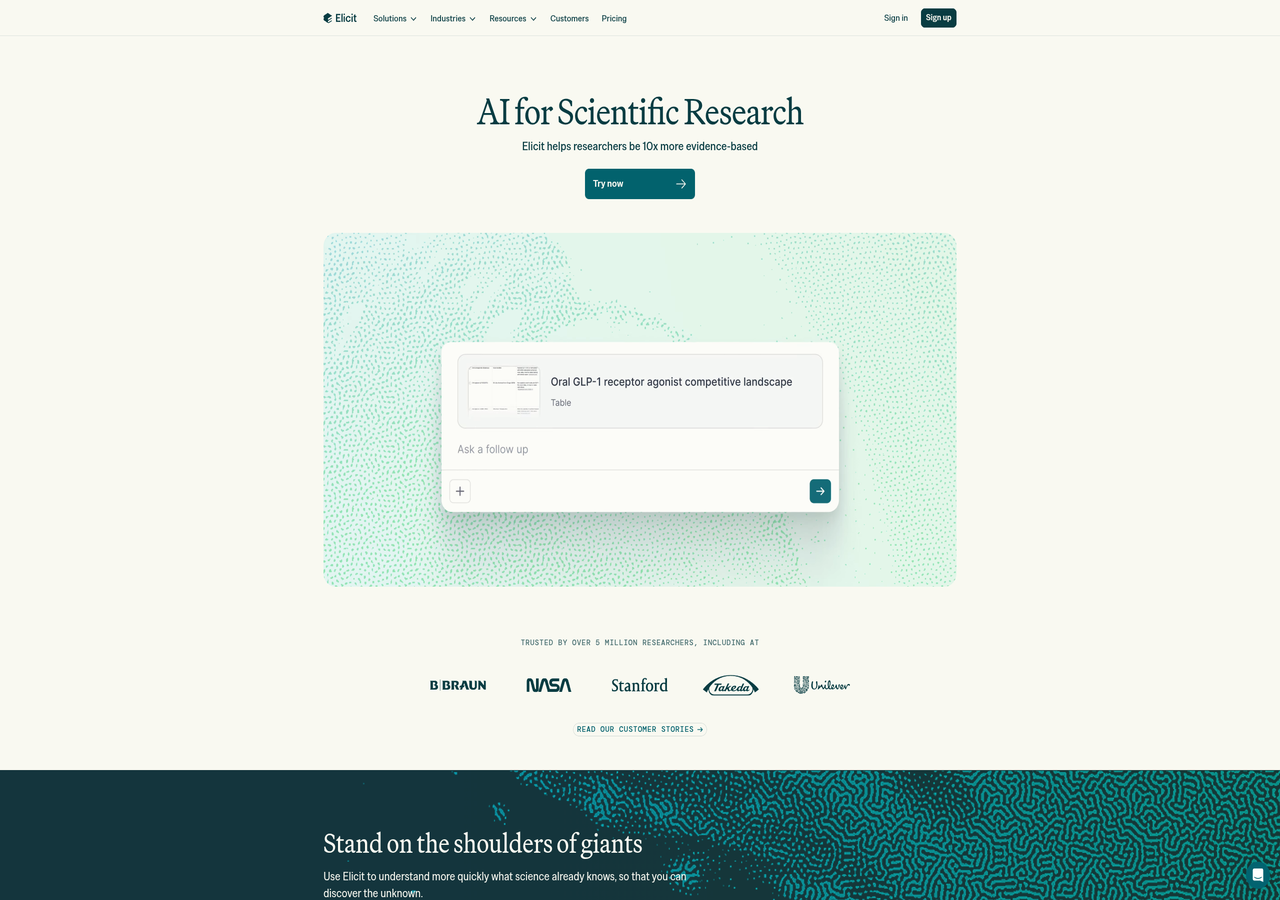
Elicit homepage, read 27 November 2026. “AI for Scientific Research”, “10x more evidence-based”, and the trust wall: B. Braun, NASA, Stanford, Takeda, Unilever. The demo card is a table on the GLP-1 competitive landscape.
Basic searches forever for free: unlimited search across 138M+ papers, unlimited summaries and full-text chat, Zotero import. The wall appears at usage, not at search. Research Agent and Research Reports are capped on Basic; the systematic-review workflow that screens 5,000 papers, Routines, custom extraction from uploaded papers and the API sit in Pro and above; exports need Plus.
The product already speaks the protocol the agent platforms are converging on: Elicit shipped its API and MCP server on 15 July 2026, according to the company blog, with API access in Pro and unlimited API in Enterprise. The research assistant was on MCP before the platforms made it the default route.
Five years from lab project to company
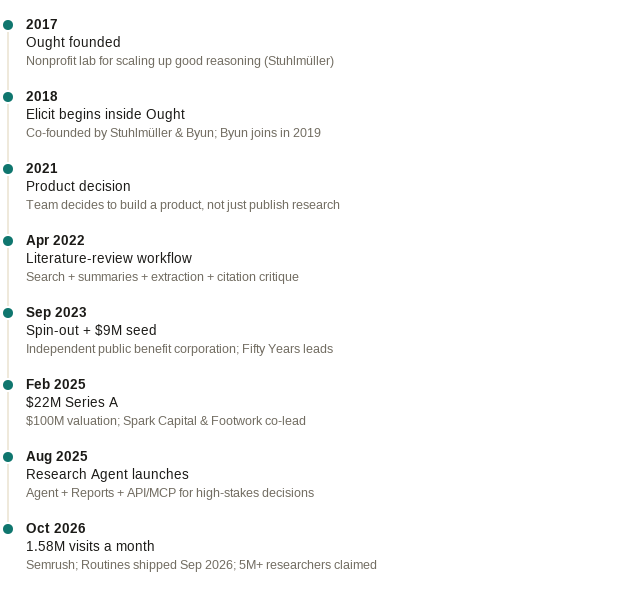
Company history; TechCrunch (25 September 2023), Elicit company blog (26 February 2025), Latent Space wiki (17 September 2026), Semrush (October 2026).
Andreas Stuhlmüller founded the non-profit lab Ought in 2017, and Elicit began inside it in 2018. Jungwon Byun joined in 2019. The team decided in early 2021 to build a product instead of publishing research, shipped the literature-review workflow in April 2022, and spun Elicit out as an independent public benefit corporation in September 2023 with a $9M seed round.
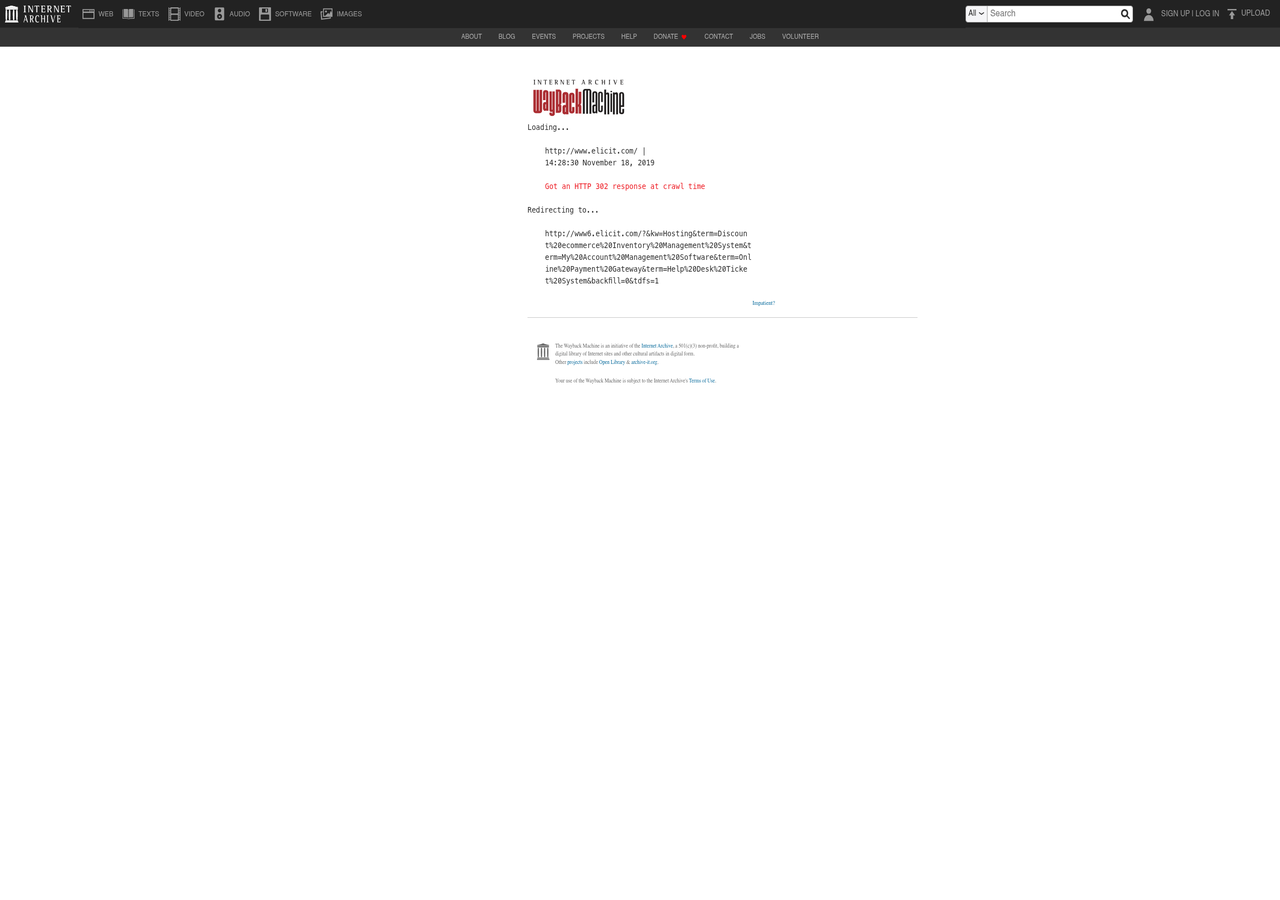
Wayback Machine, 18 November 2019. The capture shows elicit.com belonged to a different company then — an e-commerce inventory system — so the domain’s age is not this company’s age. The AI research Elicit was still on elicit.org in 2023.
The 2019 capture is a warning, not a credential. The domain is older than the company; the company is younger than the domain. What counts as survival is the stretch from the September 2023 spin-out: two funding rounds, a paid tier that users asked for, and 1.58M visits a month three years later.
The price list: $0 to $229 a user
Two price lists, one Pro
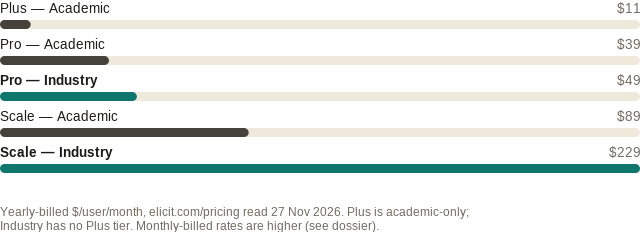
Yearly-billed prices per user per month, elicit.com/pricing, read 27 November 2026. Plus is academic-only; Industry has no Plus tier.
| Plan | Yearly-billed price | What it unlocks |
|---|---|---|
| Basic | $0 | Unlimited search of 138M+ papers, unlimited summaries and full-text chat, Zotero import; Research Agent and Reports capped |
| Plus (Academic only) | $11/user/month | $132 a year; monthly $19 (third-party); exports in RIS/CSV/BIB/PDF/DOCX, 500,000+ clinical trials, standard usage |
| Pro (Academic) | $39/user/month | $468 a year; monthly $69 (third-party); systematic-review workflow screening 5,000 papers, 20 columns, 135 data sources, Routines, API |
| Pro (Industry) | $49/user/month | $588 a year; monthly $75 (third-party); same workflow as Academic Pro, at standard usage |
| Scale (Academic) | $89/user/month | $1,068 a year; monthly $149 (third-party); chart extraction, real-time collaboration, 200 data sources, 30 columns, admin panel |
| Scale (Industry) | $229/user/month | $2,748 a year; monthly $375 (third-party); same team features as Academic Scale, at 5x usage |
| Enterprise | Custom | Screens 40,000 papers, 40 columns, PRISMA-grade screening precision, SSO & SAML, no training on customer data by default, unlimited API |
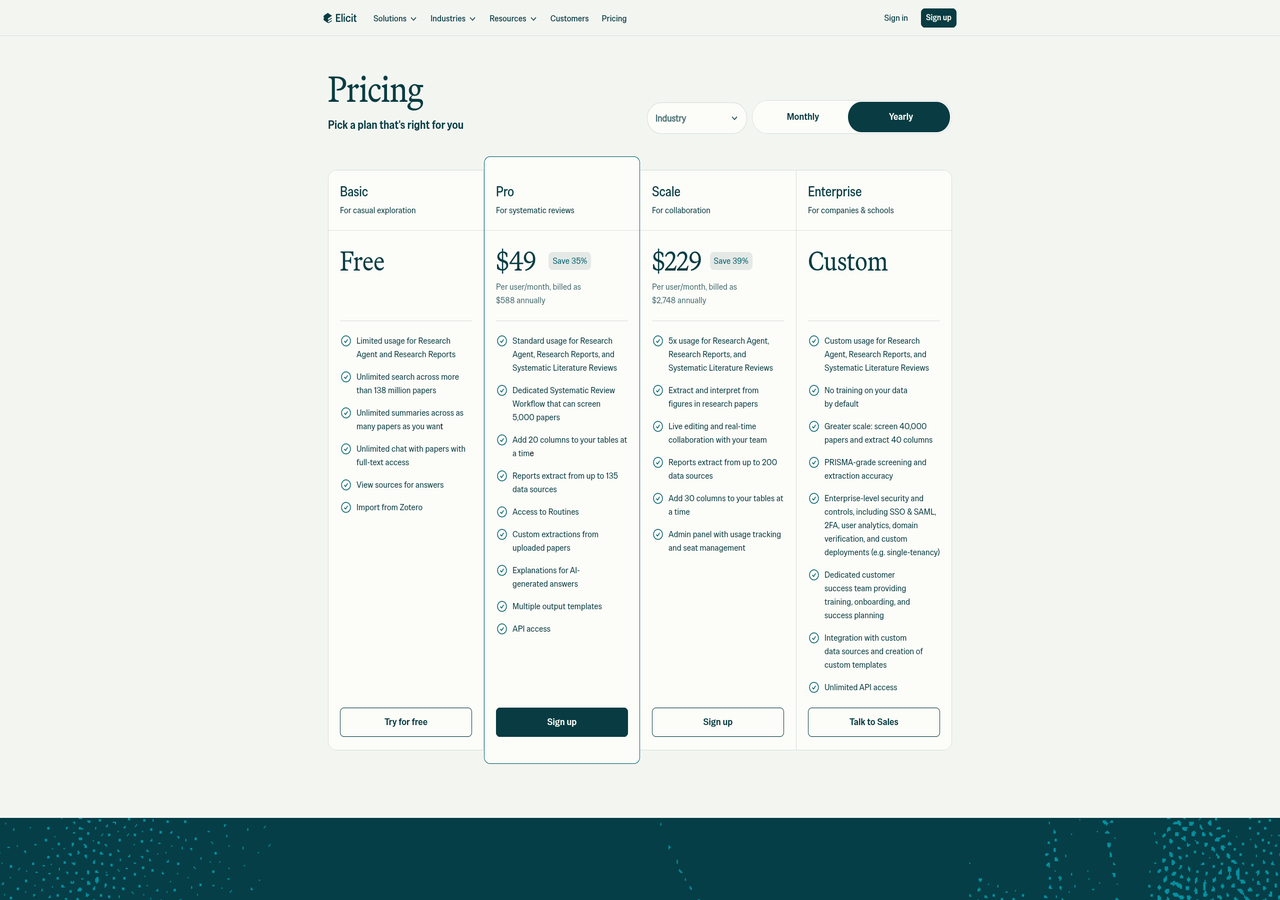
Elicit pricing page, read 27 November 2026. Industry view, yearly billing selected: Basic free, Pro $49 (save 35%, $588 a year), Scale $229 (save 39%, $2,748 a year), Enterprise custom. The Academic list is the cheaper one.
The page holds two price lists behind one dropdown, and the default is Industry — which is how the $49 and $229 figures got quoted as monthly prices in some databases. They are yearly-billed per-user monthly rates. The Academic list is the cheaper one: Plus $11, Pro $39, Scale $89. A researcher reading the wrong list overstates the price by a quarter.
The anchor is the workflow, not the search. Basic searches forever for free; Pro screens 5,000 papers, runs Routines, extracts from uploaded papers and opens the API. Scale adds chart extraction, real-time collaboration and an admin panel. Enterprise screens 40,000 papers with PRISMA-grade precision, SSO and a promise not to train on customer data by default.
Then the basket, where the money is
A typical paying user lands on Pro: $39 a month on Academic yearly billing, $49 on Industry yearly billing, or $468 to $588 a year. Plus at $11 is the light tier for researchers who mainly want exports; Scale at $89 to $229 is the team tier, and its seat count is not disclosed, so it stays out of the typical figure.
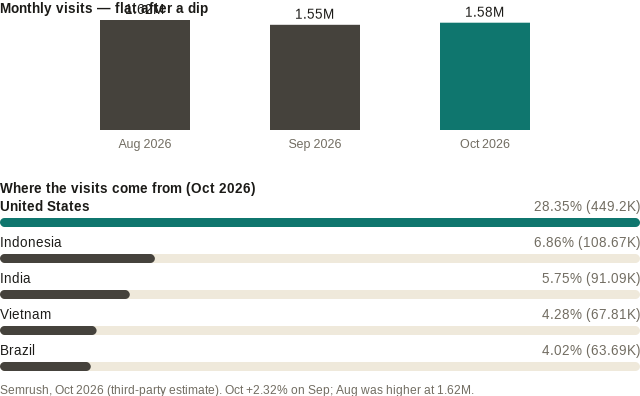
Monthly visits, Semrush, August to October 2026 (third-party estimate). October is up 2.32% on September; August was higher at 1.62M.
The cross-check runs the other way. Footwork said in February 2025 that Elicit had tens of thousands of paying subscribers and millions in annual revenue; at 30,000 subscribers that implies roughly $100 to $300 a year each, below the $468-a-year Pro figure. The gap is the mix: many subscribers sit on the $132-a-year Plus tier, and prices have risen since — Industry Scale moved from $169 to $229 in October 2026 alone.
The traffic is flat, not rising: 1.62M in August, 1.55M in September, 1.58M in October. The growth story is not the traffic line; it is the conversion of a flat audience into paying subscribers, and the audience is mostly American (28.35%) with Indonesia and India next.
What keeps researchers coming back
| Mechanism | Status | How it shows up |
|---|---|---|
| Free tier | ✓ | Basic free: unlimited search of 138M+ papers, unlimited summaries and full-text chat (official pricing page) |
| No signup | Not verified | Whether search works without an account was not verified this round |
| Trial | — | No free trial of the paid tiers was found; the Basic free tier is the entry point |
| Advertising | — | No on-site advertising; a Similarweb AdSense detection is a detection, not a fact |
| API | ✓ | API in Pro and above, unlimited API in Enterprise; MCP server shipped 15 July 2026 (company blog) |
| Export | ✓ | RIS/CSV/BIB/PDF/DOCX exports from Plus up (official pricing page) |
| Team collaboration | ✓ | Scale: real-time editing and collaboration, shared Library (official pricing page and company blog) |
| SSO / SAML | ✓ | Enterprise: SSO & SAML, 2FA, domain verification, single-tenant deployment (official pricing page) |
| Annual discount | ✓ | Yearly billing saves 35–43% against monthly rates: Plus 42%, Pro 43% Academic / 35% Industry, Scale 40% Academic / 39% Industry |
| Upgrade path | ✓ | Basic → Plus → Pro → Scale → Enterprise (official pricing page) |
| Cancel | ✓ | Cancel anytime; access runs to the end of the paid period, then drops back to Basic; the paid period is not refunded (terms, updated 15 September 2025) |
| Skip | — | No per-use billing to skip; not applicable |
| Pause | Not verified | No pause-subscription term was found in the help centre this round |
| Referral programme | Not verified | No referral reward was found this round |
| Gift subscription | — | Not applicable to a research subscription |
The retention is in the workflow and the team, not in a contract. A researcher who builds a Library of screened papers has a reason to stay, and Scale’s shared Library turns one person’s subscription into a team’s. Cancel anytime and keep access to the end of the paid period — the friction is low, so the users who stay are the ones who save time.
The thin spot is the social proof. G2 scores 4.5 out of 5 from one review and Capterra 5.0 out of 5 from one review; Trustpilot has no listing for elicit.com at all. Against a homepage claiming 5 million+ researchers, the public review record is nearly empty — the trust on the page comes from the client wall and the sentence-level citations, not from review platforms.
The category is bigger than one brand
Five research tools, one shelf
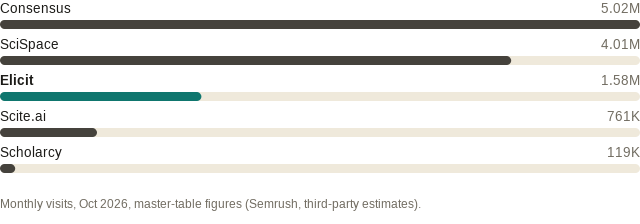
Monthly visits, October 2026, master-table figures (third-party estimates, Semrush).
| Site | Monthly visits | Category | What it sells |
|---|---|---|---|
| Consensus | 5.02M | AI research | AI academic search over 400M+ papers; Pro $12 a month billed yearly |
| SciSpace | 4.01M | AI research | Paper reading, writing and citation tools; Premium $12 a month billed yearly |
| Elicit | 1.58M | AI research | Systematic-review workflows over 138M+ papers; Pro $39–$49 a month billed yearly |
| Scite.ai | 761.19K | AI research | Citation analysis: whether a paper was supported or refuted; Basic $12 a month billed yearly |
| Scholarcy | 119.09K | AI research | Paper summariser and literature matrices; Plus $9.99 a month or $90 a year |
Elicit is third of five by traffic and holds 13.8% of the category’s 11.49M visits. Consensus, at 5.02M, is about 3.2 times Elicit’s traffic and sells a $12-a-month Pro; SciSpace, at 4.01M, sells a $12-a-month Premium. Elicit’s Pro at $39 to $49 a month is the most expensive in the category — and the only one anchored on the systematic review.
The cheap end is crowded: Scholarcy Plus is $9.99 a month, Consensus Pro and SciSpace Premium are both $12. The expensive end is Elicit alone, with Consensus Deep at $45 a month the nearest rival. The price gap is the positioning gap: the others sell answers; Elicit sells the review.
Where the visits come from
| Channel | Share of visits | Platform & stack |
|---|---|---|
| Direct traffic | 51.38% | Semrush, October 2026, desktop journey; Similarweb marketing channels put Direct at 48.51%, first of all channels |
| Brand search | Not verified | “elicit” draws 49,500 searches a month, position 1, 6.23% of organic traffic (Semrush, October 2026) |
| Organic search | Not verified | Organic search fell 15.17% in October while total visits rose (Semrush); misspelt variants “ellicit” and “elecit” draw 3,600 and 1,600 searches a month |
| AI search | Not verified | Claude sent about 18K visits, ChatGPT about 8K, Perplexity about 3K in October 2026 (Semrush AI Traffic) |
| Email & SMS | Not verified | No mailing-list size, cadence or SMS channel was found this round |
| Word of mouth | Not verified | Investor Footwork: the product grew “through word-of-mouth” to 400,000+ monthly active users (26 February 2025) |
| Meta paid ads | Not verified | Ad Library returned access denied on 27 November 2026; no ad count verified |
| Referring domains | Not verified | 2.39M backlinks, 14.41K referring domains, up 27.2% (Semrush, October 2026) |
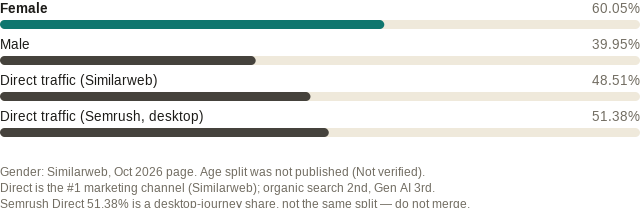
Audience by gender, Similarweb, October 2026 page. The age split was not published. Direct is the first channel on both sources, at different shares.
Direct is the first channel by either count — 51.38% on the Semrush desktop journey, 48.51% on Similarweb’s marketing split — and the brand term is only 6.23% of organic traffic, so the direct visits are people typing the address or opening a bookmark, not people searching. The audience is 60.05% female (Similarweb); the age split was not published.
| Layer | What it runs on |
|---|---|
| Platform | Framer (site images served from framerusercontent.com) |
| Payments | Not verified — no payment processor was named on the pricing page or in the terms this round |
| Analytics | Google Analytics (third-party technology detection) |
| API & integrations | Elicit API and MCP server (company blog, 15 July 2026); Zotero import; exports in RIS/CSV/BIB/PDF/DOCX |
| Data sources | 138M+ papers and 545,000 clinical trials (company); Semantic Scholar, PubMed and OpenAlex (third-party) |
| Models | “A mix of first-party and third-party models” (founder, TechCrunch, 25 September 2023); no model list published |
| Support | Help centre at support.elicit.com; no support-desk vendor named this round |
| Subscription billing | Not verified — no billing vendor was named on the pricing page or in the terms |
The stack is a Framer marketing site in front of a research product that runs its own models and its own paper index. The technology that matters for the business is not the storefront; it is the citation: every AI claim carries a sentence-level source, and that is the trust mechanism the whole price list rests on.
Three things not to quote as facts
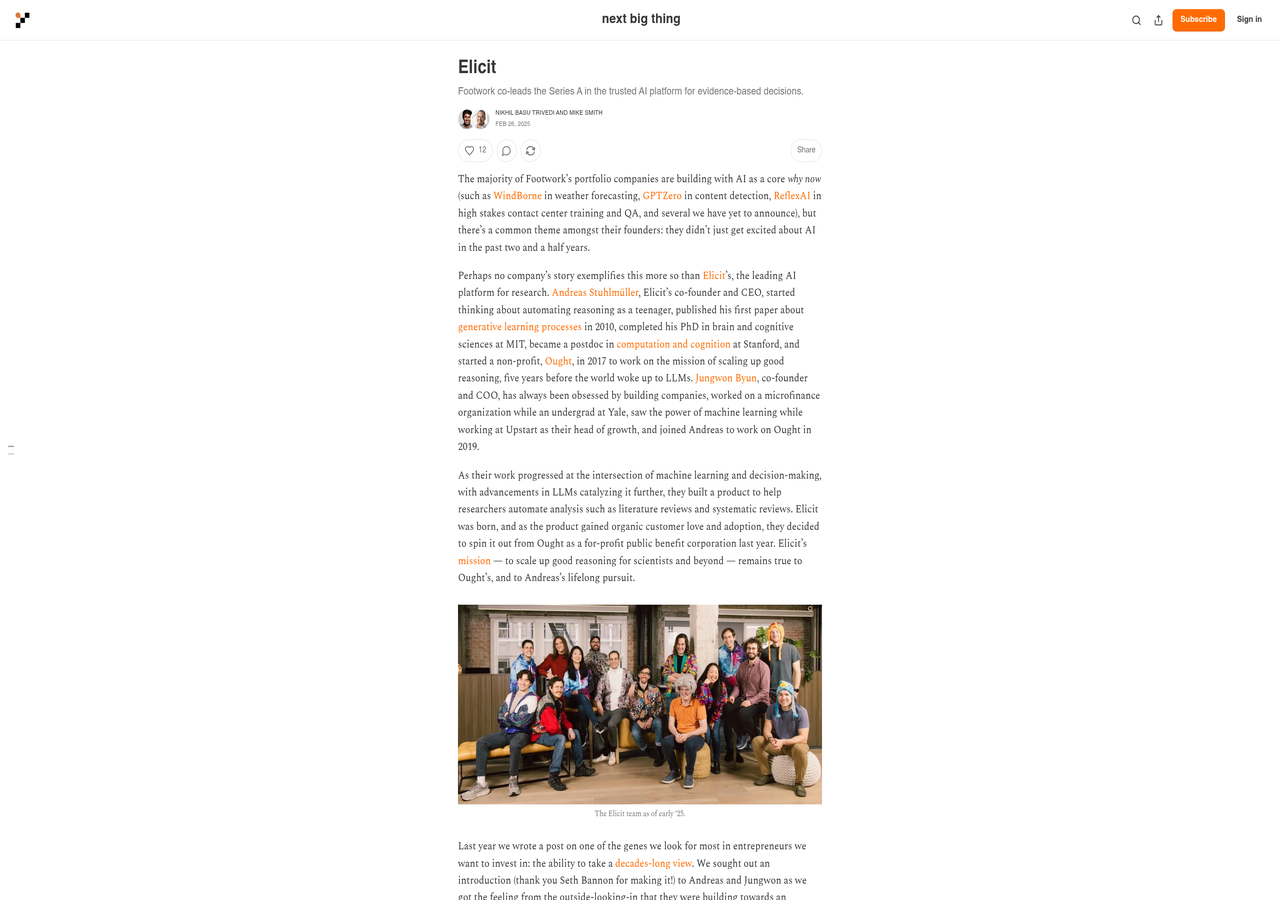
Footwork, 26 February 2025. The investor’s case for the $22M Series A: 400,000+ monthly active users, tens of thousands of paying subscribers, “millions in annual revenue” — and growth “through word-of-mouth”.
First, the revenue. “Millions in annual revenue” is an investor’s round number from February 2025, nine months old, with no audited figure behind it. The $1M ARR in four months is a founder’s recollection from a 2025 podcast. Quote both with their dates, or quote neither as today’s revenue.
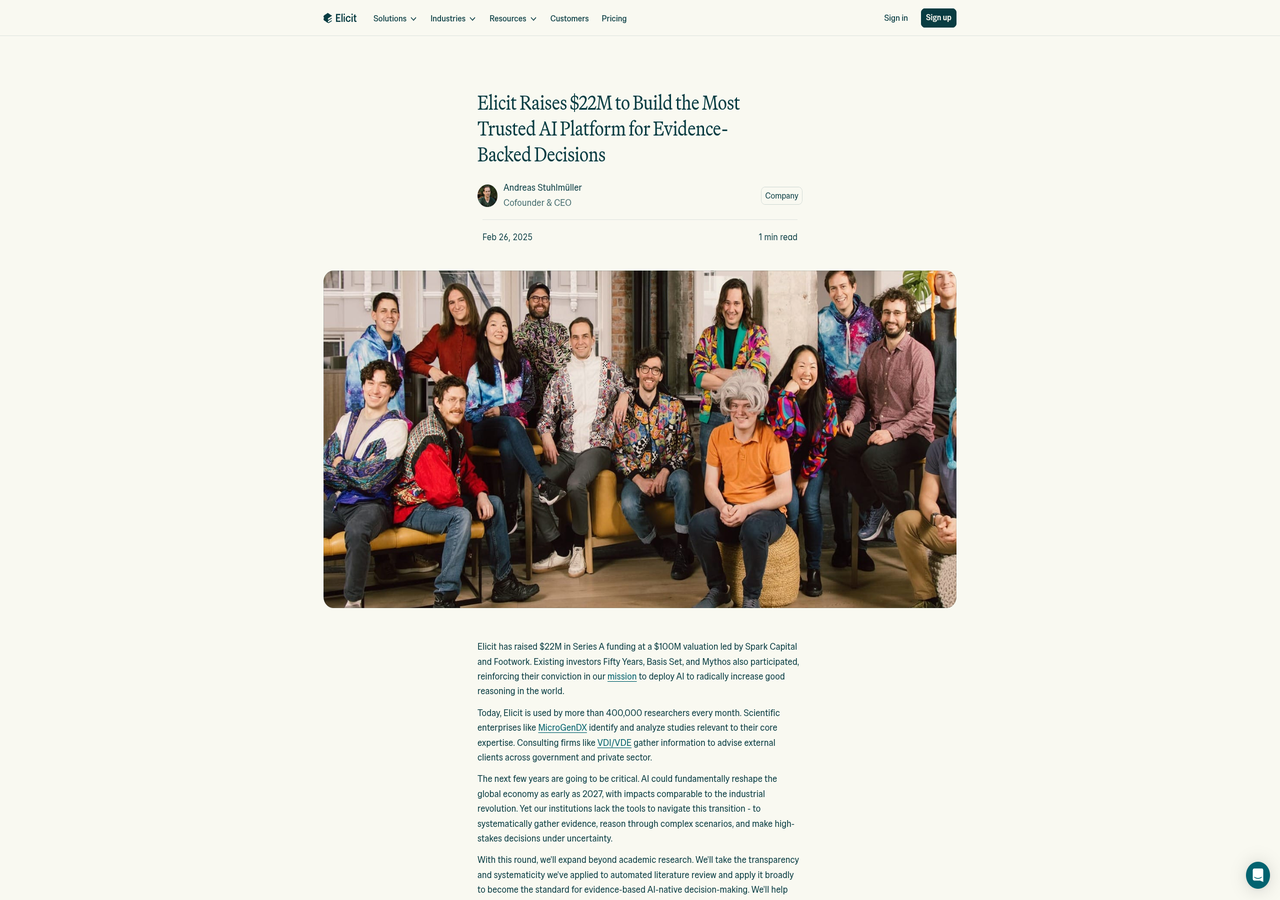
Elicit company blog, 26 February 2025. “$22M Series A at a $100M valuation”, led by Spark Capital and Footwork; “more than 400,000 researchers every month”.
Second, the valuation. $100M at a February 2025 Series A sits next to “millions” of revenue from the same month, and the two numbers invite a multiple nobody has published. The honest line is the pair itself: $22M raised, $100M valuation, revenue in the low millions — and no profit figure at all.
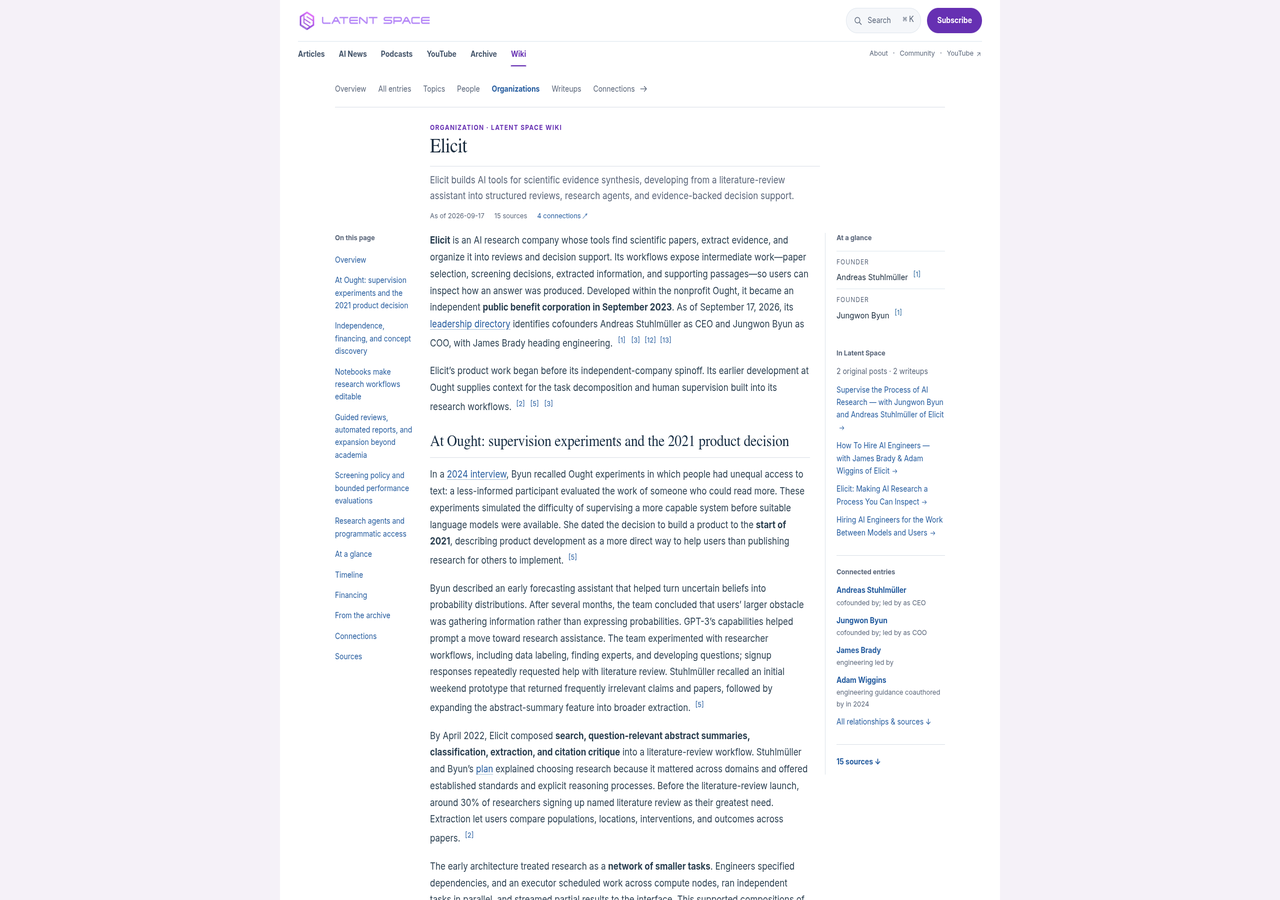
Latent Space wiki, updated 17 September 2026. The product decision in early 2021, the literature-review workflow of April 2022, and the founders still in their seats.
Third, the founding year. The product began in 2018 inside Ought, the company became independent in September 2023, and some databases say 2020 or 2023. Pick one year and the story is wrong in the other direction: 2018 overstates the company’s age, 2023 understates the product’s. The split is the fact.
Elicit is the third teardown in our AI research tools collection. The nearest rival is Consensus at 5.02M visits a month, and the most useful side-by-side is Elicit vs Consensus. For the other AI research teardown in the database, see the SciSpace teardown.
The full teardown is for members
The full breakdown is for members: the $39 Pro math, the word-of-mouth machine that runs on shared Libraries, the $100M valuation question — and what a founder should copy, and what not to.
Similar sites in the database
Elicit (1.58M) sits just below Cozy Earth (1.59M) in the database. The sites nearest to it on traffic are shown below.
| Site | Monthly visits | Category |
|---|---|---|
| Pair Eyewear | 1.6M | Eyewear · Customizable snap-on top frame eyewear DTC brands |
| Thrive Causemetics | 1.6M | Beauty & personal care · Vegan makeup DTC brands |
| eSign | 1.59M | Electronic signature |
| Cozy Earth | 1.59M | Home · Bedding & loungewear DTC brands |
| Elicit | 1.58M | AI research |
| Bubble (bubble.io) | 1.58M | No-code · App building platform |
| PrepostSEO | 1.55M | SEO tools |
| Bigjpg | 1.53M | Image tools · AI upscaling |
| Lovevery | 1.53M | Mother & baby · Montessori toy subscription |
Related teardowns
- Consensus — 5.02M visits a month, AI research, $12-a-month Pro, the category leader and the cheapest way into the same job.
- SciSpace — 4.01M visits a month, AI research, $12-a-month Premium, the reading-and-writing rival to Elicit’s review workflow.
Read the next one in your inbox
The new ones go out by email first, one a week, with the traffic source and month attached to every number. Leave your address and the next one comes to you.