
Framer Pricing: $10 a Month to $50M ARR
Monthly visits
5M
Similarweb, October 2026. Third-party estimates, not official MAU/DAU.
Framer draws an estimated 5 million visits a month (October 2026, Similarweb) — the 117th-largest site in our database of 901, and the second-largest no-code website builder we track, just behind Webflow at 5.5 million. It gives the whole site away free and charges rent on the domain name: free to build and publish, then $10 a month for a custom domain and $30 for the professional tier.
The pitch fits in one line: the site is free, the address is what you pay for. More than half a million people use the platform each month, the company says it reached $50 million in annual recurring revenue in 2025 with the past year at break-even, and it has never offered a time-limited free trial — the free tier is the trial, and the meter runs on bandwidth, pages and AI credits.
| Site | Framer, framer.com |
|---|---|
| What it is | No-code website builder: designs publish directly as production-grade websites, with an AI design agent, CMS, hosting and analytics built in |
| Who it is for | Designers and startup and marketing teams who want to ship marketing and brand sites without writing code |
| Category | No-code · Website builders |
| Monthly visits | 5M, October 2026. Third-party estimates, not official MAU/DAU; Similarweb 5M (+5.67%). Semrush Trending gives 6.46M for the same period — a different methodology, shown separately, not blended into a trend |
| Founded | 2014, Amsterdam, by Koen Bok and Jorn van Dijk (About page; the Series C blog says “We started Framer in 2015…”, and third parties give 2013, 2014 or 2015 — the three accounts conflict, and this page uses the About page figure) |
| Headquarters | Amsterdam, Netherlands (teams also in San Francisco, New York and Barcelona) |
| Operator | Framer (privately held; $100M Series D in August 2025 at a $2 billion valuation; not listed, not acquired; legal entity name not verified on the site) |
| Survival engine | Recurring revenue. Per-site subscriptions — free to build, then $10 a month for a custom domain and $30 for the professional tier — plus editor seats and add-ons turn 5M monthly visits into $50M ARR (company figure, not audited accounts) |
| Pricing | Free $0 (1,000 pages, 10 CMS collections, 1 GB bandwidth a month, 500 AI credits to try, Framer subdomain, “Made in Framer” badge); Basic $10/month billed yearly ($15 billed monthly); Pro $30/month billed yearly ($45 billed monthly); Enterprise custom, yearly only. Prices exclude tax. Source: framer.com/pricing, read 20 November 2026 |
| Pricing model | Freemium subscription, per site; monthly billing costs 50% more than yearly; no time-limited free trial — the free tier is the trial |
| Free hook | Free tier (build and publish a whole site, no card) — the only way in |
| Meta ads | About 190 active ads on 20 November 2026 (Meta Ad Library, Page “Framer”, Page ID 462763837213465, United States only) |
| Country breakdown | Not published for October 2026 |
TL;DR
- Framer draws an estimated 5 million visits a month (October 2026), and 55.41% of them arrive direct — people type the name in. The brand word “framer” draws 60,500 searches a month in the United States at rank 9, and “framer templates” draws another 12,100.
- The money is the address: free to build and publish on a Framer subdomain, then $10 a month for a custom domain and $30 for the professional tier, with the bill rising per site, per editor seat and per add-on. The company says it reached $50 million in annual recurring revenue in 2025 and broke even over the past year, after raising $100 million in August 2025. The revenue figure is the company’s own account, not audited accounts.
- The risks are that the $2 billion valuation sits on an unaudited $50 million ARR estimate, that Trustpilot scores it 1.6 out of 5 while G2 scores it 4.5 — with surprise editor-seat charges the dominant complaint — and that there is no HTML export for self-hosting, so a site that leaves Framer has to be rebuilt.
The first screen sells the agent, not the price
The first screen is a promise, not a sales page
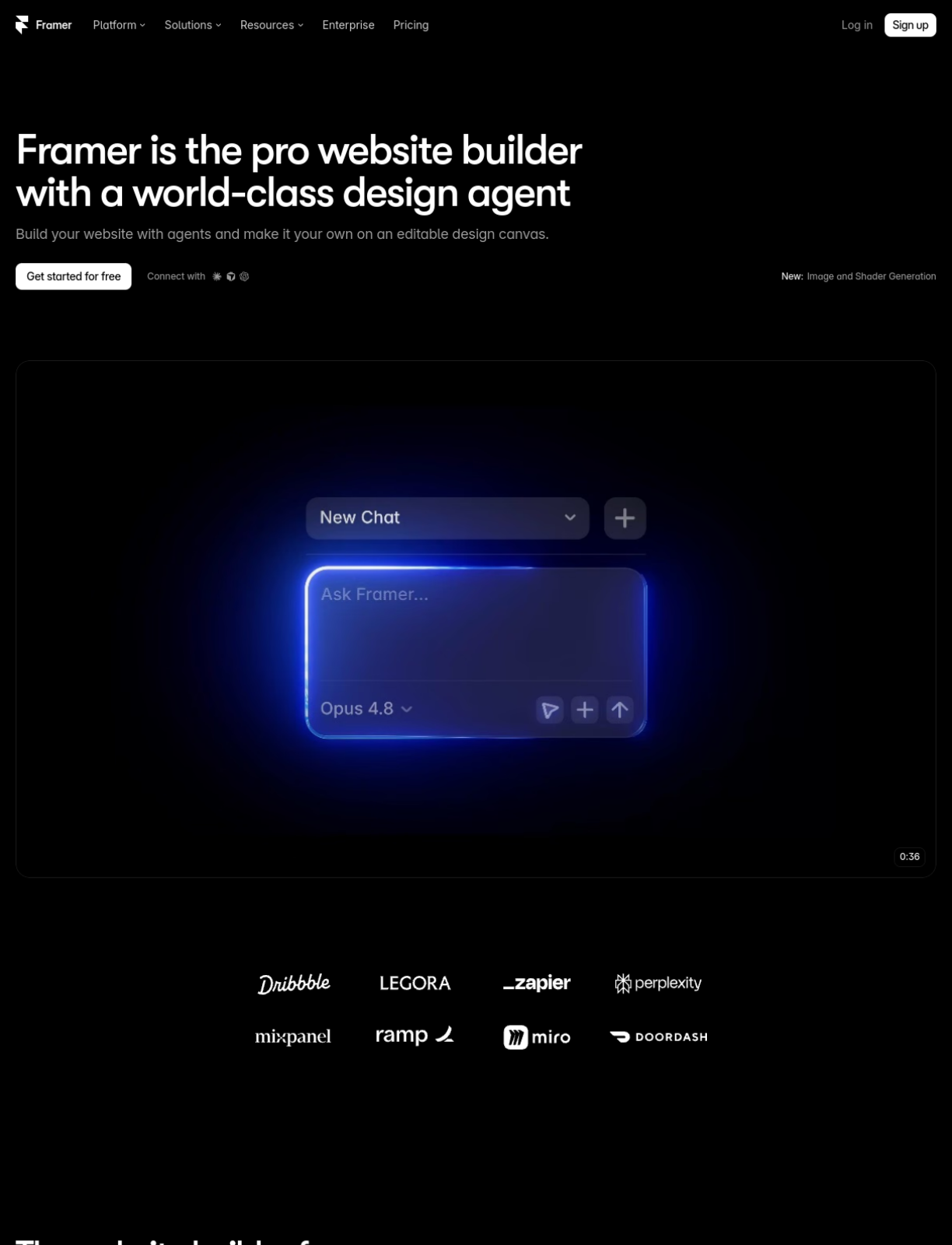
The homepage opens with a single line — “Framer is the pro website builder with a world-class design agent” — over a “Get started for free” button and a glowing “Ask Framer…” agent box. No price appears anywhere on the first screen, and the only money on the page is the promise that getting started is free.
The three things the page sells are the agent, the canvas and the publish button. Framer is a website builder that starts with an agent — describe what you need and it builds layouts, sections and components — and everything stays editable on a canvas until you publish. The hosting, CMS, analytics, SEO and AEO are already there, so going live needs no separate build step.
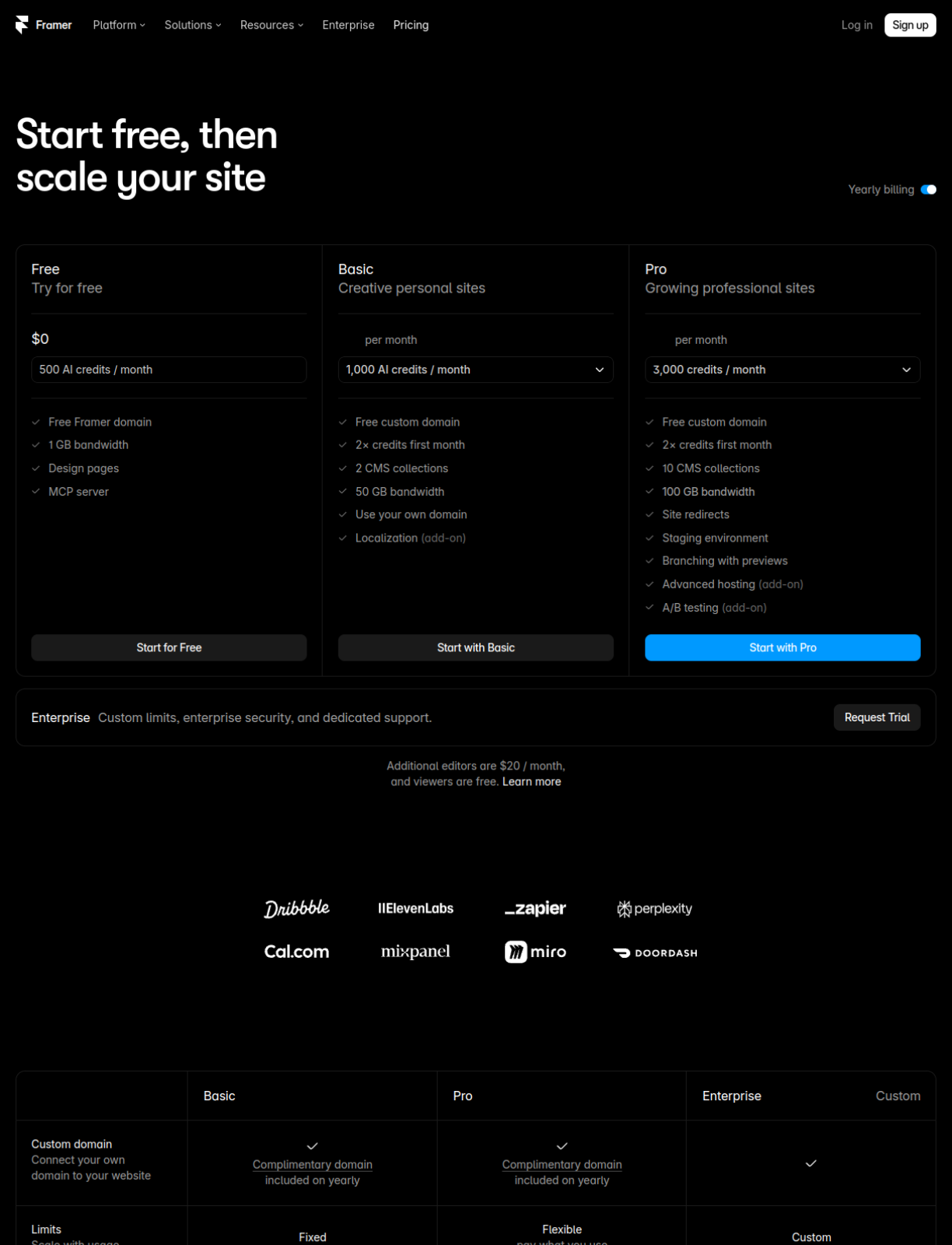
The pricing page reads the other way round: yearly billing first, monthly second. The toggle sits on yearly, and shows Free at $0, Basic with 1,000 AI credits a month and Pro with 3,000. Flip to monthly billing and the same two plans read $15 and $45 — half as much again for paying month to month.
The page also runs a quiet second meter: AI credits. Free gets 500 credits once to try the agent, Basic gets 1,000 a month and Pro gets 3,000, with larger credit packs selectable on both paid plans. The credits are the newest wall in the pricing — the agent is free to try, and heavy use of it is what the subscription pays for.
Three prices, and the bill follows the site
| Plan | Price | What it is |
|---|---|---|
| Free | $0 | 1,000 pages, 10 CMS collections, 5 MB file uploads, 1 free locale, 500 AI credits to try, up to 3 editors, 1 GB bandwidth a month, Framer subdomain, “Made in Framer” badge |
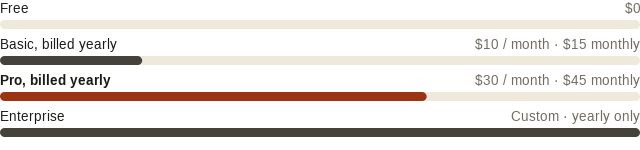
| Basic, billed yearly | $10 / month | $120 a year as shown; custom domain (first year free), 30 pages, 2 CMS collections, 1,000 CMS items, 50 GB bandwidth, 30-day analytics, 1,000 AI credits a month, 20 CDN locations |
| Basic, billed monthly | $15 / month | Same Basic features, billed month to month; $5 a month more than the yearly price |
| Pro, billed yearly | $30 / month | $360 a year as shown; 150 pages, 10 CMS collections, 2,500 CMS items, 100 GB bandwidth, 90-day analytics, 3,000 AI credits a month, 300+ CDN locations, redirects, staging, branching previews |
| Pro, billed monthly | $45 / month | Same Pro features, billed month to month; $15 a month more than the yearly price |
| Enterprise | Custom | Yearly only; custom limits, unlimited editors, volume discounts on credits, enterprise security, uptime guarantee, SCIM and SSO |
What the subscription does, and what it does not
The pricing page reads like a checklist of everything a small team needs to run a site, and it is also a map of what the subscription does not include. Every row below was read from framer.com/pricing and the Framer Help Center on 20 November 2026, and anything that could not be verified is marked as not found rather than filled in.
| Mechanism | Hit | What we found |
|---|---|---|
| Free tier | ✓ | Free $0: 1,000 pages, 10 CMS collections, 1 GB bandwidth a month, no card, no time limit |
| No account | — | No use without an account; the free tier still needs a signup |
| Free trial | — | No time-limited trial of a paid plan; the permanent free tier is the trial instead |
| Ads on the site | — | No ads on the site; the company buys about 190 Meta ads instead |
| API | 未核到 | No Framer REST API found on the pricing page or homepage this round |
| MCP server | ✓ | MCP server on all plans; Claude, Codex and Cursor can connect to it |
| Email capture | ✓ | Forms send submissions to email, Google Sheets or custom webhooks, with spam protection |
| SMS capture | — | No SMS capture on the pricing page |
| Auto-renew | ✓ | Subscriptions renew automatically unless cancelled before the next renewal date (Help Center) |
| Cancel anytime | ✓ | Cancel in workspace settings; paid features run to the end of the billing period |
| Pause subscription | 未核到 | No pause option in the cancel, refund or subscription help articles |
| Skip a delivery | — | Not applicable; this is software, not a shipped product |
| Free shipping | — | Not applicable; nothing is shipped |
| Gift subscription | — | No gift subscription on the pricing page |
| Loyalty plan | — | No loyalty plan for Framer’s own users on the pricing page |
| First-order hook | ✓ | Free tier with a whole published site, plus a free custom domain for the first year on yearly billing and double AI credits in the first month |
| Financing | 未核到 | No financing or instalment option found on the pricing page |
| Subscribe & save discount | ✓ | Yearly billing saves 33%: Basic $15 to $10, Pro $45 to $30 a month; students get Basic free for a year |
| Refer a friend | 未核到 | No referral programme found on the pricing page or homepage |
| Affiliate plan | 未核到 | No affiliate programme found on the pricing page or homepage |
| Templates | ✓ | Marketplace template library, free and paid side by side, creators set their own prices |
| Integrations | ✓ | MCP, Slack, GitHub pull requests, Figma Sync, Unsplash, Notion, Airtable, Contentful, Sanity, HubSpot, Calendly, WhatsApp and Instagram |
| Mobile app | — | No mobile app; the desktop app downloads from the site instead |
| White-label reports | — | Removing the badge is not white-labelling; it only takes the brand off a site you already own |
| History lock-in | ✓ | No HTML export for self-hosting (Help Center FAQ); the site stays on Framer hosting, though published output files can be downloaded |
| Team seats | ✓ | Extra editors $20 a month each, content editors $10; viewers are free; Enterprise has unlimited editors |
| Single tools sold alone | ✓ | Extra pages, CMS items, bandwidth, locales, Convert A/B testing and Advanced Hosting sold as add-ons |
| Free courses | 未核到 | Framer University exists as a free learning site, but course counts were not verified this round |
| Community | ✓ | Marketplace and Community, with a dedicated community subdomain |
Three gaps matter most. First, the free tier lets a personal site run forever on a Framer subdomain, which means the smallest sites never pay — the money starts only when the site needs its own name on it.
Second, there is no middle tier: a site that outgrows Basic at $10 a month faces Pro at $30, three times the price, and the G2 reviews already call the per-site stacking steep. Third, the trial story is the free tier itself — there is no clock on it, so a user who never needs a custom domain can stay free for years.
The arithmetic of the business is simple once the tiers are laid out. $50 million of annual recurring revenue across an estimated 45,000 to 55,000 paying customers works out to about $1,000 a customer a year — roughly three Pro sites at $30 a month — $360 a year each — with the bigger plans and the add-ons making up the rest. The customer count is a third-party estimate, so the arithmetic is a check on the company’s figure, not a proof of it.
5 million visits, and the rent does the selling
From $25 million to $50 million

Framer’s revenue path is the company’s own account, told in public over two years: $25 million of annual recurring revenue in 2024, $50 million in 2025, and a target of $100 million for 2026. A $100 million Series D arrived in August 2025 at a $2 billion valuation, and the company says it broke even over the past year.
The chart mixes estimates and targets on purpose and says so: the first bar is a third-party estimate, the second is the company’s figure, and the third is a target, not a result. The path is steady doubling, not a spike: eleven years from a prototyping tool to a $50 million revenue line, with the business-plan customers arriving only in the last year.
Two sources, two months, one number to use
The traffic figure needs two sources because the two trackers disagree on the method. Similarweb’s public page gives 5 million visits for October 2026, up 5.67% on the month. Semrush’s Trending page gives 6.46 million for the same period, down 6.3% — a different methodology, so the two numbers are shown separately and never blended into a trend.
What the two sources agree on is the shape: a mid-sized builder, just behind Webflow and far behind the mass-market builders, with most of its visits arriving direct. The 5 million figure is the one this teardown uses, and it is the 120th-largest figure in our database of 901 sites.

Where the visits come from
The channel mix is the first thing that makes Framer look like a brand business rather than a search business. Direct is 55.41% of visits — people type the name in or open a bookmark. Organic search is second and referrals third, and the page publishes no shares for either, so none is given here.
| Channel | Share of visits | Platform & stack |
|---|---|---|
| Direct | 55.41% | Similarweb’s top marketing channel, October 2026 |
| Organic search | Brand words first | “framer” 60,500 a month rank 9 in the US, “framer templates” 12,100 (Semrush, November 2026) |
| Referrals | Third channel | Similarweb, October 2026; the share was not published, so none is given here |
| AI referrals | Not published | No AI referral figure was readable for October 2026 |
| Backlinks | Not published | 223 referring sites, 170 outbound links (Similarweb, October 2026) |
| Platform | — | Framer App and Framer Sites, plus Atlassian Cloud (BuiltWith, 19 November 2026) |
| Hosting | — | Amazon AWS EC2 and Vercel, with Amazon CloudFront as the verified CDN (BuiltWith) |
| — | Loops, Amazon SES, Apple iCloud Mail, Google Apps, DMARC and SPF (BuiltWith) | |
| Analytics | — | Google Analytics/GA4, HubSpot, Hotjar, Facebook Pixel, OpenAI Conversion Tracking (BuiltWith) |
| Payment | — | No processor listed by BuiltWith; cards and PayPal in some regions, Stripe behind refunds (Help Center) |
| Advertising | — | About 190 active Meta ads, 20 November 2026; Google AdSense signal on the site (Similarweb) |
The rest of the stack is unremarkable, which is the point: its own app and sites on AWS and Vercel, CloudFront for delivery, Google Analytics and a long tail of product analytics for measurement. A company that sells websites runs its own website on its own tools — and the stack is the same commodity stack every SaaS site in this database uses.
What people search for
| Keyword | Monthly searches | Rank |
|---|---|---|
| framer | 60,500 | 9 |
| framer templates | 12,100 | — |
| framer seo | 90 | — |
Monthly searches are Semrush figures for the United States, November 2026. A third party puts the brand word at about 673,000 searches a month without naming a country or method; the two figures conflict and are shown side by side, with Semrush as the figure used.

The keyword table is a brand table. The word “framer” draws 60,500 searches a month in the United States at rank 9, and “framer templates” draws another 12,100 — people looking for a starting point, not a buying keyword. The third term is not a buying keyword at all, but a question about search optimisation.
That dependence cuts both ways. A brand word that owns its own name is a gift — “framer” is the category shorthand for designers — but it also means Framer has no generic keyword to fall back on: nobody searching for “website builder” finds Framer first, and the only non-brand term in the top three is a question from someone whose site is not ranking.
Priced between WordPress and Webflow
| Site | Monthly visits | Free tier | Starting paid price |
|---|---|---|---|
| WordPress.com | 94.92M (Semrush, Oct 2026) | Free to publish | Personal $4 a month (yearly billing) |
| Wix | 21.47M (Semrush, Oct 2026) | Free to publish | Light $17.77 a month (yearly billing) |
| Carrd | 16.4M (Hypestat, Aug 2026) | Free, no custom domain | Pro $19 a year ($1.58 a month) |
| Webflow | 5.5M (Similarweb, Oct 2026) | Free Starter, no custom domain | Basic $15 a month (yearly billing) |
| Framer | 5M (Similarweb, Oct 2026) | Free, 1,000 pages, Framer subdomain | Basic $10 a month (yearly billing) |
Rival visits, Semrush, Similarweb and Hypestat overview pages, read 20 November 2026. Rival prices from the vendors’ own pricing pages and third-party reads, November 2026, and Everstood’s own verified table for Webflow and Carrd. WordPress.com’s October figure is disputed on its own page — see the dossier note — and is shown as reported.
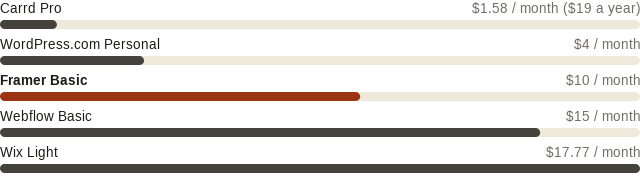
The rivals table puts Framer in the middle of a market that is bigger on both sides. WordPress.com draws 94.92 million visits a month — about nineteen times Framer — and starts paid plans at $4 a month. Wix draws 21.47 million and starts at $17.77. Framer is smaller than both, and cheaper than both at the door except for WordPress.com.
The price chart shows the same gap at the entry tier: Carrd starts at $1.58 a month, WordPress.com at $4, Framer at $10, Webflow at $15, Wix at $17.77 — all billed yearly, for a comparable entry tier.
The prices are not directly comparable, because Carrd sells a single page and the others sell a site. But the ordering is honest: Framer asks a new customer for two and a half times what WordPress.com asks, and two thirds of what Webflow asks — and the free tier has to do the work of justifying the rest.
Two review sites, two different companies

The split is the story. Designers on G2 praise the canvas, the Figma import and shipping a site without a developer — and then complain, in the same reviews, that the bill climbs with every extra site. Trustpilot reads like a different company: three quarters of its reviews are one star, and the complaints are about charges nobody warned them about — an editor seat billed after sharing a project link, AI credits burning through hundreds on small edits, support that only answers through a bot.
Both samples are real, and both are skewed. G2 collects working designers who chose the tool; Trustpilot collects people who arrived after a charge. Read together they say the product is loved and the billing is resented — which is exactly the risk in a business that charges per site, per seat and per credit.
Four rounds, one valuation jump
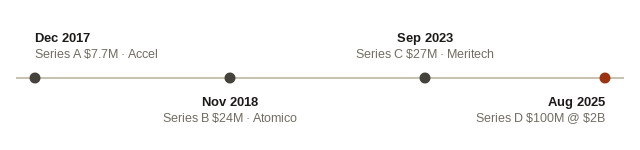
The rounds track the pivot. The first two funded a prototyping tool; the third, in September 2023, funded the turn into a website builder; the fourth, $100 million in August 2025, is a bet on the enterprise line — bigger customers, annual contracts, AI agents doing the building. TechCrunch reported the round on 28 August 2025 at a $2 billion valuation.
The valuation is the risk, stated plainly: $2 billion is about forty times the $50 million annual recurring revenue the company reported the same month, and that revenue figure is the company’s own account, not audited accounts. The funding proves investors believe the rent model; it does not prove the rent is fairly priced.
Framer is the first site with a full teardown in the No-code · Website builders collection. Compare Framer with Webflow and Carrd side by side.
The full teardown is for members
The full analysis of pricing, acquisition, conversion and retention is member content. Membership is $29 a month or $249 a year.
Similar sites in the database
Framer (5M) sits between Consensus (5.02M) and Coolors (4.9M) in the database.
| Site | Category | Monthly visits | Source |
|---|---|---|---|
| Bookshop.org | Books · Independent bookstore-supporting online bookstore | 5.3M | Similarweb, Oct 2026 |
| Consensus | AI research · Academic research | 5.02M | Semrush, Oct 2026 |
| Coolors | Design tools · Colour palette tools | 4.9M | Semrush, Oct 2026 |
Compare Framer with Webflow and Carrd side by side. The full database, with working filters, is on the teardowns index.
Read the next one in your inbox
The new ones go out by email first, one a week, with the traffic source and month attached to every number. Leave your address and the next one comes to you.