
Linear Pricing: $10 a Seat to $100M ARR
Monthly visits
10.2M
Similarweb, October 2026. Third-party estimates, not official MAU/DAU.
Linear draws an estimated 10.2 million visits a month (October 2026, Similarweb) — the 67th-largest site in our database of 901, and the only product-planning site we track. It charges software teams by the seat, starting at $10 a month, and says it passed $100 million in annual recurring revenue in early 2026.
The pitch fits in one line: the free tier lets a whole team move in, and the 250-issue cap makes them pay. More than 40,000 companies pay, existing customers spend 77% more than they did at first, and the company has been cash-flow positive since 2021.
| Site | Linear, linear.app |
|---|---|
| What it is | Issue tracking and product planning for software teams, keyboard-first, with AI agent workflows |
| Who it is for | Engineering and product teams that plan and ship software |
| Category | Productivity · Product planning & issue tracking |
| Monthly visits | 10.2M, October 2026. Third-party estimates, not official MAU/DAU; Similarweb 10.2M (+8.37%). Semrush only has a February 2026 cache (4.68M) — a different month, shown separately, not blended into a trend |
| Founded | 10 January 2019, San Francisco, by Karri Saarinen, Jori Lallo and Tuomas Artman |
| Headquarters | San Francisco; about 100–160 people (sources differ by date) |
| Operator | Linear Orbit, Inc. (Wikipedia; not named on the homepage or pricing page) |
| Survival engine | Recurring revenue. Seat subscriptions at $10 or $16 per user a month, plus AI usage fees, turn 10.2M monthly visits into $100M+ ARR — company claims, not audited accounts |
| Pricing | Free $0 (250 issues, 2 teams, 5 MB uploads); Basic $10/user/month billed yearly or $12 billed monthly; Business $16/user/month yearly or $18 monthly; Enterprise custom, yearly only. Prices exclude tax. Source: linear.app/pricing, read 20 November 2026 |
| Pricing model | Freemium subscription, per seat; no free trial; yearly billing saves about 17%; AI usage billed separately |
| Free hook | Free tier (unlimited members, 250 issues) — the only way in |
| Meta ads | No official Page found in the Meta Ad Library; 0 official active ads on 20 November 2026 |
| Country breakdown | Not published for October 2026; Semrush February 2026 cache: United States 19.55%, Japan 6.29%, Germany 5.72%, India 4.98%, United Kingdom 4.08% |
TL;DR
- Linear draws an estimated 10.2 million visits a month (October 2026), and 77.7% of them arrive direct — people type the name in. The brand word "linear" draws 60,500 searches a month at rank 1 and is worth 62.57% of organic traffic (February 2026); the generic phrase "linear project management" draws only 1,300.
- The money is the seat: free to 250 issues, then $10 or $16 per user a month, with AI usage billed on top since August 2026. More than 40,000 companies pay, net revenue retention is 177%, and the company says it passed $100 million in annual recurring revenue in early 2026, cash-flow positive since 2021. Profit has never been disclosed.
- The risks are that traffic is a quarter of Atlassian's and just over a quarter of ClickUp's, that small teams can work free indefinitely inside the 250-issue cap, that the price already rose once in 2026 (Standard $8 became Basic $10), and that the AI usage line is brand new, with no published price or revenue share.
The first screen sells speed, not the price
The first screen is a product demo, not a sales page
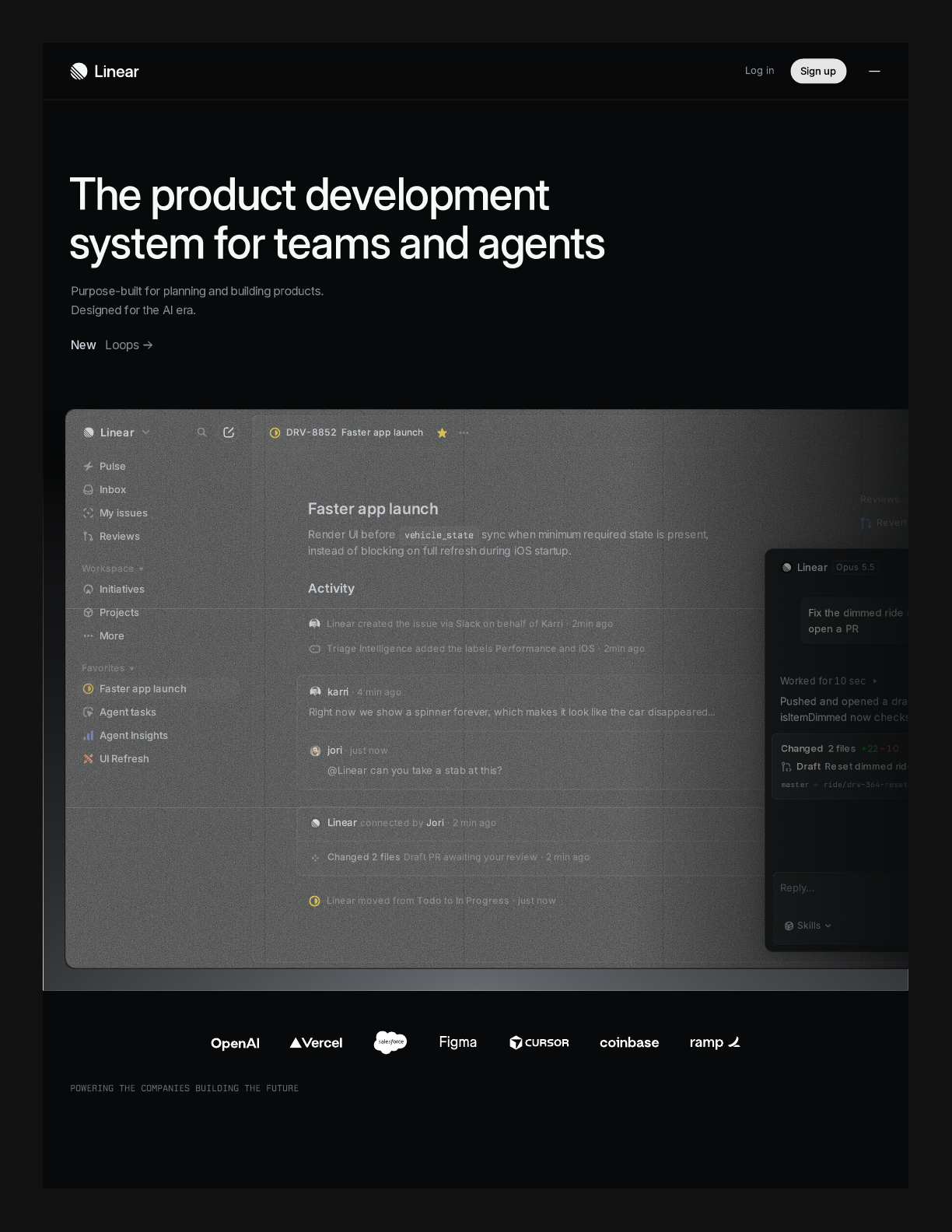
The Linear homepage, read 20 November 2026. The hero is "The product development system for teams and agents" — over a product screenshot and two buttons, "Get started" and "Open the app". No price appears on the first screen.
The homepage we read on 20 November 2026 opens with a promise and no price. "The product development system for teams and agents" sits over a screenshot of the product, beside "Get started" and "Open the app". Below it: "Linear powers over 50,000 product teams", with customer logos including OpenAI, Ramp, Cash App, Loom, Square, Retool, Vercel and Scale.
That is the whole funnel in one screen. The visitor is not asked to buy, or even to see a price — the product is the interface itself, and the first taste of it is free. The free tier needs no card and no sales call: open a workspace, invite the whole team, and start filing issues. The wall appears only when the work piles up.
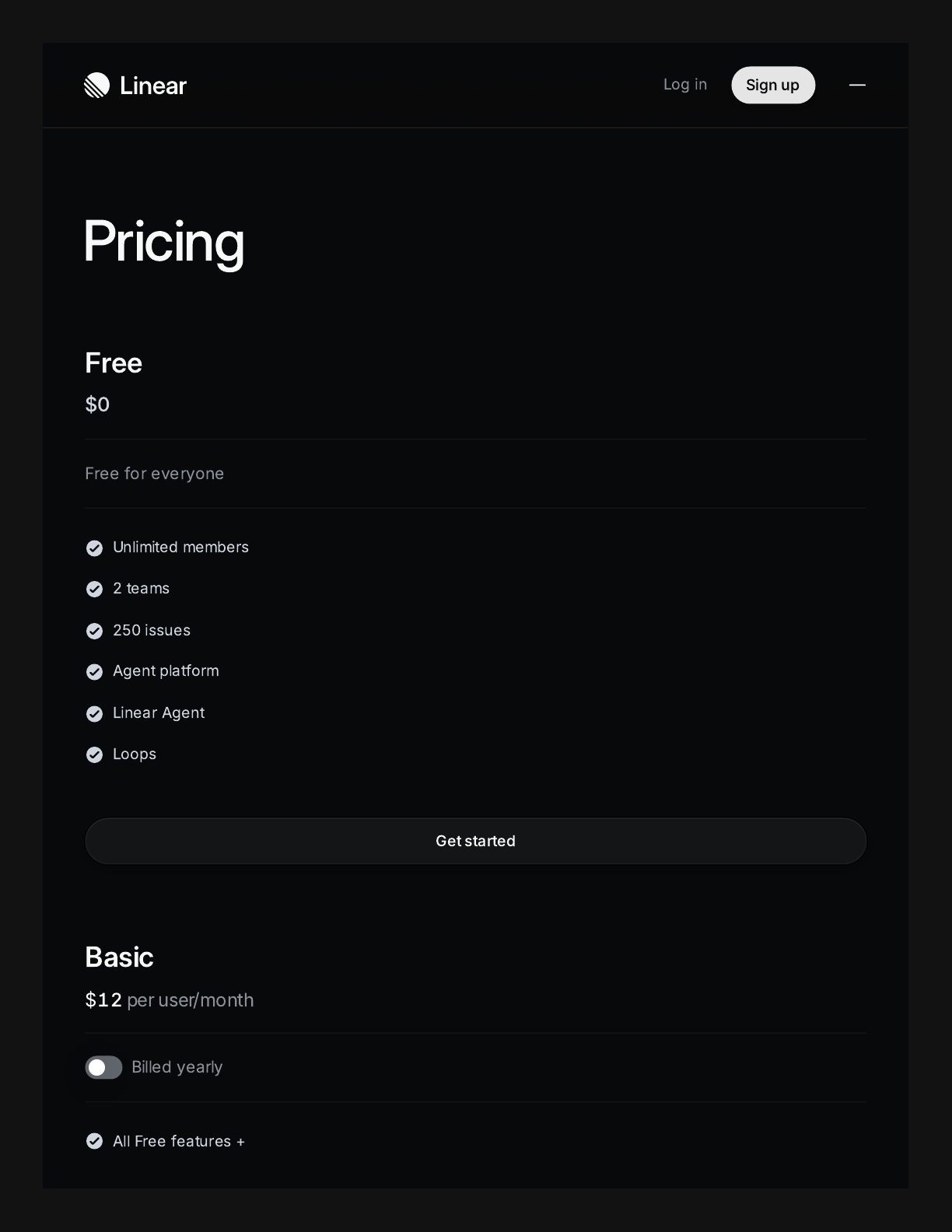
The Linear pricing page, read 20 November 2026, monthly view: Basic $12 a user a month, Business $18, with the yearly toggle showing $10 and $16. Free $0 sits on the left.
The pricing page keeps the same order: product first, price second. The yearly toggle is on by default, showing $10 and $16 a user a month; switching it off shows $12 and $18. The free tier sits on the left at $0, and Enterprise is quoted, yearly only. The page carries no "trial" wording and no "money-back" wording at all — both were searched and are absent.
The page's own numbers frame the pitch. The free tier allows unlimited members but only 250 issues, 2 teams and 5 MB uploads. Basic lifts the issue cap and the team cap to 5, at 50 MB uploads and 500 automations. Business lifts everything again — 250 MB uploads, 5,000 automations, unlimited integrations — and adds the AI layers, Triage Intelligence and Code Intelligence, that the cheaper tiers never see.
Four prices, two of them per seat
| Plan | Price | What it is |
|---|---|---|
| Free | $0 | Unlimited members, 2 teams, 250 issues, 5 MB uploads, 100 automations, 2 GB storage, 1 app integration, 1 API key |
| Basic, billed yearly | $10 / user / month | $120 a user a year; unlimited issues, 5 teams, 50 MB uploads, 500 automations, 100 GB storage, 3 integrations, 3 API keys, Insights |
| Basic, billed monthly | $12 / user / month | Same Basic features, billed month to month; $2 a user a month more than the yearly price |
| Business, billed yearly | $16 / user / month | $192 a user a year; unlimited teams, private teams, guest accounts, 250 MB uploads, 5,000 automations, 250 GB storage, unlimited integrations, SSO/SAML, SCIM, audit log |
| Business, billed monthly | $18 / user / month | Same Business features, billed month to month; $2 a user a month more than the yearly price |
| Enterprise | Quoted | Yearly only; SAML, SCIM, audit log, HIPAA, uptime SLA, dedicated manager, custom terms, invoice and purchase-order billing |
Prices from the Linear pricing page, yearly and monthly views, read 20 November 2026. Prices exclude tax. The free tier's 5 MB upload limit is the live-browser read; text fetches and third-party reviews said 10 MB.
The monthly price, billed monthly or yearly
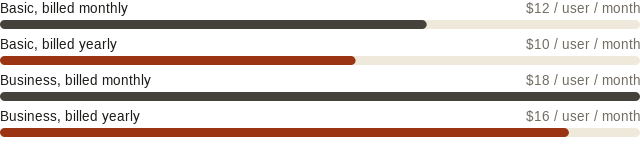
Paying yearly cuts $2 a user a month off each paid tier — about 17%. The yearly discount is the retention lever: it trades a small discount for twelve months of commitment.
Monthly prices, Linear pricing page, read 20 November 2026.
One plan, two prices, and a cap underneath. Basic is $12 a user a month when billed monthly and $10 on the yearly bill; Business is $18 or $16. The gaps — $2 and $2 — are small in dollars and large in behaviour: the yearly bill is the default view, and the monthly price is one toggle away.
The $10 tier is the price that matters, and the wall in front of it is deliberately low. Two hundred and fifty issues is a few weeks of work for a busy team, and the free tier never charges for people — only for the work itself. What costs real money is the volume: more issues, more teams, private teams, guests, and the AI layers that only Business unlocks.
What the subscription does, and what it does not
| Mechanism | Hit | Why, in one line |
|---|---|---|
| Free tier | ✓ | Free $0: unlimited members, 2 teams, 250 issues, 5 MB uploads |
| No account | — | Opening a workspace needs an account; there is no no-account query page |
| Free trial | — | No free trial on any paid tier; the pricing page carries no trial wording |
| Ads on the site | — | No ad slots seen on the pages read; Similarweb lists one ad-network signal, not ad inventory |
| API | ✓ | API and webhooks on all tiers; rate limits rise by tier (standard, standard, 2×, 5×); MCP access on all tiers |
| Email capture | 未核到 | No first-hand evidence of list capture found on the pages read |
| SMS capture | — | No SMS marketing evidence found on the pages read |
| Auto-renew | ✓ | Fees renew automatically until the customer ends the agreement (Terms §4.1, 9 June 2026) |
| Cancel anytime | ✓ | Cancel in billing settings or by email; the workspace drops to the Free tier at the end of the period |
| Pause subscription | 未核到 | No pause terms found in the pages read |
| Skip a delivery | — | Software subscription, not applicable |
| Free shipping | — | Not applicable |
| Gift subscription | — | No gift plan on the pricing page |
| Loyalty plan | — | No loyalty programme found on the pages read |
| First-order hook | ✓ | Free tier with unlimited members and 250 issues; students get one year free, partner startups up to six months of Business free |
| Financing | 未核到 | Checkout payment methods not read this round; Visa is the only payment signal found |
| Subscribe & save discount | ✓ | Yearly billing saves about 17%: Basic $12 to $10, Business $18 to $16 a user a month |
| Refer a friend | 未核到 | No referral programme evidence found; the only claim comes from a coupon aggregator, not the company |
| Templates | — | No template library found on the pages read; Linear Method is a methodology document, not templates |
| Integrations | ✓ | GitHub, GitLab, Slack, Figma, Sentry, MCP, Salesforce (Business add-on), homepage and pricing page first-hand |
| Mobile app | ✓ | iOS and macOS apps exist; no Linux app; store ratings not read this round |
| White-label reports | — | No white-label reporting found on the pages read |
| History lock-in | — | No history limits by tier on the pricing page; cancelling freezes new issues instead — data stays, work stops |
| Team seats | ✓ | Billing is per unpaused user; guest accounts start at Business |
| Single tools sold alone | — | No single tool sold alone on the pages read; the Salesforce integration is a Business add-on, not a standalone sale |
| Free courses | — | No free courses found on the pages read; Linear Method is public documentation |
| Community | 未核到 | No official community size found on the pages read |
The table is what is missing as much as what is there. There is no free trial at all, no pause button, no loyalty programme and no referral scheme. The retention tools are the issue cap, the yearly discount and the freeze itself: cancel, and the workspace keeps every issue but cannot file a new one past 250.
The arithmetic is worth doing, because the company publishes no funnel figures. One hundred million dollars of annual revenue divided by 40,000-plus paying companies is about $2,500 a company a year, or roughly $208 a month. At $10 to $16 a seat, that is 13 to 21 seats per paying company on average — by arithmetic rather than by any published figure.
The rest of the table is the refund rule, and it is the hard version of the exit. The terms say fees are non-cancellable and, except as expressly stated, non-refundable. A customer who cancels keeps the data and loses the ability to work: the workspace drops to the free tier, and past 250 issues nothing new can be filed until the bill is paid again.
What the review sites say
Third-party ratings for Linear
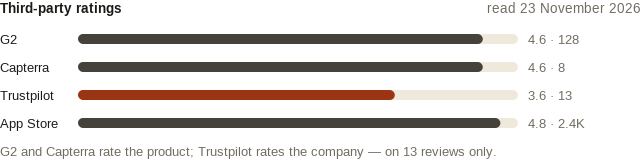
Third-party ratings for Linear. G2, Capterra, Trustpilot and the App Store read 23 November 2026.
Sources: g2.com/products/linear/reviews; capterra.com/p/10026109/Linear; trustpilot.com/review/linear.app; apps.apple.com/us/app/linear-mobile/id1645587184. Capterra's own page also shows 4.4 (5) in its comparison area; the 4.6 here is its labelled "Overall rating" from 8 reviews.
The product scores high wherever it is scored as a product. G2 gives Linear 4.6 out of 5 from 128 reviews; Capterra gives the same 4.6, from only 8 reviews; the iOS app holds 4.8 from 2,400 ratings. Trustpilot is the outlier at 3.6 from 13 reviews — and it rates the company, not the app.
The split is the same one Sézane shows: people who use the product rate it, people who argue with the bill rate the company. Four of Trustpilot's thirteen reviews are one star — 31% — against 61% five star, so a single unhappy customer moves the score a lot. Capterra's 8 reviews are too few to lean on either; the G2 number, 128 reviews at 4.6, is the one with weight.
10.2 million visits, and the seat count does the selling
Fifteen thousand companies became forty thousand in fourteen months
Paying companies, June 2025 to August 2026

Paying companies rose from 15,000-plus at the Series C in June 2025 to 40,000-plus in August 2026 — about 2.7 times in fourteen months. Net revenue retention is 177%.
Paying-company counts: company statements, June 2025 and August 2026. The 2.7 times figure is arithmetic.
The customer line is the company telling on itself, in public, for two years. At the Series C in June 2025 it counted 15,000-plus paying companies; in its August 2026 growth post it counted 40,000-plus. Existing customers keep spending more — net revenue retention of 177% means the average old customer now pays 77% more than at first.
The shape of the line is the point. The claims rise fast and then keep rising — customers nearly tripling in fourteen months, retention far above 100%, cash in the bank above everything raised. That is either a business compounding, or a business dressing a good year as a trend. The public record does not say which, and no profit figure has ever been published to settle it.
Two sources, two months, one number to use
Monthly visits, December 2025 to October 2026
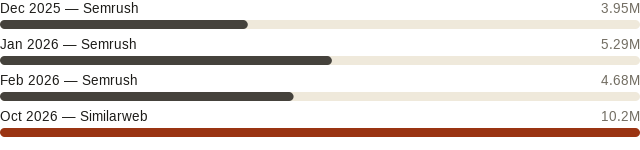
October was 10.2M on Similarweb, up 8.37% on the month. The Semrush figures are a February 2026 cache — a different source and a different month, shown separately.
Monthly visits: Semrush cache (December 2025–February 2026) and Similarweb (October 2026). Third-party estimates, not official MAU/DAU.
Similarweb has the site at 10.2 million visits in October, up 8.37% on the month, ranked 5,399th worldwide. The Semrush page this round only served a cache from March, showing February at 4.68 million — January 5.29 million, December 3.95 million. The two sources are eight months apart, so no growth rate is drawn between them.
The honest reading is that the master-table number is the Similarweb one, and the Semrush numbers are a stale second opinion. What the October figure does show is direction: up 8.37% in a month when the biggest rival, ClickUp, fell 1.56% and Atlassian fell 7.72% on the same Semrush pages.
Where the visits come from
| Channel | Share of visits | Platform & stack |
|---|---|---|
| Direct | 77.7% | Similarweb's top marketing channel, October 2026; Semrush February 2026 cache: Direct 84.71%, google.com 5.09% |
| Organic search | Second channel | Similarweb, October 2026; the share was not published, so none is given here |
| AI referrals | At least 45K a month | ChatGPT 28K, Gemini 10K, Claude 7K — Semrush AI Traffic, February 2026 cache; the list ends with "and more", so 45K is a floor |
| Backlinks | 256.36K (−5.51%) | From 12.05K referring domains (+2.75%), Semrush, February 2026 cache |
| Platform | — | Next.js with Radix UI and Base UI; React, MobX, Sentry (BuiltWith, 19 November 2026) |
| Hosting | — | Cloudflare hosting and CDN; Google Cloud (BuiltWith) |
| Email & SMS | — | Postmark, Amazon SES, Google Apps for Business; Klaviyo (BuiltWith) |
| Analytics | — | PostHog, Hotjar, FullStory, Nielsen, Google Analytics (BuiltWith; Similarweb) |
| Payment | — | Stripe and Klarna (BuiltWith); Visa signal (Similarweb) |
| Advertising | — | No official Meta ads found on 20 November 2026; LinkedIn Ads signal (BuiltWith) |
Marketing channels, Similarweb, October 2026; traffic journey and backlinks, Semrush, February 2026 cache; technologies, BuiltWith, 19 November 2026. The two traffic sources use different definitions and months, so their shares are not added together.
Direct is the whole story: 77.7% of visits on Similarweb, and the next channel is organic search — links on the changelog, the method pages and the sites that cite the product. People do not discover Linear; they search for it, or they arrive from a team that already uses it. Paid marketing is close to zero: an analyst citing internal figures puts total paid-marketing spend from founding to September 2023 at about $35,000.
The stack matches the story. Next.js runs the site, Cloudflare hosts it, Stripe takes the payments, and the analytics list is long — PostHog, Hotjar, FullStory — for a company that buys almost no ads. AI referrals are the new direction: at least 45,000 a month in the February cache, and the company counts them as a channel worth naming.
Backlinks, 256,360 from 12,050 referring domains, are down 5.51% on the month in the February cache, while referring domains are up 2.75%. The site is linked to far less than it advertises — and it advertises almost nothing: no official Meta ads could be found on 20 November 2026, against 23,000 keyword results that are mostly courses, probes and other uses of the word "linear".
What people search for
| Keyword | Monthly searches | Share of organic | Rank |
|---|---|---|---|
| linear | 60,500 | 62.57% | 1 |
| linear ai | 4,400 | 4.55% | 1 |
| linear app | 3,600 | 3.72% | 1 |
| linear documentation | 1,600 | 1.65% | 1 |
| linear project management | 1,300 | 1.34% | 1 |
Monthly searches are Semrush figures for linear.app, February 2026 cache. The top five terms together are worth about 74.83% of organic traffic.
Top organic keywords by monthly searches
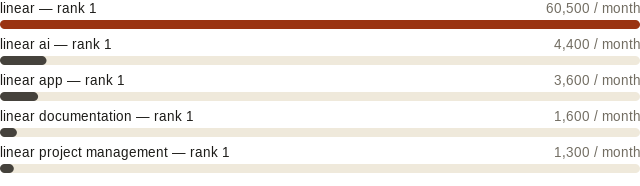
The brand word "linear" draws 60,500 searches a month — fourteen times the next term, "linear ai" — and ranks 1st, worth 62.57% of organic traffic.
Top organic keywords, Semrush, February 2026 cache.
Search here has one head, not two. The brand word "linear" draws 60,500 searches a month at rank 1 and is worth 62.57% of organic traffic. The next four terms together are worth barely a tenth of that, and the only generic phrase in the list, "linear project management", draws 1,300 a month.
That split is the word-of-mouth bet made visible. Linear ranks for its own name and almost nothing else, and its growth post says the work is done by the product and the changelog. The risk is the mirror image: a brand word worth three-fifths of all search traffic belongs to whoever owns the name, and "linear" is also an ordinary English word — the ad library proves it, with 23,000 unrelated results.
Rivals four times its size, and cheaper at the door
| Site | Monthly visits | Free tier | Starting paid price |
|---|---|---|---|
| Atlassian (all products) | 43.85M (Semrush, Oct 2026) | Jira free, up to 10 users | Jira Standard $7.91–$8.15 a user a month (third-party, Sep–Nov 2026; Atlassian raised cloud prices on 13 October 2026) |
| ClickUp | 36.99M (Semrush, Oct 2026) | Free Forever, unlimited tasks and members, 60 MB storage | Unlimited $7 a user a month (third-party, Oct 2026; a new tier structure is due no earlier than January 2027) |
| Shortcut | Not published | Free, up to 10 users | Team $8.50 a user a month (third-party, Oct–Nov 2026); 14-day trial, no card needed |
Rival visits, Semrush overview pages, read 20 November 2026. Rival prices from third-party reviews, September–November 2026; Jira and ClickUp pricing pages were not read this round. Atlassian is shown for comparison only — it is a listed company and is not an independent site in this database.
Entry price, yearly billing, per user a month
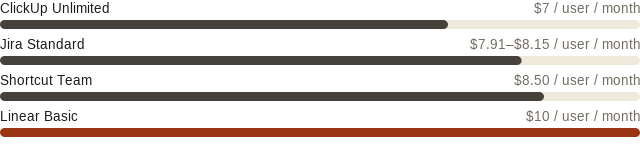
Linear's $10 entry is the highest of the four — $3 above ClickUp, about $2 above Jira Standard and $1.50 above Shortcut Team. At the middle tier, Linear Business at $16 matches Jira Premium.
Entry prices, yearly billing: ClickUp, Jira and Shortcut from third-party reviews, October–November 2026; Linear from its pricing page, read 20 November 2026.
The rivals are bigger and cheaper at the door. Atlassian's whole site at 43.85 million visits is more than four times Linear, and ClickUp at 36.99 million is more than three times. Jira Standard starts at $7.91 to $8.15 a user a month, ClickUp Unlimited at $7, Shortcut Team at $8.50 — all below Linear Basic at $10.
The ownership changed the contest. Atlassian is listed, and its Jira brand word draws 246,000 searches a month — about four times "linear". ClickUp's own traffic fell off a cliff in September, from 61.22 million in August to 37.58 million, with no explanation published. Linear is still independent and self-funded, which is the point of this database — but it charges the highest entry price against rivals three to four times its size.
Seven years on the record
From a waiting list to $100M in annual revenue
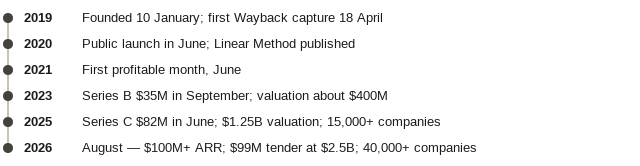
Company and product history, 2019–2026. Sources: company growth post August 2026, Wikipedia "Linear Orbit, Inc.", and Wayback Machine CDX API, read 23 November 2026.
Yearly first captures of linear.app, all status 200: 2019 18 April, 2020 7 January, 2021 10 January, 2022 9 January, 2023 6 January, 2024 4 January, 2025 1 January, 2026 1 January. No gap years — the homepage has been captured every year since 2019.
Seven years, and the record is unbroken. The company was founded in January 2019, opened to the public in June 2020, and turned its first profitable month a year later — before it ever spent real money on marketing. The Wayback Machine has captured the homepage every year since April 2019.
The money follows the same line. Series B in September 2023 at about a $400M valuation, Series C in June 2025 at $1.25B, then a $99M tender in August 2026 that priced the company at $2.5B — a secondary sale, not new funding, and the same month it announced $100M+ in annual recurring revenue. Nothing here is audited; every figure is the company's own, or a news report of it.
Linear is the only site in the Productivity · Product planning & issue tracking collection. Compare Linear with Todoist and ClickUp side by side.
The full teardown is for members
The full analysis of pricing, acquisition, conversion and retention is member content. Membership is $29 a month or $249 a year.
Similar sites in the database
Linear (10.2M) sits between diagrams.net (10.62M) and pdfFiller (10.06M) in the database.
| Site | Category | Monthly visits | Source |
|---|---|---|---|
| 123RF | Design tools | 10.76M | Semrush, Oct 2026 |
| diagrams.net | Diagram tools | 10.62M | Semrush, Oct 2026 |
| pdfFiller | PDF tools | 10.06M | Semrush, Oct 2026 |
Compare Linear with Todoist and ClickUp side by side. The full database, with working filters, is on the teardowns index.
Read the next one in your inbox
The new ones go out by email first, one a week, with the traffic source and month attached to every number. Leave your address and the next one comes to you.