
How Todoist makes money on a $5 to-do list
Monthly visits
16.3M
Similarweb, October 2026. Third-party estimates, not official MAU/DAU.
Todoist draws an estimated 16.3 million visits a month (October 2026, Similarweb) — the 50th-largest site in our database of 901, and the only task manager we track. It has been selling the same to-do list since 2007, and it has never taken venture capital to do it.
The pitch fits in one line: the same list, for nineteen years, for $5 a month — from a company that promises it will never sell out. The free tier is the funnel, the $5 Pro subscription is the business, and permanence is the product.
| Site | Todoist, todoist.com |
|---|---|
| What it is | To-do list and task manager: lists, projects, reminders and automations, on phone, tablet, watch, desktop and the web |
| Who it is for | People and small teams who want one list that syncs across every device |
| Category | Productivity · Task management |
| Monthly visits | 16.3M, October 2026. Third-party estimates, not official MAU/DAU; Similarweb 16.3M (+0.65%); Semrush October 2026 figures could not be read this round |
| Founded | 2007, launched by Amir Salihefendic while a student in Denmark, with a single blog post; Doist; earliest Wayback Machine capture 2 February 2007 |
| Headquarters | None — fully remote since 2011; about 100 people in 40 countries |
| Operator | Doist Inc. (private; founder Amir Salihefendic, majority owner; never took venture capital) |
| Survival engine | Repeat purchase. A free list becomes a daily habit, the free tier's limits push heavy users to a $5-a-month Pro subscription, and teams expand it seat by seat at $8 a user a month |
| Pricing | Beginner free; Pro $5/month billed yearly ($60/year) or $7/month billed monthly, 7-day free trial; Business $8/user/month billed yearly ($96/year) or $10/user/month billed monthly, 14-day free trial. Source: todoist.com/pricing and Help Center, read 20 November 2026 |
| Pricing model | Freemium subscription; free Beginner tier; Pro and Business billed monthly or yearly, yearly billing saves 20% |
| Free hook | Free Beginner tier (5 projects); Pro 7-day trial, Business 14-day trial; no card needed to start free |
| Meta ads | About 12 active ads in the Meta Ad Library on 20 November 2026 (Todoist advertiser page; all started 19 November 2026, all Business/team-focused) |
| Country breakdown | Not published for October 2026. Semrush, January 2026: United States 25.58% (2.67M); Brazil 7.13% (744.32K); Germany 5.81% (605.89K); United Kingdom 5.2% (542.39K); Russian Federation 4.66% (486.47K) |
TL;DR
- Todoist draws an estimated 16.3 million visits a month (October 2026), and 78.15% of them arrive direct — people type the name in. The brand word "todoist" draws 74,000 searches a month at rank 1, but the bigger search door is generic: "time management methods" draws 1,830,000 a month at rank 6.
- The money is the renewal, not the signup: Pro is $5 a month billed yearly ($7 billed monthly), Business is $8 a user a month billed yearly ($10 billed monthly). The founder puts revenue above $20 million a year; third-party estimates disagree, from about $11.2 million to $26.5 million.
- It survives by outlasting everyone: founded 2007, left alone for four years and still growing, fully remote since 2011, zero outside investment, and a homepage that promises it will never sell out. The risks are flat growth — up 0.65% in October — and a category where Trello, TickTick, Asana and ClickUp all chase the same list.
The first screen sells clarity, not features
The first screen is a promise that nothing will be sold
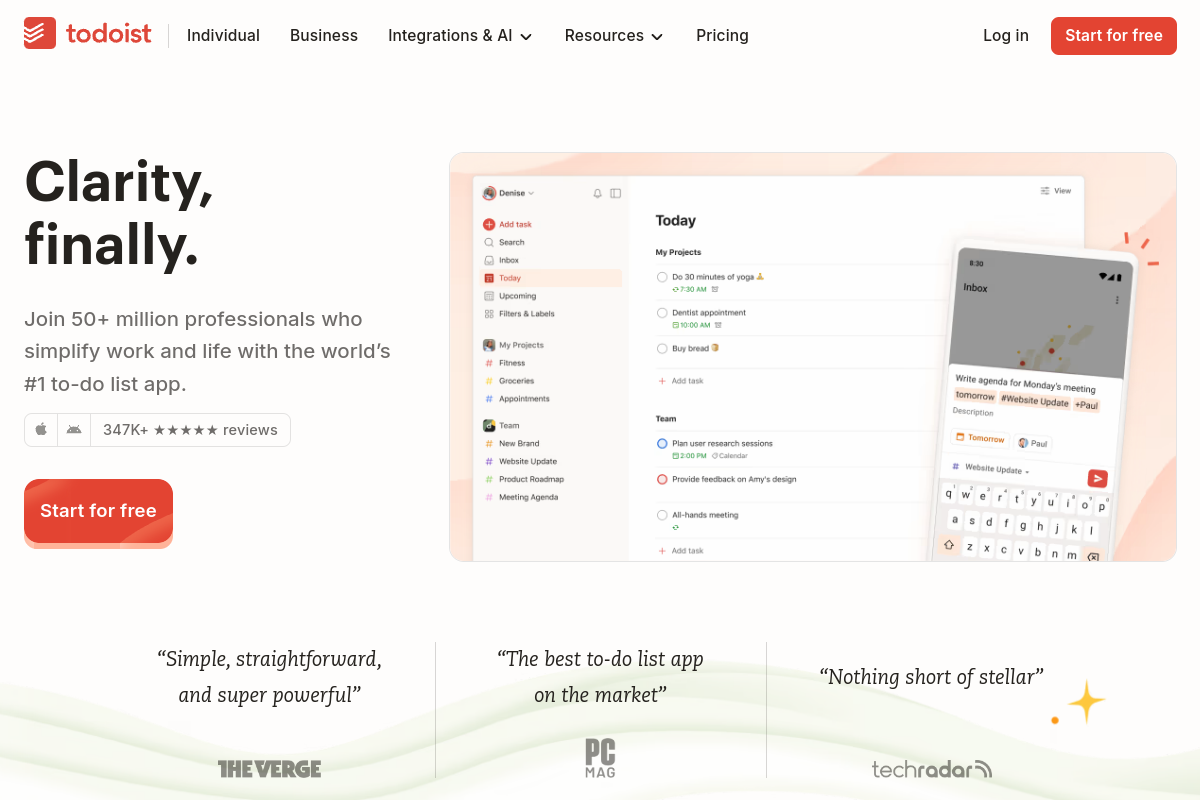
The Todoist homepage, read 20 November 2026. The hero is "Clarity, finally." — "Join 50+ million professionals who simplify work and life with the world's #1 to-do list app" — beside a "Start for free" button and a 347K+ five-star review badge, with quotes from The Verge, PC Mag and TechRadar below.
The homepage we read on 20 November 2026 opens on a feeling, not a feature list. "Clarity, finally." sits over a task list and a phone, and the subhead counts 50+ million professionals. The button says "Start for free" — no price, no trial length, no card.
Further down the page turns the feeling into a pledge. "We've been building Todoist for 19 years and 295 days. Rest assured that we'll never sell out to the highest bidder." Below it: "Independent, bootstrapped, and remote since 2011. The only people we answer to are the ones who use Todoist." A to-do list is a trust product, and the page sells the trust first.
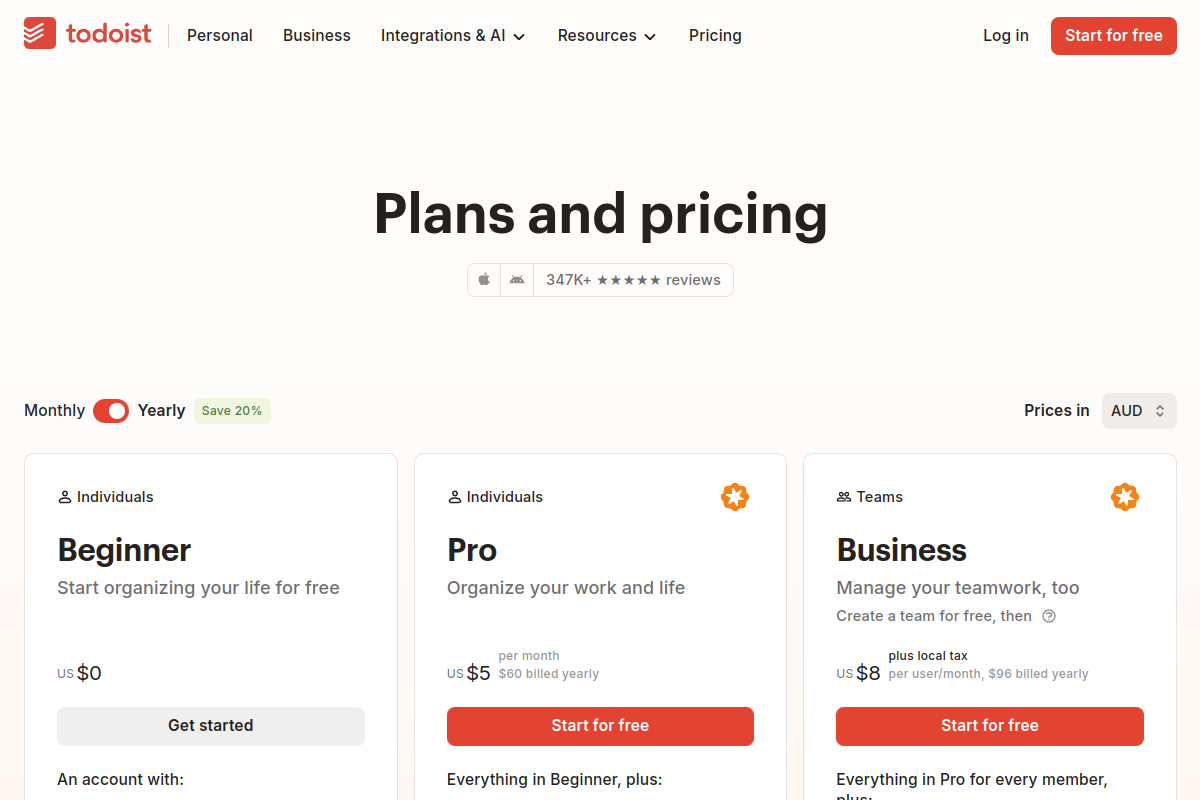
The Todoist pricing page, read 20 November 2026, yearly view: Beginner US $0, Pro US $5 per month billed $60 yearly, Business US $8 per user per month billed $96 yearly, with a Monthly/Yearly toggle marked "Save 20%". The capture renders prices in AUD; the dollar figures in this teardown come from the same page's text, read the same day.
The pricing page is the opposite of a hard sell. Three cards — Beginner, Pro, Business — with the yearly view shown by default and a toggle marked "Save 20%". The Pro and Business buttons both read "Start for free", and the word "trial" does not appear on the page at all. The trial lengths live only in the Help Center: 7 days for Pro, 14 for Business.
Two prices for the same list
| Plan | Price | What it is |
|---|---|---|
| Beginner | $0 | 5 personal projects, Quick Add, task reminders, list and board layouts, 3 filter views, 1-week reporting history, 5MB uploads, Ramble 10 sessions a month |
| Pro, billed yearly | $5 / month | $60 billed yearly; 300 personal projects, 150 filter views, full reporting history, 100MB uploads, calendar and table layouts, custom reminders, task duration, Automations Beta, unlimited Ramble; 7-day free trial |
| Pro, billed monthly | $7 / month | Same Pro features, billed month to month; $2 a month more than the yearly price; trial converts to a paid subscription unless cancelled |
| Business, billed yearly | $8 / user / month | $96 billed yearly, plus local tax; everything in Pro for every member, plus up to 500 team projects, 1,000 members and guests, roles and permissions, centralised billing; 14-day free trial |
| Business, billed monthly | $10 / user / month | Same Business features, billed month to month, plus local tax; $2 a user a month more than the yearly price |
Prices from the Todoist pricing page, both toggle views, and the Help Center plans FAQ, read 20 November 2026. The pricing page shows the yearly view by default; the monthly prices come from the Monthly view read the same day.
The monthly price, billed monthly or yearly
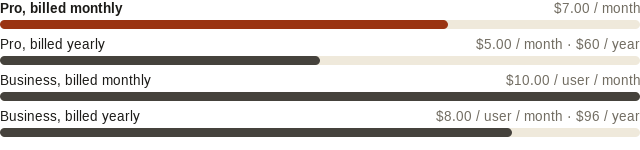
Paying yearly cuts $2 a month off each plan — Pro falls from $7 to $5, Business from $10 to $8. The yearly discount is the retention lever: it trades 20% of the price for twelve months of commitment.
Monthly prices, Todoist pricing page and Help Center, read 20 November 2026.
One list, two prices. Pro is $7 a month when billed monthly and $5 when billed yearly; Business is $10 a user a month, or $8 on the yearly bill. The $2 gap is the whole retention pitch in numbers: pay for the year, save 20%.
The original price was set with no research at all. Amir Salihefendic picked $29 a year as a student, because it covered the server costs — and competitors later copied the model. The price has roughly doubled since, to $60 a year, while the product stayed a list.
What the subscription does, and what it does not
| Mechanism | Hit | Why, in one line |
|---|---|---|
| Free tier | ✓ | Beginner is $0: 5 personal projects, 3 filter views, 1-week reporting history, 5MB uploads |
| No account | — | Even the free tier needs an account; no card is needed to start free |
| Free trial | ✓ | Pro 7 days, Business 14 days (Help Center, read 20 November 2026); the trial converts to paid unless cancelled |
| Ads on the site | — | No ad slots seen on the pages read; Similarweb lists a DoubleClick signal, not ad inventory |
| API | ✓ | "Connect via developer tools" on the homepage; 120+ integrations on the pricing comparison table |
| Email capture | ✓ | Sendgrid and Postmark run email, per BuiltWith; Mail is Similarweb's third marketing channel |
| SMS capture | 未核到 | No SMS marketing evidence found on the pages read |
| Auto-renew | ✓ | Subscriptions renew each period; yearly plans bill $60 or $96 a year |
| Cancel anytime | ✓ | Cancel anytime and keep paid features until the current billing period ends (Help Center) |
| Pause subscription | 未核到 | No pause terms found in the Help Center pages read |
| Skip a delivery | — | Software subscription, not applicable |
| Free shipping | — | Not applicable |
| Gift subscription | — | No gift plan on the pricing page |
| Loyalty plan | — | No loyalty programme found on the pages read |
| First-order hook | ✓ | Free Beginner tier, "Start for free" buttons, and 20% off for yearly billing |
| Financing | 未核到 | Checkout payment methods not read this round; Stripe is the payment processor, per BuiltWith |
| Subscribe & save discount | ✓ | Yearly billing saves 20%: Pro $7 to $5, Business $10 to $8 a month |
| Refer a friend | 未核到 | No referral programme evidence found on the pages read |
| Templates | ✓ | 50+ project templates, homepage first-hand |
| Calendar and table views | ✓ | Pro unlocks calendar and table layouts, pricing comparison table |
| Mobile app | ✓ | Phone, tablet, watch, desktop and web, homepage first-hand; 347K+ five-star reviews |
| Integrations | ✓ | 120+ integrations, pricing comparison table; email and calendar included |
| Refund window | ✓ | Yearly plans refundable within 30 days of purchase or renewal; monthly payments are not refundable (Help Center) |
The table is what is missing as much as what is there. There is no pause button, no loyalty programme and no referral scheme — the retention tools are the free tier's limits, the yearly discount and the trial that converts unless cancelled. The exit is visible: cancel anytime, keep the features until the period ends.
One number on the page does not match the company story. The homepage counts 50+ million professionals, but the paying subscriber count is not published — 50 million is registered users, not payers. At $60 a year, the founder's $20 million-plus revenue implies roughly 330,000 paying users by arithmetic, not by any published figure.
The rest of the table is the refund rule, and it is the honest version of the exit. Monthly payments are not refundable when you cancel; yearly plans get a full refund inside 30 days of purchase or renewal. The trial is the real guarantee: seven days on Pro, fourteen on Business, and the first payment lands only when the trial ends.
16.3 million visits, and nearly all of them direct
Two months, one flat line
Monthly visits, September to October 2026

October was 16.3M, up 0.65% on the month. September's 16.19M is arithmetic from that change, not a published figure.
Monthly visits, Similarweb, October 2026. Third-party estimates, not official MAU/DAU.
Similarweb has the site at 16.3 million visits in October, up 0.65% on September — about 16.19 million by arithmetic from the change. Growth has flattened to a rounding error. The Semrush October figures could not be read this round: the overview page is gone and the data sits behind a sign-up wall.
The flat line is the story, not a footnote. A nineteen-year-old product with 50 million registered users and a name people type in directly does not grow by acquisition any more — it grows by keeping the list open every morning. The traffic question for Todoist is not where the next million comes from, but whether the current sixteen million keep coming back.
A January map of the audience
Where the visits come from
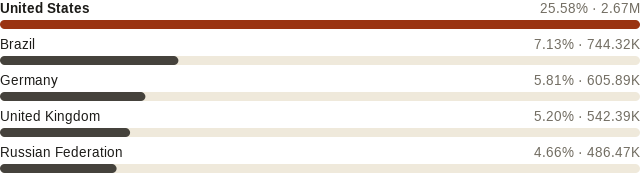
The United States sends 25.58% of visits; Brazil, Germany, the United Kingdom and Russia together send 22.78%. The top five are worth 48.38%.
Traffic share by country, Semrush, January 2026 — the October 2026 split was not published. Third-party estimates.
The country map we can show is from January 2026, because the October split was not published. The United States sends 25.58% of visits (2.67 million that month), and the next four countries — Brazil, Germany, the United Kingdom and Russia — together send 22.78%. The top five are worth 48.38%, and the rest is spread thin.
That spread fits the business. A to-do list needs no shipping, no local warehouse and no translation of the core loop — the same list works in São Paulo and Berlin. The American share is a quarter, not nine-tenths, which is the opposite of the subscription-box sites in this database.
Where the visits come from
| Channel | Share of visits | Platform & stack |
|---|---|---|
| Direct | 78.15% | Similarweb's top marketing channel, October 2026; Semrush desktop journey, January 2026: Direct 84.27%, google.com 5.96% |
| Organic search | Second channel | Similarweb, October 2026; brand word "todoist" 74,000 searches a month at rank 1, January 2026 |
| Third channel | Similarweb, October 2026; Sendgrid and Postmark run email, per BuiltWith | |
| AI referrals | At least 50K visits | ChatGPT 29K, tomo.ai 11K, Gemini 10K — January 2026, Semrush; about 0.5% of that month's visits |
| Backlinks | 646.54K (−2.89%) | From 42.72K referring domains (−0.73%), Semrush, January 2026 |
| Platform | — | Astro and React, with GSAP; no web-server software listed; Contentful as headless CMS |
| Hosting | — | Amazon AWS EC2 (Virginia), CloudFront, Cloudinary, BunnyCDN; DNS via Route 53; Amazon SSL with HSTS |
| Email & SMS | — | Sendgrid, Postmark, Zendesk, Google Apps for Business; SPF and DMARC with a Reject policy |
| Analytics | — | Google Analytics 4, Google Tag Manager, Microsoft Clarity, Reddit and TikTok conversion pixels |
| Payment | — | Stripe, per BuiltWith; PayPal also listed as a payment method, per Similarweb |
| Advertising | — | About 12 active Meta ads, all Business/team-focused, all started 19 November 2026 |
Marketing channels, Similarweb, October 2026; traffic journey and backlinks, Semrush, January 2026; technologies, BuiltWith, 19 November 2026. The two traffic sources use different definitions, so their shares are not added together.
Direct is the whole story: 78.15% of visits on Similarweb, 84.27% of desktop visits on the Semrush journey. People do not discover Todoist; they return to it. Organic search is second, mail is third, and the paid side is nearly invisible — paid search traffic fell 49.47% in January on Semrush, and the Meta Ad Library holds about twelve ads, all launched on the same day and all selling the Business plan to teams.
The stack matches the story. Stripe takes the payments, Contentful runs the content, AWS hosts it, and the analytics list is long — Google Analytics 4, Clarity, Reddit and TikTok pixels — for a company that says it hired marketing very late. AI referrals are a rounding error with a direction: ChatGPT sent about 29,000 visits in January, roughly half of one percent of the month.
Backlinks, 646.54 thousand from 42.72 thousand referring domains, are down 2.89% and 0.73% on the month. The site is linked to far more than it advertises — and it advertises almost nothing.
What people search for
| Keyword | Monthly searches | Share of organic | Rank |
|---|---|---|---|
| time management methods | 1,830,000 | 19.31% | 6 |
| todoist | 74,000 | 28.40% | 1 |
| todo | 49,500 | 1.94% | 3 |
| to do list | 40,500 | 2.56% | 1 |
| todolist | 5,400 | 2.07% | 1 |
Monthly searches are Semrush figures for todoist.com, January 2026, read from a cached copy. The October 2026 keyword figures could not be read this round. The top five terms together are worth about 53.9% of organic traffic.
Top organic keywords by monthly searches
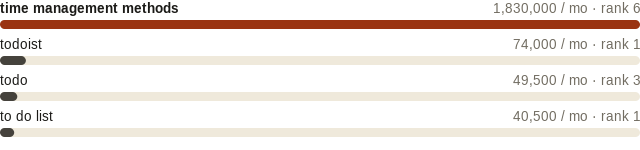
The generic phrase "time management methods" draws 1,830,000 searches a month — nearly twenty-five times the brand word — but ranks only 6th. The brand word "todoist" draws 74,000 and ranks 1st.
Top organic keywords, Semrush, January 2026, read from a cached copy.
Search here has two heads, not one. The brand word "todoist" draws 74,000 searches a month at rank 1 and is worth 28.40% of organic traffic. The bigger head is generic: "time management methods" draws 1,830,000 searches a month — nearly twenty-five times the brand word — and ranks 6th, worth 19.31% of organic traffic.
That split is the content bet made visible. Todoist ranks for the question, not just the name, and the question is worth more searches than the brand. The risk is the mirror image: a generic term at rank 6 can be taken by anyone who writes a better page, and the brand word alone is worth barely a quarter of organic traffic.
What outsiders say
Third-party ratings

Trustpilot rates Todoist 3.2 out of 5 from 83 reviews; G2 rates it 4.5 out of 5 from 869 reviews.
Trustpilot rating and review count, trustpilot.com/review/todoist.com, read 22 November 2026; G2 rating and review count, g2.com/products/todoist/reviews, read 22 November 2026.
The outside scores split by audience. Trustpilot gives Todoist 3.2 out of 5 from 83 reviews — the praise is for cross-platform sync and natural-language entry, and the complaints are about subscriptions that are hard to cancel and accounts that are hard to delete. G2 rates it 4.5 out of 5 from 869 reviews, and its reviewers are mostly small businesses that value fast setup and simple task entry.
The gap is the audience, not the product. Trustpilot is where unhappy customers go to complain; G2 is where business users leave structured reviews. Neither number is audited, and the Trustpilot sample is small — 83 reviews against 50 million registered users — so the scores are a weather report, not a verdict.
Nineteen years on the record
Todoist on the Wayback Machine, 2007 to 2026
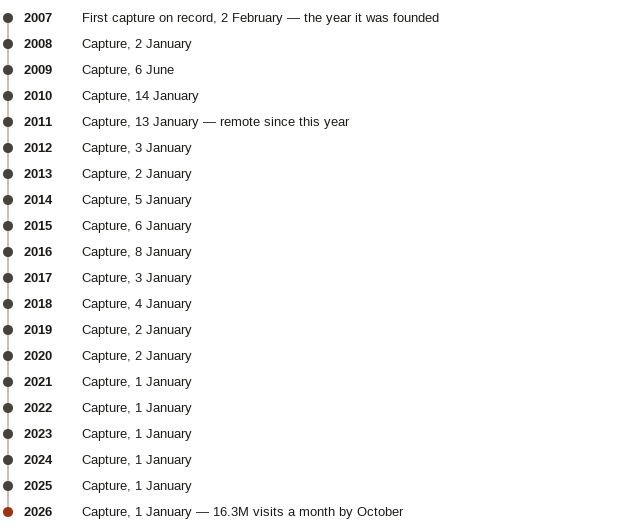
The Wayback Machine has captured todoist.com every year since February 2007, the year the site was founded. The first capture is dated 2 February 2007.
Wayback Machine captures of todoist.com, web.archive.org, read 22 November 2026; founding year from the founder's own account as reported by third parties.
The archive runs unbroken for nineteen years: a capture in January of almost every year from 2008 on, through 1 January 2026. That continuity is the survival claim in its simplest form — the same domain, live, every year since a student's blog post launched it.
The first capture also settles the founding year. Todoist says it launched in 2007, and the archive's earliest record is 2 February 2007, with no capture before that date. The four quiet years that followed, when the founder left for another job, left no gap in the record either.
Todoist is the only task manager in the Productivity · Task management collection. Compare Todoist with Notion and Calendly side by side.
The full teardown is for members
The full analysis of pricing, acquisition, conversion and retention is member content. Membership is $29 a month or $249 a year.
Similar sites in the database
Todoist (16.3M) sits between DupliChecker (16.39M) and Pixlr (16.21M) in the database.
| Site | Category | Monthly visits | Source |
|---|---|---|---|
| Gymshark | Fitness apparel | 16.45M | Semrush, Oct 2026 |
| DupliChecker | Writing tools | 16.39M | Semrush, Oct 2026 |
| Pixlr | Image tools | 16.21M | Semrush, Oct 2026 |
Compare Todoist with Notion and Calendly side by side. The full database, with working filters, is on the teardowns index.
Read the next one in your inbox
The new ones go out by email first, one a week, with the traffic source and month attached to every number. Leave your address and the next one comes to you.