
LeetCode Premium Pricing: $35 a Month
Monthly visits
37.38M
Semrush, October 2026. Third-party estimates, not official MAU/DAU.
LeetCode draws an estimated 37.38 million visits a month (October 2026, Semrush) — the 19th-largest site in our database of 901 — and charges $35 a month or $159 a year for Premium while more than 3,000 problems stay free. The free bank teaches the patterns; the paid plan sells the last weeks before the interview.
The pitch fits in one line: the problems are free, the shortlist is not. Premium unlocks company-tagged questions with frequency sorting, official solutions, mock interviews and an AI assistant — the things that matter once a candidate knows which company they are facing and when.
| Site | LeetCode, leetcode.com |
|---|---|
| What it is | Online platform for software coding interview preparation: a problem bank of 3,816 problems (Wikipedia, January 2026; other counts run to 4,200+), weekly and biweekly contests, a Discuss forum, and enterprise assessments |
| Who it is for | Job seekers and students preparing for technical interviews, and employers screening candidates with assessments |
| Category | Education · Coding interview prep |
| Monthly visits | 37.38M, October 2026. Third-party estimates, not official MAU/DAU; Semrush 37.38M (-1.68% on September's 38.02M) |
| Founded | 7 August 2015, by Winston Tang; Hercy Chang is CEO |
| Headquarters | Palo Alto, California (Wikipedia; CB Insights lists Fremont, California instead) |
| Operator | LeetCode LLC (Wikipedia; privately held, unlisted and unacquired) |
| Survival engine | Renewal-led. The only priced revenue line is the Premium subscription — $35 a month or $159 a year, auto-renewing, with the yearly plan locking the subscriber in for 12 months. Enterprise assessments are the second line, but their price and share are not published |
| Pricing | Free $0; Premium Monthly $35/month (list $39); Premium Yearly $159/year ($13.25/month, list $299, save 62%). Black Friday code THANKS2026 brings the annual plan to $129 (9–30 November 2026, verified on the live subscribe page, 20 November 2026). Enterprise assessments are quoted, with no public price. Source: leetcode.com/subscribe, read 20 November 2026 (list prices; current prices confirmed by third-party reads, 14 October–17 November 2026) |
| Pricing model | Per-person subscription, monthly or yearly, auto-renewing; no free trial — the free tier stands in for one; cancel before the renewal date, access runs to the end of the billing period; generally non-refundable |
| Free hook | Free tier: 3,000+ free problems, the daily challenge, weekly and biweekly contests, and the Discuss forum — all $0, no card required |
| Meta ads | Not verified on 20 November 2026 (the Meta Ad Library returned HTTP 403 to this round's read; this is not a zero) |
| Country breakdown | India 60.27% (22.53M); United States 22.49% (8.41M); Singapore 1.87% (697.49K) — Semrush, October 2026 |
TL;DR
- LeetCode draws an estimated 37.38 million visits a month (October 2026), and 49.59% of them arrive direct — candidates going straight to the problem bank. The top organic keyword is the brand itself: "leetcode" at 1,830,000 searches a month, 57.99% of organic traffic.
- The money is the renewal: Premium is $35 a month or $159 a year, and the yearly plan locks the subscriber in for 12 months at 62% off the monthly rate. No audited profit figure exists; third-party revenue estimates run from $8M to $33.7M — a fourfold disagreement.
- The risks are that the free tier is strong enough that third parties agree most people pass interviews without paying, the paid user count and conversion rate are not published, and enterprise assessments exist but their price and share are not published either.
The first screen is a feed, not a sales page
No hero headline — the homepage is the community
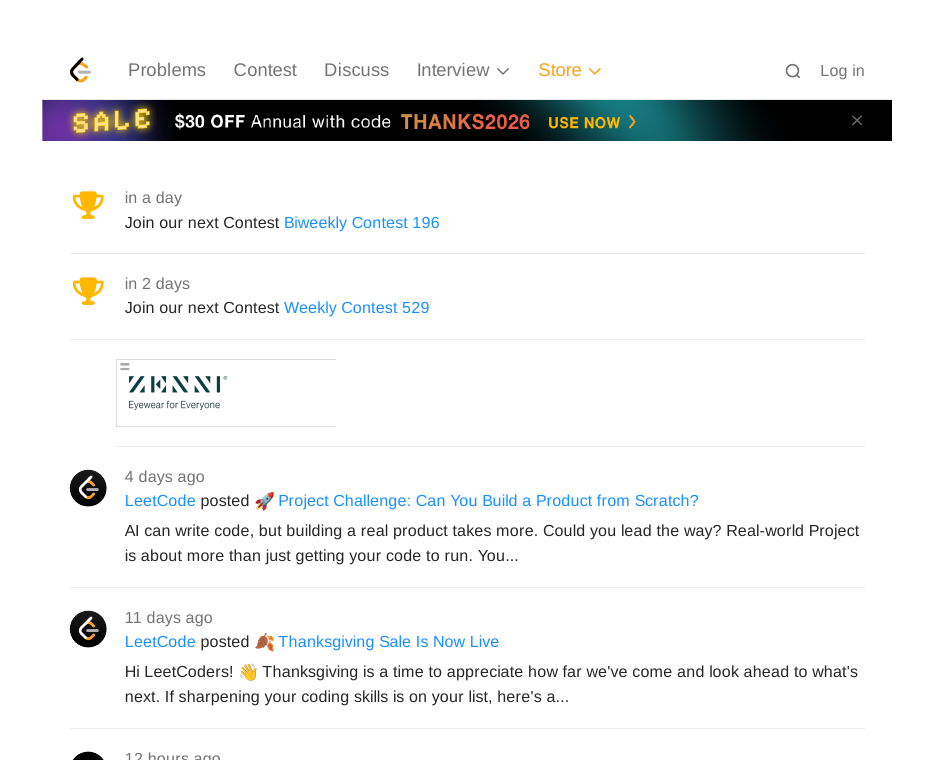
The LeetCode homepage, read 20 November 2026. There is no marketing hero: the logged-out page is a community feed, topped by a "$30 OFF Annual with code THANKS2026" sale banner and entries for Biweekly Contest 196 and Weekly Contest 529, followed by Discuss posts and interview experiences.
The homepage we read on 20 November 2026 has no sales pitch at all. The top of the page is a feed: contest announcements, a project challenge post, a Thanksgiving sale post, and recent Discuss threads — an Amazon SDE II interview experience, a hackathon write-up. The header links are Problems, Contest, Discuss, Interview and Store.
That is the funnel, and it is upside down from the usual one. The visitor is not asked to buy, or even to look at a price — the feed is the product, and the habit is the hook. A candidate who comes back for the daily problem and the next contest is already inside the loop before Premium is ever mentioned.
Two prices, one decision
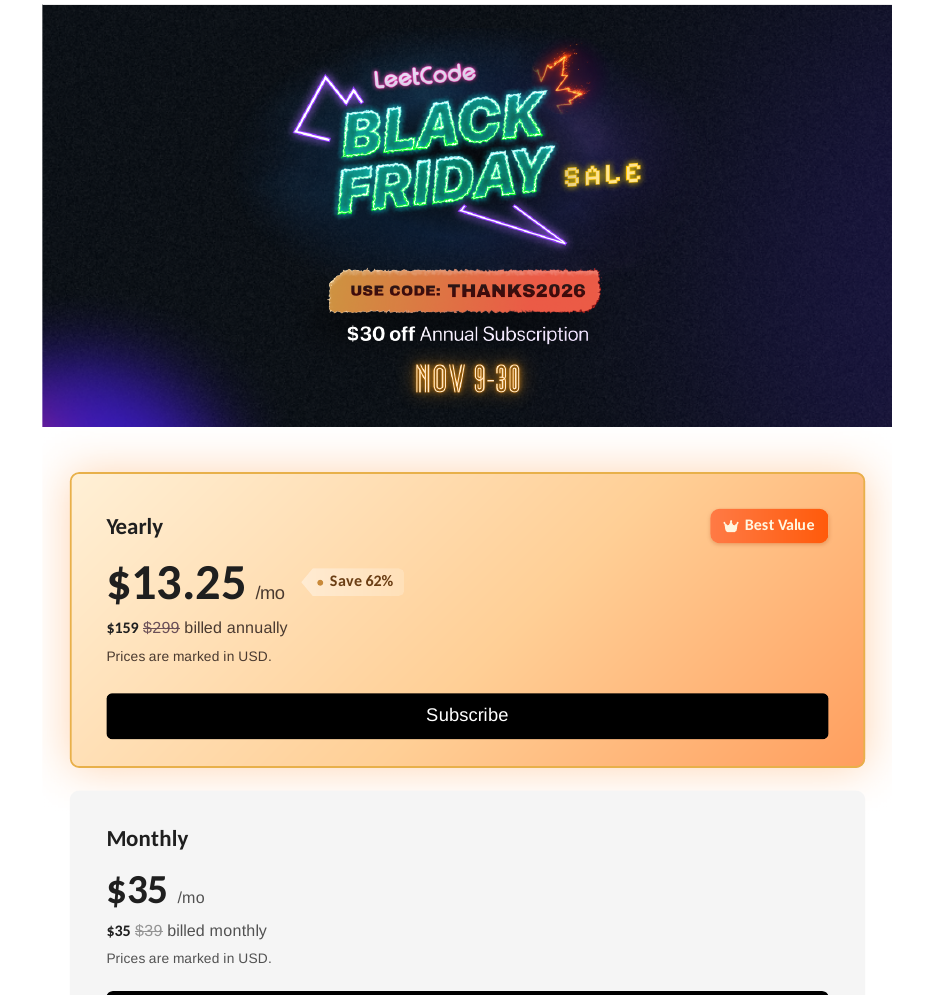
The LeetCode Premium subscribe page, read 20 November 2026. A Black Friday hero shows "$129 $159" for the annual plan with code THANKS2026; below it the Yearly card reads $13.25 a month, "$159 $299 billed annually", "Save 62%", and the Monthly card reads $35 a month, "$35 $39 billed monthly". The capture shows the hero and both price cards, rendered from the live browser's full-page save.
The subscribe page keeps the same order as the homepage: the sale first, the price second. The hero is a Black Friday banner — "$30 off Annual Subscription", code THANKS2026, 9–30 November — and the two cards sit below it. Yearly is marked "Best Value" at $13.25 a month; Monthly is $35 a month.
The page's own numbers frame the pitch. There is no trial period anywhere on the page — the free tier is the trial. The only thing that changes between the plans is the commitment: twelve months at $159, or one month at a time at $35.
Three ways to pay, one of them quoted
| Plan | Price | What it is |
|---|---|---|
| Free | $0 | 3,000+ free problems, standard judging, contests and the Discuss forum; no card required |
| Premium Monthly | $35 / month (list $39) | Company-tagged questions with frequency sorting, Premium-only problems, official solutions, mock interviews, Ask Leet AI credits and priority judging |
| Premium Yearly | $159 / year, $13.25 a month (list $299) | The same Premium features as Monthly, billed once a year; marked "Save 62%" against twelve months at $35 |
| Student group | $119 / year (third-party read) | Yearly Premium for groups of 50 or more students from the same school; list $179 |
| Enterprise assessments | Quoted, no public price | LeetCode Interview and online assessments for employers, plus contest sponsorship and training |
Prices from the LeetCode subscribe page, read 20 November 2026 (list prices $39 and $299 shown on the page); current prices $35 and $159 confirmed by third-party reads of the same page, 14 October–17 November 2026. The student group price is a third-party read of the schools page. Enterprise pricing is not published anywhere on the site.
What 12 months costs

Twelve months at the monthly rate costs $420; the yearly plan costs $159, and the Black Friday code takes it to $129. The yearly plan is the whole discount: there is no other way to pay less.
Arithmetic from the published prices, 20 November 2026. The $129 Black Friday price was verified on the live subscribe page, 20 November 2026.
One plan, two commitments. The yearly plan pays for itself in about five months — four months at $35 is $140, five months is $175, and the year costs $159 — so the break-even sits just past four and a half months. Third parties give the same advice: buy one $35 month once interviews are scheduled, buy the year only for a long preparation run.
The missing price is the point. There is no annual billing option to sell beyond the year itself, and no trial to convert — the retention pitch is the discount. A subscriber who stops preparing cancels, and the subscription runs to the end of the period with no refund in most cases.
What the subscription is made of
| Mechanism | Hit | Why, in one line |
|---|---|---|
| Free tier | ✓ | Free account with 3,000+ free problems, standard judging, contests and Discuss (third-party read of the subscribe page, 14 October 2026) |
| No sign-up to browse | 未核到 | Problems can be browsed without signing in; whether they can be submitted without an account is not stated on the pages read |
| Free trial | — | No trial period is published anywhere on the site; a third-party read states there is currently no free trial |
| Daily challenge | ✓ | One new problem a day, updated on UTC, with a monthly perfect-attendance lucky draw (Wikipedia, citing the help centre) |
| Weekly contests | ✓ | Weekly and biweekly contests, four problems each, with a personal ranking on first entry (Wikipedia) |
| Contest ranking | ✓ | Contest rankings show on the profile page after competing (Wikipedia) |
| Discuss community | ✓ | Forum for problem discussion, interview process and experience reports; the homepage itself is the feed (live browser read, 20 November 2026) |
| Auto-renewal | ✓ | Monthly and yearly plans both auto-renew; cancel before the renewal date to avoid the next charge (official help centre) |
| Yearly discount lock-in | ✓ | Yearly $159 against 12 × $35 = $420, marked "Save 62%", locking the subscriber in for 12 months (subscribe page, 20 November 2026) |
| Cancel keeps access | ✓ | After cancelling, the subscription stays active until the end of the current billing period (subscribe page FAQ and help centre) |
| Refunds | — | Fees are generally non-refundable and not prorated; refund requests are reviewed case by case and may be granted as exceptions (Terms, 5 April 2024; help centre) |
| Student group price | ✓ | $119 a year, list $179, for groups of 50 or more students from the same school (third-party read of the schools page) |
| Enterprise assessments | ✓ | LeetCode Interview, online assessments, contest sponsorship and training exist (official About page); the price is not published |
| Ask Leet AI assistant | ✓ | Premium members get 500 extra monthly credits and up to 30 solution analyses a day (subscribe page, 20 November 2026) |
| Cloud save and Playgrounds | ✓ | Code and layouts save to the cloud; unlimited Playgrounds with folders (subscribe page, 20 November 2026) |
| Email marketing | 未核到 | No newsletter signup or paid-conversion email sequence was seen on the pages read |
| Public API | 未核到 | No official public API was found; the unofficial GraphQL interface does not count |
| Ads on the site | — | No evidence of advertising as a revenue line; a third-party ad-income model is a hypothetical calculation, not a business line |
| Loyalty programme | — | No points or membership tiers were found; the monthly attendance draw is a participation incentive, not a loyalty plan |
| Mobile apps | ✓ | iOS and Android apps exist; store purchases must be cancelled inside the store, not by deleting the app (third-party read, 24 October 2026) |
| Progress lock-in | ✓ | Solved problems, submission history, contest rankings and saved lists all live in the account; switching platforms means rebuilding them |
The table is what is missing as much as what is there. There is no trial, no loyalty programme and no public API. The retention tools are the discount ladder, the daily habit, and the record itself — the problems a candidate has solved, the contests they have ranked in, and the lists they have built.
One number on the page does not match the company story. The site counts 37.38 million visits a month, and the About page speaks of hundreds of thousands of active users — but how many of those visitors pay $35 or $159 is not published. The renewal only works if enough of them convert.
What outsiders say
Review scores, read 22 November 2026

Two kinds of reviewers rate two different things. Product reviewers on G2 and SourceForge score the practice platform itself — 4.5 and 3.8 out of 5 — while Trustpilot, where buyers review the company, sits at 1.9 out of 5 from 26 reviews.
Review scores: G2 4.5/5 (15 reviews), SourceForge 3.8/5 (4 reviews), Trustpilot 1.9/5 (26 reviews), all read 22 November 2026. Capterra has no LeetCode entry, so no score is given for it.
The Trustpilot complaints cluster on one theme: the renewal. Review after review describes an annual Premium charge arriving with no reminder, followed by a refused refund — the same two facts the pricing section already states. One reviewer says support told them to withdraw a card dispute so a refund could be issued, then refused it. The BBB file counts 118 complaints in three years, many of them about the same renewal charge.
The split is the point. The product keeps its reputation — the daily challenge, the contests, the problem bank — while the billing experience is what buyers warn each other about. A subscription business that auto-renews into silence can afford that split only while the product stays the default.
37.38 million visits, and most of them type the brand name
From 38 million to 37.38 million
Monthly visits, August to October 2026

October was 37.38M, down 1.68% on September's 38.02M, after August's 36.01M. The three months wobble around the high thirties of millions; the level does not move.
Monthly visits, Semrush, August to October 2026. Third-party estimates, not official MAU/DAU.
The traffic line is the interview calendar, not the brand. October fell 1.68% from September, to 37.38 million — but the site still sits 20th in a database of 901, between Calendly at 39.11 million and ClickUp at 36.99 million.
The shape of the line is the argument. August was 36.01 million, September 38.02 million, October 37.38 million — a wobble, not a trend. What does not wobble is the direct share: almost half of visits arrive direct, which is what a daily habit looks like.
Where the visits come from
| Channel | Share of visits | Platform & stack |
|---|---|---|
| Direct | 49.59% | Semrush's top channel, October 2026; the second source is google.com at 13.12% of the journey |
| Organic search | Second channel | Semrush, October 2026; the channel share was not published, so none is given here |
| AI referrals | ChatGPT 113K visits | Semrush, October 2026; Gemini 25K and Claude 24K follow; no total is given |
| Referring domains | 129.39K | Semrush, October 2026; backlinks 58.69M, up 10.03% on the month |
| Average session | 17:42 | Semrush, October 2026; a long session for a site most people open to solve one problem |
| Platform | — | Next.js: the homepage and subscribe page both serve static assets from /_next/static/ paths (observed 20 November 2026) |
| Hosting | — | Not verified; BuiltWith returned HTTP 403 to this round's read, so no count is given |
| Payment | — | Billing contact billing@leetcode.com (help centre); supported card types and PayPal were not verified on the pages read |
| Analytics | — | Not verified; BuiltWith returned HTTP 403 to this round's read, so no tool is named |
| Advertising | — | Meta Ad Library returned HTTP 403 to this round's read, so no ad count is given; not a zero |
| Referral loop | — | NeetCode (3.59M visits) sends its visitors to leetcode.com first; LeetCode's own audience also visits NeetCode and takeuforward.org |
Marketing channels, Semrush, October 2026; technologies, observed from the LeetCode site, 20 November 2026. BuiltWith returned HTTP 403, so no BuiltWith count is given. The two traffic sources use different definitions, so their shares are not added together.
Direct is the whole story: 49.59% of visits on Semrush, and the next source is google.com at 13.12%. The site is linked to far more than it is visited: 58.69 million backlinks from 129,390 referring domains, up 10.03% on the month.
The stack matches the story. One framework is visible — Next.js, from the /_next/static/ asset paths — and the rest is not published. The distribution is the habit: candidates return daily for the new problem, weekly for the contest, and the brand name is the search term.
What people search for
Search here has one head, not two. Semrush's top organic keyword for the site is the brand itself: "leetcode" at 1,830,000 searches a month, 57.99% of organic traffic, followed by "leetcode login" at 246,000. No pricing or review phrase makes the top five.
Top organic keywords, October 2026
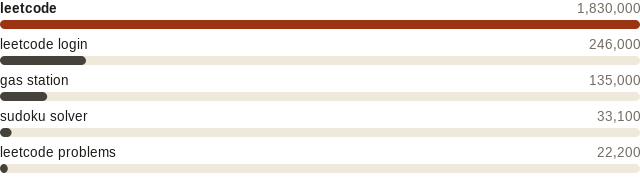
The brand word dwarfs everything else: 1,830,000 searches a month for "leetcode" against 246,000 for "leetcode login". The long tail is the problem bank itself — "gas station" is a problem name, and it brings 135,000 searches a month on its own.
Monthly search volumes, Semrush, October 2026. The seven target phrases for this teardown (leetcode premium pricing, leetcode premium worth it and the rest) returned no Semrush volume this round, so no volume is given for them.
What the numbers do show is that the audience arrives by brand name: the traffic belongs to the name, not the marketing. The long tail is thousands of problem pages, each carrying one small keyword — "gas station" at 135,000, "sudoku solver" at 33,100, "leetcode problems" at 22,200.
A crowd five times smaller
| Site | Monthly visits | Free tier | Starting paid price |
|---|---|---|---|
| LeetCode | 37.38M (Semrush, Oct 2026) | Free, 3,000+ problems | Premium $35 a month or $159 a year |
| Codeforces | 7.32M (Semrush, Oct 2026) | Free contest platform | No paid tier found |
| HackerRank | 6.11M (Semrush, Oct 2026) | Free personal practice | Enterprise quoted; published prices conflict |
| NeetCode | 3.59M (Semrush, Oct 2026) | Free course roadmaps | Pro $119 a year or $297 lifetime |
| Codewars | 883.08K (Semrush, Oct 2026) | Free practice platform | No paid tier found |
Rival visits, Semrush October 2026 reads; the four rivals are outside the master table and are marked as such. Rival prices, the rivals' pricing pages and third-party reads, 20 November 2026. HackerRank's enterprise prices conflict across sources, so none is quoted here.
Monthly visits, October 2026
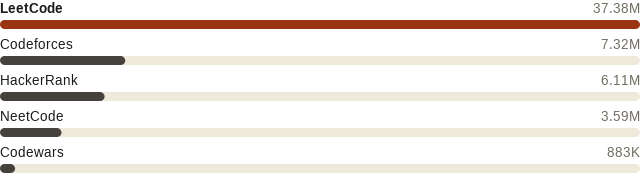
LeetCode draws 37.38 million visits a month — five times Codeforces at 7.32 million, six times HackerRank at 6.11 million, and ten times NeetCode at 3.59 million. The gap is the default: when a candidate says "grind LeetCode", the name is the category.
Monthly visits, October 2026 third-party estimates; the four rivals are outside the master table, read from Semrush on 20 November 2026.
The revenue estimates disagree by four times

Three third-party revenue estimates, none of them audited: $8M, $14.2M and $33.7M. The spread is the honest number here — the company publishes no revenue and no profit figure, so the range is all there is.
Third-party revenue estimates, 2024; no audited figure is published. One further claim of more than $250M in annual recurring revenue was found with no source and is not used here.
The rivals are smaller — Codeforces at 7.32 million visits is a fifth of LeetCode — and the cheapest way to prepare is not LeetCode's Premium but Codeforces, which charges nothing at all. What LeetCode sells against them is the shortlist: company-tagged questions, frequency sorting and mock interviews for the weeks before the real one.
The funding does not split the field either. LeetCode raised $11.7M in total — a $1.7M round in March 2021 and a $10M Series A in December 2021 — and nothing since. HackerRank, the enterprise rival, raised $114.02M. LeetCode has run ten years on the smaller pile, which is the closest thing to a profitability signal the public record offers.
Ten years on $11.7M
From a side project to a Series A, 2015–2025
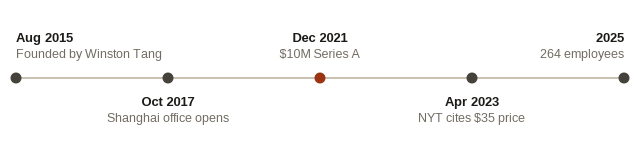
Ten years, two funding rounds, and nothing since December 2021. The company was founded in August 2015, opened a Shanghai office in October 2017, and raised its $10M Series A in December 2021 — then kept selling the same subscription.
Milestones: founded 7 August 2015 (Wikipedia); Shanghai office October 2017 (company release); Series A $10M, Lightspeed China Partners, December 2021 (Wikipedia, citing Yicai Global); The New York Times cites the $35 monthly price, 5 April 2023 (Wikipedia); 264 employees in 2025 (LeadIQ, via Wikipedia).
The timeline is the retention story in another form. No new funding in almost five years, no acquisition, no listing — the business has to pay for its 264 employees out of subscriptions and enterprise assessments. The $159 yearly plan is what makes that arithmetic work.
LeetCode is the only site in the Coding interview prep collection. Compare LeetCode with Quizlet side by side.
The full teardown is for members
The full analysis of pricing, acquisition, conversion and retention is member content. Membership is $29 a month or $249 a year.
Similar sites in the database
LeetCode (37.38M) sits between Calendly (39.11M) and ClickUp (36.99M) in the database.
| Site | Category | Monthly visits | Source |
|---|---|---|---|
| Calendly | Scheduling tools | 39.11M | Semrush, Oct 2026 |
| ClickUp | Project management | 36.99M | Semrush, Oct 2026 |
| CloudConvert | File conversion | 35.41M | Semrush, Oct 2026 |
Compare LeetCode with Quizlet side by side. The full database, with working filters, is on the teardowns index. The Coding interview prep collection has the one coding interview prep site in one place.
Read the next one in your inbox
The new ones go out by email first, one a week, with the traffic source and month attached to every number. Leave your address and the next one comes to you.