
How Luma AI makes money: credits, not clips
Monthly visits
2.91M
October 2026. Third-party estimate, not official MAU/DAU. Semrush counted 2.91M for the month, down 4.37% on September.
Luma AI draws an estimated 2.91M visits a month (October 2026, Semrush), down 4.37% on September after 3.54M in August. It is the 181st-largest site in our database of 901, one place behind The Farmer’s Dog at 2.93M.
The pitch fits in one line: no free tier, just credits. From $30 to $300 a month, a subscription buys 10,000 to 150,000 credits for AI video and image generation — and whatever is left at month’s end simply disappears.
| Site | Luma AI, lumalabs.ai |
|---|---|
| What it is | AI video and image generation platform (Luma Agents, Ray 3.2, UNI-1): text-to-video, image-to-video, plus third-party models including Veo, Kling and Sora |
| Who it is for | Creative teams, agencies and brands, and independent creators who need finished video and images fast |
| Category | Video tools |
| Monthly visits | 2.91M, October 2026. Third-party estimate, not official MAU/DAU; Semrush, down 4.37% on September (3.04M) and 3.54M in August |
| Founded | 2021, per the company’s own about page; the first web capture is 29 October 2021 |
| Headquarters | Redwood City, California (per the about page; third-party profiles still list Palo Alto) |
| Operator | Luma AI, Inc. |
| Survival engine | Recurring-revenue-led. Three credit plans — Plus $30, Pro $90, Ultra $300 a month — buy 10,000, 40,000 and 150,000 credits that reset monthly, with extra spending on top. APIs and Claude/ChatGPT integrations spread the same credit pool into other people’s workflows. The company has also raised about $1.06 billion in venture funding |
| Pricing | Plus $30 a month (10,000 credits, $300 a year); Pro $90 a month (40,000 credits, $900 a year); Ultra $300 a month (150,000 credits, $3,000 a year). Source: the site’s own pricing page, read 25 November 2026 |
| Pricing model | Credit subscription; credits reset monthly and do not roll over; extra spending capped by the user; Team and Enterprise by quote |
| Free hook | Trial credits only — no free plan on the pricing page, and the trial amount is not published |
| Meta ads | About 90 active ads from the official Luma page (Facebook Page ID 128208393698608), read 25 November 2026; a keyword search returns about 1,300 results, most from unrelated advertisers |
| Country breakdown | United States 28.5% (828.98K), India 11.89% (345.74K), United Kingdom 4.55% (132.38K) (Semrush, October 2026) |
TL;DR
- Luma AI charges $30–$300 a month for credits: 2.91M monthly visits, no free tier, only trial credits before you pay.
- The money is subscriptions: credits reset monthly, unused credits expire, and overages bill on top — renewals are the engine.
- The catch is trust: Trustpilot sits at 1.4 from 72 reviews, mostly about credits burned on failed generations, while traffic falls 4.37%.
No free tier, just credits: the subscription is the product
Three plans, one meter: the credit
| Plan | Price | Credits a month | Agents usage | Cancel and refund |
|---|---|---|---|---|
| Plus | $30 a month, $300 a year ($25 a month billed yearly) | 10,000 | Base usage | Cancel in settings or by email, at least 1 day before the term ends; fees non-refundable |
| Pro | $90 a month, $900 a year ($75 a month billed yearly) | 40,000 | 4x usage with the Luma Agents | Cancel in settings or by email, at least 1 day before the term ends; fees non-refundable |
| Ultra | $300 a month, $3,000 a year ($250 a month billed yearly) | 150,000 | 15x usage with the Luma Agents | Cancel in settings or by email, at least 1 day before the term ends; fees non-refundable |
| Team | Contact us | Shared team credits | Team management, SSO, usage analytics | — |
| Enterprise | Contact us | Committed usage | Custom fine-tuning, dedicated training | — |
The meter is the credit. A Ray 3.2 clip at 1080p, five seconds long, costs 400 credits — so a Plus subscription buys about 25 of them a month, Pro about 100, Ultra about 375. Third-party models cost more per second: Veo 3.1 runs 140 credits a second, against 80 for Ray at the same resolution, so asking for Veo by name is asking for a premium. The pricing page lists a rate for every model, resolution and length, and shows the total before each generation.
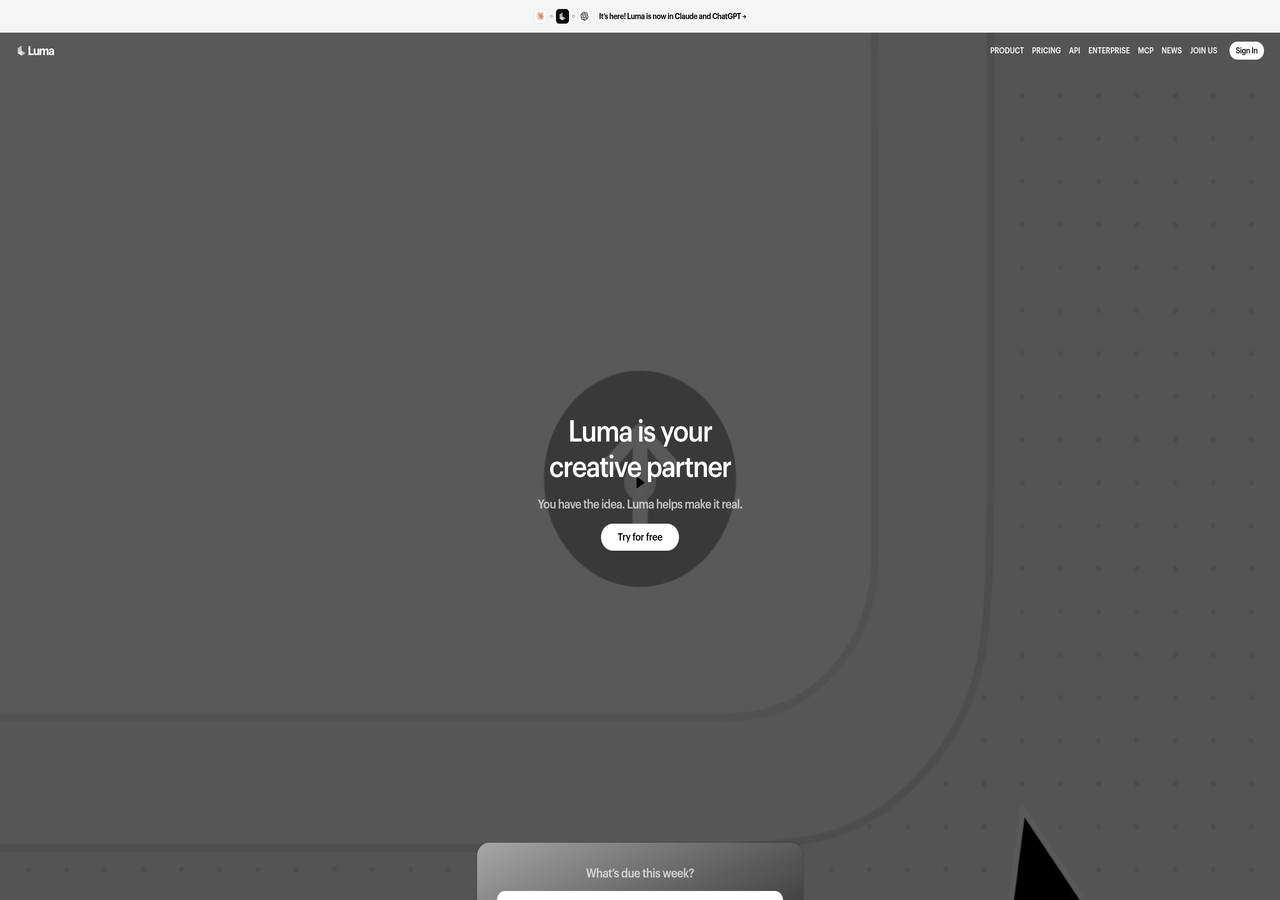
The homepage leads with the new positioning: “Luma is your creative partner”, with a banner announcing Luma is now in Claude and ChatGPT. Screenshot of the Luma AI homepage, read 25 November 2026.
The three tiers differ in almost nothing but the credits. Pro adds four times the usage with the Luma Agents, Ultra fifteen times — and the pricing page never defines what that multiple means. No feature is tied to a higher tier: the same models, the same commercial use, the same guest collaborators. One independent review put it plainly: choose a tier by credits, not features. That is the whole upsell — when 10,000 credits run out mid-project, the next tier is the only way to keep the same tools.

What the monthly credits buy, at 400 credits per Ray 3.2 clip: Plus covers about 25 five-second clips a month, Pro about 100, Ultra about 375. Pricing page, read 25 November 2026.
The free tier is gone, and the history shows when. Dream Machine launched in June 2024 with 30 free generations a month and a top plan at $499 — Tom’s Guide covered the launch, and the queue was 120 seconds on day one. Two years later the pricing page lists three paid plans and no free one; the only way in without paying is trial credits, and the amount is not published anywhere on the page. The product moved upmarket while the search demand stayed with the old name.
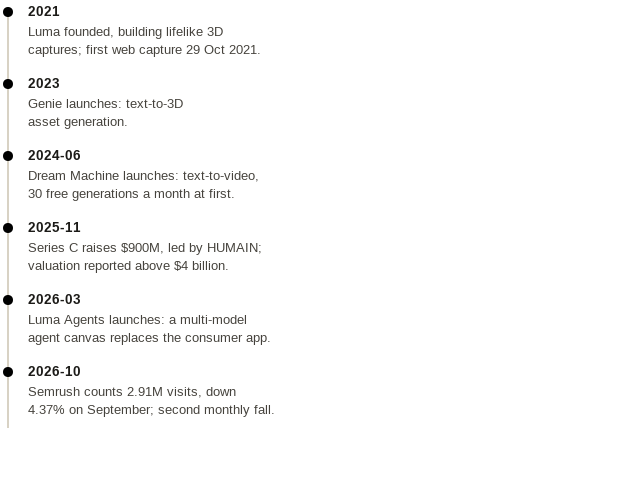
From 3D captures in 2021 to a credit-priced agent workbench in 2026. Dates from the company’s own about page, the Wayback Machine and the Series C announcement.
About page, first party; Wayback Machine CDX, read 25 November 2026; Business Wire, 19 November 2025.
Underneath the subscriptions sits a pile of venture money. Luma raised $900 million in a Series C in November 2025, led by HUMAIN, at a reported valuation above $4 billion — Business Wire carried the announcement, and TechCrunch confirmed it in January 2026. The round brings the total raised to about $1.06 billion across five rounds, by third-party counts; the company’s own page says more than $1.1 billion. That money, not the subscriptions, is what pays for the model training and the 2-gigawatt compute cluster the round was announced alongside.
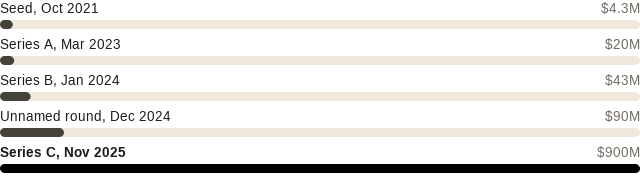
Five funding rounds, third-party reported: the $900M Series C of November 2025 is twenty times the size of the four rounds before it combined. Business Wire, 19 November 2025.
Business Wire, 19 November 2025; earlier rounds per third-party reporting.
Agents and APIs spread the same credit pool — and the reviews say the pool leaks
The brand word is an old product name
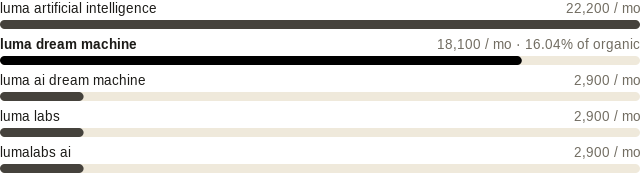
Brand words dominate the search table, and the biggest traffic word is the old product name. Semrush, October 2026, read 25 November 2026.
Search still asks for the product Luma has moved past. “Luma dream machine” draws 18,100 searches a month and 16.04% of the site’s organic traffic — the largest single word in the table — while “luma artificial intelligence” draws 22,200 but only 3.24%. The new positioning, Luma Agents, has no search word in the top five at all. A visitor arrives looking for the free video app of 2024 and finds a $30-a-month agent workbench instead.

Desktop journeys, Semrush October 2026. “Other sources” is the remainder after Direct and google.com.
Semrush, October 2026, read 25 November 2026.
Direct traffic is the largest slice at 45.02% of desktop journeys, and google.com is next at 26.26% — bookmarks, return visits and traffic no referrer explains. The AI channel is still small: Gemini sent about 22,000 visits in October, ChatGPT 12,000, about 1.2% of the month between them. Paid search has almost stopped: down 95.77% in the month, while organic search fell 7.26%. The audience also visits lunaai.video, aivideogenerator.me and invideo.io — three more AI video tools, which says the loyalty here is to the job, not the brand.
What keeps people coming back
| Mechanism | Status | What we found |
|---|---|---|
| Free tier | — | No free plan on the pricing page; only trial credits of an unpublished amount |
| No registration | — | An account is required; the free trial needs a sign-in |
| Trial | ✓ | Free trial credits; the pricing page and FAQ both promise them, the amount is not published |
| Ads | — | No ad scripts in the homepage code; no “ad-free” perk on the pricing page |
| API | ✓ | Luma API live; Uni-1 priced per token |
| Batch generation | ✓ | Agents generate in parallel across video, image, audio and text |
| Commercial use | ✓ | Commercial use is an included right on every paid plan |
| Credits | ✓ | Monthly credits by plan; balances reset and do not roll over |
| Overage cap | ✓ | Users can set an extra spending limit; generation pauses at the limit |
| Team sharing | ✓ | Team plan shares credits, with SSO and usage analytics |
| Mobile app | ✓ | iOS app exists (App Store 4.5 from 1.8K ratings); Android not verified |
| Claude / ChatGPT | ✓ | “Luma is now in Claude and ChatGPT” (homepage banner, 25 November 2026) |
| Cancel | ✓ | Cancel in account settings or by email, at least 1 day before the term ends (Terms of Service, 14 May 2026) |
| Refund | — | All fees are final and non-refundable unless Luma decides otherwise (Terms of Service) |
| Skip / pause | Not verified | No subscription pause found; skip does not apply to a credit subscription |
| Email list | Not verified | No newsletter form found on the homepage or pricing page |
| Referral rewards | Not verified | No referral terms found; a Creator Program is reported but not verified |
| Gift subscription | — | No gift subscription found |
| Loyalty scheme | — | No loyalty scheme found; subscription credits are a spending unit, not a reward |
Retention here is a meter, not a lock-in. There is no streak to protect and no feed to open — but the credits reset monthly, so a subscriber who stops paying loses the balance, and a heavy user who runs out can set an extra spending limit that stops the moment it is hit. The 14-day refund that image tools offer does not exist: the terms say all fees are final and non-refundable. The subscription renews automatically, and cancelling means telling Luma at least a day before the term ends.
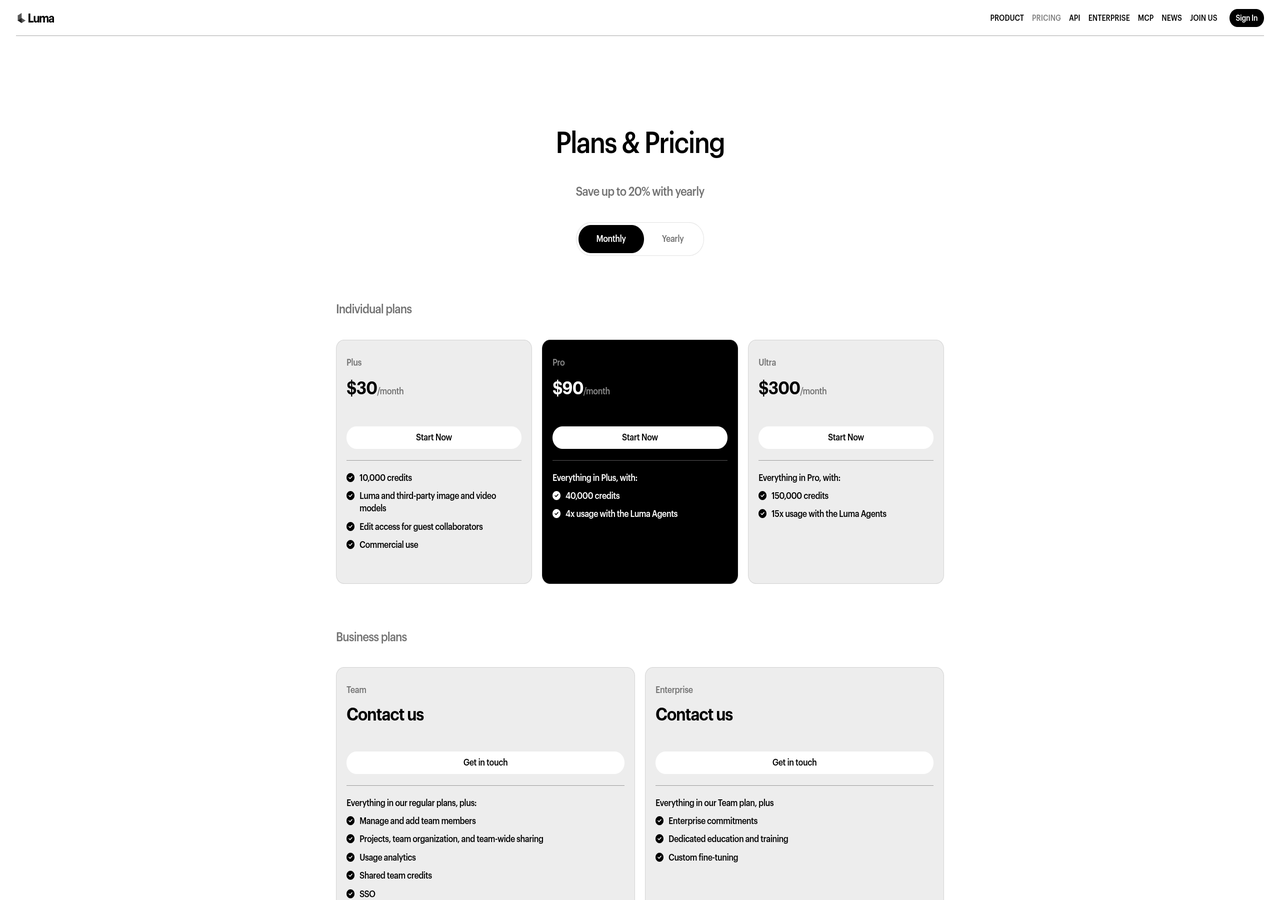
The pricing page sells the meter: three plans, 10,000 to 150,000 credits a month, and no free tier anywhere on the page. Screenshot of the Luma AI pricing page, read 25 November 2026.
The pricing page is honest about what the free tier costs — there is not one. Starter’s list in other tools is a list of free limits; here the page opens with the price. Team and Enterprise are both “Contact us”, with shared credits, SSO and usage analytics for teams, and committed usage, dedicated training and custom fine-tuning for enterprises. The yearly toggle promises 20% off, and the footer adds the trust lines: trial credits and commercial use on every plan.

Two outside scores, two different products: Trustpilot rates the company’s billing, the App Store rates the app. Trustpilot and App Store, read 25 November 2026.
Trustpilot, 72 reviews; App Store, 1.8K ratings; read 25 November 2026.
The outside scores disagree, and the gap is the story. Trustpilot gives the company 1.4 out of 5 from 72 reviews, 86% of them one star, read 25 November 2026. The complaints repeat one charge: credits burned on failed generations, with no way to cancel online and refunds refused. The App Store tells the other side: the Dream Machine app scores 4.5 from 1.8K ratings. One is the website’s billing; the other is the app’s craft — and the billing is what subscribers pay for.
Traffic is slipping, and the funnel narrows with it

Three months of visits, Semrush: 3.54M in August, 3.04M in September, 2.91M in October 2026 — down 4.37% in the month, the second fall in a row.
Semrush, October 2026, read 25 November 2026.
October is the warning, and it is the second in a row. Visits fell from 3.54M in August to 3.04M in September and 2.91M in October — down 4.37% in the month, after a 14.1% fall the month before. Organic search fell 7.26% in the same month. For a site with two income lines, the fall hits both: fewer visits means fewer trial users reaching the credit limit, and fewer API calls from the integrations that carry the same pool.
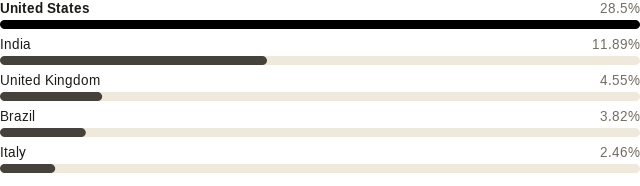
Visits by country, Semrush October 2026: the United States, India and the United Kingdom together are 44.94% of traffic.
Semrush, October 2026, read 25 November 2026.
The traffic is desktop-first where it matters most. In the United States 76.47% of visits are desktop, while in India 58.23% are mobile and in the United Kingdom 62.66% — the shape of a desk tool in the US and a phone tool in the growth markets. Backlinks are heavy — 596.91K links from 27.17K domains, up 34.91% in the month — which fits a year of funding news and model launches. The top three countries are 44.94% of all visits, so no single market decides the total.
| Channel | Share of visits | Platform & stack |
|---|---|---|
| Search (Google) | “luma dream machine” 18,100 searches a month, ranks 1st; brand words lead | Google organic search; the Learning Hub carries the SEO copy |
| Direct | 45.02% of desktop journeys | Browser bookmarks and typed URLs; unattributed traffic |
| Referral | Visitors leave for google.com and apple.com | — |
| Social | — | Facebook page 25.2K followers; Instagram @lumalabsai 500.7K followers (Ad Library, 25 November 2026); referral share not verified |
| AI chat | About 34,000 visits (Gemini 22K, ChatGPT 12K) | ChatGPT and Gemini referrals; about 1.2% of October visits |
| Backlinks | 596.91K links, 27.17K domains | Up 8.72% and 34.91% in the month; funding news and model launches |
| Subscriptions | Main revenue line by product design; scale not verified | Credit subscriptions via Stripe; fees final, non-refundable |
| API / Enterprise | Second revenue line; scale not verified | Luma API, Claude/ChatGPT connectors, Adobe Firefly integration |
| — | No email list found on the site |
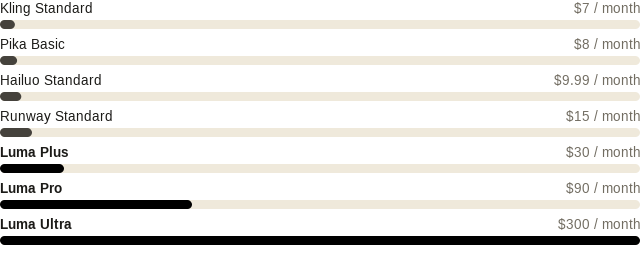
Monthly entry price of rival AI video tools, third-party-checked November 2026. Kling is $6.99 a month as an intro price, about $9 on renewal; Pika is $8 a month on annual billing.
Rival prices third-party-checked November 2026; Luma prices from its own pricing page, read 25 November 2026.
The rivals prove the category can charge less. Kling opens at $7 a month, Pika at $8, Hailuo at $9.99 and Runway at $15 — all third-party-checked in November 2026 — against Luma’s $30 entry. Sora, the giant in the room, shut its app in April 2026, which leaves Luma as one of the few places still selling access to Sora-family models. Luma’s bet is the bundle: every model in one credit pool, plus an agent canvas that plans the shoot.
| Area | What we found |
|---|---|
| Platform | Next.js site, content by Sanity CMS; pricing prices load by script |
| App | App runs at app.lumalabs.ai; the old /dream-machine/pricing redirects to /app |
| Models | Ray 3.2 (video), Uni-1/Uni-1.1 (image and multimodal); Veo 3.1, Kling 4.0, Seedance, MiniMax, Nano Banana, GPT Image, ElevenLabs audio |
| Output | Video up to 20 seconds (Ray, 1080p); images up to 4K; music up to 5 minutes |
| Analytics & payments | Segment and Stripe markers in the homepage code; no Google Analytics marker found in the static read |
| Languages | Multi-language briefs supported; interface language count not verified |
| Mobile app | iOS app live (App Store 4.5/5, 1.8K ratings); Android not verified |
| API | Luma API live; Uni-1 priced per token |
| Integrations | Claude and ChatGPT connectors (same account and credits); Adobe Firefly (third-party, May 2026) |
| Ads | None found in the homepage code; no “ad-free” perk on the pricing page |
Three things should not be quoted as facts. No subscriber count, conversion rate, API revenue, model cost or profit figure is published, so neither income line can be sized and the split between them cannot be proved. The terms say nothing about what happens to unused credits when a subscription is cancelled mid-term — the clause search for “credits” in the terms returns nothing. The Meta Ad Library shows about 90 active ads from the official Luma page, read 25 November 2026 — a snapshot, not a strategy.
The open question is the rebrand. Luma owns brand demand — “luma dream machine” draws 18,100 searches a month — but the demand is for a product the company has moved past, and the new agent workbench has no search word yet. If the Agents name catches on, the funnel widens and the credits catch more users; if it does not, subscriptions narrow with traffic, with no free tier and no email list to fall back on. Five years of survival is real. So is the point of failure.
All video tools tracked here are in the Video tools collection. Luma AI against its closest matches: compare Luma AI with Runway and VEED.io side by side. The closest pattern match among published teardowns is Runway — the same credits playbook, at half the entry price.
The full teardown is for members
The full analysis of pricing, acquisition, conversion and retention is member content. Membership is $29 a month or $249 a year.
Similar sites in the database
Luma AI (2.91M) sits between The Farmer’s Dog (2.93M) and Caudalie (2.9M) in the database.
| Site | Category | Monthly visits | Source |
|---|---|---|---|
| Img2Go | Image tools | 3.02M | Semrush, Oct 2026 |
| The Farmer’s Dog | Pet supplies / fresh dog food subscription | 2.93M | Semrush, Oct 2026 |
| Luma AI | Video tools / AI video generation | 2.91M | Semrush, Oct 2026 |
| Caudalie | Beauty / grape-seed skincare DTC brand | 2.9M | Semrush, Oct 2026 |
| Rogue Fitness | Fitness / strength training equipment DTC brand | 2.8M | Semrush, Oct 2026 |
Compare Luma AI with Runway and VEED.io side by side. The full database, with working filters, is on the teardowns index.
Read the next one in your inbox
The new ones go out by email first, one a week, with the traffic source and month attached to every number. Leave your address and the next one comes to you.