
How Nebula makes money from $6 subscriptions
Monthly visits
1.7M
October 2026. Third-party estimate, not official MAU/DAU. Semrush counted 1.7M for the month, down 13.92% on September (1.97M).
Nebula draws an estimated 1.7M visits a month (October 2026, Semrush), down 13.92% on September. It is the 252nd-largest site in our database of 920, just behind Cotopaxi at 1.71M and ahead of HexClad at 1.7M.
| Site | Nebula, nebula.tv |
|---|---|
| What it is | A creator-owned streaming service: documentaries, video essays, podcasts and classes from independent creators, with no ads |
| Who it is for | Viewers of educational YouTube creators — Wendover, Real Engineering, Jet Lag: The Game — who will pay for ad-free, early and exclusive originals |
| Category | Content · Creator-owned streaming |
| Monthly visits | 1.7M, October 2026. Third-party estimate, not official MAU/DAU; Semrush, down 13.92% on September (1.97M) |
| Founded | Launched 23 May 2019 with 75 creators; founder and CEO Dave Wiskus; parent company Standard Broadcast LLC |
| Headquarters | Not verified — no headquarters is disclosed on the site |
| Operator | Nebula Entertainment & Broadcasting LLC; parent Standard Broadcast LLC; CuriosityStream holds a minority stake since September 2021 |
| Survival engine | Repeat buying, paid up front by the year. The $6-a-month subscription is the only revenue line; the annual plan at $60 is the default, churn halved to 4.4% in 2023, and lifetime memberships sold $4.1M in one year |
| Pricing | $6/month or $60/year; annual via a creator link $36/year; lifetime $500 one-off; gift memberships $6, $60 or $500. Source: nebula.tv and nebula.tv/join, read 26 November 2026; lifetime and gift pages verified 27 November 2026 |
| Pricing model | Subscription only: monthly, annual (the default, marked best value) and a lifetime one-off; no free tier, no free trial; cancel anytime; the FAQ states no refund policy |
| Typical basket (derived) | Derived from listed prices and plan structure (November 2026): a typical paying subscriber pays $60 a year — the annual plan, which the join page marks best value at $5 a month effective. A monthly subscriber pays $6 a month. Nebula does not disclose real average order value, so this is a derivation, not a company figure |
| Free hook | None on the site — no free tier and no free trial. The free funnel is YouTube: videos reach YouTube a week after their Nebula premiere |
| Meta ads | No Nebula ads surfaced in the first results of a Meta Ad Library keyword search on 27 November 2026 (about 2,500 active keyword matches, mostly unrelated advertisers; advertiser suggestions were all astrology and psychic pages) — no exact own-ad count is published here |
| Country breakdown | United States 69.0% (1.17M); United Kingdom 5.82% (98.88K); Canada 4.0% (67.97K) (Semrush, October 2026) |
| Audience | Not verified — Similarweb’s public page showed “No Data to Display” for age and gender on 27 November 2026 (free search limit reached, not zero traffic) |
TL;DR
- Nebula sells the audience back to the creators: a $6-a-month subscription, paid up front by the year, funds the originals YouTube’s algorithm would never pay for — and half of any profit goes back to the creators.
- The company has never published Nebula’s revenue or profit. The parent company Standard is profitable, the CEO said in August 2024, and the direct-subscription numbers are strong: direct subscribers up about 200K in 2023, churn halved to 4.4%, lifetime value $75 against a $25 target acquisition cost.
- The traffic is the brand, not the category: all five top search terms are “nebula”, and direct visits are 49.52% of desktop traffic. Trustpilot gives 3.0 out of 5 from 34 reviews — but some of those reviews belong to an astrology app with the same name.
The subscription is the whole business
The homepage sells the creators, not the price
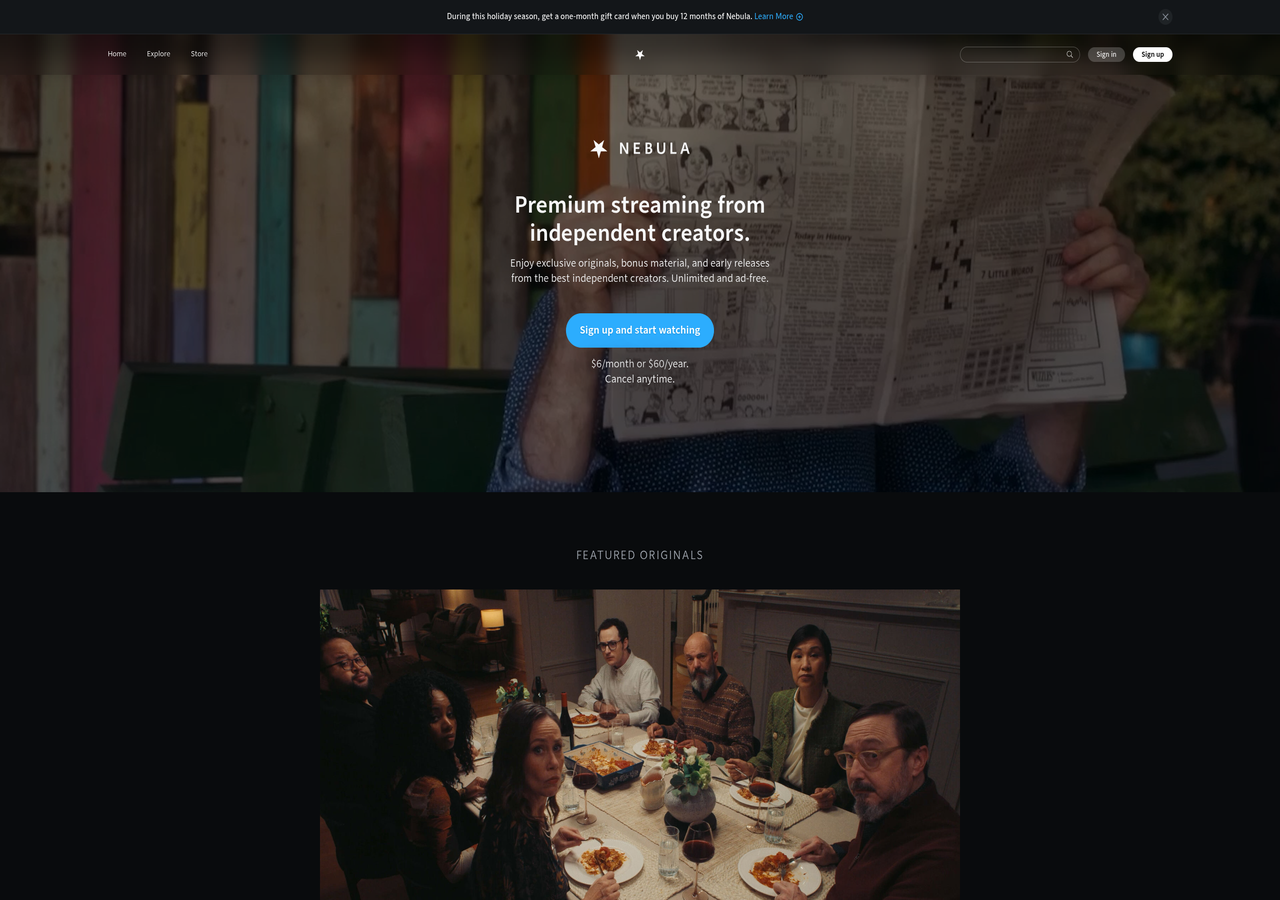
Screenshot of the nebula.tv homepage, read 26 November 2026. The hero names the owners — creator-owned and operated — and the price sits in the same breath: $6 a month or $60 a year, cancel anytime.
The first screen names the owners before it names the price. “Premium streaming from independent creators”, the homepage says, and underneath it the promise: exclusive originals, bonus material and early releases, unlimited and ad-free. The price follows in the same breath — $6 a month or $60 a year, cancel anytime.
The page sells the ownership model as the product. “Creator-owned and operated”, it says, and a longer line explains the point: the model “empowers creators to sustain their work financially and encourages innovation and creativity, without the constraints imposed by profit-driven external stakeholders.” The creators are the catalogue and the sales pitch at once.
The seasonal offer sits at the top of the page. During the holiday season, buying 12 months earns a one-month gift card, and the join page repeats the deal as “A year for you, a month for them”. The offer is temporary — it is due to be re-checked once the season ends — but the mechanism is permanent: the gift is the referral.
Search is the brand name
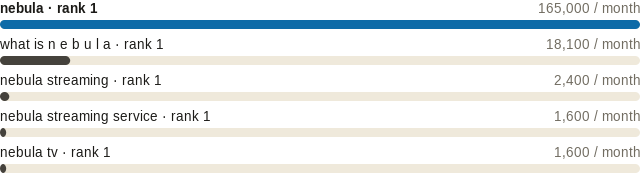
Semrush, October 2026 — monthly search volumes (last updated 11 November 2026).
Every one of the top five search terms is the brand name. “Nebula” brings 165,000 searches a month at rank 1, worth 10.01% of organic traffic, and the other four are the same word with a question attached: “what is n e b u l a” at 18,100, “nebula streaming” at 2,400, “nebula streaming service” at 1,600 and “nebula tv” at 1,600 — all rank 1.
That shape is a strength and a warning at once. Nobody discovers Nebula by searching for a category — they arrive already knowing the name, which is why direct visits are 49.52% of desktop traffic. The warning is underneath: organic search fell 42.98% in October, so the brand funnel is carrying a shrinking search funnel.
Seven years, one price rise at a time
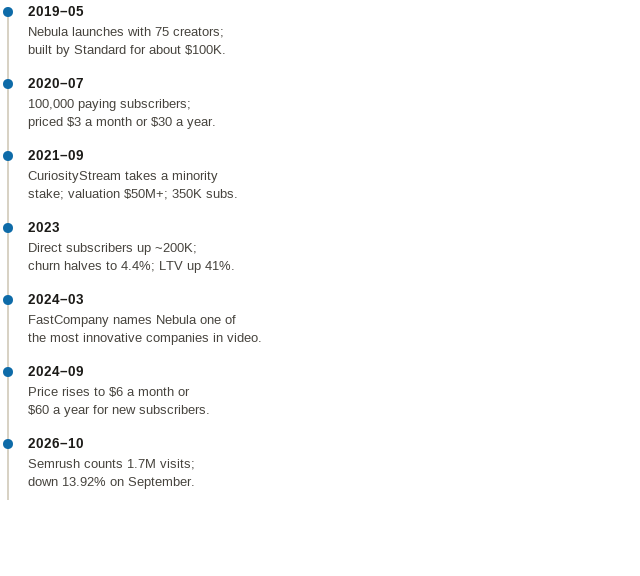
Company history; Wikipedia and Tubefilter (2019–2020), BusinessWire (2021), company blog (2023), FastCompany (2024), Semrush (October 2026). Revenue is not disclosed.
Nebula launched on 23 May 2019 with 75 creators, built by the parent company Standard for about $100,000 with two engineers. A year later it had 100,000 paying subscribers at $3 a month or $30 a year, and by September 2021 CuriosityStream had taken a minority stake at a valuation above $50 million, with 350,000 paying subscribers and retention above 80%.
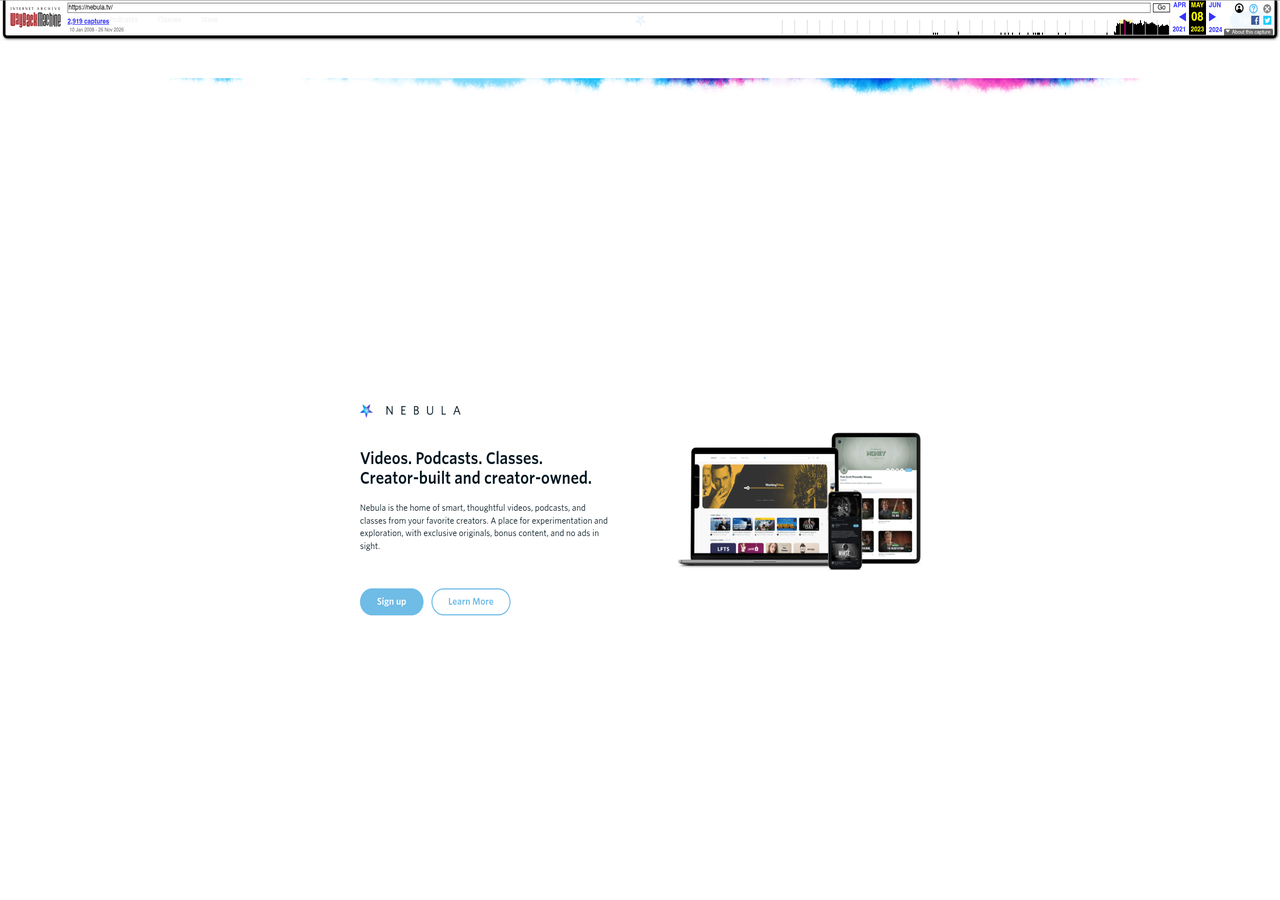
Wayback Machine snapshot of nebula.tv, 8 May 2023 — the earliest readable capture. No 2019 capture exists in the archive; the 2023 page already shows the finished idea at $5 a month or $50 a year.
The archive cannot show the launch. No 2019 capture of nebula.tv exists in the Wayback Machine at all — the calendar year is empty, and the captures around it are a parked-domain page, a redirect and blank pages. The earliest readable capture is 8 May 2023, and it already shows the finished idea: “Videos. Podcasts. Classes. Creator-built and creator-owned.”, at $5 a month or $50 a year.
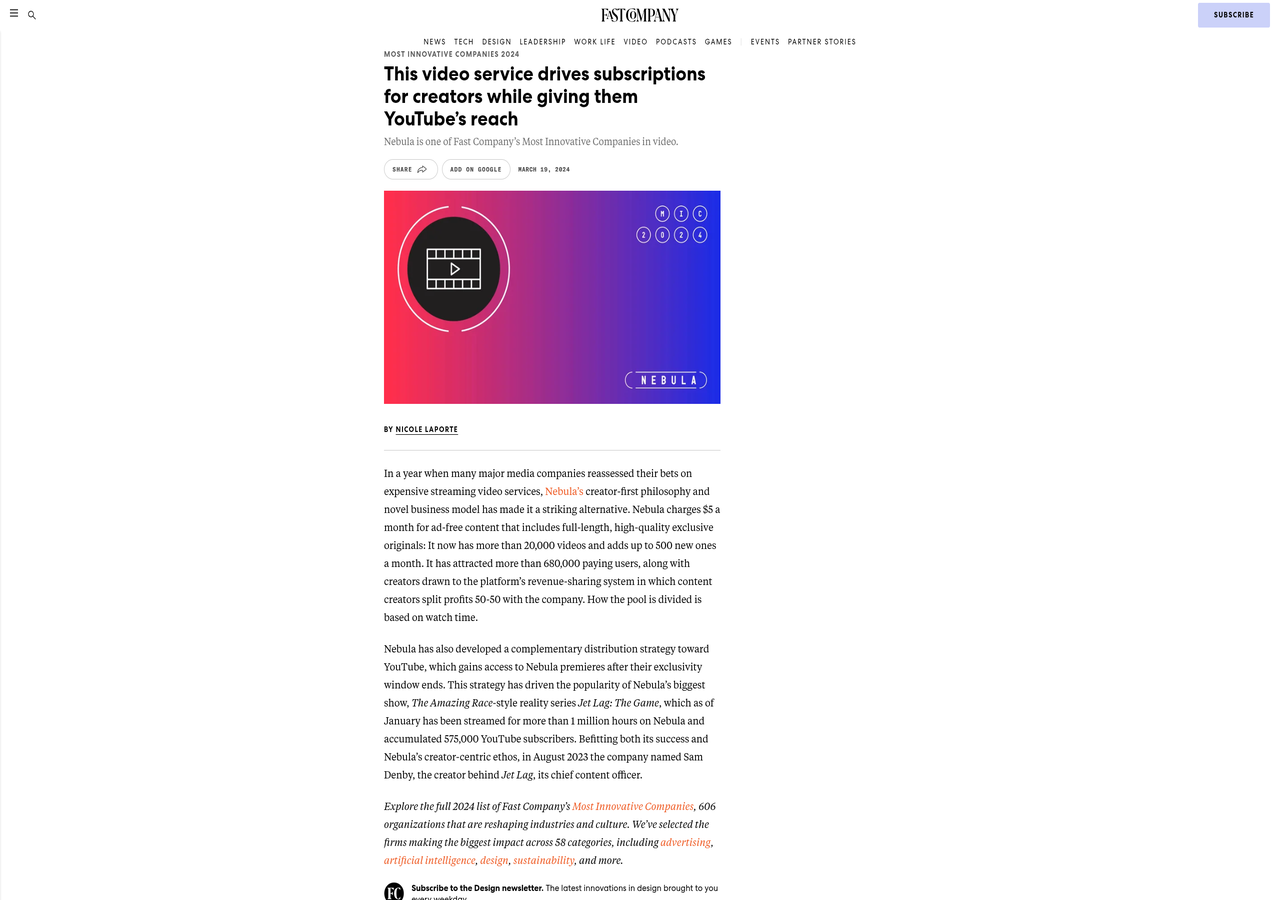
FastCompany, 19 March 2024. The article reported 680,000-plus paying users, 20,000-plus videos and up to 500 new videos a month, with Jet Lag streamed more than 1 million hours.
FastCompany named Nebula one of the most innovative companies in video in March 2024, and the numbers it reported are the growth story in one paragraph: 680,000-plus paying users, 20,000-plus videos, up to 500 new videos a month, and Jet Lag streamed more than 1 million hours. The price in that article — $5 a month — is already history: the rise to $6 came six months later.
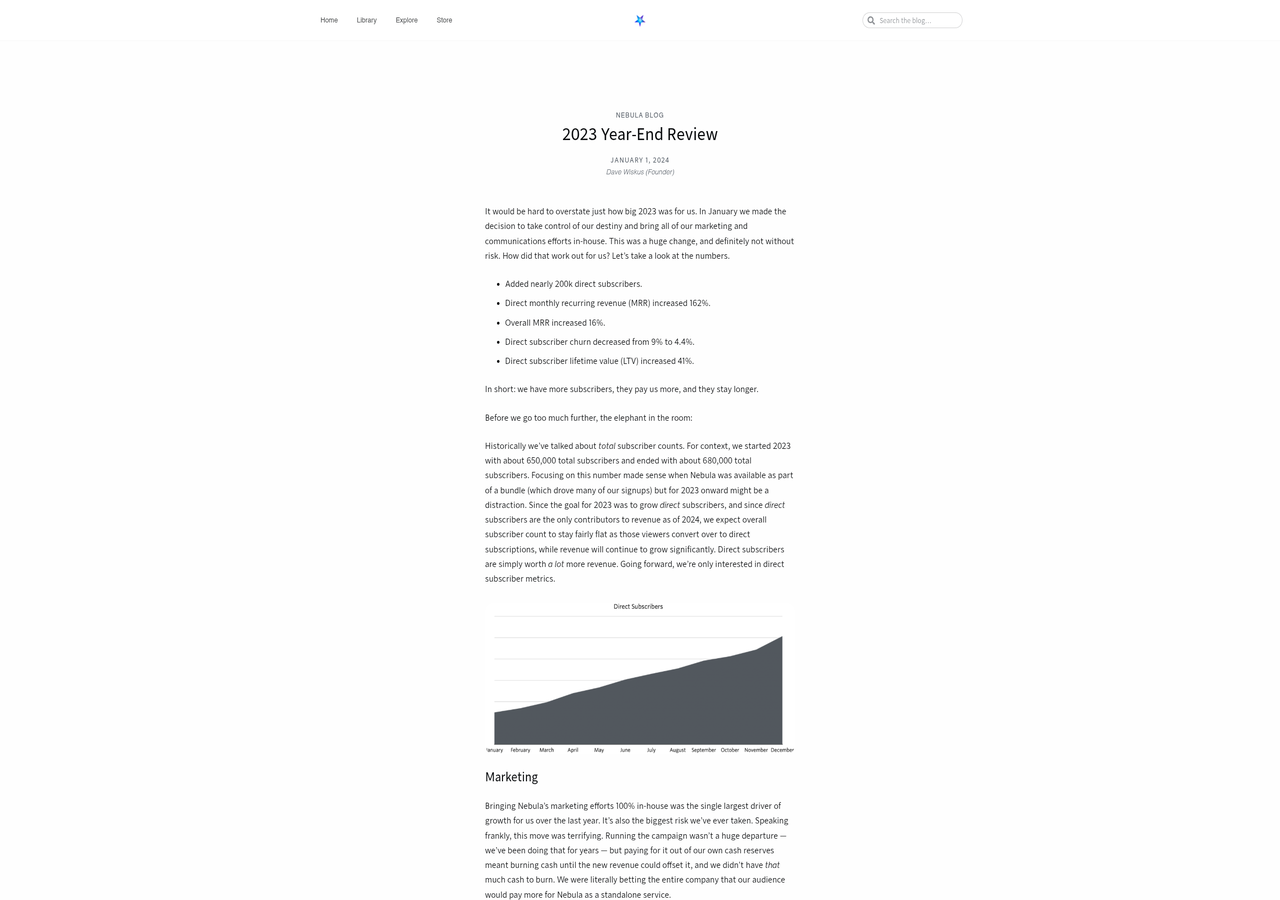
Nebula’s official blog, 1 January 2024. The 2023 review is the company’s own account of the turn to direct subscriptions — first-party figures, not audited accounts.
The company’s own 2023 review is the clearest account of the turn that made it work. Direct subscribers rose by about 200,000, direct monthly recurring revenue rose 162%, churn fell from 9% to 4.4%, and lifetime value rose 41% to $75 against a $25 target acquisition cost. Lifetime memberships sold more than $4.1 million in the same year.
The price list: $6 a month, $60 a year, $500 for life
Three ways to pay
| Plan | Price | What it buys |
|---|---|---|
| Monthly | $6/mo | $72 a year if paid monthly; cancel anytime |
| Annual | $60/yr | $5 a month effective; the default, marked BEST VALUE on the join page |
| Annual via creator link | $36/yr | $3 a month effective; 40% off the standard annual price |
| Lifetime | $500 once | Pay once, watch forever; no subscription; the blog calls it “not the best deal” |
| Gift membership | $6 / $60 / $500 | One month, one year or lifetime; gift codes refundable only if unredeemed |
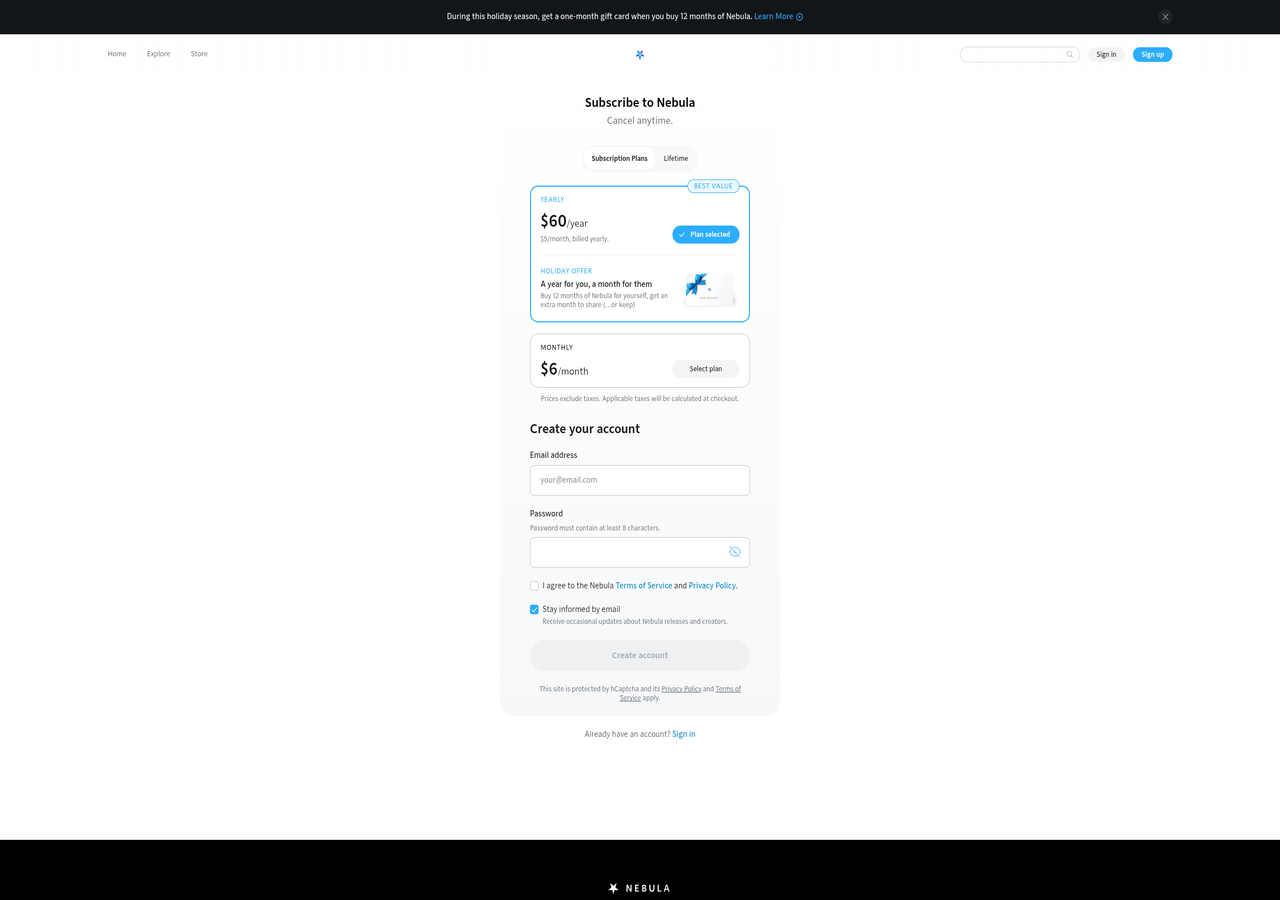
Screenshot of the nebula.tv join page, read 26 November 2026. Yearly is the default and the deal the page pushes; the Lifetime tab sits beside it.
There are three doors, and the middle one is the one the page pushes. Monthly is $6, annual is $60 — $5 a month effective, marked BEST VALUE — and the lifetime is $500, “Pay once, watch forever”, with no subscription attached. A creator’s own link cuts the annual price to $36, 40% off, which is how the creators get paid for bringing the audience.
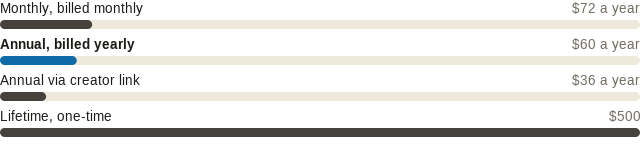
List prices, November 2026. The annual plan saves $12 a year against monthly billing; the creator link saves $24.
The arithmetic is the retention design. Annual billing saves $12 a year against paying monthly, and the creator link saves $24 — but the real lock is the prepay itself: a year paid up front is twelve months a subscriber does not have to decide again. The lifetime, at $500, takes about eight years of annual payments to break even, which is why the blog calls it “not the best deal” and sells it as support instead.
Gifts are the third door, and the guest pass is the fourth. A gift membership costs $6 for a month, $60 for a year or $500 for life, and every subscriber gets one guest pass a quarter — a week of access, for a new subscriber only. Refunds are the gap: the FAQ, last updated 18 April 2026, does not mention refunds at all, and only unredeemed gift codes can be returned.
Three months, one source

Semrush, August to October 2026. Third-party estimates, not official MAU/DAU.
October’s 1.7M is a Semrush figure, down 13.92% on September’s 1.97M and below August’s 1.86M — three months from one source is a direction, not a trend. The average session lasts 8 minutes 52 seconds, and the site ranks 31,397th globally and 14,068th in the United States. The public Semrush page did not show pages per visit or a bounce rate this round.
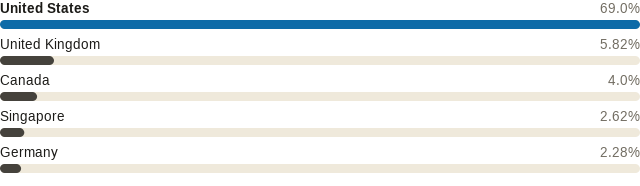
Semrush, October 2026. Third-party estimates, not official MAU/DAU.
The audience is concentrated, not spread out. The United States is 69.0% of visits at 1.17M, the United Kingdom 5.82% and Canada 4.0%, with Singapore at 2.62% and Germany at 2.28% — three quarters of the traffic sits in the English-speaking world. The United States is 74.89% desktop, and Singapore’s desktop share is listed at 100%, a sample quirk rather than a fact about devices.
What keeps subscribers paying
Everything that lowers the first purchase
| Mechanism | Status | How it shows up |
|---|---|---|
| Annual prepay | ✓ | $60 a year is the default, marked BEST VALUE; annual subscribers more than doubled in two months in 2023 |
| Lifetime membership | ✓ | $500 one-off, “Pay once, watch forever”; 2023 sales over $4.1M |
| Cancel anytime | ✓ | “Cancel anytime” on the homepage and join page |
| Guest pass | ✓ | One per quarter for every subscriber, one week of access, new subscribers only (FAQ) |
| Gift membership | ✓ | $6, $60 or $500; unredeemed gift codes are refundable by email |
| Email capture | ✓ | “Stay informed by email” is checked by default on the join page |
| Offline downloads | ✓ | “Download and watch offline” is listed as a subscription benefit |
| One-week exclusive window | ✓ | Nebula First: a week on Nebula before the video reaches YouTube |
| No ads | ✓ | Ad-free is a headline benefit; there is no advertising on the service |
| Pause subscription | — | Not verified — the FAQ does not mention pausing |
| Refund guarantee | — | Not verified — the FAQ does not mention refunds; only unredeemed gift codes can be returned |
| Free tier | — | No free tier, no free trial; the catalogue is behind the subscription |
The funnel is the video doing its own demonstration. A viewer watches a creator on YouTube, the video ends on a cliffhanger, and the next part is a week away on Nebula — the exclusive window is the trial, and there is no free tier to fall back on. The guest pass softens the first step: one per quarter, a week of access, for someone who has never subscribed.
The choice is $6 a month, $60 a year or $500 for life, and the annual plan is the one the page pushes, because a year paid up front is twelve months without a cancellation decision. The lifetime is the anchor that makes the annual plan look cheap: $500 takes about eight years of annual payments to break even, so the annual plan reads as the sensible deal. The missing pieces are the ones the FAQ never mentions: no pause button and no refund policy on record.
Where the visits come from

Semrush, October 2026. The public Semrush page showed the traffic journey for desktop only; no complete channel split was published.
| Channel | Share of visits | Platform & stack |
|---|---|---|
| Direct | 49.52% | Nebula — the brand name is the channel |
| YouTube | 8.28% | youtube.com is the second stop in the traffic journey; creators’ videos end with a Nebula call to action |
| AI traffic | Not verified | a2e.ai 148 visits, ChatGPT 109, Gemini 67 (Semrush, October 2026) |
| Social, email, referral | Not verified | No channel split published on the public Semrush page this round |
Half the visits arrive by typing the address. Direct is 49.52% of desktop traffic, and the second stop in the journey is youtube.com at 8.28% — the creators’ own videos, ending with a call to watch the rest on Nebula. The funnel is not bought: no Nebula ads surfaced in the first results of a Meta Ad Library search, and the company says its whole marketing budget goes to sponsoring its own creators.
The warning is underneath the direct share. Organic search fell 42.98% in October, so the brand funnel is carrying a shrinking search funnel — and the site has no category keywords to fall back on, because every top search term is the brand name. AI traffic is a rounding error: 148 visits from a2e.ai, 109 from ChatGPT and 67 from Gemini in the month.
| Layer | What it runs on |
|---|---|
| Platform | Self-built by Standard’s in-house engineering team (Variety, August 2024); two engineers and about $100,000 at launch |
| Player | VideoJS (third-party detection, Similarweb, April 2026) |
| Subscription & billing | Own subscription system — monthly, annual and lifetime; the payment processor is Not verified (the join page is protected by hCaptcha) |
| Not verified — no email provider confirmed this round | |
| API | Not verified — no public API confirmed this round |
| Ads | None — ad-free is a headline benefit; Similarweb listed Google AdSense in April 2026, treated here as a detection error, not an ad business |
The category is smaller than the brand
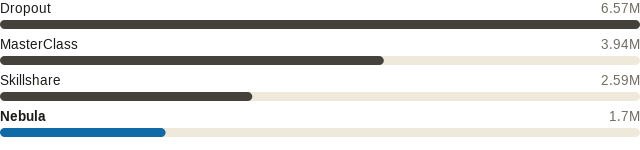
Semrush, October 2026. Traffic figures are third-party estimates, not official MAU/DAU. Prices are each site’s own public pricing page, November 2026.
| Site | Monthly visits | Entry price | Model |
|---|---|---|---|
| Dropout | 6.57M | $6.99/mo | Creator comedy streaming; annual $55.99 first year, then $69.99 |
| MasterClass | 3.94M | $10/mo | Celebrity classes; Standard plan, billed annually |
| Skillshare | 2.59M | $13.99/mo | Creator classes; Premium annual, $167.88 a year; 7-day free trial |
| Nebula | 1.7M | $6/mo | Creator-owned streaming; annual $60, lifetime $500 |
Nebula is the smallest of the four by traffic and the cheapest by the month. Dropout draws 6.57M visits a month, 3.9 times Nebula’s 1.7M, and charges $6.99 a month; MasterClass draws 3.94M at $10 a month; Skillshare draws 2.59M at $13.99 a month effective on its annual plan. Nebula’s $6 a month undercuts all three, and its $60 annual plan sits near Dropout’s $55.99 first year.
The price gap is not the whole story. Nebula is the only one of the four that is creator-owned, and the only one with a lifetime membership — $500, pay once, watch forever. The others sell classes or comedy; Nebula sells the creators themselves, and the subscription is the only thing for sale: no free tier, no free trial, no ads, no enterprise plan.
The category comparison has a limit. YouTube Premium, Netflix and CuriosityStream are the names a buyer would actually compare Nebula against, and none of them is in this database — YouTube and Netflix are giants, CuriosityStream is listed. The comparison that matters is against the brand a viewer already watches for free.
Three things not to quote as facts

App Store rating via a third-party check, October 2026; Trustpilot read 27 November 2026. The two samples measure different things — see below.
First, the Trustpilot score. Nebula scores 3.0 out of 5 on Trustpilot, from 34 reviews — 35% of them one-star — while the app scores 4.8 out of 5 from about 14,000 ratings on the App Store. The Trustpilot page mixes in reviews for an astrology app with the same name: one 1-star review complains about buying a reading and being charged every week, which is not a streaming complaint at all. Quote both, or quote neither as the whole story.
Second, the revenue. The company has never published Nebula’s revenue or profit, so there is no number to quote — only proxies. The $150 million valuation from August 2024 is for Standard as a whole, the parent company including its talent-management business, not for Nebula alone; the $50 million-plus figure from 2021 was the valuation at the CuriosityStream investment. Third-party revenue estimates exist, and they disagree with each other by an order of magnitude.
Third, the launch and the archive. Nebula launched on 23 May 2019, according to Wikipedia — Tubefilter says June 2019, a month’s difference that matters if you are counting the age of the company. The Wayback Machine holds no 2019 capture at all: the earliest readable snapshot is 8 May 2023, and it already shows the finished idea at $5 a month or $50 a year. Do not cite 2019 as an archived date.
Nebula is the only site in our Content · Creator-owned streaming collection. The closest rival is Dropout at 6.57M visits a month, and the most useful side-by-side is Nebula vs Dropout vs MasterClass. For the other creator subscription with a full teardown, see MasterClass.
The full teardown is for members
The full breakdown is for members: the annual prepay as the product, the $4.1M lifetime sale, the creator sponsorship loop, the Jet Lag funnel, the one-week YouTube bargain, the astrology-app review problem — and what a founder should copy, and what not to.
Similar sites in the database
Nebula (1.7M) sits between Cotopaxi (1.71M) and HexClad (1.7M) in the database. The three sites closest to it on traffic are shown below.
| Site | Monthly visits | Category |
|---|---|---|
| Seed Health | 1.72M | Health supplements |
| Removal.AI | 1.71M | Image tools · AI background removal |
| Cotopaxi | 1.71M | Outdoor gear |
| Nebula | 1.7M | Creator streaming |
| HexClad | 1.7M | Kitchen cookware |
| Memrise | 1.7M | Language learning |
Related teardowns
- Dropout — 6.57M visits a month, creator comedy streaming, $6.99 a month.
- MasterClass — 3.94M visits a month, celebrity classes, Standard $10 a month.
Read the next one in your inbox
The new ones go out by email first, one a week, with the traffic source and month attached to every number. Leave your address and the next one comes to you.