
How Obsidian makes money on a free app
Monthly visits
6.5M
Similarweb, October 2026. Third-party estimates, not official MAU/DAU.
Obsidian draws an estimated 6.5 million visits a month (October 2026, Similarweb) — the 96th-largest site in our database of 901, and the largest local-first notes tool we track. It has sold the same promise since 2020: your notes live on your device, in plain text, and nobody can take them away.
The pitch fits in one line: the app is free without limits and needs no sign-up; the money comes later, when the notes have to move between devices. Fewer than 1% of users pay for Sync — and Sync is about 80% of the revenue.
| Site | Obsidian, obsidian.md |
|---|---|
| What it is | Local-first Markdown knowledge base: bidirectional links, a graph view, Canvas and a plugin ecosystem, on the user's own device |
| Who it is for | Heavy note-takers, researchers and writers who want to own their notes as plain-text files |
| Category | Notes · Local Markdown knowledge bases |
| Monthly visits | 6.5M, October 2026. Third-party estimates, not official MAU/DAU; Similarweb 6.5M (+5.83%); global rank #8,936, category rank #222 |
| Founded | 2020, founded by Shida Li and Erica Xu (Dynalist Inc.; Dynalist, their earlier outliner, dates to 2016) |
| Headquarters | Not published (no office address is listed; the founders met at the University of Waterloo, Canada) |
| Operator | Dynalist Inc. (private; CEO Steph Ango since February 2023; 100% user-funded, no investors) |
| Survival engine | Repeat purchase. Sync subscriptions: under 1% of users pay, and Sync is about 80% of revenue (third-party estimate) |
| Pricing | App free; Sync Standard $4/user/month, Sync Plus $8/user/month (both billed annually); Publish $8/site/month billed annually; Catalyst $25 one-time; Commercial $50/user/year, optional. Source: pricing page, read 20 November 2026 |
| Pricing model | Free app with optional paid add-ons; no free-tier limits, no trial, no paywall on the editor |
| Free hook | The whole app, free without limits, no sign-up required |
| Meta ads | 0 active ads in the Meta Ad Library on 20 November 2026 (no advertiser page for obsidian.md) |
| Country breakdown | Not published (the Similarweb page shows no country breakdown) |
TL;DR
- Obsidian draws an estimated 6.5 million visits a month (October 2026), up 5.83% on September, and 55.78% of visits arrive from organic search — the first channel, with direct traffic second. It runs zero Meta ads.
- The money is Sync, not the app: the editor, the graph and the plugins are free forever, and the bill only appears when notes have to move between devices. Sync Standard is $4 a month billed annually, Plus is $8, Publish is $8 a site a month, and under 1% of users pay for any of it.
- It survives on a tiny cost base: a team of about nine, no venture money, profitable from day one by the CEO's account, and 4 million+ users by the same account. The open risks are the revenue estimates, which conflict by a factor of ten, and a paying base under 1% of users.
The app is free. The sync is the business
A first screen that sells nothing
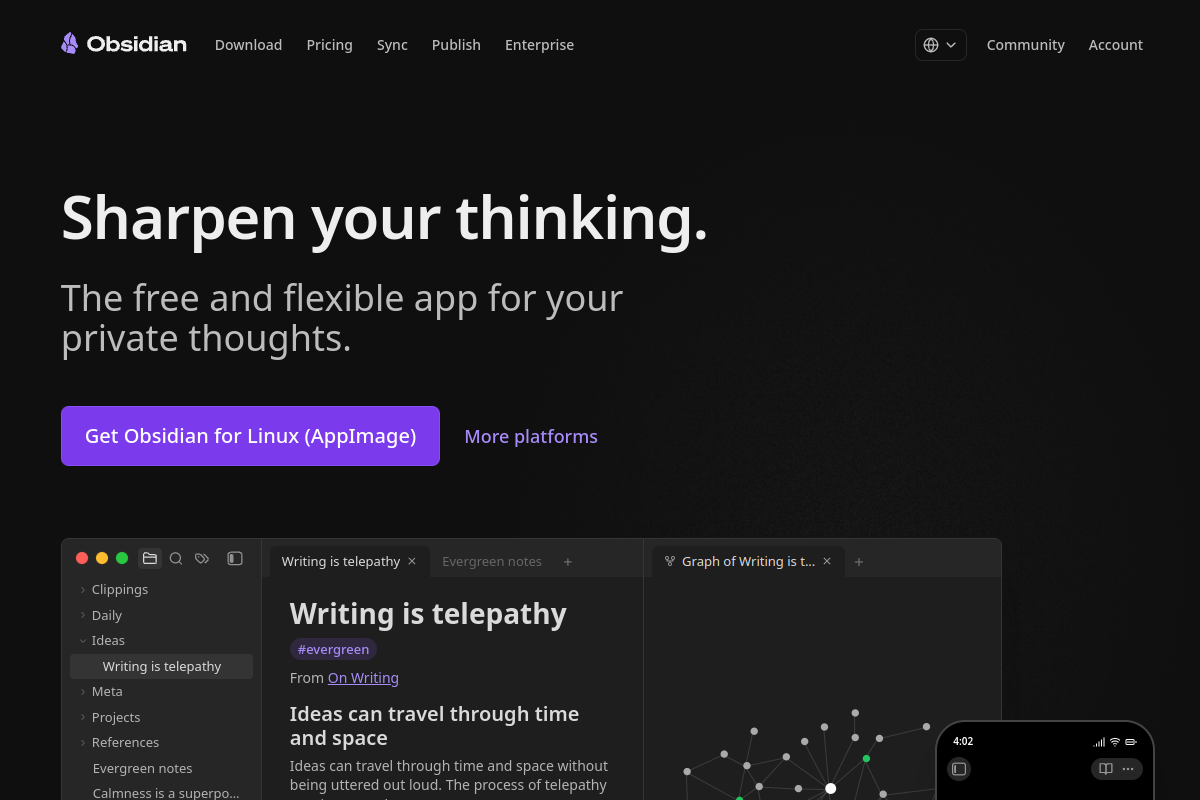
The Obsidian homepage, read 20 November 2026. "Sharpen your thinking." sits over "The free and flexible app for your private thoughts." Below it, the app itself: a note called "Writing is telepathy", its folder tree, and the graph view.
The homepage we read on 20 November 2026 opens on a promise, not a price. "Sharpen your thinking." sits over "The free and flexible app for your private thoughts." No plan, no price, no monthly figure on the first screen at all — only a download button and the app itself, a note and its graph.
The three claims below it do the selling. "Your thoughts are yours": notes stay on the device, readable offline, and not even Obsidian can read them. "Your mind is unique": thousands of plugins and themes shape the app to the user. "Your knowledge should last": open file formats, so there is never lock-in. The product is the pitch, and the price is nowhere to be seen.
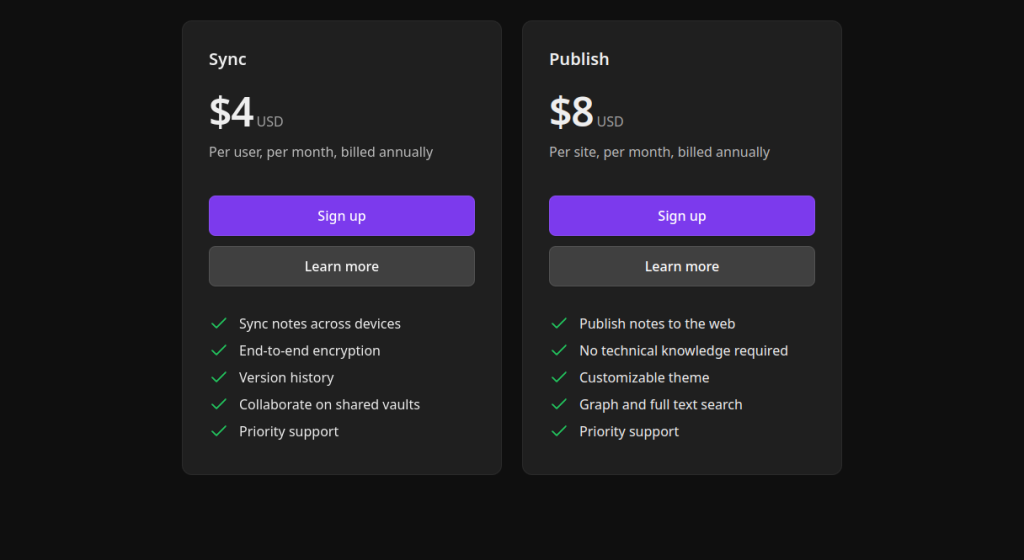
The Obsidian pricing page, read 20 November 2026. Sync is $4 a month per user, billed annually, and Publish is $8 a month per site, billed annually. Sync lists end-to-end encryption, version history and shared-vault collaboration; Publish lists themes, custom domains, graph and full-text search.
The pricing page starts where the homepage left off: "Free without limits. No sign-up required. No strings attached." The paid cards sit a scroll down — Sync at $4 a month per user, Publish at $8 a month per site, both billed annually — and below them, two more cards that are not really products: Catalyst at $25 once, and a Commercial licence at $50 a user a year.
That layout is the business model in miniature. The app is the free tier, and it has no limits to lift. The only things money buys are moving notes between devices and putting them on the web — plus two licences that exist to let supporters pay. The pricing page only shows the $4 Sync card; the Standard and Plus split lives on the Sync page.
What a month of sync costs
| Plan | Price | What it is |
|---|---|---|
| App | Free | The full app: editor, graph, Canvas, plugins, no sign-up, no limits |
| Sync Standard | $4 / user / month, billed annually ($48/year) | 1 vault, 1 GB storage, 5 MB max file size, 1 month version history |
| Sync Plus | $8 / user / month, billed annually ($96/year) | 10 vaults, 10 GB storage, 200 MB max file size, 12 month version history, upgradable to 100 GB |
| Publish | $8 / site / month, billed annually ($96/year) | Publish notes to the web, up to 4 GB hosting per site, custom domain, graph and full-text search |
| Catalyst | $25 one-time | Early access to beta versions, community badges, exclusive channels; supports development |
| Commercial | $50 / user / year | Optional since February 2025; supports development, featured-organization eligibility |
Prices from the Obsidian pricing page, read 20 November 2026 (rendered page; Yearly billing selected by default). Monthly-billed prices ($5 Sync Standard, $10 Sync Plus, $10 Publish) are third-party cross-checks, not shown on the rendered page this round. Students, faculty and nonprofits get 40% off Sync and Publish; Sync and Publish are refundable within 7 days, Catalyst and Commercial are not.
What a month of Obsidian costs, by plan

Sync Standard is $4 a month billed annually; Plus doubles it to $8 for ten vaults and a year of version history. Publish costs the same $8, per site.
Price per month by plan, annual billing, Obsidian pricing page, 20 November 2026. Catalyst ($25 one-time) and Commercial ($50 a year) are not on the same scale and are excluded.
The ladder is short on purpose. Standard syncs one vault for $48 a year; Plus syncs ten for $96. The jump buys storage and history, not features — the editor is identical at every tier, because the editor is free. Publish is priced per site, not per user, so a second public notebook doubles the bill.
Catalyst and Commercial are the tell. Neither unlocks anything: Catalyst buys early beta access and a badge, Commercial buys the right to be listed as a supporter. Since February 2025 the Commercial licence is optional — companies may use Obsidian for work free. The company gave up a forced charge and kept the voluntary one.
The one percent that pays
| Mechanism | Hit | Why, in one line |
|---|---|---|
| Auto-renew | 未核到 | No auto-renewal terms found on the pages read |
| Cancel anytime | 未核到 | Cancellation path not found on the pages read |
| Free tier | ✓ | The whole app is free, without limits and no sign-up required |
| No account | ✓ | No account is needed to use the full app |
| Free trial | — | No public free trial; Sync and Publish charge from day one |
| Pause subscription | 未核到 | No pause option found on the pages read |
| Skip a delivery | — | Notes software, not applicable |
| Free shipping | — | Not applicable |
| Gift subscription | ✓ | Obsidian Credit can be bought for friends and family, and pays for any licence or service |
| Loyalty plan | — | No points-based loyalty programme found |
| First-order hook | ✓ | The free app itself: full editor, graph and plugins before any payment |
| Annual plan | ✓ | Sync $4 a month billed annually, Publish $8 a month billed annually |
| Lifetime buyout | — | No lifetime plan; Catalyst $25 one-time is a supporter licence, not a buyout |
| Refer a friend | 未核到 | No referral programme found on the pages read |
| Ads on the site | — | No advertising on the site; the app collects no telemetry and sells no user data |
| API | ✓ | Open plugin API; 2,700+ community plugins |
| Email capture | 未核到 | No email-capture design found on the pages read |
| SMS capture | 未核到 | No SMS marketing found on the pages read |
| Financing | 未核到 | Checkout payment methods not read this round; PayPal is listed |
| Version history | ✓ | One month of history on Sync Standard, 12 months on Sync Plus |
| Education discount | ✓ | 40% off Sync and Publish for students, faculty and nonprofits |
The machine has one gear, and it is narrow. Fewer than 1% of users pay for Sync, yet Sync is about 80% of the revenue — the free users are the marketing, the plugin authors and the word of mouth, and a thin slice of them pays for everything. There is no trial, no lock-in and no ad to fall back on.
That narrowness is the whole bet. A user who never syncs never pays, and can leave at any time with plain-text files that open anywhere. Retention is not a contract here; it is the vault itself getting bigger, the plugins getting more personal, and the graph getting harder to rebuild elsewhere.
Under 1% of users, about 80% of revenue

Sync reaches under 1% of users and still funds about 80% of the revenue. The free app is the funnel; the sync is the toll.
Shares from readthesignal, April 2026 (third-party estimate). Two different shares, shown side by side.
The revenue figure behind the chart is the open question. One third-party estimate puts annual recurring revenue at $25 million; another puts yearly revenue at about $2 million — a factor of ten apart, and the company publishes no official number. The $25 million figure also clashes with the 1% claim: at $48 a year per Standard subscriber it would need about 520,000 payers, roughly 13% of 4 million users, not under 1%.
Two estimates, ten times apart

One estimate says $25 million a year, another says about $2 million. The company publishes no official figure, so both are shown, not reconciled.
Third-party estimates: readthesignal, April 2026; fueler.io, 2025. The $2 million figure fits the under-1% paying share; the $25 million figure does not.
The $2 million figure fits the shape of the business better. At $48 a year it needs about 42,000 paying users — about 1% of 4 million, close to the published claim. Either way, the story is the same: a nine-person team, no investors, and a product that has been profitable from day one by the CEO's account. The exact revenue is unknown; the profitability is not in doubt on the available record.
6.5 million visits, and not one ad bought them
One number, one direction
Similarweb has the site at 6.5 million visits in October 2026, up 5.83% on September. The global rank is #8,936 and the category rank is #222 in Programming and Developer Software. Visits bounce 44.24% of the time, run 3.38 pages deep and last 2:45 on average — a working session, not a glance.
September's figure was not published, so there is no three-month line to draw here — only the direction, up, and the size, 6.5 million. Semrush figures for October could not be read this round: its overview page returns a 404, and the domain report sits behind a registration wall. The country split was not published either, on either source.
Where the visits come from
Organic search first, everything else second

Organic search sends 55.78% of visits. Direct traffic is second and referrals third, but their shares were not published.
Channel shares, Similarweb, October 2026. The "all other channels" bar is 100 minus 55.78; the split between direct, referrals and the rest was not published.
| Channel | Share of visits | Platform & stack |
|---|---|---|
| Organic search | 55.78% | First channel (Similarweb, October 2026); brand word "obsidian" leads |
| Direct | 2nd largest | Share not published this round |
| Referrals | 3rd largest | 177 referring websites (Similarweb, October 2026) |
| Meta ads | 0 active | No advertiser page for obsidian.md in the Meta Ad Library, 20 November 2026; the ~29 keyword matches are all third-party |
| Keywords | 26.3K total | Top terms: obsidian, obsidian download, obsidian vault, obsidian notes, 옵시디언 |
| Platform | — | React, pixi.js, Intersection Observer, WebAuthn (BuiltWith, 18 November 2026) |
| Hosting | — | Cloudflare Hosting, CDN and DNS; GitHub Hosting; Varnish (BuiltWith, 18 November 2026) |
| — | Mailgun, plus DMARC and SPF; no dedicated email-marketing tool listed (BuiltWith, 18 November 2026) | |
| Payment | — | PayPal (BuiltWith, 18 November 2026; also in Similarweb technographics) |
| Analytics | — | Fastly listed under analytics and tracking; AI Index 33/100, low (BuiltWith, 18 November 2026) |
| Support | — | Discord, forum and developer docs; support@obsidian.md |
Marketing channels, Similarweb, October 2026; technologies, BuiltWith, 18 November 2026; Meta ads, Meta Ad Library, 20 November 2026. Channel shares beyond organic search were not published this round, so they are not estimated here.
Search is the whole story, and the brand is the search. More than half the visits arrive from organic search, and the first keyword is the brand name itself — people looking for Obsidian, not for "notes app". Direct traffic is second, which means a large share of visitors already know the name. Nothing here is bought: zero Meta ads, and no paid-search share published.
The stack matches the story. Cloudflare hosts and serves the site, GitHub hosts alongside it, React and pixi.js run the front end, PayPal takes the payments, and Mailgun handles the mail. Fifty-one live technologies in total, and no email-marketing platform among them — the company does not run the usual funnel machinery, because the funnel is the free app.
What the stack does not show is a moat in software. The technology is ordinary — a Markdown editor, a checkout form, a sync service. The moat is the file format and the community: plain-text notes that outlive any app, and 2,700+ plugins that make each vault unreplicable.
What people search for
| Keyword | Cost per click | Note |
|---|---|---|
| obsidian | $1.02 | Brand word, first keyword (Similarweb, October 2026) |
| obsidian download | $1.86 | Second keyword; the download is the conversion |
| obsidian vault | $3.67 | Highest CPC of the top five; vaults are the product |
| obsidian notes | $2.24 | Fourth keyword |
| 옵시디언 | $1.91 | Korean-language term; the audience is not English-only |
Top keywords, Similarweb, October 2026. Monthly search volumes were not published on the Similarweb page; Semrush figures for October 2026 could not be read this round (registration wall). Total keywords 26.3K.
Search here has one head, not two. Every top keyword is the brand or the product itself — "obsidian", "obsidian download", "obsidian vault", "obsidian notes" — plus a Korean transliteration that shows the audience reaches beyond English. Nobody arrives here looking for "best notes app"; they arrive looking for Obsidian, and the download is the conversion.
The Korean term is the quiet signal. A notes app with a Korean search term in its top five is not a local product with a website; it is a global one with a community that translates itself. That is also why the plugin directory matters: 2,700+ plugins, built by volunteers, in every language the users speak.
What outsiders say

The stores agree: the app itself scores 4.5 on the App Store from 2,800 ratings and 4.4 on Google Play from 19,501, while G2 gives it 4.5 from only 14 reviews. The praise is the same everywhere — owning the files, the graph, the plugins — and so is the complaint: the mobile app is the weaker side, and the setup takes hours before the app feels like yours.
G2's fourteen reviews are too few to lean on, but they name the same trade-off the stores do: the learning curve is real, advanced features live in community plugins, and Sync is a paid add-on that some reviewers call fiddly to replace. One reviewer put it plainly — the app hands you a blank canvas and expects you to build your own system first.
Six years, no investors, still hiring
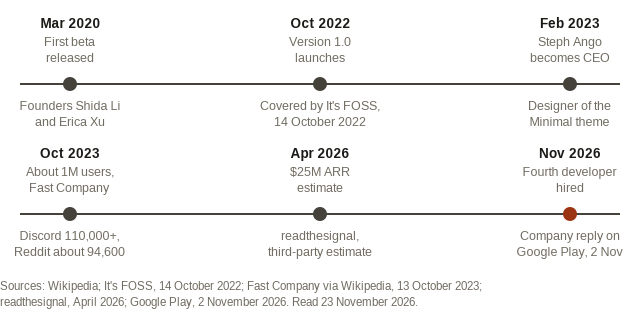
The record is the point: six years from first beta to a fourth developer hired, with no funding round anywhere in it. The 1.0 launch in October 2022 drew press coverage that repeated the same promise the pricing page still makes — personal use stays free. Fast Company put users at about one million in October 2023, and the revenue estimate that followed in April 2026 is the one figure the company has never confirmed.
Obsidian is the only local Markdown knowledge base in the Notes · Local Markdown knowledge bases collection so far. Compare Obsidian with Notion and Evernote side by side.
The full teardown is for members
The full analysis of pricing, acquisition, conversion and retention is member content. Membership is $29 a month or $249 a year.
Similar sites in the database
Obsidian (6.5M) sits between Dropout (6.57M) and Clockify (6.39M) in the database.
| Site | Category | Monthly visits | Source |
|---|---|---|---|
| Evernote | Notes · AI workspace | 6.58M | Semrush, Oct 2026 |
| Dropout | Content · Comedy streaming | 6.57M | Semrush, Oct 2026 |
| Clockify | Time tracking · Work hours management | 6.39M | Semrush, Oct 2026 |
Compare Obsidian with Notion and Evernote side by side. The full database, with working filters, is on the teardowns index.
Read the next one in your inbox
The new ones go out by email first, one a week, with the traffic source and month attached to every number. Leave your address and the next one comes to you.