
How Omnisend makes money: $50M ARR on $16 plans
Monthly visits
1.36M
October 2026. Third-party estimate, not official MAU/DAU. Semrush counted 1.36M for the month, up 2.89% on September 2026 (1.32M).
Omnisend draws an estimated 1.36M visits a month (October 2026, Semrush). It is the 295th-largest site in our database of 927 — and the fourth-largest of the six sites in the Email marketing tools collection.
| Site | Omnisend, omnisend.com |
|---|---|
| What it is | Email and SMS marketing automation platform for ecommerce: automation flows, forms, AI assistant and push notifications |
| Who it is for | Online stores on Shopify, WooCommerce and BigCommerce that need email and SMS automation |
| Category | Email marketing |
| Monthly visits | 1.36M, October 2026. Third-party estimate, not official MAU/DAU; Semrush; up 2.89% on September 2026 (1.32M); August was 1.49M |
| Founded | 2014, Vilnius, Lithuania, as Soundest; renamed Omnisend in November 2017; founded by Rytis Lauris and Justas Kriukas |
| Headquarters | London, United Kingdom (registered entity Omnisend Limited, formerly Soundest Limited); founded in Vilnius; team of 250+ worldwide |
| Operator | Omnisend Limited — private, not listed, not group-controlled; one $1.6M round in December 2019; the founders are still in charge |
| Survival engine | Renewals: list-size pricing — the bill rises as a store’s list grows — and the Shopify App Store plus a free tier turned 150,000+ brands into $50M of ARR |
| Pricing | Free $0; Standard from $16/mo; Pro from $59/mo; Custom on request; SMS from $0.007 a message; first 3 months −30%. Prices read from omnisend.com/pricing, 28 November 2026 |
| Pricing model | Monthly subscription by billable contacts; pay 3 months upfront to save 30%; no annual billing option published; SMS metered on top |
| Typical basket (derived) | $16/month — the Standard plan, the mainstream paid plan for a 500-contact store (range $16–$59 at entry list sizes; $81 at 5,000 contacts); derived from listed prices and plan structure; the company has not disclosed current ARPU |
| Free hook | Permanent free tier (500 emails a month, 250 contacts, no card) + free 5-day migration + 24/7 human support on every plan |
| Meta ads | Active ads — the official Omnisend page in the Meta Ad Library shows about 77 active ads in the US (about 96 worldwide) on 28 November 2026, of about 250 ads in total; the newest visible ads started running on 20 November 2026 |
| Country breakdown | United States 59.73% (813.29K); United Kingdom 5.62% (76.47K); China 3.83% (52.17K); Canada 3.14%; India 2.82% (Semrush, October 2026) |
| Audience | Female 51.77% / Male 48.23% (Similarweb, April 2026); age split not published in the free data |
TL;DR
- Omnisend sells email and SMS automation to online stores: Free to $59 a month by list size, and the bill rises as the list grows. The site draws 1.36M visits a month (October 2026, Semrush), up 2.89% on September.
- The money is renewals. 150,000+ brands use it, the founder says it reached $50M in annual recurring revenue in March 2024 and is profitable, and it got there on a single $1.6M funding round — the Shopify App Store did the selling.
- The other side: organic search traffic fell 34.2% in October, the free tier caps at 500 emails a month, and Trustpilot’s recent complaints are about compliance suspensions and SMS billing. Klaviyo, the listed rival, costs more at small list sizes and about the same at 15,000 contacts.
Members also unlock: Category benchmarks in full · The $16 math · The Shopify shelf · What a founder should copy — and what not to See the full teardown →
The list is the subscription
The visits are the brand
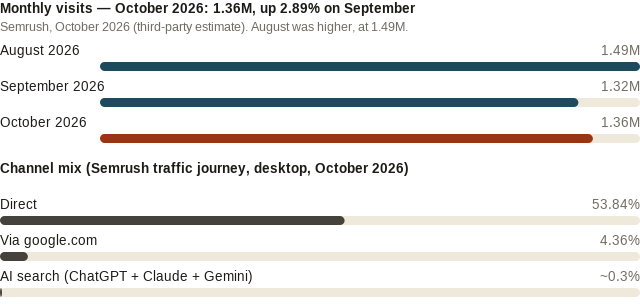
Monthly visits, Semrush, October 2026 (third-party estimate). Direct traffic is 53.84% of desktop visits; the brand term does the work.
October 2026 drew an estimated 1.36M visits, up 2.89% on September’s 1.32M — after a softer August at 1.49M. The largest keyword is the brand itself, and the journey data says the same thing: 53.84% of desktop visits arrive direct, and the next stop is google.com at 4.36%.
That split is the shape of the business. A free tier sits on 150,000 brands’ stores, each one a billboard for the next store, and the paying slice is small: 7,200 paying customers in August 2019, when the founder last gave the number, at about $75 a month each.
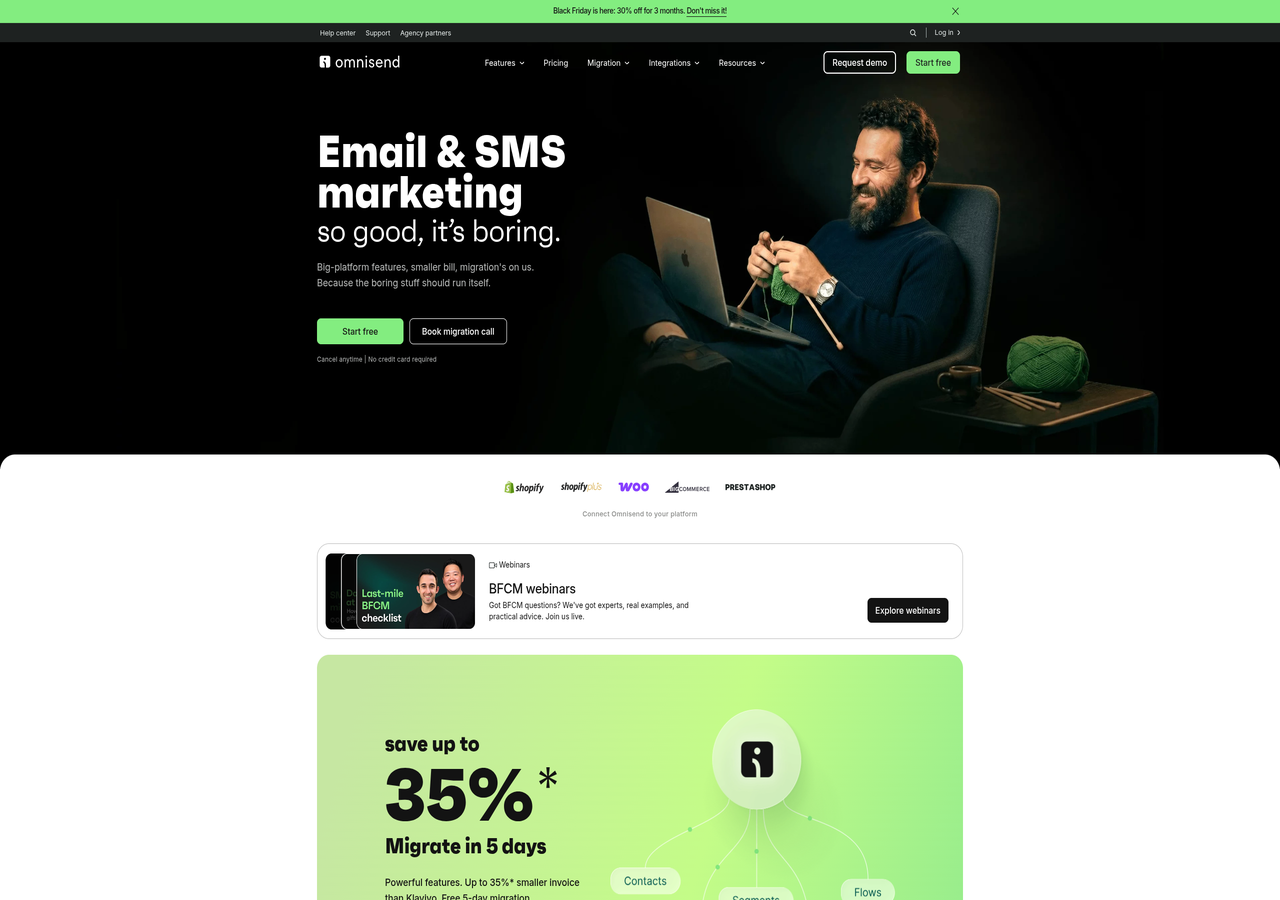
Screenshot of the Omnisend homepage, read 28 November 2026. The hero sells the price, not the product: boring is the promise.
The homepage opens on the price, not the product: “Email & SMS marketing so good, it’s boring.” Below it, the subhead does the selling — “Big-platform features, smaller bill, migration’s on us” — and the migration block promises up to 35% less than Klaviyo with a free five-day move.
Twelve years, one round of funding
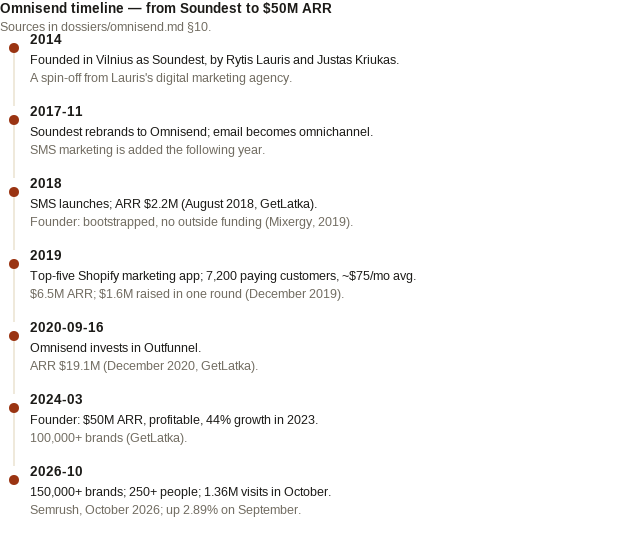
Timeline, 2014 to 2026. One funding round in twelve years.
Omnisend started in 2014 as Soundest, a spin-off from the founder’s digital marketing agency in Vilnius, and took its current name in November 2017 as email became omnichannel. SMS followed in 2018, and by August 2019 the company had 7,200 paying customers and about $550,000 a month in revenue.
The funding record is thin on purpose. The founder tried to raise money early and failed, then built the company on its own revenue — one $1.6M round in December 2019 is the only outside money on record, and the founders are still in charge.
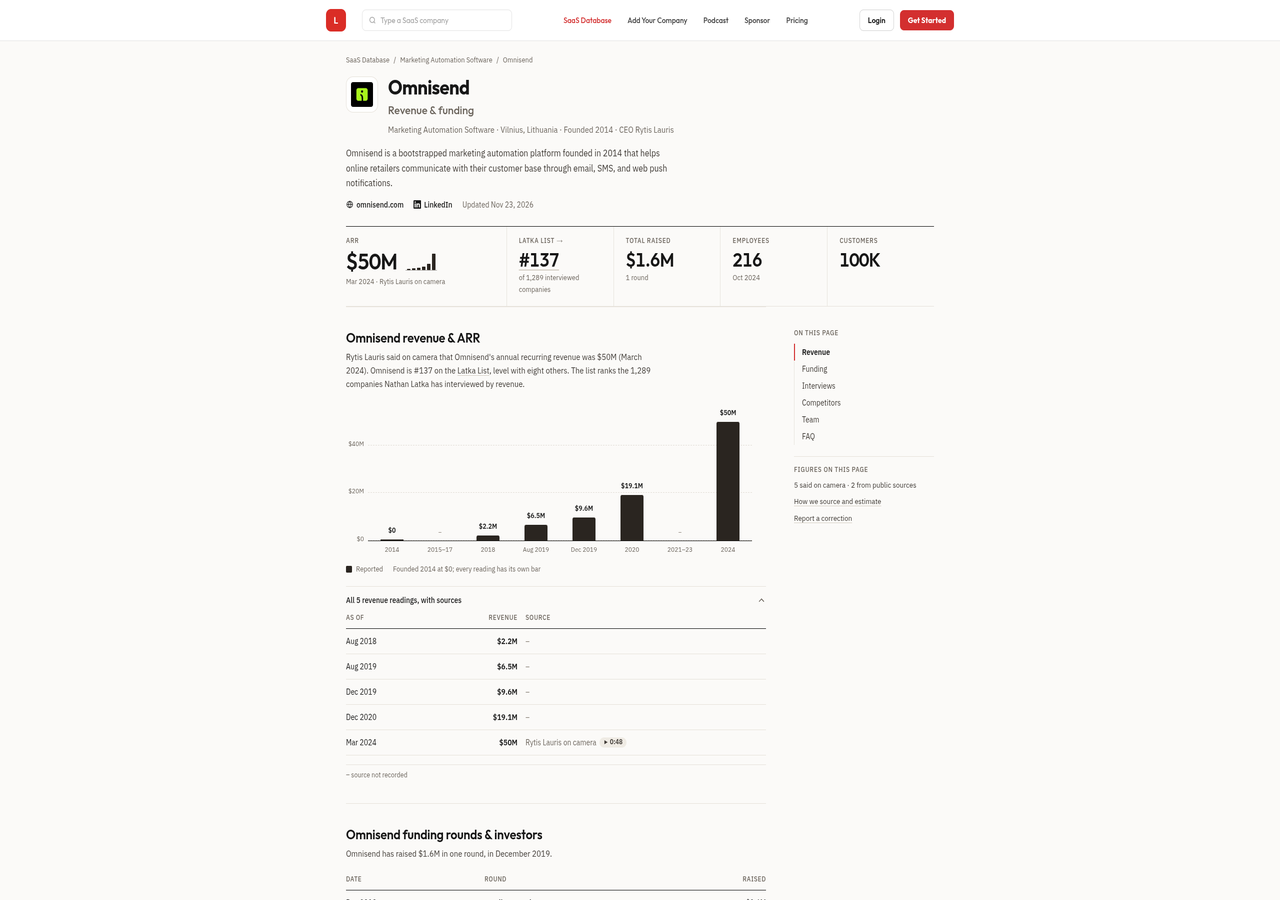
Screenshot of the GetLatka founder interview page, 2026. The founder said on camera that revenue was $50M in March 2024 — and that the company was profitable.
The profit claim rests on the founder’s word, given twice: profitable in a 2019 interview, and $50M in annual recurring revenue with “Profitable: Yes” in March 2024. No margin, no net income and no audited figure has ever been published, so this page records the claim with its sources and does not turn it into a number.
Benchmarked against 6 peers in Email marketing tools — computed from the Everstood database. Visits are third-party estimates (October 2026).
| Monthly visits — category median | 1.55M |
| Median starting paid price | |
| Sites with a free tier | |
| This site's rank in the group |
Member benchmark · Unlock the full benchmarks & the member sections →
The price list: $16 buys the first 500 contacts
Three tiers, one price per contact count

Prices from omnisend.com/pricing, read 28 November 2026. The price is per contact count, not per seat — and the list decides the tier.
| Plan | Price | What it is |
|---|---|---|
| Free | $0 | 250 contacts, 500 emails a month, 500 web push notifications; no card required; 24/7 support; free migration |
| Standard | $16/mo | 500 contacts, 6,000 emails a month, unlimited web push; $11.20/mo for the first 3 months; automations, forms, AI assistant |
| Pro | $59/mo | 2,500 contacts, unlimited emails; $41.30/mo for the first 3 months; adds SMS from $0.007 a message, advanced reporting, dynamic content, AI product recommender |
| Custom | On request | Large contact counts or send volumes; custom contact amount; account expert free from $400 a month |
The ladder is short and the anchor is the middle tier. Free costs nothing and covers 250 contacts and 500 emails a month. Standard at $16 is where the product becomes a marketing tool: 500 contacts, 6,000 emails a month, automations and the AI assistant. Pro at $59 adds SMS and unlimited sends, and the page marks it “Agent Pro”.
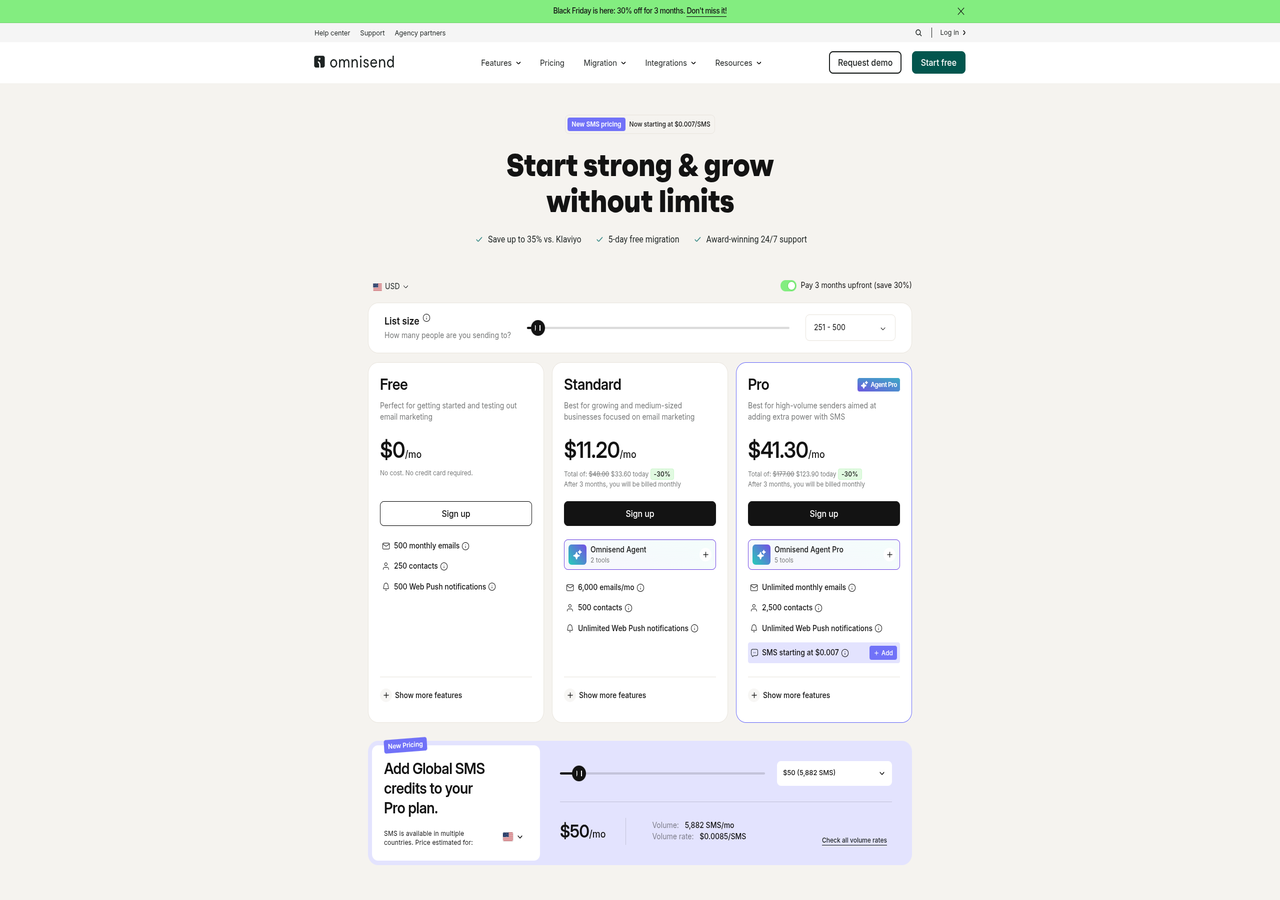
Screenshot of the Omnisend pricing page, read 28 November 2026. The prices shown are the first-three-months prices; the list prices sit struck through behind them.
The prices on the page are the first-three-months prices, not the list prices: Standard shows $11.20 a month with the total struck through at $48.00 for three months — $16 a month — and Pro shows $41.30 against $177.00, or $59 a month. A Black Friday banner ran across the top of the page on the day this teardown was read.
The arithmetic that matters is per contact. Standard at $16 for 500 contacts is about three cents a contact a month; Pro at $59 for 2,500 is about two cents. The price only jumps when the list crosses a tier, never when a store sends one more email — which is why the list, not the send, is the subscription.
The $16 typical basket
The typical order is the middle tier. Standard at $16 a month is the mainstream paid plan: the tier where a 500-contact store gets the whole email product, and the tier the pricing page’s own comparison is built around. The range runs $16 to $59 at entry list sizes, and the company has not disclosed what its payers actually pay on average, so this page does not multiply $16 by 150,000 and call it revenue.
One older number cross-checks the shape. In August 2019 the founder said the average paying customer paid about $75 a month — seven years ago, when the list sizes were smaller and the tiers were different. It is a history point, not a current average, and the $16 figure in this teardown is the monthly list price.
What brings stores back
| Mechanism | Status | How it shows up |
|---|---|---|
| Free tier | ✓ | Permanent free tier: 500 emails a month, 250 contacts, 500 web push notifications, no card (pricing page) |
| No sign-up | — | An account is required; there is no try-before-register mode |
| Free trial | — | No day-count trial; the free tier is the trial, with no card required (pricing page) |
| Advertising | — | No advertising revenue line; no third-party ads inside the product |
| API | ✓ | Omnisend MCP: operate the account from an AI tool (pricing page); developer API in the docs |
| List-size pricing | ✓ | Billed on billable contacts who received automated messages; the bill rises as the list grows (pricing page) |
| 3 months upfront, −30% | ✓ | Pay 3 months upfront to save 30%; Standard $11.20/mo and Pro $41.30/mo for the first 3 months (pricing page) |
| Cancel & refund | Not verified | No cancel or refund terms appear on the pricing page; the Terms page was not read this round |
| SMS metered | ✓ | $0.007 a message from Pro up; Global SMS credits can be added; auto-refill follows the account settings (pricing page) |
| Integration lock-in | ✓ | Shopify, WooCommerce, BigCommerce deep integrations; one account holds up to 500 stores; 30 integrations (G2) |
| Automation library | ✓ | Pre-built welcome, abandoned cart and post-purchase flows that run on their own (homepage) |
| Free migration | ✓ | Contacts, data and segments moved for free in 5 days (pricing page) |
| Referral programme | ✓ | Bloggers take 3× the first payment, once; agencies take 10–30% for as long as the customer pays (founder, 2019) |
| 24/7 human support, all plans | ✓ | Live chat and email support on every plan, including Free (pricing page) |
The table has no subscription rows to skip, pause or cancel — the retention work is done by the list itself. A store that grows from 250 contacts to 500 pays $16; from 500 to 2,500 pays $59. Each crossing is a decision point, and each one unlocks something the store has started to need: automations at Standard, SMS and the AI recommender at Pro.
The free tier is the lock-in. Five hundred emails a month is enough to prove the product and too little to run a store on, and the data — the list, the segments, the flows — grows inside Omnisend until moving means rebuilding it elsewhere. The five-day free migration does the same work in reverse: it removes the cost of moving in.
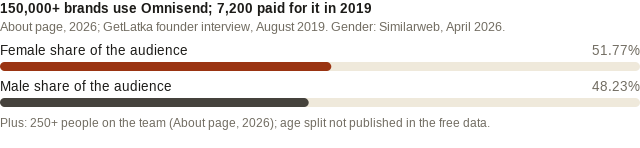
Who pays, and who does not. 150,000+ brands use the product; the last paying count the founder gave was 7,200, in 2019 (About page, 2026; GetLatka founder interview).
The audience is a funnel with a thin neck. 150,000+ brands use the product and 7,200 paid for it in 2019 — the last year the founder gave the number — and the rest of the shape is not published: no age breakdown exists in the free Similarweb data, and the gender split is nearly even, 51.77% female to 48.23% male. What is known is the fit: reviewers say the strongest match is small business.
A 4.6 on G2, a 4.4 on Trustpilot
The public review record is strong and unusually consistent. G2 shows 4.6 out of 5 from 1,266 reviews, Capterra 4.7 out of 5 from 836, Trustpilot 4.4 out of 5 from about 500, and the Shopify App Store 4.7 out of 5 from 3,254. The praise repeats: quick setup, automations that run themselves, and support staff named in the review.
The complaints repeat too, and they are specific. G2 reviewers ask for deeper reporting, freer templates and more flexible automation. Trustpilot’s recent one-star reviews are about accounts suspended by automated compliance checks and a $20,000 SMS billing dispute from October 2026 — the same automation that protects deliverability, charging the customer first and explaining later.
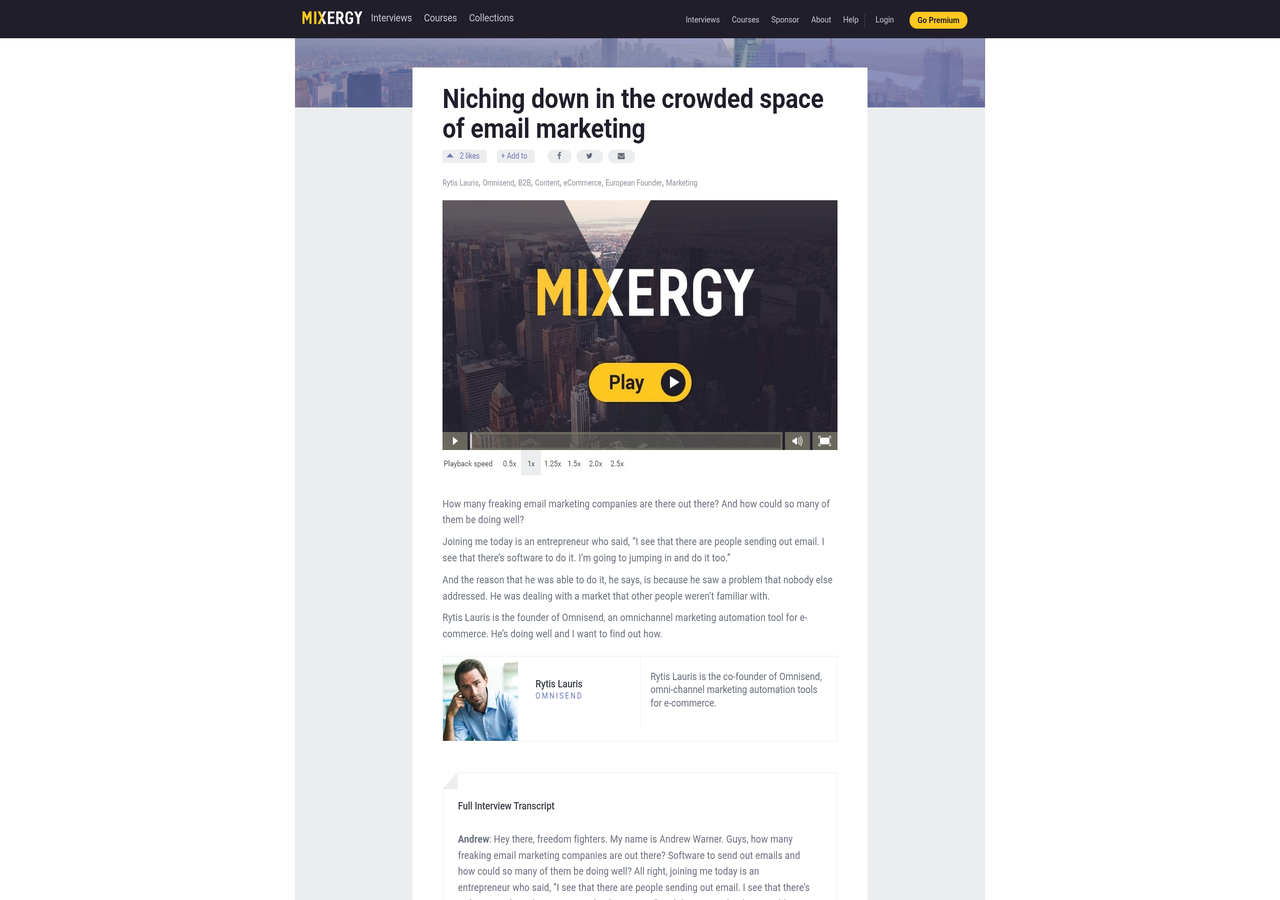
Screenshot of the Mixergy founder interview, 2019. The founder said the company was profitable and bootstrapped, doing above $6M in annual recurring revenue.
The 2019 interview is the oldest first-party record of the model. The founder told Mixergy the company was profitable, bootstrapped, doing above $6M in annual recurring revenue, and breaking even on a new customer in about three months. Seven years on, the revenue is $50M, the team is 250+, and the model — free tier, list-size pricing, no sales team — is unchanged.
The shelf: cheaper than Klaviyo, until the list grows

Five thousand contacts, one month. Omnisend is 81% of Klaviyo’s price on Standard, 90% on Pro (Omnisend comparison blog, data as of August 2026).
| Site | Monthly cost, 5,000 contacts | Pricing model | What it sells |
|---|---|---|---|
| Omnisend Standard | $81 | Per contact count | Email automation, 60,000 sends a month |
| Omnisend Pro | $90 | Per contact count | Email + SMS, unlimited sends, AI product recommender |
| Klaviyo Email | $100 | Per active profile | Email + SMS, 50,000 sends a month, B2C CRM |
The rivals are not all in the database, and this page says so. Klaviyo is listed on the New York Stock Exchange and is out of the database under the independence rule; its price here is Omnisend’s own August 2026 read of Klaviyo’s pricing page. Brevo, at 6.5M visits a month, is the nearest email-marketing rival in the database, and it has its own teardown.
The gap is the whole pitch, and it shrinks as the list grows. At 500 contacts Omnisend is $16 against Klaviyo’s $20; at 5,000 it is $81 against $100; at 15,000 the Standard plan is $207 against $350 — but the Pro plan, at $348, is two dollars cheaper than Klaviyo and no longer a bargain. The cheap price has a cost the rivals do not carry: SMS is metered from $0.007 a message, and the October Trustpilot record shows what happens when the meter runs without a warning.
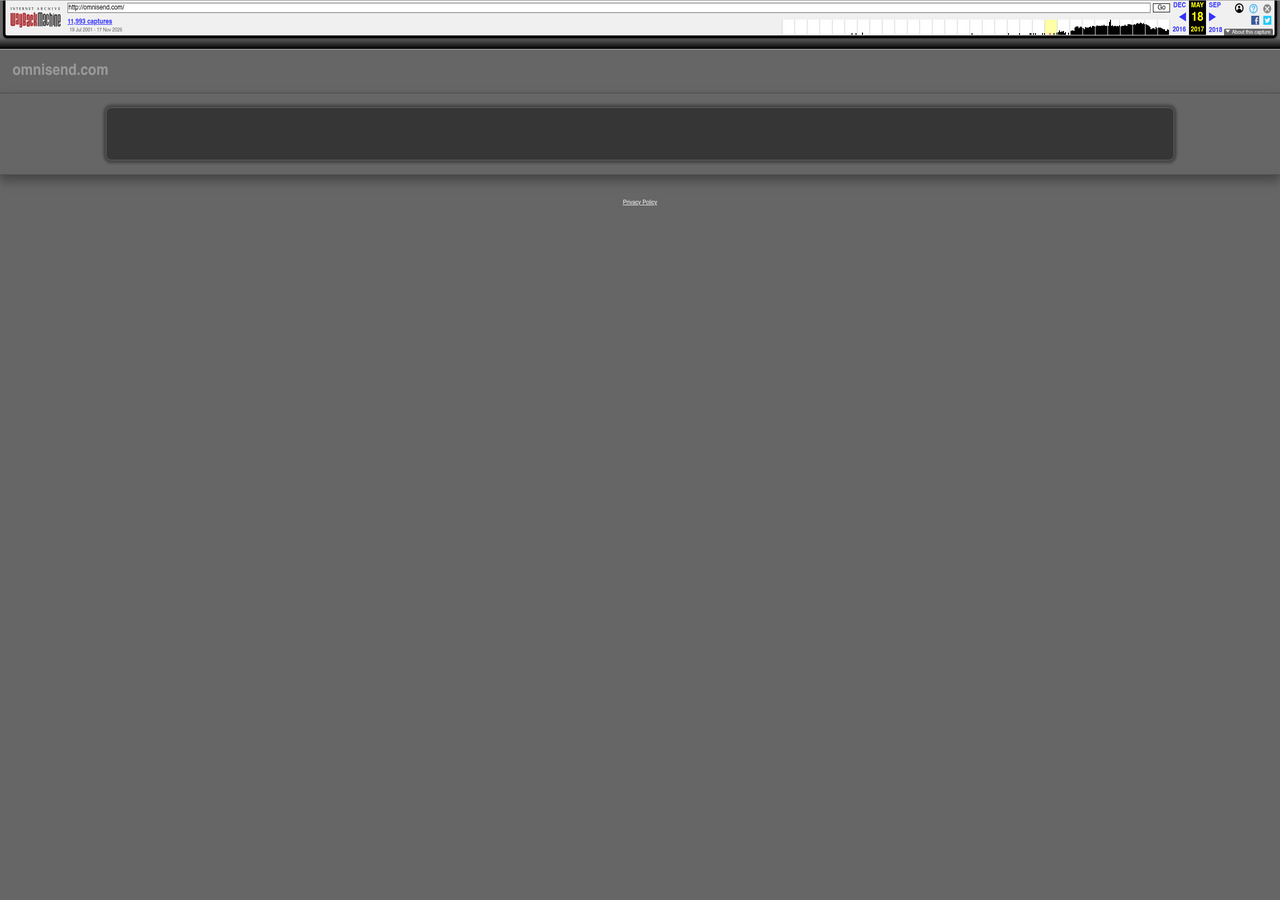
Screenshot of the Wayback Machine’s earliest capture of omnisend.com, 18 May 2017. The capture is a near-empty placeholder page, not the 2017 homepage — the CDX record is the evidence that the domain existed by then.
The site has been live since at least 18 May 2017, the date of the earliest Wayback capture of omnisend.com. The capture itself is a near-empty placeholder page — a domain header and a Privacy Policy link — so it proves the domain existed then, not what the homepage looked like. Twelve years after founding, the domain, the model and the ownership are all unchanged.
Where the visits come from
| Channel | Share of visits | Platform & stack |
|---|---|---|
| Direct | 53.84% | Semrush traffic journey, desktop, October 2026; Similarweb (April 2026) puts it at 78.75% — the mirrors disagree |
| Organic search | Share not published | Semrush: organic search traffic fell 34.2% month-on-month in October 2026; top keyword “omnisend login”, 1,600 searches a month |
| Referrals | google.com 4.36% | Semrush traffic journey, desktop; Similarweb ranks referrals third, share not published |
| Paid search | Share not published | Semrush: paid search traffic fell 41.41% month-on-month in October 2026 |
| Meta paid ads | About 77 active ads (US) | Ad Library live-browser check, 28 November 2026: official page Omnisend, about 96 active ads worldwide, about 250 in total |
| AI search | About 0.3% | Semrush, October 2026: about 2,000 visits from ChatGPT, 2,000 from Claude, 265 from Gemini |
Direct traffic dominates at 53.84% of desktop visits, with google.com next at 4.36% — the shape of a product people arrive at by name or from an app store they already use. AI search is about 0.3% of visits: some 2,000 from ChatGPT, 2,000 from Claude and 265 from Gemini in October.
The channel shares disagree between mirrors — one puts direct at 78.75% and this page’s 53.84% comes from Semrush’s desktop journey — so this page uses the mirror that matches the month and notes the conflict, rather than picking one number as the truth. Paid search fell 41.41% in October and organic search fell 34.2%, which is the number to watch next month.
| Layer | What it runs on |
|---|---|
| Platform | Hosted SaaS: omnisend.com and app.omnisend.com; WordPress marketing site |
| Channels | Email, SMS and web push in one dashboard; automation flows, forms, segmentation, reports |
| AI | Omnisend AI (copy, send times, segmentation, with human approval); RFM and churn prediction; Omnisend MCP |
| Payments | Not verified — the checkout page was not read this round |
| Infrastructure | Google Cloud (Google Cloud customer case study) |
| Integrations | 30 integrations (G2); Shopify, WooCommerce, BigCommerce, Google Analytics, Facebook; one account holds up to 500 stores |
| Support | 24/7 live chat and email on every plan, including Free; named support staff in public replies |
The stack is a hosted service with a WordPress marketing site: no download, no self-hosting, the whole product behind a login. The servers sit on Google Cloud, the AI runs on outside models with the system picking per task, and the integrations run through the app stores — Shopify, WooCommerce and BigCommerce first. Nothing in the stack is owned end to end except the brand.
Omnisend is the third teardown in our Email marketing tools collection. The nearest teardown on traffic is Crisp at 1.4M visits a month, and the most useful side-by-side is Omnisend vs AWeber vs GetResponse. For the closest email rival by traffic, see the Brevo teardown.
Unlock the full Omnisend teardown
Inside the full teardown:
- Category benchmarks in full
- The $16 math
- The Shopify shelf
- The review record, and what it costs
- What a founder should copy — and what not to
Prefer to inspect a full teardown first? Read the iLovePDF teardown — fully unlocked.
Similar sites in the database
Omnisend (1.36M) sits just below MagicEraser and just above Pictory in the database. The sites nearest to it on traffic are shown below.
| Site | Monthly visits | Category |
|---|---|---|
| BaubleBar | 1.4M | Jewelry · Affordable luxury fashion jewelry DTC brands |
| Papier | 1.4M | Stationery · Personalised paper DTC brands |
| Crisp | 1.4M | Customer support · Omnichannel messaging |
| MagicEraser | 1.37M | Image tools · AI photo editing |
| Omnisend (omnisend.com) | 1.36M | Email marketing |
| Pictory | 1.32M | Video tools · AI video generation |
| AG1 | 1.3M | Health & wellness · Greens powder subscription DTC brands |
| Moroccanoil | 1.28M | Beauty · Hair care DTC brand |
Related teardowns
- Brevo — 6.5M visits a month, the customer engagement platform.
- AWeber — 2.19M visits a month, the email marketing platform.
- GetResponse — 1.74M visits a month, email marketing and automation.
Read the next one in your inbox
The new ones go out by email first, one a week, with the traffic source and month attached to every number. Leave your address and the next one comes to you.
Free email brings one full teardown a week. Membership opens the whole archive, all of it, right now.