
How Crisp makes money: $95 flat, no per-seat tax
Monthly visits
1.4M
October 2026. Third-party estimate, not official MAU/DAU. Similarweb counted 1.4M for the month, up 1.52% on September 2026 (about 1.38M).
Crisp draws an estimated 1.4M visits a month (October 2026, Similarweb). It is the 293rd-largest site in our database of 927 — one of five sites tied at 1.4M — and the only site in the Customer support · Omnichannel messaging category.
| Site | Crisp, crisp.chat |
|---|---|
| What it is | Omnichannel customer messaging platform: live chat widget, shared inbox, knowledge base, CRM and Hugo AI agent, priced per workspace |
| Who it is for | Small and mid-size businesses and SaaS teams that need customer messaging in one place |
| Category | Customer support · Omnichannel messaging |
| Monthly visits | 1.4M, October 2026. Third-party estimate, not official MAU/DAU; Similarweb; up 1.52% on September 2026 (about 1.38M) |
| Founded | 2015, Nantes, France; founded by Baptiste Jamin and Valérian Saliou |
| Headquarters | Nantes, France (2 boulevard de Launay, Nantes 44100) |
| Operator | CRISP IM SAS — private, fully bootstrapped since inception, no venture capital, no listing, no acquisition; the founders are still in charge |
| Survival engine | Renewals: flat per-workspace pricing — $95 buys ten seats where rivals charge per agent — and a free tier whose “Powered by Crisp” widget spreads the name across 600,000+ businesses |
| Pricing | Free $0; Mini $45/mo; Essentials $95/mo; Plus $295/mo; Enterprise custom; 14-day free trial, no card required. Prices read from crisp.chat/en/pricing, 28 November 2026 |
| Pricing model | Monthly subscription per workspace, unlimited conversations; annual billing switchable inside the app (annual discount not published); Hugo AI credits metered on top |
| Typical basket (derived) | $95/month — the Essentials tier, the mainstream paid plan for a ten-seat team (range $45–$295); derived from listed prices and plan structure; the company has not disclosed actual ARPU |
| Free hook | Permanent free tier (2 seats, chat widget, shared inbox, mobile app) + 14-day full-feature trial, no card required |
| Meta ads | No active ads — the Crisp page in the Meta Ad Library shows no active ads on 28 November 2026; about 21 past ads, all stopped, last ran January–February 2026; the page carries a notice that it was disabled after review for violating the ad publishing rules |
| Country breakdown | Not publicly disclosed (Similarweb page did not show country data) |
| Audience | Not verified — Similarweb audience data is a paid feature |
TL;DR
- Crisp sells flat-rate customer support: $95 a month buys a ten-seat workspace where rivals charge per agent — $190 at Freshdesk, $290 at Intercom, $550 at Zendesk. The site draws 1.4M visits a month (October 2026, Similarweb), up 1.52% on September.
- The money is renewals. 600,000+ businesses use the free chat widget, 10,000 pay, and the company has been profitable and bootstrapped since 2015 with a team of about twenty to thirty people — no funding, no sales team, no acquisition.
- The other side: the review record is split — 4.5 out of 5 on G2 from 207 reviews against 1.9 out of 5 on Trustpilot from 56 — and the terms say “No refunds”. Hugo, the AI agent, moved from free to metered credits in February 2026, and some users say the switch came without warning.
Members also unlock: The $95 math — with the payer-mix table and chart that test the eight-figure ARR claim · Hugo, priced by the answer · The review split, and what it costs · What a founder should copy — and what not to See the full teardown →
Flat pricing, funded by renewals
The visits are the brand
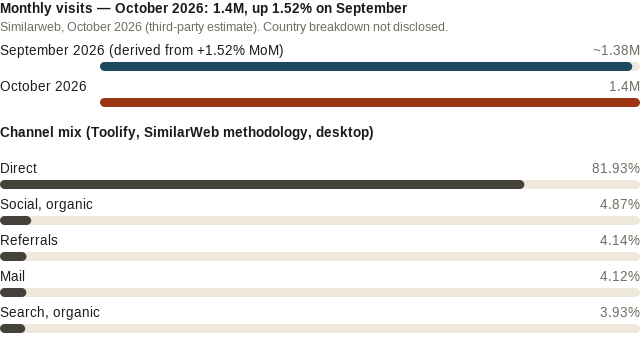
Monthly visits, Similarweb, October 2026 (third-party estimate). Direct traffic is 81.93% of visits; the brand term does the work.
October 2026 drew an estimated 1.4M visits, up 1.52% on September’s roughly 1.38M. The largest keyword is the brand itself: “crisp” draws about 70,700 visits a month, according to a third-party mirror of the search data. Direct traffic is 81.93% of visits — people type the name in, or arrive from a widget they already use.
That split is the shape of the business. A free chat widget sits on 600,000 businesses’ websites, each one carrying the brand, and 10,000 of them pay. The paying share is 1.7% — a thin slice, but at $45 to $295 a workspace it funds a team of twenty to thirty without outside money.
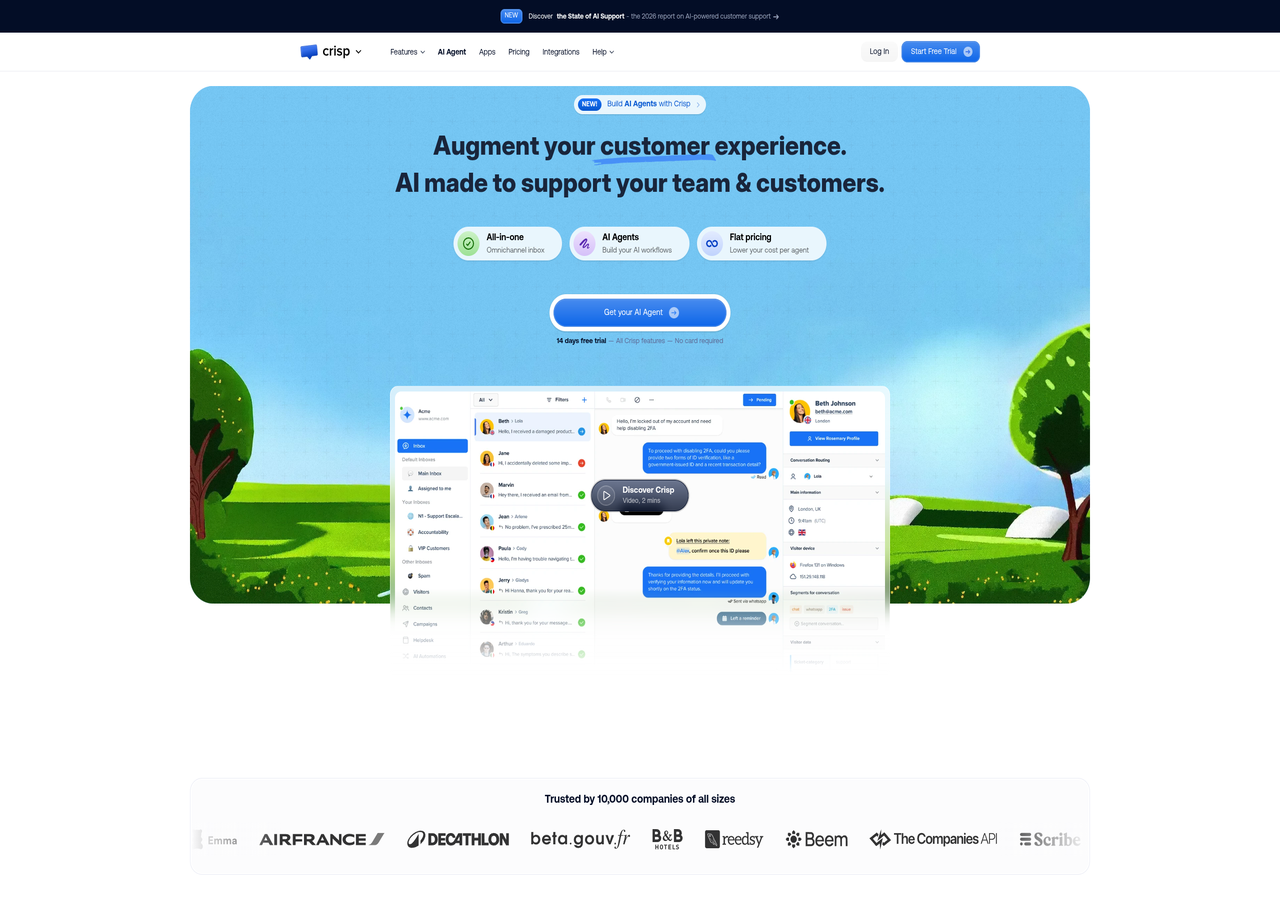
Screenshot of the Crisp homepage, read 28 November 2026. The trial is the whole pitch: fourteen days, every feature, no card.
The homepage opens on the trial, not the price: “Augment your customer experience. AI made to support your team & customers.” Below it, three badges — omnichannel inbox, AI agents, flat pricing — and a line the company repeats everywhere: “Trusted by 10,000 companies of all sizes”, with Emma, Air France, Decathlon and Reedsy on the logo wall.
Eleven years, no funding
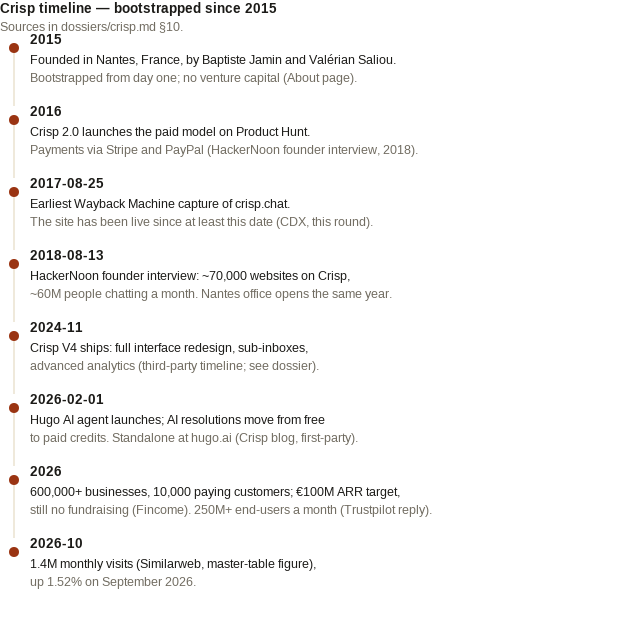
Timeline, 2015 to 2026. The company has been bootstrapped since day one.
Crisp started in 2015, built in three months in a co-founder’s flat in Nantes, and the founders chose to bootstrap instead of fundraise. The About page still says it plainly: “Fully bootstrapped since inception, we thrive without venture capital influence.” A founder interview from 2018 records the same choice in the founder’s own words: “we are 100% independent.”
The record since is a straight line. A paid model launched on Product Hunt in 2016; the earliest Wayback capture is 25 August 2017; a Nantes office opened in 2018, when about 70,000 websites ran the widget. In July 2026 the founders told a podcast the company was bootstrapped with eight-figure revenue in dollars, used by 600,000 businesses, with a team of about thirty — and that they had turned down an acquisition offer the year before.
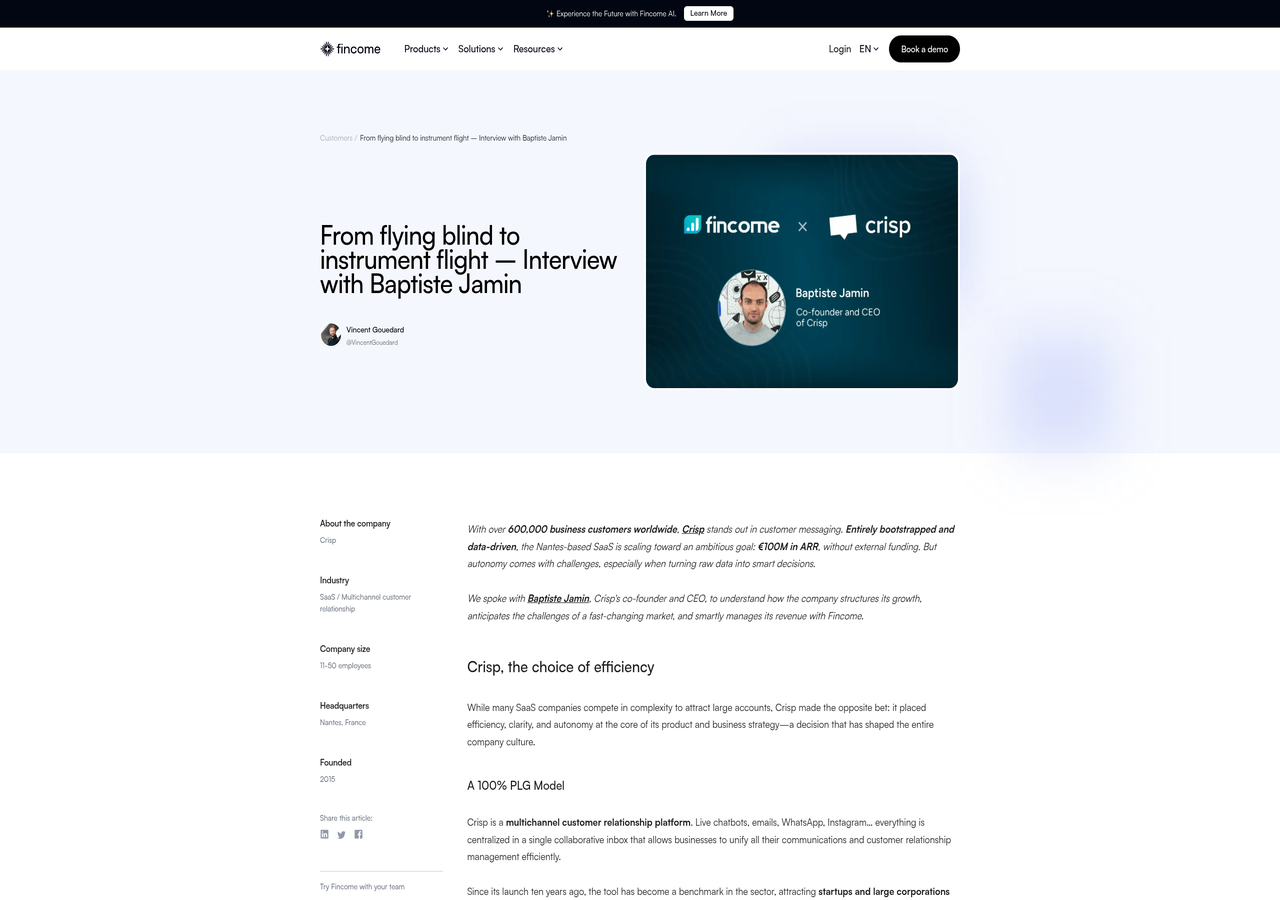
Screenshot of the Fincome founder interview, 2026. The interview calls Crisp “lean, profitable, global SaaS” — and records the €100M ARR target, still without fundraising.
The profit claim rests on the founders’ word, repeated twice: the Fincome interview calls the company “lean, profitable, global SaaS”, and the July 2026 podcast calls it profitable and bootstrapped. No margin, no net income and no audited figure has ever been published, so this page records the claim with its sources and does not turn it into a number.
The price list: $95 buys ten seats
Four tiers, one price per workspace
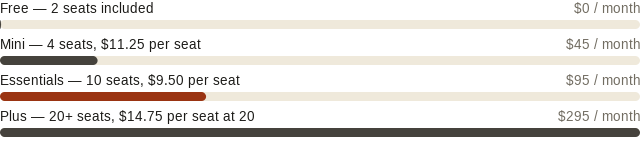
Prices from crisp.chat/en/pricing, read 28 November 2026. The price is per workspace, not per seat — and the conversation count is unlimited.
| Plan | Price | What it is |
|---|---|---|
| Free | $0 | 2 seats, 100 customer profiles, zero AI credits; chat widget, shared inbox, mobile app, contact form, e-commerce integrations |
| Mini | $45/mo | 4 seats, 5,000 profiles, $5 AI credits (about 90 automated conversations); adds shared email inbox, shortcuts, chat triggers, private notes |
| Essentials | $95/mo | 10 seats, 50,000 profiles, $25 AI credits (about 450 automated conversations); adds omnichannel inbox, knowledge base, automation, analytics |
| Plus | $295/mo | 20+ seats, 200,000 profiles, $75 AI credits (about 1,350 automated conversations); adds ticketing, 100+ integrations, white label; marked “Best value” |
| Enterprise | Custom | Dedicated onboarding, personalised SLA, enhanced rate limits, custom features, team training |
The ladder is short and the anchor is the middle tier. Free costs nothing and covers two seats, a chat widget and a shared inbox. Mini at $45 adds a shared email inbox and four seats. Essentials at $95 is where the product becomes a support desk: ten seats, the omnichannel inbox, a knowledge base, automation, and $25 of Hugo AI credits a month. Plus at $295 adds ticketing, white-labelling and $75 of credits, and the page marks it “Best value”.
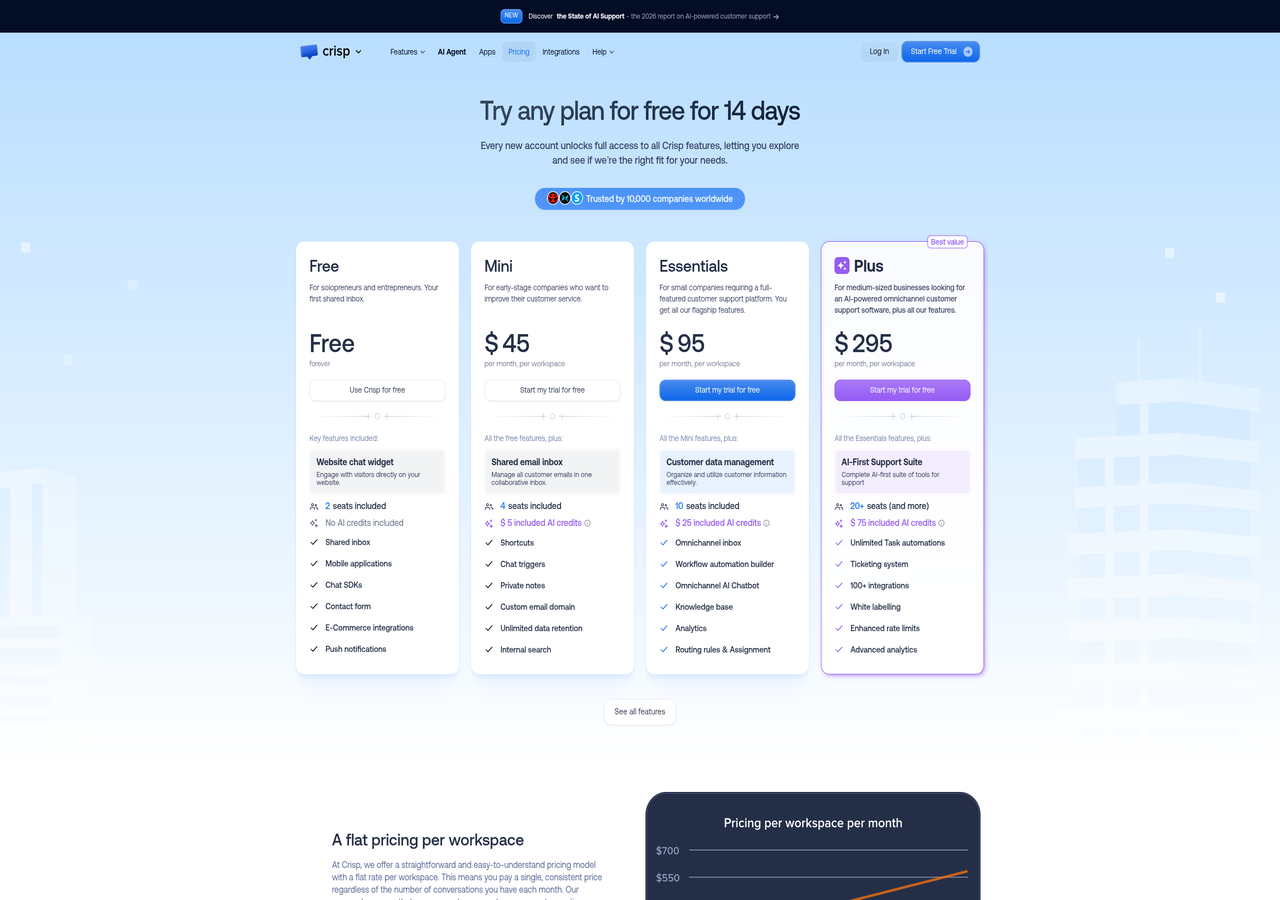
Screenshot of the Crisp pricing page, read 28 November 2026. Four plans, one price per workspace; the annual switch lives inside the app.
The arithmetic that matters is per seat. Essentials at $95 for ten seats is $9.50 a seat; Plus at $295 for twenty seats is $14.75 a seat. The price only jumps when a team crosses a tier, never when it hires one more person — which is the opposite of the per-seat rivals, whose bills rise with every hire.
The $95 typical basket
The typical order is the middle tier. Essentials at $95 a month is the mainstream paid plan: the tier where a ten-seat team gets the whole product, and the tier the pricing page’s own comparison table is built around. The range runs $45 to $295, and the company has not disclosed what its 10,000 payers actually pay on average, so this page does not multiply $95 by 10,000 and call it revenue.
Annual billing exists but its price does not. The pricing page says a subscriber can switch monthly to yearly inside the app, and publishes no discount rate — so the $95 figure in this teardown is the monthly price, and any yearly saving is not verified.
What brings teams back
| Mechanism | Status | How it shows up |
|---|---|---|
| Free tier | ✓ | Permanent free tier: 2 seats, chat widget, shared inbox, mobile app (pricing page) |
| No sign-up | — | An account and a workspace are required; there is no try-before-register mode |
| Free trial | ✓ | 14 days, all features, no card required (homepage and pricing page) |
| Advertising | — | No advertising revenue line; no third-party ads inside the product |
| API | ✓ | Developer APIs, chat SDKs, MCP server (pricing comparison table) |
| Flat workspace pricing | ✓ | One consistent price per workspace regardless of conversation count (pricing page) |
| Annual billing switch | ✓ | Monthly can switch to yearly inside the app (pricing FAQ); discount rate not published |
| Cancel & refund | ✓ | Terms (27 July 2026): termination immediate, current month charged in full, “No refunds” |
| Hugo AI credits | ✓ | $5 / $25 / $75 monthly allowance by tier, pay-as-you-go on top; credits reset on the 4th, do not roll over |
| Integration lock-in | ✓ | 100+ integrations claimed; 85 counted by a third-party review, November 2026 |
| Knowledge base | ✓ | Self-service help centre from Essentials up (pricing page) |
| White label | ✓ | Plus tier removes the “We run on Crisp” mark (pricing page) |
| “Powered by Crisp” badge | ✓ | Free-tier widget carries the brand; founders call it a growth amplifier |
The table has no subscription rows to skip, pause or cancel — the retention work is done by the price structure itself. A team that grows from two seats to four pays $45; from four to ten pays $95. Each crossing is a decision point, and each one unlocks something the team has started to need: the email inbox at Mini, the knowledge base and automation at Essentials, ticketing and white-labelling at Plus.
The free tier is the lock-in. A widget installed once carries the brand to every visitor, and the data — 100 customer profiles on Free, 5,000 on Mini, 50,000 on Essentials — grows inside Crisp until moving means leaving it behind. The integrations do the same work: 100+ on the pricing page, 85 counted by a third-party review in November 2026, from Shopify and WordPress to Slack and HubSpot.
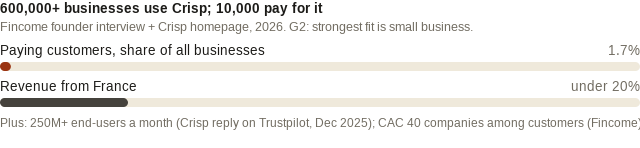
Who pays, and who does not. 10,000 paying customers out of 600,000+ businesses — 1.7% — carry the whole company (Fincome founder interview and Crisp homepage, 2026).
The audience is a funnel with a thin neck. 600,000+ businesses use the product and 10,000 pay for it — 1.7% — and the rest of the shape is not published: no age or gender breakdown exists in the free Similarweb data, and the company says less than 20% of revenue comes from France, with large French companies among its customers. What is known is the fit: reviewers say the strongest match is small business.
A 4.5 on G2, a 1.9 on Trustpilot
The public review record is split, and the split is the warning. G2 shows 4.5 out of 5 from 207 reviews, praising quick setup and the switch from Intercom and Zendesk. Trustpilot shows 1.9 out of 5 from 56 reviews, 71% of them one star, and the complaints repeat: accounts frozen by automated fraud checks, annual fees refused a refund, support slow to answer. Both samples are small, and this page does not average them.
The scores above are quoted from text reads on 28 November 2026, not screenshots: both review pages blocked screenshot capture that day. The gap between the platforms is itself a data point — the same product, reviewed by different kinds of buyer, lands 2.6 points apart.
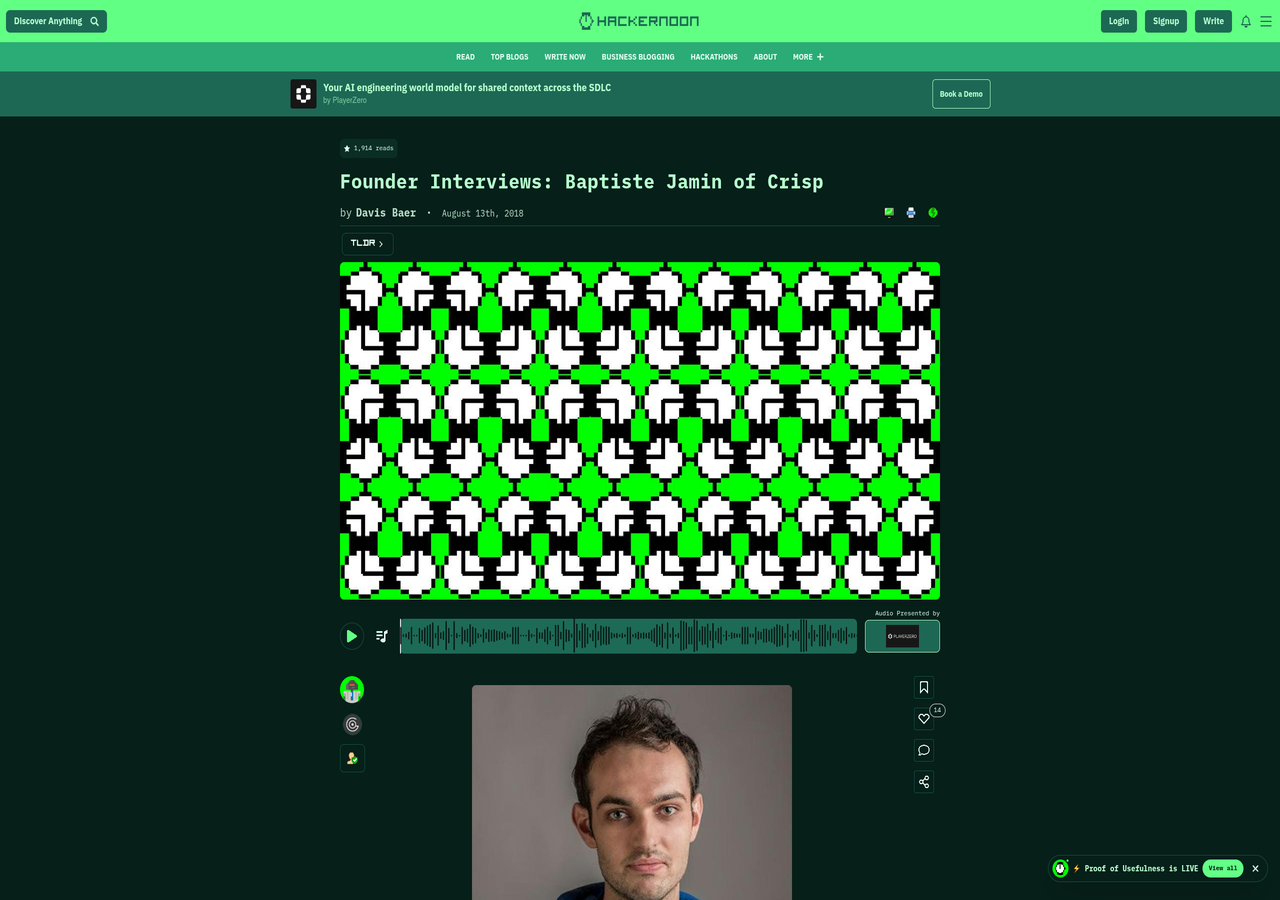
Screenshot of the HackerNoon founder interview, 13 August 2018. The founders built the first version in three months — and chose to bootstrap instead of fundraise.
The 2018 interview is the oldest first-party record of the model. About 70,000 websites ran Crisp then, some 60 million people chatted through it each month, and half of the users who installed it were still there ten weeks later. The team was five people. Eight years on, the team is about twenty to thirty, the user count is 600,000 businesses, and the model — free widget, flat price, no sales team — is unchanged.
The shelf: cheaper than the per-seat rivals
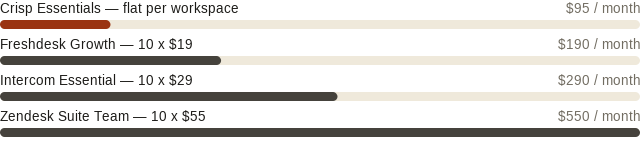
Ten seats, one month. Crisp is 17% of Zendesk’s price, a third of Intercom’s and half of Freshdesk’s (annual prices, third-party reads, October–November 2026).
| Site | Monthly cost, 10 seats | Pricing model | What it sells |
|---|---|---|---|
| Crisp | $95 | Flat per workspace | Omnichannel messaging, AI agent included in the tier |
| Freshdesk | $190 | 10 × $19/seat | Helpdesk with omnichannel inbox |
| Intercom | $290 | 10 × $29/seat | Customer messaging, Fin AI at $0.99 per resolution |
| Zendesk | $550 | 10 × $55/seat | Support suite, AI resolutions metered on top |
The rivals are not in the database, and this page says so. Intercom, Zendesk and Freshdesk are all larger, funded or acquired — Zendesk was taken private by a buyout firm in 2022 — and all three charge per agent, so a ten-seat team pays two to six times Crisp’s price. The gap is the whole pitch, and the review sites repeat it: one calls Crisp “75% of Intercom’s messaging capability at 15% of the cost”.
The cheap price has a cost the rivals do not carry. Hugo’s per-answer charge is about $0.05 to $0.10 a conversation against Intercom’s Fin at $0.99 a resolved conversation — a tenth of the rival’s toll — but the AI only became metered in February 2026, and users who had built workflows on free AI found them stopped without notice. Crisp’s own replies admitted the migration was handled poorly.
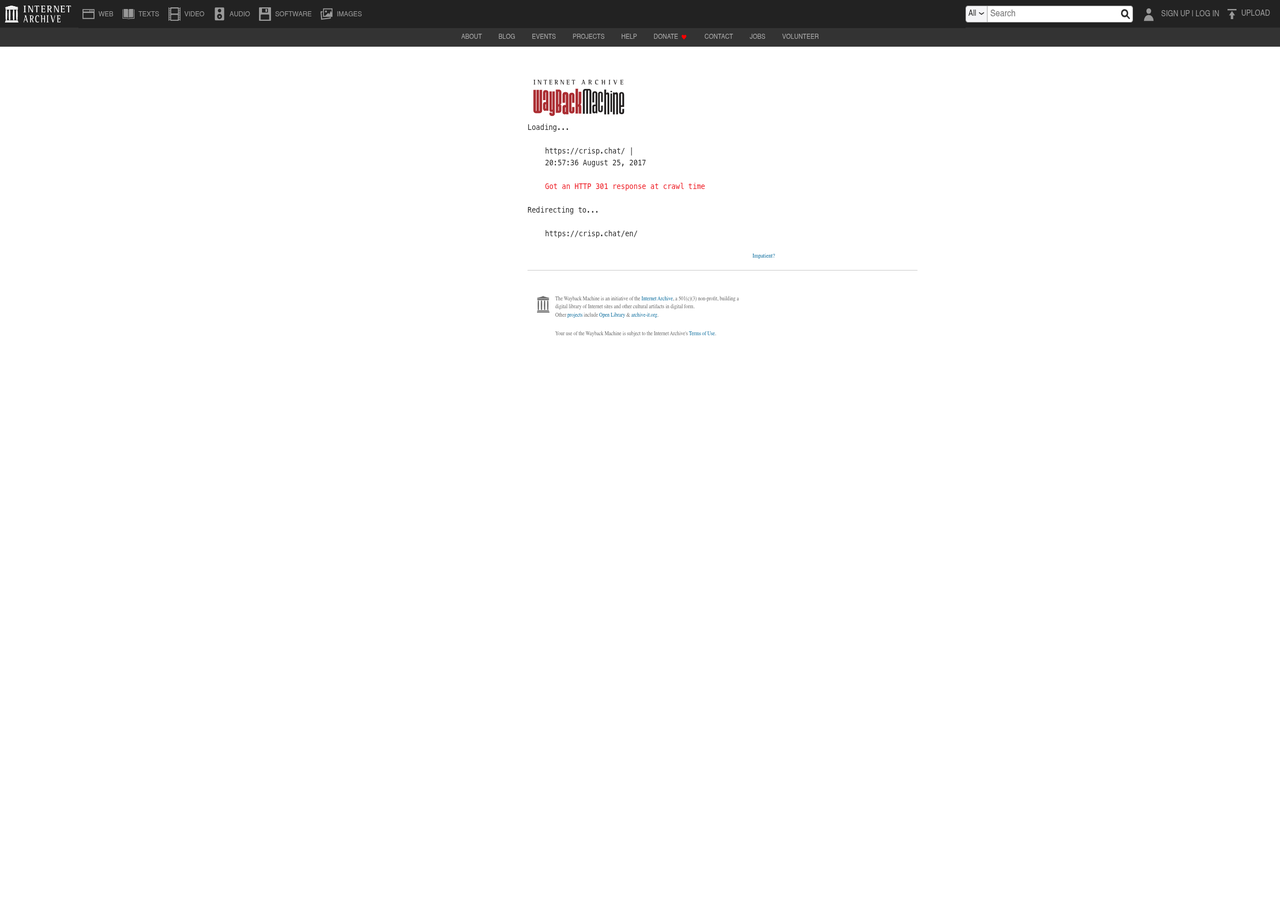
Screenshot of the Wayback Machine’s earliest capture of crisp.chat, 25 August 2017. The capture is a redirect page, not the 2017 homepage — the CDX record is the evidence that the site was live by then.
The site has been live since at least 25 August 2017, the date of the earliest Wayback capture. The capture itself is a redirect to the English homepage, so it proves the domain was live, not what the homepage looked like. Eleven years after founding, the domain, the model and the ownership are all unchanged.
Where the visits come from
| Channel | Share of visits | Platform & stack |
|---|---|---|
| Direct | 81.93% | Toolify, desktop; Shipsite agrees at 82.86% |
| Organic search | 3.93% | Toolify; HypeStat agrees at 3.93% |
| Referrals | 4.14% | Toolify; Shipsite agrees at 4.26% |
| 4.12% | Toolify; Shipsite agrees at 3.27% | |
| Social, organic | 4.87% | Toolify; HypeStat puts it at 0.19% — the mirrors disagree |
| Paid search | 0.33–0.41% | Toolify 0.33%; Shipsite 0.41% |
| Meta paid ads | No active ads found | Ad Library live-browser check, 28 November 2026: no official crisp.chat page; the only page named “Crisp” is CRISP.CO, a law-firm growth firm |
| AI search | 0.47–0.57% | Toolify 0.47%; Shipsite 0.57% |
| Display | 0.09–0.18% | Toolify 0.09%; Shipsite 0.18% |
Direct traffic dominates at 81.93%, with organic search at 3.93% and referrals at 4.14% — the shape of a product people arrive at by name or from a widget they already use. Paid search is 0.33% to 0.41% of visits, and AI search is 0.47% to 0.57%: small, but the founders say traffic from ChatGPT converts better than traffic from Google, without giving a number.
The channel shares disagree between mirrors — one puts direct at 90.83% and social at 0.19%, against 81.93% and 4.87% here — so this page uses the mirror that agrees with a second source and notes the conflict, rather than picking one number as the truth.
| Layer | What it runs on |
|---|---|
| Platform | Hosted SaaS: crisp.chat and hugo.ai (Terms page) |
| Chat widget | JavaScript embed; shared inbox, knowledge base, CRM, MagicBrowse co-browsing, LiveTranslate in 50+ languages |
| AI | Hugo AI agent (OpenAI, Anthropic, Google, Mistral models, auto-selected); MCP server; AI copilot and writing assistant |
| Payments | Stripe and PayPal (Stripe Checkout, Stripe Link); checkout page itself not read |
| Infrastructure | DigitalOcean primary servers with AWS backup (third-party) |
| Integrations | 100+ claimed on the pricing page; 85 counted by a third-party review, November 2026; Shopify, WordPress, Slack, HubSpot, Zapier |
| Support | support@crisp.chat; in-app chat; 24/5 global support (company replies) |
The stack is a hosted service with a JavaScript widget: no download, no self-hosting, the whole product behind a login. Payments run through Stripe and PayPal, the servers sit on DigitalOcean with AWS as backup, and the AI runs on outside models — OpenAI, Anthropic, Google and Mistral — with the system picking the model per task. Nothing in the stack is owned end to end except the brand.
Crisp is the first teardown in our Customer support · Omnichannel messaging collection. The nearest site on traffic is Marine Layer at 1.4M visits a month, and the most useful side-by-side is Crisp vs Tally vs Todoist. For the closest SaaS rival by traffic, see the Tally teardown.
Unlock the full Crisp teardown
Inside the full teardown:
- The $95 math — payer-mix ARR table and chart
- Hugo, priced by the answer
- The review split, and what it costs
- What a founder should copy — and what not to
Prefer to inspect a full teardown first? Read the iLovePDF teardown — fully unlocked.
Similar sites in the database
Crisp (1.4M) sits just below Papier and just above MagicEraser in the database. The sites nearest to it on traffic are shown below.
| Site | Monthly visits | Category |
|---|---|---|
| Thuma | 1.4M | Home · Bedroom furniture DTC brands |
| Marine Layer | 1.4M | Apparel · Casual clothing DTC brand |
| BaubleBar | 1.4M | Jewellery · Light-luxury fashion jewellery DTC brand |
| Papier | 1.4M | Stationery · Personalised paper goods DTC brand |
| Crisp (crisp.chat) | 1.4M | Customer support · Omnichannel messaging |
| MagicEraser | 1.37M | Image tools · AI photo editing |
| Omnisend | 1.36M | Email marketing · E-commerce marketing automation |
| Pictory | 1.32M | Video tools · AI video generation |
Related teardowns
- Tally — 15.1M visits a month, the online form tool.
- Todoist — 16.3M visits a month, the task manager.
- Ko-fi — 15.1M visits a month, the creator tipping and membership platform.
Read the next one in your inbox
The new ones go out by email first, one a week, with the traffic source and month attached to every number. Leave your address and the next one comes to you.
Free email brings one full teardown a week. Membership opens the whole archive, all of it, right now.