
How Ritual makes money: $250M on $33 refills
Monthly visits
1.23M
October 2026. Third-party estimate, not official MAU/DAU. Semrush counted 1.23M for the month, down 6.56% on September 2026 (1.32M).
Ritual draws an estimated 1.23M visits a month (October 2026, Semrush). It is the 307th-largest site in our database of 927 — and the third-largest of the three sites in the Health & wellness DTC collection.
| Site | Ritual, ritual.com |
|---|---|
| What it is | Subscription vitamins and supplements: daily multivitamins, prenatal vitamins, protein and gut-health formulas, delivered monthly |
| Who it is for | Women who want traceable, clinically-backed vitamins on a monthly delivery |
| Category | Health & wellness / DTC |
| Monthly visits | 1.23M, October 2026. Third-party estimate, not official MAU/DAU; Semrush; down 6.56% on September 2026 (1.32M); August was 736.93K |
| Founded | 2015, Los Angeles, California; first product Essential for Women launched 2016; founded by Katerina Schneider |
| Headquarters | Los Angeles, California, United States (Similarweb); 51–200 employees |
| Operator | Natals, Inc. d/b/a Ritual — private, not listed, not group-controlled; about $60M raised from venture firms; the founder is still CEO |
| Survival engine | Renewals: a $33-a-month subscription for a vitamin taken every day, and traceability — every ingredient listed with its source — is the pitch that keeps the renewal coming |
| Pricing | Women’s 18+ $33/month on subscription ($37.50 buy once, plus $10.99 shipping); 50+ $39/month; bundles save up to 35%. Prices read from ritual.com, 29 November 2026 |
| Pricing model | Monthly subscription, auto-renewing; 30-day supply every 30 days; free shipping on subscriptions; 30-day money-back guarantee on the first order only |
| Typical basket (derived) | $33/month — the Women’s 18+ subscription, the mainstream product (range $33–$92 up to the three-product Trio bundle); derived from listed prices and bundle structure; the company has not disclosed its actual average order value |
| Free hook | No free tier and no trial; the hook is 40% off the first order (29 November 2026) + a 30-day money-back guarantee on the first order + free gifts with Starter Sets |
| Meta ads | Active ads — the official Ritual page in the Meta Ad Library shows about 310 active ads in the US (about 400 worldwide) on 29 November 2026; the newest among the first 30 shown started running on 23 November 2026 |
| Country breakdown | United States 94.52% (1.17M); Canada 1.77% (21.86K); United Kingdom 0.85% (10.44K); India 0.55%; Brazil 0.21% (Semrush, October 2026) |
| Audience | Female 73.49% / Male 26.51% (Similarweb, October 2026); age split not published in the free data |
TL;DR
- Ritual sells traceable vitamins on a $33-a-month subscription: the flagship Women’s Multivitamin costs $33 a month on subscription or $37.50 bought once, and the site draws 1.23M visits a month (October 2026, Semrush), down 6.56% on September.
- The money is the refill. The founder says the company passed $250M in net sales in 2024 and has been profitable since 2021, with 2M+ customers and retail in Target, Ulta and Walmart — built on about $60M of venture funding.
- The other side: Trustpilot gives 3.4 out of 5 from 212 reviews, with recent complaints about surprise subscription charges and hard cancellations; organic search fell 7.56% in October; and the New York Times called out its paid-article quotes in 2018.
Members also unlock: Category benchmarks in full · The $33 math · The shelf is the sampler · The complaint file · What a founder should copy — and what not to See the full teardown →
The refill is the product
The visits are the brand
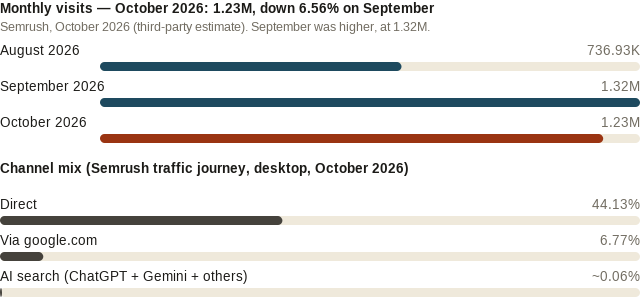
Monthly visits, Semrush, October 2026 (third-party estimate). Direct traffic is 44.13% of desktop visits; the brand term does the work.
October 2026 drew an estimated 1.23M visits, down 6.56% on September’s 1.32M — after a thin August at 736.93K. The largest keywords are the brand itself: “ritual” draws 74,000 searches a month, “ritual vitamins” 40,500, and the journey data says the same thing: 44.13% of desktop visits arrive direct.
That split is the shape of the business. A subscription that renews itself does not need to be found every month — it needs to be found once, then kept. The brand term does the finding: every one of the top five keywords is a Ritual name, and the site’s own pages say the same thing in the traffic mix, with google.com next at 6.77%.
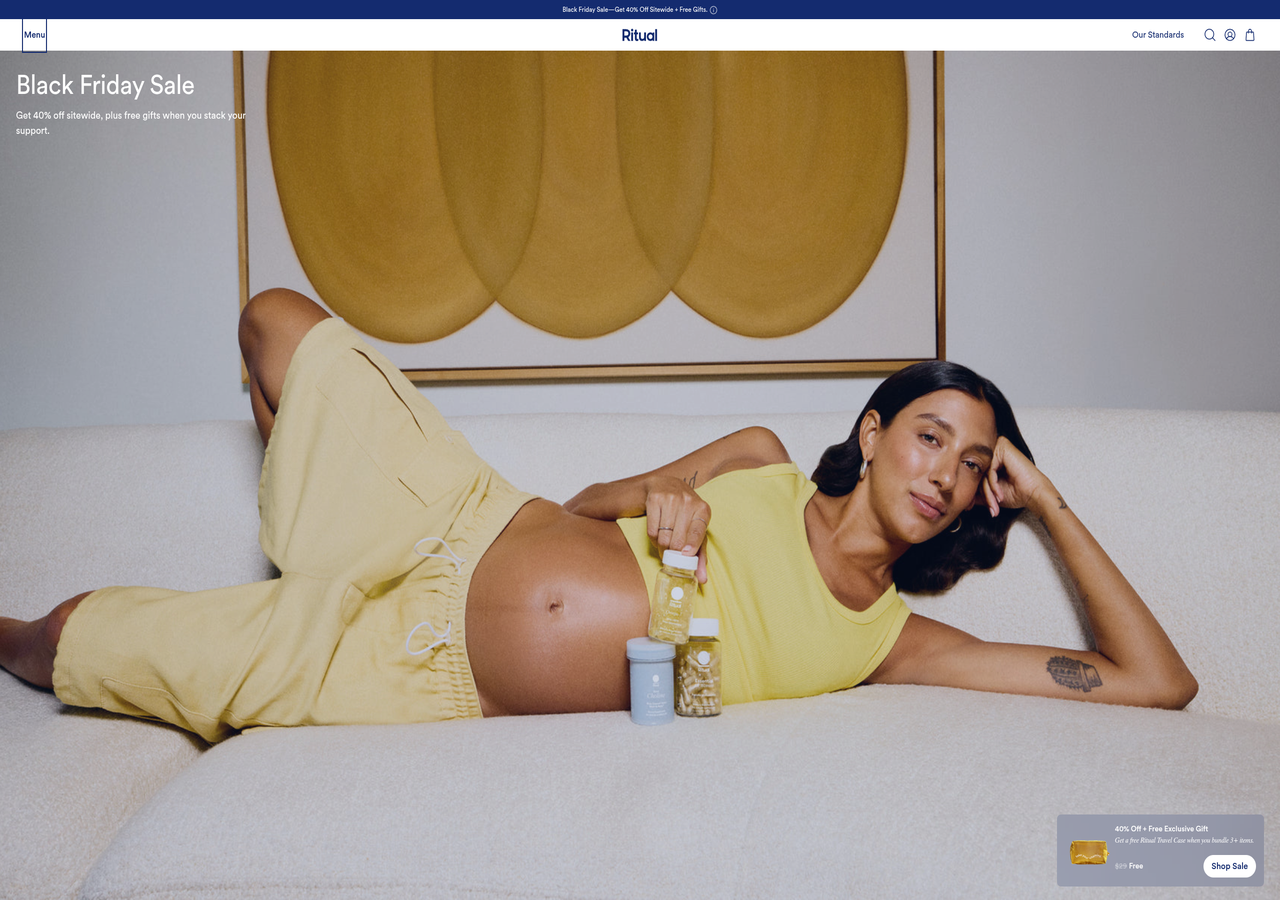
Screenshot of the Ritual homepage, read 29 November 2026. The Black Friday hero sells the discount, not the vitamin: 40% off sitewide, plus free gifts.
The homepage opens on the discount, not the product: “Black Friday Sale — Get 40% off sitewide + free gifts.” Below it, the proof points do the selling — 2.6 billion capsules sold, 100% of ingredients made traceable, $5M invested in clinical studies — and the founder and her science team are named on the page.
Eleven years, three funding chapters
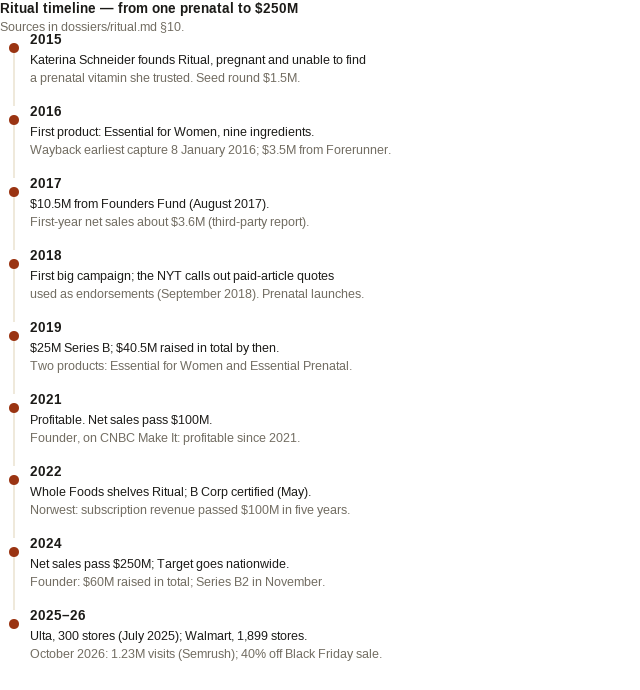
Timeline, 2015 to 2026. Three funding chapters, one product line.
Ritual started in 2015, when Katerina Schneider, four months pregnant, could not find a prenatal vitamin she trusted. The first product, Essential for Women, launched in 2016 with nine ingredients; the funding came in small rounds — $1.5M seed, $3.5M from Forerunner, $10.5M from Founders Fund — and a $25M Series B by 2019.
The funding record is modest for the revenue. The founder puts total venture money at about $60M; PitchBook counts $67.8M, with a Series B2 in November 2024. Either way it is a small pile next to $250M of annual sales — the subscription paid for the growth, not the investors.

Screenshot of the CNBC Make It interview, 2024. The founder says the company became profitable in 2021, after passing $100M in net sales.
The profit claim rests on the founder’s word, given on camera: profitable since 2021, after passing $100M in net sales, and $250M by the end of 2024. No margin, no net income and no audited figure has ever been published, so this page records the claim with its sources and does not turn it into a number.
Ritual against its category
Benchmarked against 43 peers in Health & wellness / DTC — computed from the Everstood database. Visits are third-party estimates (October 2026).
| Monthly visits — category median | 934.5K |
| Median starting paid price | |
| Sites with a free tier | |
| This site's rank in the group |
Member benchmark · Unlock the full benchmarks & the member sections →
The price list: $33 buys the month
Three prices for one bottle
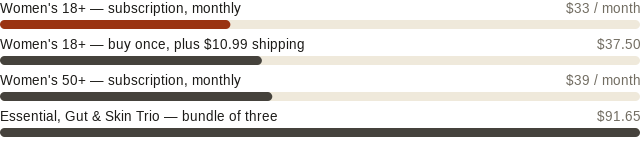
Prices from ritual.com, read 29 November 2026. The subscription is the default: cheaper than buy-once, with free shipping.
| Product | Subscription plan | Buy once | What you get |
|---|---|---|---|
| Women’s Multivitamin 18+ | $33/mo | $37.50 + $10.99 shipping | Nine ingredients; delayed-release capsules; mint-essenced; 30-day supply |
| Women’s Multivitamin 50+ | $39/mo | Not verified | Eight nutrients for postmenopausal women; two capsules a day |
| Men’s Multivitamin 18+ | $33/mo | Not verified | Multivitamin for men 18–49; same subscription structure |
| Men’s Multivitamin 50+ | $39/mo | Not verified | Multivitamin for men 50+; same subscription structure |
| Essential Prenatal | Not verified | $44.32 | Twelve nutrients; same formula at Walmart for $36.98 |
| Essential, Gut & Skin Trio | $91.65 | $141 | Three products bundled; save $49, about 35% off |
The prices on the page are the sale prices, not the list prices: the 18+ shows $19.80 with $33.00 struck through, and the buy-once price sits below in a separate box — $37.50 plus $10.99 shipping. A Black Friday banner ran across the top of the page on the day this teardown was read.
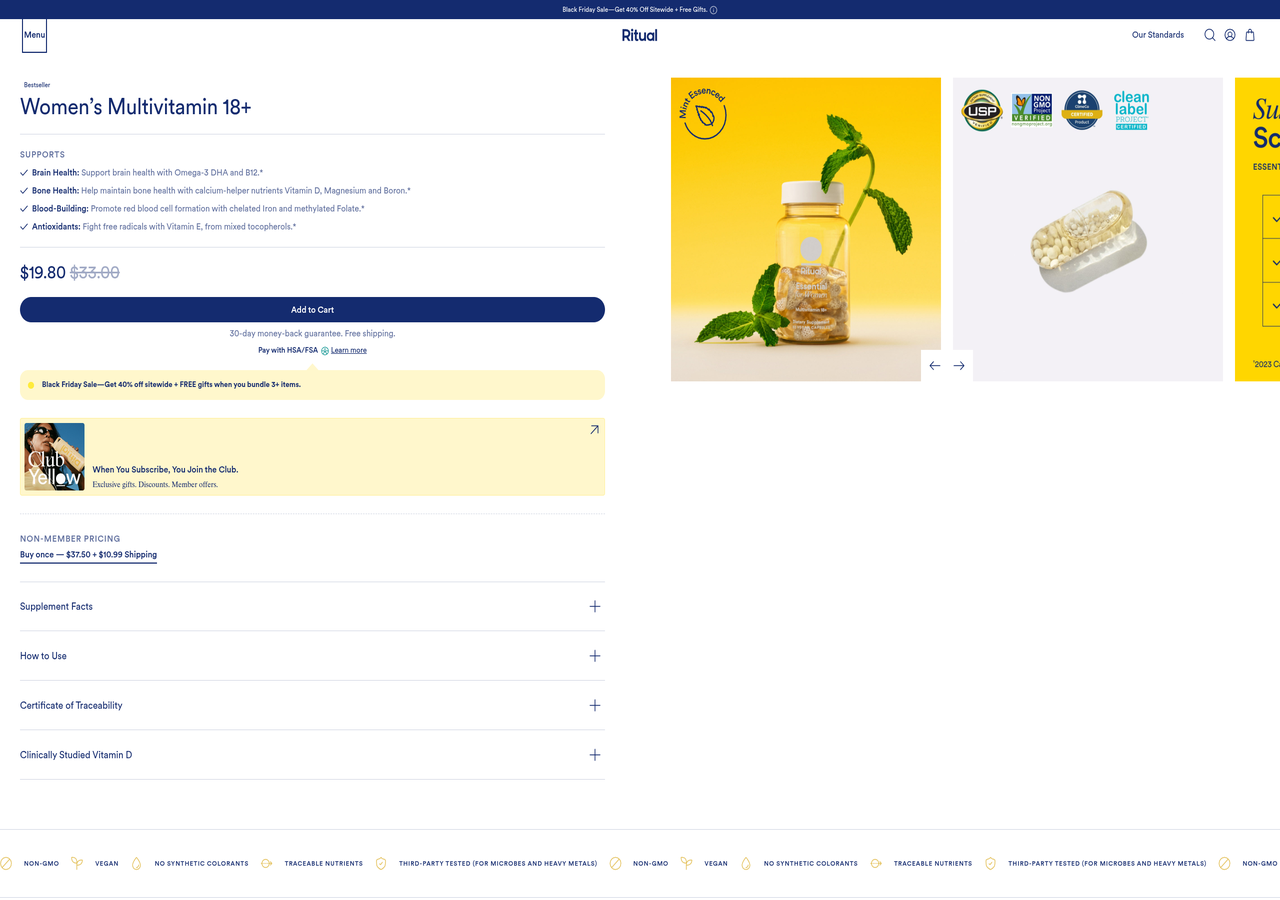
Screenshot of the Women’s Multivitamin 18+ product page, read 29 November 2026. The subscription price is the struck-through $33.00; the buy-once price sits in its own box below.
The arithmetic that matters is per month. At list price the subscription saves about $15 a bottle — $33 with free shipping against $37.50 plus $10.99 bought once — and under the 40% off sale the first bottle is $19.80, a $28.69 saving. The 50+ costs $39 a month, and the Trio bundle is $91.65 against $141 bought separately.
The $33 typical basket
The typical order is one bottle a month. The 18+ at $33 is the mainstream product: the tier the homepage is built around, the price the Black Friday sale is cut from, and the price the comparison with Seed Health and AG1 is built on. The range runs $33 to $92 up to the three-product Trio, and the company has not disclosed what its customers actually pay on average, so this page does not multiply $33 by 2 million and call it revenue.
What brings subscribers back
| Mechanism | Status | How it shows up |
|---|---|---|
| Skip a delivery | ✓ | “Pause, skip, change your delivery date, or cancel anytime” from the Account Page (help centre) |
| Pause the subscription | ✓ | Same line; snoozing keeps Club Yellow benefits (help centre) |
| Cancel anytime | ✓ | Self-serve in the Account Page; cancelling ends Club Yellow benefits (help centre) |
| Free shipping | ✓ | Free shipping on every subscription order, no minimum (Subscriber Perks page) |
| Loyalty programme (Club Yellow) | ✓ | Six tiers by lifetime order count; 12% off every order; milestone gifts at month 4 and month 12 (terms, 6 October 2026) |
| First-order hook | ✓ | 40% off sitewide + free gifts, 29 November 2026 (homepage) |
| Bundle & save | ✓ | Up to 35% off bundles; Trio $91.65 against $141 (shop pages) |
| 30-day money-back guarantee | ✓ | First order only (help centre) |
| Gift subscription | Not verified | No gift subscription product found on the official site |
| Free tier | — | No free tier; vitamins are sold by the bottle |
| Free trial | — | No day-count trial; the 40% off first order is the trial |
| Referral programme | Not verified | No referral programme found on the official site this round |
The table has no free tier to hide behind — the retention work is done by the calendar. A bottle lasts 30 days, the next one ships on its own, and the only decision a subscriber makes is whether to stop it. Club Yellow turns staying into progress: the fourth order brings a free gift, the twelfth brings the top tier, and cancelling wipes the benefits.
The subscription is the lock-in. Skipping and pausing are free and self-serve, which looks generous — and it is also the reason the complaints are about billing, not about being trapped. The friction is not in leaving; it is in noticing: the renewal is automatic, the charge lands at the start of each period, and the refund covers the first order only.
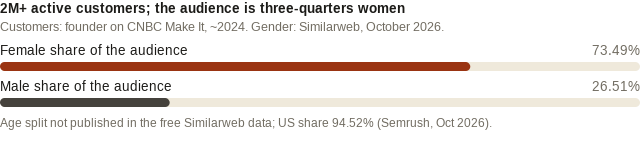
Who pays, and who does not. 2M+ active customers; the audience is about three-quarters women (Similarweb, October 2026; founder on CNBC Make It).
The audience is a funnel with a narrow neck. Two million-plus customers have bought at least once, and the gender split is 73.49% women to 26.51% men — the product is made for women, and the buyers are mostly women. What is not published is the age split, and no subscription count has ever been given, so this page does not turn 2 million customers into 2 million subscribers.
A 4.6 on the product page, a 3.4 on Trustpilot
The public review record is split, and the split is the story. The product page shows 4.6 out of 5 from 1,252 ratings, first-party and on the page that sells the bottle. Trustpilot shows 3.4 out of 5 from 212 reviews, and the recent one-star reviews are about unexpected subscription charges and cancellations that were hard to finish online.
The praise repeats too, and it is specific. Trustpilot’s happier reviewers name the same things the homepage sells: clean, traceable ingredients, third-party testing, and the minty flavour that makes a daily pill pleasant. The product works; the billing is what people argue about — which is the cost of a model that charges first and explains later.
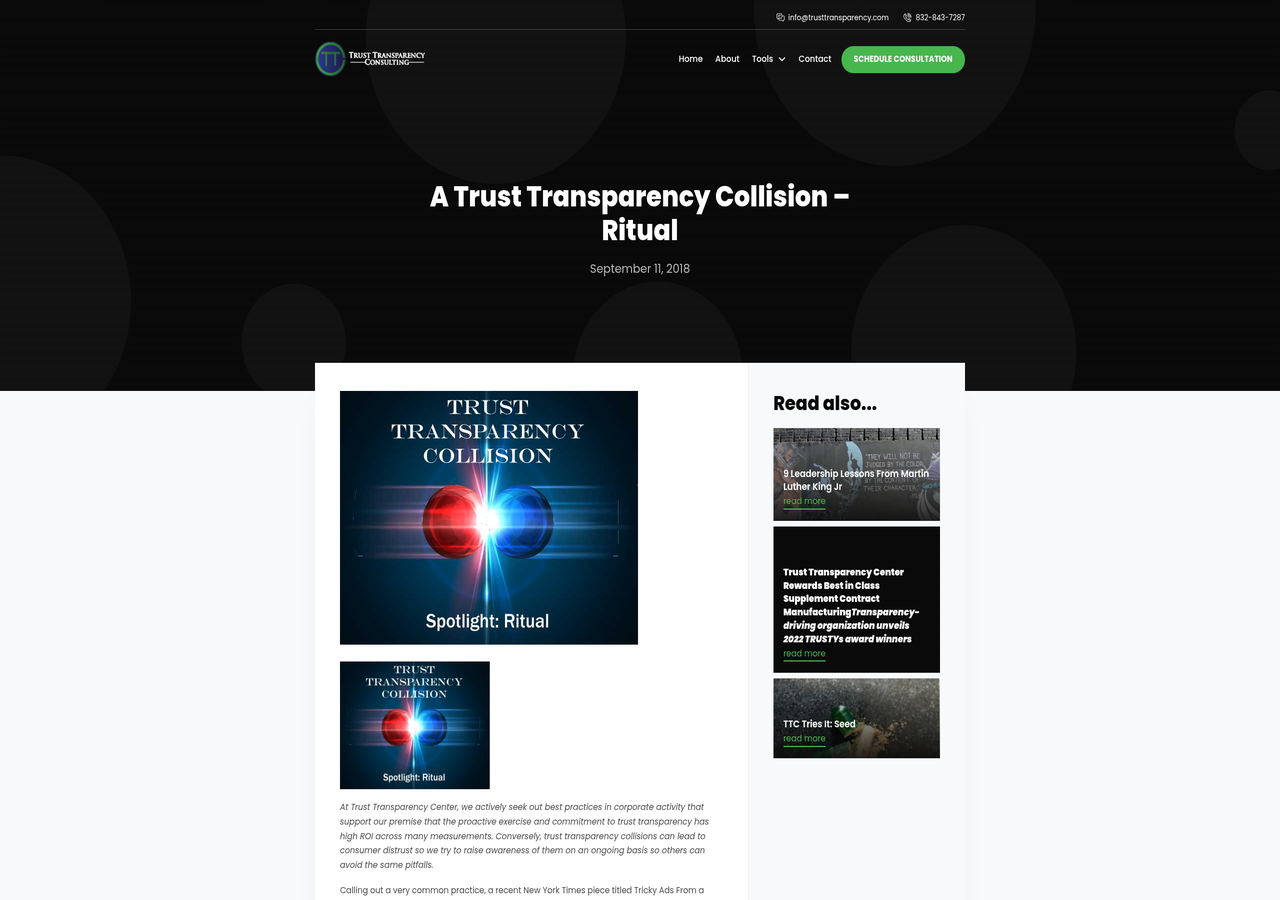
Screenshot of the Trust Transparency post, September 2018, on the New York Times piece “Tricky Ads From a Vitamin Company that Talks Up Openness.” Ritual had quoted paid articles in its ads as if they were endorsements.
The 2018 rebuke is the oldest first-party record of the risk. The Times found Ritual quoting paid articles on Well & Good and PureWow in its Facebook and Instagram ads, and using Times and CNN coverage to imply endorsement. The company answered by spending on clinical trials instead — $5M so far — and the transparency pitch survived because the product changed with it.
The shelf: the cheapest subscription in the aisle
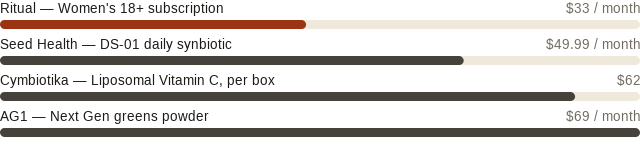
Monthly subscription price, health-wellness brands. Ritual is the cheapest of the four; AG1’s gummies start at $43 a month (total table / site-data, October 2026).
| Site | Monthly cost | What it sells |
|---|---|---|
| Ritual Women’s 18+ | $33/mo | Nine-ingredient multivitamin, 30-day supply |
| Seed Health DS-01 | $49.99/mo | Daily synbiotic, 24 strains |
| Cymbiotika Liposomal Vitamin C | $62/box | Liposomal vitamin C, 28 sachets |
| AG1 Next Gen | $69/mo | Greens powder, 75+ ingredients |
The gap is the whole pitch, and it runs the other way from most premium brands. Ritual is the cheapest subscription in the group by $17 a month, and the pitch is not that it costs less — it is that the ingredients are traceable. The premium is the science, not the price: $5M in clinical studies, third-party testing, and a visible supply chain.
The rivals are not all in the same aisle. Seed Health sells at Target, Amazon and Costco too; AG1 is at Costco and Target; Cymbiotika passed 5,000 stores in October 2026. Ritual’s shelf is the newest of the four — Walmart only in October 2025 — and the subscription is still where the money is made.
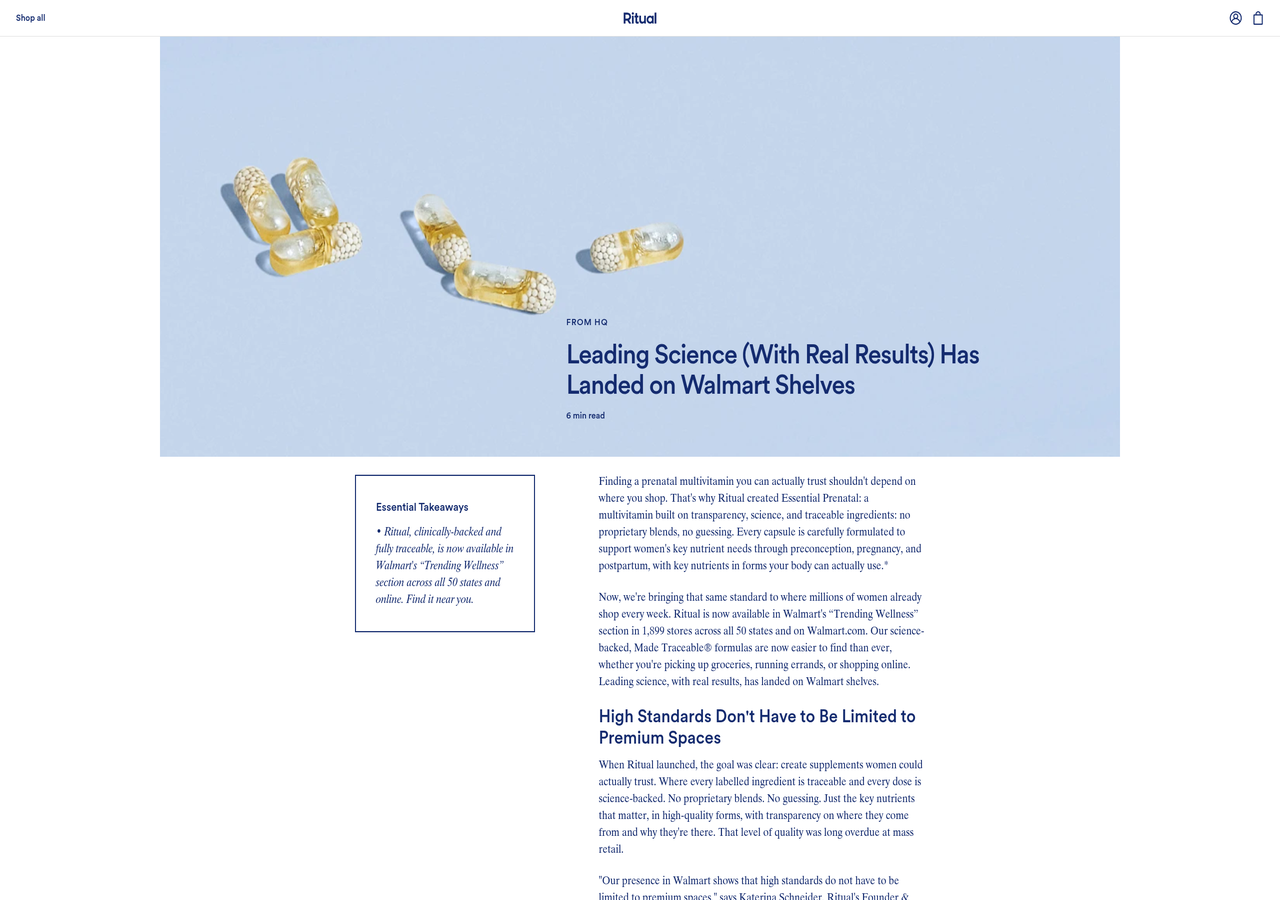
Screenshot of Ritual’s journal, 2025: “Leading Science (With Real Results) Has Landed on Walmart Shelves.” Ritual is in 1,899 Walmart stores across all 50 states.
The shelf does the sampling. A first-time buyer spends $36.98 on a prenatal at Walmart, tries the formula, and the cheapest way to keep going is the subscription — the 18+ is $33 a month with free shipping, against $37.50 plus $10.99 bought once. The shelf does not undercut the subscription: the Walmart price is a buy-once price, and the subscription is still cheaper every month after.
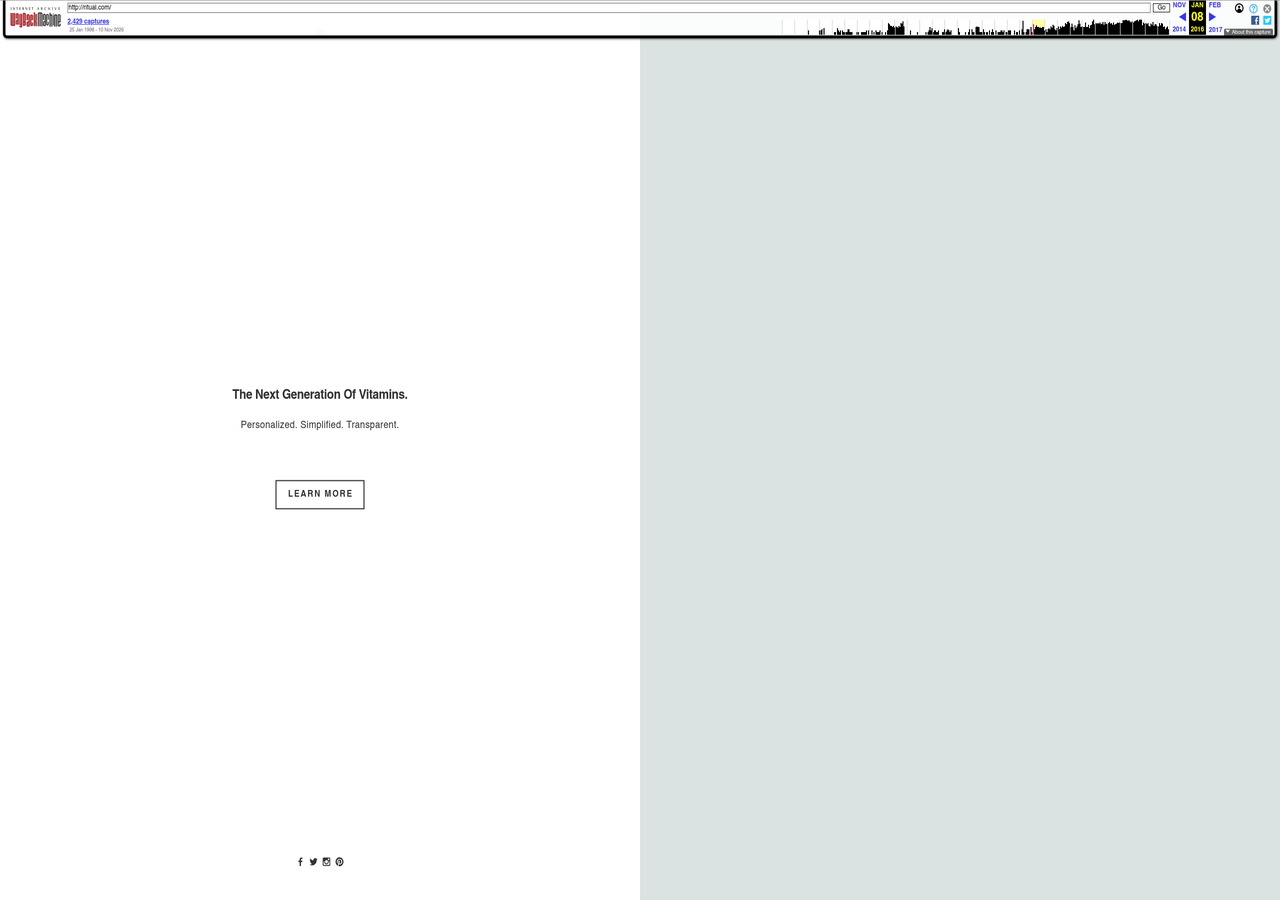
Screenshot of the Wayback Machine’s earliest capture of ritual.com, 8 January 2016. The capture is a near-empty placeholder page, not the 2016 storefront — the CDX record is the evidence that the domain existed by then.
The site has been live since at least 8 January 2016, the date of the earliest Wayback capture of ritual.com. The capture is a near-empty placeholder page — a headline, a “Learn More” button and social icons — so it proves the domain existed then, not what the store looked like. Ten years after founding, the domain, the model and the ownership are all unchanged.
Where the visits come from
| Channel | Share of visits | Source |
|---|---|---|
| Direct | 44.13% | Semrush traffic journey, desktop, October 2026; Similarweb ranks direct third, share not published |
| Organic search | Share not published | Semrush: organic search traffic fell 7.56% month-on-month in October 2026; top keyword “ritual”, 74,000 searches a month |
| Referrals | google.com 6.77% | Semrush traffic journey, desktop |
| Paid search | Share not published | Semrush: paid search traffic fell 63.61% month-on-month in October 2026 |
| Meta paid ads | About 310 active ads (US) | Ad Library live-browser check, 29 November 2026: official page Ritual, about 400 active ads worldwide |
| AI search | About 0.06% | Semrush, October 2026: 497 visits from ChatGPT, 157 from Gemini, 76 from shopnova.ai |
Direct traffic dominates at 44.13% of desktop visits, with google.com next at 6.77% — the shape of a product people arrive at by name. AI search is about 0.06% of visits: some 500 from ChatGPT, 157 from Gemini and 76 from shopnova.ai in October.
The channel shares disagree between mirrors — Similarweb puts total visits lower and ranks organic search first — so this page uses the mirror that matches the month and notes the conflict, rather than picking one number as the truth. Paid search fell 63.61% in October and organic search fell 7.56%, which is the number to watch next month.
| Layer | What it runs on |
|---|---|
| Platform | Shopify store: ritual.com on Shopify CDN; account portal for subscriptions |
| Stack | Shopify-hosted storefront, account portal and help centre — nothing self-hosted |
| Channels | DTC subscriptions on ritual.com; retail at Target, Whole Foods, Ulta, Costco, Walmart; Amazon store. Direct is the largest channel by share of visits at 44.13% (Semrush, October 2026) |
| AI | Not verified — no AI product line on the official site |
| Payments | Not verified — the checkout page was not read this round |
| Infrastructure | Shopify hosting; help centre at help.ritual.com |
| Integrations | Club Yellow loyalty programme; HSA/FSA eligible checkout |
| Support | Help centre; account self-serve for pause, skip and cancel; 30-day money-back guarantee on the first order |
The stack is a Shopify store with an account portal: no download, no self-hosting, the whole product behind a login. The subscriptions run through the portal, the loyalty programme runs through Club Yellow, and the retail runs through the shelves — Target, Ulta, Costco and Walmart first. Nothing in the stack is owned end to end except the brand.
Ritual is the third teardown in our Health & wellness DTC collection. The nearest teardown on traffic is AG1 at 1.30M visits a month, and the most useful side-by-side is Ritual vs Seed Health vs AG1. For the closest health rival by traffic, see the Cymbiotika teardown.
Unlock the full Ritual teardown
Inside the full teardown:
- Category benchmarks in full
- The $33 math
- The shelf is the sampler
- The complaint file
- What a founder should copy — and what not to
Prefer to inspect a full teardown first? Read the iLovePDF teardown — fully unlocked.
Similar sites in the database
Ritual (1.23M) sits just below AISongMaker and just above Monos in the database. The sites nearest to it on traffic are shown below.
| Site | Monthly visits | Category |
|---|---|---|
| Podia | 1.25M | Education · Creator courses & membership platform |
| Rifle Paper Co. | 1.25M | Stationery · Design stationery DTC brands |
| Book of the Month | 1.24M | Content · Book subscription box |
| AISongMaker | 1.23M | AI music tools |
| Ritual (ritual.com) | 1.23M | Health & wellness / DTC |
| Monos | 1.2M | Travel goods / Luggage DTC brand |
| Faherty | 1.2M | Apparel / Casual apparel DTC brand |
| Taylor Stitch | 1.2M | Apparel · Menswear DTC brands |
Related teardowns
- Seed Health — 1.72M visits a month, the daily synbiotic subscription.
- AG1 — 1.30M visits a month, the greens powder subscription.
- Cymbiotika — 1.26M visits a month, liposomal supplements on subscription.
Read the next one in your inbox
The new ones go out by email first, one a week, with the traffic source and month attached to every number. Leave your address and the next one comes to you.
Free email brings one full teardown a week. Membership opens the whole archive, all of it, right now.