
How Synthesia makes money: $19 Starter
Monthly visits
2.78M
October 2026. Third-party estimate, not official MAU/DAU. Semrush counted 2.78M for the month, down 8% on September (3.04M), and down from 3.14M in August.
Synthesia draws an estimated 2.78M visits a month (October 2026, Semrush), down 8% on September. It is the 184th-largest site in our database of 901, one place behind Rogue Fitness at 2.8M.
Synthesia sells the first video for free and the next thousand to the enterprise: credits, 140+ languages and a retention rate above 140% turn one training team into a big $100K contract, while the filed accounts still show a $69.9M loss in 2025.
| Site | Synthesia, synthesia.io |
|---|---|
| What it is | AI avatar video generation: text to video, AI avatars, voiceover and translation in 140+ languages, AI video assistant Syren |
| Who it is for | Enterprise teams and creators who need training and marketing videos at volume, without filming |
| Category | Video tools · AI avatar video |
| Monthly visits | 2.78M, October 2026. Third-party estimate, not official MAU/DAU; Semrush, down 8% on September |
| Founded | 2017, London; the first web capture is 15 August 2017 |
| Headquarters | London, United Kingdom (New York office opened September 2026) |
| Operator | Synthesia Limited |
| Survival engine | Repeat-led. The free tier makes the first video; enterprise expansion does the rest: net revenue retention above 140%, $100K+ contracts tripled in a year, and about 70% of revenue from enterprise deals (Sacra estimate). The brand does the front work: 90% of the Fortune 100 already use it, and 65,000+ businesses are customers |
| Pricing | Basic $0; Starter $19 a month or $14 a month billed annually ($168 a year); Pro $89 a month or $59 a month billed annually ($708 a year); Team $99 a month or $79 a month billed annually ($948 a year); Enterprise custom. Source: the site’s own pricing page, read 25 November 2026 (live browser; the Black Friday offer then cut yearly Pro to $44 and Team to $59, and Pro’s first month to $19, to 7 December 2026) |
| Pricing model | Freemium subscription (Starter to Team); Enterprise by custom contract |
| Free hook | Basic $0: 500 credits a month, 10 minutes of video or voiceover, 9 AI avatars, watermarked, no credit card required |
| Meta ads | About 210 keyword matches in the US Ad Library (read 25 November 2026); third-party tracker adradar counted 157 active ads on 10 November 2026 |
| Country breakdown | United States 39.36% (1.09M); India 11.65% (323.55K); United Kingdom 7.69% (213.55K) |
TL;DR
- Synthesia charges $19 a month for its Starter plan: 2.78M monthly visits, 65,000+ customers, no free trial — the first video is free, the money is in the enterprise contract.
- The money is expansion inside existing customers: net revenue retention above 140%, $100K+ contracts tripled in a year, and enterprise deals are about 70% of revenue — one training team becomes a six-figure contract.
- The catch is the proof: filed accounts show a $69.9M pre-tax loss in 2025, wider than 2024, and every purchase is non-refundable — the $150M ARR is a run rate, not money already banked.
The first video is free; the next thousand are an enterprise contract
Nineteen dollars in, a hundred thousand out
| Plan | Monthly price | Billed annually | Credits | What it is |
|---|---|---|---|---|
| Basic | $0 | — | 500 credits a month | 9 AI avatars, 10 minutes of video or voiceover, watermark, share link only, no download |
| Starter | $19 (first month $9) | $14 a month, $168 a year | 1,250 credits a month | 125+ AI avatars, downloads, no watermark, 3 personal avatars |
| Pro | $89 (first month $19, Black Friday) | $59 a month, $708 a year | 72,000 credits a year | API, interactive video, 5 personal avatars, brand video pages |
| Team | $99 (first month $29) | $79 a month, $948 a year | 72,000 credits a year, shared pool | Up to 10 seats, SCORM export, real-time collaboration |
| Enterprise | Let’s talk | Custom | Custom | 240+ AI avatars, SSO, dedicated success manager, invoicing |
The price is a meter, not a menu. Every feature on the page is priced in credits — one shared pool for video minutes, dubbing minutes, survey responses and Syren videos — and the tiers are credit allowances with avatars attached. Basic gives 500 credits a month, enough for one short watermarked video; Starter gives 1,250 a month; Pro and Team give 72,000 a year. A minute of Syren video costs about 1,000 to 2,000 credits, so the meter runs out fast, and running out is the upsell.
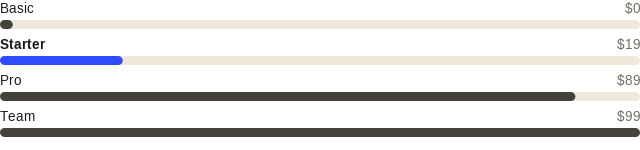
The ladder runs from free to $99 a month; Enterprise has no printed price. Monthly-pay prices, read 25 November 2026.
Synthesia pricing page, read 25 November 2026 (live browser).
The free tier is the funnel, and it is deliberately small. Nine avatars, ten minutes a month, a watermark on every frame, no download — enough to make one real video and show it to a manager, not enough to run a training programme on. The upgrade trigger is built into the product: the moment a team wants the watermark gone, the video downloaded, or the eleventh minute, the price is $19. No trial period exists, because the free tier is the trial.
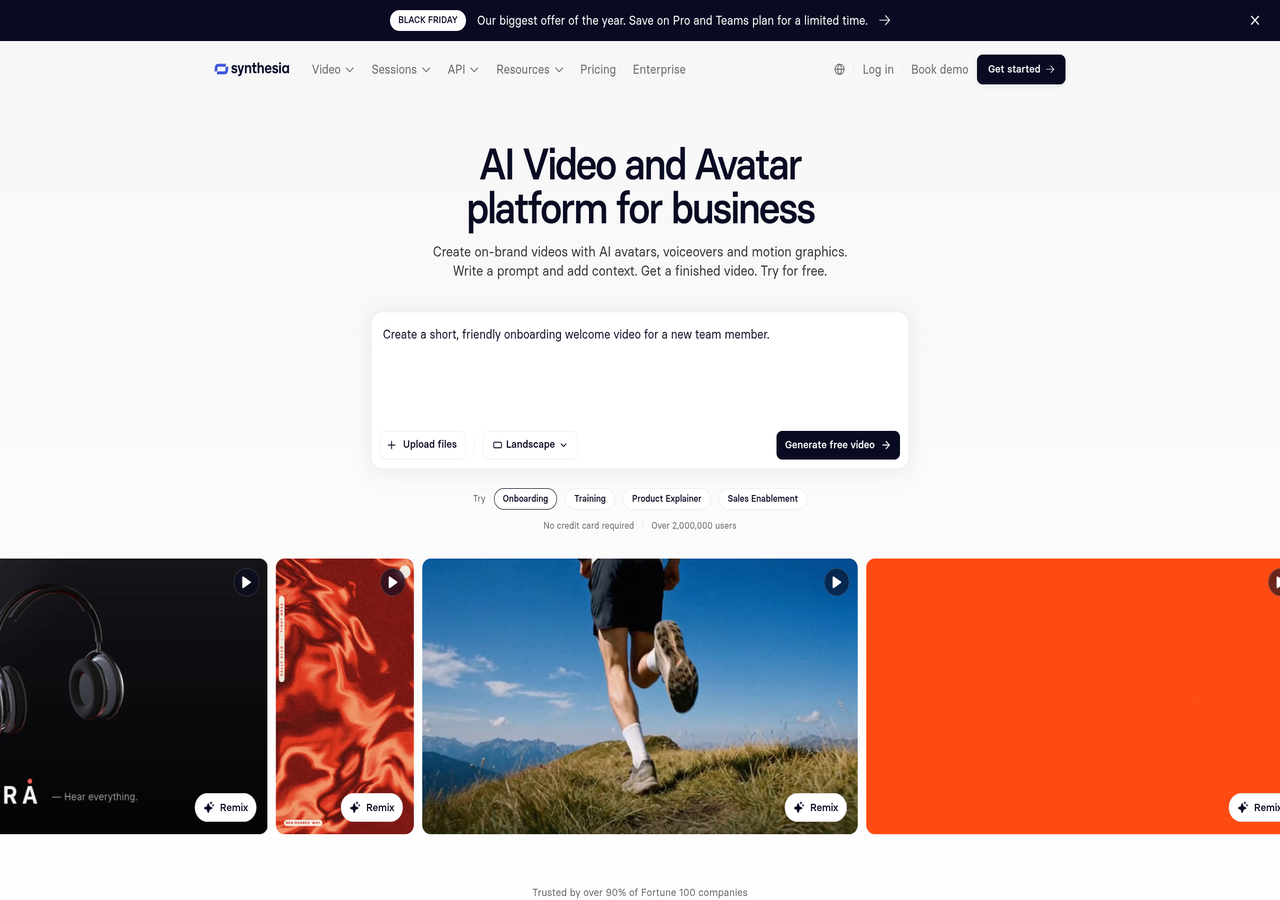
The homepage leads with the product, not the price: “AI Video and Avatar platform for business”, a prompt box, and “Over 2,000,000 users”. Screenshot of the Synthesia homepage, read 25 November 2026.
The homepage sells time, not video. “Save up to 90% of time and cost on video production” sits under the hero, next to “No credit card required” and “Over 2,000,000 users”. The prompt box in the middle is the product demo: type a script, get a finished video. Below the fold, the trust line does the enterprise selling — “Trusted by over 90% of Fortune 100 companies” — with a logo wall of Reuters, Zoom, SAP and Merck.
The retention number is the whole pitch
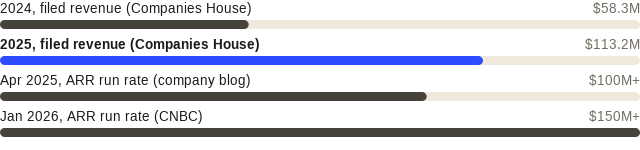
Filed revenue doubled in a year; the ARR run rate sits above it. The two measure different things — revenue already booked, and a monthly run rate times twelve. Companies House filings via GetLatka; ARR via the company blog and CNBC.
GetLatka, updated 20 November 2026; Sacra.
The expansion math is the business. Net revenue retention above 140% means the average customer spends 40% more a year after signing; contracts above $100,000 tripled in twelve months; and the company says it signed several seven-figure contracts in 2026. Enterprise deals are about 70% of revenue by one estimate, and the self-serve tiers exist to feed that pipeline — a training team starts on Starter, outgrows it, and becomes a contract.
The money trail is unusually solid for a private company, because the filings are public. UK accounts show $58.3M of revenue in 2024 and $113.2M in 2025, up 94%, with a $390.5M cash balance at the end of 2025. The same filings show the other side: a pre-tax loss of $59.2M in 2024 and $69.9M in 2025, and a risk section that says cash flow is negative and the company depends on outside capital. Revenue doubled; the loss grew with it.
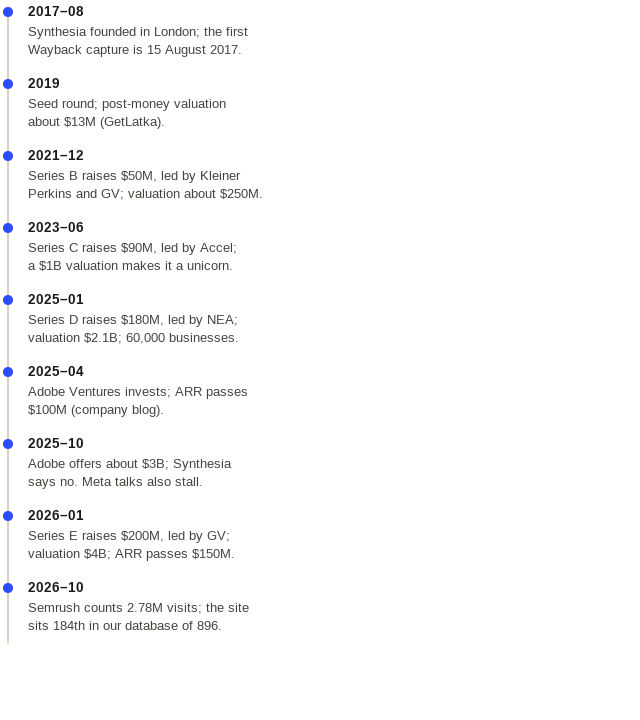
Nine years from founding to a $4B valuation — with the loss widening in the filed accounts all the way. Dates from the Wayback Machine, TechCrunch and Companies House filings.
Wayback Machine, first capture 15 August 2017; TechCrunch, 26 January 2026.
The funding history reads like a bet on the same story. Seed in 2019, a $50M Series B in December 2021, a $90M Series C in June 2023 that made it a unicorn, a $180M Series D in January 2025 at $2.1B, and a $200M Series E in January 2026 at $4B, led by GV. About $530M raised in total. Adobe invested in April 2025, then offered about $3B to buy the company later that year; Synthesia said no, and Meta’s talks went nowhere either.
Traffic is slipping while the sales team grows

Three months down in a row: 3.14M in August, 3.04M in September, 2.78M in October, down 8% in the month. Semrush overview, read 25 November 2026.
Semrush, last updated 11 November 2026.
The traffic line is the one number moving the wrong way. Semrush counts 2.78M visits in October, down 8% on September and down from 3.14M in August — three months of decline while the company was opening a New York headquarters and raising at $4B. The cause is not published, and this page does not guess one. What is published is that paid search jumped 335% in the same month, to 55,300 visits, while organic search rose only 2%.
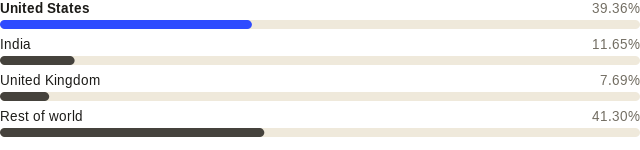
The United States is the largest market at 39.36% of visits; India and the UK follow. Semrush, October 2026.
The traffic that remains is deep, not wide. Visitors view 7.28 pages per visit and stay 13 minutes 34 seconds on average, with a 46.4% bounce rate — the shape of people who came to make a video, not to browse. The brand word does the heavy lifting: “synthesia” ranks first in organic search at 60,500 searches a month, about 44% of all organic traffic. Direct visits are the largest channel at 41.52%, ahead of Google at 21.89%.
A brand every Fortune 100 company already uses — and a loss that keeps growing
What keeps teams paying
| Mechanism | Status | What we found |
|---|---|---|
| Free tier | ✓ | Basic $0: 500 credits a month, 10 minutes of video or voiceover, 9 AI avatars, watermarked |
| No sign-up | — | An account is required even for the free tier; “no credit card required” is not no sign-up |
| Free trial | — | No trial period; the free tier is the trial |
| Advertising | — | No advertising on the site; the homepage code shows no ad scripts |
| API | ✓ | Video creation, dubbing and interactive avatars; Pro includes 360 minutes of video a year |
| Credits | ✓ | One shared credit pool for video, dubbing, surveys and Syren; a minute of Syren video costs about 1,000–2,000 credits |
| Auto-renewal | ✓ | Subscriptions renew automatically; the terms require 30 days’ notice to stop renewal |
| Cancel | ✓ | Cancel in account settings under Billing; access runs to the end of the paid period |
| Refund | — | All purchases are non-cancelable and non-refundable, even if the subscription went unused |
| First-month offer | ✓ | Starter $9, Pro $19 and Team $29 for the first month on the Black Friday offer to 7 December 2026 |
| Annual discount | ✓ | Starter 26.3%, Pro 33.7%, Team 20.2% off the monthly price when billed annually |
| Seat expansion | ✓ | Team adds seats at $20 a seat a month, up to 10 members; Enterprise seats are custom |
| Shared credit pool | ✓ | Team and Enterprise share one credit pool, with per-user caps on Enterprise |
| Brand kits | ✓ | Brand colours, custom fonts and brand avatars from Pro up |
| SCORM export | ✓ | Team and Enterprise export SCORM packages into a learning management system |
| Multilingual | ✓ | 140+ languages and voices on every plan; dubbing in 70+ languages on Basic, 140+ on Team and Enterprise |
| Voice cloning | ✓ | Clone your own voice for a personal avatar, from Pro up |
| Personal avatars | ✓ | Starter 3, Pro 5, Team and Enterprise unlimited |
| Interactive video | ✓ | Interactive calls to action, branches and quizzes, from Pro up |
| Content moderation | ✓ | Every video passes content moderation; stock avatars may not be used in paid ads |
| SSO / SAML | ✓ | Enterprise: SAML/SSO and SCIM provisioning |
| Dedicated success manager | ✓ | Enterprise only |
| Education discount | — | No student, non-profit or education discount |
| Referral rewards | Not verified | No referral terms found |
| Email capture | Not verified | No mailing-list size or capture mechanism found |
Retention here is a lock, not a ritual. The credits meter, the annual discount and the non-refundable terms all point the same way: once a team’s training library lives in Synthesia, leaving means rebuilding it somewhere else. The exit is narrow by design — cancel in settings, keep access to the end of the period, and no money back, even for a subscription that was never used. What holds a team is the library it has already built, not a contract it signed.
The outside scores agree, with a catch
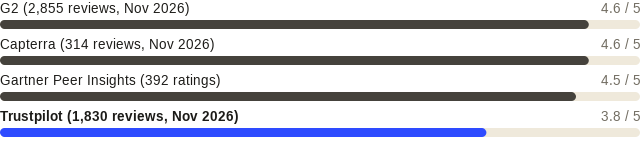
Four scores from four different samples: G2 4.6, Capterra 4.6, Gartner 4.5, Trustpilot 3.8. The Trustpilot score is the lowest, and 13% of its reviews are one star. tavus.io summary, November 2026.
tavus.io, November 2026; aitooltesting, 7 June 2026.
The outside scores agree on the product and part ways on the company. G2 gives 4.6 from 2,855 reviews and Capterra 4.6 from 314, with ease of use the most praised feature; Trustpilot gives 3.8 from 1,830, with 13% one-star reviews. The complaints repeat: videos rejected by content moderation — a plumber’s explainer, a restaurant training video — and refunds refused under the non-refundable terms. Among rivals, HeyGen scores 2.4 on Trustpilot, D-ID 1.6 and Runway 1.2, so Synthesia’s 3.8 is the best of a sceptical bunch.
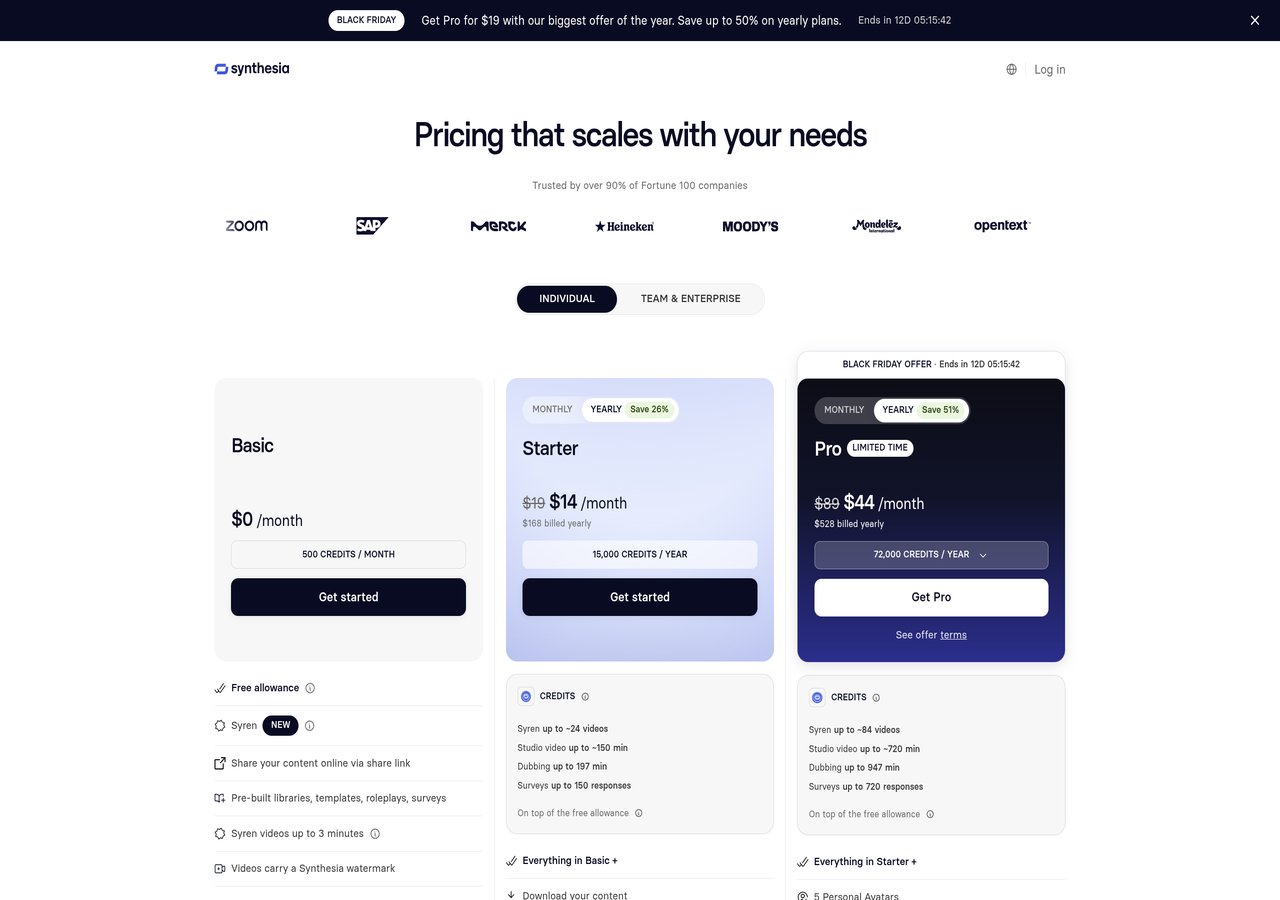
The pricing page on the individual tab: Basic $0, Starter $19 (first month $9), Pro $89 — with the yearly view showing the Black Friday price of $44 a month. Screenshot of the Synthesia pricing page, read 25 November 2026.
The pricing page hides its second half behind a tab. The individual tab shows Basic, Starter and Pro; Team and Enterprise sit behind a “Team & Enterprise” switch, and the Enterprise price is never printed — “Let’s talk.” The yearly toggle is where the discounts live: Starter drops to $14 a month, Pro to $59, Team to $79, and the Black Friday offer cuts Pro to $44 and Team to $59 until 7 December 2026. The first month is $9 on Starter, $19 on Pro and $29 on Team.
Three numbers that are not the same thing
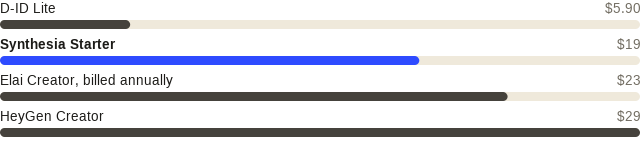
Synthesia’s $19 Starter is the second-cheapest way in; its $89 Pro is the most expensive mid-tier in the set. Third-party-checked prices, November 2026.
HeyGen comparison page, October 2026; revoyant, November 2026.
The rivals prove the premium is a choice, not a cost. D-ID starts at $5.90 a month, Elai at $23 and HeyGen at $29; Synthesia’s $19 Starter sits second-cheapest, but its $89 Pro is the most expensive mid-tier, against HeyGen’s $49. The $40 gap is the enterprise story: 140% retention, a $4B valuation and compliance badges that a $49 plan cannot print. Without the enterprise customers, the Pro price has no defence — and the traffic line warns the story needs new buyers, not just bigger ones.
Three numbers should never be quoted as one. Filed revenue was $113.2M in 2025; ARR passed $150M in January 2026; the valuation is $4B. The first is money already booked, the second is a monthly run rate times twelve, and the third is a price investors paid for the future — about 35 times filed revenue. The loss belongs with all three: $69.9M in 2025, wider than the $59.2M of 2024. A $150M run rate and a $70M loss can both be true.
| Channel | Share of visits | Platform & stack |
|---|---|---|
| Search (Google) | Brand word “synthesia” 60,500 searches a month, rank 1, 44.36% of organic traffic; organic search 502.36K (+2%) | Semrush, Oct 2026 |
| Direct | 41.52% of visits | Semrush, Oct 2026 |
| Paid search | 55.3K visits (+335%) | Semrush, Oct 2026 |
| AI referrals | ChatGPT 7K, Perplexity 1K, Gemini 1K visits | Semrush, Oct 2026 |
| Meta ads | About 210 keyword matches in the US Ad Library; 157 active ads (adradar, 10 Nov 2026) | Meta Ad Library, read 25 Nov 2026 |
| Not verified | HubSpot appears twice in the homepage code (weak signal) | |
| Social | Not verified | Founder posts and the AI 100 announcement; no follower counts found |
| Subscriptions | Enterprise contracts about 70% of revenue; self-serve about 30% (Sacra estimate) | — |
| Backlinks | 47.18K referring domains (+17%), 1.69M backlinks | Semrush, Oct 2026 |
| Area | What we found |
|---|---|
| Platform | Webflow; homepage HTML references cdn.prod.website-files.com |
| Payments | Card payment on standard terms; Stripe and PayPal not verified |
| Marketing automation | HubSpot (2 references in the homepage code — weak signal) |
| Customer service | Intercom (28 references in the homepage code); Help Center at help.synthesia.io |
| Reviews | Not verified; no review widget found on the homepage |
| Subscription billing | Not verified; no billing-app marker found |
| API | AI Video, Dubbing and Interactive Avatars APIs; ChatGPT and Claude MCP integration |
| Integrations | PowerPoint import, SCORM export, LMS embed, Chrome extension AI Screen Recorder |
| Ads | None found in the homepage code |
Three things should not be quoted as facts. No subscriber count, audited profit figure or 2026 revenue figure has been published, so neither income line can be sized beyond the filed accounts and the ARR run rate. The $200M revenue target for 2026 is a forecast, not a result. And the 65,000 customers are a company count from 2026, not an audited user base — the homepage’s “over 2,000,000 users” counts free accounts too.
The open question is the traffic line. A company that lives on enterprise expansion does not lose 8% of its visits in a month without a cause, and no cause is on record — the funding is fresh, the offices are opening, and the paid search spend is up 335%. If the visits come back, the funnel keeps its feed; if they do not, the $89 Pro has to justify itself against a $49 rival with fewer buyers arriving. Nine years is real. So is the loss.
All video tool sites tracked here are in the Video tools collection. Synthesia against its closest matches: compare Synthesia with Descript and Vidnoz side by side. The closest pattern match among published teardowns is Descript — the same subscription video editor, sold to teams from $24 a month instead of $89.
The full teardown is for members
The full analysis of pricing, acquisition, conversion and retention is member content. Membership is $29 a month or $249 a year.
Similar sites in the database
Synthesia (2.78M) sits between Rogue Fitness (2.8M) and Originality.ai (2.71M) in the database.
| Site | Category | Monthly visits | Source |
|---|---|---|---|
| Caudalie | Beauty · Grape-seed skincare DTC | 2.9M | Semrush, Oct 2026 |
| Rogue Fitness | Fitness · Strength training DTC | 2.8M | Similarweb, Oct 2026 |
| Synthesia | Video tools · AI avatar video | 2.78M | Semrush, Oct 2026 |
| Originality.ai | Writing tools · AI detection | 2.71M | Semrush, Oct 2026 |
| Nuts.com | Food · DTC grocery | 2.7M | Semrush, Oct 2026 |
Compare Synthesia with Descript and Vidnoz side by side. The full database, with working filters, is on the teardowns index.
Read the next one in your inbox
The new ones go out by email first, one a week, with the traffic source and month attached to every number. Leave your address and the next one comes to you.