
How Vivobarefoot makes money on $125 shoes
Monthly visits
2.58M
October 2026. Third-party estimate, not official MAU/DAU. Semrush counted 2.58M for the month, up 24.21% on September.
Vivobarefoot draws an estimated 2.58M visits a month (October 2026, Semrush), up 24.21% on September — from 1.84M in August and 2.08M in September. It is the 194th-largest site in our database of 901. The brand word draws 74,000 searches a month — but the largest search term is the category phrase, “barefoot shoes”, at 110,000.
The pitch fits in one line: less shoe, more money. A Primus Lite IV costs $125 — more than a $90 Xero Prio with the same job — because Vivobarefoot sells foot health, not footwear, and a 100-day trial lets the shoe prove it on your feet.
| Site | Vivobarefoot, vivobarefoot.com |
|---|---|
| What it is | Minimalist barefoot shoes DTC brand (thin soles, wide toe boxes, zero drop; own site plus wholesale, franchise, retail and ReVivo resale) |
| Who it is for | Runners and everyday wearers who want barefoot shoes and a natural gait |
| Category | Shoes · Minimalist barefoot shoes DTC brand |
| Monthly visits | 2.58M, October 2026. Third-party estimate, not official MAU/DAU; Semrush, up 24.21% on the month |
| Founded | Brand 2004 (Terra Plana sub-brand); standalone company 2012. Earliest Wayback Machine capture: 22 January 2005 |
| Headquarters | London |
| Operator | VIVOBAREFOOT LIMITED — private, unlisted; Clark family holds 63.4%, Sofina 14.4% (minority, partnered 2024) |
| Survival engine | Brand-led. Customers pay $125–$210 for foot health, not footwear — B Corp certified, podiatrist and athlete endorsed, sold with a 100-day trial; ReVivo trade-ins and VivoRewards points bring them back for the next pair |
| Pricing | Primus Lite IV $125; Gobi III Sneaker Leather $170 list ($119 Black Friday sale); Sensus Chelsea $200; Gobi Boot II $210. Source: vivobarefoot.com, read 24 November 2026 |
| Pricing model | One-off purchase at a brand premium — no subscription; the second sale is resale and trade-in |
| Free hook | 100-day trial (wear them, return for a full refund); email sign-up discount (third-party reports 10%–15%) |
| Meta ads | Not verified — the ad library was not read this round |
| Country breakdown | United States 43.61% (1.13M); United Kingdom 22.32% (576.32K); Germany 11.89% (307.03K) (Semrush, October 2026) |
TL;DR
- Vivobarefoot was founded as a standalone company in 2012 by seventh-generation cobblers Galahad and Asher Clark, and it charges $125 to $210 for shoes with less material than a $90 pair: the price is the brand — B Corp certified, podiatrist and athlete endorsed, and sold with a 100-day trial that lets the shoe prove itself on your feet.
- The money is real and published by the company itself: £91.4m revenue and 1.2m pairs sold in 2024/25, with ReVivo refurbished shoes adding £3.9m and up to 15% of sales — but profit sits near breakeven (EBITDA −0.7% in 2023/24) and the US fell 10% while traffic rose 24%.
- The weak spot is the service behind the promise: Trustpilot sits at 2.7/5 from 12,984 reviews, and the newest complaints are almost all about the AI support bot “Horatio” not answering and refunds taking over a month — the brand does the selling, and the returns experience is where it leaks.
Less shoe, more money: the brand is the product
The price list is a premium on less material
| Shoe | Price | What it is |
|---|---|---|
| Primus Lite IV (training) | $125 | Best-selling barefoot trainer; 239g, recycled upper, made in Vietnam |
| Gobi III Sneaker Leather (everyday) | $170 list, $119 on sale | Classic leather sneaker; 322.4g, chrome-free leather, made in Vietnam |
| Gobi II Sneaker Leather (previous generation) | $170 list, $102 on sale | Same line, one generation older; clearance pricing |
| Sensus Chelsea (boot) | $200 | Chelsea boot; Wild Hide leather, removable thermal insole |
| Gobi Boot II (boot) | $210 | Lace-up barefoot boot; unlined Wild Hide leather, 3mm cork insole |
| Xero Prio (rival) | ~$90 | The value pick; about 90% of the shoe for 72% of the price, per a 2026 review |
| Merrell Vapor Glove 6 (rival) | $90–$110 | Zero-drop trainer sold in big-box retail |
| Saguaro Smart II (rival) | $45–$50 | The budget entry; about a third of Vivobarefoot’s price |
The shoe costs more because it has less in it. A Primus Lite IV is a thin sole, a wide toe box and almost no structure, and it sells for $125, against about $90 for a Xero Prio that does the same job. The $35 gap is not materials: it is the brand — a B Corp certificate, a podiatrist on the homepage, and a promise of 57% stronger feet in six months, with no study cited.
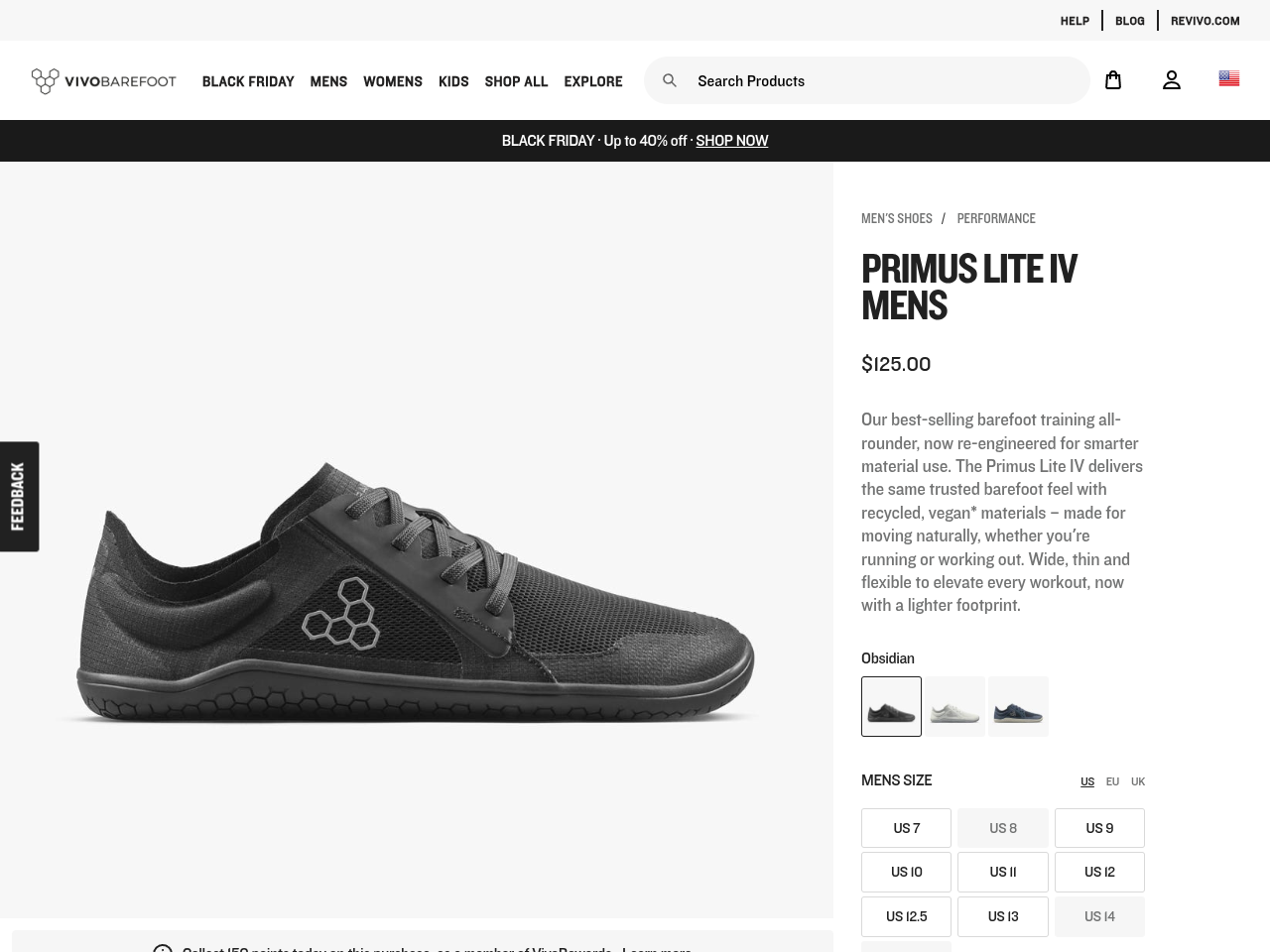
The Primus Lite IV product page, read 24 November 2026. $125.00, Obsidian colourway — “Our best-selling barefoot training all-rounder, now re-engineered for smarter material use.”
The price holds because the buyer is not comparing shoes. She is buying a foot-health story told by people she trusts: an NFL player, a three-time world champion surfer, a functional podiatrist and a sports scientist, all on the homepage. The 100-day trial closes the sale — wear the shoes outside for three months, return them for a full refund if they do not work.
A $125 shoe in a $45-to-$210 market
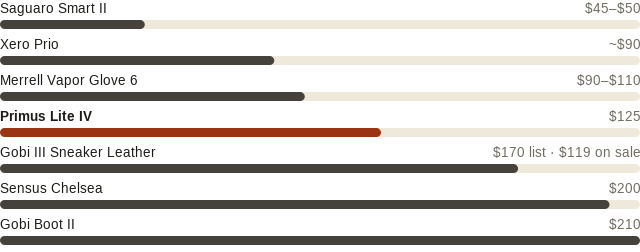
A $125 shoe in a $45-to-$210 market. The Primus Lite IV sits above the value picks and below the boots — the whole Vivobarefoot line is priced at the top of its category.
Primus Lite IV, Gobi III, Sensus Chelsea and Gobi Boot II from vivobarefoot.com, read 24 November 2026; Xero, Merrell and Saguaro from third-party reviews, November 2026.
The discounting tells the other half of the story. The Gobi III lists at $170 and sells at $119 in the Black Friday sale; the previous-generation Gobi II is $102, down from $170. The brand charges a premium and then cuts it by 30–40% in November — the full price is the anchor, the sale is the closer.
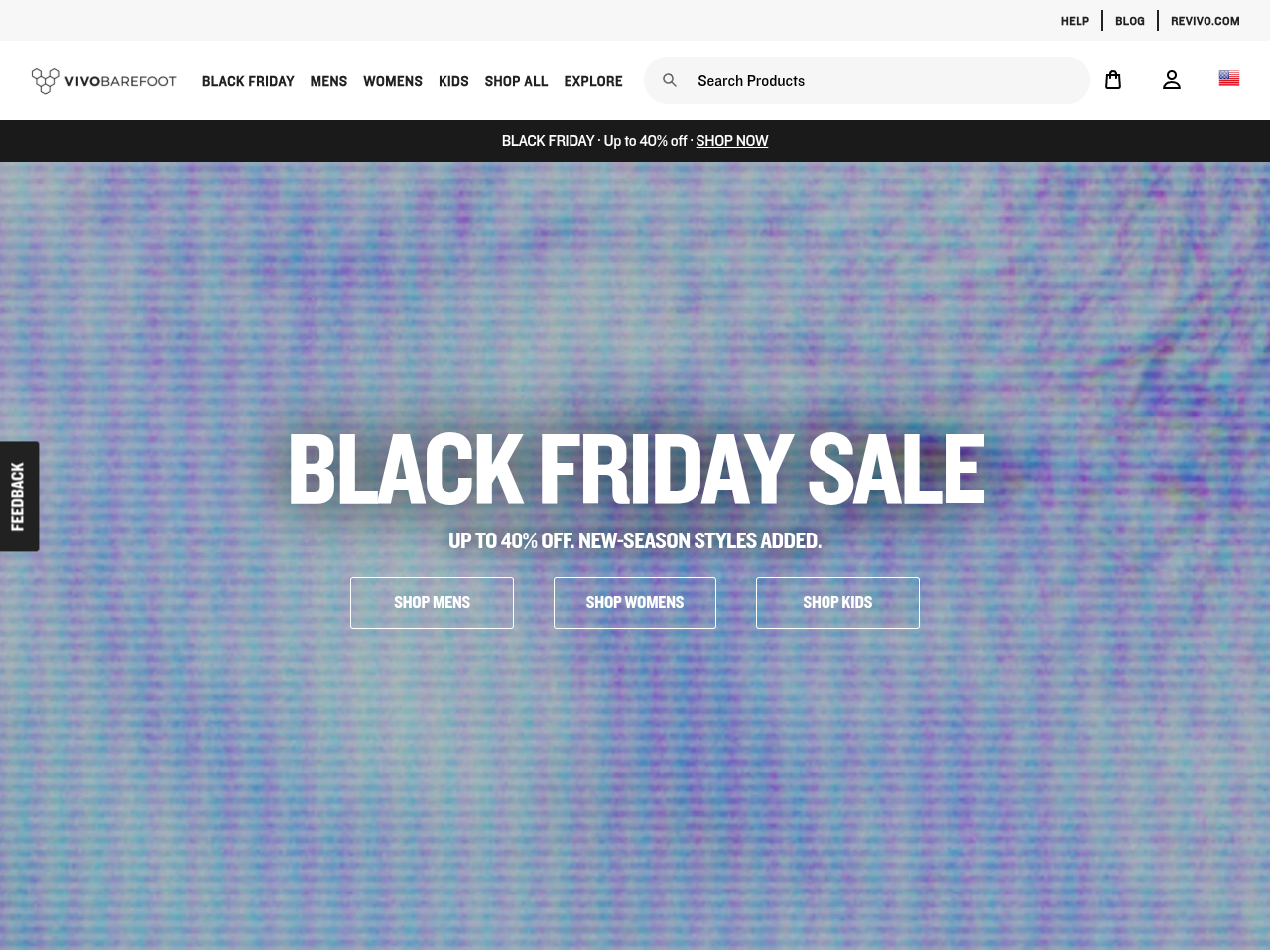
The Vivobarefoot homepage, read 24 November 2026. Black Friday sale — up to 40% off, new-season styles added. The premium price is the anchor; the sale is the closer.
Twenty years from a sub-brand to a standalone company
Twenty years from a sub-brand to a standalone company
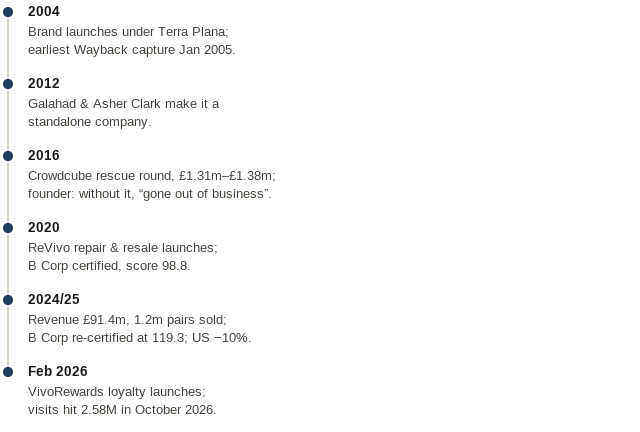
Twenty years from a sub-brand to a standalone company. The founder’s own words carry the early history — the company publishes no audited accounts.
FashionUnited, 25 March 2026; Highstead; Wayback Machine, first capture 22 January 2005; Antavo, 3 March 2026.
Vivobarefoot started in 2004 as a sub-brand of Terra Plana, and became a standalone company in 2012, run by seventh-generation cobblers Galahad and Asher Clark. In 2016 it nearly died: a Crowdcube round of £1.31m–£1.38m from 1,121 small investors saved it, and the founder says that without it the company would have gone out of business.
The family still holds the company: the Clark family owns 63.4%, with Sofina — a listed Belgian investor that partnered with the business in 2024 — at 14.4%. The founder says the family still controls the business and is “not slaves to impatient capital”. That control is the point: no outside owner can force the price down.
The second sale is the same shoe, sold twice
What brings a customer back
| Mechanism | Hit | Why, in one line |
|---|---|---|
| 100-day trial | ✓ | Wear them outside for 100 days; full refund if they do not work |
| Free shipping threshold | ✓ | Standard shipping $5, free over $160; express $10 |
| Cancel an order | ✓ | Self-service cancellation within 15 minutes of ordering |
| Loyalty programme | ✓ | VivoRewards: 200 points on sign-up, 150 per shoe, 500 points = 15% off |
| Trade-in | ✓ | Take Back: send any brand’s old trainers, get 20% off new shoes |
| Repair & resale | ✓ | ReVivo: refurbished shoes at 20%–50% off, repairs and resoles |
| Refer a friend | ✓ | VivoRewards points for referrals (terms via Antavo) |
| First-order hook | ✓ | 100-day trial plus email sign-up discount (third-party reports 10%–15%) |
| Multi-scenario buying | ✓ | 60 men’s styles across running, trail, everyday and outdoor |
| Kids’ sizes | ✓ | Children outgrow shoes — a natural repeat purchase |
| Gift subscription | — | No gift subscription found |
| Gift card | Not verified | No gift card page found |
| Subscription | — | No subscription product; shoes are a one-off purchase |
| Skip / pause a subscription | — | Not applicable — no subscription to skip or pause |
| Free plan | — | No free tier; the trial is the free offer |
| Trial (software sense) | — | No software trial; the 100-day trial is the equivalent |
| Student / NHS discount | ✓ | Third-party reports about 15% via Student Beans and Blue Light (not first-party verified) |
| Email capture | ✓ | Email sign-up earns a first-order discount and 100 VivoRewards points |
| VivoHealth courses | ✓ | Foot-health courses; members get 25% off and a free course monthly |
| Store experience | ✓ | London flagship and Bristol store; VivoBiome foot-scan custom shoes |
| Free returns | Not verified | Return shipping cost not published on the product page |
| Exchange | Not verified | No direct exchange — return, then order again |
| API | — | No public API |
There is no subscription to renew, so the repeat purchase has to be designed into the product. The same customer buys a trainer, a trail shoe, a everyday leather shoe and a boot — and then a smaller size when the children grow. VivoRewards, launched in February 2026, pays 150 points per shoe and 500 points for a 15% voucher.
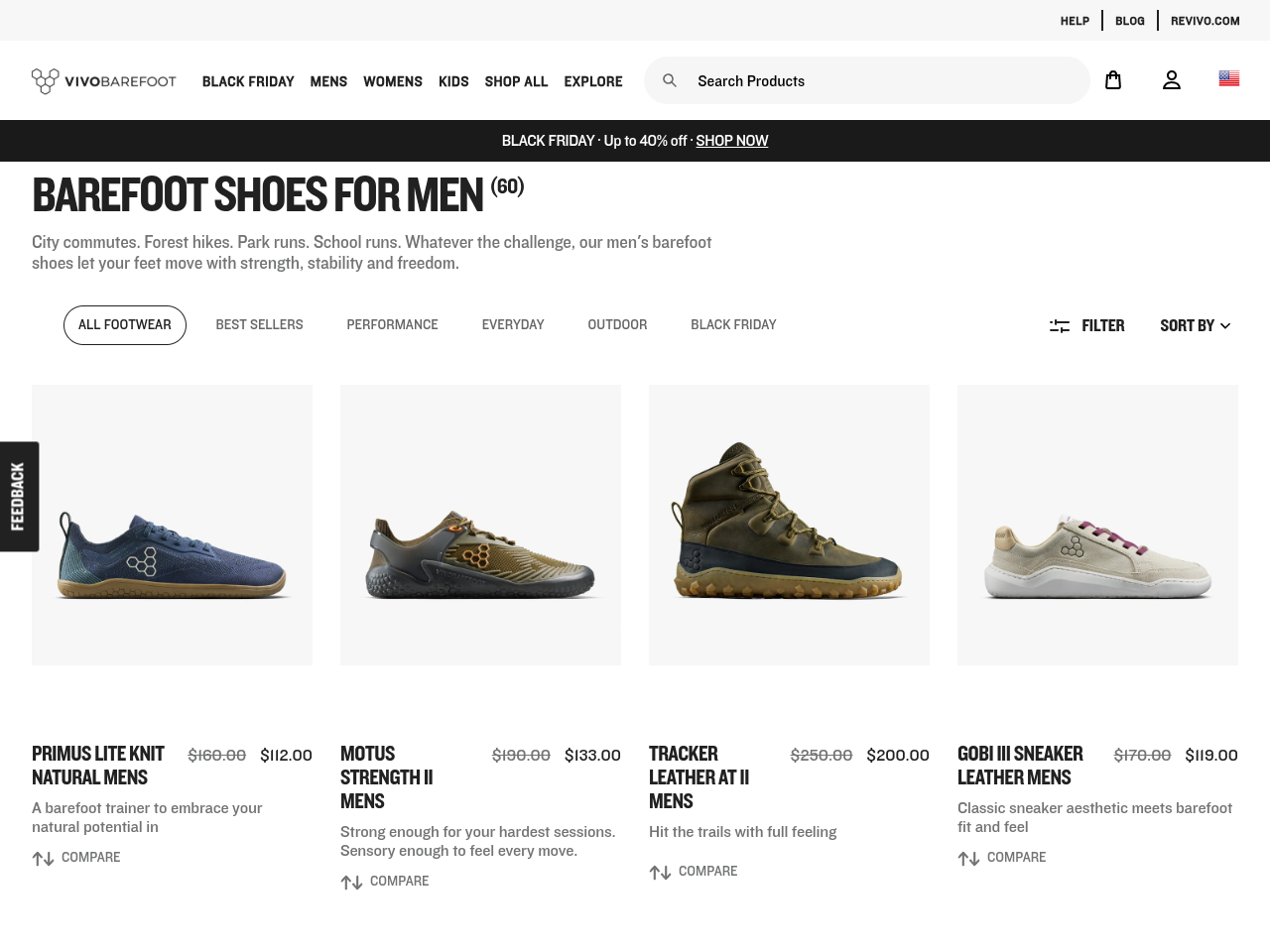
The men’s page, read 24 November 2026. 60 results — “City commutes. Forest hikes. Park runs. School runs.” Gobi III lists at $170, on sale at $119.
ReVivo is the clever part. The company takes back worn shoes, repairs and resells them at 20%–50% off, and in 2024/25 that second store turned over £3.9m on 62,000 pairs — up to 15% of the brand’s sales. One pair of shoes earns twice: once new, once refurbished.
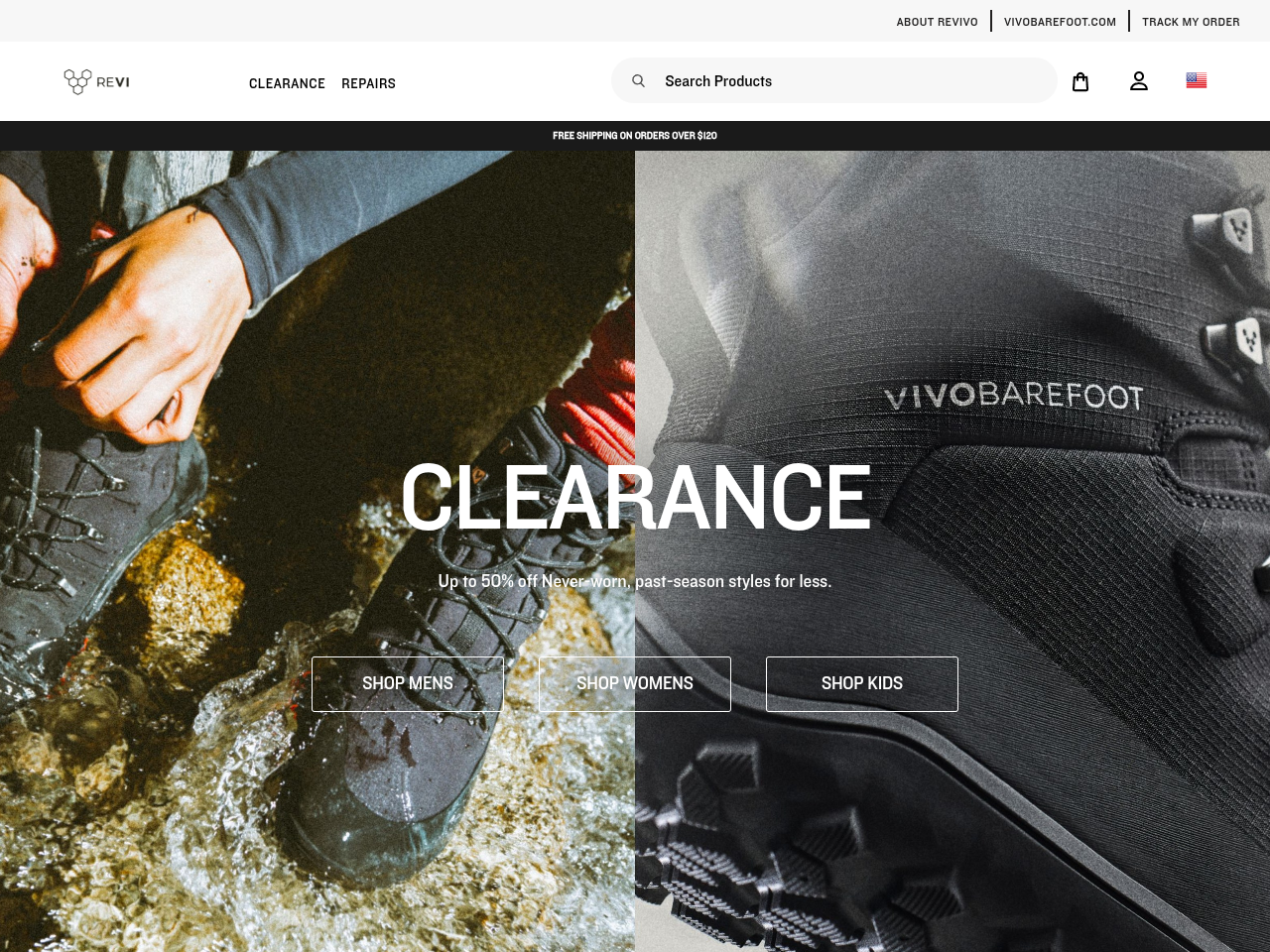
The ReVivo store, read 24 November 2026. Clearance up to 50% off — “Never-worn, past-season styles for less.” Free shipping over $120.
The trade-in closes the loop. Send back any brand’s old trainers and get 20% off a new pair — the discount pulls the next full-price sale forward, and the returned shoe goes back on sale as refurbished. More than 170,000 pairs have been refurbished since 2020.
£91.4m of revenue, roughly zero profit — and a 2.7-star service desk
Five years of growth, no profit to show for it
| Year | Revenue | Profit / notes |
|---|---|---|
| 2020/21 | £36m | Not disclosed |
| 2021/22 | £50m | Not disclosed |
| 2022/23 | £73m | EBITDA +2.0% |
| 2023/24 | £87m | EBITDA −0.7%; free cash flow −£1.6m; e-commerce contribution margin 25.8% |
| 2024/25 | £91.4m | Profit not disclosed; 1.2m pairs sold (+12%) |
The revenue line is real and it is published: £36m in 2020/21, £91.4m in 2024/25, with 1.2m pairs sold in the latest year. But the profit line is missing. The company reported EBITDA of +2.0% in 2022/23 and −0.7% in 2023/24, with free cash flow of −£1.6m — and it has disclosed nothing for 2024/25. Selling more shoes is not the same as making money on them.
Revenue tripled in four years; profit stayed near zero
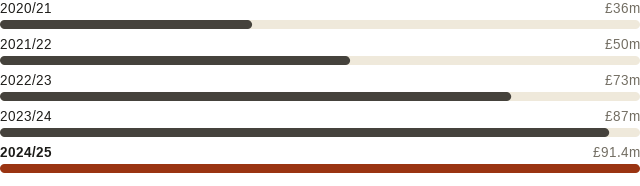
Revenue tripled in four years; profit stayed near zero. The company reports its own figures — no audited accounts are published.
Company Unfinished Business reports via FashionUnited, 25 March 2026.
Europe grows, America shrinks

Europe grows, America shrinks. The US fell 10% to £33.1m in 2024/25 — the company blames wrong stock, price competition, a weak dollar and tariff uncertainty.
FashionUnited, 25 March 2026.
The geography explains the traffic. Visits rose 24% in October, but the US — 43.61% of visits and the biggest market — saw revenue fall 10%. Traffic is not sales: Americans are browsing more and buying less, while the rest of the world grew 53% to £15.8m on the back of wholesale.
The search footprint is the brand word
The brand word is the search footprint
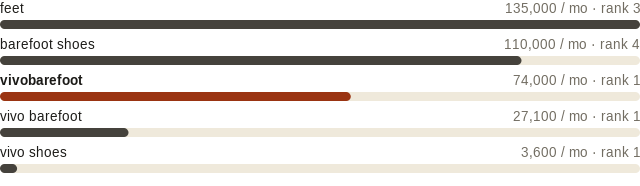
The brand word is the search footprint. “vivobarefoot” draws 74,000 searches a month and a third of organic traffic; the category phrase “barefoot shoes” is bigger at 110,000 — and Vivobarefoot ranks only fourth for it.
Semrush, October 2026, read 24 November 2026.
Three months, still climbing

Three months, still climbing. August’s 1.84M rose to 2.08M in September and 2.58M in October — up 24.21% on the month.
Semrush, read 24 November 2026.
| Channel | Share of visits | Platform & stack |
|---|---|---|
| Direct | 40.11% | Semrush, October 2026; the largest channel — brand return visits and existing customers |
| Google search | 6.18% of desktop journeys | Semrush, October 2026; brand word “vivobarefoot” 74,000 searches a month |
| Organic search | “barefoot shoes” 110,000 a month | Semrush, October 2026; organic traffic up 7.83% on the month |
| Paid search | — | Paid search traffic down 7.31% on the month (Semrush, Oct 2026); spend not published |
| Meta ads | Not verified | The ad library was not read this round |
| AI referrals | ChatGPT 459, Claude 312, Gemini 116 visits | Semrush, October 2026; still in the hundreds, not a channel yet |
| — | No list size published; email sign-up earns a first-order discount and 100 loyalty points | |
| Referral | — | No referral programme beyond loyalty points for recommending friends |
| Backlinks | 141.91K links, 9.89K domains | Semrush, October 2026; links up 0.52%, domains up 25.27% on the month |
| Platform | — | Magento 2 storefront with Fastly CDN; loyalty on Antavo |
Direct is the largest channel at 40.11%, and the brand word is a third of organic search — customers come looking for Vivobarefoot by name. The category word is the gap: “barefoot shoes” draws 110,000 searches a month and the site ranks fourth, so most of that demand goes to someone else first.
The service desk is where the brand leaks
The company and its reviewers no longer agree

The company and its reviewers no longer agree. Trustpilot gives Vivobarefoot 2.7 out of 5 from 12,984 reviews; in May 2023 the same page read 4.5 from 7,000+.
Trustpilot, read 24 November 2026; May 2023 figure via Honest Brand Reviews.
Trustpilot rates the company 2.7 out of 5 from 12,984 reviews — down from 4.5 in May 2023. The recent one-star reviews are almost all about the same sequence: an AI support bot called Horatio that never answers, a refund that takes over a month, a return with no confirmation for five weeks. The shoes get praised; the service gets blamed.
| Area | What we found |
|---|---|
| Platform | Magento 2 storefront with Fastly CDN; static assets on /media/catalog/product/ |
| Payments | Not verified; third-party reports list Visa, Mastercard, American Express, PayPal, Google Pay and Klarna |
| Reviews | Yotpo product reviews on the store; Trustpilot company page 2.7/5 |
| Analytics | Not verified; the homepage returns 403 to curl, so tracking code could not be read |
| Email provider | Not verified; no email sign-up or provider evidence on the pages read |
| Loyalty stack | Antavo AI Loyalty Cloud (VivoRewards, launched 25 February 2026) |
| Resale | ReVivo, a separate store at revivo.com for refurbished shoes and repairs |
| Support | AI bot “Horatio” plus WhatsApp and email; help centre at support.vivobarefoot.com (Zendesk) |
| llms.txt | Returns 301; whether a valid file exists is not verified |
| App | Not verified; no mobile app mentioned on the homepage or product pages |
Three things in this story should not be quoted as facts. The company says it serves 1.5m pairs a year and is a £100m business, but that is the founder’s own count in an interview, not the annual report’s £91.4m and 1.2m pairs. The “57% stronger feet” claim is the company’s own line, with no study cited. And no audited revenue, profit, subscriber count or repeat-purchase rate is published at all.
The open question is the service desk. A business that charges a premium for a promise needs the returns experience to match the product — and October’s traffic is still rising while the US is buying less. Whether the brand can fix the refund queue before the next sale season is the test the next quarter will answer.
Vivobarefoot is the fifth teardown in the footwear DTC collection. Compare Vivobarefoot with Lems and Vessi side by side.
The full teardown is for members
The full analysis of pricing, acquisition, conversion and retention is member content. Membership is $29 a month or $249 a year.
Similar sites in the database
Vivobarefoot (2.58M) sits between FlexClip (2.58M) and Acorns (2.57M) in the database.
| Site | Category | Monthly visits | Source |
|---|---|---|---|
| Skillshare | Education · Online creative courses | 2.59M | Semrush, Oct 2026 |
| Fourthwall | Content · Creator commerce & memberships | 2.59M | Semrush, Oct 2026 |
| FlexClip | Video tools · Online video editor | 2.58M | Semrush, Oct 2026 |
| Vivobarefoot | Shoes · Minimalist barefoot shoes DTC brand | 2.58M | Semrush, Oct 2026 |
| Acorns | Finance · Micro-investing subscription | 2.57M | Semrush, Oct 2026 |
Compare Vivobarefoot with Lems and Vessi side by side. The full database, with working filters, is on the teardowns index.
Read the next one in your inbox
The new ones go out by email first, one a week, with the traffic source and month attached to every number. Leave your address and the next one comes to you.