
Basecamp Pricing: $29–$199, No Per-User Fees
Monthly visits
12.84M
Semrush, October 2026. Third-party estimates, not official MAU/DAU.
Basecamp draws an estimated 12.84 million visits a month (October 2026, Semrush) — the 60th-largest site in our database of 901 — and its price list has one rule no rival follows: the headcount is free. Five plans, $0 to $199 a month, and no plan charges per user.
The company behind it, 37signals, says it has been profitable for 27 years, carries zero debt and is privately held. The money is the subscription, renewed every month by teams that stay because leaving means rebuilding how they work.
| Site | Basecamp, basecamp.com |
|---|---|
| What it is | Project management and team collaboration platform: message boards, to-dos, kanban card tables, chat, calendar, docs and files, in one place |
| Who it is for | Small teams and freelancers who want project management without per-seat billing |
| Category | Project management · Collaboration |
| Monthly visits | 12.84M, October 2026. Third-party estimates, not official MAU/DAU; Semrush 12.84M (-29.38% on September's 18.19M; August was 14.91M) |
| Founded | February 2004, in Chicago, Illinois, by 37signals (founded 1999 as a web design company by Jason Fried, Carlos Segura and Ernest Kim) |
| Headquarters | Chicago, Illinois, United States |
| Operator | 37signals LLC (privately held, unlisted; a minority, no-control stake was sold to Jeff Bezos's Bezos Expeditions in 2006) |
| Survival engine | Recurring-led. The subscription is the only revenue line for the product itself — four paid plans at a flat monthly price, renewed by teams that have built their work inside it. Brand-led is the second engine: the founders' blog, books and podcast bring in customers without paid acquisition, and the company says it spent under $25,000 on advertising in four years around 2008 |
| Pricing | Free $0; Freelancer $29/month; Pro $79/month; Pro Plus $99/month; Pro Unlimited $199/month billed annually ($329/month monthly, per third-party reads of the same page). Source: basecamp.com/pricing, read 20 November 2026 |
| Pricing model | Flat per-account monthly fee, no per-user fees on any plan; 30-day free trial on paid plans, no credit card required; cancel any time, annual packages refunded pro rata |
| Free hook | Free plan forever — 1 project, 3 users, 1 GB — plus a 30-day free trial on paid plans |
| Meta ads | Not verified on 20 November 2026 (the Meta Ad Library search for "Basecamp" returned a site error page; this is not a zero) |
| Country breakdown | United States 47.9% (6.15M); India 17.87% (2.29M); Canada 3.63% (466.23K); United Kingdom 3.54% (454.67K); Philippines 3.35% (429.71K) — Semrush, October 2026 |
TL;DR
- Basecamp draws an estimated 12.84 million visits a month (October 2026), down 29.38% on September, and 59.0% of them arrive direct — people typing the address, not clicking ads.
- The price is flat: $29 to $199 a month per account, however many people use it. A 50-person team pays $199 a month on Pro Unlimited; the same team would pay $549.50 on Asana's Starter plan at $10.99 a seat.
- The risks are that the traffic fell by almost a third in a month, the October 2026 repricing put user caps on the cheaper plans, and the pricing page itself disagrees with its own FAQ: the card says $199 a month billed annually, the FAQ says $329.
The first screen sells straightforward, not features
One headline, one promise
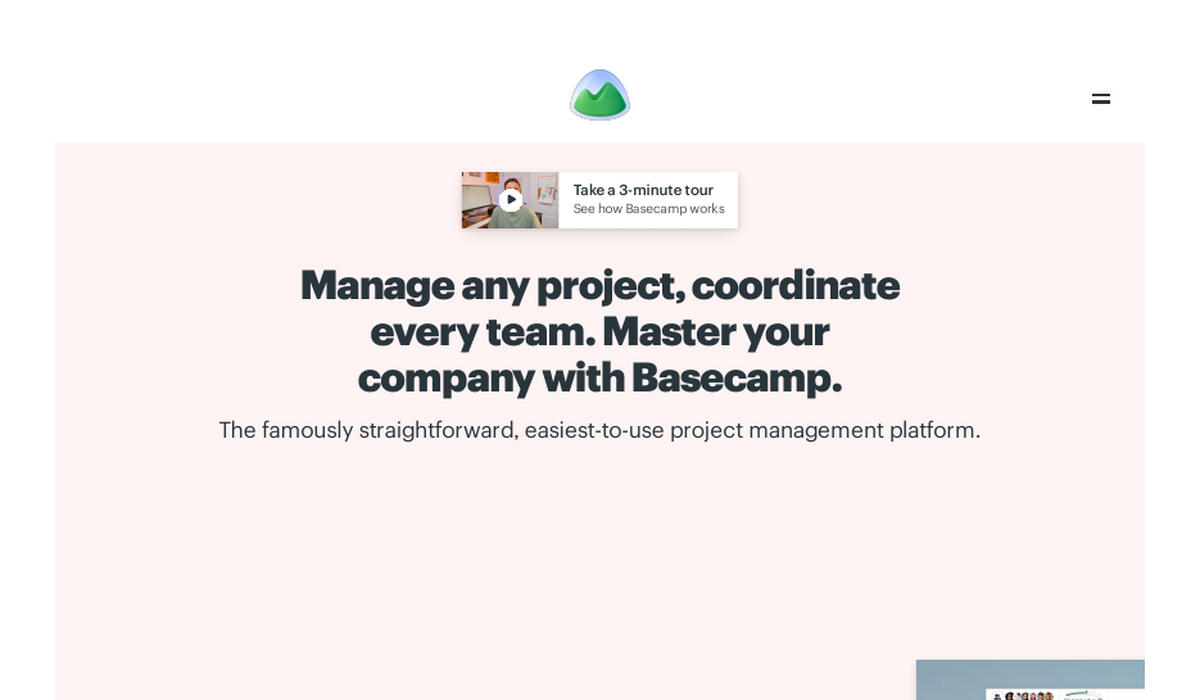
The Basecamp homepage, read 20 November 2026. The headline reads "Manage any project, coordinate every team. Master your company with Basecamp.", with the sub-headline "The famously straightforward, easiest-to-use project management platform." and a "Want an account? Sign up free" button.
The homepage we read on 20 November 2026 opens with a promise about control, not a feature list. The headline is "Manage any project, coordinate every team. Master your company with Basecamp.", and the line under it — "The famously straightforward, easiest-to-use project management platform." — is the whole pitch in one sentence.
Below the headline is a live counter — about 100,200 people were using Basecamp at the moment we read the page, a number that moved by the minute — and a letter that starts "Hey there— Tell me if this sounds about right." The page then shows real project screens, including a website redesign with Shell, Coca-Cola, IBM and Nike among the client logos. No star rating, no logo strip: the trust is the letter and the work.
Five prices, one rule: the headcount is free
The price list, read on 20 November 2026
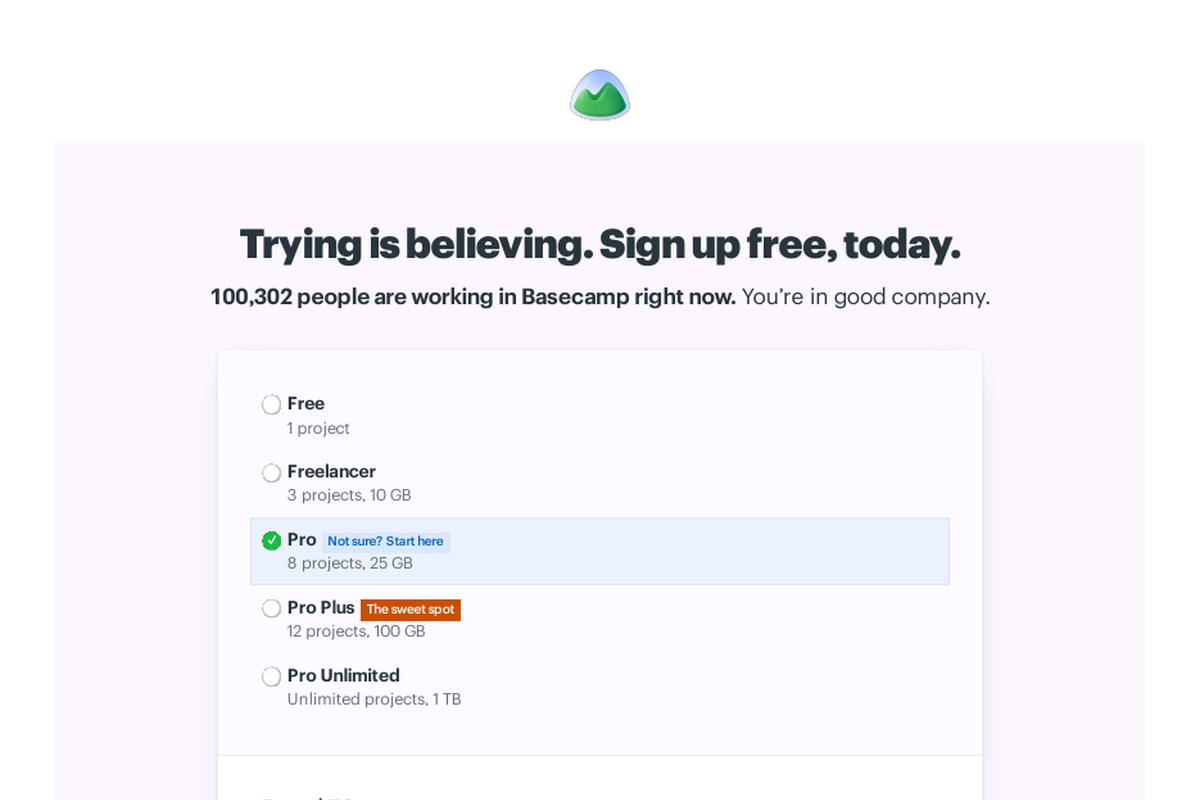
The Basecamp pricing page, read 20 November 2026. The heading reads "Trying is believing. Sign up free, today." The plan selector lists Free, Freelancer, Pro, Pro Plus and Pro Unlimited; the Pro pane reads "$79/mo" with a "Start a 30-day free trial" button.
The pricing page is a selector, not a grid of cards. Five plans, picked one at a time, and every one of them says "no per-user fees". The default is Pro at $79 a month, and the plan marked "The sweet spot" is Pro Plus at $99.
The limits are the price. Free allows 1 project, 3 users and 1 GB; Freelancer 3 projects, 5 users and 10 GB for $29; Pro 8 projects, 10 users and 25 GB for $79; Pro Plus 12 projects, 15 users and 100 GB for $99; Pro Unlimited drops all three limits for $199 a month billed annually.
| Plan | Monthly price | Projects | Users | Storage | What unlocks |
|---|---|---|---|---|---|
| Free | $0 | 1 | 3 | 1 GB | The basics; no templates, no time tracking |
| Freelancer | $29 | 3 | 5 | 10 GB | Same as Free, plus room for clients |
| Pro | $79 | 8 | 10 | 25 GB | Multiple tools per project, project templates |
| Pro Plus | $99 | 12 | 15 | 100 GB | Adds time tracking and enhanced admin |
| Pro Unlimited | $199, billed annually ($329 monthly) | Unlimited | Unlimited | 1 TB | Everything, plus priority support and onboarding |
Prices from basecamp.com/pricing, read in the live browser on 20 November 2026. The $329 monthly figure for Pro Unlimited is not printed on the plan card; it is the figure third-party reads of the same page record, and the FAQ quotes it (see below). Annual billing is available only on Pro Unlimited.
Monthly price by plan
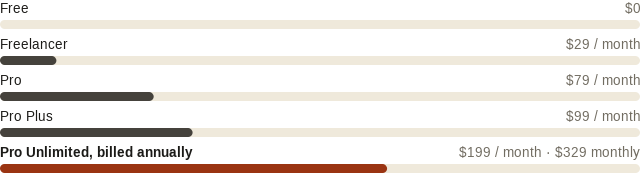
The steps are small until the last one. Four plans sit between $0 and $99, and the unlimited plan costs twice the one below it — $199 a month billed annually, $329 monthly. The jump buys the removal of every limit, not new features.
Plan prices, basecamp.com/pricing, read 20 November 2026. The $329 monthly figure is the third-party read of the same page; the plan card prints only the $199 annual-billing price.
The comparison is the argument. The price does not rise with headcount, so a team of 50 pays the same $199 as a team of 500 would. The meter that every rival runs — dollars per seat per month — is the one Basecamp refuses to install.
The $329 that should say $199
The page disagrees with itself. The Pro Unlimited card says $199 a month, billed annually. The FAQ asks "Could we really add 500 users and run unlimited projects and still just pay $329/month total on Pro Unlimited?" and answers "Yes." The $329 is the monthly-billed price, but the FAQ does not say that, and the answer does not restate an amount.
The gap is worth $1,560 a year — $329 a month is $3,948 over twelve months against $2,388 on annual billing, a 39.5% saving. The other three paid plans show no annual price at all, so no discount can be worked out for them. The confusion is small, but it sits on the page that asks for the money.
| Plan | 3 months, monthly billing | 6 months, monthly billing | 12 months, monthly billing | 12 months, annual billing | 12-month saving |
|---|---|---|---|---|---|
| Free | $0 | $0 | $0 | $0 | — |
| Freelancer, $29/month | $87 | $174 | $348 | Not published | Not published |
| Pro, $79/month | $237 | $474 | $948 | Not published | Not published |
| Pro Plus, $99/month | $297 | $594 | $1,188 | Not published | Not published |
| Pro Unlimited | $987 ($329 × 3) | $1,974 ($329 × 6) | $3,948 ($329 × 12) | $2,388 ($199 × 12) | $1,560 (39.5%) |
Arithmetic from the published plan prices, 20 November 2026. Only Pro Unlimited publishes an annual-billing price, so only its saving can be worked out.
What keeps people paying
| Mechanism | Hit | Why, in one line |
|---|---|---|
| Free plan | ✓ | Free forever: 1 project, 3 users, 1 GB (pricing page, 20 November 2026) |
| 30-day free trial | ✓ | On every paid plan; no credit card required, and no automatic charge when it ends (pricing page buttons and FAQ) |
| No sign-up to try | — | A trial needs an account; the page promises no credit card, not no account |
| Ads | — | No advertising inside the product and no ad revenue line |
| API | ✓ | REST API with OAuth 2.0; the free plan includes AI agent access and ChatGPT/Claude connectors with MCP support |
| Email capture | — | No newsletter or email signup was found on the homepage or the pricing page |
| Self-serve cancel | ✓ | "Cancel any time, no questions asked, no retention specialists trying to talk you out of it" (pricing page) |
| Prorated refund, annual | ✓ | Annual packages are refunded pro rata on cancellation (pricing page FAQ) |
| Prorated refund, monthly | — | Monthly billing is not automatically prorated for unused time (Terms) |
| Data export | ✓ | Account owners can export a full HTML copy; HTML only, no CSV or JSON |
| Annual discount | ✓ | Pro Unlimited only: $199 a month billed annually against $329 monthly |
| Nonprofit discount | ✓ | Registered 501(c)(3) nonprofits pay 10% less; classroom use is free |
The table is the retention story in one view. Everything that costs the customer nothing — the free plan, the trial, the API — is there to get them in, and everything that costs them money is a flat monthly charge that does not grow with headcount. The only thing missing is an email list: the site that lives on repeat visits does not appear to collect email addresses on its two most-visited pages.
12.84 million visits, and most of them come direct
From 18.19 million to 12.84 million
Monthly visits, August to October 2026

October was 12.84M, down 29.38% on September's 18.19M, after August's 14.91M. The September peak and the October fall are both unexplained — no source ties either move to a product change.
Monthly visits, Semrush, August to October 2026. Third-party estimates, not official MAU/DAU.
The traffic line is the one number that does not fit the profit story. October fell by almost a third in a single month, and organic search fell 20.55% at the same time. The site still sits 62nd in a database of 901, between Wordcounter.net at 13.24 million and VEED.io at 12.68 million.
The shape of the line is the argument. A site that lives on subscriptions does not need more traffic — it needs the same teams to keep paying. But a 29% fall in a month is the kind of move that usually means something changed: a search update, a redesign, or a season. No source explains it, and the teardown does not guess.
Where the visits come from
| Channel | Share of visits | Platform & stack |
|---|---|---|
| Direct | 59.0% | Semrush's top channel, October 2026; the next source is google.com at 3.46% |
| Organic search | Second channel | Semrush, October 2026; the channel share was not published, so none is given here. Organic search traffic fell 20.55% on the month |
| AI referrals | ChatGPT 6K visits | Semrush, October 2026; Claude 2K and Gemini 2K follow; no total is given |
| Referring domains | 54.24K | Semrush, October 2026; backlinks 739.86K, up 8.91% on the month |
| Average session | 21:21 | Semrush, October 2026; a long session for a project tool |
| Platform | — | Ruby on Rails, extracted from Basecamp itself in 2003 and open-sourced in July 2004 |
| Hosting | — | Self-hosted data centres since leaving AWS; the founder says the move saves about $10 million (secondary source) |
| Payment | — | Not published; annual billing by check, ACH, wire or credit card on Pro Unlimited |
| Analytics | — | Not verified; no BuiltWith or Wappalyzer read was available this round |
| Advertising | — | Meta Ad Library search returned a site error on 20 November 2026, so no ad count is given; not a zero |
| Referral loop | — | The founders' blog, books and podcast send readers straight to the site; visitors also go to google.com and 37signals.com |
Marketing channels, Semrush, October 2026; technologies, observed from the Basecamp site and public sources, 20 November 2026. The two traffic sources use different definitions, so their shares are not added together.
Visits by country, October 2026
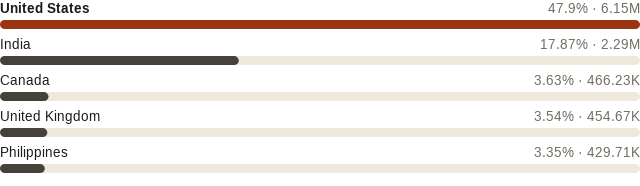
The United States is nearly half the traffic at 47.9%, and India is next at 17.87%. The top five countries are all English-speaking markets, which fits a product sold in English only.
Country shares, Semrush, October 2026. Third-party estimates, not official MAU/DAU.
Direct is the whole story: 59.0% of visits on Semrush, and the next source is google.com at 3.46%. The site is linked to far more than it is visited: 739,860 backlinks from 54,240 referring domains, up 13.94% on the month.
The stack matches the story. The product is built on the framework its own CTO created, and the company runs its own data centres. The distribution is the founders: each post, book and podcast episode sends readers straight to the homepage.
What people search for
Search here has one head. Semrush's top organic keyword for the site is the brand itself: "basecamp" at 165,000 searches a month, and the site ranks first for it. The largest non-brand term is "basecamp email" at 49,500, where the site ranks third.
Top organic keywords, October 2026
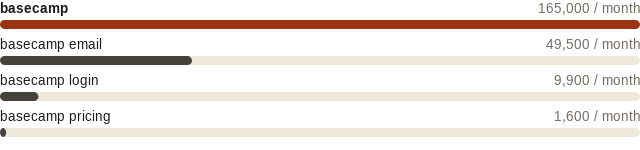
The brand word brings 165,000 searches a month. The pricing term that matters to this teardown — "basecamp pricing" — brings 1,600, and the site ranks first for it, at a $9.90 cost per click.
Monthly search volumes, Semrush, October 2026. The other target phrases for this teardown (basecamp vs asana, basecamp alternative and the rest) returned no Semrush volume this round, so no volume is given for them.
What the numbers do show is that the audience arrives by brand name. The login term alone brings 9,900 searches a month — people who already pay, coming back. That is the recurring engine in search form.
The flat price against the per-seat crowd
| Site | Monthly visits | Free tier | Starting paid price |
|---|---|---|---|
| ClickUp | 36.99M (Semrush, Oct 2026) | Free $0 | Core $9/user/month, billed annually |
| Todoist | 16.3M (Similarweb, Oct 2026) | Free $0 | Pro $5/month, billed annually |
| Basecamp | 12.84M (Semrush, Oct 2026) | Free $0 | Freelancer $29/month, flat; Pro Unlimited $199/month billed annually |
Rival visits, October 2026 third-party estimates from the master table; Todoist's figure is Similarweb, the rest Semrush, so the Todoist row is not directly comparable. Rival prices, the rivals' pricing pages via third-party reads, October–November 2026. Asana, Monday.com and Trello are not in the database, so their visits are not given here; their per-seat prices are in the charts below.
Monthly cost for a 10-person team
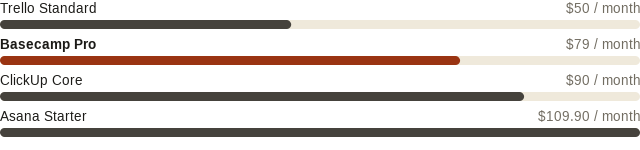
At 10 people, Basecamp Pro at $79 a month sits in the middle: dearer than Trello's $50, cheaper than ClickUp's $90 and Asana's $109.90. The flat price is not the cheapest way to run a small team.
Arithmetic from the published per-seat prices, 20 November 2026: Asana Starter $10.99/user/month, ClickUp Core $9/user/month, Trello Standard $5/user/month, all billed annually; Basecamp Pro $79/month flat.
Monthly cost for a 50-person team
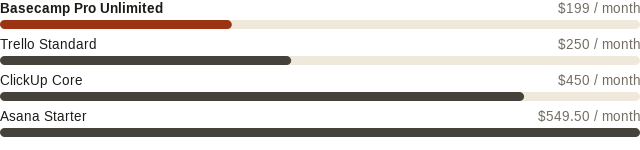
At 50 people the flat price wins outright: $199 against $250, $450 and $549.50. The per-seat meter is what makes the rivals expensive at scale — and the meter is exactly what Basecamp does not install.
Arithmetic from the published per-seat prices, 20 November 2026: Asana Starter $10.99/user/month, ClickUp Core $9/user/month, Trello Standard $5/user/month, all billed annually; Basecamp Pro Unlimited $199/month billed annually.
The crossover is the argument. At 10 people, Basecamp Pro at $79 a month is dearer than Trello's $50 and cheaper than ClickUp's $90 and Asana's $109.90. At 50 people, the flat price wins outright: $199 against $250, $450 and $549.50. The price is not cheap for a small team — it is cheap for a big one, and it never rises with headcount.
The rivals are bigger, and the cheapest way to run a small team is not Basecamp's. What Basecamp sells against them is the cap: no per-user meter, no surprise when the team grows, and a company that says it has been profitable for 27 years without outside money beyond one minority stake.
What the review sites say
Third-party ratings, November 2026

Third-party ratings, read 22 November 2026. G2 scores Basecamp 4.1 out of 5 from 5,490 reviews; Capterra 4.4 out of 5 from 14,437 reviews, with 88% positive, 10% neutral and 2% negative sentiment; Trustpilot 2.3 out of 5 from 41 reviews.
Sources: g2.com/products/basecamp/reviews; capterra.com/p/56808/Basecamp; trustpilot.com/review/basecamp.com. Capterra's listed starting price of $15 per user is stale — Basecamp charges a flat $29 to $199 a month — so only its rating is used here.
The work-software review sites agree with each other, and the complaint site does not. G2 and Capterra both score Basecamp above 4 out of 5 across thousands of reviews, praising the same things the homepage sells: simple to learn, easy to run, no per-seat billing. Trustpilot, with 41 reviews, scores it 2.3 — and almost every recent one is about the same thing.
The split is recent, and it has a date. The Trustpilot complaints cluster in May to October 2026, after the Basecamp 5 redesign shipped: long-time users call the new layout harder to navigate, say search got worse, and ask for the old version back. One October review calls the upgrade solid. The renewal question is whether the redesign cost is a one-off grumble or a lasting reason to leave.
Twenty-two years on the record
Yearly first captures, 2004–2026
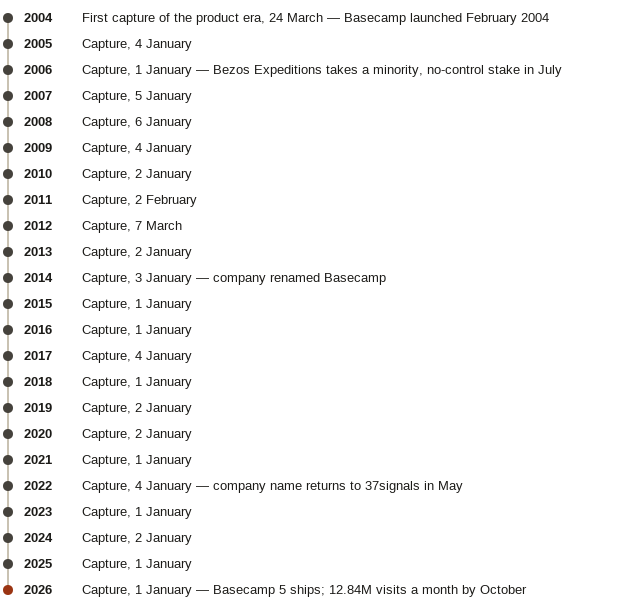
Wayback Machine, yearly first captures of basecamp.com, 2004–2026, read 22 November 2026 via the CDX API. The domain has captures back to 1996, but those predate the product, which launched in February 2004; the timeline starts at the first capture of the product era, 24 March 2004.
Source: web.archive.org CDX API, yearly first 200-status captures; raw data in the research dossier. Milestone years: Bezos Expeditions minority stake, July 2006; company renamed Basecamp, 2014; name returns to 37signals, May 2022.
The archive backs the longevity claim the pricing page makes. Basecamp has a capture in every year since 2004, the year the product launched — 23 years of the same address doing the same job. The company behind it is older still: 37signals was founded in 1999, and the product came five years later.
Two dates on the line matter to the money story. In July 2006 Jeff Bezos's Bezos Expeditions took a small, no-control stake — the only outside money the company has ever taken. In May 2022 the company dropped the Basecamp name and went back to 37signals. The product outlived the name change, and the price list outlived both.
Basecamp is one of three sites in the Project management collection. Compare Basecamp with ClickUp side by side.
The full teardown is for members
The full analysis of pricing, acquisition, conversion and retention is member content. Membership is $29 a month or $249 a year.
Similar sites in the database
Basecamp (12.84M) sits between Wordcounter.net (13.24M) and VEED.io (12.68M) in the database.
| Site | Category | Monthly visits | Source |
|---|---|---|---|
| Pixelcut | Image tools | 13.64M | Semrush, Oct 2026 |
| Wordcounter.net | Writing tools | 13.24M | Semrush, Oct 2026 |
| VEED.io | Video tools | 12.68M | Semrush, Oct 2026 |
Compare Basecamp with ClickUp side by side. The full database, with working filters, is on the teardowns index. The Project management collection has the three project management sites in one place.
Read the next one in your inbox
The new ones go out by email first, one a week, with the traffic source and month attached to every number. Leave your address and the next one comes to you.