
ClickUp Pricing: $9 a Seat to $300M ARR
Monthly visits
36.99M
Semrush, October 2026. Third-party estimates, not official MAU/DAU.
ClickUp draws an estimated 36.99 million visits a month (October 2026, Semrush) — the 20th-largest site in our database of 901, and the largest project-management site we track. It charges teams by the seat, starting at $9 a month, and says it passed $300 million in annual recurring revenue in September 2025.
The pitch fits in one line: the free tier lets a whole team move in for nothing, and the 60-megabyte storage cap makes them pay. More than 20 million users are on the platform, the company has raised $535 million in equity, and it cut about a fifth of its staff in May 2026 while saying an IPO is two years away.
| Site | ClickUp, clickup.com |
|---|---|
| What it is | All-in-one project management and productivity platform: tasks, docs, boards, Gantt, goals, time tracking, AI and automation |
| Who it is for | Teams that need tasks, docs and collaboration in one workspace |
| Category | Project management |
| Monthly visits | 36.99M, October 2026. Third-party estimates, not official MAU/DAU; Semrush 36.99M (−1.56%). August was 61.22M and September 37.58M — the drop is unexplained on the Semrush page |
| Founded | 2017, San Diego, California, by Zeb Evans and Alex Yurkowski |
| Headquarters | San Diego; about 1,010–1,300 people (sources differ by date) |
| Operator | Mango Technologies, Inc. DBA ClickUp |
| Survival engine | Recurring revenue. Seat subscriptions at $9 to $100 per user a month, plus AI usage, turn 36.99M monthly visits into $300M ARR — company claims, not audited accounts |
| Pricing | Free Forever $0 (60 MB storage, unlimited tasks and members); Core $9/user/month billed yearly (regular $12); Business $17/user/month yearly (regular $25); Enterprise custom; MAX $100/user/month yearly (regular $120). Monthly prices are not shown on the pricing page. Source: clickup.com/pricing, read 20 November 2026 |
| Pricing model | Freemium subscription, per seat; yearly billing saves up to 33% by the page's claim; AI usage billed separately on some tiers |
| Free hook | Free Forever tier (unlimited members and tasks, no credit card) — the only way in |
| Meta ads | Not verified this round — the Ad Library returned 403 on 20 November 2026; indirect signs are a Google Performance Max trace on the blog and paid search down 36.42% in October |
| Country breakdown | United States 27.83% (10.3M), Brazil 12.99% (4.81M), India 6.23% (2.3M), Philippines 4.84% (1.79M), Germany 3.14% (1.16M) — Semrush, October 2026 |
TL;DR
- ClickUp draws an estimated 36.99 million visits a month (October 2026), and 55.73% of desktop visits arrive direct. The brand word "clickup" draws 246,000 searches a month at rank 1 and is worth 50.92% of organic traffic; the only pricing-intent term in the top five, "clickup pricing", draws 6,600.
- The money is the seat: free forever with 60 MB of storage, then $9 or $17 per user a month, with a $100 MAX tier on top for the full AI engine. The company says it passed $300 million in annual recurring revenue in September 2025 with 20 million-plus users. No profit figure has ever been published.
- The risks are that traffic fell from 61.22 million in August to 36.99 million in October with no explanation, that the free tier never charges for people — only for storage, automations and AI — and that the $4 billion valuation is a 2021 price tag with no new priced round since.
The first screen sells one workspace, not a price
The first screen is a product demo, not a sales page
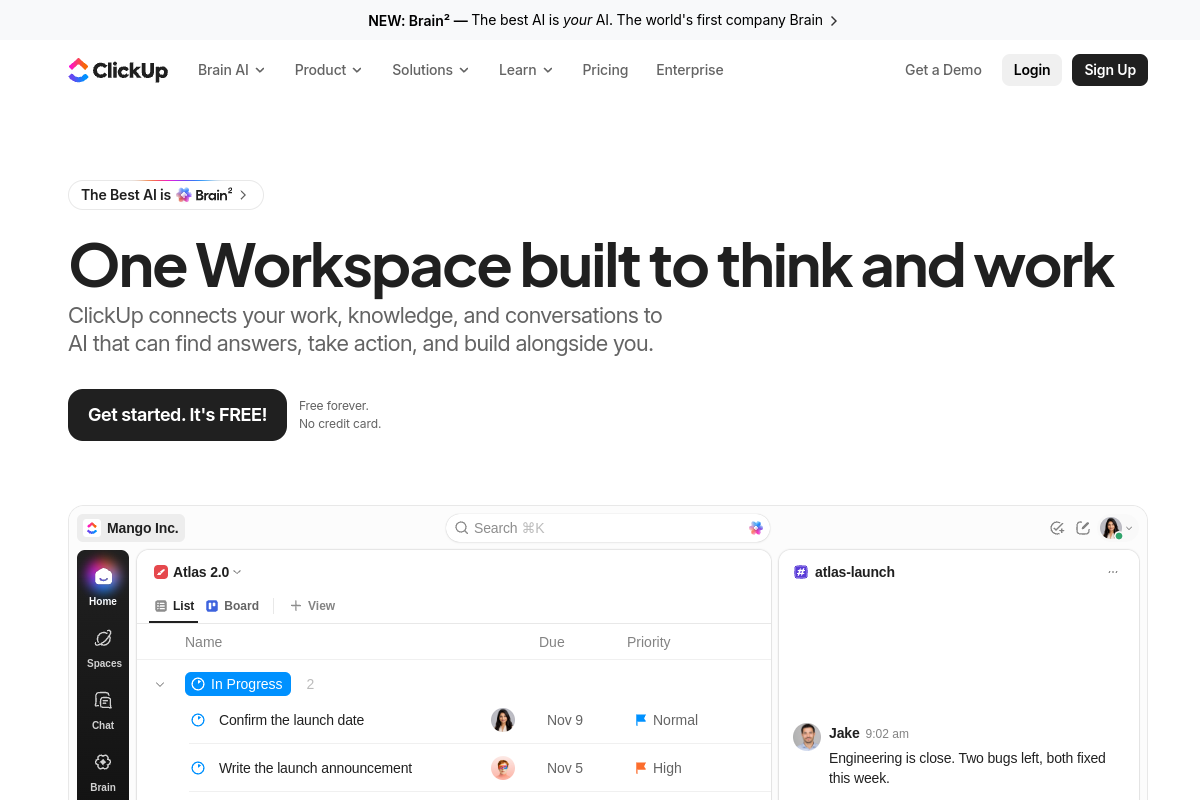
The ClickUp homepage, read 20 November 2026. The hero is "One Workspace built to think and work" — over a product screenshot and one button, "Get started. It's FREE!". No price appears on the first screen.
The homepage we read on 20 November 2026 opens with a promise and no price. "One Workspace built to think and work" sits over a screenshot of the product, beside "Get started. It's FREE!" and the line "Free forever. No credit card." Below it: "100+ products to replace fragmented software & maximize human productivity."
That is the whole funnel in one screen. The visitor is not asked to buy, or even to see a price — the product is the interface itself, and the first taste of it is free. The free tier needs no card and no sales call: open a workspace, invite the whole team, and start filing tasks. The wall appears only when the work piles up.
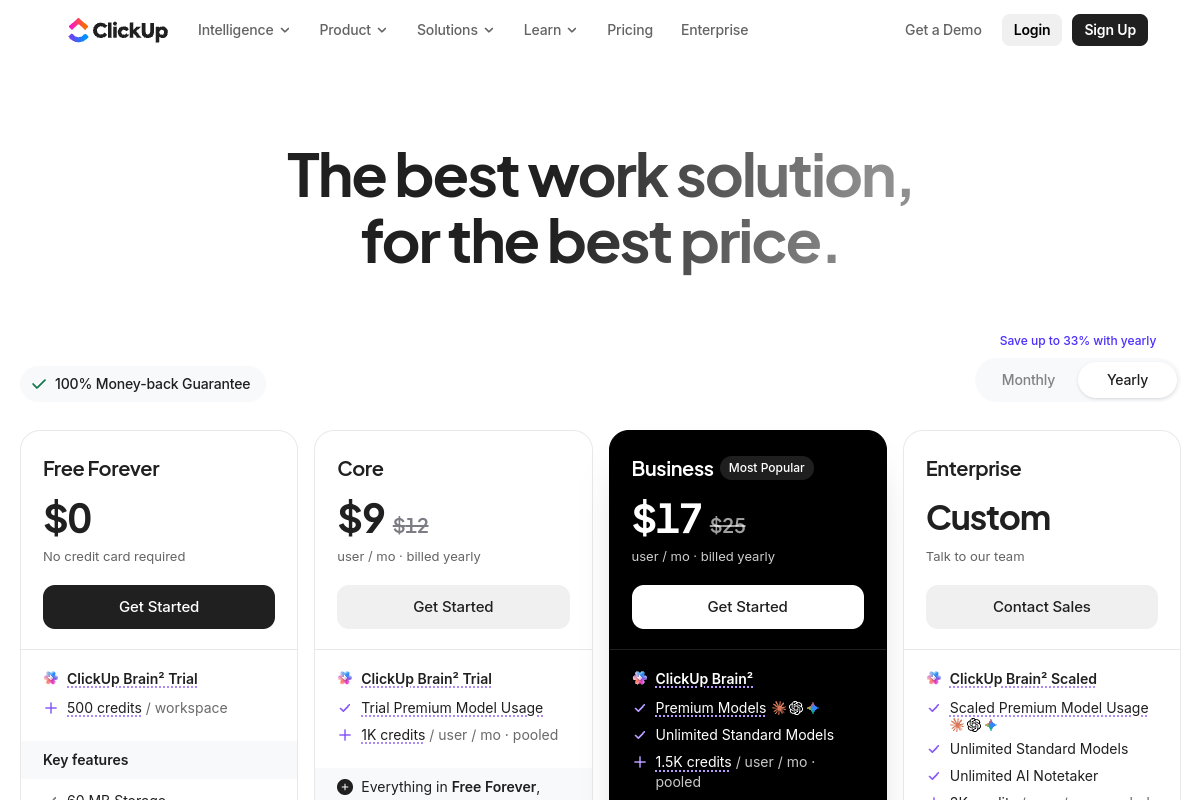
The ClickUp pricing page, read 20 November 2026, yearly view: Free Forever $0, Core $9 a user a month (regular $12), Business $17 (regular $25), Enterprise custom. The page shows only yearly-billed prices; the MAX tier sits below the crop.
The pricing page keeps the same order: product first, price second. The yearly toggle is on by default, showing $9 and $17 a user a month, with the struck-through regular prices of $12 and $25 beside them. The free tier sits on the left at $0, and Enterprise is quoted. The page carries a "100% Money-back Guarantee" badge and a "Save up to 33% with yearly" line.
The page's own numbers frame the pitch. The free tier allows unlimited members and tasks but only 60 MB of storage and one form. Core lifts the storage cap and adds unlimited Gantt charts, 1,000 automations a month and Goals. Business lifts everything again — 10,000 automations, private views and docs, Timesheets — and adds the AI layers that the cheaper tiers never see in full.
Five prices, four of them per seat
| Plan | Price | What it is |
|---|---|---|
| Free Forever | $0 | Unlimited tasks and members, 60 MB storage, collaborative docs, Kanban boards, calendar view, sprint management, time tracking, video calls, 1 form, 24/7 support |
| Core, billed yearly | $9 / user / month | $108 a user a year; regular price $12; unlimited storage and Spaces, unlimited forms, unlimited Gantt charts, unlimited ClickUp Chat, 1K automations a month, Goals, Google Drive, Dropbox and Box |
| Business, billed yearly | $17 / user / month | $204 a user a year; regular price $25; most popular; everything in Core, plus advanced dashboards, webhooks, 10K automations a month, resource management, Google SSO, private views and docs, Timesheets |
| Enterprise | Quoted | Everything in Business, plus white labelling, 1M automations a month, enterprise permissions and governance, advanced SSO, SCIM and SAML, audit logs, enterprise API |
| MAX, billed yearly | $100 / user / month | $1,200 a user a year; regular price $120; everything in Enterprise, plus the full MAX AI engine: custom skills, context engine, unlimited AI fields, Notetaker, AI image generation, Autopilot Agents |
Prices from the ClickUp pricing page, yearly view, read 20 November 2026. Monthly-billed prices are not shown on the page; third-party claims of $12 and $25 a month coincide with the struck-through regular prices and are not used here.
The monthly price, billed yearly
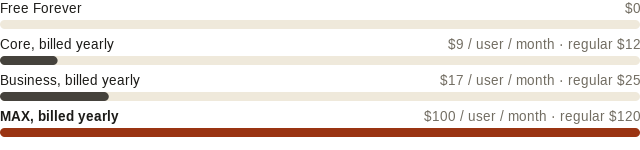
Paying yearly cuts the sticker price by up to a third — Core $9 against a regular $12, Business $17 against $25, MAX $100 against $120. The yearly discount is the retention lever: it trades a small discount for twelve months of commitment.
Monthly prices, ClickUp pricing page, read 20 November 2026.
One plan, two prices, and a cap underneath. Core is $9 a user a month on the yearly bill against a regular $12; Business is $17 against $25; MAX is $100 against $120. The gaps — $3, $8 and $20 — are small in dollars and large in behaviour: the yearly bill is the default view, and the monthly price is not shown at all.
The $9 tier is the price that matters, and the wall in front of it is deliberately low. Sixty megabytes is a few weeks of attachments for a busy team, and the free tier never charges for people — only for the storage, the automations and the AI. What costs real money is the volume: more storage, more automations, private views, and the AI engine that only MAX unlocks in full.
What the subscription does, and what it does not
| Mechanism | Hit | Why, in one line |
|---|---|---|
| Free tier | ✓ | Free Forever $0: unlimited tasks and members, 60 MB storage, 1 form |
| No account | — | Opening a workspace needs an account; there is no no-account query page |
| Free trial | ✓ | 14-day paid-tier trial, no credit card — four third-party sources agree; the pricing page itself does not mention a trial |
| Ads on the site | — | No ad slots seen on the pages read |
| API | ✓ | Webhooks and automation integrations on Business; enterprise API and integrations on Enterprise |
| Email capture | 未核到 | No first-hand evidence of list capture found on the pages read |
| SMS capture | — | No SMS marketing evidence found; SMS two-factor on Business is a security feature, not marketing |
| Auto-renew | 未核到 | The pricing FAQ does not state renewal or reminder terms; the terms page was not read this round |
| Cancel anytime | ✓ | Cancel any time; the plan lasts until the end of the billing cycle unless downgraded at once (pricing FAQ) |
| Pause subscription | 未核到 | No pause terms found in the pages read |
| Skip a delivery | — | Software subscription, not applicable |
| Free shipping | — | Not applicable |
| Gift subscription | — | No gift plan on the pricing page |
| Loyalty plan | — | No loyalty programme found on the pages read |
| First-order hook | ✓ | Free Forever with unlimited members and no card; a 14-day trial is the second hook, by third-party accounts |
| Financing | 未核到 | Checkout payment methods not read this round; the FAQ lists major credit cards and bank transfer for Enterprise |
| Subscribe & save discount | ✓ | Yearly billing saves up to 33% by the page's claim; non-profits, students and startups get directed discounts |
| Refer a friend | 未核到 | No referral programme evidence found on the pages read |
| Templates | ✓ | 1,000-plus ready-made templates and 100-plus automation templates, by third-party counts; the template library page was not read |
| Integrations | ✓ | Slack, Google Drive, GitHub, Salesforce, OneDrive, Gmail, Microsoft Teams, homepage and pricing page first-hand |
| Mobile app | ✓ | ClickUp 4.0 desktop and mobile apps are shown on the homepage; store ratings not read this round |
| White-label reports | ✓ | White labelling is an Enterprise feature on the pricing page |
| History lock-in | 未核到 | No history limits by tier on the pricing page; hitting a usage limit freezes new items, data stays |
| Team seats | ✓ | Billing is per user; the whole workspace upgrades together; guest seats are rationed by tier |
| Single tools sold alone | — | No single tool sold alone on the pages read; MAX is a bundle, not a standalone sale |
| Free courses | — | No free courses found on the pages read |
| Community | 未核到 | No official community size found on the pages read |
The table is what is missing as much as what is there. There is no pause button, no loyalty programme and no referral scheme on the pages read. The retention tools are the storage cap, the automation quotas and the yearly discount: cancel, and the workspace keeps its data but cannot create anything new past the limit.
The arithmetic is worth doing, because the company publishes no funnel figures. Three hundred million dollars of annual revenue divided by $9 a seat a month is about 2.8 million seats; divided by $17 it is about 1.5 million. The real mix includes Enterprise and MAX at higher prices, so the paid-seat count is lower — but the order of magnitude is a few million seats out of 20 million-plus users.
The rest of the table is the exit, and it is the soft version. The pricing FAQ promises a full refund within 30 days and lets a customer cancel any time, with the plan running to the end of the billing cycle. New users are billed pro rata for the time left in the cycle, and each workspace pays separately.
What outsiders say
Review scores, read 22 November 2026

Two kinds of reviewers rate two different things. G2 and Capterra score the product itself — both 4.6 out of 5 — while Trustpilot, where buyers review the company, sits at 4.1 out of 5.
Review scores: G2 4.6/5 (15,868 reviews), Capterra 4.6/5 (5,164 reviews), Trustpilot 4.1/5 (725 reviews), all read 22 November 2026. Capterra's star split is 3,428 five-star, 1,473 four-star, 205 three-star, 32 two-star and 25 one-star.
The three review sites agree on the product and disagree on the company. G2 scores it 4.6 out of 5 from 15,868 reviews and Capterra 4.6 from 5,164, while Trustpilot — where buyers review the company, not the product — sits at 4.1 from 725. Capterra's own split is 95% positive, 4% neutral and 1% negative.
The Trustpilot complaints cluster on billing, not features. One November 2026 reviewer says ClickUp moved their workspace to a new Business Plus plan without asking, showing $39 a user a month while the public page showed $25. Others describe seat reductions that need 30 days' notice and renewals billed for seats they no longer use.
36.99 million visits, and the seat count does the selling
From about $10 million to $300 million in five years
Annual recurring revenue, self-funded era to September 2025
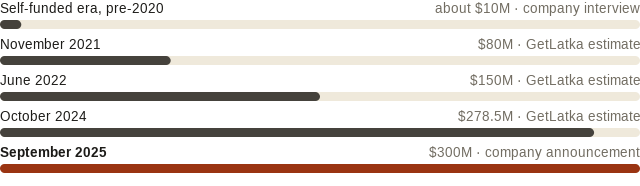
Revenue grew about thirty times from the self-funded era to $300 million in September 2025. The three middle figures are GetLatka database estimates, not company statements; only the $10 million and $300 million ends come from the company itself.
ARR: company announcements and interviews for the ends, GetLatka estimates for November 2021, June 2022 and October 2024.
The revenue line is the company telling on itself, in public, for five years. It did about $10 million a year before taking outside money, then raised $535 million in equity across three rounds and reached $300 million in annual recurring revenue in September 2025, with 20 million-plus users. The middle of the line is estimated, not announced.
The shape of the line is the point. The claims rise fast and then keep rising — revenue tripling in a year at the Series C, AI product sales up 400% in 2025. That is either a business compounding, or a business dressing a good year as a trend. The public record does not say which, and no profit figure has ever been published to settle it.
The layoff the CEO called an AI upgrade
Reported dates, first funding round to second cut
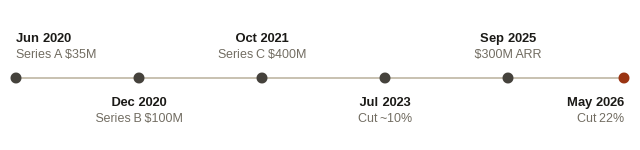
Six reported dates, from the first venture round to the second cut. The $4 billion valuation is from October 2021; no new priced round has followed.
Reported timeline: Series A $35M, June 2020; Series B $100M, December 2020; Series C $400M at a $4B valuation, October 2021; staff cut of about 10%, July 2023; $300M ARR announced, September 2025; staff cut of 22%, May 2026. Sources: TechCrunch, BusinessWire, Wikipedia.
The money story has a second half the revenue line does not show. In July 2023 ClickUp cut about 10% of its staff, and on 21 May 2026 chief executive Zeb Evans announced a 22% cut — roughly 290 of about 1,300 people — and called it an embrace of AI, not a cost cut.
The same announcement promised million-dollar salary bands for the people who stay and said about 3,000 internal AI agents now do work the staff used to do. TechCrunch, reporting the announcement on 25 May 2026, noted a Gartner survey finding that about 80% of companies using autonomous technology have cut jobs — without clear financial returns.
Two months, one cliff
Monthly visits, August to October 2026

October was 36.99M on Semrush, down 1.56% on the month. The August figure of 61.22M fell 38.6% in September, and the Semrush page gives no reason for the drop.
Monthly visits: Semrush overview page, read 20 November 2026. Third-party estimates, not official MAU/DAU.
Semrush has the site at 36.99 million visits in October, down 1.56% on the month, ranked 1,236th worldwide. The same page shows August at 61.22 million and September at 37.58 million — a fall of 38.6% in one month, with no explanation published. Paid search traffic fell 36.42% in October, while organic search slipped 1.33%.
The honest reading is that the master-table number is the October one, and the August number is a spike nobody has explained. What the October figure does show is direction: down, in a month when the biggest rival, Atlassian, fell 7.72% on the same Semrush pages, while Linear rose 8.37%.
Where the visits come from
| Channel | Share of visits | Platform & stack |
|---|---|---|
| Direct | 55.73% | Semrush desktop journey, October 2026; google.com is second at 5.14% |
| Organic search | Brand-led | Semrush, October 2026; the brand word "clickup" is worth 50.92% of organic traffic |
| AI referrals | At least 81K a month | ChatGPT 39K, Claude 34K, Gemini 8K — Semrush AI Traffic, October 2026; the list ends with "and more", so 81K is a floor |
| Backlinks | 173M (+0.1%) | From 95.9K referring domains (+10.88%), Semrush, October 2026 |
| Platform | — | Not verified this round; the stack page returned 403 |
| Hosting | — | Not verified this round |
| Email & SMS | — | Not verified this round; no newsletter box seen on the homepage |
| Analytics | — | Not verified this round |
| Payment | — | Major credit cards; bank transfer for Enterprise orders over a minimum (pricing FAQ) |
| Advertising | — | Meta ads not verified this round (Ad Library returned 403); a Google Performance Max trace appears on the blog |
Marketing channels, Semrush, October 2026; traffic journey and backlinks, Semrush, October 2026. Technologies were not verified this round — the BuiltWith page returned 403.
Visits by country, October 2026
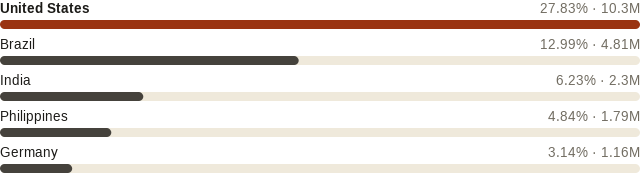
The United States sends 27.83% of visits, Brazil 12.99% and India 6.23%. Desktop is 96.3% of the American visits in the Semrush panel — a panel figure, not a true device split.
Country shares, Semrush, October 2026.
Direct is the whole story: 55.73% of desktop visits on Semrush, and the next named source is google.com at 5.14%. People do not discover ClickUp; they search for it, or they arrive from a team that already uses it. Paid search is shrinking fast, down 36.42% on the month, and the blog carries a Google Performance Max trace — the paid side is there, but it is pulling back.
The stack is the one gap in this teardown. The technology page returned 403, so no platform, host, email or analytics vendor is named here. What is named is the compliance list: SOC 2 Type II, ISO 27001, GDPR and HIPAA badges sit on the homepage, and the pricing page carries the same promises in the Enterprise tier.
What people search for
| Keyword | Monthly searches | Share of organic | Rank |
|---|---|---|---|
| clickup | 246,000 | 50.92% | 1 |
| click up | 49,500 | 10.24% | 1 |
| clickup docs | 49,500 | 10.24% | 1 |
| clickup login | 6,600 | 1.36% | 1 |
| clickup pricing | 6,600 | 1.36% | 1 |
Monthly searches are Semrush figures for clickup.com, October 2026. The top five terms together are worth about 74.28% of organic traffic.
Top organic keywords by monthly searches
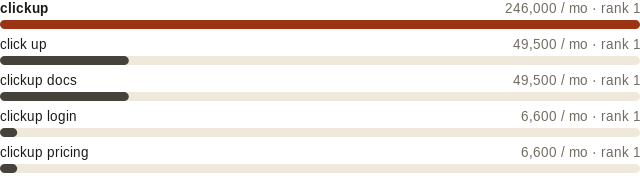
The brand word "clickup" draws 246,000 searches a month — five times the next term — and ranks 1st, worth 50.92% of organic traffic.
Top organic keywords, Semrush, October 2026.
Search here has one head, not two. The brand word "clickup" draws 246,000 searches a month at rank 1 and is worth 50.92% of organic traffic. The next two terms are spelling variants of the same name, worth 10.24% each. The only generic phrase in the list with buying intent, "clickup pricing", draws 6,600 a month.
That split is the word-of-mouth bet made visible. ClickUp ranks for its own name and almost nothing else, and its growth comes from the product and the template library. The risk is the mirror image: a brand word worth half of all search traffic belongs to whoever owns the name, and "click up" is also an ordinary English phrase.
Cheaper than Linear, dearer than Todoist
| Site | Monthly visits | Free tier | Starting paid price |
|---|---|---|---|
| Atlassian (all products) | 43.85M (Semrush, Oct 2026) | Jira free, up to 10 users | Jira Standard $7.91–$8.15 a user a month (third-party, Sep–Nov 2026) |
| Todoist | 16.3M (Similarweb, Oct 2026) | Beginner free, 5 projects | Pro $5 a month, $60 a year (Everstood teardown, Nov 2026) |
| Linear | 10.2M (Similarweb, Oct 2026) | Free, unlimited members, 250 issues | Basic $10 a user a month, $120 a year (Everstood teardown, Nov 2026) |
| Asana | Not verified this round | Personal free, up to 2 users | Starter $10.99 a user a month (third-party, Sep–Oct 2026) |
| monday.com | Not verified this round | Free, up to 2 seats | Basic $9 a seat a month (third-party, Sep–Oct 2026) |
| Notion | Not verified this round | Free for individuals | Plus $10 a member a month (third-party, Sep–Oct 2026) |
Rival visits, Semrush and Similarweb overview pages, October 2026. Rival prices from third-party reviews, September–October 2026, except Todoist and Linear, which come from Everstood's own teardowns. Atlassian is shown for comparison only — it is a listed company and is not an independent site in this database.
Entry price, yearly billing, per user a month
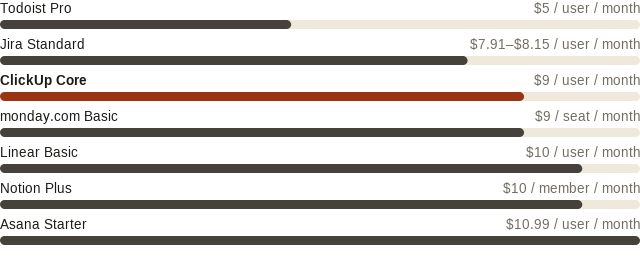
ClickUp's $9 entry sits in the middle of the pack — $4 above Todoist, $1 above Jira Standard, level with monday.com, and $1 below Linear and Notion. At the middle tier, ClickUp Business at $17 is the dearest of the group.
Entry prices, yearly billing: Todoist and Linear from Everstood teardowns; Jira, monday.com, Notion and Asana from third-party reviews, September–October 2026.
The rivals are bigger and cheaper at the door. Atlassian's whole site at 43.85 million visits is larger than ClickUp, and Jira Standard starts at $7.91 to $8.15 a user a month, below ClickUp Core at $9. Todoist Pro starts at $5. Only at the middle tier does ClickUp charge the most: Business at $17 against Linear at $16 and monday.com Standard at $12.
The ownership changed the contest. Atlassian is listed, Asana and monday.com are listed, and their Jira brand word draws 246,000 searches a month — the same as "clickup". ClickUp is still independent and venture-backed, which is the point of this database — but it charges a middle-tier price against rivals with deeper pockets and steadier traffic.
ClickUp is the largest site in the Project management collection. Compare ClickUp with Todoist and Linear side by side.
The full teardown is for members
The full analysis of pricing, acquisition, conversion and retention is member content. Membership is $29 a month or $249 a year.
Similar sites in the database
ClickUp (36.99M) sits between LeetCode (37.38M) and CloudConvert (35.41M) in the database.
| Site | Category | Monthly visits | Source |
|---|---|---|---|
| LeetCode | Education | 37.38M | Semrush, Oct 2026 |
| CloudConvert | File conversion | 35.41M | Semrush, Oct 2026 |
| Jotform | Form tools | 33.18M | Semrush, Oct 2026 |
Compare ClickUp with Todoist and Linear side by side. The full database, with working filters, is on the teardowns index.
Read the next one in your inbox
The new ones go out by email first, one a week, with the traffic source and month attached to every number. Leave your address and the next one comes to you.