
How Toggl Makes Money on $9 Seats
Monthly visits
7.2M
Similarweb, October 2026. Third-party estimates, not official MAU/DAU.
Toggl draws an estimated 7.2 million visits a month (October 2026, Similarweb) — the 89th-largest site in our database of 901, and the largest time-tracking site we track, ahead of Clockify at 6.39 million and Harvest at 1.05 million. It charges teams by the seat, starting at $9 a month, and says it has taken $0 in venture capital since 2006.
The pitch fits in one line: the free tier lets three people track time for nothing, and the fourth person makes the team pay. More than 70,000 companies and 5 million users use the product, the company says, and the whole business is a timer that started as an internal tool in Tallinn.
| Site | Toggl, toggl.com |
|---|---|
| What it is | Time tracking and capacity planning tool: one-click timer, tasks, capacity planning and profitability reports for billable teams |
| Who it is for | Freelancers, agencies and professional-services teams that bill by the hour |
| Category | Time tracking |
| Monthly visits | 7.2M, October 2026. Third-party estimates, not official MAU/DAU; Similarweb 7.2M (+0.89%), ranked #6,282 worldwide, bounce rate 47.87%, 7.16 pages a visit, 3:49 average stay |
| Founded | 2006, Tallinn, Estonia, by Alari Aho and Krister Haav; the company was registered in 2007 and the product went public the same year |
| Headquarters | Tallinn, Estonia; about 111 people by one database count, 51–200 by another — the counts differ by date and source |
| Operator | Toggl OÜ (Estonian registry 11346813) |
| Survival engine | Recurring revenue. Seat subscriptions at $9 to $16 per user a month, plus two per-seat add-ons, turn 7.2M monthly visits into a business that has never taken venture capital |
| Revenue | €10M–€50M a year (Tracxn database estimate, year-end 2020; a five-fold wide interval, not audited accounts). No profit figure is published; one aggregator claims €2.37M operating profit for 2024, unverified |
| Pricing | Free $0 (up to 3 users); Starter $9/user/month billed yearly ($12 monthly); Premium $16/user/month yearly ($24 monthly, marked Best value); Enterprise custom. Add-ons: Time Off Management $2/user/month, Capacity Management $5/user/month yearly ($6 monthly). Source: toggl.com/pricing, read 20 November 2026 |
| Pricing model | Freemium subscription, per seat; yearly billing saves 25% on Starter and 33% on Premium by arithmetic; a 30-day trial needs no card |
| Free hook | Free tier for up to 3 users, no credit card — plus a 30-day full-feature trial that never auto-converts to paid |
| Meta ads | 0 active ads on 20 November 2026 (Meta Ad Library, Page “Toggl”, Page ID 158503080868939, 35.7K followers) |
| Country breakdown | Not published for October 2026 — the Similarweb page did not show a country split. A February 2025 Semrush cache put the United States at 20.46%, Russia at 5.89% and the United Kingdom at 4.69% |
TL;DR
- Toggl draws an estimated 7.2 million visits a month (October 2026), and 73.35% of visits arrive direct. The brand word “toggl” draws 27,100 searches a month at rank 1, and the generic word “stopwatch” draws 1,000,000 — but both keyword figures come from a February 2025 cache, 21 months old.
- The money is the seat: free for 3 users, then $9 or $16 per user a month, with $2 and $5 add-ons on top. The company has taken no venture capital in 18 years. No credible revenue figure has ever been published, and no profit figure either.
- The risks are that traffic grew only 0.89% in October while Clockify grew 3.11% — a same-day Similarweb read put Clockify at 7.1 million visits, effectively tied — that the free tier is the shortest in the category at 3 users against Clockify’s 5, and that the no-refunds policy sits next to a 1.9 out of 5 on Trustpilot.
The first screen sells a timer, not a price
The first screen is a clock, not a sales page
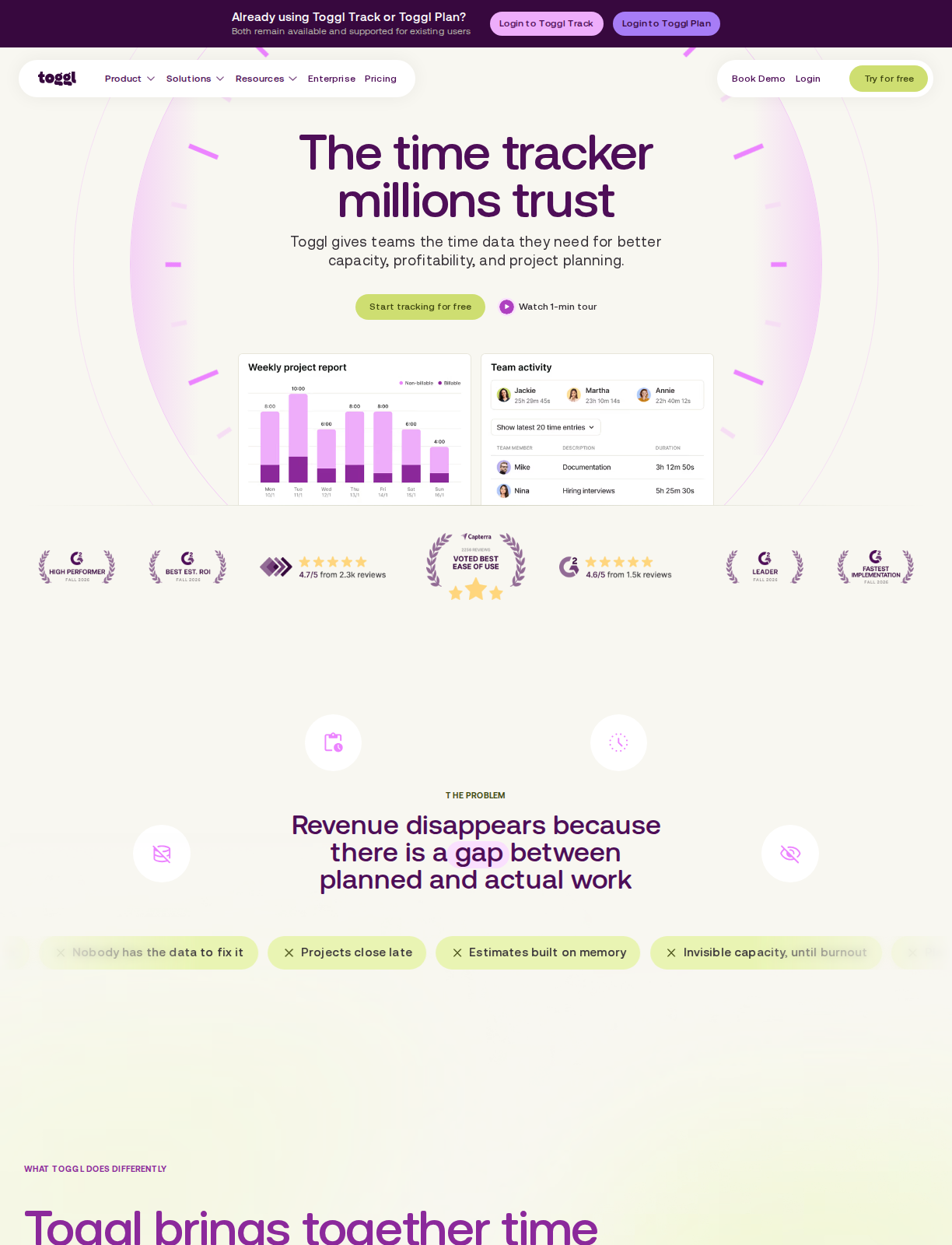
The Toggl homepage, read 20 November 2026. The headline is “The time tracker millions trust” — over “Start tracking for free” and two product cards, a weekly project report and team activity. The review badges below the fold show G2 4.6 out of 5 and Capterra 4.7 out of 5 as displayed on the site; the G2 platform itself reads 4.5 out of 5 from 1,685 reviews.
The homepage we read on 20 November 2026 opens with a promise and no price. “The time tracker millions trust” sits over a clock face, beside “Start tracking for free” and the lines “No credit card required” and “Free 30-day trial for all features”. Below it: “Revenue disappears because there is a gap between planned and actual work.”
That is the whole funnel in one screen. The visitor is not asked to buy, or even to see a price — the product is a timer, and the first taste of it is free. The free tier needs no card: open a workspace, invite up to three people, and start the clock. The wall appears only when the fourth person joins, or when the team wants to charge for the hours.
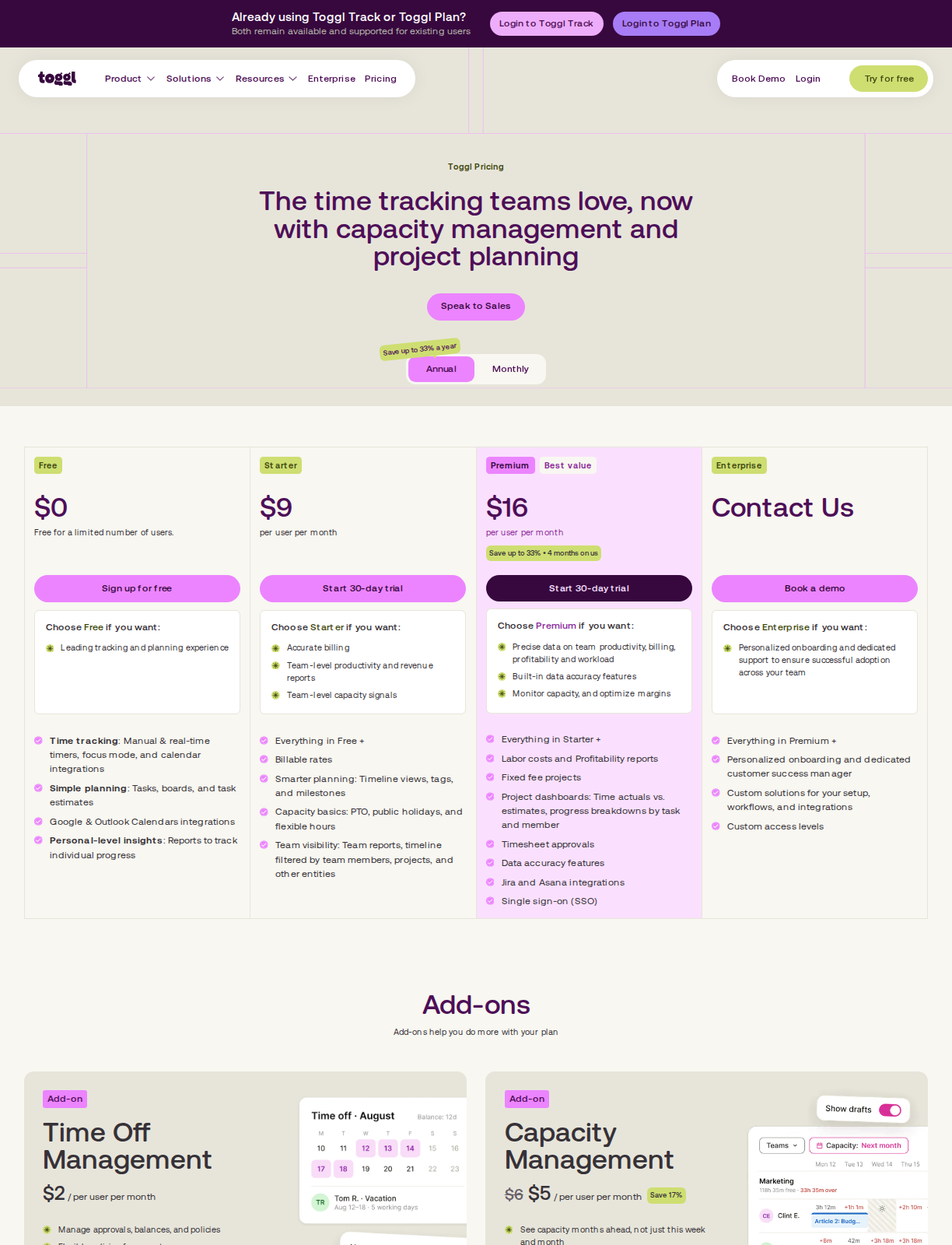
The Toggl pricing page, read 20 November 2026, yearly view: Free $0, Starter $9 a user a month, Premium $16 “Best value”, Enterprise “Contact Us”. The add-ons sit below the plans: Time Off Management $2 a user a month and Capacity Management $5 (struck $6). The cookie dialog was dismissed before this capture, as a visitor would.
The pricing page keeps the same order: product first, price second. The yearly toggle is on by default, showing $9 and $16 a user a month, with Premium marked “Best value” and “Save up to 33% • 4 months on us”. The free tier sits on the left at $0, and Enterprise is quoted. The page carries the lines “100% team adoption” and an anti-surveillance pledge: no screenshots, no keystroke logging, no location tracking.
The page’s own numbers frame the pitch. The free tier allows three users, manual and real-time timers, focus mode, calendar integrations and personal reports. Starter adds billable rates, timeline views and team reports. Premium adds labour costs and profitability reports, fixed-fee projects, timesheet approvals and single sign-on. The wall is not storage or seats alone — it is the right to charge for the hours.
Four prices, two of them per seat
| Plan | Price | What it is |
|---|---|---|
| Free | $0 | Up to 3 users; manual and real-time timers, focus mode, calendar integrations, tasks and boards, personal reports |
| Starter, billed yearly | $9 / user / month | $108 a user a year; $12 a user a month on monthly billing; everything in Free, plus billable rates, timeline views, tags and milestones, PTO and public holidays, team reports |
| Premium, billed yearly | $16 / user / month | $192 a user a year; $24 a user a month on monthly billing; most popular; everything in Starter, plus labour costs and profitability reports, fixed-fee projects, project dashboards, timesheet approvals, Jira and Asana integrations, single sign-on |
| Enterprise | Quoted | Everything in Premium, plus personalised onboarding and a dedicated customer success manager, custom solutions and integrations, custom access levels |
| Time Off add-on | $2 / user / month | Approval workflows, accrual balances, custom time-off policies, team time-off visibility, absence and balance reports |
| Capacity add-on | $5 / user / month | $6 on monthly billing, “Save 17%”; team timelines by group, draft projects, utilisation, workload and profitability forecasts inside reports, over-capacity flags, organisation holiday calendar |
Prices from the Toggl pricing page, read 20 November 2026. Third-party pages still list Premium at $18 or $20 a month — those figures match the euro prices, not the dollar ones, and are not used here.
The monthly price, billed yearly

Paying yearly cuts the sticker price by a quarter on Starter and a third on Premium — $9 against $12, $16 against $24. The yearly discount is the retention lever: it trades a small discount for twelve months of commitment.
Monthly prices, Toggl pricing page, read 20 November 2026.
One plan, two prices, and a cap underneath. Starter is $9 a user a month on the yearly bill against $12 monthly; Premium is $16 against $24. The gaps — $3 and $8 — are small in dollars and large in behaviour: the yearly bill is the default view, and the monthly price sits beside it in smaller type.
The $9 tier is the price that matters, and the wall in front of it is deliberately low. Three users is a freelancer and two collaborators, and the free tier never charges for the timer itself — only for the fourth seat, the billable rate and the profitability report. What costs real money is the volume: more people, more projects, and the reports that turn hours into invoices.
What the subscription does, and what it does not
| Mechanism | Hit | Why, in one line |
|---|---|---|
| Free tier | ✓ | Free $0: up to 3 users, timer and personal reports fully open |
| No account | — | Opening a workspace needs an account; there is no no-account query page |
| Free trial | ✓ | 30-day Premium trial, no credit card, never auto-converts to paid (help docs) |
| Ads on the site | — | No ad slots seen on the pages read; the company also runs 0 Meta ads, 20 November 2026 |
| API | ✓ | Toggl API and MCP/CLI on all tiers, pricing page first-hand |
| Email capture | ✓ | Signing up opts into marketing mail, opt-out any time (pricing page footer) |
| SMS capture | — | No SMS marketing evidence found |
| Auto-renew | ✓ | Cancellation takes effect at the end of the billing cycle; renewal is the default (help docs) |
| Cancel anytime | ✓ | Cancel any time; the plan lasts until the end of the billing cycle (help docs) |
| Pause subscription | 未核到 | No pause terms found in the pages read |
| Skip a delivery | — | Software subscription, not applicable |
| Free shipping | — | Not applicable |
| Gift subscription | — | No gift plan on the pricing page |
| Loyalty plan | — | No loyalty programme found on the pages read |
| First-order hook | ✓ | Free tier for 3 users with no card; a 30-day no-card trial is the second hook |
| Financing | 未核到 | Checkout payment methods not read this round; the pricing page shows no payment methods |
| Subscribe & save discount | ✓ | Yearly billing saves 25% on Starter and 33% on Premium, by arithmetic; non-profit and student discounts exist, rates unpublished |
| Refer a friend | 未核到 | No referral programme evidence found on the pages read |
| Templates | ✓ | Project templates are a Premium feature — save a project and reuse it (pricing page) |
| Integrations | ✓ | Jira, Asana, Google and Outlook calendars, Slack, Trello, Notion, GitHub, Salesforce, QuickBooks, homepage and pricing page first-hand |
| Mobile app | ✓ | iOS and Android apps exist, pricing page first-hand; store ratings not read directly this round |
| White-label reports | ✓ | A company logo can be added to PDF report exports, no watermark — report branding, not full white-labelling |
| History lock-in | ✓ | Free-tier data is deleted after 6 months of inactivity; paid-tier data is kept indefinitely (help docs) |
| Team seats | ✓ | Billing is per user; the fourth seat is the first paid one (pricing FAQ) |
| Single tools sold alone | ✓ | Time Off Management $2 and Capacity Management $5 per user a month, sold as add-ons |
| Free courses | 未核到 | No free course found on the pages read |
| Community | ✓ | An official community exists at community.toggl.com; its size was not verified |
The table is what is missing as much as what is there. There is no pause button, no loyalty programme and no referral scheme on the pages read. The retention tools are the three-user cap, the yearly discount and the data rule: leave the free tier idle for six months and the hours are deleted, while paid data is kept indefinitely.
The exit is the soft version with one hard edge. The help docs promise a full 30-day trial with no card and no auto-conversion, and cancellation any time with the plan running to the end of the cycle. The hard edge is the refund rule: no refunds except for a billing error, stated in the same help docs. That rule is also the most common complaint in the low-star reviews.
The second meter is easy to miss. Time Off at $2 and Capacity at $5 per user a month are sold as add-ons, and the Capacity trial converts automatically after 30 days unless the admin switches auto-subscribe off. The core trial never auto-converts; the add-on trial does. The two rules sit on the same help pages, pointing in opposite directions.
The free tier, in headcount
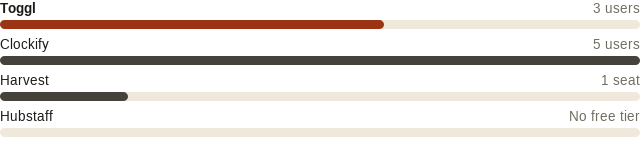
Toggl’s free tier stops at 3 users — the thinnest in the category. Clockify gives 5, Harvest gives 1 seat (one source says no free tier at all, only a 30-day trial), and Hubstaff gives none. The fourth seat is Toggl’s whole business model — and its thinnest wall.
Free-tier headcount: Toggl pricing-page FAQ, read 20 November 2026; Clockify, Harvest and Hubstaff from third-party reviews, October–November 2026.
What outsiders say

The two big review platforms agree, and both read high. G2 gives Toggl 4.5 out of 5 from 1,685 reviews, and Capterra gives 4.7 out of 5 from 2,592 ratings, both read on 23 November 2026. The homepage itself displays G2 at 4.6 — the platform reads 4.5. The complaints repeat on both sites: reports that resist customising, a mobile app reviewers call the weakest part, and slow loading on large reports.

Trustpilot reads the same product from the other side. Its TrustScore is 1.7 out of 5 from 68 reviews, read 23 November 2026 — 54% five-star against 22% one-star, with only six reviews in the last twelve months. The newest, dated 22 November 2026, gives one star and says managers cannot tell manually added hours from tracked ones. A June reviewer paid $324 to renew for a year, stopped using it, and was refused any refund or credit.
The split is the retention story in miniature. G2 and Capterra reviewers are the buyers who stayed and like the timer; Trustpilot reviewers are the customers who hit the billing wall and remember how they were treated. The no-refunds rule sits behind both: it protects a year's revenue at the cost of the angriest reviews a buyer ever writes.
7.2 million visits, and the seat count does the selling
A tie at the top of time tracking
Monthly visits, October 2026

Toggl leads Clockify by about 800,000 visits a month in the database figures, and Harvest trails far behind. A same-day Similarweb read put Clockify at 7.1M instead — the two trackers disagree on the method, so the chart uses the database figures.
Monthly visits, October 2026: Toggl from Similarweb, Clockify and Harvest from Semrush, as recorded in the database. Third-party estimates, not official MAU/DAU.
Similarweb has the site at 7.2 million visits in October, up 0.89% on the month, ranked 6,282nd worldwide. The database has Clockify at 6.39 million from Semrush, and a same-day Similarweb read put it at 7.1 million, up 3.11%. On either reading the two products are effectively tied, and the tie is moving in one direction: Clockify’s growth rate is more than three times Toggl’s.
The honest reading is that the October figure shows direction, not scale: up, but barely, in a month when the biggest rival in the category grew three times faster. The business is not shrinking; it is standing still while the challenger catches up.
Where the visits come from
| Channel | Share of visits | Platform & stack |
|---|---|---|
| Direct | 73.35% | Similarweb, October 2026; referrals second, organic search third — their shares were not published |
| Organic search | Brand-led | Semrush February 2025 cache; the brand word “toggl” is worth 16.09% of organic traffic |
| AI referrals | — | Not verified this round; the Semrush cache carried no AI referral figures |
| Backlinks | 714.52K (−0.16%) | From 32.43K referring domains, Semrush February 2025 cache |
| Platform | — | Main site served from Webflow hosting (resource paths observed on the homepage and pricing page); Webflow, Gatsby JS, React and jQuery among 142 live technologies (BuiltWith, 19 November 2026) |
| Hosting | — | Amazon AWS, CloudFront and Cloudflare delivery, nginx and AWS Lambda (BuiltWith, 19 November 2026) |
| Email & SMS | — | Registration opts into marketing mail, opt-out any time; Sendgrid signal on the site (BuiltWith); no newsletter box seen on the homepage |
| Analytics | — | Google Analytics and GA4, Google Tag Manager, HubSpot and 6sense (BuiltWith, 19 November 2026) |
| Payment | — | PayPal appears in Similarweb payment signals; full payment methods not verified this round |
| Advertising | — | 0 active Meta ads on 20 November 2026 (Meta Ad Library); Google AdSense signal on the site (Similarweb) |
Marketing channels, Similarweb, October 2026; traffic journey and backlinks, Semrush February 2025 cache. Technologies: BuiltWith profile for toggl.com, 142 live technologies, last detected 19 November 2026.
Visits by country, February 2025
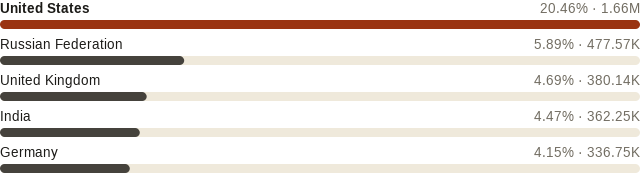
The United States sends 20.46% of visits, Russia 5.89% and the United Kingdom 4.69%. These are February 2025 figures from a Semrush cache — the October 2026 country split was not published.
Country shares, Semrush, February 2025 cache.
Direct is the whole story: 73.35% of visits on Similarweb, with referrals second and organic search third. People do not discover Toggl; they type the name, or they arrive from a team that already uses it. The browser extension is the quieter channel — a timer button embedded in Asana, Jira, Trello and Notion, putting the product inside the tools its users already open.
The stack is unremarkable, which is the point: 142 live technologies on BuiltWith, last detected 19 November 2026 — Webflow for the marketing site, React and Gatsby in the mix, CloudFront and Cloudflare for delivery, Google Analytics and HubSpot for measurement. A company that sells time tracking runs its own site on the same commodity stack every SaaS site in this database uses.
What people search for
| Keyword | Monthly searches | Share of organic | Rank |
|---|---|---|---|
| stopwatch | 1,000,000 | 5.94% | 7 |
| stop watch | 201,000 | 5.22% | 6 |
| toggle | 40,500 | 7.45% | 1 |
| toggl | 27,100 | 16.09% | 1 |
| toggl track | 9,900 | 5.88% | 1 |
Monthly searches are Semrush figures for toggl.com, February 2025 cache. The top five terms together are worth about 40.58% of organic traffic. October 2026 keyword figures were not readable.
Top organic keywords by monthly searches
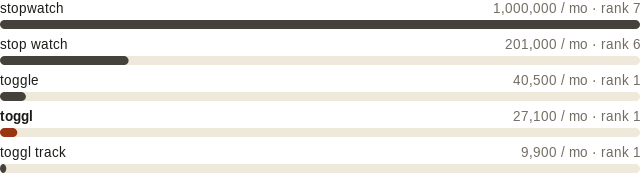
The generic word “stopwatch” draws 1,000,000 searches a month — 37 times the brand word “toggl” at 27,100. The brand still ranks 1st for its own name, but a tenth of organic traffic arrives on words that describe a kitchen tool.
Top organic keywords, Semrush, February 2025 cache.
Search here has two heads, not one. The brand word “toggl” draws 27,100 searches a month at rank 1 and is worth 16.09% of organic traffic. The generic word “stopwatch” draws 1,000,000 a month at rank 7 and is worth 5.94%, with “stop watch” adding 201,000 more. Together the two generic terms are worth about 11% of organic traffic.
That split is the category bet made visible. Toggl ranks for its own name and for the plain-English word for what it does, and its growth comes from the product and the browser extension. The risk is the mirror image: a visitor who searched for a stopwatch is not a team looking to buy time tracking, and the conversion of that traffic was never published.
Dearest at the door, cheapest nowhere
| Site | Monthly visits | Free tier | Starting paid price |
|---|---|---|---|
| Toggl | 7.2M (Similarweb, Oct 2026) | Free, up to 3 users | Starter $9 a user a month (pricing page, Nov 2026) |
| Clockify | 6.39M (Semrush, Oct 2026) | Free, up to 5 users | Basic $3.99 a seat a month (third-party, Oct–Nov 2026) |
| Harvest | 1.05M (Semrush, Oct 2026) | Free, 1 seat — one source says no free tier, only a 30-day trial | Teams $9 a seat a month (third-party, Oct 2026) |
| Hubstaff | Not verified this round | No free tier, 14-day trial only | Starter $4.99 a seat a month (third-party, Oct–Nov 2026) |
| RescueTime | Not verified this round | Lite free tier | Solo $7 a month (third-party, Oct–Nov 2026) |
| Todoist | 16.3M (Similarweb, Oct 2026) | Beginner free, 5 projects | Pro $5 a month, $60 a year (Everstood teardown, Nov 2026) |
| Linear | 10.2M (Similarweb, Oct 2026) | Free, unlimited members, 250 issues | Basic $10 a user a month, $120 a year (Everstood teardown, Nov 2026) |
Rival visits from the database, October 2026. Rival prices from third-party reviews, October–November 2026, except Todoist and Linear, which come from Everstood’s own teardowns. Hubstaff and RescueTime are not in this database.
Entry price, yearly billing, per user a month
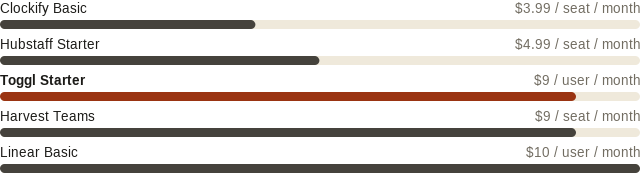
Toggl’s $9 entry is more than twice Clockify’s $3.99 and nearly twice Hubstaff’s $4.99. At the middle tier, Toggl Premium at $16 is the dearest of the group — against Clockify Standard at $5.49.
Entry prices, yearly billing: Toggl and Linear from Everstood teardowns; Clockify, Hubstaff and Harvest from third-party reviews, October–November 2026.
The rivals are cheaper at the door and nearly as big. Clockify at 6.39 million visits in the database trails Toggl by about 800,000 — though a same-day Similarweb read put it at 7.1 million, effectively tied — and its Basic tier starts at $3.99 a seat a month, less than half of Toggl’s $9. Hubstaff starts at $4.99. Only at the top does Toggl match the pack: Premium at $16 is level with Linear Business at $16.
The free tier is where the price gap bites hardest. Toggl gives three users; Clockify gives five, and until April 2026 it gave unlimited users. A three-person team can use Toggl forever without paying, and a five-person team can use Clockify forever without paying. The fourth seat is Toggl’s whole business model — and its thinnest wall.
Toggl is the largest site in the Time tracking collection. Compare Toggl with Clockify and Harvest side by side.
The full teardown is for members
The full analysis of pricing, acquisition, conversion and retention is member content. Membership is $29 a month or $249 a year.
Similar sites in the database
Toggl (7.2M) sits between beehiiv (7.2M) and King Arthur Baking (7.1M) in the database.
| Site | Category | Monthly visits | Source |
|---|---|---|---|
| TransferNow | File transfer · Large files | 7.23M | Semrush, Oct 2026 |
| beehiiv | Newsletters | 7.2M | Semrush, Oct 2026 |
| King Arthur Baking | Food & drink · Baking ingredients DTC brands | 7.1M | Similarweb, Oct 2026 |
Compare Toggl with Clockify and Harvest side by side. The full database, with working filters, is on the teardowns index.
Read the next one in your inbox
The new ones go out by email first, one a week, with the traffic source and month attached to every number. Leave your address and the next one comes to you.